Introduction
The indiscriminate use of pesticides has led to the elimination of beneficial insects, the development of resistant pest species, the emergence of secondary pests, environmental pollution, and toxicity to humans (Aktar et al., Reference Aktar, Sengupta and Chowdhury2009; Quandahor et al., Reference Quandahor, Kim, Kim, Lee, Kusi and Jeong2024; Wang et al., Reference Wang, Ou, Li, Wei, Huang and Yang2023). Given the compatibility of biological control methods with other pest control methods and their advantages, including the lack of side effects on the environment, this approach can be of considerable importance in integrated pest management (IPM) (Schöller et al., Reference Schöller, Prozell, Al-Kirshi and Reichmuth1997). Chemical control is one of the important strategies in IPM and biological control agents usually respond to the applications of chemical insecticides, which may result in a decrease in the population of biological control agents. In recent years, IPM systems have tried to utilise natural enemies in combination with lower doses of insecticides to control pests (Asadi, Reference Asadi2022). The combined use of biological control agents and insecticides for pest management requires sufficient knowledge about the selective aspects and effects of insecticides on natural enemies (Biondi et al., Reference Biondi, Zappalà, Stark and Desneux2013; Endo and Tsurumachi, Reference Endo and Tsurumachi2001). Regarding the use of chemical compounds in the integrated management of plant pests, understanding the acute and chronic toxicity effects of these compounds on natural enemies is essential to maximise the control capacity in this method (Craft, 1990; Rosenheim and Hoy, Reference Rosenheim and Hoy1998). The assessment of various effects of chemical compounds on natural pest enemies should be comprehensive and take into account both lethal effects (acute toxicity) and sublethal effects (evaluation of demographic parameters). For this reason, one of the most suitable methods for studying natural enemies is demographic toxicology, which is used to study the side effects of various chemical and plant compounds, biopesticides, and biocontrol on natural enemies and non-target organisms (Alan and Daniel, Reference Alan and Daniel1982; Forbes and Calow, Reference Forbes and Calow1999; Mahdavi et al., Reference Mahdavi, Saber, Rafiee-Dastjerdi and Mehrvar2011; Razmjou et al., Reference Razmjou, Mahdavi, Rafiee-Dastjerdi, Farhoomand and Molapour2018). Therefore, stable population parameters (including the intrinsic rate of increase (rm), net reproductive rate (R 0), finite rate of increase (λ), and mean generation time (T)) have been recommended for evaluating the overall effects of pesticides, and the basis of this method is the two parameters of survival and fecundity.
The parasitoid wasp Habrobracon hebetor Say (Hymenoptera: Braconidae) is a cosmopolitan species and has been reported from various parts of the world parasitising the larvae of Lepidoptera (Darwish et al., Reference Darwish, El-Shazly and El-Sherif2003). This parasitoid wasp was first reported from Iran by Farahbakhsh who collected it from the larvae of Plodia interpunctella Hübner 1813 (Lepidoptera: Pyralidae) and Ephestia kuehniella Zeller, 1879 (Lepidoptera: Pyralidae) in Varamin. This parasitoid wasp has a high potential for parasitism of host larvae, and since 1995, it has been mass-reared and released in different parts of Iran (Attaran, Reference Attaran1996; Forouzan et al., Reference Forouzan, Sahragard and Airmafi2003; Forouzan et al., Reference Forouzan, Amir and Sahragard2008). This natural enemy, along with the parasitoid wasp Trichogramma brassicae Bezdenko, 1968 (Hymenoptera: Trichogrammatidae), is also used to control the cotton bollworm (Helicoverpa armigera (Hübner) (Lepidoptera: Noctuidae)) (Forouzan et al., Reference Forouzan, Sahragard and Airmafi2003).
Given the importance of understanding the sensitivity of different life stages of the parasitoid to insecticides and in order to determine the best time for their release in the field and the implementation of spraying, the present study has been conducted to evaluate the sensitivity level of the adult stage of the parasitoid wasp H. hebetor to the recommended dose. The objective of this study was to investigate the sublethal effects of four insecticides (tetraniliprole, flupyradifurone, flubendiamide, and spirotetramat used in cotton fields to manage cotton bollworm (Fatima et al., Reference Fatima, Tariq and Gulzar2013; Mbuji et al., Reference Mbuji, Xue, Guo, Li, Lv and Zhang2024)) on immature and adult life stages of the parasitoid wasp H. hebetor under laboratory conditions and to determine the compatibility of these insecticides with the parasitoid wasp H. hebetor.
Materials and methods
Rearing flour moth, E. kuehniella
The initial colony of E. kuehniella was established using eggs of this insect obtained from the Entomology Research Department of the Iranian Plant Protection Research Institute (Tehran, Iran). Immature stages were reared in plastic trays (a diameter of 70 cm and a height of 25 cm). In each container, 2.5 kg of wheat flour, 0.5 kg of wheat bran, and 40 g of yeast were added. Then, 1 g of E. kuehniella eggs was evenly distributed on the surface of these containers. The colony was maintained in a room maintained at 27 ± 2°C, 65 ± 5% RH, and a photoperiod of 16:8 (L:D). After 3–4 days, the eggs hatched, and the flour moth larvae emerged. The larvae then fed on the flour mixture in the containers. After 30–35 days, the adult insects emerged. The adult moths were collected from the rearing containers using an electric aspirator and transferred to the egg-laying containers. For egg-laying, transparent plastic cylindrical containers (11 cm in diameter and 30 cm in height) were used. To provide ventilation, an 8-cm diameter opening was created in the bottom part of the containers, which was covered with a mesh fabric (size 50). After transferring the moths to these containers, the mouths of the containers were covered with a mesh fabric (size 18). Then, the containers were placed upside down on a white paper surface. After 24 h, the eggs laid by the moths were collected from the paper sheets and used to establish a new colony (Fooladi et al., Reference Fooladi, Golmohammadi and Ghajarieh2015; Rafiee-Dastjerdi et al., Reference Rafiee-Dastjerdi, Hassanpour, Nouri-Ganbalani, Golizadeh and Sarmadi2012; Sarmadi et al., Reference Sarmadi, Nouri-Gonbalani, Rafiee-Dastjerdi, Hassanpour and Farshbaf-Pourabad2010).
Rearing parasitoid wasp H. hebetor
The adult parasitoid wasps H. hebetor were obtained from an insectarium in Gorgan, Iran (36°50ʹ18.2″N 54°26ʹ43.9″E). For rearing, containers with a diameter of 8 cm and a height of 10 cm were used. In each container, 50 fifth-instar larvae of the flour moth E. kuehniella were placed, and then 10 pairs of male and female H. hebetor wasps were added. After 24 h, the adult wasps were removed, and the containers containing the flour moth larvae and wasp eggs were placed for rearing at 27 ± 2°C, 65 ± 5% relative humidity, and a photoperiod of 16 h light and 8 h dark, until the emergence of the new generation of adult wasps (Fooladi et al., Reference Fooladi, Golmohammadi and Ghajarieh2015; Rafiee-Dastjerdi et al., Reference Rafiee-Dastjerdi, Hassanpour, Nouri-Ganbalani, Golizadeh and Sarmadi2012; Sarmadi et al., Reference Sarmadi, Nouri-Gonbalani, Rafiee-Dastjerdi, Hassanpour and Farshbaf-Pourabad2010).
Insecticides
The insecticides used in this study were tetraniliprole (Vayego® SC 20%, Bayer Crop Science, Germany), which belongs to the diamide group; flupyradifurone (Sivanto® SL 20%, Bayer Crop Science, Germany), which belongs to the butenolide group; flubendiamide (Takumi® WG 20%, Sangyo Kaisha, Japan), which belongs to the diamide group; and spirotetramat (Movento® SC 10%, Bayer CropScience, Germany), which belongs to the keto-enol group.
The lethal effects of insecticides on H. hebetor
Bioassay testing of insecticides was conducted on the adult stage of H. hebetor (Mahdavi et al., Reference Mahdavi, Saber, Rafiee-Dastjerdi and Mehrvar2011). Preliminary dose-setting experiments were carried out to determine 20% and 80% mortality ranges. Twenty individuals of H. hebetor (adult stage) were placed in test containers. Distilled water was used in control treatments. Each concentration of the insecticides was bioassayed in four replications. Parasitoids were exposed to the treatments for 24 h. Mortality was recorded 24 h after treatment.
The sublethal effects of insecticides on H. hebetor
The sublethal effects of tetraniliprole, flupyradifurone, flubendiamide, and spirotetramat on the reproductive, biological, and population parameters of the parasitoid wasp H. hebetor were investigated. The parameters examined included reproductive rates, population growth rate, fecundity, fertility, longevity, and sex ratio. In this study, the male and female wasps were exposed to the 25% lethal concentration (LC25) of the following insecticides: tetraniliprole (30.8 µg ai/L), flupyradifurone (130.8 µg ai/L), flubendiamide (807 µg ai/L), and spirotetramat (34.2 µg ai/L). This value was chosen as a low-lethal concentration because it is the mortality threshold recommended for the use of pesticides in IPM (Desneux et al., Reference Desneux, Decourtye and Delpuech2007). For this purpose, 50 female wasps, less than 24 h old, were placed in groups of 10 in glass tubes. After adding 10 male wasps to each tube, they were allowed to mate (Rafiee Dastjerdi et al., Reference Rafiee Dastjerdi, Hejazi, Nouri Ganbalani and Saber2008). For the control group, distilled water was used. Half an hour after the glass tubes were dried at room temperature, the mated female wasps (from the 24-h-old wasps that had been with the males) were placed in Petri dishes. After 24 h, 27 individuals that had survived LC25 treatment were randomly selected and transferred individually to separate Petri dishes. All the above steps were also carried out for the control group. Three late-instar larvae of the flour moth were provided as food for each wasp in the Petri dishes daily (Rafiee Dastjerdi et al., Reference Rafiee Dastjerdi, Hejazi, Nouri Ganbalani and Saber2008; Sarmadi et al., Reference Sarmadi, Nouri-Gonbalani, Rafiee-Dastjerdi, Hassanpour and Farshbaf-Pourabad2010). The Petri dishes were checked daily, and after counting the number of eggs laid by each wasp, they were kept in an incubator until the emergence of the adult wasps. During this period, the number of hatched eggs, the number of larvae and pupae formed, and the number of emerged male and female adults in each container were recorded. These actions continued until the death of all the experimental wasps. Based on the collected data, the reproductive life tables of the wasp were constructed. To determine the sex ratio and hatch rate for the control and the insecticide treatments, 27 eggs were collected from each treatment on three different days. The number and sex of the emerged adults were recorded until the last individual emerged from the control treatment (Fooladi et al., Reference Fooladi, Golmohammadi and Ghajarieh2015; Rafiee-Dastjerdi et al., Reference Rafiee-Dastjerdi, Hassanpour, Nouri-Ganbalani, Golizadeh and Sarmadi2012; Sarmadi et al., Reference Sarmadi, Nouri-Gonbalani, Rafiee-Dastjerdi, Hassanpour and Farshbaf-Pourabad2010).
Life tables
The toxicological life table approach was used to determine the overall effects of insecticides on parasitoid wasps (Elzen et al., Reference Elzen, Maldonado and Rojas2000; Walthall and Stark, Reference Walthall and Stark1996). The life tables and demographic data analysis, including daily mortality and fecundity data, were structured using the Carey (Reference Carey1993) method. In this study, the age at first oviposition was denoted by alpha (α), the age at last oviposition by beta (β), and the maximum possible age by omega (ω).
To construct the life table for the parasitoid, the data were organised into a table with two columns based on age x and the number of individuals surviving to age x (Nx). The remaining parameters were calculated from the data in these two columns as follows:
x: Wasp age (days)
lx: Proportion of females surviving to the beginning of age x, calculated as lx =  $\frac{{{N_x}}}{{{N_0}}}$, where N 0 is the initial number of female individuals in the experiment.
px: This parameter represents the survival period, which is the proportion of individuals that have survived to age x and remain alive in the age interval from x to x + 1. It is calculated as px =  ${\text{ }}\frac{{{l_{x + 1}}}}{{{l_x}}}$
qx: Proportion of individuals alive at age x that die in the age interval x to x + 1, which is the age-specific mortality. It is calculated as qx = 1 − px.
dx: Proportion of the original cohort that dies in the age interval from x to x + 1. This represents the frequency distribution of mortality and is calculated as dx = 1 − lx + 1.
lx: The average number of individuals alive in the age interval from x to x + 1. This is calculated as lx =  $\frac{{{l_x} + {l_{x + 1}}}}{2}$.
ex: Life expectancy at age x, which is the average number of days remaining until the individual reaches age x, calculated as ex =  $\frac{{{T_x}}}{{{l_x}}}$.
Data analysis
To normalise the data obtained from the study of nonlethal effects before analysing variance, logarithmic data transformation was used. Additionally, the variance of population parameters and standard errors were calculated using the jackknife resampling technique. The SAS program (SAS Institute, Inc.; SAS Institute, 2002) and Excel 2020 software were used to construct the tables to show the analysis of variance on the data. Comparison of means was performed using the Duncan’s multiple range test.
Results
Bioassay experiments
The results of the bioassay of the adult parasitoid wasp H. hebetor to tetraniliprole, flupyradifurone, flubendiamide, and spirotetramat are shown in table 1. The LC50 values indicated that tetraniliprole (46.6 µg ai/L) was the most lethal compound for the adult female wasps, while spirotetramat (67.9 µg ai/L), flupyradifurone (193.2 µg ai/L), and flubendiamide (1088.8 µg ai/L) had lower toxicity, respectively. The toxicity of insecticides on H. hebetor adults was different, as inferred by the confidence intervals of LC50. Also, the LC25 values were estimated to be 30.8 µg ai/L for tetraniliprole, 34.2, 130.8, and 807 µg ai/L for spirotetramat, flupyradifurone, and flubendiamide, respectively.
Results of contact bioassay of tested insecticides on adult H. hebetor in the laboratory

df = 3 for all treatments.
The effects of insecticides on the reproductive parameters
The mean net reproductive age in the control was 17.12 days, and no significant difference was observed between all treatments and the control. The mean net fertility age in the control was 20.00 days. There was no significant difference in the mean net fertility age among any of the insecticide treatments. The most adverse effect on the oviposition period was due to fluopyradifurone and tetraniliprole (table 2). The highest mean adult longevity of the parasitoid wasps was in the control, and the lowest mean longevity was in the spirotetramat treatment.
Reproductive parameters of the parasitoid wasp H. hebetor in control and insecticide treatments

The means followed by a different letter in the same row are significantly different among cultivars based on Duncan’s multiple range test (P < 0.05).
Based on the results of the analysis of variance (table 2), the studied insecticides had a significant effect on the lifetime reproductive rates (eggs), mean reproductive age (days), and daily reproductive rates.
Regarding the net reproductive rate, a significant difference was observed between the control and the insecticide treatments, but no significant difference in the gross reproductive rate (GRR) was observed between the treatments of tetraniliprole and spirotetramat. Among the insecticides, flubendiamide was the most suitable insecticide with the least adverse effect on the net and GRRs.
The results of the comparison of the mean reproductive parameters of the parasitoid wasp in the control and insecticide treatments are presented in table 2. The values of the GRR in the control and insecticide treatments are shown in table 3. The number of offspring produced in the control was higher than in the insecticide treatments. Among the insecticide treatments, flubendiamide (77.34) had the highest and fluopyradifurone (63.68) had the lowest GRR. The control followed by spirotetramat had the highest effects on the net reproduction rate, while tetraniliprole had the least effect on the net reproduction rate.
Comparison of the mean stable population parameters of the parasitoid wasp H. hebetor in the control and insecticide treatment groups using Duncan’s multiple range test

The means followed by a different letter in the same row are significantly different among cultivars based on Duncan’s multiple range test (P < 0.05) and df = 4 for all treatments.
The effects of insecticides on the life table parameters
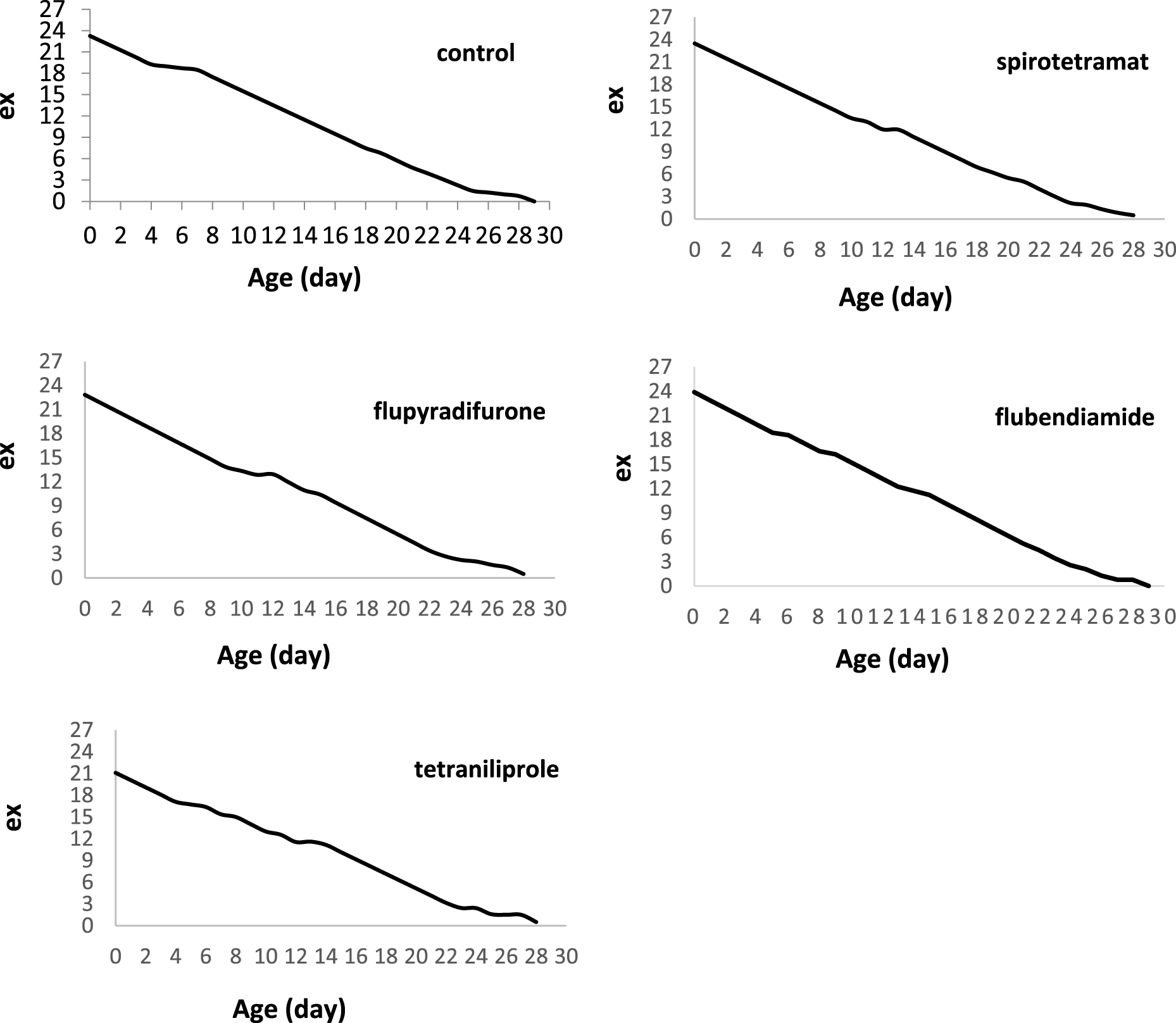
The life expectancy of adult insects in the control, tetraniliprole, flupyradifurone, flubendiamide, and spirotetramat treatments was 23.25, 23.88, 23.5, 22.83, and 21.09 days, respectively. The flubendiamide treatment had the highest life expectancy, while the lowest was observed in the tetraniliprole treatment (fig. 1).
Graph of changes in life expectancy (ex) of the parasitic wasp H. hebetor treated with the tested insecticides.

As seen in fig. 2, survival (lx) in adult parasitic wasps decreases with increasing age, with the highest survival rate corresponding to the control treatment and the lowest to the tetraniliprole insecticide. The survival rate graphs include the mortality of the parasitic wasps, which are plotted separately and compared with each other (fig. 2). These graphs showed that the pre-adult duration of the wasp was much shorter than the adult stage, but the maximum lifespan occurred in the adult stage. The graphs indicated that at lower temperatures, the mortality rate during the pre-adult stage at sublethal doses was higher than that of the control (fig. 2).
Age-specific survival (lx) and age-specific fertility (mx) graphs of the parasitic wasp H. hebetor treated with the tested insecticides.

The effects of insecticides on the population growth parameters
The highest intrinsic rate of population increase (rm) was observed in the control (0.259), while tetraniliprole (0.226 females/female/generation) had the most adverse effect on the intrinsic rate of population increase. The results of the mean reproductive ages are presented in table 3. According to the results, flubendiamide, tetraniliprole, and spirotetramat had the highest mean generation time, while the control and fluopyradifurone had the lowest. There were no significant differences among the treatments of tetraniliprole, spirotetramat, and flubendiamide. Additionally, the longest and shortest population doubling times were observed in spirotetramat (2.90 days), tetraniliprole (2.90 days), and the control (2.66 days), respectively (table 3). Based on the results obtained, it can be concluded that all the insecticides used have adverse effects on the life table parameters.
Discussion
Studies on the sublethal effects of tetraniliprole, flupyradifurone, flubendiamide, and spirotetramat insecticides on reproductive and population parameters of the parasitoid wasp H. hebetor have not been conducted in Iran. In this regard, considering the use of the mentioned pesticides in cotton pest management in Iran, their lethal and sublethal effects were studied on H. hebetor. The results of the experiments showed that among the pesticide treatments, tetraniliprole had the highest mortality rate and the lowest intrinsic population growth rate. Additionally, the use of flubendiamide insecticide had the least adverse effects on the parasitoid wasp.
Various studies have been conducted on the effects of insecticide compounds on H. hebetor. Asadi et al. (Reference Asadi, Karimi and Abbasipour2018a) reported that the application of essential oils extracted from rosemary (Rosmarinus officinalis Spenn. (Lamiales: Lamiaceae)) and sage (Salvia officinalis (Lamiales: Lamiaceae)) caused adverse effects on the biological parameters of H. hebetor. Asadi et al. (Reference Asadi, Rafiee-Dastjerdi, Nouri-Ganbalani, Naseri and Hassanpour2018b) stated that there is a significant difference in the percentage of host parasitism by adult wasps exposed to lethal concentrations of malathion. The parasitism rate of H. hebetor increased with the decrease in lethal concentration, indicating that each insecticide has a different effect on female insects. In this experiment, different insecticides had varying sublethal effects on the wasp. Saber and Abedi (Reference Saber and Abedi2013) studied the effects of methoxyfenozide and pyridalyl on the larval ectoparasitoid H. hebetor and concluded that methoxyfenozide and pyridalyl have moderate and low acute toxicity effects on H. hebetor.
It is recommended that rm be used to assess overall pesticide effects because it is based on both fecundity parameters and survivorship. The rm value determines the exponential increase of a population, where rm > 0 indicates population increase, rm = 0 indicates a constant population, and rm < 0 indicates that a population is declining to extinction. In the present study, the rm value was greater than zero, which indicates that H. hebetor treated with the tested insecticides exhibited exponential population increase. The results of the present study showed that the highest intrinsic rate of population increase was observed in flupyradifurone and flubendiamide (0.240 and 0.242), and the insecticide tetraniliprole (0.226) had the most adverse effect on the intrinsic rate of population increase. Fooladi et al. (Reference Fooladi, Golmohammadi and Ghajarieh2015) estimated the intrinsic population growth rates for the control and treatments of abamectin, flonicamid, thiacloprid, and thiosulfate to be 0.26, 0.24, 0.23, 0.22, and 0.21, respectively. They reported that the rm value in insecticide treatments was lower than in the control treatment, which is consistent with the results of the present study. Rezaei et al. (Reference Rezaei, Gheibi, Hesami and Zohdi2018) also investigated the sublethal effects of the insecticides thiacloprid, abamectin, and tondexir (garlic and red pepper extract) on the wasp H. hebetor through contact and host-poisoning methods. The highest rm value in both methods was related to the control, and the insecticide treatments had a lower value compared to the control. Rezaei et al. (Reference Rezaei, Hesami, Gheibi and Zohdi2019) investigated the sublethal effects of abamectin, proteus, and sirinol (which is green and has a garlic odour, with its active ingredient derived from garlic extract in edible oils) insecticides on the wasp H. hebetor through contact and poisoned bait methods. They found that the intrinsic rate of population increase was reduced in both contact and poisoned-host methods compared to the control group. Additionally, sublethal concentrations of abamectin, proteus, and sirinol decreased the lifespan of the adult wasps compared to the control, which is consistent with the findings of the current study.
The results of the present study indicate that the studied compounds have very little adverse effect on various growth parameters of the parasitoid wasp. A study demonstrated that the field-recommended doses of the insecticides diazinon and fipronil have a very high adverse effect on all developmental stages of H. hebetor. In contrast, the field recommended doses of fozalon and pyriproxyfen are relatively lethal to larval stages but exhibit very low toxicity to the pupal and adult stages of the parasitoid (Rashidi et al., Reference Rashidi, Nouri-Ganbalani and Imani2018). Faal-mohammadali et al. (Reference Faal-mohammadali, Seraj and Talebi-Jahromi2013) studied the lethal and sublethal effects of the insecticides chlorpyrifos and fenpropathrin on the larval, pupal, and adult stages of the parasitoid H. hebetor in the laboratory. In LC25 tests on the adult stage, mean longevity and fecundity showed significant differences between chlorpyrifos (15.93 ± 1.37 days and 128.20 ± 20.20 eggs) and fenpropathrin (12.76 ± 0.78 days and 124.00 ± 12.27 eggs) as compared with the control (20.41 ± 0.72 days and 281.00 ± 12.95 eggs). In addition, net reproductive rate and intrinsic rate of increase indicated significant differences between chlorpyrifos (22.89 ± 6.43 and 0.19 ± 0.02) and fenpropathrin (14.44 ± 3.58 and 0.17 ± 0.02) as compared with the control (55.55 ± 12.54 and 0.24 ± 0.02). They concluded that both insecticides had negative effects on H. hebetor. Results from different studies show varying levels of toxicity among different insecticides. However, the insecticides studied in this research are significantly more appropriate and have less risks.
The insecticides tested in our study are less hazardous compared to several other insecticides (including methoxyfenozide, biscaya, abamectin, proteus, fozalon, pyriproxyfen, diazinon, and fipronil). Therefore, if the results of field tests are confirmed, these insecticides can be used as alternatives to the aforementioned insecticides in IPM (Abedi et al., Reference Abedi, Saber, Gharekhani and Mehrvar2013, Reference Abedi, Saber, Gharekhani, Mehrvar and Mahdavi2012; Ahmadpour et al., Reference Ahmadpour, Rafiee-Dastjerdi, Naseri, Hassanpour, Ebadollahi and Mahdavi2021; Jarahi and Safavi, Reference Jarahi and Safavi2016; Rashidi et al., Reference Rashidi, Nouri-Ganbalani and Imani2018; Rezaei et al., Reference Rezaei, Gheibi, Hesami and Zohdi2018).
Based on the results obtained, it can be concluded that all the insecticides tested in this study showed minimal differences in lifespan, generation time, and intrinsic growth rate compared to the control, and the use of these insecticides has minimal lethal and sublethal effects on the parasitoid wasp H. hebetor. These insecticides have the potential to be applied in IPM programs (in this study, cotton bollworm) alongside biological control agents, if the supplementary field studies confirm the laboratory results.
Competing interests
None.