




1. Introduction
All groups considered in this paper are finite and p is always supposed to be a prime;
$\mathcal {N}$
 and
$\mathcal {N}_p$
 are used to denote the class of nilpotent groups and the class of p-nilpotent groups, respectively.
The norm
$N(G)$
 of a group G, introduced by Baer [Reference Baer1] in 1934, is defined as the intersection of the normalisers of all subgroups of G. Clearly,
$N(G)$
 is a characteristic subgroup of G. Over the years, many authors have studied both the properties of
$N(G)$
 and its relationship with the structure of G (see Baer’s foundational papers [Reference Baer1–Reference Baer3] and the recent survey [Reference Guo and Wang8]). Recently, there has been interest in various ‘generalised norms’. On the one hand, Li and Shen in [Reference Li and Shen9] introduced the subgroup
$D(G)$
 of a group G, which is the intersection of the normalisers of the derived subgroups of all subgroups in G; and Shen et al. in [Reference Shen, Shi and Qian16] (see also Gong and Guo in [Reference Gong and Guo6]) introduced the subgroup
$S(G)$
 (denoted
$N^{\mathcal {N}}(G)$
 in [Reference Gong and Guo6]) of a group G, which is the intersection of the normalisers of the nilpotent residual of all subgroups in G. In [Reference Li and Guo10, Reference Li and Guo11], we introduced the subgroup
$N_{\mathcal {N}_p}(G)$
 of a group G that is the intersection of the normalisers of the p-nilpotent-residual of all subgroups in G, and gave the relationship between
$N^{\mathcal {N}}(G)$
 and
$N_{\mathcal {N}_p}(G)$
 . More generally, Su and Wang in [Reference Su and Wang18] introduced a subgroup of a group G which is the intersection of the normalisers of the
$\mathcal {F}$
 -residual of all subgroups in G, where
$\mathcal {F}$
 is a nonempty formation.
On the other hand, researchers investigated the normalisers of specific classes of subgroups. Shen et al. [Reference Shen, Shi and Zhang17] investigated the normalisers of all noncyclic subgroups and classified the groups in which every noncyclic subgroup is normal; Romalis and Sesekin [Reference Romalis and Sesekin15] studied groups in which every nonabelian subgroup is normal, and Nagrebeckii [Reference Nagrebeckii12] later completely classified such groups. Subsequently, Nagrebeckii [Reference Nagrebeckii13] and Bruno and Phillips [Reference Bruno and Phillips5] classified the groups such that any nonnilpotent subgroup is normal. Ballester-Bolinches et al. [Reference Ballester-Bolinches, Cossey and Zhang4] analysed the intersection of the normalisers of subgroups not belonging to a specified class in a finite group G. These studies focus on the normalisers of noncyclic subgroups, nonabelian subgroups and nonnilpotent subgroups, whereas in this paper, we aim to investigate the case of non-p-nilpotent subgroups.
We consider the characteristic subgroup
$\mathcal {N}_p(G)$
 , which is the intersection of the normalisers of all non-p-nilpotent subgroups of a group G, that is,

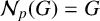
If G is p-nilpotent, we define
$\mathcal {N}_p(G)=G$
 .
Recall that the p-nilpotent residual of G, denoted by
$G^{\mathcal {N}_p}$
 , is the unique smallest normal subgroup N of G such that
$G/N$
 belongs to
$\mathcal {N}_p$
 . We investigate properties of
$\mathcal {N}_p(G)$
 , with the following as our main results.
Theorem 1.1. Let G be a group. If
$G^{\mathcal {N}_p}\leq \mathcal {N}_p(G)$
 , then
$G^{\mathcal {N}_p}$
 is a p-group.
Investigating group structures through subgroup indices leads to interesting results. We derive new properties of p-solvable groups.
Theorem 1.2. Let G be a p-solvable group and assume that p is the maximal prime divisor of
$|G|$
 . If the index of
$\mathcal {N}_p(G)$
 in G is coprime with p, then
$l_p(G)\leq 1$
 .
A chief factor
$U/V$
 of G is called central in G if
$U/V\leq Z(G/V)$
 . We investigate the exact number of noncentral p-chief factors of G contained in
$\mathcal {N}_p(G)$
 .
Theorem 1.3. Let G be a p-solvable group. Then,
$\mathcal {N}_p(G)$
 contains at most one noncentral p-chief factor of G.
It is well known that p-nilpotency is the local version of nilpotency. It is interesting to find the relationship between
$\mathcal {N}_{\mathcal {N}}(G)$
 and
$\mathcal {N}_p(G)$
 . (The intersection of the normalisers of all nonnilpotent subgroups of G was investigated in [Reference Ballester-Bolinches, Cossey and Zhang4] and denoted by
$\mathcal {K}_{\mathfrak {C}}(G)$
 .)
Theorem 1.4. Let G be a group. Then,
$\mathcal {N}_{\mathcal {N}}(G) = \bigcap _{p||G|}\mathcal {N}_p(G)$
 .
2. Proof of the main results
Lemma 2.1. Let G be a group. Then,
$N(G)\leq \mathcal {N}_p(G)$
 .
Lemma 2.2. Let K be a subgroup of G and N be a normal subgroup of G. Then:
-
(1) $K\cap \mathcal {N}_p(G)\leq \mathcal {N}_p(K)$
 ;
-
(2) $\mathcal {N}_p(G)N/N\leq \mathcal {N}_p(G/N)$
.


Proof.
$(1)$
 If H is a non-p-nilpotent subgroup of K, then H is also a non-p-nilpotent subgroup of G, so
$K\cap \mathcal {N}_p(G)\leq \mathcal {N}_p(K)$
 .
$(2)$
 Let
$\overline {G}=G/N$
 . For any non-p-nilpotent subgroup
$\overline {H}$
 in
$\overline {G}$
 , obviously, H is a non-p-nilpotent subgroup of G. For any element
$g \in \mathcal {N}_p(G)$
 , by definition, g normalises H. It follows that
$\overline {g}$
 normalises
$\overline {H}$
 , that is,
$\overline {g} \in \mathcal {N}_p(G/N)$
 . So,
$\mathcal {N}_p(G)N/N\leq \mathcal {N}_p(G/N)$
 .
Lemma 2.3. Let G be a group. Then,
$\mathcal {N}_p(G)$
 is p-solvable.
Proof. Let
$S=\mathcal {N}_p(G)$
 . Every non-p-nilpotent subgroup of S is normal in S. Let M be a non-p-nilpotent maximal subgroup of S. Then,
$M\lhd S$
 and, from Lemma 2.2,
$M=\mathcal {N}_p(M)$
 and
$S/M=\mathcal {N}_p(S/M)$
 . By induction, M and
$S/M$
 are p-solvable, so S is p-solvable. However, if every maximal subgroup of S is p-nilpotent, then S is a p-nilpotent group or a minimal non-p-nilpotent group. Hence, S is p-solvable.
Proof of Theorem 1.1.
Suppose that the theorem is false and let G be a counterexample of minimal order. Since
$G^{\mathcal {N}_p}\leq {\mathcal {N}_p}(G)$
 , by Lemma 2.3, G is p-solvable. Obviously,
$G^{\mathcal {N}_p}$
 is not a
$p'$
 -group. We may assume that P is a Sylow p-subgroup of
$G^{\mathcal {N}_p}$
 and
$P\neq 1$
 .
Suppose that G has two minimal normal subgroups
$N_1, N_2$
 with
$N_1\neq N_2$
 . From Lemma 2.2,
$G/N_i$
 satisfies the hypothesis and
$G^{\mathcal {N}_p}N_i/N_i=(G/N_i)^{\mathcal {N}_p}$
 is a p-group by the choice of G for
$i=1, 2$
 . Since
$G^{\mathcal {N}_p}\lesssim (G^{\mathcal {N}_p}/G^{\mathcal {N}_p}\cap N_1)\times (G^{\mathcal {N}_p}/G^{\mathcal {N}_p}\cap N_2)$
 ,
$G^{\mathcal {N}_p}$
 is a p-group, which is a contradiction. So, G has a unique minimal normal subgroup, N say. The minimality of G implies
$G^{\mathcal {N}_p}/N$
 is a p-group. By the p-solvability of G, N is a p-group or a
$p'$
 -group. If N is a p-group, then
$G^{\mathcal {N}_p}$
 is a p-group, which is a contradiction. So, N is a
$p'$
 -group.
Observe that
$G^{\mathcal {N}_p}=NP$
 . Consequently,
$G=N_G(P)G^{\mathcal {N}_p}=N_G(P)N$
 by a Frattini argument. If
$N\leq \Phi (G)$
 , then
$P\lhd G$
 , which leads to
$N\leq P$
 , which is a contradiction. So, we may assume that
$N\nleq \Phi (G)$
 , there exists a maximal subgroup M of G such that
$G=NM$
 and
$N\nleq M$
 . If M is not p-nilpotent, then
$M\lhd G$
 since
$N\leq G^{\mathcal {N}_p}\leq \mathcal {N}_p(G)$
 . The uniqueness of N implies
$N\leq M$
 , contrary to
$N\nleq M$
 . So, M is p-nilpotent. It follows that
$G^{\mathcal {N}_p}\leq N$
 and that
$G^{\mathcal {N}_p}= N$
 is a
$p'$
 -group. Then, G is p-nilpotent and
$G^{\mathcal {N}_p}=1$
 , which is a contradiction.
Corollary 2.4. Let G be a group. If
$G^{\mathcal {N}_p}\leq \mathcal {N}_p(G)$
 , then
$l_p(G)\leq 2$
 .
Proof. By Theorem 1.1,
$G^{\mathcal {N}_p}\leq O_p(G)$
 , so
$G/O_p(G)$
 is p-nilpotent. It is clear that
$l_p(G)\leq 2.$

Corollary 2.5. Let G be a group. If
$\mathcal {N}_p(G) = G$
 , then
$G^{\mathcal {N}_p}$
 is a p-group.
We give an example to show that if
$G^{\mathcal {N}_p}$
 is a p-group, we may have
$\mathcal {N}_p(G) \neq G$
 .
Example 2.6. Let
$p=3$
 and

Then,
$|G|=36$
 , G is not
$3$
 -nilpotent and
$G^{\mathcal {N}_3}=\langle a, b\rangle $
 is a
$3$
 -group. If H is any non-
$3$
 -nilpotent proper subgroup of G, then
$|H|=18$
 or
$|H|=6$
 . It is clear that
$H_1=\langle a, c^2\rangle $
 is a non-
$3$
 -nilpotent subgroup of G and
$H_1\ntrianglelefteq G$
 . So,
$\mathcal {N}_3(G) < G$
 . Moreover, since
$\mathcal {N}_3(G)\trianglelefteq G$
 , we have
$\mathcal {N}_3(G)=1$
 .
Proof of Theorem 1.2.
Suppose that the theorem is false and let G be a counterexample of minimal order. Let P be a Sylow p-subgroup of G. From the hypothesis,
$P\leq \mathcal {N}_p(G)$
 .
Claim 1.
$\Phi (G)=1$
 ,
$O_p(G)$
 is an elementary abelian p-group, and is the unique minimal normal subgroup of G,
$O_{p'}(G) = 1$
 and
$C_G(O_p(G)) = O_p(G)$
 .
If K is a proper nontrivial normal subgroup of G, then

by Lemma 2.2. The minimality of G implies that
$l_p(G/K)\leq 1$
 . It follows from [Reference Robinson14, 9.3.8] that
$\Phi (G)=1$
 ,
$O_{p'p}(G)$
 is an elementary abelian p-group, which is also a unique minimal normal subgroup of G, and
$C_G(O_{p'p}(G))=O_{p'p}(G)$
 .
If
$O_{p'}(G)\neq 1$
 , then
$l_p(G/O_{p'}(G))\leq 1$
 by the minimality of G. Also from
$l_p(G) = l_p(G/O_{p'}(G))$
 , we see
$l_p(G)\leq 1$
 , which is a contradiction. So,
$O_{p'}(G) = 1$
 , which leads to
$O_{p'p}(G)=O_p(G)$
 and to
$C_G(O_p(G)) = O_p(G)$
 .
Claim 2.
$G = \mathcal {N}_p(G)$
 and so
$G^{\mathcal {N}_p} = O_p(G)$
 .
It is clear that
$O_{p'}(\mathcal {N}_p(G))\leq O_{p'}(G) = 1$
 . If
$\mathcal {N}_p(G) < G$
 , then
$l_p(\mathcal {N}_p(G))\leq 1$
 by the choice of G, and so
$P\lhd \mathcal {N}_p(G)$
 . Since P char
$\mathcal {N}_p(G)\lhd G$
 , it follows that
$P\lhd G$
 . So,
$l_p(G)\leq 1$
 , which is a contradiction.
Corollary 2.5 implies that
$G^{\mathcal {N}_p}$
 is a p-group, so that
$G^{\mathcal {N}_p}\leq O_p(G)$
 . From the minimality of
$O_p(G)$
 , we conclude that
$G^{\mathcal {N}_p} = O_p(G)$
 .
Claim 3.
$G = PQ$
 ,
$Q\in \mathrm {Syl}_q(G)$
 .
Since G is p-solvable, it follows from [Reference Gorenstein7, Theorem 6.3.5] that G possesses a Hall
$\{p, q\}$
 -subgroup L for any prime
$q\neq p$
 . Without loss of generality, we let
$L = PQ$
 , where
$Q\in \text {Syl}_q(G)$
 . We claim that
$L=G$
 . Suppose that
$L < G$
 . If L is p-nilpotent,
$Q\lhd L$
 . Since
$[O_p(G), Q] = 1$
 , we have
$Q\leq C_G(O_p(G))=O_p(G)$
 , which is a contradiction. So, L is non-p-nilpotent and
$L\lhd G$
 by Claim 2. Because
$[O_p(G), O_{p'}(L)]\leq [O_p(L), O_{p'}(L)] = 1$
 , we have
$O_{p'}(L)\leq C_G(O_p(G))=O_p(G)$
 . So,
$O_{p'}(L)\leq O_p(G)$
 and then
$O_{p'}(L) = 1$
 . Lemma 2.2 implies that
$P\leq L\cap \mathcal {N}_p(G)\leq \mathcal {N}_p(L)$
 . By the choice of G,
$l_p(L)\leq 1$
 , so that
$P\lhd L$
 . Therefore, P char
$L\lhd G$
 ,
$P\lhd G$
 and so
$l_p(G)\leq 1$
 , which is a contradiction.
We claim that Q is a minimal normal subgroup of M. Suppose that
$Q_1 < Q$
 and
$Q_1\lhd M$
 . Let
$G_1 = O_p(G)Q_1P_1 = PQ_1$
 . Clearly,
$G_1 < G$
 . Since
$[O_p(G), O_{p'}(G_1)]\leq [O_p(G_1),O_{p'}(G_1)] = 1$
 , we have
$O_{p'}(G_1)\leq C_G(O_p(G))=O_p(G)$
 and so
$O_{p'}(G_1)=1$
 . Lemma 2.2 implies that
$P\leq G_1\cap \mathcal {N}_p(G)\leq \mathcal {N}_p(G_1)$
 , which leads to
$l_p(G_1)\leq 1$
 by the choice of G. So,
$G_1$
 is q-nilpotent and non-p-nilpotent. By Claim 2,
$G_1\lhd G$
 . So,
$P = O_p(G)P_1\lhd G_1$
 . Therefore,
$P\lhd G$
 and
$l_p(G)\leq 1$
 , which is a contradiction.
Next, we show that Q is cyclic with order q. Note that g acts on
$O_p(G)$
 , for any element g of Q. If
$C_{O_p(G)}(g)\neq 1$
 , by Maschke’s theorem, there exists a subgroup
$A_1$
 such that
$O_p(G) = A_1\times C_{O_p(G)}(g)$
 and g also acts on
$A_1$
 . (Clearly,
$A_1> 1$
 . If
$A_1 = 1$
 , then
$C_{O_p(G)}(g)= O_p(G)$
 and
$g\in C_G(O_p(G))\leq O_p(G)$
 , which is a contradiction.) If
$\langle g\rangle A_1$
 is non-p-nilpotent, then
$\langle g\rangle A_1\lhd G$
 by Claim 2. So,
$A_1$
 char
$\langle g\rangle A_1\lhd G$
 and, thus,
$A_1\lhd G$
 , contrary to the minimality of
$O_p(G)$
 . Hence,
$\langle g\rangle A_1$
 is p-nilpotent, and then
$[g, O_p(G)] = [g, A_1][g, C_{O_p(G)}(g)] = 1$
 and
$g\in C_G(O_p(G)) = O_p(G)$
 , which is a contradiction. So,
$C_{O_p(G)}(g) = 1$
 for any element g of Q. Therefore,
$Q\ltimes O_p(G)$
 is a Frobenius group. By [Reference Gorenstein7, Theorem 10.3.1] and the minimality of Q, it follows that Q is cyclic with order q.
Since
$q < p$
 , G is q-nilpotent and
$P\lhd G$
 , this implies that
$l_p(G)\leq 1$
 , which is a contradiction.
Now, we give two examples to show that the hypothesis in Theorem 1.2 that p is the maximal prime divisor of
$|G|$
 cannot be removed.
Example 2.7. Let
$p = 2$
 and
$G = S_4$
 , the symmetric group of degree four. It is clear that
$\mathcal {N}_2(G) = G$
 . So, G satisfies the hypothesis of Theorem 1.2, but
$l_2(G) = 2$
 .
Example 2.8. Let
$p = 3$
 and
$G = \langle a, b, c, d, e \mid a^3 = b^3 = c^3 = e^3 = d^{13} = 1, a^b = a^c = a, b^c = b, a^d = a^2c, b^d = a^2, c^d = b^2, a^e = a^2c^2, b^e = bc^2, c^e = a, d^e = d^9\rangle $
 . Either K is
$3$
 -nilpotent or
$K=\langle a, b, c, d\rangle $
 or
$K=G$
 for any subgroup K of G. Hence,
$\mathcal {N}_3(G) = G$
 . So, G satisfies the hypothesis of Theorem 1.2, but
$l_3(G) = 2$
 .
Before giving the proof of Theorem 1.3, we recall the following definition: the maximum normal p-nilpotent subgroup of the group G, denoted by
$F_p(G)$
 , is the product of all the normal p-nilpotent subgroups of G.
Lemma 2.9. Let G be a p-solvable group. If
$U/V$
 is a noncentral p-chief factor of G and
$U\leq \mathcal {N}_p(G)$
 , then
$G/C_G(U/V)$
 is p-nilpotent.
Proof. Suppose that the theorem is false and let G be a counterexample of minimal order.
We claim that
$V=1$
 and U is a minimal normal subgroup of G. Suppose that
$V\neq 1$
 . It is clear that
$U/V$
 is a noncentral p-chief factor of
$G/V$
 . By Lemma 2.2,
$U/V\leq \mathcal {N}_p(G)V/V\leq \mathcal {N}_p(G/V)$
 , which implies that
$(G/V)/(C_{G/V}(U/V))$
 is p-nilpotent by the choice of G. So,
$G/C_G(U/V)$
 is also p-nilpotent, which is a contradiction.
Let
$C=C_G(U)$
 . By [Reference Robinson14, Theorem 9.3.3],
$F_p(G)\leq C$
 . Since G is p-solvable, by [Reference Robinson14, Theorem 9.3.4],
$\Phi (G)<F_p(G)$
 . If
$C\leq \Phi (G)$
 , then
$F_p(G)\leq \Phi (G)$
 , which leads to
$F_p(G/\Phi (G))=1$
 , contrary to the fact that
$F_p(G/\Phi (G))\neq 1$
 by the p-solvability of
$G/\Phi (G)$
 . Clearly,
$C\nleq \Phi (G)$
 . So, there exists a subgroup M of G such that
$G=CM$
 and
$C\cap M\leq \Phi (M)$
 .
As U is a noncentral p-chief factor, we have
$M\nleq C$
 . Since
$U\cap M\lhd M$
 and
$[C, U\cap M]=1$
 , we have
$U\cap M\lhd CM=G$
 , which yields
$U\cap M=1$
 or
$U\cap M=U$
 . Clearly, M is not p-nilpotent. Since
$U\leq \mathcal {N}_p(G)$
 , we have
$U\leq N_G(M)$
 . If
$U\cap M=1$
 , then
$[U, M]\leq U\cap M=1$
 and so
$M\leq C_G(U)=C$
 , which contradicts the fact that
$M\nleq C$
 . So,
$U\leq M$
 .
It is not difficult to see that U is also a noncentral p-chief factor of M. It follows from Lemma 2.2 that
$U\leq \mathcal {N}_p(M)$
 . Hence,
$M/C_M(U)$
 is p-nilpotent by the choice of G. Since
$G/C=CM/C\cong M/C\cap M=M/C_M(U)$
 , it follows that
$G/C$
 is also p-nilpotent, which is a contradiction.
Proof of Theorem 1.3.
Suppose that the theorem is false and let G be a counterexample of minimal order. Then, there exist subgroups
$V\leq U\leq L\leq K\leq \mathcal {N}_p(G)$
 such that
$U/V$
 and
$K/L$
 are two noncentral p-chief factors of G. Lemma 2.2 implies that U and
$K/L$
 are contained in
$\mathcal {N}_p(G/V)$
 . So,
$V=1$
 and U is a minimal normal subgroup of G by the choice of G.
Set
$C=C_G(U)\cap C_G(K/L)$
 . From Lemma 2.9,
$G/C_G(U)$
 and
$G/C_G(K/L)$
 are p-nilpotent, which implies that
$G/C$
 is p-nilpotent. If
$C\leq \Phi (G)$
 , then G is p-nilpotent, which implies that every p-chief factor of G is central, which is a contradiction. So, there exists a subgroup M of G such that
$G=CM$
 and
$C\cap M\leq \Phi (M)$
 . Since
$M/\Phi (M)\lesssim G/C$
 , it follows that M is p-nilpotent.
It is not difficult to see that U is also a noncentral p-chief factor of
$UM$
 . If
$UM$
 is p-nilpotent, then
$U\leq Z(UM)$
 by [Reference Robinson14, Theorem 9.3.3], from which we can conclude that
$U\leq Z(G)$
 , which is a contradiction. So,
$UM$
 is non-p-nilpotent. It follows from
$K\leq \mathcal {N}_p(G)$
 that
$K\leq N_G(UM)$
 and that
$(K\cap M)L/L\lhd G/L$
 . Hence,
$(K\cap M)L=L$
 or
$(K\cap M) L=K$
 . If
$(K\cap M)L=K$
 , then
$K\leq ML$
 . As
$K/L$
 is a minimal normal subgroup of
$ML/L$
 and
$ML/L$
 is p-nilpotent,
$K/L\leq Z(ML/L)$
 and
$K/L$
 is a central p-chief factor of G, which is a contradiction. So,
$(K\cap M)L=L$
 .
Since
$[K, UM]\leq K\cap UM=U(K\cap M)$
 , we have
$[K,UM]\leq L$
 . Thus,
$UM\leq C_G(K/L)$
 . It follows from
$G=CM$
 that
$K/L$
 is a central p-chief factor of G, which is a contradiction.
Finally, we examine the relationship between
$\mathcal {N}_{\mathcal {N}}(G)$
 (the intersection of the normalisers of all nonnilpotent subgroups of G, which was investigated and denoted by
$\mathcal {K}_{\mathfrak {C}}(G)$
 in [Reference Ballester-Bolinches, Cossey and Zhang4]) and
$\mathcal {N}_p(G)$
 .
Lemma 2.10. Let G be a group. Then,
$\mathcal {N}_{\mathcal {N}}(G)\leq \bigcap _{p||G|}\mathcal {N}_p(G)$
 .
Proof. For any prime p,

Consequently,
$\mathcal {N}_{\mathcal {N}}(G)\leq \mathcal {N}_p(G)$
 . This completes the proof.
Proof of Theorem 1.4.
By Lemma 2.10, we only need to show that
$\bigcap _{p||G|}\mathcal {N}_p(G)\leq \mathcal {N}_{\mathcal {N}}(G)$
 . If H is nonnilpotent, there exists at least one prime q, such that H is non-q-nilpotent. So,
$\bigcap _{p||G|}\mathcal {N}_p(G)\leq N_G(H)$
 , which implies that
$\bigcap _{p||G|}\mathcal {N}_p(G)\leq \mathcal {N}_{\mathcal {N}}(G)$
 .



