Introduction
Children around the world are engaging in above-average levels of care and support for their sick or disabled parents and guardians (Aldridge and Becker, Reference Aldridge and Becker1999; Becker, Reference Becker2007; Robson et al., Reference Robson, Ansell, Huber, Gould and Blerk2006), siblings (Dahlblom et al., Reference Dahlblom, Herrara, Peña and Dahlgren2009) and ageing grandparents (Skovdal, Reference Skovdal2010a). There is no doubt that caring for an ailing, ageing or disabled guardian can be a highly stressful situation for a child. Furthermore, a child caring for an adult arguably falls outside contemporary and Anglophone understandings of what childhood should be about. It may therefore be no surprise that ‘being a young carer is portrayed in almost wholly negative terms in the [Anglophone] literature’ (Olsen, Reference Olsen1996: 44). Studies of children caring for parents with diseases as diverse as diabetes, HIV/AIDS, cancer and mental disorders, can testify to this trend (Aldridge and Becker, Reference Aldridge and Becker1999; Bauman et al., Reference Bauman, Johnson Silver, Berman, Gamble and Shifren2009; Cooklin, Reference Cooklin2006; Gates and Lackey, Reference Gates and Lackey1998; Gray et al., Reference Gray, Robinson and Seddon2008; Jacobson and Wood, Reference Jacobson and Wood2004). Research has reported that caregiving children often live in poverty and social exclusion (Dearden and Becker, Reference Dearden and Becker2000), have emotional difficulties (Dearden and Becker, Reference Dearden and Becker1995, Reference Dearden and Becker1998, Reference Dearden and Becker2004) and impaired mental health (Bauman and Germann, Reference Bauman, Germann, Foster, Levine and Williamson2005; Cree, Reference Cree2003; Shifren, Reference Shifren2009). They experience ill health and restricted opportunities for developing friendships and social networking, including taking part in leisure activities, and have been described as having limited visions of the future (Aldridge and Becker, Reference Aldridge and Becker1993; Dearden and Becker, Reference Dearden and Becker2000) and difficulties with education (Dearden and Becker, Reference Dearden and Becker1998, Reference Dearden and Becker2004). Nevertheless, a few studies in the UK (Aldridge, Reference Aldridge2008; Becker, Reference Becker and Davies2000), North America (Beach, Reference Beach1994; Blackford, Reference Blackford1999; Gates and Lackey, Reference Gates and Lackey1998) and Australia (Pakenham et al., Reference Pakenham, Chiu, Bursnall and Cannon2007) have also observed some positive effects of caregiving, including maturity and the development of a sense of responsibility and self-worth. Whilst a focus on the negative impact of young caregiving has taken precedence, it is increasingly acknowledged that emphasising the detrimental outcomes for caregiving children potentially contributes to the victimisation of this group of children (cf. Aldridge, Reference Aldridge2008; Becker, Reference Becker2007; Evans and Becker, Reference Evans and Becker2009; Joseph et al., Reference Joseph, Becker, Becker and Regel2009). However, we know little about the implications of such representations of caregiving children for policy and practice. We apply theories of recognition and identity to argue that local representations of caregiving children have an impact on how caregiving children cope with often difficult circumstances. It is against this background, and in our interest to highlight the importance of identity and recognition in policy and practice, that we draw on research from Western Kenya to explore the agency and resilience of caregiving children.
Caregiving children in sub-Saharan Africa
African children's care, work and contribution to their household are not new. There are numerous anthropological studies in Africa that highlight the competence and active role children play in sustaining their household and how this is an important part of their socialisation (Katz, Reference Katz1996; Kenyatta, Reference Kenyatta1979; Porter, Reference Porter1996; Raum, Reference Raum1940) and livelihood in contexts of poverty and disease (Abebe and Aase, Reference Abebe and Aase2007; Abebe and Kjørholt, Reference Abebe and Kjørholt2009; Abebe and Skovdal, Reference Abebe and Skovdal2010).
The literature available on caregiving children in sub-Saharan Africa (SSA) remains limited but is steadily expanding. Research on caregiving children in SSA was spearheaded by Robson and colleagues, who have usefully mapped out the circumstances of caregiving children, including the problems they are facing, such as disruption of schooling, loss of friends and isolation, the difficulties of looking after an ailing person and the wider household and the trauma as a result of caring and bereavement (cf. Robson, Reference Robson2000, Reference Robson2001, Reference Robson2004; Robson and Ansell, Reference Robson, Ansell, Holloway and Valentine2000; Robson et al., Reference Robson, Ansell, Huber, Gould and Blerk2006). In addition to identifying the problems faced by caregiving children, they have also outlined the potential benefits of young caregiving, including learning new skills, developing close and loving relationships with the person they care for and growing up as a mature and responsible person (Robson et al., Reference Robson, Ansell, Huber, Gould and Blerk2006). Careful about viewing children as non-competent as common Anglophone understandings of childhood represent them, but seeing them as active and competent as their social environments allow (Hutchby and Moran-Ellis, Reference Hutchby and Moran-Ellis1998), Robson and Ansell (Reference Robson, Ansell, Holloway and Valentine2000: 191) in their earlier work questioned the appropriateness of using the term ‘young carers’ in Zimbabwe, arguing that such a term ‘is perhaps to pathologise the work in which they engage’.
However, since the foundation was laid by Robson and colleagues, a number of studies have focused on the psychosocial distress experienced by caregiving children (cf. Bauman et al., Reference Bauman, Foster, Silver, Berman, Gamble and Muchaneta2006, Reference Bauman, Johnson Silver, Berman, Gamble and Shifren2009; BBC News, 2009; Cluver et al., Reference Cluver, Gardner and Operario2009; Donald and Clacherty, Reference Donald and Clacherty2005; Martin, Reference Martin2006; Shifren, Reference Shifren2009). Whilst there is no doubt that a minority of caregiving children suffer from mental ill health, it can be argued that the focus on children's poor mental health, rather than representing children's experience, reflects common Anglophone constructions of childhood as a period of innocence and psychological fragility in the absence of adult protection (Skovdal, Reference Skovdal, Evers, Notermans and van Ommering2010b; Summerfield, Reference Summerfield2000, Reference Summerfield and Rosen2004). Other scholars have moved beyond the vulnerability of caregiving children and focused on the protective factors and agentic capabilities of children within their local context. This field of research explores how these children, in contexts of poverty and disease, interact with their social context in order to cope with very difficult circumstances and build resilience (Evans, Reference Evans2005; Evans and Becker, Reference Evans and Becker2009; Skovdal, Reference Skovdal, Evers, Notermans and van Ommering2010b, in press; Skovdal and Ogutu, Reference Skovdal and Ogutu2009; Skovdal et al., Reference Skovdal, Ogutu, Aoro and Campbell2009).
While it is unhelpful to see children as either victims or social agents, as this binary distinction shadows the plurality of experiences and childhoods (Abebe and Kjørholt, Reference Abebe and Kjørholt2009; Kesby et al., Reference Kesby, Gwanzura-Ottemoller and Chizororo2006), this distinction helps locate this study within the literature. Becker (Reference Becker2007), in his commentary about global perspectives on young caregiving, argues that:
if the focus of research turns away from the ‘vulnerability’ of young carers to one concerned with ‘resilience’, then researchers may be better equipped analytically to explain differences in experiences and outcomes between young carers within and across countries (p. 40, emphasis in the original).
It is this direction that this paper seeks to facilitate by exploring the pathways through which caregiving children in Kenya cope with difficult circumstances. To make our findings relevant to the international literature on caregiving children, we seek to identify the underlying processes that can facilitate caregiving children's resilience. In this effort, we are drawing on a theoretical framework that highlights the association between local understandings of childhood, identity and recognition to resilience.
Identity and recognition
In an effort to move away from common understandings of caregiving children, which reflect what Evans and Becker (Reference Evans and Becker2009) call the ‘deficit model’ of childhood, to a focus on the agency of caregiving children, we adopt a constructionist viewpoint on resilience. The starting point for our framework is therefore that local understandings of childhood can facilitate or undermine the resilience of caregiving children through processes of recognition or misrecognition.
Resilience is not an individual attribute, but it is located at the social/individual interface. Ungar (Reference Ungar2008: 225), for example, notes that:
in the context of exposure to significant adversity, whether psychological, environmental, or both, resilience is both the capacity of individuals to navigate their way to health-sustaining resources, including opportunities to experience feelings of well-being, and a condition of the individual's family, community and culture to provide these health resources and experiences in culturally meaningful ways.
Drawing on this understanding of resilience, Skovdal et al. (Reference Skovdal, Ogutu, Aoro and Campbell2009) have highlighted that caregiving children's ability to cope depends on children's ability to participate in community life and actively navigate and negotiate social support – a process mediated by local understandings of childhood which recognise children as social actors and shape their identity.
Identity can be defined as a socio-psychological process of positioning oneself in relation to others. As such, identity is as much about identification as about recognition (Duveen, Reference Duveen, Deaux and Philogène2001). Recognition refers to patterns of representation that circulate in a society and create the symbolic environment for the development of identities. Social representations can be described as systems of socially constructed, commonsense knowledge, including values, ideas and practices, which enable people to orientate themselves in their social world (Moscovici, Reference Moscovici and Herzlich1973). Drawing on the theory of social representations, Duveen (Reference Duveen1993:172) has defined identity as:
a psychological process through which meanings are organised and which enables the person to position themselves as a social actor. Social identity in this sense is a way of organising experience which contributes towards the definition of self, but does so by locating the self within the collective world.
Identity is, thus, intertwined with one's place in a community. This suggests that ‘it is not enough simply to assert an identity; that assertion must also be validated, or not, by those with whom we have dealings’ (Jenkins, Reference Jenkins1996: 42).
The impact of recognition on the development of self has been theorised by G. H. Mead. Mead (Reference Mead1934) conceptualises the self as arising through the relationship between the I, the here and now self in action, and the Me, the self as an object of knowledge. Only by being able to see oneself through the eyes of the other(s), as an object, can one become self-conscious. Therefore, the way we are seen or recognised by others is integral to our sense of self. The ‘other’ can take many forms: it can be a reference group, an institution, or a knowledge system (Marková, Reference Marková2006). Concerning caregiving children, the ‘other’ can be the prevalent representations of childhood. In Mead's terms, such representations and norms form part of the ‘generalised other’. Mead argues that for a person to be socialised as a member of a community, he or she has to appropriate the perspective of the generalised other (Mead, Reference Mead1934). Therefore, in order to construct an identity, caregiving children have to situate themselves in relation to the norms and representations that define childhood (see Duveen, Reference Duveen, Deaux and Philogène2001; Duveen and Lloyd, Reference Duveen and Lloyd1986; Moloney and Walker, Reference Moloney and Walker2007). The representation of caregiving children as children who have lost their childhood and the lack of recognition of their efforts can therefore be detrimental to their identity. Taylor (Reference Taylor1992: 25) refers to this as ‘misrecognition’:
Our identity is partly shaped by recognition or its absence, often by the misrecognition of others, and so a person or a group of people can suffer real damage, real distortion, if the people or the society around them mirror back to them a confining or demeaning or contemptible picture of themselves.
Against that, Honneth (Reference Honneth1995) has argued that recognition of a person's abilities and achievements enhances that person's social esteem in that he or she is recognised as a contributor towards achieving community goals. Thus, recognition can play a legitimating and empowering role. Being recognised means being acknowledged as a competent and legitimate social actor (Noble, Reference Noble2009).
However, as our review of the literature highlights children in the West are too often seen as lacking agency. This is part of the common Anglophone representations of childhood that position children as adults in the making. This perspective on childhood is also evident in traditional child development theories (cf. Piaget, Reference Piaget1953). As a result, caregiving children are seen predominantly as victims. Relating Western notions of childhood to the literature on caregiving children, Evans and Becker (Reference Evans and Becker2009: 244) point out:
children's role in caring for parents/relatives with HIV conflicts with hegemonic Western notions of childhood as a protected phase when children should be free to play with their friends and go to school without having to think about responsibilities associated with ‘adulthood’.
On the other hand, social representations and contexts that recognise children as competent social actors have the potential of enhancing the agency of caregiving children (Robson et al., Reference Robson, Bell, Klocker, Panelli, Punch and Robson2007). As Hutchby and Moran-Ellis argue (Reference Hutchby and Moran-Ellis1998: 6): ‘Childhood is not a natural phenomenon or fixed stage of life, but a historically and culturally variable social construction.’ Therefore, different contexts produce different understandings about the role of children in the community. In order to be able to support caregiving children, we need to recognise them as both competent social actors and potentially vulnerable beings in need of protection. In this effort, it is necessary to deconstruct universalistic representations of childhood and critically explore the benefits of ‘other childhoods’ (Kesby et al., Reference Kesby, Gwanzura-Ottemoller and Chizororo2006).
Methodology
To gain a more in-depth understanding of how identity and recognition are played out and have the potential to facilitate the resilience of caregiving children, this case study brings together the views of 48 caregiving children and ten adults from the Bondo district of Western Kenya. The study was granted ethical clearance by the Research Ethics Committees of the London School of Economics and the Department of Gender and Social Services in Kenya. We have used pseudonyms to protect the identity of participants.
Study location and participants
The data for this study were collected between November 2006 and September 2007 from two rural communities in Bondo district. Bondo district borders Lake Victoria and is characterised by its many fish-landing beaches and high HIV prevalence rates (Nyambedha and Aagaard-Hansen, Reference Nyambedha and Aagaard-Hansen2007). Bondo is one of the poorest districts in Kenya, with 47.2 per cent of its people living in absolute poverty (GOK, Reference GOK2002) and still has one of the highest HIV prevalence rates (15.3 per cent) in the country, which, despite a decrease, remains twice the Kenyan national average of 7.4 per cent (NASCOP/MOH, Reference NASCOP/MOH2008).
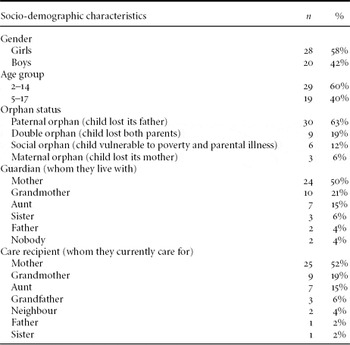
A total of 48 children and ten adults were purposively sampled for this study. The children were sampled through community gatekeepers who were instructed to identify roughly an equal number of boys and girls between 11–17 years old who provided above-average levels of care and support to adults. The type of care the children engaged in involved nursing of parents (feeding, bathing, administering medicines), domestic duties (cleaning, washing and cooking), income generation (farming, charcoal burning, sewing) and emotional support (listening, providing advice and praying). The socio-demographic characteristics of the children, as well as whom they care for, are presented in Table 1.
Socio-demographic characteristics of participating children

Data sources
Photography has been identified as a particularly useful method in doing research with children whose views and perceptions have previously been marginalised (Wang, Reference Wang, Checkoway and Gutiérrez2006; Wilson et al., Reference Wilson, Dasho, Martin, Wallerstein, Wang and Minkler2007). Reflecting the objectives of this paper, photography gave us a medium to involve children in the research process, bringing forward their voices rather than the representations that may be held by the researchers in the way children are conceptualised and understood (McDonald, Reference McDonald2009). Following a series of workshops on how to take photos and the ethical implications of taking a photograph, we distributed disposable cameras to all 48 children and encouraged them to address four questions when taking photos: (1) ‘What is your life like?’, (2) ‘What is good about your life?’, (3) ‘What makes you strong?’ and (4) ‘What needs to change?’. From the 240 photos generated, the children were asked to pick their six favourite photos and write reflections for each photo prompted by three questions: (1) ‘I want to share this photo because. . .’, (2) ‘What's the real story this photo tells?’, and (3) ‘How does this story relate to your life and/or the lives of people in your neighbourhood?’. The children were also provided with colour pens and paper to draw-and-write reflections they were unable to capture on camera, either for practical or ethical reasons. A total of 184 photos and 56 drawings were generated from this exercise. In different workshops, the children were encouraged to write essays on their caring experiences (n = 27) and complete historical time lines (n = 48) and daily diagrams (n = 48). An additional 24 individual interviews and two group conversations were conducted to expand on some of the issues and themes brought up in their written reflections. All the 24 children that were interviewed had diverse experiences that would enrich this qualitative study. To gain a better insight of the social setting in relation to being a child and caregiving, ten individual interviews with adults (caregivers, community representatives, social development officers) were conducted. All interviews were recorded.
Data preparation and analysis
All the data were verbatim transcribed, translated and typed before being imported to AtlasTi for coding and thematic network analysis (cf. Attride-Stirling, Reference Attride-Stirling2001; Braun and Clarke, Reference Braun and Clarke2006). Thematic analysis systematises the data into a hierarchical order with basic and descriptive themes at the lowest order. These basic themes are summarised into more abstract principles (organising themes) that encapsulate a principle issue evident in the data set (global theme) (Attride-Stirling, Reference Attride-Stirling2001). The first author did a primary analysis which generated a total of 122 basic themes which made up 20 organising themes and five global themes (dynamics and characteristics of life-worlds; determinants of caring experiences; characteristics and perceptions of ‘young carers’ in Western Kenya; social coping strategies; psychological coping strategies). This paper reports on a secondary analysis of this data set, exploring identity and recognition and how this can potentially lead to resilience. This secondary analysis required us to look at networks and relationships between the organising and basic themes identified in the primary analysis. Key themes relevant to this particular study were identified and grouped together to theorise the socio-cultural context and symbolic resources that facilitated resilience. Our analysis revealed an interwoven relationship between the social recognition of caregiving children's agency (rooted in local constructions of childhood) and the construction of positive social identities which enhances their resilience.
Findings
The HIV and AIDS epidemic has affected many families in SSA. However, to fully understand the agency and coping strategies of children and households affected by AIDS, an appreciation of the cultural context is necessary. Our findings are intrinsically linked to the cultural systems of the Luo ethnic group, the second largest ethnic group of people in Kenya, and must be understood against this unique socio-cultural and religious context. Whilst Luo culture is traditionally characterised by a clear gender and age hierarchy, governing social relations and dictating certain practices (Potash, Reference Potash1978; Southall, Reference Southall1952), the continuity and transformation of these practices are influenced by religion, modernity, disease and poverty. Whilst modernity and the introduction of free and accessible primary education may challenge certain cultural systems, disease and poverty, reflecting a continued lack of structural support, have reinforced the traditional value of children in this context as active contributors to their household.
Representations of childhood and social recognition of agency
In contexts of disease and poverty, many children in Bondo are expected to contribute to their household livelihoods, both through income-generating activities and by helping out with domestic responsibilities. Children's active contribution is framed by their position as competent members of their household. The children are assigned responsibilities that reflect the expectations of this poor rural community setting, expectations that are undoubtedly different from children living in a middle-class home in an urban centre.
A ten-year-old is a grown up. That one can do everything. She can wash t-shirts, she can wash your skirt, she can wash dirty clothes, that is a grown up . . . She can also work, fetch water, cook, mop the house or plaster it using cow dung. (Female adult 2 in an interview)
The representation of children as active participants in the household economy is a reflection of the dynamic interplay between their material needs and normative expectations. Because of the endemic poverty that characterises the area, many households remain dependent on children's contribution to sustain household livelihoods.
In our culture, a child must go to the garden, he must clear the compound and the land for cultivation. He has to cultivate because that is how we get food. In Luo culture, if you don't work hard, you will not get anything to eat. A lazy person remains poor. (Male adult 5 in an interview)
Such socio-cultural understandings of childhood, coupled with the lack of social welfare, the AIDS epidemic and poverty have all contributed to the added responsibilities of children providing care and support to ailing or ageing household members. The next quotation illustrates the agency of some caregiving children, giving detail to some of the added duties they may take on, the psychosocial benefits of caring, as well as pride in contributing to the family and community.
When we help the sick we use our talent. Sometimes I help my mother by fetching water, firewood, wash the clothes and the utensils. I always find ways of helping the sick. When I help my parents I feel good and they also help me in time of trouble and with school. When one of my parents is sick, I help him or her by giving them food to help them recover from the disease they have. Helping someone teaches us to love people and it promotes peace within the family and in the community. (Michael, age 15, in photovoice exercise)
The caregiving responsibilities of children like Michael are acknowledged by adults in the community. One female community member, for example, makes a clear distinction between caregiving and non-caregiving children, highlighting the positive contribution of children in caring for sick and elderly guardians.
The difference between a child whose parents are still alive and well and a child who is living and caring for the ill or the old adult is that the child living with the sick or old grandmother is good because she knows that if there is no water, she is the one to fetch it. She checks if there is flour, or whether food is lacking. But the one living with the parents relaxes and knows that the mother will do this and that. (Female adult 4 in an interview)
As this community member notes, caregiving children meet, and possibly exceed, the expectations of their community and culture. The above quotations have alluded to the competence and agency of children in this rural community setting in sustaining their household economy and have highlighted the active participation of some children in caring for their ageing or ailing guardians. A number of children drew clear links between their activities as caregivers and a collective appreciation by the community.
I help my grandmother by fetching water, harvesting, washing plates and even cooking. Sometimes I even go and search for money to buy food for her. This photo is related to me because it shows good behaviour. It makes people in the area live in peace and harmony and creates love within the community. (Pascal, age 14, in photovoice exercise)
I took this picture because the mother in this photo is a widow. She is the mother whom I am always taking care of. I always fetch water and collect firewood for her during my leisure time. The photo is connected to me and my community because I am loved by everyone in the community. (Catherine, age 14, in photovoice exercise)
As a result of the social recognition of their caring duties, many children expressed a sense of pride and fulfilment. Fourteen-year-old Everline, for example, who first cared for her mother and subsequently her grandmother, as well as 17-year-old Carren, take pride in the respect and love they have earned from their communities.
People in the community love me, they are proud of me, making me earn respect from the adults. (Everline, age 14 in an interview)
There was a day my mother was feeling unwell and it was my responsibility to work hard and feed my younger siblings and keeping them clean all the time. I carry on that way and feel it is very good. The villagers are very proud of me (Carren, age 17 in an essay)
Here we have shown that the social representations of childhood in Bondo are based on the image of children as active participants in community life. These representations draw on the history and cultural heritage as well as the lived circumstances of this community which are characterised by disease and poverty. Rather than adults in the making, children are seen as agents who can play a vital role in the community. These local understandings of childhood, position children in relation to the wider community and provide a guide for social behaviour. In this sense, they mediate intra-community relations. By emphasising the active role of children in the community, representations of childhood encourage caregiving activities as a valuable community resource. Caregiving children's position within this network of meanings is characterised by a moral duty to look after their ailing family members. Through caring for ailing guardians, children fulfil their moral duty towards the community and, for that reason, they are being respected and recognised. This recognition forms part of their sense of self and enhances their self-esteem and sense of achievement vis-à-vis the community. These feelings and emotions can help the children build resilience and positive caregiving identities. Therefore, recognition becomes a source of social support that children can draw on.
Identity and resilience
As argued in our theoretical framework, identity is both a position towards others and a perspective towards the world. By taking on an identity position, individuals can organise their experiences and make sense of the world around them. Caregiving identities, by defining children's active role in community life, help the children make sense of their difficult circumstances. In addition, by being recognised by the community, caregiving children are able to construct positive identities. Instead of seeing themselves as victims, they attribute positive meanings to their caregiving role and responsibilities and see themselves as contributors to community life. This sense of agency allows children to draw on social and symbolic resources in order to cope with very difficult circumstances. In this section, we seek to show that resilience and, consequently, children's psychological well-being are built upon participation and agency and are intrinsically linked to the construction of positive caregiving identities.
A large number of children acknowledged the benefits of caregiving. Fifteen-year-old Janet cared primarily for her bedridden father and received limited support from her also sick mother. She subsequently moved in with her grandmother with whom she is now staying. Her quotation shows how some children, by constructing a caregiver identity, make sense of their caregiving duties. Janet gains confidence from this identity and sees caregiving as a positive experience. She happily takes on the role of caring for others outside of her household and adopts this identity to positively define herself in relation to the overall community.
The way I have been taking care of the sick in the past has helped me to become courageous in assisting others. I find it quite easy, so when anybody is sick I can pay them a visit and assist them accordingly. My experience has made me brave and courageous to handle various issues. (Janet, age 15, in an interview)
What also transpires from Janet's account is the construction of a positive caregiver identity that facilitates character building and resilience. This was also noted by 14-year-old Francis who compares himself with non-caring children. The caregiver identity that Francis develops positions him in relation to the social representations of childhood in this local community. Key characteristics of this identity are being responsible and self-reliant, which help Francis and many other caregiving children construct a distinctive positive identity compared to non-caring children.
Caring for the sick has made me a responsible boy. I do not loiter around doing nothing. Caregiving children are hard working and it makes them self-reliant and gives them the skills needed for daily survival. (Francis, age 14, in an interview)
Positive meanings and emotions can help children cope with the negative effects of difficult circumstances, building psychological resilience towards improved emotional well-being (Tugade and Fredrickson, Reference Tugade and Fredrickson2004). It has also been shown that the meanings caregiving children give to their experience have an impact on how well they cope, with positive meanings and positive caregiving identities being linked to more successful coping (Skovdal and Ogutu, Reference Skovdal and Ogutu2009). Positive identities help the children widen their ability to negotiate social support. This is illustrated by 15-year-old Michael who draws on his caregiver identity to access support and improve his well-being.
There are different ways to help the needy. You can use your talent to help somebody. The greatest challenge is to identify the talent that God has given you . . . this photo is related to my life in that when I use my talent to help others and use it wisely, God also feels happy. Sometimes I also get gifts from others when I help them. Some give me gifts like clothes and food when they can afford. Helping the needy has really improved my life. (Michael, age 15, in photovoice exercise)
These quotations illustrate that caregiving can be constructed as a positive experience. As such, caregiving children are able to draw on and reinforce a positive caregiver identity which can facilitate resilience and well-being. However, in order to construct a positive identity, children must be acknowledged by their communities as social actors. Therefore, social recognition of children's caregiving role by the community can be conceptualised as a source of social support that children can draw on to cope with their circumstances.
Implications for policy and practice
To appropriate policy and practice for caregiving children in Kenya and beyond, the aim of this paper was to highlight the importance of recognition and identity in understanding and promoting resilience. To do this, we focused on a local Kenyan context where children have been observed to cope well with young caregiving (Skovdal and Ogutu, Reference Skovdal and Ogutu2009; Skovdal et al., Reference Skovdal, Ogutu, Aoro and Campbell2009). An immediate limitation is that our Kenyan case study is not representative of other young caregiving contexts in Africa, nor does it represent an ideal context – largely because of the lack of support services available to caregiving children. So, whilst we are keen to emphasise the agency of children, we are acutely aware that by focusing on children's resilience we are shadowing the real grim reality that has left many of the participating children in very difficult circumstances. However, we believe that our Kenyan case study has provided useful pointers to some of the social psychological resources that can facilitate resilience, which, alongside our theoretical framework, have implications for future policy and practice.
We have argued that children's position within the community is mediated by a complex web of factors that include the socio-cultural and religious context, disease and poverty. In light of this, we have explored how recognition of agency is played out amongst caregiving children in rural Kenya as they cope with difficult circumstances. We have shown that recognition of children's agency – in our Kenyan context – is intrinsically linked to local understandings of childhood which, contrary to dominant Anglophone understandings of childhood, construct children as active agents in community life. We found that this social recognition encouraged children's participation in community life and enabled them to construct positive identities that enhanced their resilience. The data presented in this paper support the argument that recognition of agency enhances resilience.
These findings have important implications for policy and practice in Kenya and other African contexts. The study shows that caregiving children are not only victims of difficult circumstances, but they can, if the social and symbolic resources are available to them, make sense of their difficult circumstances, and construct social meanings that will help them cope (Antonovsky, Reference Antonovsky1979, Reference Antonovsky1987). There is therefore a need to develop and make available the social and symbolic resources that children draw on to build positive social identities and cope. What these social and symbolic resources are will differ across cultural contexts, emphasising the need for further research in this area in different cultural contexts. As social and symbolic resources (e.g. social representations) are dynamic and open to change, efforts should be made to reframe negative and victimising representations of children in difficult circumstances and explore how alternative and strengths-based representations can open up promising arenas for future interventions. Reflecting this recommendation, programmes targeting caregiving children in African contexts, in addition to providing the children with practical support, need to provide the children and adults in their communities with social spaces in which they can assess the circumstances surrounding caregiving children. For example, caregiving children can be brought together into youth clubs to engage with each other through sports and income generating activities (Skovdal, in press) and adults can be sensitised through community mobilisation tools such as community conversations (UNDP, Reference UNDP2004), stepping stones (Welbourn, Reference Welbourn1995) or participatory learning and action techniques (Rifkin, Reference Rifkin1986).
Whilst our findings explicitly highlight recognition of children's agency as a social and symbolic resource, our findings also, albeit implicitly, highlight the limitations of a misrecognition of caregiving children's agency. In the introduction, we highlighted a concern by Olsen (Reference Olsen1996) that the literature on caregiving children in Anglophone contexts is predominantly represented in negative terms, a concern others have also more recently recognised (Aldridge, Reference Aldridge2008; Skovdal, Reference Skovdal, Evers, Notermans and van Ommering2010b). For Taylor (Reference Taylor1992) such victimisation can be a form of misrecognition because it shrinks or distorts the children's social reality to a reality objectified by social services and care workers (in an Anglophone context), international aid agencies (African context), researchers and policy-makers. In their investigation of the importance of social identities in policy, Hockey and James (Reference Hockey and James2003: 90) have noted that children, and indeed representations of childhood, are shaped by policy as a ‘conceptual category and social identity that is given material form in everyday life’. It is therefore a concern when the majority of research into the circumstances of caregiving children is problem-focused, leading researchers and policy-makers to overwhelmingly dwell on the negatives of young caregiving. We therefore suggest that policy and practice for caregiving children in all countries should take this into account and shift its focus. In order to support caregiving children, policy interventions ought to enhance children's coping abilities by recognising them as agents, rather than undermining the potential benefits of caregiving.
However, there is a fine line between acknowledging the agency of caregiving children and detracting responsibility from the state. Welfare support is essential in helping caregiving children cope with difficult circumstances. But this support should be designed within a framework of building resilience and encouraging agency and children's coping skills. The success of any programme seeking to support caregiving children in Africa and beyond are therefore dependent on the attitudes of all people involved, from community members, to donors, service providers, policy-makers and researchers. We conclude that incorporating recognition of children's agency in policy and practice can help implement more successful interventions.
Acknowledgements
We are forever grateful to the children of the two communities that participated in this study, and Vincent Onyango and Cellestine Aoro for their support in data collection and dedication to build rapport with the children.