1. Introduction
Particle ellipsis is a phenomenon in which speakers omit NP-final particles. One common type of particle ellipsis in Korean, a case-marking language with SOV canonical order, is case ellipsis, whereby case markers such as -i/-ka (nominative) and -(l)ul (accusative) are omitted.
Case ellipsis for subjects and objects in Korean exhibits several clear differences in acceptability that have not received a unified explanation. A detailed comparison between patterns of subject and object case ellipsis shows that case ellipsis for wh-word subjects, subjects in non-canonical, OSV sentences and non-specific subjects is unacceptable, whereas case ellipsis for objects with similar properties is acceptable.
The main purpose of this paper is to provide a new, probability-based analysis of variable case marking that accounts for the above three types of subject–object asymmetries noted in the literature by using the usage probability of the properties of case-markable phrases in their syntactic or discourse context. We show that these three types of subject–object asymmetries in Korean case ellipsis can be given a unified explanation in terms of asymmetries in the probabilistic properties associated with subjects and objects. Our probability-based account also explains why sentences with a non-case-marked subject that have been predicted to be syntactically ill-formed by previous syntactic accounts are acceptable when the subject represents expected, predictable information in context. These results provide strong support for the view that grammatical asymmetries manifested by the subject–object asymmetries in case ellipsis should be explained by asymmetries in the usage probability of the properties of argument NPs in context rather than by categorical syntactic constraints.
This paper is organized as follows. In Section 2, we give an overview of the basic facts regarding subject–object asymmetries in case ellipsis. Section 3 discusses recent syntactic accounts of particle ellipsis and evaluates them from the viewpoint of how effectively they can account for the subject–object asymmetries in case ellipsis discussed in Section 2. In Sections 4 and 5, we first introduce the rationale behind our probability-based account of variable case marking. We then present our analysis of the acceptability difference between case ellipsis for subjects and objects in non-canonical, OSV sentences. In Sections 6 and 7, we argue that a similar probability-based explanation is possible for the two other subject–object asymmetries in case ellipsis. The fact that the sentences containing an unmarked non-specific subject or an unmarked wh-word subject are judged more acceptable than those with a case-marked subject in the high predictability condition provides strong support for the view advocated here that speakers’ judgments of acceptability are affected by satisfaction or violation of probabilistic constraints on form reduction motivated by considerations of processing efficiency. Finally, Section 8 concludes the paper.
2. Subject–object asymmetries in case ellipsis
Previous research on the phenomenon of case ellipsis in Japanese and Korean has identified a number of linguistic and non-linguistic factors that can affect the naturalness of case ellipsis. These factors include the following: the formality of the extralinguistic context, familiarity among interlocutors (H.-S. Lee & Thompson Reference Lee and Thompson1985, Ko Reference Ko2000), the kind of semantic role that a nominal argument bears (D. Lee Reference Lee2002), specificity of the object (D. Kim Reference Kim1993), syntactic position of the argument (Ahn & Cho Reference Ahn and Cho2006a, Reference Ahn and Chob, Reference Ahn and Cho2007), length of the argument NP, utterance length and proximity of the NP to the predicate (Fry Reference Fry2001, T. Kim Reference Kim2008), contrastiveness and focus (Tsutsui Reference Tsutsui1984; Masunaga Reference Masunaga and Poser1988; Ko Reference Ko2000; D. Lee Reference Lee2002; T. Kim Reference Kim2008; H. Lee Reference Lee2008, Reference Lee2009) and animacy and definiteness of argument NPs (Fry Reference Fry2001; H. Lee Reference Lee2006b, Reference Lee2007; T. Kim Reference Kim2008).Footnote [2] This section compares patterns between subject and object case ellipsis with respect to word order, wh-words and non-specificity and shows that the acceptability of subject and object case ellipsis exhibits systematic variations with respect to these factors.
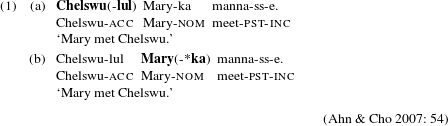
Hong (Reference Hong1994, Reference Hong2004), Y. Kim (Reference Kim1998a, Reference Kimb), Ahn (Reference Ahn, Kim, Kim and Park1999) and Ahn & Cho (Reference Ahn and Cho2006a, Reference Ahn and Chob, Reference Ahn and Cho2007) suggested that unmarked subjects show a more limited distribution than unmarked objects. They observe that an unmarked direct object can appear in a non-canonical, sentence-initial position without resulting in ill-formedness (see (1a)). By contrast, the sentence in which the unmarked subject is in a non-canonical position directly before the verb is judged to be quite unnatural by native speakers (see (1b)):Footnote [3]
Ahn & Cho (Reference Ahn and Cho2006a, Reference Ahn and Chob, Reference Ahn and Cho2007) observed another subject–object asymmetry in case ellipsis that involves the (in)compatibility of unmarked arguments with non-specific modifiers. They claim that unmarked subjects cannot be modified by the non-specific modifiers han/etten ‘a certain’:

By contrast, this restriction does not apply to unmarked objects:

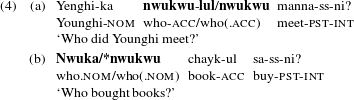
The third case of subject–object asymmetry in case ellipsis is found in the class of Korean ‘wh-words’ such as nwukwu (‘who’) and mwues (‘what’). As observed by Hong (Reference Hong1994), case ellipsis for wh-word objects occurs naturally, whereas case ellipsis for wh-word subjects leads to unacceptable outcomes:
Ahn & Cho (Reference Ahn and Cho2006a, Reference Ahn and Chob, Reference Ahn and Cho2007) also claim that there is an interpretive difference between unmarked subject wh-phrases and object wh-phrases. We will discuss the issue of the interpretation asymmetry between unmarked subject wh-phrases and object wh-phrases in Section 7 below.
In summary, case ellipsis for subjects and objects in Korean exhibits several clear differences in acceptability that have not received a unified explanation. A detailed comparison between patterns of subject and object case ellipsis shows that case ellipsis for subjects in non-canonical, OSV sentences, non-specific subjects and wh-word subjects is unacceptable, whereas case ellipsis for objects with similar properties is acceptable.
3. Syntactic accounts of case ellipsis
Syntactic approaches to case variation in Korean have generally attempted to account for the phenomenon of case ellipsis by positing distinct syntactic properties for case-marked NPs and NPs not marked for case. Two broad classes of analysis are most relevant to the specific subject–object asymmetries in Korean case ellipsis that this article examines. The first class accounts for the possibility of argument case ellipsis by allowing argument NPs to be caseless when they are left-dislocated or when they are part of a syntactic complex predicate. Examples of this class of accounts include those of Ahn (Reference Ahn, Kim, Kim and Park1999), Ahn & Cho (Reference Ahn and Cho2006a, Reference Ahn and Chob, Reference Ahn and Cho2007, Reference Ahn, Cho, Grohmann and Panagiotidis2009) and Hong (Reference Hong1994, Reference Hong2004). The second class attempts to account for the variability in case marking by allowing case ellipsis only when NPs occur in the canonical A(rgument)-position. Examples of this class of accounts are those of Y. Kim (Reference Kim1998a, Reference Kimb) and K. Choi (Reference Choi2005, Reference Choi2007). In this section, we review Ahn & Cho’s account of variable case marking in detail.Footnote [4] We will not discuss the second class of accounts here because in that class of analysis, the realization of case markers for the subject and the object is determined by the same structural conditions, and thus no subject–object asymmetries can be predicted (see K. Choi Reference Choi2005, Reference Choi2007 for a detailed discussion).
Ahn & Cho (Reference Ahn and Cho2006a, Reference Ahn and Chob, Reference Ahn and Cho2007, Reference Ahn, Cho, Grohmann and Panagiotidis2009) offer an account for the three types of subject–object asymmetries in case ellipsis. Their analysis, couched within the structural framework of the Minimalist Program (Chomsky Reference Chomsky1995), rests on the following key assumptions defended in their earlier research:

Ahn & Cho (Reference Ahn and Cho2006a, Reference Ahn and Chob, Reference Ahn and Cho2007, Reference Ahn, Cho, Grohmann and Panagiotidis2009) claim that once the above properties of case-marked and unmarked subjects and objects are recognized, the types of subject–object asymmetries mentioned above can be naturally accounted for. The two key components of their analysis can be summed up as follows:
(i) The unacceptability of OSV sentences with an unmarked subject. The ill-formedness of case ellipsis for the subject NP in (1b) above can be accounted for by the assumption (5a). Under Ahn & Cho’s account, the bare subject NP Mary in (1b) occupies the Spec-T position, not the sentence-initial, Spec-Force position, as shown in (6):

The derivation (6) is predicted to be ill-formed because the bare NP cannot occupy Spec-T, where the formal feature checking of  ${\rm\Phi}$-/D-features is required.
(ii) The incompatibility of an unmarked subject with non-specific modifiers. Ahn & Cho (Reference Ahn and Cho2006a, Reference Ahn and Chob, Reference Ahn and Cho2007) contend that the ill-formedness of (2) above follows from the status of the unmarked subject as a left-dislocated bare NP: (2) is ill-formed because the position of non-specific subjects in Korean, which Ahn & Cho assume as Spec-T, is structurally incompatible with left-dislocated nominals, which occupy Spec-Force.
Although these concrete predictions are impressive, Ahn & Cho’s analysis faces several non-trivial difficulties. First of all, their analysis predicts OSV sentences with an unmarked subject to be ill-formed, but these sentences are acceptable in an appropriate discourse context. Consider the following example:
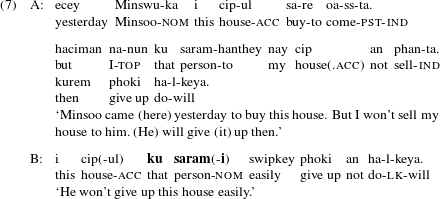
In Korean, the OSV order typically marks the object as prominent information such as topic or contrastive focus, and the subject as new information (H.-W. Choi Reference Choi1999). This is illustrated in B’s utterance in (7) above, where i cip ‘this house’ is the topic, and the object ku saram ‘that person’, referring to Minsoo, is part of the comment (the information that is asserted about the topic).Footnote [7] In this context, unlike in Ahn & Cho’s example (1b), case ellipsis for both the subject and the object is just as felicitous as case marking. Thus, it seems that the source of the unnaturalness that speakers feel regarding example (1b) (with the unmarked subject) is the difficulty involved in having to presuppose a detailed discourse to support the rare use of case ellipsis for the immediately preverbal subject (which tends to be new information), not the syntactically ill-formed derivation associated with it. We return to this point later, in Section 4 below.
A second major problem with Ahn & Cho’s analysis concerns the fact that unmarked subject NPs do not always resist modification by non-specific modifiers. Although it is true that speakers feel that the sentence in (2) is not acceptable if given in isolation, the modification of an unmarked subject by etten ‘a certain’ is natural in a context in which the subject referent is expected in the situation described by the predicate, as illustrated by the following example:
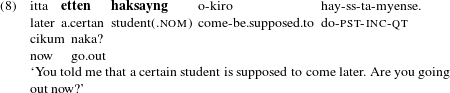
This presents a serious problem for Ahn & Cho’s account, which attempts to explain the problematic example (2) in terms of the bare subject NP’s inability to occupy the Spec-T position, the position for a non-specific subject. It is generally the case that the information structure of a given sentence and the information status of an encoded referent collectively affect the acceptability of case ellipsis for a subject NP. Im (Reference Im2007) observes that the unmarked form is preferred when an NP represents expected or predictable information:
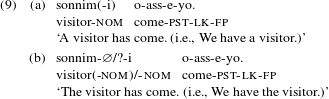
Assuming that both (9a) and (9b) are sentence-focus utterances said by a husband to his wife who has just come home, the information status of sonnim ‘guest, visitor’ may depend on the wife’s knowledge of the visitor. It may be that the wife was expecting a visitor and thus knows who the visitor is (i.e., the (b) utterance). On the other hand, the wife was not expecting anyone and does not know who the visitor is (i.e., the (a) utterance). Whereas both the case-marked and non-case-marked form are acceptable in (a), the unmarked form is the better option in (b). Although sentence-focus calls for case marking, it does not fit predictable information. Thus, the use of - $i$ is less natural in (b) than in (a). This correlation between the high predictability and improved acceptability of the use of case ellipsis casts strong doubt on the claim that the unacceptability of example (2) is due to its syntactic ill-formedness. Instead, it suggests that the possible source of the unacceptability of (2) is the need to presuppose a detailed discourse context that makes the modification of the unmarked subject by etten ‘a certain’ felicitous, namely a context that establishes a predictable relationship between the subject referent and the situation described by the predicate. Ono, Thompson & Suzuki (Reference Ono, Thompson and Suzuki2000) find a similar correlation between information predictability and the (non-)use of nominative case markers in Japanese.
A third problem of Ahn & Cho’s analysis concerns their account of case ellipsis involving wh-phrases. As observed by Hong (Reference Hong1994), case ellipsis for wh-word objects occurs naturally, whereas case ellipsis for wh-word subjects leads to unacceptable outcomes. However, Ahn & Cho’s account is limited to interpretive differences between unmarked subject/dislocated wh-phrases and case-marked wh-phrases/in situ object wh-phrases, and offers no explanation for why case ellipsis on subject/dislocated wh-phrases is dispreferred.
The unacceptability of case ellipsis with unmarked wh-subjects of transitive verbs (see (4) above) is in sharp contrast with the case of wh-subjects of some classes of intransitive verbs. Whereas explicit case marking seems to be the preferred option for encoding the wh-subject of all classes of verbs, case ellipsis is clearly more acceptable for the wh-subject of some classes of unaccusative verbs such as issta ‘exist’, ota ‘come’ and naota ‘come out, come to’ than for that of transitive verbs. This is illustrated in the following example:
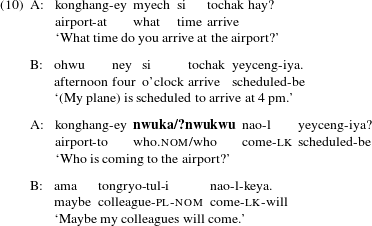
Hong (Reference Hong1994) proposes an account of the acceptability difference between case ellipsis for the unmarked subject of transitive verbs and case ellipsis for that of unaccusative verbs. According to Hong (Reference Hong1994), the argument of unaccusative verbs is base-generated in the complement position, where case ellipsis can be allowed. So, when this type of argument stays in the complement position, this syntactic account predicts that case ellipsis on it can be allowed. In contrast, the subject of transitive verbs is base-generated in the specifier position, where case ellipsis is not allowed.
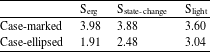
However, this type of analysis cannot handle the gradient pattern of acceptability of case ellipsis for subjects of subtypes of intransitive verbs. H. Lee (Reference Lee2011a) elicited judgments for sentences which contain the case-marked or case-ellipsed form of the focused subject of three subtypes of intransitive verbs: unergative verbs, change of state unaccusative verbs and informationally light unaccusative verbs (verbs of existence/continuous state and verbs of change of location).Footnote [8] The mean judgments for the two forms of each argument role compared in this study are shown in Table 1. As shown in the table, case marking is more acceptable for the subject of change of state verbs than that of informationally light unaccusative verbs, whereas the mean judgments for the case-ellipsed form show the reverse pattern. We can observe that the three subtypes of intransitive subjects all prefer the case-marked form over the case-ellipsed form, but the subject of unergative verbs does so to a greater extent than that of unaccusative verbs.
Average ratings.
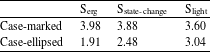
To summarize, we have shown that previous syntactic accounts of case ellipsis are inadequate in accounting for the systematic difference in the degree of acceptability of case ellipsis for subjects of different classes of verbs. In addition, the crucial examples containing an unmarked subject which are predicted to be syntactically ill-formed by their account are acceptable when the subject represents expected, predictable information in context. This presents a serious problem for previous syntactic accounts of case ellipsis and suggests that the explanation of the observed subject–object asymmetries in case ellipsis cannot be a purely syntactic one.
4. Usage probability and subject–object asymmetries in case ellipsis in OSV sentences
In this paper we propose a new usage-based account of variable case marking that can account for the subject–object asymmetries noted in the literature in terms of asymmetries in the usage probability of properties between subjects and objects. In probabilistic models of grammar (Boersma & Hayes Reference Boersma and Hayes2001, Bod, Hay & Jannedy 2003, Bresnan & Ford Reference Bresnan and Ford2010), grammatical constraints are defined in terms of graded preferences, weights or rankings, rather than categorical or discrete levels of grammaticality. These models are well-suited to account for case ellipsis because they can describe syntactic phenomena in terms of grammaticality that emerges from preferences that develop over phrases and constructions. In turn, such preferences can be linked to factors that affect processing difficulty, such as frequency/probability of use, prototypicality, complexity, etc.
Haspelmath (Reference Haspelmath2008: 5) argues that any efficient sign system in which costs correlate with signal length follows the Zipfian principles in (11) (see also Introduction of Bybee & Hopper (Reference Bybee and Hopper2001) and Hawkins (Reference Hawkins2004: 46–47)).

Evidence from syntactic reduction provides support for the pervasive effect of the principles in (11). In a study using a database of spontaneous English, Wasow, Jaeger & Orr (Reference Wasow, Jaeger, Orr, Wiese and Simon2011) found that speakers are less likely to mention the relativizer that in non-subject-extracted relative clauses (e.g., I like the way (that) it vibrates) when the relative clause is predictable (see also Jaeger Reference Jaeger2006). Further evidence comes from the optional that-mentioning in English complement clauses. Jaeger (Reference Jaeger2006) analyzed the same spontaneous database that was employed for the study by Wasow et al. (Reference Wasow, Jaeger, Orr, Wiese and Simon2011) and found that speakers are less likely to mention the complementizer that when the complement clause is predictable.
4.1 A probabilistic account of subject–object asymmetries in case ellipsis in OSV sentences
In this section we will discuss a probability-based account of the subject–object asymmetry in case ellipsis found in non-canonical, OSV sentences presented in H. Lee (Reference Lee2012). We will propose that the acceptability difference between subject and object case ellipsis in non-canonical OSV sentences reflects asymmetries in probabilistic properties of argument NPs. In the following sections, this account is extended to account for other types of subject–object asymmetries in case ellipsis noted in the literature.
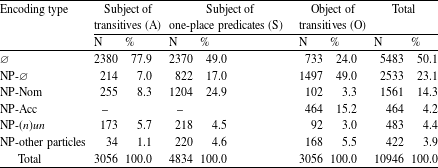
In Korean, SOV is regarded as the canonical order and is also documented to be the most frequent word order. T. Kim (Reference Kim2008) has examined argument realization patterns by analyzing the use of what he calls ‘zero-marking’, nominative and accusative case markers and other particles such as -(n)un, in 9249 clausal units produced by 20 native speakers of Korean. His study found that among the various patterns of word order observed in conversational Korean, OV (51.95%), SOV (19.37%), V (19.23%) and SV (6.42%) are the most common patterns. The dominance of the OV pattern, which involves subject ellipsis and overtly realized object NPs, is due to asymmetries in the probabilistic patterns of the use of subjects and objects. The dominance of subject ellipsis appears to be borne out in a number of quantitative studies of argument ellipsis in Japanese and Korean (Hinds Reference Hinds and Givón1983, Shibamoto Reference Shibamoto, Miyagawa and Kitagawa1984, Nariyama Reference Nariyama2000, Fry Reference Fry2001, M. Kim Reference Kim2001, T. Kim Reference Kim2008) and is also supported by H. Lee’s (Reference Lee2010b) study, in which we examined the encoding and the information status of referents in three grammatical roles (the subject of transitive predicates (A), the subject of one-place predicates (S), and the object of transitive predicates (O)) in conversational Korean Table 2 below shows all argument types in terms of encoding and argument types. In terms of argument type, the subject of one-place predicates is by far the most frequent argument type (4384 tokens; 44.2% of the total). In terms of the encoding type, argument ellipsis is most frequent (5483 tokens; 50.1% of the total), followed by particle ellipsis (2533 tokens; 23.1% of the total). In other words, the encoding types which are more or less attenuated in form are by far dominant over the three explicit encoding types; the two types of ellipsis add up to 73.2% of the total.
All argument tokens by encoding and argument types.
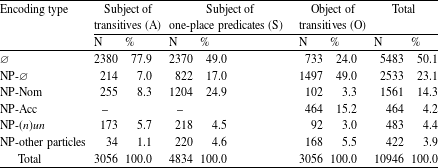
We also observe that there is asymmetry in the token frequency of argument ellipsis in terms of argument types: it is most frequent with the subject of transitive predicates than with other two types. Transitive subjects exhibit an ellipsis rate that is almost 30% higher than that of the subjects of one-place predicates and almost 54% higher than that of direct objects. This pattern is consistent with previous observations that argument ellipsis in Japanese and Korean is most commonly associated with transitive subjects (Fry Reference Fry2001, M. Kim Reference Kim2001, Shimojo Reference Shimojo2005, T. Kim Reference Kim2008, Ueno & Polinsky Reference Ueno and Polinsky2009). On the other hand, the majority of direct objects (76%) are overtly expressed. In terms of the token frequency of encoding type, particle ellipsis is the most frequent encoding type for direct objects (49%), followed by argument ellipsis (24%) and explicit case marking (18.5%).
T. Kim’s (Reference Kim2008) study also found that OSV occurs very rarely (1.92% of 3692 tokens of transitive clauses). This order typically marks the object as prominent information such as topic or contrastive focus, and the subject as new information (H.-W. Choi Reference Choi1999). The correlation between the OSV order and the new subject can lead to a particular bias toward the form of the subject NP. Crosslinguistically and also in Korean, focus is more frequently associated with objects than subjects in transitive clauses. Because focus is a rare and unexpected property for subjects, they are expected to show a strong overall preference for explicit case marking over case ellipsis. The rarity of new information subjects in Korean is supported by empirical data from H. Lee (Reference Lee2010b). This study found a clear asymmetry between the subject (A and S) and the object (O) in their accommodation of new information. New mentions tend to go into the O role (54.8%). The A slot shows the smallest proportion of new mentions (8.7%), whereas the S slot shows a higher proportion (36.5%) (see also T. Kim Reference Kim2008).
Because newness is a rare and unexpected property for the subject, the current probability-based account predicts that the case-marked form to be preferred over the unmarked form as the suitable form for this less probable subject type, i.e., new information subject. This explains why case ellipsis for focus subject in (12B) is not acceptable. In B’s utterance in (12), there is a clear preference for case marking for the subject.
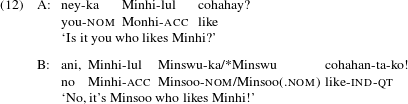
The acceptability of (1a), repeated here as (13), can be explained similarly.

Case marking on the sentence-initial object is motivated by the fact that objecthood is less likely in sentence-initial position than in the immediately preverbal position. However, the unmarked object form is not ruled out because it is compatible with the probabilistic property of the OSV order (i.e., marking the object as given) and with the general information status of elements occurring sentence-initial position (i.e., high predictability and low information content).
Our probability-based account further predicts that the sentence in (1b) (with the unmarked subject), although unacceptable out of context, is judged natural by speakers when the predictability of the subject referent increases. One such case is when the subject has a higher degree of givenness as in (7), repeated here as (14).
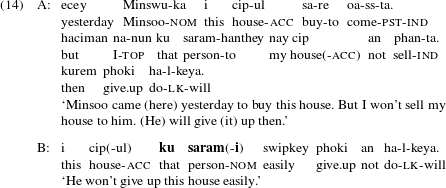
In B’s utterance in (14), the referent of i cip ‘this house’ is the topic of the sentence, and the referent of ku saram ‘that person’, Minsoo, is part of the relationally new information predicated about the topic, as indicated by its occurrence in the immediately preverbal position. However, it is referentially given by virtue of having been previously mentioned in context, i.e., in A’s utterance. The referential givenness of the subject referent contributes to higher referential predictability (Jaeger Reference Jaeger2006), and the increased predictability may in turn increase preference for the unmarked subject form. In this case, both case ellipsis and case marking with respect to the subject is felicitous: while the relational newness of the subject referent favors the use of case marking, the use of case ellipsis for the subject in (14B) is also felicitous because of the increased predictability of the subject referent.
Using case markers to mark less probable phrases has been argued to have a processing advantage (Jaeger Reference Jaeger2010): when speakers use case markers to mark less probable phrases, they can buy more time to produce syntactic elements that are difficult to process and spread information on the phrase’s grammatical and discourse function over a longer time, thereby leading to more uniform information density compared to leaving it unmarked. Thus, from the perspective of usage probability, the presence of case markers can be interpreted as a signal to expect the unexpected, a rational exchange of time for reduced information density or a meaningful delay.
The sentence processor’s preference to uniformly distribute information across linguistic signals for increased processing efficiency (by using an extra morpheme or word to mark less probable phrases) is likely to have been grammaticalized as probabilistic linguistic constraints that penalize zero marking for rare types of subject (e.g., new subjects, focused subjects, subjects occurring in the non-initial position following the object, etc.). Violations of such constraints, unlike violations of core syntactic principles, give rise to mild unacceptability and can be remedied by non-syntactic information. This explains why referential predictability improves the acceptability of case ellipsis for rare types of subjects. The predictability condition on acceptable case ellipsis may be an important component of the recoverability condition on ellipsis phenomena in general, and thus it is not surprising that satisfying it improves the acceptability of unacceptable case ellipsis induced by violations of the probabilistic constraints that penalize zero marking for rare subject types.
This view of case marking can also account for the fact that in general, subject case ellipsis occurs less frequently and is also less acceptable than object case ellipsis (T. Kim Reference Kim2008, H. Lee Reference Lee2010a). Given the high frequency of overt realization of object NPs and the rarity of overt realization of subject NPs, it is not surprising that case ellipsis is more acceptable for the more frequent type of explicit NPs, i.e., overt objects, whereas case marking is more acceptable for the rare type of explicit NPs, i.e., overt subjects.
A similar explanation is possible for the acceptability contrast between (1a) and (1b). As noted above, the subject in OSV sentences can be considered more marked than the object. It is doubly marked due to its association with two rare properties for subject, i.e., overt realization and non-canonical syntactic position, whereas the object in OSV sentences is associated with only one property unexpected for object, i.e., non-canonical syntactic position. Thus, case marking is more strongly enforced for the subject than for the object, and this explains why case ellipsis for the subject in OSV sentences is not acceptable out of context.
4.2 Experimental evidence
In H. Lee (Reference Lee2012), we investigated the effects of the degree of the subject referent’s predictability in context on the acceptability of case ellipsis for the subject through a rating experiment that elicited speakers’ judgments on the acceptability of OSV sentences containing the case-marked or unmarked form of a transitive subject.
Sixty undergraduate students at Korea University and Sungkyunkwan University in Seoul participated in this experiment. Each participant was asked to read short conversations between speakers and indicate to what degree the two subject forms were suitable in the given context. To do this, they had to rate the acceptability of sentences containing a case-marked or unmarked subject by assigning them a grade from 1 to 5 on a five-point rating scale (1 = completely unacceptable, 5 = perfectly acceptable).
The predictability of the subject in OSV sentences was manipulated by means of variation in context sentences (sentences uttered by the first speaker). In the high predictability condition, the referent of the subject in the target OSV sentences is referentially given, i.e., introduced in the previous speaker’s utterance. On the other hand, in the low predictability condition, the subject in the target OSV sentences is not only new to the discourse but also functions as a contrastive focus or an informational focus. Consistently with the typical information structure of OSV sentences, in both conditions, the referent of the object in the target OSV sentences is the topic of the sentence, and the referent of the subject is relationally new by virtue of being part of the comment predicated about the topic (the high predictability condition) or by virtue of being in focus (the low predictability condition). To keep the influence of factors other than predictability of the subject referent in the target sentences to a minimum, we included only definite subjects and objects as the head of subject and object NPs. The following three kinds of definite subjects were included in our stimuli: pronouns, names and definite descriptions.Footnote [9]
We found a significant main effect of subject predictability ( $F$1(1,118) = 26.88,
 $p$ = .00001;
 $F$2(1,38) = 5.69,
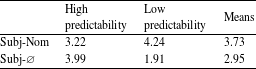
 $p$ = .022). As shown in Table 3, the mean judgments for case-marked subjects in the OSV sentences were higher in the low predictability condition than in the high predictability condition, whereas the pattern of the mean judgments for unmarked subjects was reversed. This confirms our major prediction tested in this experiment that whereas case marking is more acceptable in the low predictability condition than in the high predictability condition, case ellipsis is more acceptable in the high predictability condition than in the low predictability condition. However, the acceptability of the OSV sentences with the unmarked form of the high predictability subject counters the predictions of purely syntactic accounts (e.g., Ahn & Cho Reference Ahn and Cho2006a, Reference Ahn and Chob, Reference Ahn and Cho2007) because such accounts predict OSV sentences with an unmarked subject to be syntactically ill-formed.
Mean judgments for subjects in OSV sentences.
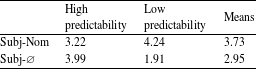
Also noteworthy is the observation that whereas only the case-marked subject form is judged acceptable in the low predictability condition, both forms are judged acceptable showing acceptability values higher than 3 in the high predictability condition. This is expected under the current account: As discussed in Section 4.1 above, case marking is felicitous because the (relational) newness of the subject referent favors the use of case marking. Use of case ellipsis for the subject in OSV sentences is also expected to be felicitous because it matches the increased expectancy of the reduced form in the high predictability condition. However, the acceptability of both forms in the high predictability condition contrasts directly with the predictions of Ahn & Cho’s (Reference Ahn and Cho2006a, Reference Ahn and Chob, Reference Ahn and Cho2007) syntactic account because on their account, OSV sentences with an unmarked subject are predicted to be syntactically ill-formed.
We also found a significant interaction between subject form and subject predictability ( $F$1(1,118) = 214.78,
 $p$ = .0001;
 $F$2(1,38) = 75.49,
 $p$ = .0001). As shown in Table 1 above, the subjects’ scores of the acceptability of OSV sentences containing the unmarked subject increase from the low predictability condition to the high predictability condition, whereas the acceptability of sentences containing the case-marked subject shows the opposite pattern. Thus, the results of this analysis indicate that the degree of the acceptability of case ellipsis for the subject in OSV sentences is correlated positively with the degree of subject predictability, whereas the degree of the acceptability of case marking for the subject in OSV sentences is correlated negatively with the degree of subject predictability.
Overall, our results clearly indicated that speakers’ judgments of OSV sentences with a case-marked or unmarked subject are sensitive to the degree of the predictability of the subject referent in context. The fact that the OSV sentences containing an unmarked subject were judged not only acceptable but also more acceptable than those with a case-marked subject in the high predictability condition provides strong support for the view advocated here that speakers’ judgments of acceptability are affected by the satisfaction or violation of probabilistic expectations about form reduction and predictability.
If an argument is more acceptable without case when its referent is more predictable, then we would expect to find similar patterns in production. To see if the predictability effect found in the rating experiment affects speakers’ production of subject form as well, a production experiment could be designed so that participants are instructed to read or listen to short conversations between two speakers and to insert the case marker for the subject in the target OSV sentences when they feel necessary. Our probability-based account of variable case marking would predict the followings: (i) case ellipsis applies more frequently to the subject in OSV sentences in the high predictability condition than to that in the low predictability condition, whereas the frequency pattern of case marking is reversed, and (ii) in the high predictability condition, the unmarked subject is more frequent than the case-marked subject; conversely, in the low predictability condition, the subject in OSV sentences occurs more frequently with a following case marker than without a case marker. Whether these predictions hold true is an empirical question that remains for future research.
5. Formalizing probabilistic constraint interaction
This section shows that probabilistic information about the properties of argument NPs can be incorporated into the grammar in the form of violable constraints on the morphological expression of case in Optimality Theory (OT; Prince & Smolensky Reference Prince and Smolensky2004). We will provide a probabilistic extension of Aissen’s (Reference Aissen2003) standard OT model for case marking, whose leading idea is that marked associations between animacy/definiteness and grammatical roles are penalized by natural language grammars.
5.1 Categorical differential case marking in OT
It is well-known that the case marking in different classes of nominals is often differentiated according to the hierarchies of animacy and definiteness, where the cut-off point is taken to vary from language to language:
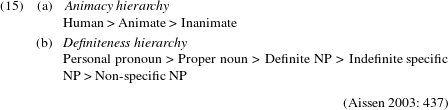
Following Bossong (Reference Bossong1985), Aissen (Reference Aissen2003) refers to splits in subject and object case marking as differential subject marking (DSM) and differential object marking (DOM), respectively. Here we briefly review her OT account of DOM.
The basic generalization is: if a given object O can be case-marked in language A, then objects which are more prominent than O on one or both of the hierarchies in (15) can also be case-marked. Aissen (Reference Aissen2003) formalizes this generalization using markedness constraints resulting from the operation of harmonic alignmentFootnote [10] in conjunction with iconicity and economy constraints pertaining to case. The constraint hierarchies which form the basis for her analysis of animacy-sensitive DOM are given in (16) (‘ $\gg$’ means ‘ranked higher than’):

The high-ranking constraints in (16a, b) penalize inanimate subjects and human objects, respectively. Crucially, constraint hierarchies derived by harmonic alignment, including (16a, b), are universal subhierarchies, which are hypothesized to be present in every grammar in the same relative order and must be interleaved with other constraints.
In DSM/DOM languages, marked configurations like those penalized by the high-ranking constraints in (16a, b) are marked or flagged as atypical but not excluded entirely. Aissen (Reference Aissen2003) implements this flagging by the formal operation of constraint conjunction. Conjunction of the iconicity constraint *Zeroc (‘Avoid null expression of case feature’) with the subhierarchies in (16) results in two new subhierarchies of iconicity constraints, which have the effect of favoring case marking:

The subhierarchy in (17a) penalizes null expression of case feature for an inanimate-referring subject over null expression of case feature for an animate- or human-referring subject. The subhierarchy in (17b) penalizes null expression of case feature for a human-referring object over null expression of case feature for an animate- or inanimate-referring object. These hierarchies logically entail implicational universals. That is, they predict that if a human-referring subject is case-marked, inanimate or non-human subjects must also be case-marked; and if an inanimate-referring object is case-marked, so must human or non-human animate objects be case-marked. The effects of the subhierarchy in (17a) can be clearly seen in a DSM system like that of the Fore language, where only inanimate subjects must be case-marked while case marking of animate subjects is possible but not obligatory, and human subjects are rarely marked (Scott Reference Scott1978). A wide typological range of object marking splits is also surveyed in Aissen (Reference Aissen2003). Her survey includes DOM systems which are predicted by interactions of iconicity constraints including those in (17) and the economy constraint in (18). See Aissen (Reference Aissen2003) for a detailed discussion.

One limitation arising from OT’s architectural decisions is the predicted absence of variation and gradiency of grammatical judgment. The standard OT grammar is deterministic, in the sense that each input is mapped onto a single output. This is tenable in some areas of linguistics, but it goes against widespread variation in the use of language. How can variation be reconciled with the deterministic nature of grammar? An alternative that is being actively pursued in the literature, is to replace the strict ranking system with a stochastic evaluation system in which constraints are weighted numerically, and in which these numerical weights have uncertainty (Stochastic OT).
St(ochastic)OT, pioneered by Boersma (Reference Boersma1998), is one of a family of probabilistic OT frameworks that can provide a unified account of categorical and variable data (see Boersma & Hayes Reference Boersma and Hayes2001 for reviews). It differs from standard OT in that it presupposes a continuous scale of constraint rankings rather than a discrete ordinal scale. That is, constraints are not simply ordered, but they have a value on the continuous scale of real numbers. Hence, constraints differ not only in dominance but in distance. Also, in StOT evaluation is stochastic. At each evaluation the value of each constraint is perturbed by temporarily adding to its ranking value random noise drawn from a normal distribution. The value permanently associated with a constraint is called a ranking value while a constraint’s value in any given evaluation is called the selection point. For example, a constraint with the mean rank of 99 (ranking value) could be evaluated at 98.12 or 100.3 (selection point). It is the constraint ranking that results from these new disharmonic values that is used in evaluation. The rank a constraint has in the grammar is the mean of a normal distribution or ‘bell curve’ of these variant values that it has when applied in evaluations; this is illustrated in Figure 1 above.Footnote [11]
Constraint ranking on a continuous scale with stochastic evaluation.
As explained by Boersma & Hayes (Reference Boersma and Hayes2001), an OT grammar with stochastic evaluation can generate both categorical and variable outputs. Categorical outputs arise when crucially ranked constraints are spread far apart on the continuous scale, so that the stochastic variation in ranking values has no discernable effect. In Figure 2 above, for example,  $\text{C}_{\text{1}}\gg \text{C}_{\text{2}}$ and the two constraints are spread apart far enough for the bulk of their ranges of variation (illustrated in a simplified way by the ovals) not to overlap.Footnote [12]
Categorical constraint ranking with ranges of variation.
Variable outputs arise when crucially ranked constraints are close enough together for the variation in their ranking values to interact with some observable frequency. This possibility is illustrated in Figure 3 below, where most of the ranges of variation of two constraints overlap. Here again  $\text{C}_{\text{1}}\gg \text{C}_{\text{2}}$, but with some discernable frequency during stochastic evaluation
 $\text{C}_{\text{1}}$ be ranked at a point in its lower range, called
 $\text{C}_{\text{1}}$, while
 $\text{C}_{\text{2}}$ is simultaneously ranked at a point c
 $_{\text{2}}$ in its higher range. As shown in Figure 4,
 $\text{C}_{\text{2}}$ will then temporarily dominate
 $\text{C}_{\text{1}}$ in selecting the optimal output, possibly producing a different output.
Free constraint ranking with ranges of variation.
Reversal of constraint dominance.
Boersma & Hayes (Reference Boersma and Hayes2001) exemplify StOT with various empirical test cases of phonological variation, and recently it has been increasingly applied to the study of syntactic variation as well (see Bresnan, Dingare & Manning Reference Bresnan, Dingare, Manning, Butt and Holloway King2001, Clark Reference Clark2004, H. Lee Reference Lee2006b, Bresnan, Deo & Sharma Reference Bresnan, Deo and Sharma2007, Bresnan & Nikitina Reference Bresnan, Nikitina, Uyechi and Wee2009, among others). Below, I will illustrate how the StOT model can be used to analyze patterns of subject–object asymmetries in Korean case ellipsis. The StOT analysis throughout incorporates Aissen’s (Reference Aissen2003) economy constraint and the subhierarchy of iconicity constraints which penalize null expression of case for an explicit transitive subject over null expression of case for an overtly realized intransitive subject or object.
5.2 Case ellipsis asymmetries in Stochastic OT
The relevant constraint subhierarchy can be derived by conjunction of the iconicity constraint *ZEROc with the subhierarchy in (19).

The resulting subhierarchy in (20) has the effect of favoring case marking for a more rare type of overtly realized argument.Footnote [13]

In StOT the variable rankings of the iconicity constraints (20) and the economy constraint *STRUCc produced by noisy evaluation will lead to reversals of constraint ranking at a frequency which is a function of the distance between the constraints on the continuous ranking scale. Given variable ranking normally distributed around a mean, the closer together the constraints are, the more the ranking reversals, and the more variable the outputs. For example, the close ranking distance between *O/Overt & *ZEROc and *STRUCc would yield the alternative outputs (case-marked and non-case-marked objects) through frequent constraint dominance reversal under stochastic evaluation.
Variable ranking between the iconicity constraints and the economy constraint.
As shown in Figure 5 above, the ranking distance between *S/Overt & *ZEROc and *STRUCc is greater, but variable outputs can arise because the two constraints are close enough together (less than 10 units) for the variation in their ranking values. The chance that *STRUCc dominates *A/Overt & *ZEROc becomes rarer as the distance between these constraints is greater. Thus, this ranking would yield the case-marked form of an explicit transitive subject as the optimal output in most evaluations. In this way the StOT account of variable case marking effectively captures the gradient pattern of case ellipsis asymmetry between argument roles.
Hong (Reference Hong1994) observes the subject–object asymmetry in Korean case ellipsis not only at the clause level but also at the noun phrase level. The following is an example of the subject–object asymmetry within the noun phrase:Footnote [14]

The StOT account of the general subject–object asymmetry in case ellipsis presented here can be extended naturally to the specifier–complement asymmetry at the noun phrase level. The relevant constraint subhierarchy can be derived by conjunction of the iconicity constraint *ZEROc with the subhierarchy in (22).

The resulting subhierarchy in (23) has the effect of favoring case marking more strongly for an overtly realized NP in the specifier position than for an overtly realized NP in the complement position.

The specifier–complement asymmetry in case ellipsis in the nominal domain can be described by the ranking in Figure 6, where *Spec/Overt & *ZEROc dominates *Compl/Overt & *ZEROc, which in turn dominates *STRUCc.
Constraint ranking yielding the specifier–complement asymmetry.
The close ranking distance between *Compl/Overt & *ZEROc and *STRUCc would yield the alternative outputs (case-marked and unmarked arguments in the complement position) through frequent constraint dominance reversal under stochastic evaluation. The ranking distance between *Spec/Overt & *ZEROc and *STRUCc is greater, so the chance that *STRUCc dominates *Spec/Overt & *ZEROc becomes rarer. Thus, this ranking would yield the case-marked form of an explicit NP in the specifier position as the optimal output in most evaluations. In this way, the StOT account of variable case marking accounts for the specifier–complement asymmetry in case ellipsis in the nominal domain in a way analogous to the account of the subject–object asymmetry in case ellipsis in the clause level.
5.3 Modeling predictability effects on case ellipsis for subject in OSV sentences
This section presents an OT account of the predictability effect on subject case ellipsis observed in the experiment reported in Section 4.2. As noted in Section 4.2, whereas only the case-marked subject form is judged acceptable and the unmarked form is judged mildly unacceptable in the low predictability condition, both forms are judged acceptable in the high predictability condition.
Preference for the reduced form in the high predictability condition can be captured in terms of the following positive markedness constraint, adapted from Bresnan (Reference Bresnan and Siegel2000):

The constraint in (24) is violated when a nominal referring to predictable information is not reduced, i.e., when it is not zero-pronominalized or unmarked. This constraint is ranked with respect to *STRUCc and other markedness constraints that penalize marked structures:

We propose the following ranking of the constraints in Korean (the comma indicates that there is no crucial ranking between the constraints separated by it):

Crucially, the higher ranking of *Subj/Foc & *ZEROc over *STRUCc has the effect of strongly enforcing case marking of focused subjects (i.e., more strongly than for non-initial subjects and overt subjects). However, when the subject refers to non-focused information that is predictable, Red/Pred will take effect, leading to case ellipsis for the subject.
Now, suppose that the subject of a transitive verb is focus and the object is topic. This results in the optimal output OSNOMV, going through the constraint competition in Tableau 1. (Constraint evaluations which have no effect in determining the outcome are shaded.) For simplicity, we consider only subject form in OSV candidates. SOV structures, which are felicitous in the context we consider here, are omitted in the tableaux. A fuller account of argument realization, however, will need to take into account interactions of word order constraints and constraints on argument form.

Due to the high-ranking constraint *Subj/Foc & *ZEROc, OSNOMV is selected as the optimal output. This candidate (case-marked form) wins over the other candidate (unmarked form) OS–ØV because the former does not violate the highest constraint *Subj/Foc & *ZEROc, which the latter does, although the former violates the lower-ranked constraint *STRUCc.
Now, let’s consider a context in which the subject of a transitive verb refers to predictable information and the object is topic. In this context, however, case ellipsis for the subject becomes optimal under the same ranking, as illustrated in Tableau 2.

The top-ranked constraint takes no effect here because the subject is not focus, so the decision is passed down to the Red/Pred. As shown in Tableau 2, OS–ØV is the best; it satisfies more higher-ranking constraints than the other candidate.
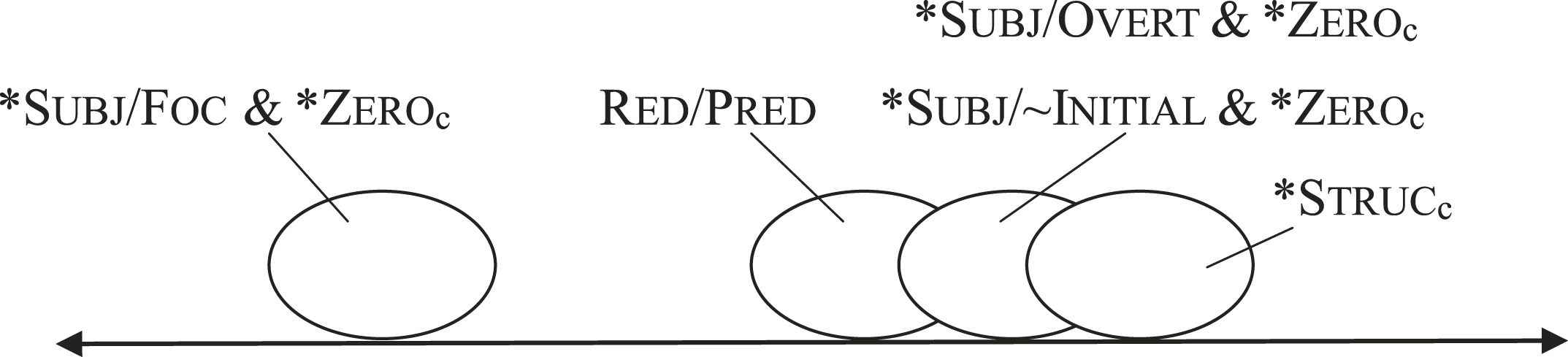
An OT grammar with stochastic evaluation can generate both categorical and variable outputs. Thus we can easily incorporate variation into our model by assuming stochastic evaluation of the constraints in (26) above ranked on a continuous scale. See Figure 7.
Constraint ranking yielding variable case marking.
The constraint Red/Pred favors case ellipsis for nominals referring to predictable information, but it is close enough to the constraints *Subj/Overt & *ZEROc and *Subj/ ${\sim}$Initial & *ZEROc favoring case marking to allow discernable variation. When ranking reversal occurs, as shown in Tableau 3, an alternative output occurs.

In sum, OT grammar with stochastic evaluation provides a unifying formal account for (i) the general subject–object asymmetry in case ellipsis, (ii) the subject–object asymmetry in the clausal and NP levels, and (iii) the predictability effects on subject case ellipsis in OSV sentences in terms of the same system of iconicity and economy constraints.
6. Non-specificity and subject–object asymmetries in case ellipsis
6.1 A probability-based account of subject–object asymmetries in case ellipsis
The second subject–object asymmetry which Ahn & Cho (Reference Ahn and Cho2006a, Reference Ahn and Chob, Reference Ahn and Cho2007) observe concerns the (in)compatibility of non-case-marked arguments with non-specific modifiers. They claim that subjects modified by the non-specific modifiers han/etten ‘a certain’ cannot be left unmarked. By contrast, such a restriction is not observed in the case of non-case-marked objects. As discussed in Section 3 above, Ahn & Cho (Reference Ahn and Cho2006a, Reference Ahn and Chob, Reference Ahn and Cho2007) attempt to account for this contrast by positing distinct positions for case-marked and non-case-marked subjects, while allowing a case-marked object to be an optional counterpart of a non-case-marked object. Their analysis accounts for the ill-formedness of (2) (repeated here as (27)) in terms of the structural incompatibility of the non-specific subject, which occupies the Spec-T position with a non-case-marked subject, which is treated as a left-dislocated, bare NP occupying the sentence-initial, Spec-F position.

Their analysis further predicts the well-formedness of (3) (repeated here as (28)) because case-marked and non-case-marked objects can be licensed in one and the same VP-internal position, a position that Ahn & Cho assume to be the position for an unmoved, non-specific object.Footnote [15]

A problem for this account is the fact that modification of a non-case-marked subject with etten ‘a certain’ is natural in a context in which the referent of the non-specific subject is expected in the situation described by the predicate. This is illustrated in example (29):
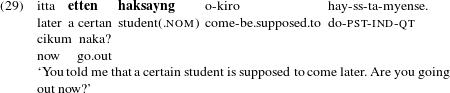
Thus, the correct generalization about the encoding of a non-specific subject seems to be that a non-specific subject modified by etten ‘a certain’ cannot be unmarked unless it represents expected, predictable information in its context rather than that the modification of a non-case-marked subject with etten is always disallowed.
The probability-based account of case ellipsis proposed here captures this generalization with no difficulty. It predicts that speakers prefer case marking on non-specific subjects because non-specificity is not a property typically expected for subjects; subjects are more frequently specific and definite than non-specific (and hence indefinite; for supporting evidence, see H. Lee Reference Lee2006b, Reference Lee2007 and T. Kim Reference Kim2008). It further predicts that sharedness of information between the speaker and the hearer will affect speakers’ choice of the form of non-specific subjects: sharedness of the content of an utterance reduces informativeness of the utterance. Thus, speakers are more likely to omit case markers when the relationship between the subject referent and the situation described by the predicate is known to the speaker and the hearer than when it is not. Regarding differences between non-specific subjects and objects, our account predicts that case markers on non-specific objects are more frequently omitted without contextual support than those on non-specific subjects because non-specificity is more frequently associated with objects than with subjects.
On the current probability-based account, the asymmetry in the acceptability of case ellipsis for non-specific subjects and objects can be accounted for as part of the larger phenomenon of definiteness effects on variable case marking. Non-specific NPs are the lowest-ranked element of the definiteness hierarchy (30). As such, non-specificity is the property that is least expected for subjects, which tend to be associated with higher-ranking elements of the definiteness hierarchy (Aissen Reference Aissen2003). Hence, non-specific subjects are more likely to take overt case marking than subjects associated with higher-ranking elements of the definiteness hierarchy (for supporting evidence, see H. Lee Reference Lee2006a, Reference Leeb, Reference Lee2007).

A further advantage of this probability-based account is that it is able to capture the animacy and definiteness effects on variable case marking in a unified way. Previous studies that examined the animacy and definiteness effects on variable case marking in Japanese and Korean have shown that these effects are similar enough to warrant a unifying analysis: as shown by Fry (Reference Fry2001), H. Lee (Reference Lee2006b, Reference Lee2007) and T. Kim (Reference Kim2008), the relative frequency of unmarked forms compared with case-marked forms increases with more probable argument types (high-prominence subjects and low-prominence objects in animacy and definiteness), and decreases with less probable argument types (low-prominence subjects and high-prominence objects). The observed correlation between the high probability of an argument’s grammatical function and case ellipsis follows the predictions of the current probability-based account but remains unexplained in purely syntactic accounts (e.g., Ahn & Cho Reference Ahn and Cho2006a, Reference Ahn and Chob, Reference Ahn and Cho2007).
6.2 Experimental evidence
6.2.1 Hypotheses and predictions
In the experiment presented in this section, we elicited speakers’ judgments on the acceptability of sentences containing the case-marked or unmarked form of a non-specific subject to investigate whether and how the sharedness of the relationship between the subject referent and the situation described by the predicate between the speaker and the hearer influences the degree of the acceptability of sentences containing the case-marked or unmarked form of the non-specific subject. Based on the above-noted sensitivity of the acceptability of the form of non-specific subjects to the information status of the utterance, we hypothesize that the sharedness of the subject–predicate relationship between the speaker and the hearer improves the felicity of the use of case ellipsis for non-specific subjects. Thus, case ellipsis for non-specific subjects should be more acceptable when the relationship between the subject referent and the situation described by the predicate is known to the speaker and the hearer than when it is not, whereas the pattern of the acceptability of case marking is reversed. However, if the previously observed unacceptability of case ellipsis for non-specific subjects is due to a structural violation, we do not expect sharedness to have any effect on the acceptability of sentences containing a non-specific subject.
6.2.2 Method
The method for this experiment was a rating questionnaire that elicited offline judgments about acceptability. Although acceptability judgments would probably not reflect actual performance in the same way as naturally occurring data would, the acceptability judgment task was chosen for the following reasons. First, given that the type of sentences that we are of interest in this study, i.e., sentences with a non-specific subject, are not highly frequent in either written or spoken Korean, it was considered necessary to use elicitation tasks, for it was unpredictable to what extent data collection methods that use naturally occurring data such as authentic spontaneous discourse would provide data rich enough for the present purposes. Second, the acceptability judgment task was used because it was considered very important to tightly control contexts and factors that are known to affect the frequency of case ellipsis in an experimental setting. Third, the acceptability judgment task was considered better-suited than the forced-choice method we used in H. Lee (Reference Lee2011b) to examine the relative goodness of sentences that involve very subtle judgments. The major advantage that the rating task has over the forced-choice method, where participants are asked to make a dichotomous choice is that it provides more sensitive and precise information about the relative goodness of sentences. The forced-choice method is more likely to exaggerate or distort possible differences in the relative goodness of sentences.
Sixty undergraduate students at Korea University and Sungkyunkwan University in Seoul participated in this experiment. Of these, 34 subjects were male and 26 were female; the age of the subjects ranged from 20 to 26 years and the mean age was 22.7 years. Each participant was asked to read short conversations between two speakers and indicate to what degree the two subject forms were suitable in the given context. To do this, they had to rate the acceptability of sentences containing a case-marked or unmarked subject by assigning them a grade from 1 to 5 on a five-point rating scale (1 = completely unacceptable, 5 = perfectly acceptable).
The sharedness of the relationship between the subject and the predicate was manipulated by means of variation in sentences preceding the conversation that establish the context and/or in variation in sentences in the second speaker’s utterance. In the known relationship condition, both the context sentence and the speakers’ utterances were used to make it clear that the second speaker knows about what the first speaker mentions about the referent of the subject. In the unknown relationship condition, the second speaker’s utterance indicated that he or she does not know about what the first speaker mentions about the referent of the subject. In both conditions, the non-specificity of the subject in the target sentence (the first speaker’s utterance) was indicated in the context sentence by using descriptions like ‘both A and B do not know who XXX (the subject referent) is’. Following Groenendijk & Stokhof (Reference Groenendijk, Stokhof and Heny1980) and Kagan (Reference Kagan2006), we assume that identifiability by the speaker is a crucial component of specificity. Thus, the referent of a specific NP is identifiable to the speaker, whereas the referent of a non-specific NP is not.Footnote [16] A sample stimulus translated into English is shown in Appendix A. Examples of experimental items are given in Appendix B.
To keep the influence of factors other than sharedness in the target sentences to a minimum, we have further controlled the items in the questionnaire in the following way:
There were 40 items per each predictability condition, and there were two versions of the target sentences of each item: one version contained a case-marked subject and the other version an unmarked subject. These 80 items were combined with 80 fillers belonging to another experiment. The stimuli and fillers were combined in three different orders for each list, to avoid ordering effect.
Thus, the experiment followed a 2 × 2 design, where the factors were (i) the sharedness of the subject–predicate relationship (known vs. unknown), and (ii) subject form (case-marked vs. non-case-marked). The two versions of the target sentences (e.g., A-1 and A-2 in Appendix A) were presented in a factorial design so that half the participants saw 40 stimuli with a case-marked subject, and half saw 40 stimuli with an unmarked subject.
6.2.3 Results and discussion
The ratings for each participant were submitted to analyses of variance (ANOVA) with participants ( $F$1) and experimental items (
 $F$2) as random factors and with as sharedness and subject form as factors. The results of the ANOVA showed that the effect of sharedness was significant in both the subject analysis and the item analysis (
 $F$1(1,118) = 4.10,
 $p$ = .028;
 $F$2(1,38) = 4.11,
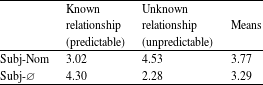
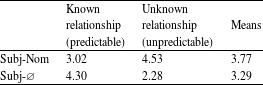
 $p$ = .050). As shown in Table 2 above, the mean judgments for case-marked non-specific subjects in the target sentences were higher in the unknown relationship condition than in the known relationship condition, whereas the pattern of the mean judgments for unmarked non-specific subjects was reversed. This result is consistent with the predictions of our account but is unexplained under purely syntactic accounts of variable case marking (e.g., Ahn & Cho Reference Ahn and Cho2006a, Reference Ahn and Chob, Reference Ahn and Cho2007). If sentences containing an unmarked non-specific subject modified by etten ‘a certain’ were unacceptable for syntactic reasons, the acceptability of those sentences ought not to be influenced by the manipulation of the sharedness of the relationship between the subject referent and predicate between the speaker and the hearer.
Another result of the current experiment that contrasts directly with the predictions of Ahn & Cho’s syntactic account is the participants’ judgments of case ellipsis for non-specific subjects in the known relationship condition. Although sentences with an unmarked non-specific subject modified by etten ‘a certain’ are predicted to be syntactically ill-formed by Ahn & Cho’s account, our results show that those sentences were judged acceptable by the participants, showing acceptability values higher than 3 (4.30) in the known relationship condition.
Mean judgments for sentences containing a non-specific subject.
The results of the ANOVA also indicate a significant main effect of subject form ( $F$1(1,118) = 19.25,
 $p$ = .0001;
 $F$2(1,38) = 8.91,
 $p$ = .00001). As shown in Table 4 above, in the known relationship condition, the mean judgments for unmarked non-specific subjects were significantly higher than those for case-marked subject. By contrast, in the unknown relationship condition, case-marked non-specific subjects showed higher acceptability values than unmarked subjects.
We also found a significant interaction between subject form and sharedness ( $F$1(1,118) = 256.79,
 $p$ = .0001;
 $F$2(1,38) = 58.89,
 $p$ = .00001). As shown in Table 4, the subjects’ scores of the acceptability of sentences containing the unmarked form of the non-specific subject modified by etten increase from the unknown relationship condition to the known relationship condition, whereas the acceptability of sentences containing the case-marked counterpart shows the opposite pattern.
This conclusion is further supported by the matched-pair  $t$-test on the group’s means for the case-marked and unmarked conditions in each level of sharedness. As shown in Table 5 below, the pair of case-marked and unmarked subjects showed a pairwise significant difference in both the known and unknown relationship conditions.
The results of  $t$-test.

These results clearly indicate that speakers’ judgments of sentences with a non-specific subject are sensitive to the sharedness of the subject–predicate relationship between the speaker and the hearer, thus providing strong support for the view that speakers’ judgments on the acceptability of sentences with a non-specific subject in context are influenced by satisfaction or violation of probabilistic expectations about form reduction and predictability.
7. A probability-based account of subject–object asymmetries in case ellipsis for WH-subjects and WH-objects
Let us now consider the subject–object asymmetry in case ellipsis found in the class of Korean ‘wh-words’ such as nwukwu ‘who’ and mwues ‘what’. As observed by Hong (Reference Hong1994), case ellipsis for wh-word objects occurs naturally, whereas case ellipsis for wh-word subjects leads to unacceptable outcomes:
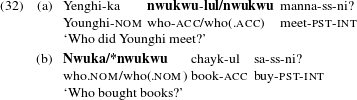
We suggest that the general ban on case ellipsis for subject wh-phrases can be explained by viewing wh-constituents in information questions as focus expressions. If we treat the wh-constituent as the focus, following Lambrecht & Michaelis (Reference Lambrecht and Michaelis1998), then we can account for the general ban on case ellipsis for subject wh-phrases in a way analogous to our account of unacceptable case ellipsis for focus subjects in Korean (H. Lee Reference Lee2010a, Reference Lee2011a). Crosslinguistically and also in Korean, the subject is the type of argument that has the lowest probability of being the focus. Thus, as predicted by principle (11b) above, speakers prefer to case-mark the subject wh-phrase, which can be regarded as the focus expression of an information question, for the same reason that they prefer to case-mark the focused subject: form reduction in the less probable subject type is not motivated for considerations of processing efficiency.
A similar explanation is possible for the acceptability difference between case ellipsis for wh-objects in situ and case ellipsis for fronted wh-objects. As illustrated in (33b), case ellipsis for wh-objects in situ occurs naturally, but case ellipsis is unnatural when the wh-object occurs in sentence-initial position, as in (33a).
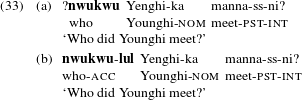
As discussed in Section 4.1 above, in Korean, new information tends to appear in immediately pre-verbal position, whereas given information is typically found in sentence-initial position. Therefore, when a wh-object, which canonically appears in immediately pre-verbal positions, appears sentence-initially, the phrase’s grammatical function, i.e., objecthood, is less likely in its syntactic context. In such a case, speakers should be less likely to omit case markers because of the low probability of the occurrence of the object NP in its non-canonical position and the resulting difficulty in making inference about objecthood.
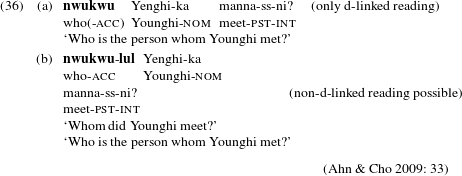
Having shown that variations in the degree of acceptability of case ellipsis for wh-subjects and wh-objects follow the predictions of the current probability-based account, let us now consider the interpretive difference between non-case-marked wh-subjects and wh-objects noted by Ahn & Cho (Reference Ahn and Cho2006a, Reference Ahn and Chob, Reference Ahn and Cho2007, Reference Ahn, Cho, Grohmann and Panagiotidis2009). They claim that non-case-marked wh-subjects and fronted wh-objects that are case-ellipsed have only a d(iscourse)-linked interpretation in the sense of Pesetsky (Reference Pesetsky, Reuland and ter Meulen1987), as shown in (34a) and (36a) below, whereas case-marked wh-subjects and fronted wh-objects can be interpreted either as d-linked or non-d-linked (see (34b) and (36b)) as well as in-situ wh-objects (see (35)):
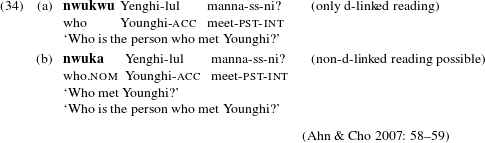
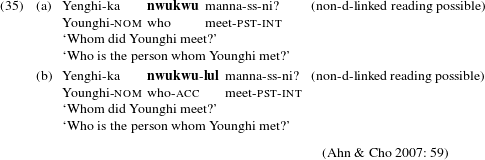
Ahn & Cho (Reference Ahn and Cho2006a, Reference Ahn and Chob, Reference Ahn and Cho2007) analyze the non-case-marked subject wh-phrase as the left-dislocated NP which undergoes a special type of movement out of  ${\rm\Phi}$P (called ‘SubMove’) to Spec-Force, where the NP gets a theta role ‘aboutness’. Consequently, the resulting chain <nwukwu, pro>, which consists of the left-dislocated wh-phrase and the resumptive pronoun in the original subject position, would induce only a d-linked reading like wh-resumption or wh-clitic-doubling constructions found in other languages (Ahn & Cho Reference Ahn and Cho2006b: 180):
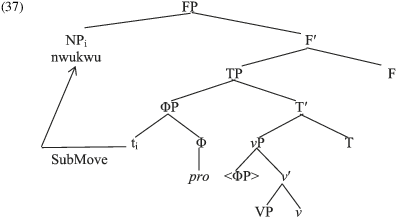
By contrast, the non-case-marked object wh-phrase in (35a) does not necessarily exhibit a d-linked interpretation since it is not left-dislocated. That is, the non-d-linked reading is predicted to be possible in (35a) but not in (34a).
A similar explanation is possible for (36). Under Ahn & Cho’s analysis, the sentence-initial non-case-marked object wh-phrase is a left-dislocated NP. It undergoes SubMove to Spec-Force, leaving pro in its base-generated position. Consequently, the resulting chain <nwukwu, pro> would induce only a d-linked reading (Ahn & Cho Reference Ahn, Cho, Grohmann and Panagiotidis2009).
Regarding the case-marked wh-phrases, Ahn & Cho (Reference Ahn, Cho, Grohmann and Panagiotidis2009) argue that these are neutral for d-linking because they are DPs lacking a  ${\rm\Phi}$-layer, which undergo a normal type of movement (rather than ‘SubMove’), as shown in (38):

Thus, the bare and only bare subject/dislocated wh-phrases are predicted to be enforced to be d-linked, while case-marked wh-phrases, lacking a  ${\rm\Phi}$-layer, are neutral for d-linking.
A third problem of Ahn & Cho’s analysis is that sentences with a non-case-marked wh-word subject, which they predict to be well-formed, are not fully acceptable even if the wh-subject is d-linked. In fact, the well-formedness of the two crucial examples they judge  $-$ (34a) and (36a)
 $-$ runs counter to most of our Korean informants’ judgments as well as most of the previous approaches to case ellipsis, including Hong (Reference Hong1994, Reference Hong2004), Y. Kim (Reference Kim1998a, Reference Kimb) and K. Choi (Reference Choi2005), who consider examples (34a) and (36a) ill-formed. Noting disagreement among Korean speakers about the judgment of (34a) and (36a), Ahn & Cho (Reference Ahn and Cho2006a, Reference Ahn and Chob, Reference Ahn and Cho2007, Reference Ahn, Cho, Grohmann and Panagiotidis2009) accept that these examples are not fully acceptable for all Korean speakers. They also claim that the examples become more acceptable if the wh-phrase is modified by an expression that induces a d-linked interpretation, as in (39) (the grammaticality judgments are Ahn & Cho’s).

Although d-linking could slightly improve the acceptability of (34a) and (36a), all of the fifteen Korean informants we consulted showed a strong preference for the case-marked version of the subject wh-phrase and fronted object wh-phrase for both the d-linked and non-d-linked reading: ten ruled out non-case-marked subject/dislocated wh-phrases and only five find (34a) and (36a) to be marginal at best. However, Ahn & Cho’s account is limited to interpretive differences between non-case-marked subject/dislocated wh-phrases and case-marked wh-phrases/in situ object wh-phrases and offers no explanation for why case ellipsis on subject/dislocated wh-phrases is dispreferred whether they are d-linked or not.
If Ahn & Cho’s (Reference Ahn and Cho2006a, Reference Ahn and Cho2006b, Reference Ahn and Cho2007) claim that non-case-marked wh-subjects have only a d-linked interpretation and the syntactic account they offer as an explanation for this restriction were correct, case ellipsis for wh-subjects should be acceptable only in d-linked questions but not in non-d-linked questions. Our probability-based account makes different predictions about the acceptability of case ellipsis for wh-subjects. The subject is the argument type that has the lowest probability of being the focus. Thus, case ellipsis for wh-subjects, which can be regarded as the focus expression of an information question (Lambrecht & Michaelis Reference Lambrecht and Michaelis1998), is expected not to be fully acceptable regardless of whether the phrase is d-linked. Our probability-based account also predicts that case ellipsis will be more acceptable for the wh-subject of informationally light unaccusative verbs than for that of transitive verbs because the former type of subject has a higher probability of accommodating new information and being the focus. In contrast, purely syntactic accounts of case ellipsis such as Ahn & Cho’s does not predict any difference in the degree of the acceptability of case ellipsis for these two types of wh-subjects. But their account predicts case ellipsis for both types of wh-subjects to be acceptable only in d-linked questions but not in non-d-linked questions. Our probability-based account makes different predictions about the acceptability of case ellipsis for wh-subjects. The subject is the argument type that has the lowest probability of being the focus. Thus, case ellipsis for wh-subjects, which can be regarded as the focus expression of an information question (Lambrecht & Michaelis Reference Lambrecht and Michaelis1998), is expected not to be fully acceptable regardless of whether the phrase is d-linked. Whether these predictions hold true is an empirical question that remains for future research.
8. Conclusion
In this paper, we have presented a new, probability-based account of variable case marking that can explain the subject–object differences in case ellipsis by the interaction between probabilistic constraints on the use of case ellipsis and the performance condition on ellipsis recoverability, i.e., the predictability condition: the unacceptability of case ellipsis for focused subjects, wh-word subjects, subjects in non-canonical OSV sentences and non-specific subjects is caused by violations of probabilistic linguistic constraints that penalize the use of case ellipsis for rare types of subjects, which can be viewed as a grammaticalization of the speakers’ preference to avoid form reduction for less probable types of phrases for increased processing efficiency.
Violations of these constraints, unlike violations of core syntactic principles, give rise to mild unacceptability and can be remedied by manipulation of context or other non-syntactic information. This explains why case ellipsis for rare types of subjects is judged acceptable when the subject represents expected, predictable information in context. These results provide strong support for the view that grammatical asymmetries manifested by the subject–object asymmetries in case ellipsis should be explained by asymmetries in the usage probability of the properties of argument NPs in context, not by categorical syntactic constraints and that native speakers’ knowledge of grammar includes not only some degree of probabilistic information, as suggested by prior work, but even access to rather fine-grained predictability and probability.
Nevertheless, this study has an important limitation in its scope in that it did not take into consideration factors other than predictability which exhibit intriguing interactions with the subject–object asymmetry in case ellipsis. Kiaer & Shin (Reference Kiaer and Shin2012) proposes a prosodic interpretation of the higher rate of case ellipsis exhibited by direct objects. They argue that (short) objects and verbs in Korean form a single phonological phrase and that object particles are omitted in order to put the head of the object NP and the verb together in one phonological phrase. According to Kiaer & Shin (Reference Kiaer and Shin2012), subjects, unlike objects, do not form a phonological phrase with their verb and hence occur more frequently under non-adjacency to their verb. This prosodic account may explain why subjects do not show a preference for case ellipsis because case ellipsis for the subject would not have the effect of reducing the size of a single phonological phrase.
This account can also explain the contrast between (40a) and (40b).
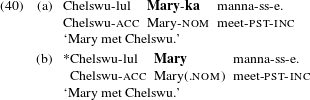
On this account, the unacceptability of OSV sentences like (40b), where the subject is non-case-marked, results from the violation of the probabilistic correlation between the prosodic properties of arguments and their form. The correlation among verb adjacency, the non-case-marked form and objecthood can lead to an expectation that the NP immediately preceding the verb in (40b) is the object. Violation of this expectation results in an unnatural outcome, as illustrated in (40b). To prevent readers or listeners from misinterpreting the subject NP not marked for case as the object, one can use an intonational break after the unmarked subject as an indication of a prosodic boundary.
The correlation among verb adjacency, a single phonological phrase and objecthood is a statistical tendency and can be naturally translated into probabilistic constraints in Stochastic OT that govern the correspondence between the prosodic and morpho-syntactic levels of structure. Further research is needed to investigate how prosody interacts with the pragmatic role played by the NP in a sentence and discourse.
APPENDIX A
Example of a judgment task in the questionnaire
The experiment is reported in Section 6.2 in the paper.
Instruction: Please read through the following conversations, and then make a judgment on the underlined expression in each conversation by assigning them a grade from 1 to 5. Use the following scale to make your judgments:

APPENDIX B
Examples of the stimuli from the experiment reported in Section 6.2
The entire set of stimuli is available from the author upon request.