

Introduction
In recent decades, the City of Copenhagen has adopted conscious strategies in order to become a ‘city of cyclists’. Cycling has grown in popularity in the Danish capital, and the numbers of trips taken have more than doubled between the 1980s and the 2010s. With its high levels of cycling – close to a third of all journeys in the city are made by bicycle – Copenhagen has achieved exemplary status among bicycle planners, policy makers and activists.Footnote 1 Meanwhile, scholars are seeking to understand and explain the Copenhagen success story. Authors variously attribute the phenomenon to bold policies, infrastructure provision and ingenious campaigns, or a thriving bicycle culture. In his final analysis, human ecologist Stefan Gössling stressed the importance of the longer term. The transition towards cycling in Copenhagen had, he argued, ‘its roots in an existing bicycle culture’, while ‘infrastructure development could be based on an existing network of bicycle tracks and lanes’.Footnote 2 Jonas Larsen stressed how the development of a ‘cycling city’ requires not only physical planning, but also supportive everyday users, whose performances add up to practices over decades.Footnote 3 Given the importance ascribed to history, tradition and infrastructure with regard to the revival of cycling in Copenhagen, there is scope for a more thorough inquiry into the history of cycling culture and infrastructure in the city. Based on primary and secondary sources, this article examines the ways in which Copenhagen's urban development, its transport infrastructure and cycling practices have co-evolved in the long term, the purpose being to understand the recursive production of mobility and its material underpinning.Footnote 4
What makes a ‘bicycle city’, one in which cycling is considered a commonplace activity practised by many? Bicycle planners, policy makers and policy analysts like to think that providing bicycle infrastructure will lead to more cycling.Footnote 5 But, in fact, there is little historical evidence to support this theory.Footnote 6 Indeed, the understanding of bicycle lanes as a way to increase cycling only emerged in the 1970s. As Ruth Oldenziel and Adri A. Albert de la Bruhèze have shown, bicycle lanes have proven extraordinarily adaptable in terms of usage and meaning-attribution.Footnote 7 In tracing the historical development of Copenhagen's bicycle network, Danish geographers have taken account of the fluidity of bicycle lanes. In spite of differences between cyclists in different periods, they find a relatively stable extension rate of bicycle infrastructure in Copenhagen.Footnote 8
The historical scholarship complicates the making of a bicycle city, not least by pointing to the importance of culturally and historically rooted practices. Authors variously conceptualize cycling cultures on the national or local level. Anne-Katrin Ebert has stressed the role of a nationally shared understanding of the bicycle, and she has assigned national bicycle organizations a great deal of importance in the meaning-making process. According to her, the Dutch touring association ANWB managed, as cycling grew in popularity in the early twentieth century, to act as a bridge between middle-class and working-class cyclists, as well as between cyclists and motorists in the Netherlands. The bicycle came to symbolize a positive version of Dutch identity, without regard to social class; it became a vehicle of consolidation rather than, as in Germany, a vehicle of class struggle. In this way, a link was created between the bicycle and Dutch national identity, which contributed to the Dutch continuing to use bicycles to a greater extent than other comparable nationalities in the post-war period.Footnote 9
Drawing on Ebert, others have highlighted the importance of a national ‘habitus’ to encompass the divergent paths of cycling in different countries. They have focused on ‘bicycle nations’ rather than ‘bicycle cities’. For example, Marie Kåstrup argued that the bicycle can be seen as a symbol of Danishness, understood as ‘democratic, modest and quotidian’.Footnote 10 Harry Oosterhuis identified five factors contributing to the dissemination of a transnationally coherent cycling culture of the late nineteenth century into nationally determined cultures during the twentieth century: differences in the effects of motoring, government policies, class and status distinctions of motoring versus cycling, the bicycle organizations’ responses to these developments, as well as their standpoints towards bicycle racing. With respect to bicycle racing, neither Denmark nor the Netherlands – whose major cycling clubs turned their back on racing in favour of touring and utility cycling – developed a national fascination with competitive cycling comparable to that existing in Italy, France and Belgium.Footnote 11
Other historians have focused on the interplay between a number of national and local factors affecting the position of cycling in a city. Cycling cultures, according to these authors, played out differently depending on access to other means of mobility (car ownership, quality of public transport), local traffic policies, urban development patterns and the strength and strategies of local social movements supporting cycling – yielding not national but local cycling cultures.Footnote 12 I side with this latter group. Despite the existence of nationally framed cycling cultures – and the impact on the city level of national regulations, import and vehicle taxation and funding structures for bicycle infrastructures – Copenhagen has been, and still is, outstanding also in the Danish context.
Inspired by social practice scholarship, this article proposes to view the relationship between, on the one hand, policy, planning and infrastructure provision (such as bicycle lanes), and on the other hand, mobility cultures and user-practices as mutually constitutive.Footnote 13 Experts and policy makers are obviously important to the conditions and fate of any infrastructure-dependent practice. But policy makers and planners are not alone in shaping user practices; practitioners innovate and shape the practices themselves. Moreover, road users and their representatives influence the processes of infrastructure provision – through their practices, direct interventions, mere strength in numbers or the demands they make to policy makers. They are potentially ‘co-producers’ of mobility systems.Footnote 14 Recognizing that professional and everyday practices constitute each other thus leaves room for innovation among road users, while still acknowledging the importance of planners and policy makers in the shaping of mobility cultures.
The main argument of the article is that Copenhagen entering the twenty-first century as a ‘city of cyclists’ is ultimately the result of a long-term co-production between cycling infrastructure and practices. The Danish capital earned its reputation as a ‘bicycle city’ early on. The network of infrastructure developed in the first half of the twentieth century was partly a result of a thriving cycling culture and the efforts made by cyclists’ organizations. In the following car-centric decades, this network made cycling a more resilient practice than elsewhere, before cyclists and their lobby organizations managed, again, to pressure policy makers to renew supportive measures for cyclists. The article thus highlights two concepts: road users as co-producers of the mobility system as well as the obduracy of infrastructure and its capacity to preserve habits and cultures of the past.
Cyclists make their way, c. 1880–1920
Until the 1870s, Copenhagen was fortified, with the former walls defining today's historic city centre. After the city withdrew its military restrictions on building activities in 1852, Copenhagen expanded rapidly with the construction of densely populated working-class neighbourhoods like Nørrebro, Vesterbro, Amagerbro and the middle-class Østerbro (jointly called brokvarterene). In the early twentieth century, the city annexed the surrounding villages and made up plans that would guide the development of Copenhagen for half a century. New city districts were planned in tandem with the extension of the city's tramway system, which came under municipal control in 1911.Footnote 15 By this time, 15 per cent of men and 11 per cent of women cycled to work, indicating that the bicycle was far from an occasional means of everyday transport. In fact, a few years earlier the directors of the private tramway companies had given up their resistance to socialization, partly because they feared a surge in cycling would risk future revenue.Footnote 16
As in so many other places, cycling in Copenhagen had its real breakthrough with the popularity of ‘the safety’ (a bicycle with two equally sized wheels and a diamond shaped frame) in the mid-1890s. According to figures in the bicycle press, roughly one in ten inhabitants owned a bicycle in 1897. Innovations such as the freewheel mechanism and foot brake made cycling safer and more comfortable, and helped to extend the use of bicycles from sport to recreation, transport of goods, work-related practices and commuting. The young, athletic men who had dominated cycling in the high-wheeler era of the 1880s were joined by middle-aged men, children and women.Footnote 17 Whereas the exclusivity of cycling in the 1880s and the new speeds involved brought conflicts between cyclists and non-cyclists, the spread of cycling towards the end of the century, Danish historian Lasse Bendtsen has argued, lowered its socio-cultural prestige but also increased the acceptance of the novelty.Footnote 18
The increasing number of cyclists resulted in a surge in demands to adjust the streets that had previously catered for pedestrians and horse-drawn carriage traffic. Major streets were usually provided with a cobble-stoned roadway for horse-drawn carriages, sidewalks and an adjacent horse track with a soft soil surface. When the local police ordinance was up for revision in the early 1880s, a committee set up by the Copenhagen city council wanted to confine cycling to the carriageways due to complaints about cyclists frightening horses. The council proved more sensitive to cyclists’ demands for smoother surfaces – essential in this era of high-wheelers and solid rubber tyres – and granted cyclists the right of access to horse tracks.Footnote 19
The first bicycle lanes in Copenhagen were self-made. By using their right of access to the horse tracks, the cyclists’ use of a small strip at the edge of these tracks eventually turned the soft soil appropriate for horse riding into a smoother and more compact surface, better adapted to cycling. The city authorities cut up the horse tracks from time to time, making cycling more difficult and signalling that the tracks, in their eyes, were meant primarily for the horsemen, most of whom were military officers. From 1891, however, some of these narrow (approximately 85 cm) sections of horse tracks were left untouched. The most frequented of these self-made bicycle tracks would later become the first official municipal bicycle lanes.Footnote 20
In 1895, cyclists’ right of access to the horse tracks came under threat again. Continued quarrels between cyclists and horsemen made the police superintendent propose a new ordinance that would ban cyclists from the horse tracks altogether. Moreover, bicycles would be made subject to registration including mandatory licence plates. The proposal stirred intense debates, revealing broad-based support for cycling in Copenhagen, and was turned down by the city council – although a ban on cycling in a few congested streets in the city centre was approved. Most speakers in the city council expressed their support for cycling; while the discussion revealed concern about the safety of pedestrians, proponents of cycling stressed how registration, meant to curb occasional misbehaviour, risked harming a useful means of transport. The chairman of the Danish unions Jens Jensen, later the first social democratic lord mayor in Copenhagen, called for a complete dismissal of any further regulation of cyclists in the city.Footnote 21
Spurred by the intense debates and struggles between cyclists and horsemen, the Bicycle Lane Association (Cykelstiforeningen) was founded in 1897. With economic support from the mainly sport-oriented Danish Bicycle Club, the new association lobbied for and built bicycle lanes separated from both the roadway and the sidewalk by kerbs along the main roads to and from Copenhagen. Falling back also on decisions taken in the city council in the mid-1890s, many of the large road construction works carried out in Copenhagen during the following years included the introduction of electric tramways in the city as well as bicycle lanes, typically 1.8 metres wide, along the roads connecting the city centre with its surroundings (Figure 1).Footnote 22
Østerbrogade had one of the first self-made bicycle tracks in Copenhagen, which, however, by the time this photograph was taken (1900–10) had been transformed by the municipality into a bicycle lane, smoother than the roadway and wide enough to allow for cyclists to ride abreast and overtake. Notice the many cyclists, including upper/middle-class women, who appear to cycle for other purposes than recreation. Photographer unknown. Museum of Copenhagen, photo ID 36115.

Meanwhile the self-made bicycle lanes in or close to the city centre multiplied. In the following years, the municipal authorities generally agreed to the pleas from the cyclists’ organizations and the police (now supporting measures for cyclists for the sake of regulation) to maintain or improve existing bicycle lanes, to lower kerbs enabling cyclists to get on and off and to turn self-made bicycle tracks into proper bicycle lanes equipped with signposts.Footnote 23
The Bicycle Lane Association was replaced in 1905 by the Danish Cyclists’ Federation (Dansk Cyklist Forbund, DCF). Despite the name, it was for some time a Copenhagen-based organization that continued to lobby for the adaptation of horse tracks to the demands of cyclists.Footnote 24 DCF was a decidedly bourgeois organization, yet the rapid decline in the price of bicycles in the first years of the new century had brought more cyclists and a change in the composition of the cycling community. The rapidly shifting ratio between cyclists and horsemen made the organization confident in its claims. Based on traffic counts carried out on a horse track in 1906, which yielded a ratio of horsemen to cyclists of 1:200, the organization proposed its transformation into a dedicated bicycle track or, alternatively, a track with two separate sections. An inferior solution, DCF threatened, would be met with ‘bitterness, perhaps even with battle’.Footnote 25 As another horse track was up for consideration four years later, a traffic count again showed the convincing result of less than one horseman per 500 cyclists. What was more, cycling peaked during rush hours, which, according to the majority (socialists and social-liberals) of the city council's preparatory committee, pointed to the utilitarian nature of cycling – ‘thousands of inhabitants making use of the bicycle as a means of transport to and from their work’ – in contrast to leisurely oriented horse riding among the affluent.Footnote 26
The bicycle network of Copenhagen developed through a seemingly constructive dialogue between the municipality and DCF about the needs of cyclists and the most appropriate design solutions.Footnote 27 Shortly after its founding, DCF expressed its preference for smooth-surfaced, tarred bicycle lanes at the edge of carriageways over Copenhagen's narrow bicycle lanes, bordered by trees. The municipal engineers preferred bicycle lanes separated and heightened from the roadway with a kerb. They argued that the surfaces of Copenhagen streets were anyhow improving at a speed that would render smoother on-street bicycle lanes redundant. DCF consequently readjusted its claims to campaign more exclusively for bicycle lanes.Footnote 28 The collaboration paid off and both parties prided themselves on the accomplishment of the fine network of bicycle lanes in the city. At the International Road Congress held in London in 1913, Vilhelm Nohr, a Copenhagen municipal engineer, boasted that almost every street in Copenhagen wider than 22 metres was equipped with bicycle lanes wide enough to allow a cyclist to overtake another. Two years later, DCF chairman Gabriel Jensen proudly announced that Copenhagen, due to the efforts of the organization, had ‘smooth, asphalted bicycle lanes, the best, any city has to offer’. Indeed, by this time, Copenhagen had already earned an international reputation as a city of cyclists. Nohr compared the number of inhabitants in Copenhagen, close to half a million, with the registered or estimated number of vehicles: 700 automobiles, 800 motorcycles, 12,200 horses – and 80,000 bicycles.Footnote 29
As in many other European cities, up until World War I, bicycle organizations championed the construction of bicycle infrastructure in Copenhagen, primarily for the comfort of cyclists.Footnote 30 The first bicycle tracks were created through cyclists’ own efforts, which would eventually – as the number of cyclists proved too great to ignore – be legitimized by the police, regulating traffic, as well as municipal engineers, providing infrastructure of various kinds. Professional practices and those of users were increasingly aligned, yielding a bicycle network of the highest international standard. The reconfiguration of cycling and horse riding was supported by the overhaul of the conservatives by socialists and liberals in the Copenhagen city council in 1902. This paved the way politically for a practice that was increasingly utility-oriented and whose practitioners increasingly came from the lower classes.
Suburbanizing the masses by bicycle, c. 1920–50
After World War I, Copenhagen grew successively beyond its municipal borders, as suburban communities of single- and multi-family houses mushroomed, in particular to the north. Based largely on initiatives from professional engineering and planning institutions, plans to co-ordinate infrastructure development and land-use regionally were drawn up. A new by-pass road was constructed through the new parts of the city, while many new radial roads were equipped with bicycle lanes. Tramway lines were extended to the municipal border and, beginning in 1934, electric suburban railways (S-trains) promoted suburban development in ‘fingers’ in contrast to concentric circles as before. Meanwhile, Copenhagen's inner city was partially renewed, to a large degree motivated by the ‘demands’ of modern traffic.Footnote 31
Many of the proposed projects reflected concerns about automobility, but car traffic was limited, although increasing in the 1920s. In the inter-war years, Copenhagen was a working-class city and cyclists ruled the streets (Figure 2). During the 1920s, the total traffic on Copenhagen's streets increased by a quarter. Traffic counts at five locations show that cycling's share of the traffic increased from 31 to 36 per cent, and automobility from 7 to 12 per cent, while walking and public transport suffered a relative decline. During the Great Depression, traffic increased only slightly. Most notably, people shifted from walking and public transport to cycling, and by 1935 cycling's share of the traffic had climbed to 44 per cent.Footnote 32 At this point, the number of cyclists was more than twice that of motorists on most streets of Copenhagen, and in some streets as much as seven times as many.Footnote 33 Bicycle ownership also increased significantly, reaching 69 per cent in 1940.Footnote 34 During World War II, walking and public transport made gains at the expense of cycling (due to the shortage of bicycle tyres and spare parts) and automobility (because of fuel rationing), but by 1950 cycling had recovered to pre-war levels.Footnote 35
As a father sent home a postcard from Copenhagen to his son in Stockholm, he chose one entitled ‘The city of bicycles. Copenhagen’. He commented: ‘Heaps of bicyclists like this one are seen all the time on the streets here . . . Indeed, the streets here are completely smooth, no hills like in Stockholm, and the distances are so short in the little country! Cordially, Dad.’ Author's collection.
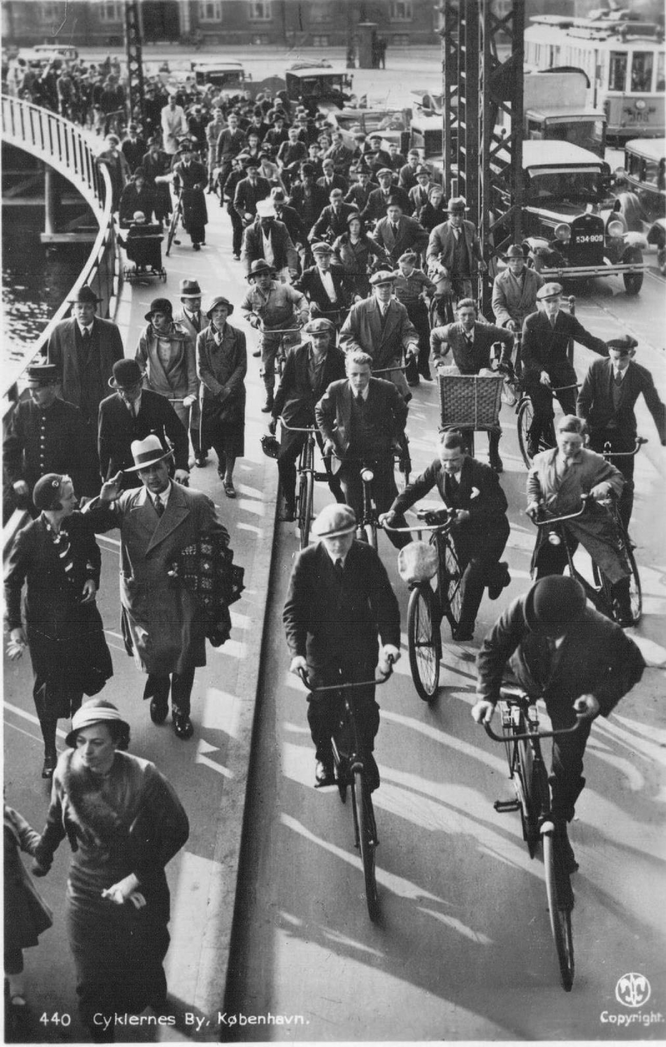
To local as well as foreign observers, Copenhagen was indeed a ‘bicycle city’, where people from all walks of life cycled. As a visiting foreigner observed in 1935, ‘reverend professors’, ‘blonde and well-groomed young beauties’ and ‘young bicycle delivery boys’, all on bikes, shared the streets of Copenhagen. The description captured two iconic bicycle user-groups: the ‘bicycle girl’ and the ‘asphalt cowboy’, the latter often blamed for disturbing Copenhagen's traffic.Footnote 36 According to DCF's member papers, women accounted for 20 per cent of the cyclists, while cycling was particularly prevalent in the working-class districts of Vesterbro and Nørrebro.Footnote 37
With bicycles and cars multiplying, the governance of cyclists took both material and cultural forms. Nationally, bicycle lanes were put forward as a measure that combined the interests of several different actors: DCF embraced them due to safety concerns, while motorists welcomed them for moving cyclists off the roadway. The support of bicycle lanes as a win–win measure grew among Danish road engineers and other traffic experts throughout the inter-war period.Footnote 38
Next to cycling infrastructure, the education of cyclists was a much-debated issue. Police assistant Max Tvermoes was a well-known public figure in Copenhagen, and DCF's vice chairman and figurehead. While he campaigned tirelessly for bicycle lanes along Danish roads, he was also an ardent proponent of the need to educate cyclists to become ‘considerate’ road users in order to ward off regulation. Tvermoes issued several booklets explaining the most important traffic rules to cyclists and stressing the importance of giving appropriate signs to indicate one's intention to stop or make a turn. Although he was ridiculed in the press as ‘Denmark's most fanatic cyclist’, his booklets were widely disseminated.Footnote 39 In 1929, DCF ran the campaign ‘Speak with your arms!’ (‘Tal med armene!’) with the same message, that cyclists should signal their intentions.Footnote 40 Judging from photographs of Copenhagen from the 1930s and beyond, these campaigns appear to have been successful (see also Figure 3). The images also show that, almost without exception, Copenhageners rode single-speed, utility bicycles in an upright cycling position.Footnote 41 Indeed, notwithstanding innovations in materials, hubs and gears in the first half of the twentieth century, until the 1950s the Danish bicycle market remained completely dominated by sturdy, black-coloured bicycles with a foot brake and no gears.Footnote 42
The Danish motorist organization FDM (Forenede Danske Motorejere) found DCF's efforts to educate cyclists unsatisfactory. But its attempt in 1932 to seize the initiative in educating the great cohorts of cyclists by establishing a special bicycle division essentially failed, and the division was dismantled after only a few years.Footnote 43 In spite of frequent outbursts against working-class cyclists’ behaviour and calls to educate them, cyclists were acknowledged by most observers as an indispensable part of Copenhagen's urban transport system. Against the backdrop of suburbanization, economic crisis and rising taxes on public transport, the bicycle gained the advantage over trams as the transport mode of choice for lower-income Copenhageners.Footnote 44 In 1935, the rivalry between cycling and trams took a dramatic turn. Aiming to secure more revenue for the city trams during the economic crisis, the deputy mayor responsible for public transport proposed a ban on cycling in the historic centre. The proposal touched a raw nerve among the cyclists and prompted a huge outburst. The chair of DCF warned of a ‘revolution’ if the authorities were to put their plan into operation.Footnote 45 In the press, many commentators agreed with the federation, praising the bicycle as the ‘people's jewel’. Given the poor state of public transport in Copenhagen, they argued, it was unfair to criticize cyclists for clogging the streets.Footnote 46
The city's experts weighed up the pros and cons of the bicycle: it was cheap, made efficient use of limited space and was a convenient vehicle for short trips. On the other hand, they considered cyclists to be unruly and unpredictable – as did their colleagues elsewhere, from Stockholm to Dublin.Footnote 47 Cycling was also highly seasonal and varied greatly over the course of a day, with high morning and afternoon peaks. The authorities had a hard time fitting this into their public transport planning. But as Vilhelm Malling, engineer at the Planning Office, emphasized in 1932, the bicycle had an ‘extraordinary importance’ in Copenhagen's traffic. In his view, doing away with cycling would be impossible ‘without radical improvement of mass means of transport’.Footnote 48 At the end of World War II, city engineer Olaf Forchhammer observed that cyclists in Copenhagen were well integrated into traffic, and he predicted that cyclists would continue to outnumber commuter train passengers, even as commuting distances continued to increase.Footnote 49
Planners, engineers and politicians agreed that the large numbers of cyclists warranted separate bicycle lanes, and they continued to respond to the requests from DCF.Footnote 50 But they also put forward many reasons for not building them: lack of space in the historic centre; conflicts with loading and unloading, and with car-based shopping in busy shopping streets; and even the overwhelming numbers of cyclists during rush hour. The massive rush-hour peaks of cyclists would, some argued, overload any imaginable network of bicycle lanes. As a result, the city mainly built bicycle lanes along main roads to improve the flow of motorized traffic.Footnote 51 Even so, the extension of the bicycle network in Copenhagen continued. Between 1912 and 1927, it doubled from 35 to 74 km, increasing to almost 100 km in 1935.Footnote 52 By then, a quarter of the road and street network in Copenhagen had bicycle lanes, although the majority of them were outside the city centre.Footnote 53
During the inter-war period, urban mobility was a highly contested issue in most European cities. In Copenhagen, levels of cycling and driving both gained ground compared to other modes, cyclists by far outnumbering motorists. But whereas the car was regarded as the vehicle of the future, the bicycle earned a reputation as a utilitarian mode of transport, helping to suburbanize the masses. Most people agreed that Copenhagen could hardly do without its cyclists; given their number and the poor state of public transport, the urban transport system would have been dysfunctional without them. Bicycle lanes were widely acknowledged as a way to deal with increasing traffic, and the network expanded. Many called for the education of (working-class) cyclists as equally important for their integration in traffic – and the tendency to indicate one's intention to turn or stop suggests that the educational efforts of DCF were, to some degree, successful. In short, although concerns about cycling had become more complex than in the previous period, the mediation between policy makers, advocacy groups and cyclists continued to produce and maintain Copenhagen as a notable bicycle city.
Cycling in the heyday of technocracy, c. 1950–75
With the resumption of comprehensive planning at the end of the war, public transport became the heart of Copenhagen's future transport system. According to the 1947 regional ‘Finger Plan’, urban development would follow existing and future commuter rail networks. An expanded road network would complement the public transport network, and spaces in between these traffic corridors would serve as green wedges.Footnote 54 Public transport remained the backbone of subsequent blueprints for the city's transport system. While the planners realized that cycling was an essential element of Copenhagen's transport system, they also continued to worry about serious competition with public transport and the ‘inconvenience’ from the unpredictability of cycling depending on weather as well as the time of the day and the year.Footnote 55
From 1950 onwards, Copenhagen experienced population decline. At that time, growth took place in neighbouring municipalities in a combination of single-family houses and high-rise apartment houses close to commuter train stations. The ‘fingers’ of the Finger Plan grew thicker and longer due to a larger than expected population growth and increase in car ownership. Around 1960, regional planners were experimenting with development patterns based on decentralization and multiple centres; they thus challenged the idea held within the City of Copenhagen that the city centre should remain the only core. While many industries left the city centre for more peripheral locations, employers working in administration and service industries remained. In terms of jobs and inhabitants, working-class Copenhagen had started to transform into a city dominated by officials and the service industry.Footnote 56
Immediately after the war, the Danish government curbed car ownership by regulating imports and later through high taxes. Once the government lifted import restrictions and prices fell in the early 1950s, and as disposable incomes increased, the number of cars in Denmark increased rapidly. However, this happened less so in Copenhagen, where car ownership stabilized at the end of the 1960s.Footnote 57 On the bridges between Sjælland and Amager, the number of cyclists dropped by 73 per cent in just 15 years (from to 75,000 to 20,500 between 1955 and 1970), while the cyclists’ share of all traffic fell dramatically from 70 per cent to 20 per cent.Footnote 58 As elsewhere, cycling in Denmark was increasingly associated with recreation and children's games and fun. But despite the setbacks, many Copenhageners kept on cycling: the 1967 traffic survey for Greater Copenhagen showed that the bicycle was very popular with commuters (21.5 per cent) and schoolchildren (32.7 per cent).Footnote 59 As women entered the labour market in the 1960s, they made ample use of the bicycle (Figure 3).Footnote 60 And even as it modernized, Copenhagen still featured as a ‘bicycle city’ in many people's minds.Footnote 61
Photograph of rush-hour traffic in Langebro, May 1959. Notice both men and women among the cyclists, the sturdy bicycles and the bicycle baskets and how several of the cyclists are giving signs either to stop or to make a turn. Photographer unknown. Reproduced from E. Klyver Isbrandtsen, Københavns færdsel, et tilbageblik (Copenhagen: Københavns Politi, Færdselsafdelingen, 1959).

Copenhagen's traffic engineers had not anticipated the rapid decline in cycling, but they were hardly averse to adapting their city to the new ‘demands’ of automobility – just like their colleagues around Europe.Footnote 62 Still, disagreements about preserving or renewing the medieval city took some of the wind out of their sails. With the 1954 Master Plan, planners finally opted for preservation. Instead of street widening in the city's core, they proposed that a larger thoroughfare along the ring of artificial lakes would surround the old city, linking the major radial roads from the suburbs.Footnote 63 During the 1950s, municipal, regional and national governments all made plans for Copenhagen's development that included expanding the capital's road network and constructing a subway system. A shortage of funds forced the authorities to limit themselves to an extension of the commuter rail network, until subsidies from the national government made the plans top priority again in the early 1960s. Some radial arteries into Copenhagen, along the ‘fingers’, were reconstructed as highways. Primary networks that had already been planned were upgraded, on paper, to highways, which sometimes involved major demolition. Meanwhile, the national railroad company, Copenhagen city and the national government jointly planned a comprehensive subway network, formalized in the national subway law of 1967.Footnote 64 Most of these grand plans were delayed or postponed in the 1970s.
At the ground level and closer to the centre, streets were widened, parking facilities established, and parking restrictions introduced in the 1950s, in an attempt to make way for cars. In the 1960s, the authorities replaced the inner-city tramlines with a bus system because it resonated better with visions of car-based mobility.Footnote 65 National and local policy makers’ focus on the car and on public transport had drawn attention away from bicycle traffic. In the 1960s, hardly anyone mentioned the bicycle. Like their colleagues elsewhere, Danish experts, police and most politicians implicitly assumed that the bicycle, an old-fashioned and outdated technology, would disappear of its own accord.Footnote 66 To them, bicycle lanes were an archaic remnant, in light of radical plans to transform Copenhagen into a supposedly more modern city. In the 1950s, some new bicycle lanes had been built, others broadened and some abandoned. DCF expressed its concern about abandoning bicycle lanes, but without success.Footnote 67 The closures continued: four bicycle lanes outside the city centre were scrapped between April 1957 and June 1959, and in 1959 the traffic police put forward a comprehensive proposal to remove the bicycle lanes in 21 different locations.Footnote 68
Asked to clarify the city's position with respect to bicycle lanes, city engineer Paul Vedel argued that they were a poor use of scarce space during off-peak hours, given that cycling was on the way out.Footnote 69 The city council's politicians dealt with the controversy more delicately. In the end, no large-scale demolition of bicycle lanes took place.Footnote 70 Cycling issues began to be carefully monitored by proponents of cycling within and outside the city council. Around the mid-1960s, the Danish press featured articles that often combined critical comments about the unsafe conditions for cyclists with arguments in favour of bicycles being superior in their flexibility.Footnote 71 Meanwhile, social democratic deputy mayors Børge H. Jensen and Edel Saunte opposed the occasional scrapping of bicycle lanes. Although they failed to influence the outcome – their antagonists pointed to the insignificance of the particular lanes – they received the moral support of city councillors from all political camps.Footnote 72 Research using maps done by Carstensen et al., however, suggests that, between 1935 and 1970, 10 km of bicycle lanes were removed and in the following five-year period another 24 km. Since new bicycle lanes were also built, the bicycle network still expanded to 175 km in 1970 but then shrunk back to 150 km in 1974.Footnote 73
In the post-war period, the heyday of technocracy, cyclists were in decline and the claims of their representatives fell largely on deaf years. Neither planners nor politicians in Copenhagen were immune to the calls for car traffic infrastructure provision. As in most European cities, motorways and urban renewal schemes progressively surfaced next to public transport schemes in post-war urban planning, though for different reasons their realization was delayed. While planners in the early post-war period expected cycling to remain significant for Copenhagen's future traffic, as cycling lost ground, they were increasingly reluctant to give cyclists their own infrastructure. Scrapping bicycle lanes was, however, so overtly anti-cycling that many Copenhageners and pro-cycling politicians urged planners to be more accommodating to cyclists’ needs. In spite of the misalignment between planning and cycling, remnants of the past – the bicycle infrastructure, protecting cyclists from being literally pushed off the streets and the reputation of Copenhagen as a cycling city built up over the years – helped maintain cycling.
Cyclists push for the bicycle city, c. 1975–2015
Like cities across the west, Copenhagen was impacted by the economic crisis of the mid-1970s. Compared to other northern European cities, Copenhagen recovered only slowly. The national government opted for a ‘balanced’ policy that contained growth in the capital city, while many affluent tax-payers left Copenhagen for neighbouring municipalities. In an attempt to attract the middle class, in the 1980s, a growing proportion of regional housing was located in Copenhagen. Still, for Copenhagen, the crisis continued throughout that decade.Footnote 74
The economic crisis coincided with a surge in cycling. The bicycle modal split for all trips in Greater Copenhagen had fallen to 17 per cent in 1975, almost equal to those taking public transport (16 per cent). Many still walked (27 per cent); more went by car (36 per cent) – even though car ownership, already low compared to other cities internationally, decreased slightly in Copenhagen. Within a decade, cycling increased to 22 per cent at the expense of walking. The bicycle's share of traffic on the bridges between Sjælland and Amager, which had dropped to a mere 15 per cent in 1975, climbed back again and reached around 30 per cent in the early 1990s.Footnote 75 The ‘boom’ in bicycle sales in the 1970s reflects the popularity in particular of multi-geared, relatively light-weight bicycles. Although the simple black bicycles have never disappeared from the streets of Copenhagen, it is clear that the bicycle has, since then, become a differentiated lifestyle product.Footnote 76
In the 1970s, Copenhagen's grassroots environmental movement and the political left began to criticize car-centred planning in Copenhagen. The movement broadened after the 1973 oil crisis, which for many was a wake-up call. In response, the authorities instituted car-free Sundays that demonstrated what a city with little or no automobility might look like.Footnote 77 In the next decade, authorities abandoned several major road projects, partly in response to protests, partly due to a lack of funds or political will. The city's subway plan was cancelled as well for financial reasons. The commuter railroad network, despite its postponed expansion, remained the backbone of the public transport system. Meanwhile, a host of technical and legal measures, such as traffic zoning, speed limits and integrated streets, slowed down or barred motorists.Footnote 78
Despite this paradigm shift, specific cycling policy measures did not extend beyond a few additional bicycle racks and the occasional new bicycle lane, normally in the outer parts of the city. The City Engineer's Office in charge of infrastructure planning repeatedly ruled out any bicycle lanes in the city centre's narrow streets or the main streets in the Brokvarter just beyond, given heavy traffic and the risk that they would interfere with loading and unloading.Footnote 79
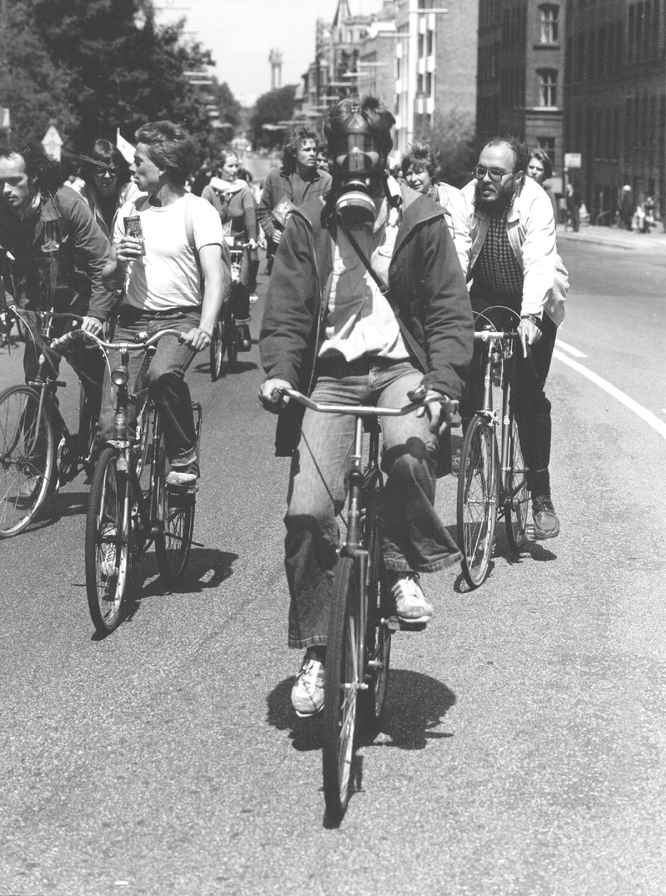
In the early and mid-1970s, independent engineers and economists pointed to the potential of the bicycle as an ‘alternative’ means of transportation.Footnote 80 But pro-bike and environmental activists were key in calling on the city to adopt cycling as a policy choice (Figure 4). Around the mid-1970s the DCF became radicalized, prompted by a new generation of young board members who considered the former leadership to have been too co-operative. In 1977, the federation picked up on the bicycle demonstrations arranged by radical groups within the urban environmental movement in Copenhagen around 1970. DCF membership skyrocketed from 3,000 in 1975 to 25,000 in 1980.Footnote 81
This photograph is from one of the many bicycle demonstrations arranged by the Danish Cyclists’ Federation during the years around 1980. The gas mask of the cyclist in the centre is meant as a criticism of the air pollution from urban automobility. In combining actions, bicycle demonstrations and lobby activities aimed at the city and national governments, the federation was the key player in the revaluation of cycling in traffic policy. Photograph: Søren Svendsen. Courtesy of Svendsen and the Danish Cyclists’ Federation.
DCF also lobbied the city to develop a bicycle plan. When the municipal authorities showed little interest, the organization developed its own.Footnote 82 Pressed by the young left-wing deputy mayor Villo Sigurdsson, the city's planners reluctantly adopted DCF's plan as an informal guide for the future. While the city council never approved the bicycle plan, the planners did use the proposal as a blueprint to develop the bicycle network in Copenhagen in the following years.Footnote 83 Half of the network that existed in 2013 had been built by the late 1970s. Indeed, the 10-year period from 1975 to 1985 saw the network's fastest rate of expansion ever.Footnote 84 Copenhagen's 1978 plans were a watershed, even if the authorities implemented them in an indirect and fragmented way. The city's engineers and planners had clearly abandoned their resistance to bicycle lanes. In the 1980s, they built them along the main streets of the outer districts and in some of the centre's narrow streets, and to a limited extent even in the medieval quarter.Footnote 85
Growth of automobile use in the city at the end of the 1980s, after a decade of decline, made the authorities undertake a critical review of the problems associated with urban automobility. The City Engineer's Office estimated that they needed to curb automobility by one third of its ‘natural’ growth in order to meet the noise threshold established by national law. The agency published a report in 1987 called ‘The car out of the city’ (Bilen ud af Byen) that jump-started a debate initiated by the left-wing deputy mayor for urban planning Gunna Starck, who had followed in Sigurdsson's footsteps. Her office implemented several measures to limit car use in the 1990s.Footnote 86
The last 20 years of development are well known: this period was when the ‘transition’ towards a cycling city allegedly took place. Like other cities, but somewhat belatedly, Copenhagen experienced a ‘renaissance’ in terms of population and economic growth. Meanwhile, the Danish decentralization policy shifted towards one where the capital region was considered the national growth engine whose transport infrastructure was of key importance. The urban renaissance has been part of a global trend, in which Copenhagen became a pioneer by turning itself into a model ‘livable’ city. Besides building its reputation as a cycling city, Copenhagen has invested in public transport. Planners drafted plans for a subway to connect the city with the airport and the new Ørestad development located on Amager, halfway to the Øresund Bridge (opened in 2000).Footnote 87
During the course of the 1990s, bicycle-centred planning became mainstream. While funding and construction was slow until the early 2000s, the city has stepped up its efforts ever since. Since the turn of the century, there has been consensus among Copenhagen's political parties that cycling is the key policy instrument for achieving a sustainable and livable city. In 2005, cycling was even at the heart of the city council election campaign. The two candidates most committed to cycling policy, the social democrat Ritt Bjerregaard and the progressive Klaus Bondam, became lord mayor and deputy mayor respectively. Bondam in particular developed policies and strategies, and also secured funding, to accelerate the transformation of Copenhagen into a cycling city. Parallel to scaling up its ambitions in terms of infrastructure provision, the council also embraced the branding of Copenhagen as a ‘city of cyclists’.Footnote 88
Recent studies have inquired into Copenhagen's present-day bicycle planning and practice. The official documents stress the ‘normality’ of cycling in Copenhagen. And indeed, notwithstanding the emergence of fashionable cycling subcultures, there is much evidence to support the idea that cycling is a mundane, ubiquitous practice: almost one bicycle per inhabitant, most of them cheap utility bicycles; and surveys that suggest that speed and convenience are the key motivations to cycle. Many cyclists indeed cut corners in their ambition to get by quickly, but at the same time the intensity and density on the bicycle lanes enforce them to comply, if not with the traffic rules, then with the informal codes of the bicycle community.Footnote 89 Cyclists in Copenhagen nurture a distinct local bicycle culture.
Young Copenhageners own ever more cars, but they use the bicycle for their daily travel. Between 1995 and 2013, car use declined from 41 per cent to 31 per cent despite increased ownership. While the city has recently invested heavily in the subway, relatively speaking, fewer people use public transport (decreasing from 26 to 17 per cent). Walking and cycling are the big winners. Walking increased from 12 to 20 per cent, cycling from 22 to 32 per cent.Footnote 90 As in so many other places, however, taking a regional perspective tends to diminish cycling's success: Copenhagen's bicycle modal split of some 30 per cent contrasts sharply with that of approximately 20 per cent in surrounding communities and 10 per cent in the rest of the metropolitan region, which moreover is in decline.Footnote 91
To summarize, in the 1970s a radicalized bicycle lobby managed to regain the initiative in bicycle matters, while a more supportive political leadership proved crucial in forcing the municipal administration to take cycling more seriously. Since then, encouraging cycling through infrastructure measures and campaigns has had ever broader support as a means to encourage cycling and reach ever higher goals in terms of the share of cycling. Cyclists and their representatives were crucial to the process. Not only did they press for change; since the city lacked cycle planning competence, former bicycle activists have populated the municipal authorities over the years.Footnote 92 Through their lobbying activities, their advisor's role, and also by helping to frame cycling as beneficial in the branding of Copenhagen, DCF representatives have contributed to the making of Copenhagen as a bicycle city.
Conclusions
This article has examined the making of Copenhagen as a bicycle city. Starting from the proposition that a city's local cycling culture can be understood as the long-term result of a recursive relationship between user practices and infrastructure provision, the article highlights two aspects in particular. First, it has showed that cyclists and their representatives were indeed co-producers of Copenhagen's mobility system. Copenhagen's first bicycle tracks were a result of cyclists who made use of the horse tracks. Somewhat later, cyclists, and in particular their representatives in cyclists’ organizations, were highly successful in advocating for bicycle infrastructure in the early twentieth century. They made use of the reconfigurations, in numbers as well as in socio-cultural leverage, between cyclists and horsemen. In this early phase, cyclists and their representatives – rather than state or municipal experts – were key in the development of Copenhagen's bicycle infrastructure. Cyclists pushed things forward.
Cycling continued to expand throughout and beyond the inter-war period, cyclists by far outnumbering motorists on the streets of Copenhagen. The social levelling of cycling made bourgeois commentators and motorist representatives call for the education and regulation of cyclists. In spite of their allegedly poor manners, however, the sheer numbers of cyclists and the lack of adequate public transport made politicians and municipal engineers acknowledge the importance of cycling for a well-functioning city. The period was one of consolidation of Copenhagen as a bicycle city, with a considerable extension of the bicycle network as well as the development of a mature and thriving bicycle culture.
Secondly, the article highlights the obduracy of infrastructure and its ability to preserve habits and cultures of the past. Copenhagen follows the general European pattern of decreasing levels of cycling in the post-war period, but never reached the same low levels as elsewhere. Bicycle use remained frequent enough to keep the local cycling culture alive. Several factors contributed to slow down the reconfiguration between cycling and driving in post-war Copenhagen: the restrictions of automobility, the absence of a vision with broad enough support for the future development of the city and a poor financial state that hindered or delayed investments in large-scale infrastructure projects that favoured public transport and cars over cycling. In addition, Copenhagen had a long and widespread cycling tradition, which had been translated into a supportive infrastructure. Whereas in many other cities the promoters of the car city could passively observe the disappearance of cyclists from the streets – a ‘do nothing’ strategy – their Copenhagen colleagues would have had to take a more active stance against cycling, such as scrapping existing bicycle lanes, in order to redistribute space to car traffic. Such a ‘chase away’ strategy was met by resistance from cyclists and certain politicians; in a city that had a reputation as a bicycle city, it politicized the seemingly apolitical building of the car city. Even though Copenhagen followed the general trend of a post-war decline in cycling, the combination of a long-standing cycling culture and bicycle lanes helps explain the city's relatively numerous cyclists.
Considering the ‘renaissance’ of cycling since the 1970s, Copenhagen could build on favourable conditions, both in terms of existing bicycle infrastructure and a long cycling tradition. Still, the resurgence of cycling did not come about by itself. The renaissance was not initially a result of planning initiatives – just like it had not been at the turn of the last century. Rather, it came from below: it was spurred by a rediscovery of the bicycle as the negative side-effects of urban automobility were becoming obvious to many and it gained momentum when DCF managed to channel public discontent into calls for bicycle lanes. The slow acceptance within the municipal administration in the 1970s of infrastructure provision for cycling in other than ‘easy’ locations suggests that little would have happened without pressure from cyclists and their representatives. The coming of Copenhagen as a ‘city of cyclists’ was conditioned by cyclists as co-producers of urban traffic; it was dependent on a vivid cycling culture that developed over a century as well as those activists and advocates who pushed for their rights and infrastructure in the city.



