Clostridium difficile infections (CDIs) are the most common healthcare-associated infections (HAIs) in the United States, with ~300,000 hospital-onset cases per year resulting in 44,500 deaths and $5.4 billion in healthcare expenses.Reference Desai, Gupta, Dubberke, Prabhu, Browne and Mast 1 We conducted a review of positive C. difficile nucleic acid amplification tests (NAAT) at Los Angeles County and University of Southern California Medical Center (LAC+USC MC), a large, public, tertiary-care, academic hospital. We found that >50% of the patients with positive tests lacked signs or symptoms of colitis and had at least 1 confounding factor at the time of stool collection, such as laxative use. To reduce these false-positive cases, we considered implementing 2-step testing requiring a confirmatory test with a toxin-specific enzyme-linked immunosorbent assay (ELISA) assay after a positive NAAT or restricting the NAAT. However, prior to implementing these expensive and labor-intensive solutions, we implemented a diagnostic stewardship program including education and introduction of lab criteria for stool sample rejection. Our interventions over the course of 12 months resulted in a nearly 2-fold reduction in positive CDI NAATs and marked reduction in hospital-onset CDI rates.
METHODS
We conducted a retrospective review of deidentified medical records of patients at LAC+USC MC whose providers ordered a C. difficile NAAT (Illumigene C. difficile loop-mediated isothermal amplification test, Meridian Biosciences, Cincinnati, OH) from May of 2016 through December of 2017. The Health Sciences Institutional Review Board deemed this study to be exempt from approval as a category 4 study.
Infections were deemed hospital-onset if diagnosed ≥48 hours after admission, in accordance with the National Health Safety Network definitions. Based on prior published data and recommendations using clinical criteria in the diagnostic evaluation of CDI,Reference Bartlett 2 – Reference Gerding and Brazier 5 we considered tests to be truly positive if tested patients met the following criteria: ≥3 episodes of diarrhea within 24 hours in the absence of administration of a laxative, and at least 1 of the following symptoms: (1) temperature≥38°C, (2) abdominal pain, (3) abdominal tenderness documented on exam, (4) white blood cell count >12,000/µL. Positive tests that did not meet these criteria were deemed falsely positive.
Starting in January of 2017, we initiated a hospital-wide educational campaign on C. difficile NAAT utilization. First, we issued a campus-wide memo educating providers on our clinical criteria. We also initiated a hospital-wide screensaver (Supplemental Figure 1) listing the above clinical criteria defining a true positive CDI test. Finally, we gave brief presentations at surgical and medical grand rounds on C. difficile NAAT utilization and CDI criteria. The interventions’ nominal costs were related to time spent drafting educational memos, creating a screensaver, and presenting at grand rounds (~8 hours of physician time).
Two diagnostic stewardship measures were implemented via the microbiology laboratory in January 2017. Clostridium difficile NAAT orders were canceled via the Laboratory Information System (LIS) if a stool sample was not received within 24 hours of order placement. Second, the laboratory initiated a ‘stick test’ on nonliquid samples such that stool samples viscous enough to support a stick’s upright position were rejected for testing.Reference Brecher, Novak-Weekley and Nagy 6 Oral vancomycin and Illumigene costs were based on acquisition cost.
Changes in standardized infection ratios (SIRs) compared to the baseline period were assessed by the χ2 test, with P≤.05 considered significant. To analyze test trends, we plotted data using control charts. We considered any point above the upper control limit, or 2 of 3 points between the 95% confidence interval limit and the upper control limit, to be statistically significant changes from the baseline.Reference Carey and Lloyd 7 Control and confidence interval limits were calculated based on values prior to the intervention to detect special cause variation from the baseline.Reference Carey and Lloyd 7
RESULTS
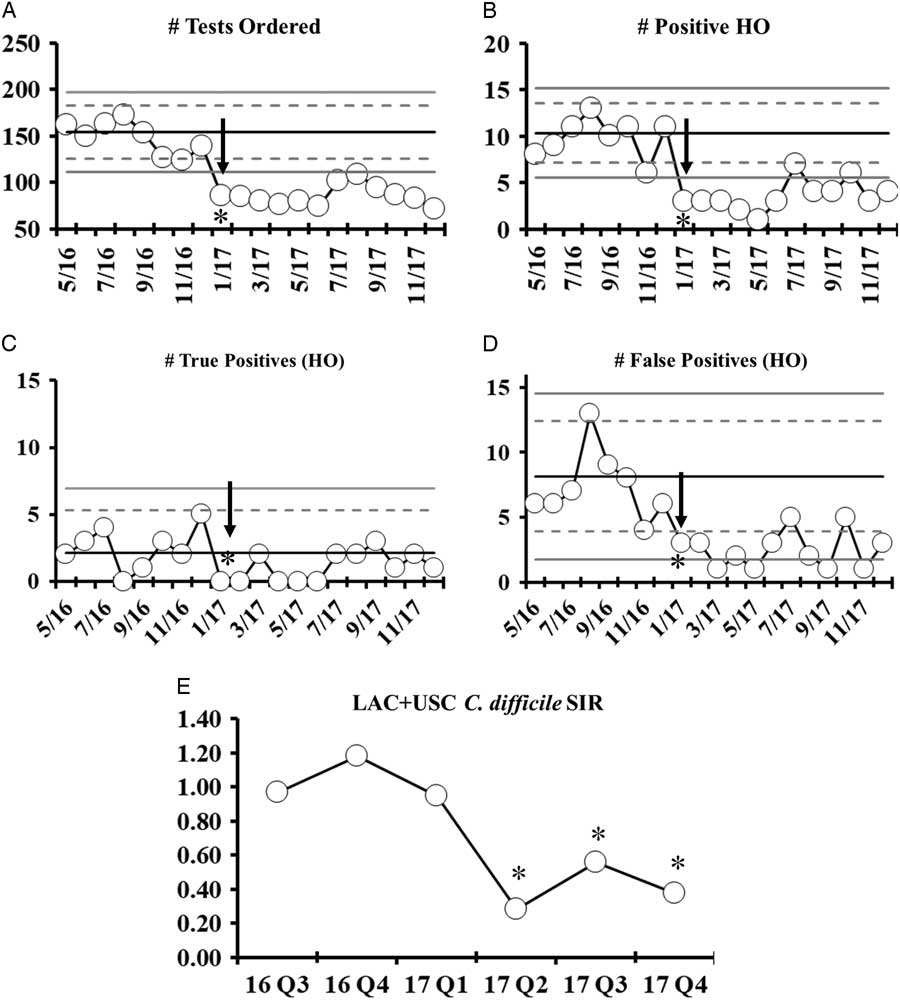
During the baseline period, from May 2016 to December 2016, an average of 148 C. difficile NAATs were ordered per month, with an average of 11 positive tests per month, and 10 of these were hospital onset (Figure 1A and 1B). Based on our CDI criteria, of all positive tests, only 20 were considered potential truly positive (ie, a 70% false-positive rate), of which 2 per month were true-positive, hospital-onset tests (ie, an 80% false-positive rate) (Figure 1C). Starting in January 2017, after implementing the diagnostic and education interventions, the average number of tests ordered fell to 85 per month (a 43% reduction) (Figure 1A), of which 7 per month were positive (36% reduction). Of the positive tests postintervention, only 4 per month were deemed hospital-onset (a 60% reduction (Figure 1B), and only 1 per month (a 66% reduction) was deemed a true-positive, hospital-onset test (Figure 1C). Our false-positive hospital-onset tests fell from 8 per month preintervention to 3 per month postintervention (63%) (Figure 1D). Furthermore, as an internal control, there was a nonsignificant change in monthly community-onset CDI cases (1 per month preintervention vs 3 per month postintervention), indicating that our results were not due to an overall decline in exposure to C. difficile. We observed no concordant rise in complications from delayed diagnosis and treatment such as colectomies or ICU admissions postintervention. Finally, the hospital’s NHSN CDI standardized infection ratio (SIR) was significantly lower postintervention (P<.001) (Figure 1E).
Changes in Clostridium difficile nucleic acid amplification test (NAAT) results over time. (A) Number of NAATs ordered per month from May 2016 to December 2017. (B) Number of positive NAATs reflecting hospital onset infection (≥48 hours after admission) from May 2016 to December 2017. (C) Number of true-positive, hospital-onset NAATs per month. (D) Number of false-positive, hospital-onset NAATs per month. (D) Changes in publicly reported, quarterly NHSN standardized infection ratio (SIR) for CDI, SIR=observed HAIs/predicted HAIs. Arrows point to the complete implementation of all interventions. *For control charts, a significant shift in process is indicated by 2 of 3 data elements between the 95% control limits (dashed line) and the 99% control limits (upper and lower solid lines), or any 1 point above or below the 99% control limits. For the SIR rates, P<.001 by χ2 test compared to 16 Q4 (last baseline period).

The reduction of ~59 NAATs per month led to a projected lab expenditure reduction of $2,017.80 per month, at a cost per test of $34.20. With an average of 5 patients per month avoiding oral vancomycin treatments, each of which cost ~$1,000 per course, we estimated a further average savings postintervention of ~$5,000 per month from drug costs avoided.Reference Bunnell, Danziger and Johnson 8
DISCUSSION
We draw several important conclusions from this study. First, hospital-onset CDI rates can be dramatically reduced by improved diagnostic stewardship. We emphasize that no other change to prevent CDI was implemented in the hospital during the course of this study (ie, there were no changes to terminal room cleaning, disinfectants used, isolation procedures, antibiotic stewardship protocols, etc). Consistent with prior studies, a positive C. difficile NAAT does not distinguish between infection and colonization. The 2-step algorithm approach has been endorsed as a method to differentiate infection from colonization (requiring both a positive NAAT and toxin enzyme immunoassay (EIA) result to define a positive case). However, EIA is known to lack sensitivity for the diagnosis of CDI.Reference Fang, Polage and Wilcox 9 While we had considered switching to 2-step testing to improve CDI rates, our low-cost, simple intervention resulted in a net reduction in hospital costs while dramatically lowering CDI rates. In contrast, switching to 2-step testing would not have decreased test ordering and would have increased laboratory costs to detect CDI.
Second, as others have described,Reference Burnham and Carroll 10 our results underscore that determining CDI rates based on a positive NAAT is complex. The false-positive rate of any test will increase when it is ordered in patients who have a low pretest probability of disease. Unfortunately, clinicians may not be aware that the NAAT detects the physical presence of genetic material from toxigenic C. difficile, but it cannot distinguish colonization from infection. As such, it is often ordered in patients with a single diarrheal episode or in the presence of laxatives, which are widespread in the hospital environment, and in the absence of fever or abdominal pain or tenderness. Thus, national data regarding the rate of CDI that are based on NAATs likely substantially overestimate the true burden of disease.
The primary limitations to the study are its retrospective, quasi-experimental design and the fact that it is a single-center study. Nevertheless, the simplicity of the interventions and the immediate and marked reduction in test ordering and CDI rates by eliminating tests in patients lacking appropriate signs and symptoms of infection suggests that similar interventions would be effective in other settings.
ACKNOWLEDGMENTS
Financial support: This study was an unfunded resident quality improvement project.
Potential conflicts of interest: Dr Susan Butler-Wu has received a speaker’s fee related to utility of NAAT for C. difficile diagnostics (Cepheid). Dr Brad Spellberg owns equity in Synthetic Biologics, which is developing a preventative strategy for C. difficile colitis. The other authors have no conflicts to declare.
SUPPLEMENTARY MATERIAL
To view supplementary material for this article, please visit https://doi.org/10.1017/ice.2018.51.