This study discusses a topic largely overlooked in academia: why large-scale political reforms occur in only a select few Chinese provinces. The article proposes the concept of “experimentation under hierarchy in local conditions” – a framework of provincial political and economic conditions – to explain both the extent and type of political reform in certain provinces, and illustrates why highly significant and large-scale reforms have occurred in Sichuan and Guangdong provinces in particular.Footnote 1 By considering the interaction of the central and local political elite, including the general secretary, provincial secretaries and grassroots-level Party committee secretaries, as well as local economic conditions, this research attempts to deepen understanding of the dynamics of hierarchical central–local relations within the context of political reform.
A trend of decentralization has been visible in the People's Republic of China (PRC) since the advent of the reform period in the 1980s.Footnote 2 The Chinese Communist Party (CCP) central authorities reduce the risk inherent in reform by permitting local governments to take the lead in carrying out gradual reform by way of smaller scale “experimental points” (shidian 试点). Once the central authorities have monitored the success and feasibility of local reforms, they are then able to make the decision to roll out the reform on a wider scale. Sebastian Heilmann defined this model of reform as “experimentation under hierarchy.”Footnote 3 This article draws on Heilmann's explanation of policymaking through regional experimentation whilst weaving in more details of the conceptual complexities within the modern political reforms of the CCP.
The concept of “experimentation under hierarchy” is developed in this study by highlighting the importance for the CCP of taking into consideration specific local conditions when carrying out reform. Political and economic conditions differ across China, compelling the Party to follow the maxim of “treatment in accordance with local conditions” (yin di zhi yi 因地制宜) when initiating experimental points.Footnote 4 Related literature indicates that, in terms of economic reform, the CCP selects areas with favourable local conditions to carry out the most progressive large-scale reforms.Footnote 5 However, little attention has been paid to applying this same logic to political reform. Introducing the concept of “experimentation under hierarchy in local conditions,” this study argues that both the economic conditions and the political dynamics of central and local elite interaction dictate both the type and the extent of the reforms initiated. This article presents two of the CCP's current and most advanced large-scale political reforms – the integrated Party and government Super Department System (da bu zhi 大部制) in Guangdong, and Public Nomination and Direct Election (gongtui zhixuan 公推直选) (PNDE) in Sichuan – to illustrate this logic in practice.
The term “large-scale” refers to those reforms which are not confined to a few places, but have instead been promoted in a wide range of local areas. The Super Department System, an integration of government and Party operations, is an administrative system innovation. In most places, it has largely just involved the amalgamation of separate government departments;Footnote 6 however, in a small number of places, Party affairs departments have been merged with government departments, simultaneously increasing administrative efficiency and reducing external Party intervention in government matters. In 2012, this reform was initiated at county and district levels all over Guangdong.Footnote 7 The PNDE of grassroots Party secretaries is a new measure introduced into the Party personnel structure to allow for the appointment of township Party secretaries by way of a two-round election, as opposed to direct selection by superiors.Footnote 8 It has been rolled out to the largest extent in Sichuan, where it was introduced province-wide at township level in 2005.Footnote 9
The political reforms in Guangdong and Sichuan are currently the largest-scale and most advanced in the entire country, and can thus be seen as “extreme cases” of the PRC's provincial-level political reform.Footnote 10 But, why have the largest-scale reforms occurred in these two provinces in particular? And why do the types of reform differ? This article uses the concept of “experimentation under hierarchy in local conditions” to answer these two questions, and proposes that the political dynamics of central–local relations can explain the extent of reforms, whereas the type of reform is instead linked to distinct provincial economic conditions.
Political and Economic Conditions of Provincial Political Reform
Explaining reform extent: political dynamics of central–local relations
Why do the largest-scale political reforms occur only in some particular provinces? This article argues that the answer lies in the hierarchical dynamics of central and local political elites.Footnote 11 This study will collectively take into account the interaction of three levels of political elites: general, provincial and grassroots Party committee secretaries, representing the highest leadership positions at the central, provincial and grassroots levels, respectively, and those with the most power of decision over political reform.Footnote 12 The provincial secretaries are the crucial link in this model: their interactions with their superiors at the central level and their subordinates at the grassroots local levels play a role in the introduction and progression of reforms.Footnote 13
It is crucial to note that carrying out political reform involves a high degree of risk for the political elite at all levels.Footnote 14 As such, in order for large-scale, province-wide programmes of political reform to be introduced, certain conditions must exist within the interaction of the three levels of central and local elites. In particular, provincial secretaries, the linchpin in the interaction, must take certain measures to lessen the risk of political reform. Two methods are particularly worthy of note. First, if innovative political reforms at a grassroots level are given the tacit approval of the central authorities,Footnote 15 the provincial secretary can deduce that the reform does not exhibit any obvious “political error” and will thus be more willing to carry it out on a wider scale. This can be labelled the “learning mechanism.” Second, if the provincial secretary and the general secretary belong to the same Party faction, the provincial secretary may be permitted more leeway to experiment with political reform. This is the “factional mechanism.”Footnote 16 These two methods are analysed in more detail below.
Provincial secretaries will often avoid taking the lead in outlining concrete novel policies of political reform; if the reform happens to result in negative consequences, the secretary's career may be put in jeopardy. The provincial secretary will have invested a great deal in his career and is unlikely to be willing to run the risk of initiating radical reform, lest he lose his hard-won position.Footnote 17 Instead, provincial secretaries will first monitor the success or failure of reforms introduced by grassroots-level Party secretaries.Footnote 18 Compared with provincial secretaries, grassroots Party secretaries have spent less time in the political arena, and so may be more willing to take the risk of launching reforms.Footnote 19
In terms of political reform, learning from the successful experiences of other localities can help to reduce the costs inherent in institutional innovations. In addition, if a scheme has already been proven successful elsewhere, it gains a certain level of legitimacy.Footnote 20 Thus, successful political reforms introduced by grassroots Party secretaries may be taken up by provincial secretaries for launch throughout the province. However, provincial secretaries will first bide their time and observe whether or not the grassroots-level reform is approved by the central authorities. If it is approved, the provincial secretary may seriously consider expanding the scope of the reform across the province. If, however, the central Party authorities surmise that the reform may result in strong opposition and resistance, or that it will threaten key principles such as the one-party system, they may prohibit any attempts to adopt it. In this case, the provincial secretary will certainly not be willing to promote the reform. In other words, the central authorities' tacit, or even explicit, approval of a grassroots-level reform becomes a reference point for the provincial secretary to assess the political risk of expanding the reform in question.Footnote 21 This clearly demonstrates the influence of the central–local hierarchy in reform experimentation.
Further to this, some provincial secretaries use their factional relationships with the general secretary to reduce the risks involved in implementing political reform. At the heart of theories of factional politics lies Andrew J. Nathan's identification of the “patron–clientship,” which defines the special alliance between two members of the political elite.Footnote 22 If a patron–clientship exists between the general secretary and the provincial secretary, the former may be more willing to allow the latter to implement larger scale reforms. In the meantime, the general secretary will retain a guiding hand in the process and extent of the reform. The provincial secretary will thus recognize that his political patron – the general secretary – genuinely permits a large-scale reform, and will be more likely to expand grassroots reforms to the provincial level.
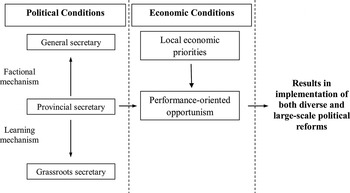
If both of these two risk-reducing political conditions – a centrally approved innovation at the grassroots level and a patron–client relationship between the provincial secretary and the general secretary – exist simultaneously in a given province, there is a far higher likelihood of large-scale political reform occurring. These political conditions are illustrated on the left-hand side of Figure 1.
Implementation of Diverse and Large-Scale Provincial-Level Reform: the “Experimentation under Hierarchy in Local Conditions” Model

Explaining reform type: interpretation of local economic conditions
Why do types of reform vary in different localities? It can be argued that the answer lies in “performance-oriented opportunism,” a condition related both to the operations of the provincial secretary, and to the economic circumstances of the province in question. This is shown in the central column of Figure 1. Once again, provincial secretaries play a crucial role. By taking into account local economic conditions, provincial secretaries are able to decide upon the type of reform which best fits the economic priorities of their province. In doing so, they are able to guide reforms in an opportunistic manner towards those political performance indicators which will earn them the highest appraisal from superiors.
The theory of “new institutionalism” proposes that human behaviour is deeply influenced by institutional structure. This need not be a formal structure per se, but can be better understood as a collection of norms, rules and routines.Footnote 23 Seen from this perspective, the institutional structure of the CCP's cadre appraisal system may be seen as a profound influencing factor upon the choices of provincial secretaries regarding programmes of political reform. Aware that political performance is a major aspect of their appraisal, cadres, including provincial secretaries, will seek the most beneficial opportunities to demonstrate their achievements in that area. The choice of reform type is thus influenced by the pay-off it will bring to the provincial secretary.
Since the Reform and Opening Up period, the two most important indicators of successful political performance in the appraisal of CCP cadres have been “economic development” and “social stability.” As former secretary of the Central Politics and Law Commission, Luo Gan 罗干, succinctly put it: “Economic development is a political achievement; maintaining social stability is also a political achievement.”Footnote 24 Furthermore, according to Minxin Pei, political elites within authoritarian regimes are often fixated on the importance of economic development as continued growth can confer a certain degree of political legitimacy.Footnote 25 However, the process of economic development is also a known trigger of social instability, which represents a major threat to the regime.Footnote 26 As a result, the CCP is also preoccupied with cadres' abilities to maintain social stability.
As good political performance is one of the most important ways in which cadres can earn promotion,Footnote 27 cadres are keen to demonstrate their achievements through the attainment of outstanding political performance indicators.Footnote 28 However, restrained by limits on resources and a relatively short time in office, cadres tend to target the most easily attainable political performance indicators wherever possible. For provincial secretaries, political performance indicators are closely tied to the “initial conditions” in their province. In economically affluent provinces, cadres aim for the performance indicator of sustained economic growth, as this is the indicator which is easiest to obtain. Such cadres are more likely to initiate administrative reform in order to increase governing efficiency and maintain high levels of economic growth, which is additionally seen as a key way of satisfying the populace and preventing social instability.Footnote 29 However, in poorer provinces, it is far more difficult for cadres to provide the remarkable and balanced economic development seen as necessary to prevent instability. It can thus be conjectured that, pre-empting the occurrence of instability, provincial secretaries in poorer provinces tend to prioritize the political performance indicator of ensuring social stability over that of economic development. Research shows that instead of pursuing administrative reform, cadres in these provinces opt for programmes such as electoral reform,Footnote 30 which ostensibly increase political participation and ease social tensions amongst the people.Footnote 31
The Causal Mechanism of “Experimentation under Hierarchy in Local Conditions” in Practice
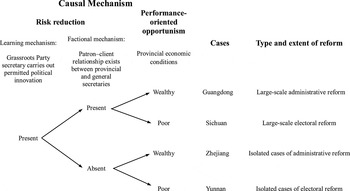
Before entering into analysis of individual cases, this research first presents a consolidated causal mechanism for provincial political reform in China. In order for large-scale political reform to occur, political elites, and provincial secretaries in particular, must reduce risk wherever possible. According to the model of “experimentation under hierarchy in local conditions,” there are two crucial background political conditions which reduce risk. First, grassroots-level innovations have been carried out and have already received the tacit approval of the central authorities: this is the learning mechanism. Second, the provincial secretary enjoys a patron–client relationship with the general secretary: this is the factional mechanism. In the event that these two conditions are fulfilled, conditions are ripe for the introduction of large-scale reform. The type of reform selected is largely dictated by the phenomenon of performance-oriented opportunism; provincial secretaries will interpret the economic conditions of their province and make the rational choice of initiating those reforms which best match provincial priorities, and thereby provide the most appropriate political performance indicators for their own work. In other words, this article argues that the most important factor influencing provincial secretaries' choice of reform type is differing local economic conditions. The framework for this causal mechanism is shown in Figure 2, alongside typical cases fitting each of the conditions.
Causal Mechanism of Large-Scale Provincial-Level Reform

If no significant and approved political innovations occur at the grassroots level, then there is no likelihood of large-scale provincial political reforms occurring at all, which is therefore outside the scope of the mechanism. In the case that such innovations do occur, and are tacitly approved, the second factor to take into consideration is whether the provincial secretary has a factional relationship with the general secretary. This is indeed the case in Guangdong and Sichuan provinces. However, if no such relationship exists, it is unlikely that large-scale reforms will be given the go-ahead; despite the existence of approved grassroots innovations, the level of risk for a large-scale reform remains prohibitive. This can be seen in the cases of Zhejiang and Yunnan provinces, where only isolated cases of reform have occurred.
In order to strengthen the validity of the causal mechanism framework, the cases of Guangdong and Sichuan constitute the experimental group, wherein all political conditions are fulfilled. This research will present detailed case studies of the large-scale political reforms in Guangdong, a province with affluent economic conditions, and Sichuan, a relatively poor province. Zhejiang enjoys a high level of economic development, similar to that of Guangdong province, and administrative reform is the chosen reform type in both provinces. On the other hand, Yunnan province is relatively underdeveloped and is therefore comparable to Sichuan province. Both provinces demonstrate instances of electoral reform. Grassroots-level innovations matching the predicted type of reform have occurred in both Zhejiang and Yunnan, but as yet, no large-scale reforms have come about. As such, these two provinces constitute a suitable control group with which to compare the cases of Guangdong and Sichuan.
A super department system reform was carried out at the local grassroots level in Fuyang city 富阳市, Zhejiang province, in 2007. This structural administrative reform touched upon the consolidation of Party and government affairs in the municipality and was of great significance.Footnote 32 However, Zhao Hongzhu 赵洪祝, the provincial secretary of Zhejiang, had no factional relationship with the then general secretary, Hu Jintao 胡锦涛, and the reform has not been extended across the province. Similarly, in 2004, led by grassroots Party secretary Luo Chongmin 罗崇敏, Luxi county 泸西县 in Honghe prefecture 红河州, Yunnan, introduced PNDE for the position of Party committee secretary in ten townships. However, the provincial secretary of Yunnan at the time, Bai Enpei 白恩培, had no factional relationship with the general secretary, and he, too, chose not to advance Luo's reforms across the province.Footnote 33
This study now moves on to consider the individual case studies of Guangdong and Sichuan. Through process tracing, it is possible to uncover why China's largest-scale reforms have occurred in these two provinces in particular, and why the reforms are of different types. These two provinces are very different: Guangdong is an affluent coastal province, whereas Sichuan is a relatively poor inland province. However, the current most advanced political reforms in China have occurred in both provinces. The pioneering and widespread administrative reform of Guangdong and electoral reform of Sichuan are two valuable case studies for deepening understanding of the circumstances of political reform across China, as well as providing a significant insight into the dynamics of central–local relations.
According to the causal mechanism, in the event that the two political conditions are fulfilled, the opportunity for large-scale political reform is greatly increased. However, the specific type of reform chosen for expansion depends on the economic conditions of the province. Provincial secretaries will select those reforms which provide the most beneficial opportunity to obtain successful political performance indicators. Cadres in affluent areas will opt for administrative reforms to promote further economic development, whereas cadres in poorer localities will instead aim to maintain stability through the introduction of electoral reform.
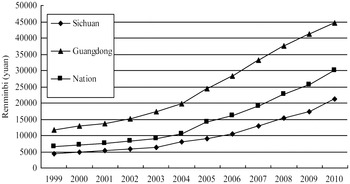
Although there are other factors involved in a robust economy, GDP growth remains a straightforward measure of economic affluence. Figure 3 illustrates the per capita GDP of Guangdong, Sichuan and the PRC as a whole from 1999 to 2010. Guangdong's per capita GDP is consistently above the national average, whilst Sichuan's is below. As expected, Guangdong's cadres have focused on administrative reform, whereas in Sichuan electoral reform programmes have attracted the most attention.
A Comparison of per Capita GDP (1999–2010) in Guangdong, Sichuan, and the PRC

Through consideration of the cases presented in this causal mechanism, it is possible to paint a picture of China's “experimentation under hierarchy in local conditions” in practice. When considering the possible routes that Chinese political reform might take, administrative reform and electoral reform spring immediately to the fore. The former allows the government to increase its administrative efficiency and boost economic development; the latter provides a tool with which to reduce some of the tensions of social instability. Guangdong and Sichuan are respectively the two most important laboratories for testing out administrative and electoral reform in all of China. Both of these reform types have been expanded to a province-wide scale, providing excellent opportunities for the CCP to learn from their experiences and potentially develop a national-level reform policy.
Increasing Administrative Efficiency: Guangdong's Super Department System Reform
Guangdong's economic development ranks amongst the most advanced of all of China's provinces. Ezra F. Vogel argues that, in the 1980s, Guangdong followed a development model similar to that of Japan and South Korea, in which the state directly led programmes of economic reform.Footnote 34 The speed of this economic development has prompted Guangdong to favour political reforms relating to administrative streamlining with the aim of increasing government efficiency. For example, in February 1998, Shenzhen issued the country's first directive to simplify administrative approval procedures.Footnote 35
In order to integrate department responsibilities effectively, in 2003 Shenzhen mayor, Yu Youjun 于幼军, pioneered the idea of consolidating different sectors. Within this reform, known as the Administration Trisection System (xingzheng sanfen zhi 行政三分制), Shenzhen municipality's various bureaus were merged according to similarities in function to create several giant bureaus. Within each of these bureaus, responsibilities were divided into decision-making, execution and supervision.Footnote 36 However, this threefold separation of responsibility was easily confused with the Western concept of separation of power, and consequently was prohibited by the central authorities at the end of 2003.Footnote 37 Furthermore, owing to the resistance of the central authorities, the then provincial Party secretary of Guangdong, Zhang Dejiang 张德江, did not dare attempt any further reform programme of this sort.
In actual fact, the main issue with the reform was not the idea itself, but simply the terminology. The reform posed no threat to the one-party system, and in 2008 the central authorities reinstated the concept under the new name, Super Department System. The new system basically consists of amalgamating departments with similar functions into one “super department.” After the central authorities adopted the system, several regional authorities followed suit with their own parallel reform programme. However, the Super Department System has by no means resolved some of the fundamental problems plaguing the CCP's administrative structure.
One of the biggest problems with the administrative system is the overlap between government and Party affairs departments, which severely impinges on the regime's administrative efficiency. Simply put, the problem of “dual rule” is manifest in the political system;Footnote 38 in order to comply with the CCP's key principle of Party-led government (yi dang ling zheng 以党领政), government departments are often subject to supervision by their corresponding Party affairs department.Footnote 39 Despite some reform at both the central and regional levels, only government departments were merged under the Super Department System, whereas Party affairs departments maintained their independence. Consequently, the problem of overlap between responsibilities remained and overall the Super Department System reform brought very little benefit to the PRC's administrative system.
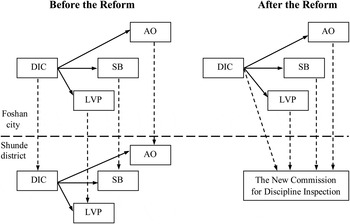
However, in 2009, Liu Hai 刘海, Party secretary of Shunde 顺德 district in Guangdong, made the decision to amalgamate both government and Party affairs departments into six super departments, largely resolving the issue of overlapping responsibilities.Footnote 40 For example, prior to the 2009 reform, Shunde district's inspection and supervision system included separate government and Party branches. The Party's Discipline Inspection Commission (DIC) was responsible for the investigation of criminal acts. The government branch was divided into three: the Letters and Visits Bureau (LVB) received and handled petitions from the public; the Audit Office (AO) was in charge of investigating officials' suspicious funds transactions; and finally, the Supervision Bureau (SB) was responsible for anti-corruption propaganda and incident briefings. In keeping with the Party-leads-government principle, the DIC had a supervising “leadership relationship” with the three government departments.Footnote 41 In addition to this, Shunde's government units had an equal “professional relationship”Footnote 42 with those of Foshan city 佛山. This set-up can be seen on the left-hand side of Figure 4.
The Inspection and Supervision System in Shunde District before and after the Super Department Reform

The post-reform system is illustrated on the right-hand side of Figure 4. Shunde district's original Party affairs' DIC, and the governmental LVB, AO and SB were incorporated into the New Commission for Discipline Inspection (qu jiwei jiguan 区纪委机关). Although this reform did manage the effective integration of government and Party affairs' functions within the inspection and supervision system, another problem remained. Shunde district falls under the jurisdiction of Foshan city, which retains the old, unreformed system. Consequently, whenever their tasks converge, there is a discrepancy in the linkages between Foshan and Shunde. As can be seen on the right of Figure 4, Shunde's New Commission for Discipline Inspection has maintained a professional relationship with all of Foshan's related departments, but this no longer resembles the one-to-one relations seen on Figure 4's left-hand side. To resolve this problem, Foshan's DIC, LVB, AO and SB are required to hold joint meetings and release documents in conjunction with Shunde's integrated New Commission for Discipline Inspection.Footnote 43
Roughly six months after the reform programme was initiated in Shunde, the People's Daily Online published a report on it, pointing out that the crucial aspect of the reform was the integrated co-ordination between the government and Party affairs' administrative structures.Footnote 44 This endorsement from the central authorities provided Wang Yang 汪洋, the provincial Party secretary of Guangdong, with the impetus to roll out the reform throughout the whole province. In addition, Wang Yang has a very close relationship with the then general secretary, Hu Jintao. Both are from Anhui province, both worked in the Communist Youth League, and together they form part of the so-called Youth League Clique, one of the CCP's main factions.Footnote 45 This close factional relationship gives Wang Yang more power to introduce reforms, and in early 2012, he decided to emulate the Shunde system throughout Guangdong. Each city was obliged to select one district or county in which to implement the new system, allowing for a gradual and steady application of the reform.Footnote 46
Guangdong's administrative system reform has attracted the attention of many outsiders. In some respects, this Super Department System is similar to the recent “joined-up government” approach taken by the UK, Australia and New Zealand.Footnote 47 According to Dali Yang, since the PRC entered the WTO, the Chinese government has been on the constant lookout for concrete examples of reform or innovation which have been shown to reinforce administrative ability. Such reforms are beneficial for the government's current goal of organizational rationalization.Footnote 48 And, in 2012, Guangdong's Super Department System reform won first place in the 16th Chinese Local Government Innovation Awards.Footnote 49 This reform will no doubt provide an invaluable learning experience for the PRC in any future attempts to implement government restructuring programmes.
Reducing Social Instability: Sichuan's PNDE Reform
Sichuan's electoral reform leads the way in China in both magnitude and progression. Sichuan is not among the least economically developed provinces (such as Yunnan, Guizhou or Tibet), but nor does it match the affluence of the eastern and coastal provinces. The process of economic development can lead to social instability, triggered by the unfair and uneven resource distribution which occurs at the early stages of growth.Footnote 50 There is even evidence that social instability is most likely to arise once average per capita GDP exceeds US$1,000.Footnote 51 As shown in Figure 3, Sichuan's average per capita GDP first rose above this amount between 2002 and 2003. Therefore, a convincing explanation for Sichuan's pioneering position is oriented around the political elite: plagued by the issue of social instability arising from uneven economic development, Sichuan's leaders have chosen the route of grassroots-level electoral reform.
In the PRC, regional officials are generally directly appointed by their superiors and there is no procedure for competitive selection by election. Under such circumstances, maintaining a politically correct attitude is more important for grassroots cadres than their actual political performance. This leads to endemic corruption and lazy governance. Electoral reform provides an element of competition to encourage better performance and more enthusiastic governance; furthermore, the impression of increased political participation may go some way to reducing social tensions. As early as 1998, Suining city 遂宁市 central district Party secretary, Zhang Jinming 张锦明, introduced direct elections for the position of mayor of Buyun 步云, a township under Suining's jurisdiction.Footnote 52 However, this reform was not permitted by the CCP central authorities as some of the mayoral candidates were not CCP members – if a non-CCP mayor were to be elected, the one-party principle would be violated. As mayoral selection reform did not receive official approval, grassroots cadres began to consider reforming the appointment procedure for Party committee secretaries instead.
Chengdu new division Party secretary, Li Zhongbin 李仲彬, was the first to implement a programme of PNDE for the position of township Party secretary. He had discovered many cases of officials illegally oppressing and bullying ordinary people, which prompted his decision to reform the cadre personnel system.Footnote 53 On 3 March 2004, Li Zhongbin announced that a system of PNDE would be introduced to elect the Party secretaries of all townships under the jurisdiction of Chengdu new division.Footnote 54 His reform was approved by the central authorities. The key difference between this reform and the unsuccessful Buyun attempt in 1998 was that only Party members were eligible to vote or stand for election. This policy of Party members selecting other Party members permits the most outstanding candidates to be promoted to the position of Party Secretary, whilst still upholding the one-party principle, and thus is more palatable to the CCP central leadership. Moreover, as the election procedure was restricted to township level, one of the lowest divisions in the administrative hierarchy, the reform was not too politically sensitive.Footnote 55
Public Nomination and Direct Election breaks from the traditional procedure of cadre selection. It is effectively a two-round election system.Footnote 56 The first round sees eligible Party members voting on potential candidates, which filters out those earning the lowest number of points – this is “public nomination.” Second, Party members cast their vote from a shortlist of candidates for the position of township Party committee secretary – this is “direct election.” Although there is still room for improvement in this electoral reform,Footnote 57 it has nevertheless greatly increased the level of competition in the cadre appointment procedure, forcing officials to pay closer attention to their political performance and conduct.
It may have been this original innovation to the grassroots-level personnel system that Sichuan's provincial Party secretary chose to replicate across the province. At the time of Li Zhongbin's reform, the Party secretary of Sichuan was Zhang Xuezhong 张学忠, who had a close personal relationship with the general secretary, Hu Jintao. Their relationship can be traced back to the mid-1970s, when they both worked in Gansu as secretaries to the Party elder Song Ping 宋平. Hu Jintao became Party secretary of Tibet in 1988, but in 1991, owing to problems with altitude sickness, he left Tibet to recuperate in Chengdu. Hu requested the central authorities to transfer Zhang Xuezhong to Tibet to take over the role of vice-provincial secretary and assist with the governance of the autonomous region. This led Hong Kong-based political commentator Ding Wang 丁望 to dub Zhang Xuezhong as Hu's “Tibetan partner” (xizang huoban 西藏伙伴).Footnote 58 After Hu returned to work at the Party centre in Beijing, he requested that Zhang Xuezhong be promoted to vice-chief of the Ministry of Personnel in 1994, and in 2000, promoted him to minister of personnel, later transferring him to the position of provincial Party secretary of Sichuan in 2002.
As a result of his relationship with Hu, Zhang Xuezhong was in a powerful position to enact sweeping reforms. He first closely monitored whether Li Zhongbin's reform would receive official approval. On 8 November 2004, the People's Daily reported news of the township Party secretary PNDE in Chengdu new division,Footnote 59 which Zhang took as tacit approval from the authorities. Three days after the People's Daily report, the Sichuan authorities announced the PNDE pilot reform in the Sichuan Daily.Footnote 60 In August 2005, the Sichuan Party committee declared that the PNDE of township-level Party secretaries would be rolled out across the entire province.Footnote 61 With this announcement, Zhang Xuezhong implemented the widest-scale reform of township Party secretary elections in China to date.
Sichuan's “experimental point” has become a point of reference for the CCP in its considerations of electoral reform. Notably, Sichuan modified its initial unsuccessful reform of mayoral elections and instead focused on reform of township Party secretary elections. In other words, Sichuan province devised a successful reform which matched the CCP's aspirations for inner-Party democracy. In a certain sense, this reform represents a mechanism of competitive authoritarianism.Footnote 62 The CCP hopes to retain electoral reform, within the confines of the Party, in order to increase levels of competition without threatening the one-party principle. This way of thinking is reflected in the PNDE of the CCP Central Committee at the 17th National Congress.Footnote 63 It has been suggested that this central-level innovation was indeed modelled on the Sichuan reforms.Footnote 64
Conclusion: Experimentation under Hierarchy in Local Conditions
Attempts to implement successful political reform in mainland China can be likened to a solitary boat, bobbing along in a vast, unknown ocean, trying to navigate its way home. Finding a programme of reform which can fulfil all the necessary requirements is extremely difficult, and cannot be rushed. Related literature has frequently pointed out that the CCP employs a style of gradual reform in order to accumulate experience and avoid replicating the Soviet Union's “big bang.”Footnote 65 However, few studies expound on how the PRC navigates its way down this path of gradual reform.
As explained by Heilmann in his article on “experimentation under hierarchy,” the CCP reduces risk by learning from local experimental points, extracting feedback from the experience, and basing nationwide reform on the successes of these pioneering experiments. This involves complex dynamics of central–local relations and a hierarchy of power and influence. He writes: “It is […] the volatile yet productive combination of decentralized experimentation with ad hoc central interference, resulting in the selective integration of local experiences into national policy-making, that is the key to understanding China's policy process.”Footnote 66 This study has considered Heilmann's concept in terms of political reform in particular, and has taken into account the importance of local conditions in influencing the introduction and progression of reforms.
This article puts forward a more elaborate concept to offer some insights into the path to political reform in China: “experimentation under hierarchy in local conditions.” This model builds on Heilmann's explanations of the hierarchy prevalent in central–local relations, and the Chinese template of gradual reform through targeted experimentation, by also weaving in significant local political and economic conditions. Put simply, provincial political elites reduce risk by referring to the central authorities' tacit approval of successful grassroots reform programmes, as well as relying on a close factional relationship with the general secretary, who acts as their patron. Further to this, in the few provinces where both these conditions are fulfilled, provincial secretaries choose to emulate the innovative reforms which best match the economic priorities of their province, thus helping them to obtain the most accessible political performance indicators.
As the two most important laboratories for large-scale, progressive reform in the PRC, Guangdong and Sichuan provide a significant glimpse into the future options for potential political reform programmes, and are therefore valuable for research in their own right. However, this is not the whole picture: Guangdong and Sichuan also prominently demonstrate the causal mechanism of “experimentation under hierarchy in local conditions,” and as such provide an insight into the CCP's entire reform policy and practice.
Looking ahead to the continuing development of the PRC's political reforms, it is highly likely that the current general secretary, Xi Jinping 习近平, will also continue to make use of the “experimentation under hierarchy in local conditions” model. This model has proven to be an effective and controllable mechanism for reducing the level of risk inherent in experimentations with political reform, and Xi can be expected to rely on his more trusted associates at the provincial secretary rank to attempt the expansion of approved reforms. In turn, these secretaries will look to political innovations at the lower ranks to inform their decisions. In short, if the Chinese developmental model is indeed that of “crossing the river by feeling the stones,” then the contribution of this article is to provide a concrete insight into how different levels of leadership interact to trace out the stones which guide their way.