INTRODUCTION
The northern Adriatic Sea (sensu Buljan & Zore-Armanda, Reference Buljan and Zore-Armanda1976) is geomorphologically, hydrographically and biogeographically a peculiar Mediterranean region. Together with the Gulf of Lion and northern Aegean Sea it is considered to be one of the coldest Mediterranean sectors. This allows the presence of a peculiar flora and fauna which support its strong boreal affinity, as well as its ecological and biogeographical similarities with the North Atlantic (Bianchi et al., Reference Bianchi, Boero, Fraschetti, Morri, Minelli, Chemini, Argano and Ruffo2004; Boero & Bonsdorff, Reference Boero and Bonsdorff2007).
The research on the polychaete fauna in the Adriatic Sea has a very long tradition (Amoureux, Reference Amoureux1983b and literature cited, Požar-Domac, Reference Požar-Domac1994 and literature cited), and is particularly related to the establishment of biological stations in Trieste and Rovinj, which later became research institutes. Systematic researches of the polychaetes in the Adriatic started right in its northern part with Grube (Reference Grube1840, Reference Grube1850, Reference Grube1860, Reference Grube1861, Reference Grube1863, Reference Grube1864) who particularly investigated polychaetes in the Gulf of Trieste and an area of Lošinj Island, and described many new species. The researches of the polychaete fauna in the northern Adriatic continued until today (Zahtila, Reference Zahtila1997; Castelli et al., Reference Castelli, Massei, Valentini and Crema1999; Mistri et al., Reference Mistri, Fano, Ghion and Rossi2002; Aleffi et al., Reference Aleffi, Bettoso and Solis-Weiss2003; Mikac et al., Reference Mikac, Musco, Đakovac, Giangrande and Terlizzi2011; Musco et al., Reference Musco, Mikac, Tataranni, Giangrande and Terlizzi2011), however, most of these studies cover ecological aspects or simply report species lists, while taxonomic ones (Zanol & Bettoso., Reference Zanol and Bettoso2006; Mikac & Musco, Reference Mikac and Musco2010; Nygren et al., Reference Nygren, Sundkvist, Mikac and Pleijel2010; Chambers et al., Reference Chambers, Lanera and Mikac2011), especially in the last few decades, are very rare. Moreover, most studies deal with soft bottoms while very little is known about the hard bottom polychaete fauna, which has not been investigated since Katzmann (Reference Katzmann1971, Reference Katzmann1972) and is lately considered by Mikac & Musco (Reference Mikac and Musco2010).
More recently, from 2003 to 2008, soft bottom polychaete fauna of the area was intensively surveyed on three offshore stations within a monitoring programme of the Centre for Marine Research (Ruđer Bošković Institute, Rovinj) (Mikac et al., Reference Mikac, Musco, Đakovac, Giangrande and Terlizzi2011). Moreover, in order to increase the knowledge about the northern Adriatic hard bottom polychaete fauna, investigation on three hard bottom stations was carried out in 2007. Taxonomic and faunistic study of the family Syllidae—the most diverse polychaete family in the Adriatic Sea—from that research, revealed high diversity in the area and resulted in 13 species recorded for the first time in the northern Adriatic (Mikac & Musco, Reference Mikac and Musco2010). These results suggested that detailed revision of the other diverse polychaete families might show similar results.
Sabellidae is the second most diverse polychaete family in the Adriatic Sea, following Syllidae (Cantone, Reference Cantone2003; Castelli et al., Reference Castelli, Bianchi, Cantone, Çinar, Gambi, Giangrande, Iraci Sareri, Lanera, Licciano, Musco and L. Sanfilippo2008). In the northern Adriatic sabellids were especially studied by Grube (Reference Grube1863, Reference Grube1870), who described several new species from the area, such as Bispira viola (Grube, Reference Grube1863), Claviramus candelus (Grube, Reference Grube1863), Hypsicomus stichophthalmos (Grube, Reference Grube1863), Parasabella tenuicollaris (Grube, Reference Grube1870) and Pseudopotamilla cerasina (Grube, Reference Grube1870). Recent revision of Knight-Jones (Reference Knight-Jones1994), resulted in the description of one more species from the northern Adriatic, Branchiomma moebii Knight-Jones, Reference Knight-Jones1994, to-date reported only from its type locality.
In a recent paper assessing the monophily of Sabellidae, the sub-family Fabriciinae was removed from the family and referred as Fabriciidae, so that Sabellidae contains at present only all the representatives of the previously considered sub-family Sabellinae (Kupriyanova & Rouse, Reference Kupriyanova and Rouse2008). In the present paper we refer to the two families Sabellidae and Fabriciidae.
Analyses of species collected during our researches increased the number of Sabellidae taxa known for the northern Adriatic area, from 29 to 38, including the description of two new species of small sabellids, one belonging to Amphicorina, collected on hard bottom, and other, belonging to Megalomma, collected on soft bottom. In this paper we also provide a revised species list of Sabellidae and Fabriciidae from the Adriatic Sea, with their distribution and literature reporting them, that will serve as a good faunal base for future research.
MATERIALS AND METHODS
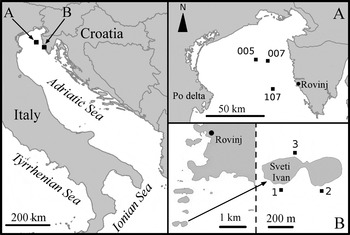
The study was carried out in the northern Adriatic Sea (Figure 1). Soft bottom samples were collected during several sampling occasions from 2003 to 2008 on three offshore monitoring stations of the Centre for Marine Research (Ruđer Bošković Institute, Rovinj), with Van Veen grab (0.1 m2) (four to five replicates per date and station). Stations SJ 005 (45°18.40′N13°18.00′E; 31 m depth) and SJ 007 (45°17.00′N13°16.00′E; 31 m depth) are situated on the profile Poreč (Croatia)—Venice-Lido (Italy), 17 and 13 nautical miles off the coast of the Istrian peninsula (Croatia), respectively. Station SJ 107 (45°02.80′N13°19.00′E; 37 m depth) is situated on the profile Rovinj (Croatia)—River Po delta (Italy), 13 nautical miles off the Istrian coast. Granulometric analyses showed high similarity in sediment composition among the three stations. Sediment is weakly sorted silty sand composed mainly of sand (ranging 66.3–70.6%), followed by silt and clay fraction (27.8–32.1%) and gravel (1.4–1.6%) (Mikac et al., Reference Mikac, Musco, Đakovac, Giangrande and Terlizzi2011).
Map of the study area: area A, soft bottom stations; area B, hard bottom stations.

Hard bottom samples were collected in summer 2007 on three coastal stations located along the Sveti Ivan Island close to Rovinj (Croatia), using SCUBA diving: Sveti Ivan 1 (45° 02.690′N13° 37.180′E), Sveti Ivan 2 (45° 02.699′N13°37.479′E) and Sveti Ivan 3 (45°02.768′N13°37.639′E). Stations are characterized by calcarenitic rocky plateaus extending from 0 to about 25 m depth, with a gentle-medium slope. Details about habitat characteristics can be found in Mikac & Musco (Reference Mikac and Musco2010). At each station, three depths were selected (1.5, 5 and 25 m), with three replicate samples at each depth by scraping the hard bottom benthos within a 10×10 cm metal frame, for a total of 27 observation units (Mikac & Musco, Reference Mikac and Musco2010).
All samples were fixed in 4% buffered formaldehyde sea-water solution, sieved through 0.5 mm (hard bottom samples) and 1 mm (soft bottom samples) mesh and preserved in 70% ethanol. Sabellidae and Fabriciidae were sorted under a stereomicroscope. Diagnostic characters were analysed, drawn and photographed under an optical microscope.
Type material was deposited at the Museo Nacional Ciencias Naturales in Madrid (MNCN), and at The Personal Collection of the Zoology Laboratory of Lecce (PCZL).
In order to complete the list of Sabellidae and Fabriciidae species and their distribution in the Adriatic Sea, the analyses of 111 research papers reporting polychaetes in the Adriatic, was done.
RESULTS
Taxonomic account
Family SABELLIDAE Johnston, 1846
Genus Amphicorina Quatrefages, Reference Quatrefages1850
This genus has been amended many times since the brief description of Quatrefages (Reference Quatrefages1850). Although the name Amphicorina was correctly used by Iroso (Reference Iroso1921), it became better known as Oriopsis Caullery and Mesnil, 1850, who erected the genus for the type species O. metchnikovi, which at present is considered a synonym of Amphicorina armandi (Claparède, 1864), after the emendation by Rouse (Reference Rouse1994).
GENUS DIAGNOSIS
Small Sabellinae with two to five pairs of crown radioles, radiolar skeleton with two rows of cells, radioles without eyes, with flanges and palmate membrane. Ventral lips present, dorsal lips without dorsal radiolar or pinnular appendages. One or two pairs of ventral radiolar appendages present (previously referred to as ventral filaments). Anterior peristomial ring developed ventrally as a narrow lobe with sometimes furcate distal end. Posterior peristomial ring collar usually present, often with a gap dorsally. Glandular girdle usually present on chaetiger 2. Body with eight thoracic and from five to 14 abdominal chaetigers. Thoracic notochaetae of two kinds: a row of elongate superior chaetae, with varying but narrow hoods, and an inferior row of smaller, thinned bayonet chaetae. Thoracic uncini acicular, with teeth of unequal sizes above the main fang. Abdominal uncini usually quadrangular, handles absent, toothed margin with a more or less enlarged basal fang. Abdominal neurochaetae needle-like or elongate and narrowly hooded.
The genus is characterized by the typical snow-flake organization of the branchial crown and by the neuropodial acicular uncini in chaetigers 1–8 with a short and blunt main fang surmounted by a series of teeth of unequal sizes above the main fang. At present, the genus includes 38 species, of which six are present in the Mediterranean Sea (Giangrande et al., Reference Giangrande, Montanaro and Castelli1999).
Amphicorina rovignensis spec. nov. (Figure 2)
MATERIAL EXAMINED
Holotype: from Sveti Ivan 3 July 2007 5 m depth. MNCN 16.01/13604.
Paratypes: 20 specimens from the same site of holotype; 1 specimen from Sveti Ivan 2 July 2007 5 m depth; one specimen from Sveti Ivan 1 July 2007 5 m depth; 1 specimen from Sveti Ivan 2 July 2007 25 m depth. PCZL.
DESCRIPTION
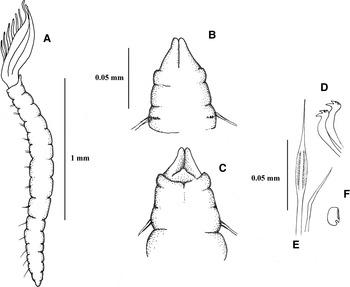
Holotype with eight thoracic and six abdominal chaetigers; 1.5 mm long (not including the 0.6 mm branchial crown), 0.1 mm wide at chaetiger 4 (Figure 2A). Branchial crown with three pairs of radioles plus a pair of ventral filaments; a pair of rounded ventral lips and a pair of dorsal lips. Radioles with two rows of skeletal cells basally and six pairs of pinnules with one row of cells; radioles flanged for most of their length. Posterior peristomial ring collar reduced dorsolaterally, with a ventral projection (Figure 2A, B, C). Two collar chaetae more slender than the remaining thoracic chaetae. Thoracic chaetigers with seven broadly hooded chaetae and one ventral bayonet chaeta (Figure 2E); dorsal chaetae longer than ventral ones. Thoracic uncini arranged in single rows per tori, seven uncini per torus, uncini with three–four rows of small teeth over a secondary tooth surmounting the main fang (Figure 2D). Abdominal neuropodia with two elongate, narrowly hooded modified chaetae; notopodia with nine rasp-shaped quadrangular uncini, with several rows of teeth of the same size and a minute anterior tooth (Figure 2F). Pygidium rounded; eyes absent.
Amphicorina rovignensis: (A) entire animal; (B) anterior end, ventral view; (C) anterior end, dorsal view; (D) thoracic uncini; (E) thoracic notochetae; (F) abdominal uncinus.

ETYMOLOGY
The name of the species refers to the location where it was found: the city of Rovinj, in which vicinity is the Sveti Ivan island.
REMARKS
All the individuals have a constant number of abdominal chaetigers. Most specimens lack the branchial crown and its analysis was possible only in two specimens, including the holotype, so that additional material is needed for a better description of the branchial crown features. Some specimens were found with eggs.
Of the 38 species described within the genus, only six are reported up to now for the Mediterranean Sea. Giangrande et al. (Reference Giangrande, Montanaro and Castelli1999) reported: A. armandi (Claparède, 1864), A. eimeri (Langerhans, 1880), A. persinosa (Ben-Eliahu, 1975), A. pectinata (Banse, 1957), and A. grahamensis Giangrande et al., 1999. In the same year, another species was described for the western Mediterranean: A. triangulata Lopez and Tena, Reference Lopez and Tena1999. This last species is the most resembling the new taxon, which in turn is similar to A. pectinata. Both species A. triangulata and A. pectinata have similar ventral projection of the collar as A. rovignensis spec. nov., but both species differ from the new taxon in having four pairs of radioles and being larger species. Amphicorina rovignensis spec. nov. is a very tiny species resambling more A. triangulata in having 6 abdominal chaetigers against more than seven present in A. pectinata, and only one pair of ventral filament against two pairs present in A. pectinata. However, the new taxon differs from A. triangulata also in the shape of ventral projection of the collar without notched tips and a longer posterior peristomial ring.
Genus Megalomma Johansson, Reference Johansson1925
This genus has a complex history: Johansson (Reference Johansson1925) recognized that Branchiomma köllikeri Claparède, 1869 did not correspond to Branchiomma Kölliker, 1858, and proposed Megalomma as a replacement name (nomen novum) for a junior homonym. Later, Johansson in his monograph (Reference Johansson1927) gave a diagnosis for Megalomma that he had named previously.
Hartman (Reference Hartman1959) regarded B. köllikeri as a junior synonym of Amphitrite vesiculosum Montagu, 1815, and she included it as type species for Megalomma (followed by Knight-Jones Reference Knight-Jones1997 and Giangrande and Licciano, Reference Giangrande and Licciano2008). However, according to Tovar-Hernández & Carrera-Parra (Reference Tovar-Hernández and Carrera-Parra.2011) who pointed out that the name of a type species remains unchanged even when it is a junior synonym or homonym, or a suppressed name, and the name of a type species should be cited by its original binomen (International Commission on Zoological Nomenclature 1999, Article 67.1.2, Recommendation 67B), the type species of Megalomma is Branchiomma köllikeri Claparède, 1869, a junior synonym of Sabella lanigera Grube, 1846 and consequently Amphitrite vesiculosum Montagu, 1815, cannot be considered type species longer.
GENUS DIAGNOSIS
Medium to large-size species, with numerous radioles. Radiolar skeleton with four or more rows of cells. Palmate membrane and radiolar flanges absent. One or more pairs of radioles each with a single, terminal compound eye along the inner radiole margin near distal end. Dorsal lips triangular, with radiolar appendage indicated by longitudinal ridge or ‘midrib’ along entire length; distinct blood vessel and radiolar sheath tissue extending through length of appendages, without a branchial skeleton extension; dorsal pinnular appendages present or absent. Ventral lips and parallel lamellae present. Posterior peristomial ring collar present. Inferior thoracic notochaete broadly hooded. Abdominal neurochaetal fascicles with elongate narrowly hooded chaetae. Thoracic uncini avicular with numerous very small teeth above the main fang, breast well developed, and handle of medium length. Companion chaetae with very thin distal ends perpendicular to the shaft. Abdominal uncini similar to thoracic ones, but with shorter handle.
The genus Megalomma Johansson, Reference Johansson1925, is characterized by a unique feature among Sabellidae, the presence of large compound eyes which it bears in at least dorsal-most radioles (Fitzhugh, Reference Fitzhugh1989). Most of the taxonomic accounts of the genus have been mainly based on morphological characters proposed by Knight-Jones (Reference Knight-Jones1997) who divided species into two main groups (groups 1 and 2) with five artificial categories based on the extent to which compound eyes occur in the radioles, whether the mid-dorsal collar margins are fused to the faecal groove or not, and whether the dorsolateral margins of the collar form pockets or not. Fitzhugh (Reference Fitzhugh2003) emended the generic diagnosis pointing out that the radiolar appendages of the dorsal lips do not have an internal skeleton and that dorsal pinnular appendages can be either present or absent. Tovar-Hernández & Salazar-Vallejo (Reference Tovar-Hernández and Salazar-Vallejo2008) modified the generic definition by the presence of a caruncle, interramal eyespots and a long dorsalmost radiolar pair. More recently the genus was the object of the important revisions with description of new taxa and phylogenetic analysis: Capa & Murray (Reference Capa and Murray2009) revised the Australian species, providing a good synthesis of the form and development of the dorsal margins of collar and proposed a cladistic analysis of some well documented species to test the validity of previous artificial classification by Knight-Jones (Reference Knight-Jones1997). In this analysis, the presence of dorsal collar margins fused to the faecal groove and the presence of pockets characterizes an apomorphic clade of Megalomma species (equivalent to group 1 by Knight-Jones), while the basal topology includes species traditionally recognized within group 2 (species with dorsal collar margins not fused to the faecal groove). This hypothesis, however, was not supported by an additional cladistic analysis successively conducted by Tovar-Hernández & Carrera-Parra (Reference Tovar-Hernández and Carrera-Parra.2011) and which includes almost all valid species.
Presently, Megalomma is composed of 33 species properly named from world-wide localities. A revision of the species present in the Mediterranean area was recently performed by Giangrande & Licciano (Reference Giangrande and Licciano2008), who report only three species for this area: M. lanigera (Grube, 1946), M. claparedei (Gravier, 1908), and M. messapicum Giangrande and Licciano, Reference Giangrande and Licciano2008. The authors also discussed the presence of M. vesiculosum (Montagu, 1815), in the Mediterranean area, since all the material previously identified as M. vesiculosum was proved to be M. lanigera. This last is the most abundant and widely distributed Mediterranean taxon.
Megalomma pseudogesae spec. nov. (Figure 3)
MATERIAL EXAMINED
Holotype: from SJ 007 12.10. 2007. MNCN 16.01/13605.
Paratypes: two specimens from the same location as holotype; one specimen from SJ 005 12.10.2007 PCZL.
DESCRIPTION
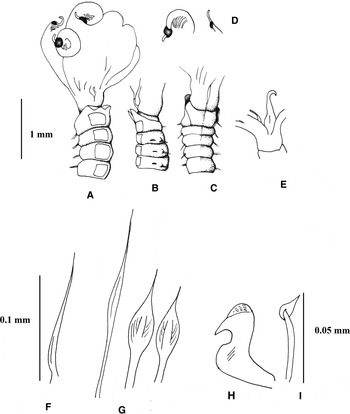
Holotype with eight thoracic and 35 abdominal chaetigers; 0.5 cm long (not including the 0.2 cm branchial crown), 0.1 mm wide, at chaetiger 4. Branchial crown with five pairs of radioles; radioles with several rows of skeletal cells; palmate membrane absent. Dorsalmost radiole bearing large rounded eye with a small free tip (Figure 3A, D), the others with smaller eyes and longer tip (Figure 3D). Anterior peristomial ring exposed dorsally and laterally beyond collar margins (Figure 3B, C). Dorsal margin of the collar not fused to the faecal groove, without pockets, and with the bases reaching the first chaetigers (Figure 3C). Collar oblique laterally and becoming higher ventrally with well-developed lappets (Figure 3A, B). Ventral lappets prominent, triangular, not overlapped, and shorter than the ventral shield of collar (Figure 3A). Lateral collar margins not covering the basal union of radioles (Figure 3B, C). Ventral shield of the first chaetiger squared, as longer as the following shields (Figure 3A). Dorsal lips erect, triangular, about one-quarter the length of the branchial crown, with mid-rib (Figure 3E). Dorsal pinnular appendages present. Ventral lips broadly rounded. Superior thoracic notochaetae elongate narrowly hooded, numbering four. Inferior thoracic notochaetae very broadly hooded, nearly paleate, numbering four (Figure 3G). Thoracic uncini numbering 10, forming a small arc and leaving a large gap between torus and ventral shield (Figure 3B); avicular, with a well developed breast and very short handle (Figure 3H). Companion chaetae with roughly symmetrical tips, as teardrop-shaped membrane (Figure 3I). Abdominal neurochaetae in two transversal rows, with elongate, narrowly hooded chaetae in the anterior row and modified, elongate, narrowly hooded chaetae in the posterior row (Figure 3F). Abdominal uncini avicular, with shorter manubrium than the thoracic ones.
Megalomma pseudogesae: (A) anterior end, ventral view; (B) anterior end, lateral view; (C) anterior end, dorsal view; (D) eyes from dorsalmost radiole (left) and from ventral most radiole (right); (E) dorsal radiolar appendage; (F) abdominal chetae; (E) thoracic chetae; (H) thoracic uncinus; (I) companion chaeta.

ETYMOLOGY
The name of the species refers to its similarity to M. gesae Knight-Jones, Reference Knight-Jones1997.
REMARKS
Megalomma pseudogesae spec. nov. share with M. gesae Knight-Jones, Reference Knight-Jones1997 and M. pigmentum Reish, 1963 several features such as: ventral flanges located at the base of branchial crown, mid-dorsal collar margins not fused to the faecal groove, and anterior peristomial ring exposed dorsally and laterally beyond collar. However, both these species have radiolar eyes only in dorsalmost pair, moreover M. pigmentum have a caruncle, ventral shield of collar transversally divided in two parts, and up to 16 pairs of radioles. Megalomma pseudogesae spec. nov. is a small sized species, same as M. gesae, with only 5 pairs of radioles. This last species, previously described as Potamilla bioculata Hartmann-Schröder, 1959, and distributed along the Pacific coast of Panama, has spherical radiolar eyes only in dorsalmost radiolar pair, all radioles with short tips, and ventral lappets of the collar longer than the ventral shield of the collar.
Faunistic account
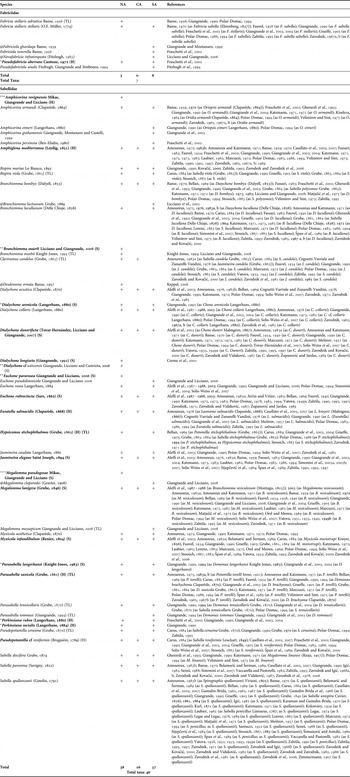
A total of 53 taxa, 46 Sabellidae and seven Fabriciidae, are reported for the Adriatic Sea (Table 1). Of these, 37 Sabellidae and six Fabriciidae are reported for the south Adriatic, 38 Sabellidae, and three Fabriciidae for the north Adriatic, while only 16 Sabellidae species are recorded in the central Adriatic Sea. Five Fabriciidae and eight Sabellidae taxa are present exclusively in the southern Adriatic, while one Fabriciidae and eight Sabellidae taxa are reported only in its northern part, and Claviramus candelus is present in the north and central, but not in the south area. Synonyms and other names under which species were reported in the analysed literature, are reported as well in Table 1. Within the present research, eight Sabellidae and one Fabriciidae species were found on hard bottom stations of Sveti Ivan island, while 12 Sabellidae species are found on the soft bottom on three offshore stations. Of these, five Sabellidae species (including the two described here) are new for the Adriatic fauna, while four Sabellidae and one Fabriciidae species were recorded for the first time in its northern part (Table 1).
The list of the Fabriciidae and Sabellidae species in the Adriatic Sea with their distribution in different Adriatic sectors and literature reporting them.

NA, northern Adriatic; CA, central Adriatic; SA, south Adriatic; in bold are the species found during the present research; (H), collected on hard bottom; (S), collected on soft bottom; **, new record for the Adriatic Sea; *, new record for the northern Adriatic; ***, described in the present research; @, alien species; (TL), species whose type locality is the Adriatic Sea.
DISCUSSION
Within the Mediterranean, 64 species of Sabellidae and 10 Fabriciidae are reported up to now (Coll et al., Reference Coll, Piroddi, Steenbeek, Kaschner, Ben Rais Lasram, Aguzzi, Ballesteros, Bianchi, Corbera, Dailianis, Danovaro, Estrada, Froglia, Galil, Gasol, Gertwagen, Gil, Guilhaumon, Kesner-Reyes, Kitsos, Koukouras, Lampadariou, Laxamana, Cuadra, Lotze, Martin, Mouillot, Oro, Raicevich, Rius-Barile, Saiz-Salinas, San Vicente, Somot, Templado, Turon, Vafidis, Villanueva and Voultsiadou2010). Prior to this research only 29 Sabellidae and two Fabriciidae taxa were known in the northern Adriatic. Current research increased the number of sabellid taxa known in the area by 31%. From 21 Fabriciidae and Sabellidae species found during this research, 10 are new for the northern Adriatic Sea. Since almost half of the records are new, we may assume that more new species will be further found in the northern Adriatic.
The number of Sabellidae taxa recorded in the northern and the southern Adriatic currently results almost the same (38 and 37, respectively). The analyses of the literature reporting Sabellidae and Fabriciidae in the Adriatic Sea (Table 1) reveals that most of the records for the northern Adriatic derive from the earlier period researches (starting already in the first half of the 19th Century and conducted mostly by Grube, continuing in the first half of the 20th Century mostly by Fauvel and Vatova, and being very intensive in the 1970s and 1980s, particularly by Amoureux, Katzmann & Zavodnik. The investigations in the northern Adriatic Sea reporting polychaetes continued until today, although most of them do not focus specifically on the polychaetes, but deal with ecological aspects of the whole benthic fauna and reporting species lists. The lack of the recent taxonomic papers focused on polychaetes in the northern Adriatic Sea is evident. High number of new records found during the present research can be particularly explained by the lack of the recent taxonomic researches. However, most of those newly recorded species were already reported for the southern Adriatic, which might indicate extending of the species areal toward the north. On contrary, the reports of the sabellids in the southern Adriatic Sea are deriving mostly from the researches conducted in the more recent period, from the 1980s until today, many of them being taxonomic (Fitzhugh et al., Reference Fitzhugh, Giangrande and Simboura1994; Giangrande, Reference Giangrande1994; Knight-Jones, Reference Knight-Jones1994; Giangrande & Licciano, Reference Giangrande and Licciano2006, Reference Giangrande and Licciano2008; Tovar-Hernández et al., Reference Tovar-Hernández, Licciano and Giangrande2007; Licciano & Giangrande, Reference Licciano and Giangrande2008).
It is particularly interesting to note that only 16 Sabellidae and none of Fabriciidae species are reported for the central Adriatic Sea. This, however, is not reflecting a low diversity of sabellids in the central Adriatic, but arises from the small number of researches conducted in that area, namely by Vatova (Reference Vatova1949a), Meštrov (Reference Meštrov1957), Gamulin-brida (1962, 1965), Katzmann (Reference Katzmann1973, Reference Katzmann1983), Cognetti-Varriale et al. (1978), Požar-Domac (Reference Požar-Domac1978), Županović & Jardas (Reference Županović and Jardas1989) and Castelli et al. (Reference Castelli, Massei, Valentini and Crema1999).
Although the number of species present in the northern area and in the southern one, resulted almost the same according to this research, some qualitative differences must be underlined. For example, most of the Fabriciidae were reported only in the southern area, as well as some species considered lessepsian migrants such as Branchiomma luctuosum (Grube, Reference Grube1870), Fabriciola ghardaqa Banse, Reference Banse1956, and Megalomma claparedei. Other species such us Megalomma messapicum, Parasabella tommasi (Giangrande, Reference Giangrande1994) and Euchone pseudolimnicola Giangrande & Licciano, Reference Giangrande and Licciano2006 were described for the south Adriatic and for the moment are not reported in the northern part. By contrast, the two new taxa described here are clearly present only in the north area, the same as Branchiomma maerli Licciano & Giangrande, Reference Licciano and Giangrande2008, B. moebii Knight-Jones, Reference Knight-Jones1994 (described for the north Adriatic) and Euchone pararosea Giangrande & Licciano, Reference Giangrande and Licciano2006, the last one being very abundant on soft bottom stations during the present research. It is interesting to note that B. maerli and E. pararosea were described for the Tyrrhenian Sea (Giangrande & Licciano, Reference Giangrande and Licciano2006; Licciano & Giangrande, Reference Licciano and Giangrande2008). Both species are described recently and this could explain why they were not recorded in the southern Adriatic Sea yet. The present identification of the specimens of Dialychone usticensis (Giangrande, Licciano & Castriota, 2006), recently described from the Ustica island (Giangrande et al., 2006), is not verified.
Beside the lessepsian migrants, other alien Sabellidae and Fabriciidae species are present in the Adriatic. Desdemona ornate Banse, 1957, found in the northern Adriatic Sea, is native to South Africa (Occhipinti Ambrogi, Reference Occhipinti Ambrogi, Leppäkoski, Gollasch and Olenin2002). Novafabricia infratorquata (Fitzhugh, Reference Fitzhugh1983), was first time found along Belize (Fitzhugh, Reference Fitzhugh1983) and then reported by Bick (Reference Bick2005) for the Gulf of Mexico and for the western Mediterranean Sea. South Adriatic specimens of this species are reported from Otranto and due to the limited available material which did not allow a good comparison with Bick's (2005) figures, are considered to probably belong to the species N. infratorquata. Caution should be taken of the previous records of Chone duneri Malmgren, 1867, Megalomma vesiculosum and Euchone rosea Langerhans, 1884 in the Adriatic. All previous records of C. duneri in the Mediterranean are to be referred to Dialychone dunerificta (Tovar-Hernández, Licciano & Giangrande, Reference Tovar-Hernández, Licciano and Giangrande2007) while the distribution of C. duneri is restricted to the Arctic Ocean (Tovar-Hernández et al., Reference Tovar-Hernández, Licciano and Giangrande2007). Consequently, all records of C. duneri in the Adriatic are considered to be D. dunerificta as well. Species previously considered belonging to the genus Chone—C. arenicola, C. collaris, C. dunerificta and C. longiseta—are attributed to the genus Dialychone, following the paper of Tovar-Hernández (Reference Tovar-Hernández2008) on the phylogeny of Chone. As far as the species E. rosea is concerned, Giangrande & Licciano (Reference Giangrande and Licciano2006) recorded this species in the southern Adriatic Sea (Brindisi) in coralligenous deposits, and report its general distribution for the Atlantic (Madeira), Ireland coasts and Mediterranean Sea. It is assumed that the specimens reported from the soft sediments in the Mediterranean Sea as E. rosea, may actually belong to a different taxon. This is possibly also the case with the northern Adriatic records of Aleffi et al., 1987–1988, 2003 and Solis-Weiss et al., Reference Solis-Weiss, Aleffi, Bettoso, Rossin and Orel2007, in the Gulf of Trieste and of Simonini et al., Reference Simonini, Ansaloni, Bonvicini Pagliai and Prevedelli2004 of the Po and Adige mouths. In previous researches M. vesiculosum was often reported from the Adriatic Sea. However, all previous findings of this species in the Mediterranean should be referred to M. lanigera (Giangrande & Licciano, Reference Giangrande and Licciano2008).
Our results point out the lack of recent taxonomic studies of polychaetes in the northern Adriatic but might also indicate the widening of the species areal from southern toward the northern Adriatic. Taking into consideration that studies on only six stations raised the number of the known sabellid species from the area by 31%, these results support the need for taxonomic studies of the polychaete fauna in the Adriatic.
The up-dated and revised species list of the Sabellidae and Fabriciidae families in the Adriatic Sea, including their distribution and literature reporting them, will serve as a good faunal base for future research.
ACKNOWLEDGEMENTS
Thanks to Andrej Jaklin and Ugo Ušić (Center for Marine Research, Rovinj—IRB) for helping with material sampling and sorting.
FINANCIAL SUPPORT
This work was carried out within the project ‘Biodiversity of benthic communities in the Adriatic Sea: natural and human impacts’ (project no. 098-0982705-2732), funded by the Ministry of Science, Education and Sports of the Republic of Croatia, and within the project ‘Faunal and biogeographic analyses of the Adriatic Sea polychaetes: taxonomic comparison of the polychaetes of Istrian and Salento coasts’, supported by the Government of the Republic of Italy in the means of the scholarship granted to the author B.M. (protocol no. 2634, 14/09/2007). The work of the authors A.G. and M.L. was carried out within the MARBEF Network of Excellence, which is funded in the Community's Sixth Framework Programme (contract no. GOCE-CT-2003-505446), the EU Integrated Project SESAME and the CMCC (Centro Euro-Mediterraneo per i Cambiamenti Climatici).