





Introduction
The term ‘polarization’ shapes current debates on worrying political developments in Western Democracies and has gained relevance in recent years, especially in view of current crises (e.g., climate change and migration; Herold, Joachim, Otteni et al. Reference Herold, Joachim, Otteni and Vorländer2023) and the rise of right-wing populism (Röllicke Reference Röllicke2023). The assumption of a divided society has become a ‘permanent narrative of our time’ (Herold, Joachim, Otteni et al. Reference Herold, Joachim, Otteni and Vorländer2023: 4, translated by the authors) and polarization even ranks among the top ten risks of the next decade according to the World Economic Forum’s Global Risk Report (World Economic Forum 2025). Due to its democracy-threatening potential, affective polarization is considered particularly problematic (Berntzen, Kelsall, and Harteveld Reference Berntzen, Kelsall and Harteveld2024; Herold, Joachim, Otteni et al. Reference Herold, Joachim, Otteni and Vorländer2023; Hutter, Schwander, Specht et al. Reference Hutter, Schwander, Specht and von Scheve2025; Röllicke Reference Röllicke2023). In contrast to issue polarization, it does not refer to differences on matters of policy but typically describes the feeling of antipathy towards an opposing political camp (outgroup) that goes along with sympathy towards one’s own political group (ingroup) (Iyengar and Westwood Reference Iyengar and Westwood2015; Neubaum Reference Neubaum, Borucki, Kleinen-von Königslöw, Marschall and Zerback2022). Affective polarization is particularly relevant given that many societies worldwide show high, in some cases even increasing, affective polarization (Boxell, Gentzkow and Shapiro Reference Boxell, Gentzkow and Shapiro2024; Garzia, Ferreira da Silva and Maye Reference Garzia, Ferreira da Silva and Maye2023; Gidron, Adams and Horne Reference Gidron, Adams and Horne2020; Reiljan Reference Reiljan2020). This applies not only to the USA, where the phenomenon has been primarily studied (Berntzen, Kelsall, and Harteveld Reference Berntzen, Kelsall and Harteveld2024; Wagner Reference Wagner2024), but also to numerous European multi-party systems, which have only recently come into focus (Bakker and Lelkes Reference Bakker and Lelkes2024; Wagner Reference Wagner2024).
Comparative research indicates that levels of affective polarization vary considerably across countries (Boxell, Gentzkow and Shapiro Reference Boxell, Gentzkow and Shapiro2024; Garzia, Ferreira da Silva and Maye Reference Garzia, Ferreira da Silva and Maye2023; Gidron, Adams and Horne Reference Gidron, Adams and Horne2020; Reiljan Reference Reiljan2020). In their longitudinal cross-national study, Gidron, Adams and Horne (Reference Gidron, Adams and Horne2020) link affective polarization to macro-level contextual factors, demonstrating that broader structural conditions shape cross-national differences in affective polarization. Moreover, recent evidence suggests that not only the levels but also the consequences of affective polarization vary across sociopolitical contexts (Berntzen Reference Berntzen, Torcal and Harteveld2025; Harteveld, Berntzen, Kokkonen et al. Reference Harteveld, Berntzen, Kokkonen, Kelsall, Linde and Dahlberg2022), further highlighting the importance of analyzing affective polarization in specific national settings. Germany – the subject of this paper – constitutes a particularly interesting case in this regard, as affective polarization is largely driven by the AfD, a populist radical right-wing party that has gained significant popular support over the past years (Deutscher Bundestag 2025; Hirndorf Reference Hirndorf2024; Hudde Reference Hudde2022; Roose Reference Roose2021). This is especially relevant in the European context, where the rise of right-wing populism has become an increasingly significant political and social phenomenon (Röllicke Reference Röllicke2023). Comparative studies focusing on the least- and most-liked parties show that Germany exhibits above-average affective polarization compared to other European countriesFootnote 1 (Areal and Harteveld Reference Areal and Harteveld2024; Reiljan Reference Reiljan, Torcal and Harteveld2025), further highlighting the importance of analyzing Germany in this context. Despite this relevance, relatively few studies have systematically investigated affective polarization in Germany, leaving a notable gap in the literature (Vorländer, Herold, Hormig et al. Reference Vorländer, Herold, Hormig and Otteni2025).
Affective polarization is widely viewed as problematic in both academic and public debates, primarily because of its presumed destructive consequences for democracy (Berntzen, Kelsall, and Harteveld Reference Berntzen, Kelsall and Harteveld2024; Hutter, Schwander, Specht et al. Reference Hutter, Schwander, Specht and von Scheve2025; Röllicke Reference Röllicke2023). Although concerns about the far-reaching political consequences of affective polarization have long been present in the literature (Iyengar, Sood and Lelkes Reference Iyengar, Sood and Lelkes2012) and are still widely debated (Druckman, Green and Iyengar Reference Druckman, Green and Iyengar2023; Kokkonen and Harteveld Reference Kokkonen, Harteveld, Torcal and Harteveld2025; Schmelzle Reference Schmelzle2021), systematic empirical investigations of these consequences have gained substantial momentum only in recent years (Berntzen, Kelsall, and Harteveld Reference Berntzen, Kelsall and Harteveld2024; Broockman, Kalla and Westwood et al. Reference Broockman, Kalla and Westwood2023; Druckman, Klar, Krupnikov et al. Reference Druckman, Klar, Krupnikov, Levendusky and Barry Ryan2021; Iyengar, Lelkes, Levendusky et al. Reference Iyengar, Lelkes, Levendusky, Malhotra and Westwood2019; Neubaum Reference Neubaum, Borucki, Kleinen-von Königslöw, Marschall and Zerback2022). Existing findings suggest that affective polarization may contribute to the erosion of democratic norms (Harteveld, Berntzen, Kokkonen et al. Reference Harteveld, Berntzen, Kokkonen, Kelsall, Linde and Dahlberg2022; Kingzette, Druckman, Klar et al. Reference Kingzette, Druckman, Klar, Krupnikov, Levendusky and Ryan2021; but see Kokkonen and Harteveld Reference Kokkonen, Harteveld, Torcal and Harteveld2025, for a nuanced overview), weaken political and social trust (Hetherington and Rudolph Reference Hetherington and Rudolph2015; Torcal and Comellas Reference Torcal, Comellas, Torcal and Harteveld2025; Torcal and Thomson Reference Torcal and Thomson2023), and hamper compromise and decision-making in politics (Hetherington and Rudolph Reference Hetherington and Rudolph2015). In this sense, affective polarization has been described as a ‘poisonous cocktail’ (Kretchner, Elad-Strenger, Hirsch-Hoefler et al. Reference Kretchner, Elad-Strenger, Hirsch-Hoefler, Orian-Harel and Halperin2024: 2) that undermines social cohesion and democratic functioning in the form of democratic backsliding (McCoy and Somer Reference McCoy and Somer2019; Orhan, Reference Orhan2022; Torcal, Stolle and Thomson Reference Torcal, Stolle, Thomson, Torcal and Harteveld2025). At the same time, some studies have challenged the universality of these effects, especially regarding democratic norms, and suggest that the consequences of affective polarization are more conditional and context-dependent than often assumed (e.g., Broockman, Kalla and Westwood Reference Broockman, Kalla and Westwood2023; Kokkonen and Harteveld Reference Kokkonen, Harteveld, Torcal and Harteveld2025; Voelkel, Chu, Stagnaro et al. Reference Voelkel, Chu, Stagnaro, Mernyk, Redekopp, Pink, Druckman, Rand and Willer2023). Against this backdrop, developing a more nuanced understanding of the mechanisms through which affective polarization translates into democratic outcomes is crucial for assessing – and potentially mitigating – its democratic risks (Lubej, Dolezal and Kirbiš Reference Lubej, Dolezal and Kirbiš2025; Shah Reference Shah2025). Two politically relevant potential consequences of affective polarization at the interpersonal (horizontal) level have so far received comparatively little scholarly attention: the willingness for self-censoring the expression of one’s own opinions (self-censorship [SC]; Carlson and Settle Reference Carlson and Settle2023) as well as the willingness for silencing others (belief in the importance of silencing others; Tsfati and Dvir-Gvirsman Reference Tsfati and Dvir-Gvirsman2018). Both outcomes are highly consequential for democratic discourse, as they shape who participates in political communication and whose voices are considered legitimate in everyday political interactions (Bar-Tal Reference Bar-Tal2017; Dubois and Szwarc Reference Dubois and Szwarc2018; Mutz Reference Mutz2002; Tsfati Reference Tsfati2020). If affective polarization discourages individuals from expressing dissenting views or increases support for restricting the speech of political opponents, it may undermine the openness, inclusiveness, and deliberative quality of democratic debate (Mutz Reference Mutz2006; Tsfati Reference Tsfati2020). Yet, despite their normative relevance, these interpersonal consequences have rarely been examined as outcomes of affective polarization (Carlson and Settle Reference Carlson and Settle2023).
One particularly understudied avenue for advancing our understanding of political consequences concerns the role of discrete emotions. Until now, most studies focus on generalized affective polarization, which is conceptualized as a unidimensional construct and exclusively based on the valence dimension of feelings (Iyengar, Lelkes, Levendusky et al. Reference Iyengar, Lelkes, Levendusky, Malhotra and Westwood2019; Reiljan Reference Reiljan2020; Röllicke Reference Röllicke2023). By contrast, only a small number of studies explicitly examine how specific outgroup-directed emotions shape political attitudes and behavior. At the same time, numerous authors emphasize that analyzing specific emotions is essential to fully understand the construct and its consequences (Bakker and Lelkes Reference Bakker and Lelkes2024; Berntzen, Kelsall, and Harteveld Reference Berntzen, Kelsall and Harteveld2024; Kretchner, Elad-Strenger, Hirsch-Hoefler et al. Reference Kretchner, Elad-Strenger, Hirsch-Hoefler, Orian-Harel and Halperin2024; Röllicke Reference Röllicke2023). Responding to these calls, the present study adopts a more fine-grained perspective on the emotional dimension of affective polarization by examining the role of the discrete negative emotions of fear, disgust, and anger alongside generalized outgroup dislike.
Overall, this study aims to address several key gaps in the literature. First, by focusing on Germany, it contributes to the study of affective polarization in multi-party systems, which remains relatively unexplored, as most prior research has focused on the United States. Second, the potential consequences of affective polarization for political discourse, in particular SC and the willingness to silence political outgroups (BISO), have received little attention in prior research. Third, by incorporating discrete emotions in the study of affective polarization, the study provides new insights into the psychological mechanisms that may drive potential consequences. Through a quantitative online survey of German adults (N = 1,918), the study aims to answer the overarching research question of how affective polarization is related to the willingness for SC and the silencing of others.
Theoretical background
Affective polarization
The concept of affective polarization originates from US-American research and was significantly shaped by the work of Iyengar, Sood and Lelkes (Reference Iyengar, Sood and Lelkes2012) (Knudsen Reference Knudsen2021; Röllicke Reference Röllicke2023). In contrast to issue-based polarization, which refers to attitudes on political issues, affective polarization typically encompasses the evaluation of political groups and describes the tendency to feel positive emotions (sympathy) towards one’s own political group and negative emotions (antipathy) towards the political outgroup (Iyengar and Westwood Reference Iyengar and Westwood2015; Neubaum Reference Neubaum, Borucki, Kleinen-von Königslöw, Marschall and Zerback2022). However, scholars have come up with various definitions and conceptualizations of the construct, which is why Bakker and Lelkes (Reference Bakker and Lelkes2024: 418) speak of ‘conceptual slippage’ in this context. The theoretical foundation of affective polarization is the Social Identity Theory (SIT) by Tajfel and Turner (Reference Tajfel, Turner, Austin and Worchel1979) (Iyengar, Lelkes, Levendusky et al. Reference Iyengar, Lelkes, Levendusky, Malhotra and Westwood2019). According to SIT, individuals categorize their social environment into groups (social categorization), distinguishing between their own group (ingroup) and other groups (outgroup) (Gollwitzer and Schmitt Reference Gollwitzer and Schmitt2019; Neubaum Reference Neubaum, Borucki, Kleinen-von Königslöw, Marschall and Zerback2022). The perception of being part of a particular group is referred to as social identity and, in the context of affective polarization, mostly refers to party affiliation (Fischer, Jander and Krueger Reference Fischer, Jander, Krueger, Fischer, Jander and Krueger2018; Huddy Reference Huddy, Huddy, Sears and Levy2013; Iyengar, Lelkes, Levendusky et al. Reference Iyengar, Lelkes, Levendusky, Malhotra and Westwood2019): If individuals identify with a party, they differentiate between their political ingroup (other supporters of the same party) and political outgroup (supporters of other parties) based on their party affiliation (Iyengar, Lelkes, Levendusky et al. Reference Iyengar, Lelkes, Levendusky, Malhotra and Westwood2019). To establish or maintain a positive self-image, the political ingroup is positively evaluated and the political outgroup is negatively evaluated in social comparison processes (Gollwitzer and Schmitt Reference Gollwitzer and Schmitt2019; Neubaum Reference Neubaum, Borucki, Kleinen-von Königslöw, Marschall and Zerback2022; Tajfel and Turner Reference Tajfel, Turner, Austin and Worchel1979). These processes represent the core of affective polarization and can explain sympathy towards the ingroup and antipathy towards the outgroup (Druckman and Levendusky Reference Druckman and Levendusky2019; Gollwitzer and Schmitt Reference Gollwitzer and Schmitt2019).
In this paper, affective polarization is examined at the micro level and conceptualized as an individual state (Bakker and Lelkes Reference Bakker and Lelkes2024; Berntzen, Kelsall, and Harteveld Reference Berntzen, Kelsall and Harteveld2024). Rather than focusing on the evaluation of political parties, we examine individuals’ evaluations of party supporters (Druckman and Levendusky Reference Druckman and Levendusky2019; Harteveld, Berntzen, Kokkonen et al. Reference Harteveld, Berntzen, Kokkonen, Kelsall, Linde and Dahlberg2022; Röllicke Reference Röllicke2023). Supporters are understood to be all individuals who feel particularly close to a party, vote for it, or support it in some way.
Following recent research on affective polarization, including discrete emotions in multiparty systems (Berntzen, Kelsall, and Harteveld Reference Berntzen, Kelsall and Harteveld2024; Kretchner, Elad-Strenger, Hirsch-Hoefler et al. Reference Kretchner, Elad-Strenger, Hirsch-Hoefler, Orian-Harel and Halperin2024), we focus exclusively on negative affect towards the political outgroup and do not consider potential positive affect towards the political ingroup. While affective polarization, based on SIT (Tajfel and Turner Reference Tajfel, Turner, Austin and Worchel1979), is often conceptualized as the difference between ingroup and outgroup evaluations (Iyengar, Sood and Lelkes Reference Iyengar, Sood and Lelkes2012; Tajfel and Turner Reference Tajfel, Turner, Austin and Worchel1979), a substantial body of research operationalizes the concept solely through outgroup-directed negativity, still referring to it as affective polarization (e.g., Berntzen, Kelsall, and Harteveld Reference Berntzen, Kelsall and Harteveld2024; Kretchner, Elad-Strenger, Hirsch-Hoefler et al. Reference Kretchner, Elad-Strenger, Hirsch-Hoefler, Orian-Harel and Halperin2024; Nelson Reference Nelson2022; Simas, Clifford and Kirkland Reference Simas, Clifford and Kirkland2020). One rationale for this approach is that increases in affective polarization are primarily driven by rising hostility towards the political outgroup (Abramowitz and Webster Reference Abramowitz and Webster2016; Finkel, Bail, Cikara et al. Reference Finkel, Bail, Cikara, Ditto, Iyengar, Klar, Mason, McGrath, Nyhan, Rand, Skitka, Tucker, Van Bavel, Wang and Druckman2020), which has also been documented for Germany (Garzia and Ferreira da Silva Reference Garzia and Ferreira da Silva2025). Moreover, when studying the consequences of affective polarization, negative outgroup affect is often the most relevant component, as Vanagt (Reference Vanagt2024: 102) emphasizes: ‘When the research question is mostly interested in the causes or consequences of out-group animosity, it may be more appropriate to focus solely on out-group dislike’. Likewise, as research on discrete emotions focuses exclusively on emotions directed at the outgroup (Bakker and Lelkes Reference Bakker and Lelkes2024), conceptualizing generalized affective polarization solely as outgroup dislike ensures consistency and comparability across our key explanatory variables. In line with the ‘least-liked party’ approach (Knöchelmann and Cohrs Reference Knöchelmann and Cohrs2024), the outgroup is more specifically defined as supporters of the party an individual feels most distant from (e.g., Areal and Harteveld Reference Areal and Harteveld2024; Berntzen, Kelsall, and Harteveld Reference Berntzen, Kelsall and Harteveld2024; Harteveld, Berntzen, Kokkonen et al. Reference Harteveld, Berntzen, Kokkonen, Kelsall, Linde and Dahlberg2022). This approach reflects the reality in multiparty systems that citizens do not necessarily identify all non-preferred parties as political outgroups (Reiljan Reference Reiljan, Torcal and Harteveld2025) and is a commonly used as well as pragmatic strategy in existing studies (Harteveld, Berntzen, Kokkonen et al. Reference Harteveld, Berntzen, Kokkonen, Kelsall, Linde and Dahlberg2022; Reiljan Reference Reiljan, Torcal and Harteveld2025; Renström, Bäck and Carroll Reference Renström, Bäck and Carroll2021). Finally, we distinguish between generalized affective polarization and discrete emotions. While the former captures overall negative affect, discrete emotions encompass specific emotional reactions towards the outgroup. The present study focuses on fear, anger, and disgust as discrete emotions as they are considered negative basic emotions (Ekman Reference Ekman1992) and have been examined in previous research on discrete emotions underlying affective polarization (Berntzen, Kelsall, and Harteveld Reference Berntzen, Kelsall and Harteveld2024; Kretchner, Elad-Strenger, Hirsch-Hoefler et al. Reference Kretchner, Elad-Strenger, Hirsch-Hoefler, Orian-Harel and Halperin2024). Taken together, we define affective polarization as individuals’ tendency to evaluate the outgroup – defined as the supporters of the political party from which they feel most distant – negatively. Following this conceptualization, an individual shows high affective polarization if they experience strong negative feelings towards their political outgroup.
Potential consequences of affective polarization
The potential consequences of affective polarization can manifest on various levels, with a distinction being made in the literature between vertical and horizontal consequences (Berntzen, Kelsall, and Harteveld Reference Berntzen, Kelsall and Harteveld2024; Harteveld, Berntzen, Kokkonen et al. Reference Harteveld, Berntzen, Kokkonen, Kelsall, Linde and Dahlberg2022). Vertical consequences concern the perception or evaluation of the political system, including democratic norms, and can therefore be understood as ‘system-oriented consequences’ (Berntzen, Kelsall, and Harteveld Reference Berntzen, Kelsall and Harteveld2024: 930) (Berntzen, Kelsall, and Harteveld Reference Berntzen, Kelsall and Harteveld2024; Harteveld, Berntzen, Kokkonen et al. Reference Harteveld, Berntzen, Kokkonen, Kelsall, Linde and Dahlberg2022). Horizontal consequences encompass the interpersonal domain and refer to interactions with other individuals, which is why they are referred to as ‘inter-citizen consequences’ (Berntzen, Kelsall, and Harteveld Reference Berntzen, Kelsall and Harteveld2024: 930). Although this differentiation is not completely clear-cut as the two levels may be intertwined (Harteveld, Berntzen, Kokkonen et al. Reference Harteveld, Berntzen, Kokkonen, Kelsall, Linde and Dahlberg2022) it is well-established in the literature (Berntzen, Kelsall, and Harteveld Reference Berntzen, Kelsall and Harteveld2024; Harteveld, Berntzen, Kokkonen et al. Reference Harteveld, Berntzen, Kokkonen, Kelsall, Linde and Dahlberg2022; Röllicke Reference Röllicke2023). The willingness for self-censoring and silencing others, which will be discussed in the following sections, both relate to interactions with members of the political outgroup and can therefore be conceptualized as potential horizontal consequences.
Willingness to self-censor
Carlson and Settle (Reference Carlson and Settle2023: 247) define SC as a low ‘likelihood of expressing one’s true opinions’. In the context of this paper, we focus on SC vis-a-vis the respective political outgroups of citizens. Accordingly, the willingness to self-censor can be described as the willingness to restrict or withhold one’s own opinions in conversations about political or social issues with supporters of the outgroup party (both online and offline) (Carlson and Settle Reference Carlson and Settle2023). It can be assumed that citizens attribute differing political views to members of the political outgroup and that SC is carried out to varying degrees depending on the situation (Carlson and Settle Reference Carlson and Settle2023). While SC can also be conceptualized as an individual personality trait (cf. Hayes, Glynn and Shanahan Reference Hayes, Glynn and Shanahan2005a, Reference Hayes, Glynn and Shanahan2005b), the focus here is on this situational component of the construct (Carlson and Settle Reference Carlson and Settle2023). Our understanding of SC is further based on the assumption that individuals weigh the expected costs and benefits of expressing their opinions (Carlson and Settle Reference Carlson and Settle2022; Menzner and Traunmüller Reference Menzner and Traunmüller2023). On the one hand, affective polarization may raise the perceived costs of expressing political opinions, thus intensifying SC. On the other hand, it may also increase the perceived benefits of opinion expression and consequently lead to lower levels of SC.
Regarding the first argument, several authors have already hypothesized that (affective) polarization increases the costs of expressing opinions towards supporters of the outgroup party and thereby promotes SC (Gibson and Sutherland Reference Gibson and Sutherland2023; Menzner and Traunmüller Reference Menzner and Traunmüller2023). Reasons for this could be that a negative evaluation of outgroup members leads people to expect threatening opinions or sanctions from them (Menzner and Traunmüller Reference Menzner and Traunmüller2023; Neumann, Kelm and Dohle Reference Neumann, Kelm and Dohle2021; Post Reference Post2019) or to generally perceive interactions as more psychologically stressful and unpleasant (Carlson and Settle Reference Carlson and Settle2022; Harteveld, Berntzen, Kokkonen et al. Reference Harteveld, Berntzen, Kokkonen, Kelsall, Linde and Dahlberg2022). Therefore, if citizens perceive the potential costs of expressing an opinion as too high in relation to the potential benefits, the willingness to self-censor towards the outgroup should increase (Gibson and Sutherland Reference Gibson and Sutherland2023; Menzner and Traunmüller Reference Menzner and Traunmüller2023).
Empirically, however, this relationship has so far been little researched. While Carlson and Settle (Reference Carlson and Settle2022, Reference Carlson and Settle2023) did not specifically examine affective polarization in their studies, they found that the likelihood of expressing one’s true opinion in a political conversation is lower towards people with a differing party identification. They attribute this, in addition to differing political views, to the fact that individuals attribute more negative characteristics to supporters of other parties and therefore want to avoid interactions with them (Carlson and Settle Reference Carlson and Settle2022; see also Hayes, Glynn and Shanahan Reference Hayes, Glynn and Shanahan2005b; Hayes, Uldall and Glynn Reference Hayes, Uldall and Glynn2010). The relationship between affective polarization and avoidance of the outgroup has been demonstrated in numerous studies, including in relation to conversations (Berntzen, Kelsall, and Harteveld Reference Berntzen, Kelsall and Harteveld2024) and political discussions (Harteveld, Berntzen, Kokkonen et al. Reference Harteveld, Berntzen, Kokkonen, Kelsall, Linde and Dahlberg2022). SC could also be seen as a form of avoidance behavior: to avoid intense discussions with outgroup members and to interact with them as little and as briefly as possible, people may be more likely to withhold their opinions.
However, drawing on SIT (Tajfel and Turner Reference Tajfel, Turner, Austin and Worchel1979), an alternative expectation can be derived according to which affective polarization may reduce rather than increase SC. From this perspective, affective polarization stems from individuals’ desire to maintain a positive social identity and to protect the status of the ingroup (Tajfel and Turner Reference Tajfel, Turner, Austin and Worchel1979), fostering perceptions of a ‘zero-sum intergroup conflict’ (Kokkonen and Harteveld Reference Kokkonen, Harteveld, Torcal and Harteveld2025: 388) and of the outgroup as opponent (Anderson Reference Anderson2022; Kingzette, Druckman, Klar et al. Reference Kingzette, Druckman, Klar, Krupnikov, Levendusky and Ryan2021; Kokkonen and Harteveld Reference Kokkonen, Harteveld, Torcal and Harteveld2025: 388). As this heightens the stakes of political competition, affectively polarized individuals may be more motivated to defend the ingroup and constrain the influence of the outgroup (Anderson Reference Anderson2022; Harteveld, Berntzen, Kokkonen et al. Reference Harteveld, Berntzen, Kokkonen, Kelsall, Linde and Dahlberg2022; Harteveld and Wagner Reference Harteveld and Wagner2023; Kokkonen and Harteveld Reference Kokkonen, Harteveld, Torcal and Harteveld2025). Under these conditions, withholding one’s true opinion may become less attractive, as expressing political views serves important identity-related and instrumental functions, such as affirming group membership, supporting the ingroup, or challenging the outgroup (DuBosar, Shaughnessy, Pittet Gonzales Reference DuBosar, Shaughnessy, Pittet Gonzales and Hutchens2025; Harteveld and Wagner Reference Harteveld and Wagner2023). Consequently, the perceived benefits of opinion expression may increase relative to its potential social or psychological costs (Harteveld and Wagner Reference Harteveld and Wagner2023), leading to lower levels of SC even in interactions with outgroup members. To date, the potential for affective polarization to reduce SC has not been empirically tested.
Taken together, affective polarization may influence the cost–benefit analysis underlying SC in opposing ways. Negative evaluations of the outgroup, expectations of social sanctions (Menzner and Traunmüller Reference Menzner and Traunmüller2023) and the perception of interactions as unpleasant (Carlson and Settle Reference Carlson and Settle2022; Harteveld, Berntzen, Kokkonen et al. Reference Harteveld, Berntzen, Kokkonen, Kelsall, Linde and Dahlberg2022) may heighten the perceived costs of expressing one’s true opinions, thereby fostering SC. At the same time, the heightened stakes of political competition may enhance the perceived benefits of opinion expression (Harteveld and Wagner Reference Harteveld and Wagner2023; Kokkonen and Harteveld Reference Kokkonen, Harteveld, Torcal and Harteveld2025), reducing individuals’ willingness to withhold their views. Given these competing mechanisms, the direction of the relationship between affective polarization and outgroup-related SC remains ambiguous. Consequently, we pose the following open research question:
RQ1: How is affective polarization associated with self-censorship (SC) in discussions with the political outgroup.
Willingness to silence others
The willingness to silence the political outgroup can be considered another possible horizontal consequence of affective polarization. In this paper, silencing others is defined as the willingness to restrict the expression of opinions by others. Conceptually, we refer to Tsfati and Dvir-Gvirsman’s (Reference Tsfati and Dvir-Gvirsman2018) work on the ‘Belief in the Importance of Silencing Others (BISO)’. They define BISO as ‘people’s belief that it is not only legitimate but also important and necessary to tell other people to refrain from expressing their political views’ (Tsfati and Dvir-Gvirsman Reference Tsfati and Dvir-Gvirsman2018: 391). This conviction can be explained, among other things, by the fact that people want to avoid the feeling of cognitive dissonance by avoiding incongruent information (Festinger Reference Festinger1957; Tsfati and Dvir-Gvirsman Reference Tsfati and Dvir-Gvirsman2018). From a group psychological perspective, BISO can be seen as an attempt to restore the positive image of the ingroup when dissent through incongruent opinions expressed by the outgroup is perceived as a threat to this group (Jetten and Hornsey Reference Jetten and Hornsey2014; Tsfati and Dvir-Gvirsman Reference Tsfati and Dvir-Gvirsman2018). Also based on SIT (Tajfel and Turner Reference Tajfel, Turner, Austin and Worchel1979), identity threats and cognitive dissonance caused by the outgroup might lead people with strong group identification to defend this identity by silencing the opposing side (Post Reference Post2019). Tsfati and Dvir-Gvirsman (Reference Tsfati and Dvir-Gvirsman2018) also suggest that people may consider the views of an outgroup to be dangerous and therefore do not want them to be spread.
To the best of our knowledge, the extent to which affective polarization may influence BISO has only been researched in one study so far. Neumann and colleagues (Reference Neumann, Kelm and Dohle2021) investigated the influence of affective polarization on BISO in the context of the COVID-19 pandemic. In their study, in- and outgroups were not defined by party preference, but by attitudes towards Corona measures. The authors assume that a negative evaluation of the outgroup may contribute to the expectation that they would express negative or even threatening opinions, which could lead to a higher BISO. This assumption was only partly confirmed as affective polarization was associated with higher BISO only among supporters of COVID-19 measures, but with lower BISO among opponents of the measures (Neumann, Kelm and Dohle Reference Neumann, Kelm and Dohle2021). However, the study was conducted in the rather specific context of the COVID-19 pandemic, raising questions of generalizability (Herold, Joachim, Otteni et al. Reference Herold, Joachim, Otteni and Vorländer2023; Neumann, Kelm and Dohle Reference Neumann, Kelm and Dohle2021).
Despite a lack of studies connecting affective polarization and BISO specifically, there are studies that examine the relationship between affective polarization and constructs similar or connected to BISO. For example, Berntzen and colleagues (Reference Berntzen, Kelsall and Harteveld2024) showed that high affective polarization is associated with high political intolerance. Intolerance in this context refers to the willingness to restrict the rights and freedoms of supporters of the political outgroup, which may include freedom of speech (Berntzen, Kelsall, and Harteveld Reference Berntzen, Kelsall and Harteveld2024; Levitsky and Ziblatt, Reference Levitsky and Ziblatt2018). Harteveld and colleagues (Reference Harteveld, Berntzen, Kokkonen, Kelsall, Linde and Dahlberg2022) come to similar conclusions. Some studies have also found that higher affective polarization is associated with stronger support for undemocratic norms (Druckman and Levy, Reference Druckman, Levy and Rudolph2022; Harteveld, Berntzen, Kokkonen et al. Reference Harteveld, Berntzen, Kokkonen, Kelsall, Linde and Dahlberg2022; Kingzette, Druckman, Klar et al. Reference Kingzette, Druckman, Klar, Krupnikov, Levendusky and Ryan2021), which could include denying outgroup supporters the right to free speech. Furthermore, affective polarization is positively associated with political participation (Iyengar and Krupenkin Reference Iyengar and Krupenkin2018; Lubej, Dolezal and Kirbiš Reference Lubej, Dolezal and Kirbiš2025; Mason Reference Mason2018; Wagner Reference Wagner2021). Given that activities resulting from BISO can be regarded as an unconventional form of political participation, affective polarization may be linked to an increased willingness to silence others (Tsfati Reference Tsfati2020; Tsfati and Dvir-Gvirsman Reference Tsfati and Dvir-Gvirsman2018). Overall, these findings suggest that people with higher affective polarization may be more likely to want to silence supporters of the political outgroup. Therefore, the following hypothesis is derived:
H1: Higher levels of generalized affective polarization are associated with a higher willingness to silence the political outgroup (BISO).
Discrete emotions in the context of affective polarization
The valence-based approach (Kretchner, Elad-Strenger, Hirsch-Hoefler et al. Reference Kretchner, Elad-Strenger, Hirsch-Hoefler, Orian-Harel and Halperin2024: 2) and the feeling thermometer have become the standard for measuring generalized affective polarization (Röllicke Reference Röllicke2023). However, this unidimensional conceptualization is criticized, as it remains unclear which specific emotions individuals feel towards their political outgroup (Kretchner, Elad-Strenger, Hirsch-Hoefler et al. Reference Kretchner, Elad-Strenger, Hirsch-Hoefler, Orian-Harel and Halperin2024; Versteegen Reference Versteegen2024). Specifying affective valence into discrete emotions is particularly relevant when examining the potential consequences of affective polarization, as specific emotions are associated with distinct appraisals and action tendencies (Bak Reference Bak2019; Berntzen, Kelsall, and Harteveld Reference Berntzen, Kelsall and Harteveld2024; Frijda Reference Frijda1986; Versteegen Reference Versteegen2024). This study therefore examines not only generalized affective polarization but also the discrete negative emotions of fear, disgust, and anger and their relationship with individuals’ willingness to engage in SC and BISO.
Fear is associated with an avoidance tendency, promotes risk aversion, and discourages individuals from offensive actions (Berntzen, Kelsall, and Harteveld Reference Berntzen, Kelsall and Harteveld2024; Lerner and Keltner Reference Lerner and Keltner2000). In the context of affective polarization, Berntzen, Kelsall, and Harteveld et al. (Reference Berntzen, Kelsall and Harteveld2024) show that fear of the political outgroup is associated with avoidance of that group. As SC can be understood as a type of avoidance behavior, fear of the outgroup possibly increases the willingness to self-censor. Following the costs and benefits framework (Section Willingness to Self-Censor), it seems plausible that fear increases the expected costs of expressing one’s political opinions in discussions with the outgroup. Emotion theory suggests that fear is elicited by a perceived threat to physical safety as well as appraisals of uncertainty, lack of control, and inferiority (Cottrell and Neuberg Reference Cottrell and Neuberg2005; Mackie and Smith Reference Mackie and Smith2018; Sirin and Villalobos Reference Sirin and Villalobos2019). Fearing one’s political outgroup may therefore reflect expectations of negative reactions, social sanctions, or physical threats when expressing one’s views, which increases the perceived costs of political expression (Menzner and Traunmüller Reference Menzner and Traunmüller2023; Neumann, Kelm and Dohle Reference Neumann, Kelm and Dohle2021; Post Reference Post2019). At the same time, perceived benefits of expression are likely to be low, as feelings of inferiority may reduce individuals’ expectations that expressing their views will be effective. Therefore, we presume:
H2: Fear of the political outgroup is associated with a higher tendency to self-censor (SC) in discussions with its members.
Following this line of argument, it seems plausible that fear not only increases individuals’ willingness to self-censor but also reduces their willingness to silence others.Footnote 2 As BISO reflects a rather confrontational tendency and therefore entails heightened risks of conflict escalation, fearful individuals may be less likely to silence their political outgroup. This assumption is in line with the avoidance tendency associated with fear, which leads individuals to refrain from confrontational behavior and seek to minimize potential conflict (Berntzen, Kelsall, and Harteveld Reference Berntzen, Kelsall and Harteveld2024; Lerner and Keltner Reference Lerner and Keltner2000). Based on this reasoning, we hypothesize:
H3: Fear of the political outgroup is associated with a lower willingness to silence its members (BISO).
Anger is considered a ‘mobilizing emotion’ (Berntzen, Kelsall, and Harteveld Reference Berntzen, Kelsall and Harteveld2024: 934) associated with approach tendencies. Emotion theory conceptualizes anger as arising from appraisals of certainty and control (Mackie and Smith Reference Mackie and Smith2018). It is most likely to arise when the ingroup is perceived to be in a relatively strong position (Sirin and Villalobos Reference Sirin and Villalobos2019). Unlike fear, anger motivates individuals to confront perceived sources of threat (Cottrell and Neuberg Reference Cottrell and Neuberg2005). In the context of affective polarization, anger toward a political outgroup may therefore increase individuals’ willingness to express their political views, even in the face of potential disagreement or conflict. Angry individuals are less likely to perceive opinion expression as risky or threatening and may instead view it as an opportunity to assert their position, defend their group, or challenge opposing views (Lerner and Keltner Reference Lerner and Keltner2000). As a result, anger can be expected to lower the perceived costs and increase the perceived benefits of political expression (Menzner and Traunmüller Reference Menzner and Traunmüller2023). Consequently, anger should reduce the likelihood of withholding one’s political opinions. Therefore, we hypothesize:
H4: Anger toward the political outgroup is associated with less self-censorship (SC) in discussions with its members.
Since angry individuals are more politically intolerant and therefore more willing to restrict the rights of others (Berntzen, Kelsall, and Harteveld Reference Berntzen, Kelsall and Harteveld2024), they may also be more likely to approve of or engage in censorship of their political outgroup. Additionally, empirical findings indicate a positive correlation between anger and political participation (Bettarelli, Close, and Van Haute Reference Bettarelli, Close and Van Haute2022; Renström and Bäck Reference Renström and Bäck2021; Valentino, Gregorowicz, and Groenendyk, et al. Reference Valentino, Gregorowicz and Groenendyk2009; Valentino, Brader, Groenendyk et al. Reference Valentino, Brader, Groenendyk, Gregorowicz and Hutchings2011). If BISO is considered an unconventional form of political participation, then angry individuals may be more likely to engage in it. Furthermore, Erisen (Reference Erisen2020: 11) emphasizes that ‘anger causes people to […] respond in a hostile manner toward people and ideas that undermine them’, which could also enhance the willingness to silence their political outgroup. It can therefore be presumed:
H5: Anger toward the political outgroup is associated with a higher willingness to silence its members (BISO).
Disgust, like fear, is also associated with an avoidance tendency (Shook, Thomas, and Ford Reference Shook, Thomas and Ford2019) and predicts individuals’ willingness to distance themselves from an outgroup (Berntzen, Kelsall, and Harteveld Reference Berntzen, Kelsall and Harteveld2024; Mackie, Devos and Smith Reference Mackie, Devos and Smith2000). Accordingly, it can be assumed that disgust is associated with an increased tendency to self-censor. However, Berntzen, Kelsall, and Harteveld (Reference Berntzen, Kelsall and Harteveld2024) also assume that ‘disgust experienced in response to an outgroup threatening the values of the ingroup results in the drive to protect those values and interests’ (Berntzen, Kelsall, and Harteveld Reference Berntzen, Kelsall and Harteveld2024: 934). This implies that disgust could, in some cases, motivate individuals to speak out in defense of their ingroup, as it may increase the perceived benefits of expressing their opinions. Thus, the relationship between disgust and SC is theoretically ambiguous: on the one hand, disgust may foster SC through avoidance; on the other hand, it may prompt individuals to express their views to protect their ingroup. In light of these competing theoretical expectations, we pose the following exploratory research question:
RQ2: How is disgust toward the political outgroup associated with an individual’s tendency to engage in self-censorship (SC) in discussions with outgroup members?
Disgust also shows a theoretically ambiguous relationship with BISO: As disgust may drive individuals to protect their ingroup (Berntzen, Kelsall, and Harteveld Reference Berntzen, Kelsall and Harteveld2024) and BISO can be understood as a protective measure aimed at safeguarding ingroup values (Tsfati and Dvir-Gvirsman Reference Tsfati and Dvir-Gvirsman2018), it is plausible that disgust is positively related to BISO. Additionally, Berntzen, Kelsall, and Harteveld (Reference Berntzen, Kelsall and Harteveld2024) identified disgust toward the outgroup as the strongest predictor of political intolerance. Given the theoretical overlap between BISO and political intolerance (Section Willingness to Silence Others), disgust might therefore increase the willingness to silence the outgroup. However, as argued above, the avoidance tendency associated with disgust (Shook, Thomas, and Ford et al., Reference Shook, Thomas and Ford2019) might also lead individuals to refrain from censoring others. We therefore pose the following research question:
RQ3: How is disgust toward the political outgroup associated with an individual’s willingness to silence outgroup members?
Methodology
Design and sample
To test our hypotheses and answer our research question, we conducted a standardized quantitative online survey among the German voting population. Quotas were applied based on age, education, and gender. The field phase ran from October 28, 2024, to November 5, 2024, with respondents being recruited via an online access panel through the commercial service provider Payback. Payback’s main business is that of a ‘loyalty program’ in which customers can collect bonus points (‘Payback points’) when buying at stores. Unlike competing companies, Payback’s survey branch takes a unique recruitment approach by not allowing self-opt in, considerably reducing selection bias and the participation of ‘professional’ respondents. Instead, the company actively recruits respondents from its pool of 31 million German Payback members, compensating them with Payback points. Although the 170,000 panelists are still not randomly selected from the entire German population, this recruitment strategy considerably enhances panel quality compared to other panel providers.
A total of 2,103 participants completed the questionnaire in full. To ensure data quality, comprehensive data cleaning was carried out: individuals who did not answer an attention test item correctly (quality control check; n = 72), completed the questionnaire too quickly (relative speed index ≥ 2; cf. Leiner Reference Leiner2019; n = 74) and provided implausible information about their year of birth (n = 1) were excluded. In four cases, incorrect inputs of the year of birth could be corrected because they could be derived from the incorrect information provided. In addition, respondents who indicated an identical ingroup and outgroup (see below) were excluded (n = 38). Analyses were performed using IBM SPSS (version 29.0.1.0).
The final sample comprises N = 1,918 respondents. Of these, 49.9 percent are male, 49.7 percent are female, and 0.4 percent do not identify with either of the genders. On average, respondents are 44 years old (M = 44.38, SD = 15.30). 54.0 percent of respondents have a lower level of formal education, while 46.0 percent have a higher level of formal education.Footnote 3 As respondents could not be asked the standard question on voting intentions (so-called ‘Sunday question’) due to the restriction by Payback, ingroup parties are used as a proxy for party preference. A comparison with the average party approval index (PZI) in the period from October 28, 2024, to November 5, 2024 (dawum n.d.) shows that the sample also provides a good representation of party preferences among the German population at the time of the survey.
Independent variables
Political outgroup. First, the outgroup party of respondents was determined. Following Berntzen, Kelsall, and Harteveld (Reference Berntzen, Kelsall and Harteveld2024), respondents were asked to select the one party from a list of all parties in the German Bundestag that they felt furthest away from. Descriptive results for the parties respondents felt closest to and furthest away from are presented in Table B.1 and Table B.2 of the online Appendix. The following questions regarding generalized affective polarization and discrete emotions were individualized by referencing the respective supporters of each respondents’ outgroup party.
Generalized affective polarization. To measure generalized affective polarization, respondents were asked to indicate their feelings towards the supporters of their political outgroup party on the feeling thermometer. This validated instrument uses an 11-point scaleFootnote 4 (0 = negative/cold feeling to 10 = positive/warm feeling) to measure feelings towards supporters of the outgroup party (e.g., Reiljan Reference Reiljan2020; Röllicke Reference Röllicke2023; Wagner Reference Wagner2024). For simplified interpretation, values were inverted so that high values represent negative feelings toward the outgroup and thus a high level of generalized affective polarization. The sample shows that generalized affective polarization is very pronounced (M = 8.74, SD = 1.80). Overall, 89.9 percent of respondents are above the midpoint of the scale and thus feel (rather) negative feelings toward their outgroup. 8.6 percent are neutral toward their outgroup, while 1.4 percent have (rather) positive feelings.
Discrete emotions toward the outgroup. Fear, disgust, and anger were operationalized based on Berntzen, Kelsall, and Harteveld (Reference Berntzen, Kelsall and Harteveld2024) and Kretchner, Elad-Strenger, Hirsch-Hoefler et al. (Reference Kretchner, Elad-Strenger, Hirsch-Hoefler, Orian-Harel and Halperin2024) and translated into German using the Differential Affect Scale by Merten and Krause (Reference Merten and Krause1993). On a seven-point Likert scale (1 = strongly disagree, 7 = strongly agree), respondents were asked to indicate which emotions they felt when thinking about supporters of their outgroup party. Two items were used for each emotion and later collapsed into a mean index. Fear was measured using the items ‘anxious’ and ‘frightened’ (Spearman-Brown = 0.67; M = 4.55, SD = 1.82), disgust using ‘disgusted’ and ‘repulsed’ (Spearman-Brown = 0.85; M = 5.28, SD = 1.75), anger using the items ‘angry’ and ‘annoyed’ (Spearman-Brown = 0.88; M = 5.49, SD = 1.62).
Controls. In addition to age, gender, and education, conflict avoidance and political interest were included as control variables, as they can be assumed to influence the dependent variables (Rothut, Sacher, Strohmeier et al. Reference Rothut, Sacher, Strohmeier and Reinemann2023). Conflict avoidance was measured based on Wolak’s (Reference Wolak2022) conflict avoidance scale, with four items translated into German (e.g., ‘I like to challenge the opinions of others.’, ‘I hate conflict.’). To measure conflict resolution skills, two items were inverted so that high values indicate high conflict resolution skills. Then, a mean index was calculated (α = 0.75, M = 3.28, SD = 1.34). Political interest was measured on a five-point Likert scale (1 = not at all, 5 = very strong) by asking participants how interested they were in politics (Rothut, Sacher, Strohmeier et al. Reference Rothut, Sacher, Strohmeier and Reinemann2023; M = 3.12, SD = 1.03). In addition, age (M = 44.38; SD = 15.30), gender (dummy-coded; 49.7% female, 49.9 male), and education (dummy-coded; 54% lower formal education, 46% higher formal education) were controlled for.
Dependent variables
Willingness to Self-Censor (SC). To measure the willingness to self-censor, we adapted a question used by Carlson and Settle (Reference Carlson and Settle2023: 247), where participants had to state ‘how likely they would be to express their true opinions in a political conversation with the person described’. For this study, the question was translated into German and the respondents were asked to indicate the likelihood of expressing their true opinion in a conversation on a social or political issue with a supporter of their individual outgroup party (1 = very unlikely, 7 = very likely). The item was inverted for the analysis so that high values represent a high willingness to self-censor (M = 2.40, SD = 1.83). The majority of respondents considered it (rather) likely to express their true opinions (78.5%), while 14.6 percent stated they would (rather) not express their true opinions. The overall tendency to self-censor therefore was rather weak in this sample.
Willingness to Silence Others (BISO). The willingness to silence others was measured based on the scale by Tsfati and Dvir-Gvirsman (Reference Tsfati and Dvir-Gvirsman2018). The items translated into German come from a current research project originating from the University of Zurich (Zerback Reference Zerbackn.d.) and were adapted to the respective outgroup indicated by respondents. Agreement with four statements relating to dealing with opinions expressed by supporters of the outgroup party was measured using a Likert scale (1 = strongly disagree, 7 = strongly agree) (e.g., ‘Sometimes, even in a democracy, people like the supporters of the [outgroup party] must be silenced.’). A mean index was formed from the four items (α = 0.81). The willingness to silence others was rather strong among survey participants (M = 5.10, SD = 1.52), with 68.4 percent (rather) approving the silencing of the outgroup and 14.7 percent (rather) not.
Results
Preliminary analysis: relationships between key constructs
Before testing our hypotheses, we first look at correlations between our key constructs (Figure 1). We can see, first, that all discrete emotions have a significant positive relationship with generalized affective polarization. Disgust (r = 0.49, p < 0.001, N = 1811) and anger (r = 0.43, p < 0.001, N = 1836) are moderately correlated with generalized affective polarization, while fear (r = 0.30, p < 0.001, N = 1823) shows a weaker correlation. This suggests that the feeling thermometer reflects specific emotional reactions toward an outgroup to a limited extent. This has already been emphasized in previous studies (Berntzen, Kelsall, and Harteveld Reference Berntzen, Kelsall and Harteveld2024; Kretchner, Elad-Strenger, Hirsch-Hoefler et al. Reference Kretchner, Elad-Strenger, Hirsch-Hoefler, Orian-Harel and Halperin2024; Röllicke Reference Röllicke2023) and underscores the relevance of investigating discrete emotions in the context of affective polarization.
Relationships between the central constructs.

Secondly, some discrete emotions correlate more strongly with our dependent variables than the feeling thermometer values. For example, disgust (r = 0.50, p < 0.001, N = 1779) and anger (r = 0.49, p < 0.001, N = 1803) show significantly stronger correlations with BISO than the feeling thermometer (r = 0.39, p < 0.001, N = 1842).
Thirdly, a more nuanced picture also emerges with regard to the willingness to self-censor: Here, anger (r = −.11, p < 0.001, N = 1726) and disgust (r = −.11, p < 0.001, N = 1706) are significantly associated with the willingness to self-censor, while no significant association can be found for fear (r = −.01, p = 0.682, N = 1719). This again suggests that fear, disgust, and anger influence the investigated constructs in different ways, which is why a detailed analysis of discrete emotions – beyond generalized dislike – is highly relevant.
Affective polarization and willingness to self-censor
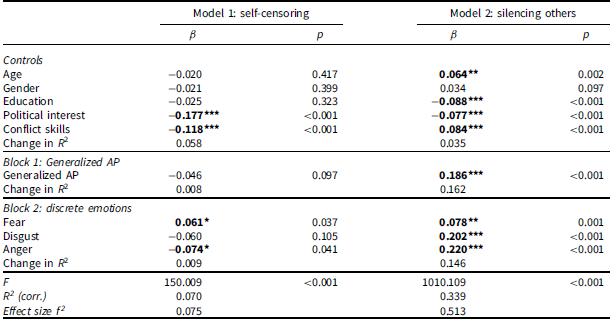
To investigate the relationship between affective polarization and the willingness to self-censor, a linear blockwise regression was calculated. For a differentiated analysis, generalized affective polarization and the discrete emotions (fear, disgust, and anger) were included in separate blocks and successively added to the regression model. In addition, conflict resolution skills as a personality-related predisposition and age, gender, education, and political interest were included as control variables in the first block of the regression model.Footnote 5 , Footnote 6 The model is significant (F(9, 1673) = 15.009, p < 0.001, f 2 = 0.075, N = 1683) and explains a total of 7.0 percent (corr. R 2 ) of the variance.
Generalized affective polarization explains 0.8 percent of the variance in SC, although the effect is not significant in the final model (β = −.046, p = 0.097).Footnote 7 With regard to our research question (RQ1), this means that higher generalized affective polarization is not associated with the tendency to engage in self-censorship in discussions with the political outgroup.
An additional 0.9 percent of the variance is explained by discrete emotions. While fear has a significant positive effect on SC (β = 0.061, p = 0.037), anger shows a significant negative effect (β = −.074, p = 0.041). These results support H2 and H4: People who are afraid of their political outgroup are more likely to engage in self-censorship (H2), whereas people who feel anger toward the outgroup are less likely to do so (H4). Although these coefficients are statistically significant, their magnitude is relatively small. No significant correlation can be found for disgust (β = −.060, p = 0.105), indicating that disgust is not related to the willingness to self-censor (RQ2).
The control variables explain an additional 5.8 percent of the variance, with both political interest (β = −0.177, p < 0.001) and conflict competence (β = −0.118, p < 0.001) showing significant negative associations with self-censorship: the lower political interest and conflict competence, the higher the tendency to self-censor (Table 1, Model 1). Notably, the standardized regression coefficients for these control variables are substantially larger than those of discrete emotions, suggesting that political interest and conflict competence exert a stronger influence on self-censorship than fear or anger.
Regression models explaining willingness to self-censor, willingness to silence others

Table 1. Long description
The table presents regression models explaining willingness to self-censor and silence others. It has two models, each with several control variables and blocks of variables. Model 1 focuses on self-censoring, while Model 2 focuses on silencing others. Each model includes columns for beta coefficients and p-values. Control variables include Age, Gender, Education, Political interest, and Conflict skills. Block 1 includes Generalized AP, and Block 2 includes discrete emotions like Fear, Disgust, and Anger. Notable trends include significant negative associations of Political interest and Conflict skills with self-censorship in Model 1, and significant positive associations of Political interest and Conflict skills with silencing others in Model 2. The table also shows changes in R-squared values for each block.
Notes: Standardized beta coefficients. Generalized AP = generalized affective polarization. Gender: 1 = female, education: 1 = high formal education. Model 1: N = 1683; Model 2: N = 1755. Significant predictors are highlighted in bold. ***p < 0.001; **p < 0.01; *p ≤ 0.05. See Table B.4 of the Appendix for changes in the effects of the predictors due to the inclusion of Block 1 and Block 2.
Affective polarization and the willingness to silence others
The effects of affective polarization on the willingness to silence others were also tested with a linear blockwise regression using the same predictors as before.Footnote 8 The regression model is significant (F(9, 1745) = 101.109, p < 0.001, f 2 = 0.513, N = 1755). Remarkably, with an explained variance of 33.9 percent, the predictive power of this model far exceeds the model for self-censorship.
Generalized affective polarization explains 16.2 percent of the variance in the willingness to silence the outgroup. The effect is significantly positive (β = 0.186, p < 0.001), supporting H3, which assumed that a higher level of generalized affective polarization is associated with a stronger willingness to silence the political outgroup.
Discrete emotions can explain a further 14.6 percent of the variance. Contrary to our expectations, which predicted a negative relationship between fear and BISO (H3), our results indicate that individuals who fear their outgroup show a higher willingness to silence its members (β = 0.078, p = 0.001). H3 must therefore be rejected. As expected, angry individuals are more willing to silence their political outgroup (β = 0.220, p < 0.001), supporting H5. Furthermore, disgust also shows a positive relationship with BISO (β = 0.202, p < 0.001), suggesting that disgusted individuals are more willing to silence the outgroup (RQ3). Notably, the coefficients for disgust (β = 0.202) and anger (β = 0.220) are even larger than that for generalized affective polarization (β = 0.186), while fear (β = 0.078) has a much smaller effect, suggesting that disgust and anger are the strongest emotional drivers of BISO, followed by generalized affective polarization.
The control variables explain another 3.5 percent of the variance. Age (β = 0.064, p = 0.002) and conflict resolution skills (β = 0.084, p < 0.001) are positively correlated to BISO, while education (β = −0.084, p < 0.001) and political interest (β = −0.077, p < 0.001) have a significantly negative effect. The willingness to silence the outgroup is therefore higher among people who are older and less interested in politics, as well as those with higher conflict resolution skills and lower formal education. Although the control variables contribute to the model, their effects are generally smaller – comparable to that of fear – than those of generalized affective polarization and the discrete emotions of disgust and anger, which emerge as the primary drivers of BISO (Table 1, Model 2).
Discussion
How does affective polarization relate to the willingness to self-censor, and the willingness to silence a political outgroup? And what role do the discrete emotions of fear, disgust, and anger play in this context? Against the backdrop of increasing polarization tendencies in Europe – particularly at the emotional level (Herold, Joachim, Otteni et al. Reference Herold, Joachim, Otteni and Vorländer2023) – this study focuses on Germany to examine the potential horizontal consequences of affective polarization for self-censorship and the willingness to silence others. Our findings can be summarized as follows:
-
(1) While generalized affective polarization was not linked to willingness to self-censor in a conversation with a supporter of the outgroup party, fear and anger were: People afraid of their outgroup were less willing to express their true opinions in conversations with outgroup party supporters. This is in line with the assumption that citizens afraid of the outgroup might engage in avoidance behavior, trying to prevent the risk of unpleasant and heated debates by staying silent or masking their true opinions (Berntzen, Kelsall, and Harteveld Reference Berntzen, Kelsall and Harteveld2024; Gibson and Sutherland, Reference Gibson and Sutherland2023; Lerner and Keltner, Reference Lerner and Keltner2000; Menzner and Traunmüller, Reference Menzner and Traunmüller2023). The opposite is true for people feeling anger towards their outgroup: They are less likely to self-censor, as anger is associated with an approach tendency and increases risk-taking and the desire for confrontation with opposing groups (Berntzen, Kelsall, and Harteveld Reference Berntzen, Kelsall and Harteveld2024; Crisp, Heuston, Farr et al. Reference Crisp, Heuston, Farr and Turner2007). Presumably, individuals see speaking out as an opportunity to express their anger towards the outgroup (Halperin Reference Halperin and Halperin2015; Kretchner, Elad-Strenger, Hirsch-Hoefler et al. Reference Kretchner, Elad-Strenger, Hirsch-Hoefler, Orian-Harel and Halperin2024). This could increase the potential benefits of expressing opinions, so that the potential costs – unlike in the case of fear – become less significant (Gibson and Sutherland Reference Gibson and Sutherland2023; Menzner and Traunmüller Reference Menzner and Traunmüller2023). However, the amount of variance explained in this analysis is low, and the effect sizes of the focal predictors are relatively small, particularly compared with the stronger effects of political interest and conflict resolution skills. These results should thus not be overinterpreted.
-
(2) In contrast to the above, the analysis regarding the willingness to silence others shows a high amount of explained variance and much stronger effects of our predictors. Our results show that a high level of affective polarization is indeed associated with a stronger willingness to silence members of the political outgroup. This finding complements the results of Neumann, Kelm, and Dohle et al. (Reference Neumann, Kelm and Dohle2021), who found initial evidence for a positive relationship between affective polarization and BISO. In addition to generalized affective polarization, the discrete emotions of fear, disgust, and anger were also identified as relevant predictors for BISO. Contrary to our expectation, individuals who fear their political outgroup are more, rather than less, willing to silence its members. At first glance, this finding appears counterintuitive, as fear is typically associated with avoidance (Berntzen, Kelsall, and Harteveld Reference Berntzen, Kelsall and Harteveld2024; Lerner and Keltner Reference Lerner and Keltner2000). However, fear is also linked to self-protective behavior (Cottrell and Neuberg Reference Cottrell and Neuberg2005), which may explain why fearful individuals engage in BISO. By silencing the political outgroup, they might attempt to mitigate perceived threats and create a safe environment (Frijda Reference Frijda1986; Kretchner, Elad-Strenger, Hirsch-Hoefler et al. Reference Kretchner, Elad-Strenger, Hirsch-Hoefler, Orian-Harel and Halperin2024). This aligns with the assumption by Tsfati and Dvir-Gvirsman (Reference Tsfati and Dvir-Gvirsman2018) that people may perceive outgroup views as dangerous and therefore do not want them to be spread.
Notably, our results reveal a seemingly paradoxical pattern: fear is positively related to both self-censorship and the willingness to silence others. One possible explanation, distinct from the argument above, lies in the conceptualization of BISO, which encompasses both the belief that silencing others is important and the behavioral intention to do so (Tsfati and Dvir-Gvirsman Reference Tsfati and Dvir-Gvirsman2018). A higher BISO score may therefore reflect support for restricting the outgroup’s political expression without necessarily indicating one’s own tendency to silence others. Taken together, it seems plausible that fearful individuals may simultaneously avoid expressing their own opinions while endorsing limitations on the outgroup’s political expression.
The positive effect of disgust on BISO also appears plausible: Feelings of disgust arising from perceived threats to ingroup values posed by an outgroup may intensify the motivation to defend these values (Berntzen, Kelsall, and Harteveld Reference Berntzen, Kelsall and Harteveld2024; Matthews and Levin Reference Matthews and Levin2012), thereby increasing the willingness to silence others. Since silencing others overlaps with intolerance, this is consistent with the findings of Berntzen, Kelsall, and Harteveld (Reference Berntzen, Kelsall and Harteveld2024), who identified disgust as the strongest predictor of political intolerance.
In addition, people who feel anger towards their outgroup also show a higher willingness to silence others. This can be attributed to the approach tendency of anger and is also consistent with the finding of Berntzen, Kelsall, and Harteveld (Reference Berntzen, Kelsall and Harteveld2024) on political intolerance. In addition, anger has a mobilizing effect and increases political participation (Valentino, Brader, Groenendyk et al. Reference Valentino, Brader, Groenendyk, Gregorowicz and Hutchings2011), with BISO potentially reflecting an attempt to limit outgroup influence and protect ingroup values as an unconventional form of political participation.
-
(3) It is evident that the willingness to silence others (BISO) is explained substantially better than the other constructs by our measures of generalized affective polarization and discrete emotions. Remarkably, all three emotions were identified as predictors for BISO, with the effect sizes indicating that anger and disgust function as the key emotional drivers. The overall model explains a substantial amount of variance, highlighting the importance of BISO as a potential consequence of affective polarization.
-
(4) Another key take-away from our study refers to the limitations of the feeling thermometer. Consistent with previous studies (Berntzen, Kelsall, and Harteveld Reference Berntzen, Kelsall and Harteveld2024; Kretchner, Elad-Strenger, Hirsch-Hoefler et al. Reference Kretchner, Elad-Strenger, Hirsch-Hoefler, Orian-Harel and Halperin2024), our findings point to the fact that its capacity to reflect the complexity of outgroup-emotions and affective polarization is limited. Although the feeling thermometer has been established as a standard measure (Iyengar, Lelkes, Levendusky et al. Reference Iyengar, Lelkes, Levendusky, Malhotra and Westwood2019), our study suggests including measures of discrete emotions in future studies of affective polarization (Berntzen, Kelsall, and Harteveld Reference Berntzen, Kelsall and Harteveld2024; Röllicke Reference Röllicke2023).
Our study has several limitations. First, as we worked with cross-sectional data, it has to be considered that the direction of causality between constructs may also be reversed. For example, individuals who exhibit a high willingness to engage in self-censorship may be less likely to engage in constructive interactions with members of the outgroup, which could increase outgroup bias and, consequently, affective polarization (Allport Reference Allport1954; Berntzen, Kelsall, and Harteveld Reference Berntzen, Kelsall and Harteveld2024; Wojcieszak and Warner Reference Wojcieszak and Warner2020). Long-term studies or experimental research will be necessary to disentangle these relationships.
Second, the conceptualization and measurement of affective polarization requires critical consideration as we focus exclusively on negative affect toward the political outgroup. While this is an established approach in research on affective polarization and discrete emotions in multiparty systems (Berntzen, Kelsall, and Harteveld Reference Berntzen, Kelsall and Harteveld2024; Kretchner, Elad-Strenger, Hirsch-Hoefler et al. Reference Kretchner, Elad-Strenger, Hirsch-Hoefler, Orian-Harel and Halperin2024), it has been criticized in some methodological studies since it represents a simplified operationalization compared to classical definitions of affective polarization, as affective distance between ingroup and outgroup evaluations (Iyengar, Sood and Lelkes Reference Iyengar, Sood and Lelkes2012) and blurs conceptual boundaries with related constructs such as outgroup dislike, negative partisanship, or negative political identity (Röllicke Reference Röllicke2023; Wagner Reference Wagner2024). Further studies should therefore also examine positive feelings toward the ingroup and check whether the present findings can be replicated when affective polarization is conceptualized as the difference between ingroup and outgroup evaluations. In addition, they may also include a greater variety of negative emotions as only three of them were considered here. For example, future studies may also examine more complex emotions such as disappointment (Kretchner, Elad-Strenger, Hirsch-Hoefler et al. Reference Kretchner, Elad-Strenger, Hirsch-Hoefler, Orian-Harel and Halperin2024) or schadenfreude (Bakker and Lelkes Reference Bakker and Lelkes2024). Moreover, we define the outgroup as the party from which respondents feel most distant, an approach providing a less nuanced and simplified understanding of affective polarization in multiparty systems (Renström, Bäck and Carroll Reference Renström, Bäck and Carroll2021; Röllicke Reference Röllicke2023; Wagner Reference Wagner2021, Reference Wagner2024). This needs to be taken into account when interpreting our results and to be addressed in future studies. The robustness of our findings should be tested in the future using alternative operationalizations of affective polarization, for example, the spread of like-dislike scores (Wagner Reference Wagner2021).
Third, the original scale by Carlson and Settle (Reference Carlson and Settle2023) that was adapted to measure willingness to self-censor in this study has not yet been widely applied in empirical research. In addition to that, it relies on one single item, asking a hypothetical question. Although this might restrict the validity of the scale, it should be noted that it has been used before and represents this study’s understanding of willingness to self-censor as a situational component, while some other scales aim to measure this construct as an individual personality trait (e.g., Hayes, Glynn and Shanahan Reference Hayes, Glynn and Shanahan2005a, Reference Hayes, Glynn and Shanahan2005b).
Fourth, the constructs examined in this study may be perceived as sensitive topics. It is therefore possible that respondents did not always answer truthfully due to social desirability bias. This may have led to distortions in our data. Especially, our measure of self-censorship may be prone to a self-serving bias with respondents over-estimating to really engage in a truthful conversation with an outgroup member.
Fifth, as our interest here primarily was to investigate the potential consequences of affective polarization, we were not able to provide information about which political groups were particularly polarized or whether the possible consequences examined may differ between different groups. Further research could take up this line of inquiry and include analysis of specific parties in the analysis of affective polarization and its consequences. Given substantial differences between political ingroups in political predispositions, values and patterns of political expression (Decker and Brähler Reference Decker and Brähler2025; Hirndorf Reference Hirndorf2024), as well as first evidence indicating varying democratic consequences of affective polarization across political camps (Rothers Reference Rothers2025), examining group-specific effects appears to be a particularly promising avenue for future research.
As our study was restricted to one national context – Germany – future studies should also investigate whether the basic relationships found here hold true under varying macro-level conditions.
Finally, research on affective polarization is currently focusing more on issue-based affective polarization, which refers to groups that form on the basis of opinions on specific issues (Herold, Joachim, Otteni et al. Reference Herold, Joachim, Otteni and Vorländer2023; Hobolt et al. Reference Hobolt, Leeper and Tilley2021; Neumann, Kelm and Dohle Reference Neumann, Kelm and Dohle2021). The investigation of topic-related affective polarization and its consequences could also provide exciting insights in the context of self-censorship and BISO and should be examined in future studies, especially with regard to sensitive topics (e.g., migration; cf. Köcher Reference Köcher2019) and current crises (e.g., the war in Ukraine or the Middle East conflict).
Despite the limitations outlined above, the present study provides new insights into the potential consequences of affective polarization and may represent an important starting point for further research. Given that affective polarization is associated with an increased willingness to engage in self-censorship and silencing others, the findings – in line with previous studies (Harteveld, Berntzen, Kokkonen et al. Reference Harteveld, Berntzen, Kokkonen, Kelsall, Linde and Dahlberg2022; Kingzette, Druckman, Klar et al. Reference Kingzette, Druckman, Klar, Krupnikov, Levendusky and Ryan2021) – point to its potential threat to democracy. Strategies are therefore needed to curb antipathy toward the political outgroup and, above all, the associated potential consequences that are dangerous to democracy (Druckman and Levy Reference Druckman, Levy and Rudolph2022; Harteveld, Berntzen, Kokkonen et al. Reference Harteveld, Berntzen, Kokkonen, Kelsall, Linde and Dahlberg2022; Iyengar, Lelkes, Levendusky et al. Reference Iyengar, Lelkes, Levendusky, Malhotra and Westwood2019). In light of current crises, it seems particularly relevant to promote constructive interactions between opposing political groups and thus counteract affective polarization (Iyengar, Lelkes, Levendusky et al. Reference Iyengar, Lelkes, Levendusky, Malhotra and Westwood2019).
Supplementary material
The supplementary material for this article can be found at https://doi.org/10.1017/S147567652610190X
Data availability statement
Data and syntax are available online.
Author contributions
Luna Laufer: Conceptualization-Equal, Data curation-Equal, Formal analysis-Equal, Investigation-Equal, Methodology-Equal, Project administration-Equal, Writing - original draft-Equal; Laura Gerstner: Conceptualization-Equal, Data curation-Equal, Formal analysis-Equal, Investigation-Equal, Methodology-Equal, Project administration-Equal, Writing - original draft-Equal; Pia Kinzler: Conceptualization-Equal, Data curation-Equal, Formal analysis-Equal, Investigation-Equal, Methodology-Equal, Project administration-Equal, Writing - original draft-Equal; Julia Stockwald: Conceptualization-Equal, Data curation-Equal, Formal analysis-Equal, Investigation-Equal, Methodology-Equal, Project administration-Equal, Writing - original draft-Equal; Anna-Luisa Sacher: Conceptualization-Equal, Project administration-Equal, Supervision-Equal; Carsten Reinemann: Conceptualization-Equal, Funding acquisition-Equal, Project administration-Equal, Supervision-Equal.
Financial support
No external funding was used for this study.
Competing interests
The authors declare none.
Ethical standards
The research was based solely on a voluntary and anonymized survey and did not include any experimental intervention (‘standard research’). Therefore, formal ethics board approval was not required in accordance with institutional and ethical guidelines.
Use of AI
AI was used for checking language.



 Open access

