Introduction
Prior to the development of antipsychotic medications treatment options for schizophrenia were limited, ineffective and often inhumane. People with schizophrenia were often labelled as ‘criminally insane’, deemed untreatable and condemned to a lifetime of incarceration in mental asylums. Indeed, when the first antipsychotic drugs, namely chlorpromazine and trifluoperazine, were introduced in the mid-1950s and 1960s, there was great scepticism that these would be able to make a difference (Marder & Jones, Reference Marder, Jones, Tyrer and Silk2008). However, as developing research standards dictated more stringent criteria in the efficacy testing of drugs, these early antipsychotic drugs did prove to be more effective than placebo in double-blinded randomized-controlled trials (RCTs) (Turner, Reference Turner2007; Marder & Jones, Reference Marder, Jones, Tyrer and Silk2008). Although the phenothiazines and other first generation antipsychotics (FGAs) were able to alleviate a significant proportion of the psychopathology, their adverse actions, particularly extrapyramidal side effects (EPSE) soon posed new challenges for psychiatrists.
The introduction of clozapine by Sandoz in 1961 and its low potential for EPSE marked the second generation antipsychotic (SGA) era. However, there was an early hiatus following reported cases of agranulocytosis and clozapine was withdrawn in many countries by the manufacturer in the 1970s (Healy, Reference Healy2002). The trial by Kane et al. (Reference Kane, Honigfeld, Singer and Meltzer1988) showing superior efficacy of clozapine over chlorpromazine in people with treatment-resistant schizophrenia led to its reintroduction for this indication, provided the blood count is monitored. This occurred at a time when a number of companies were testing other antipsychotic compounds thought, like clozapine, to be ‘atypical’ by dint of their lower propensity to cause EPSE compared with many FGAs. In 1993, risperidone was enthusiastically received by doctors and patients hoping that it would have markedly fewer side effects than its predecessors. Other SGAs such as olanzapine, quetiapine and amisulpiride followed soon after and were found to be superior over FGAs in all domains in the registration trials as reviewed in an early meta-analysis conducted by Leucht in 1999 (Leucht et al. Reference Leucht, Pitschel-Walz, Abraham and Kissling1999).
However, the metabolic side effects of SGAs, such as obesity, dyslipidaemias and abnormal glucose metabolism soon became apparent; they are no less problematic than EPSE and as difficult to manage, if not more so. This meant that initial notions that SGA would be more effective, a combination of efficacy and tolerability, were questioned, particularly the argument that the greater cost of the SGA would be offset by better treatment adherence, fewer relapses and hospitalizations and better quality of life. In an attempt to clarify whether SGAs were as effective and well tolerated as they were initially believed to be, much research has been conducted, comparing them with FGAs.
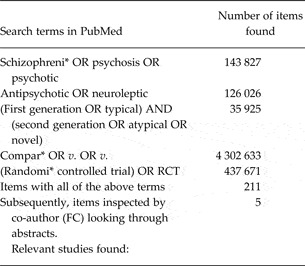
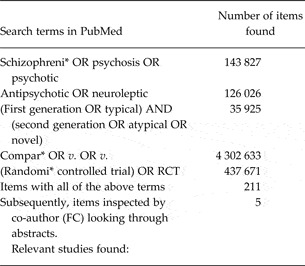
This paper looks at the methodology and findings of the larger (n > 150) RCTs comparing FGAs and SGAs, and the meta-analyses related to this question (see Table 1 for search terms). The paper also covers the re-analysis of smaller, prior studies and the use of mathematical modelling to gain further clarity on the issue. It does not include evidence concerning drugs not yet licensed. However, the recent withdrawal of support by its manufacturer for the metabotropic glutamate receptor agonist that had initially shown promise (Patil et al. Reference Patil, Zhang, Martenyi, Lowe, Jackson, Andreev, Avedisova, Bardenstein, Gurovich, Morozova, Mosolov, Neznanov, Reznik, Smulevich, Tochilov, Johnson, Monn and Schoepp2007) means that the context of the discussion and the prospects for new treatments for schizophrenia are presently gloomy.
Search terms and findings in PubMed
Pragmatic (effectiveness) v. explanatory (efficacy) studies
Most larger studies are pragmatic as defined by the CONSORT statement (Zwarenstein et al. Reference Zwarenstein, Treweek, Gagnier, Altman, Tunis, Haynes, Oxman and Moher2008). They concern effectiveness, aiming to determine whether the intervention works when used in normal practice; explanatory or efficacy studies aim to determine whether an intervention can work. Most studies conducted by pharmaceutical companies to meet the stringent criteria for FDA registration concern efficacy. Such studies are designed to demonstrate or refute whether a drug has a defined benefit compared with a comparator drug or placebo; outcomes in psychiatry are often symptoms and patients are usually highly selected for being concordant with treatment, and having single diagnoses with core features. Such people do not necessarily represent the wider range of patients for which the drug may ultimately be used; ‘poorly adherent participants and those with conditions which might dilute the effect are often excluded’ from efficacy studies (Zwarenstein et al. Reference Zwarenstein, Treweek, Gagnier, Altman, Tunis, Haynes, Oxman and Moher2008). Pragmatic studies, on the other hand, reflect the realities and practicalities of the setting where the intervention is most likely to take place, and usually recruit subjects with a broader range of characteristics that represent the group for which the drug is generally used (Zwarenstein et al. Reference Zwarenstein, Treweek, Gagnier, Altman, Tunis, Haynes, Oxman and Moher2008); little selection takes place and follow-up is often longer in order to reflect a clinically relevant epoch in the life of someone with a long-term condition. Primary outcomes in pragmatic studies tend to go beyond symptom reduction and include quality of life, or discontinuation of allocated treatment, a ‘behaviour’ of prescribers or patients that infers an unsatisfactory treatment outcome that may combine lack of efficacy or tolerability. All of these differences highlight the dangers of accepting explanatory studies at ‘face value’ and accepting that any benefits they demonstrate will be replicated in the clinical setting.
While there is increasing recognition and support for the benefits of pragmatic studies in the interpretation of intervention effectiveness (Marson et al. Reference Marson, Kadir and Chadwick1997; Hotopf et al. Reference Hotopf, Churchill and Lewis1999; Tunis et al. Reference Tunis, Stryer and Clancy2003; Zarin et al. Reference Zarin, Young and West2005), there are disadvantages. Some argue that pragmatic trials could easily be conducted and interpreted to favour a desired outcome primarily through selection bias, i.e., the preference of the patient for or against a treatment is likely to influence the outcome (Ernst & Canter, Reference Ernst and Canter2005). We stress that the necessity of a stringent explanatory study is crucial in the prior stages of development of any intervention. Indeed, the explanatory study answers the first question ‘Can it work?’. The pragmatic study then looks at the next question ‘Does it work in the normal setting?’. Both study designs are important in the treatment of patients with schizophrenia and the question as to whether efficacious interventions are effective (Patil et al. Reference Patil, Zhang, Martenyi, Lowe, Jackson, Andreev, Avedisova, Bardenstein, Gurovich, Morozova, Mosolov, Neznanov, Reznik, Smulevich, Tochilov, Johnson, Monn and Schoepp2007).
Major clinical studies
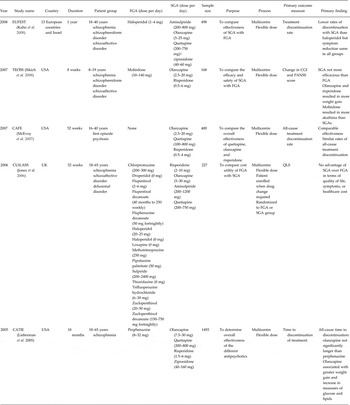
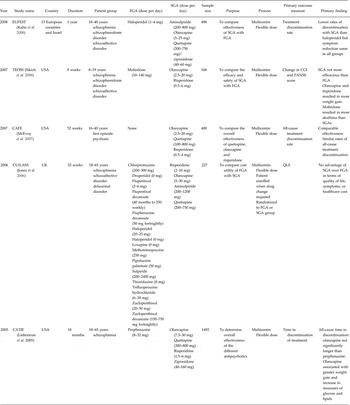
The first of the RCTs which compared SGAs with FGAs was also by far the largest. The CATIE (Clinical Antipsychotic Trials of Intervention Effectiveness) study was conducted between 2001 and 2004 in the United States by Lieberman et al. (Reference Lieberman, Stroup, McEvoy, Swartz, Rosenheck, Perkins, Keefe, Davis, Davis, Lebowitz, Severe and Hsiao2005). They investigated treatment effectiveness measured in terms of time to discontinuation. It was followed by the CUtLASS-1 study (Cost Utility of the Latest Antipsychotic Drugs in Schizophrenia Study) conducted by Lewis and colleagues in the English National Health Service (Jones et al. Reference Jones, Barnes, Davies, Dunn, Lloyd, Hayhurst, Murray, Markwick and Lewis2006). This study compared the cost-utility of a larger number of FGAs and SGAs, testing the hypothesis that there would be a clinically relevant benefit for patients randomized to the latter drugs. Most subjects in CATIE and CUtLASS were young or middle-aged men with chronic schizophrenia; both studies also included a stratum of treatment resistant schizophrenia comparing clozapine with other SGAs. Two further studies focused on younger subjects followed in 2007. The CAFE study (Comparison of Atypicals for First Episode) (McEvoy et al. Reference McEvoy, Lieberman, Perkins, Hamer, Gu, Lazarus, Sweitzer, Olexy, Weiden and Strakowski2007) did not have an FGA comparator but instead compared the treatment discontinuation rate between patients taking different SGAs; the TEOSS (Treatment of Early Onset Schizophrenia Spectrum Disorders) (Sikich et al. Reference Sikich, Frazier, McClellan, Findling, Vitiello, Ritz, Ambler, Puglia, Maloney, Michael, De Jong, Slifka, Noyes, Hlastala, Pierson, McNamara, Delporto-Bedoya, Anderson, Hamer and Lieberman2008) compared the FGA molindone with SGAs in terms of change in Clinical Global Impression (CGI) and Positive and Negative Symptoms Scale (PANSS) score. The last and most recent trial to study this subject is another very large one: EUFEST (European First Episode Schizophrenia Trial) (Kahn et al. Reference Kahn, Fleischhacker, Boter, Davidson, Vergouwe, Keet, Gheorghe, Rybakowski, Galderisi, Libiger, Hummer, Dollfus, Lopez-Ibor, Hranov, Gaebel, Peuskens, Lindefors, Riecher-Rossler and Grobbee2008). EUFEST was carried out in 13 European countries, and compared the time to discontinuation between haloperidol and SGAs. The characteristics and findings of these studies are summarized in Table 2.
Summary table of large clinical trials comparing FGAs with SGAs
Methodological considerations, findings and other points of interest
CATIE
Funded by the National Institute of Mental Health, the aim of this study was to investigate the compare the effectiveness of atypical and conventional antipsychotic drugs given the massive changes in prescribing habits after the introduction of SGAs to the US. CATIE compared a FGA, perphenazine, with several SGAs in a double-blind study. The primary outcome was all-cause discontinuation of treatment. Overall, 74% of patients discontinued the medication to which they were randomized. The time to discontinuation for any cause was significantly longer in the olanzapine group compared with the quetiapine (p < 0.001) or risperidone (p = 0.002) groups, but not when compared with perphenazine (p = 0.021 but a p-value of ≤ 0.017 was required for statistical significant for multiple comparisons) or ziprasidone groups (p = 0.028, but p ≤ 0.013 was required). The time to discontinuation for lack of efficacy was longer in olanzapine than perphenazine (hazard ratio 0.47; p < 0.001) or the other SGAs but there was no significant differences between groups in time until discontinuation due to intolerable side effects. This suggests that olanzapine has an advantage over perphenazine in terms of efficacy, but that its side effects negate this advantage. Indeed, more subjects discontinued olanzapine because of weight gain or metabolic differences compared with other drugs (9% v. 1–4%, p < 0.001), whereas more patients discontinued perphenazine because of EPSE (8% v. 2–4%, p = 0.002).
It should be noted, however, that patients with existing tardive dyskinesia were not randomized to perphenazine and, at 18 months long, the study was relatively brief to assess and evaluate the relative risk of tardive dyskinesia among the agents. In addition, the study participants were probably not representative of all patients who receive treatment; many had been ill for more than 15 years, had trialled multiple SGAs without success and so were probably relatively treatment resistant. This may partially explain the high rates of discontinuation and it may have been more suitable to try clozapine than yet another conventional or atypical antipsychotic drug (Cheng & Jones, Reference Cheng, Jones, Mortimer and McKenna2010). A second phase of CATIE (McEvoy et al. Reference McEvoy, Lieberman, Stroup, Davis, Meltzer, Rosenheck, Swartz, Perkins, Keefe, Davis, Severe and Hsiao2006) enrolled patients who had been discontinued for lack of efficacy and randomly assigned them to risperidone, olanzapine, quetiapine or open label clozapine. The best outcome was with clozapine-treated patients. Only 56% were discontinued compared with 71% of patients treated with olanzapine, 86% with risperidone and 93% with quetiapine. These patients also showed a greater improvement in symptom reduction than those randomized to the other antipsychotics.
CUtLASS
This trial was funded by the United Kingdom Health Technology Assessment (HTA) programme in order to ascertain whether the additional cost of SGAs would be offset by improved quality of life or a reduction in costs associated with the use of health care resources. The primary outcome was the total score on the Quality of Life Scale (QLS) with the hypothesis that SGA use would be associated with an average five point advantage on this measure, an effect that would be clinically meaningful. Patients were randomized to either an SGA or an FGA after which prescribers and patients could choose which particular compound to use from either class. The use of antipsychotics was therefore the open label, but the ratings were undertaken by raters blind to allocation. The hypothesis of advantage for SGA was excluded; there was no significant difference in scores on the QLS, between patients who had been given FGAs v. SGAs. This pattern was also seen for a variety of secondary outcomes including symptoms, side effects including motor disorders (Peluso et al. Reference Peluso, Lewis, Barnes and Jones2012) and drug preferences. There was a trend for patients in the FGA arm to have had lower mean healthcare costs than those in the SGA arm (US$34 750 v. US$37 185). While SGAs on patent are much more expensive than FGAs, it was hospitalization costs which accounted for most of the total cost in both groups (93.2% of the total cost in the FGA group and 81.5% in the SGA group). As in CATIE, CUtLASS-2 (Lewis et al. Reference Lewis, Barnes, Davies, Murray, Dunn, Hayhurst, Markwick, Lloyd and Jones2006) involved a parallel study to investigate how clozapine compared with SGA in treatment-resistant schizophrenia. Clozapine was found to be better.
The vast difference in the cost and level of healthcare provided between countries is a major limitation in the interpretation of a cost-utility analysis such as CUtLASS. However, the ability for this study to ‘put a price’ on the overall cost of healthcare for patients with schizophrenia provides healthcare administrators with the information to make practical and ethical decisions on prescription guidelines where resources are scarce. The findings of no advantage for SGA in terms of quality of life are more readily applicable to other countries.
CAFE
The CAFE study, conducted in United States, was the first study to compare antipsychotic medications among patients suffering their first psychotic episode and diagnoses of schizophrenia, schizoaffective disorder and schizophreniform disorder were included. The premise for studying this population was that first episode psychosis (FEP) patients responded better to antipsychotic medications (Lieberman et al. Reference Lieberman, Jody, Geisler, Alvir, Loebel, Szymanski, Woerner and Borenstein1993; Robinson et al. Reference Robinson, Woerner, Alvir, Geisler, Koreen, Sheitman, Chakos, Mayerhoff, Bilder, Goldman and Lieberman1999) and that the dose they required to achieve a clinical response was lower than patients who had suffered multiple episodes (Zhang-Wong et al. Reference Zhang-Wong, Zipursky, Beiser and Bean1999; Malla et al. Reference Malla, Norman, Scholten, Zirul and Kotteda2001). However, it was also known that FEP patients were more sensitive to the side effects of antipsychotic medication (Zhang-Wong et al. Reference Zhang-Wong, Zipursky, Beiser and Bean1999; Malla et al. Reference Malla, Norman, Scholten, Zirul and Kotteda2001) and that most FEP patients discontinued their medications (Lieberman et al. Reference Lieberman, Jody, Geisler, Alvir, Loebel, Szymanski, Woerner and Borenstein1993; Robinson et al. Reference Robinson, Woerner, Alvir, Geisler, Koreen, Sheitman, Chakos, Mayerhoff, Bilder, Goldman and Lieberman1999). The rates for any-cause discontinuation were comparable between olanzapine, risperidone and quetiapine and overall, 68.4% of patients assigned to the olanzapine group, 70.9% assigned to the quetiapine group and 71.4% assigned to the risperidone group discontinued treatment before 52 weeks. The difference in median times to all-cause discontinuation did not differ significantly between the three groups. Although the olanzapine group was found to have a greater improvement in the PANSS positive subscale scores, it was also found to be associated with the greatest increase in weight and body mass index (BMI).
Points of interest in this study beyond the focus on FEP include the fact that there was no FGA comparator. In a previous study comparing only risperidone and haloperidol, efficacy was comparable; the haloperidol group suffered from more EPSE while the risperidone group suffered more weight gain (Schooler et al. Reference Schooler, Rabinowitz, Davidson, Emsley, Harvey, Kopala, McGorry, Van Hove, Eerdekens, Swyzen and De Smedt2005). This echoes the results of CATIE and CUtLASS in the more chronically unwell population.
TEOSS
This publicly funded trial conducted in the United States compared the efficacy of molindone, a rarely used FGA with low propensity to weight gain, with the SGAs, olanzapine and risperidone, in young people (aged 8–19 years old) with schizophrenia, schizoaffective disorder or schizophreniform disorder; follow-up of 8 weeks was relatively short. In the United States, as with many other countries, the mainstay of treatment for younger patients is SGAs. In this trial, patients were considered to be ‘responders’ if their CGI score improved by 1 or 2 points and they had achieved a 20% or greater reduction in the PANSS. Secondary outcome measures included neurological and metabolic side effects. No differences in the response rates between subjects taking the molindone or the SGAs were found, neither in the time to treatment discontinuation, nor on any last observation carried forward symptom measures. Patients randomized to molindone had significantly more akathisia than those on the SGAs whereas patients on risperidone experienced higher rates of constipation; those on olanzapine had higher rates of weight gain and increased appetite. Subjects randomized to olanzapine gained an average of 6.1 kg over the study period of 8 weeks as well as experiencing other metabolic disturbances; this increase in body weight led to the discontinuation of olanzapine treatment in the trial by the National Institute of Mental Health (NIMH) Data and Safety Monitoring Board in spring 2006 as there was no evidence for greater efficacy; patients already randomized to olanzapine continued their participation. In contrast, patients on risperidone gained, on average, 3.6 kg and molindone, 0.3 kg, with some subjects in that arm even losing weight.
One major limitation of this study is the brevity of the period of observation which was put in place in accordance with national guidelines for the treatment of early onset psychoses (‘Practice parameter for the assessment and treatment of children and adolescents with schizophrenia. American Academy of Child and Adolescent Psychiatry,’ 2001). These guidelines recommended 6–8-week trials and the authors argued that a longer trial would have increased the risk of subjecting patients to ineffective treatment. However, it is possible that different patterns of response or side effects would have emerged over a longer period. Another limitation is the choice of molindone as the FGA comparator. As noted above, this antipsychotic was chosen because of its low propensity for weight gain and EPSE. However, molindone was not a commonly used in clinical practice such that the results were always going to be of restricted use. Molindone is no longer manufactured so the potentially important results of TEOSS are left in a vacuum.
EUFEST
The latest large-scale study comparing typical v. atypical antipsychotics was conducted by the European First-Episode Schizophrenia Trial (EUFEST) study group and included 50 centres in 13 European countries and Israel. Like CAFE, this group studied were patients suffering from their FEP and had not previously been treated with any antipsychotic medications for any substantial period of time. Unlike CAFE which was blinded, this study was open-label with psychiatrists and patients aware of the medication to which they had been randomized. The main outcome measure was all-cause treatment discontinuation, an outcome that may have been subject to systematic bias in an open trial where clinicians' preconceptions may play a part in the decision to change a treatment. When compared with haloperidol, the SGAs had lower risks for any-cause discontinuation; amisulpiride (HR 0.37 [95% CI 0.24–0.57]), olanzapine (HR 0.28 [0.18–0.43]), quetiapine (HR 0.52 [0.35–0.76]) and ziprasidone (HR 0.51 [0.32–0.81]). Reduction in symptomatology was similar for all groups at around 60%, consistent with previous studies. Haloperidol was associated with the highest rates of EPSE but the lowest weight gain, along with ziprasidone, while olanzapine was associated with the most weight gain. EUFEST has been an important heuristic study in the development of pragmatic trials in schizophrenia for reasons discussed by Rosenheck (Reference Rosenheck2008).
These large clinical trials, which between them, cover patients at all stages of disease progression and range from children to adults of 65 years old, have resulted in similar findings despite the differences in their methodology. The fact that haloperidol resulted in more EPSE did not come as a surprise. However, the rapid and extreme increases in weight with olanzapine, along with lack of evidence for increased efficacy, to the extent that it was found unethical to continue to randomize patients to the olanzapine group in the TEOSS trial, has alerted psychiatrists to the severity of the metabolic side effects of SGAs. Indeed, the most common cause of natural death in patients with schizophrenia, is cardiovascular disease, accounting for 34% of death in men and 31% in women and is significantly higher than the risk in the general population (Brown, Reference Brown1997).
With the lack of an obvious champion among FGAs and SGAs, psychiatrists and patients alike await the development of newer drugs which offer a reduction of symptoms and hopefully, a reduction in side effects present in existing medications. Since 2009, three new SGAs were approved by the United States Food and Drug Administration (FDA). These are iloperidone, asenapine and lurasidone. While asenapine and lurasidone can be associated with dose-related treatment-emergent akathisia, iloperidone claims to be free of EPSE or akathisia if prescribed within the recommended dose range as well as having a modest impact on weight change and minimal effect on glucose and lipid levels (Citrome, Reference Citrome2011a). Asenapine and lurasidone were both found to be comparable in terms of efficacy and have a favourable side effect profile compared with older SGAs, especially when comparing changes in weight gain with olanzapine. One study found that mean weight gain with olanzapine (5.5 kg) was significantly higher than that with asenapine (1.6 kg) (p < 0.0001) (Schoemaker et al. Reference Schoemaker, Naber, Vrijland, Panagides and Emsley2010) and a recent review of the literature on asenapine concluded that it had an ‘acceptable safety profile across the different disease states studied, although it was not devoid of metabolic and EPS-related adverse effects’ (Stoner & Pace, Reference Stoner and Pace2012). Similarly, lurasidone was found to have a much more favourable weight gain profile than olanzapine with 5.6% of patients gaining ≥7% body weight on lurasidone v. 34.4% on olanzapine and 4.2% on haloperidol (Citrome, Reference Citrome2011b). While these new drugs seem to be a promising alternative to older SGAs, longer term studies are required to ensure their advantages.
Attempts to review and summarize studies
The major studies reviewed above are, by and large, not yet included in systematic reviews; those published to date focus on smaller trials. The pooled effects of such reviews support, by and large, the results of individual, more recent pragmatic studies. Several meta-analyses have been conducted using methodologically elegant approaches that have drawn attention to some interesting points in the design of the original trials.
One of the first meta-analyses (Leucht et al. Reference Leucht, Pitschel-Walz, Abraham and Kissling1999) indicated that when there were statistically significant advantages for an SGA over haloperidol, the effect sizes were very small. Likewise, a subsequent meta-analysis (Geddes et al. Reference Geddes, Freemantle, Harrison and Bebbington2000) found that the advantages of the SGAs were generally apparent only when patients received excessive dosages (>12 mg/day) of the comparator, haloperidol. At lower doses there was no difference in dropout rates. While SGAs were associated with significantly less EPSE, their overall tolerability and efficacy was not superior, indicating that they, themselves, had side effects which many patients found difficult to tolerate. Leucht et al. (Reference Leucht, Wahlbeck, Hamann and Kissling2003) conducted another meta-analysis in 2003 to investigate for any advantage of SGAs over low-potency FGAs. Only clozapine was found to be more efficacious and to have significantly lower EPSE than low potency FGAs. At doses of less than 600 mg/day of chlorpromazine or equivalent doses of FGAs, the risk of inducing EPSE was not significantly higher than the risk with SGAs. Similar to the findings of the Geddes study, SGAs were not superior in terms of efficacy.
A later meta-analysis by Davis et al. (Davis et al. Reference Davis, Chen and Glick2003) suggested that there were advantages for the SGAs clozapine, risperidone and olanzapine (and perhaps, amisulpiride) when compared with haloperidol but not with other SGA drugs. It is possible that the advantages of specific SGAs may be related to the time that studies were carried out. Studies conducted in the early 1990s were likely to involve patients who had received only FGA drugs and responded poorly. However, patients in studies conducted in the late 1990s may have received both FGAs and SGAs and entered trials because they did poorly on both (Marder & Jones, Reference Marder, Jones, Tyrer and Silk2008). The uncertainty in the superior efficacy of olanzapine over high- and low-potency FGA comparators highlights the fact that any advantages olanzapine may have are modest; this has been the finding of the large clinical trials previously described. Several other meta-analyses have been conducted in recent years with similar findings to previous one. In Leucht's 2009 meta-analyses (Leucht et al. Reference Leucht, Corves, Arbter, Engel, Li and Davis2009), he concluded that ‘Second-generation antipsychotic drugs differ in many properties and are not a homogeneous class…’.
More recently, Bayesian statistical methodology was applied in a meta-analysis comparing the clinical efficacy and adverse effects of haloperidol with clozapine, olanzapine, aripiprazole and risperidone (Klemp et al. Reference Klemp, Tvete, Skomedal, Gaasemyr, Natvig and Aursnes2011). This approach allowed the authors to pool studies which compared different SGAs with FGAs and placebo, and ranked the antipsychotic medications according to their clinical efficacy and adverse effects. The main limitation of this study was that it was able to include only studies reporting rates of responders and adverse events. Thirty double-blinded RCTs were included in the study and the drugs ranked according to three end-points: efficacy, weight gain and EPSE. The order of efficacy, in descending order of response ratio compared with placebo [95% CI], was as follows: clozapine (1.99; 1.76–2.26), olanzapine (1.86; 1.70–2.06), risperidone (1.85; 1.69–2.01), aripiprazole (1.55; 1.36–1.76) and haloperidol (1.40; 1.25–1.57). For weight gain, again in descending order compared with placebo, olanzapine was the most likely to induce weight gain; response ratio of (12.21; 10.22–15.05), followed by clozapine, risperidone, haloperidol and aripiprazole (4.57; 3.07–6.54). For inducing EPSE, in descending order v. placebo, haloperidol was found to have the highest risk; response ratio (2.33; 2.03–2.49), risperidone, clozapine, aripiprazole and olanzapine (0.91; 0.77–1.05). While it is refreshing to be presented with a ranked comparison of the antipsychotic drugs, attention should be paid to the differences between the response ratios. Although haloperidol appeared to have the lowest efficacy and the highest risk for EPSE, the range of response ratios in these categories were much smaller (efficacy: 1.40–1.99; EPSE: 0.91–2.33) than in the category of weight gain where olanzapine performed the worst, and the range and magnitude of the response ratio was much larger (4.6–12.2). This highlights that while haloperidol appears to be inferior in terms of efficacy and EPSE, they actual difference compared with other antipsychotics is modest. However, the risk of inducing weight gain is very high with all the antipsychotics and with olanzapine and clozapine, the risk being more than twice that of haloperidol.
Clinical implications
Psychiatrists have long been advised to tailor the treatment to their individual patient. Many large trials and meta-analyses have now equipped psychiatrists with a substantial amount of information to make clinical decisions regarding the prescription of antipsychotics according to what may best suit their patients. However, even the largest trials give results pertinent to the group, or average subject, and are too small to investigate patient heterogeneity in a way that mimics the psychiatrist's clinic. It is not enough to prescribe what is believed to be the lesser of two evils and hope for the best; we have to apply best judgments within highly complex environments. Guidelines have been established for physical health monitoring of patients on antipsychotic medication including the APA Guidelines, American Diabetes Association Guidelines (Consensus development conference on antipsychotic drugs and obesity and diabetes, 2004) and the Mount Sinai Guidelines (Marder et al. Reference Marder, Essock, Miller, Buchanan, Casey, Davis, Kane, Lieberman, Schooler, Covell, Stroup, Weissman, Wirshing, Hall, Pogach, Pi-Sunyer, Bigger, Friedman, Kleinberg, Yevich, Davis and Shon2004). All recommend the regular monitoring of weight, glucose, lipids and blood pressure and there is evidence that such measures are useful in the short term (Chen et al. Reference Chen, Chen and Huang2009). It is, therefore, the duty of the psychiatrist to ensure that such monitoring is performed and if necessary to change medications or prescribe management for the side effects.
As more and more SGAs have patents expiring, there is concern that psychiatrists will switch to the generic SGAs in ever greater numbers, believing that they are a better option for their patients. In our current situation, better antipsychotic drugs are those prescribed with best care, regardless of class or category.
Future research
Past research has focused mainly on comparing efficacy and side effects of FGAs v. SGAs. Most research has been conducted over the period of a year at maximum. Long-term research is needed to give a clearer idea of the long-term effects and impact of both FGAs and SGAs. The impact of FGAs and SGAs can also be considered in terms of disability-adjusted life years (DALYs) which would allow governments and health authorities to evaluate the economic costs of the treatment of schizophrenia and related disorders. Long-term trials are difficult and compromised by high rates of discontinuation and change from allocated treatments, so carefully applied observational approaches need to be devised and can be fruitful (Tiihonen et al. Reference Tiihonen, Lonnqvist, Wahlbeck, Klaukka, Niskanen, Tanskanen and Haukka2009).
To date, most of the large clinical studies have taken place in Europe and the United States. However, genetic stratification is likely at the population or ethnic level. Clozapine has remained a first-line treatment in some countries such as China and in some eastern European and south Asian nations, suggesting that there may be a population variation in genetic predisposition to blood dyscrasia (Healy, Reference Healy2002). Conversely, some ethnic groups such as Pima Indians and South Sea Islanders are particularly prone to metabolic disorders such as diabetes. To delineate whether these groups are particularly vulnerable to the metabolic side effects of antipsychotics would alert psychiatrist to take extra care in prescribing to these groups as well as explaining the biological mechanisms of the effects.
Conclusions
We remain far from achieving an ideal antipsychotic medication that alleviates the symptoms of schizophrenia without leaving the patient with metabolic and other costs. Nevertheless, large RCTs and meta-analyses have equipped clinicians with a more thorough understanding of the benefits and side effects of existing antipsychotics and a realization that the responsibility for careful prescribing still lies with them. The lesson that a new class of drugs is not necessarily better needs to be remembered when, as we hope it soon will, a new drug or class of compounds completes the challenging obstacle course of development and licensing. When this happens we can hope, but should be careful, about the hype.
Declaration of Interest
Frances Cheng: none.
Peter B. Jones was a member of a scientific advisory board for Roche in 2011 and has previously received fees from Eli Lilly, Janssen and BMS for lecturing. He was a member of the scientific advisory board for Eli Lilly's SOHO observational study 1999–2003 and was PI for a study funded by GSK in 2007 investigating cognitive and related endophenotypes in FEP. He was a PI for the HTA CUtLASS study.