“Gather up the fragments that remain that nothing be lost.”
John 6:12
The Mite Box stands before Him—
His called Evangelist of Fragments
His beloved Apostle of Trifles
His holy Priest of Insignificances.
“The ‘Might’ Box,” The Shield (1925): 67
Every year, the young women at Kansas City National Training School (KCNTS) published a yearbook called The Shield. On the verge of completing their course to become deaconesses in the Methodist Episcopal Church, the volume celebrated the graduating class's various accomplishments, including those of its mite box auxiliary.Footnote 1 In 1925, the KCNTS auxiliary had set its sights on raising $1,800 through penny contributions to its mite box (also called a cent or collection box), a small receptacle with a slot to collect coins. Hoping to make the box “a vital reality” for their peers, the KCNTS group hung posters, created a colourful bulletin board, held discussions by the common room fireside, and performed tableaux recounting the history of home missions. Months of activity were capped by a service in the campus chapel. The young women gathered with a “thrill of gladness” as they sang the Methodist doxology: “Praise God, from Whom all blessings flow; Praise Him, all creatures here below.” And finally, after a year of anticipation, the mite box was broken open and its pennies tallied up (Fig. 1).
A KCNTS student poses with mite-boxes on the school grounds. From a snapshot album circa 1921–1922. Used with permission of Saint Paul School of Theology, Kansas City, Kans.

Along with their description of this moment in the 1925 yearbook, the student editors added something of the utmost importance here: an article written in the mite box's own voice. “I am the Mite Box of K.C.N.T.S.,” it introduced itself to readers. It then listed some of its accomplishments. Thousands of dollars, said the box, “have passed through me into many different fields of need.” It recalled with pride how it was the largest box at the Annual Meeting of the Woman's Home Missionary Society in 1925. It also reflected on some of its favorite moments, such as the joy it felt watching Misao Nagata, an orphaned Korean girl, grow up a Christian thanks to KCNTS contributions. The box ended on a meditative note: just as Jesus blessed the trifles and did not despise the fragments, so does he bless penny offerings. Each mite box will stand before Jesus in heaven as his Evangelist of Fragments and beloved Apostle of Trifles.Footnote 2
The talking KCNTS mite box was more than a bit of school-girlish fun. By the mid-1920s, such boxes had been addressing humans directly and figuring at the center of often-elaborate opening ceremonies for more than a generation. Other studies have noted mite boxes only in passing; however, a hundred years ago they were ubiquitous in U.S. religion.Footnote 3 They crossed Protestant-Catholic lines and spilled out into fundraising by nascent NGOs, such as UNICEF. Historians of early twentieth-century American Judaism have even mistaken them for “a uniquely Jewish form of fund-raising.”Footnote 4 This article focuses on the mite box heyday, from circa 1870–1930, and more particularly on their circulation within the Woman's Foreign Missionary Society (WFMS) of the Methodist Episcopal Church. Yet my aim is not to flesh out the history of missions or benevolent work per se. Instead, I use the WFMS as a case study to explore what these boxes reveal about the intersection of Protestantism and capitalism.
Traditional economic histories often reiterate Max Weber's theory that Calvinist Protestantism produced the self-disciplined rationality necessary for a capitalist habitus. Marxist historians, such as E. P. Thompson, argued that other Protestants, namely Methodists, also pushed forward the engine of capitalism, in this case by nurturing a pietism so emotionally satisfying that it diverted the working classes from revolt. As historian Mark Valeri has pointed out, these two narratives have produced a history of capitalism that largely ignores religious emotions or treats them as “fractious and irrational sideshows.”Footnote 5 What little has been written about mite boxes largely follows the same lines. In the Weberian mold, they have been viewed as didactic tools to discipline the middle classes into rational accumulation, one penny at a time.Footnote 6 In a quasi-Marxist analysis, argued by Joan Brumberg in her well-known essay about late nineteenth-century women's missions, mite boxes (and other missionary collection techniques) are positioned as an opiate that distracted white women from Western misogyny by focusing on the plight of their “heathen sisters” abroad.Footnote 7
While there is some truth in both characterizations, neither one adequately accounts for the mite box and its voice. This article contends that to better understand this widespread and enduringly popular vehicle of monetary circulation, we must examine capitalism from the empirical ground up; the word “doing” in the title is therefore intended to underline that capitalism is not a free-floating, unified system that exists sui generis. Rather, people “do” capitalism in ways that are participatory and contingent on experience. Second, and relatedly, this article argues that talking boxes were no mere sideshow; they offer important insight into the emotional states and physical sensations that are a deeply influential, and often forgotten, motivation for economic activity. As nodes of encounter between money, objects, and humans, mite boxes enable us to glimpse the emotional labor that is invested in capitalist systems.
Anthropologist Marcel Mauss provides an early precedent for this type of work. A contemporary of Weber's, Mauss extended his uncle Émile Durkheim's contention that there was a religious basis for the notion of economic value by arguing that market exchange was never entirely beholden to utilitarian materialism, even among Europe's growing middle classes. Acknowledging how performances and tactile sensations contribute to economic systems, he wrote that “everything, food, objects, and services, even ‘respect’ . . . is a cause of aesthetic emotion” and further concluded that scholars must “jumble up together, colour and define differently the principal notions [of] . . . liberality, generosity, and luxury, as against savings, interest, and utility.”Footnote 8
Decades later, sociologist Colin Campbell's path-breaking study of nineteenth-century bourgeois capitalism refined a similar argument. It explicitly challenged Weber's thesis, and broader assumptions about the inherent rationality of modern capitalism, by showing how capitalist accumulation and consumerist spending were more than the supply and demand sides of an economic system. Campbell argued that they shared a common root in a set of ideas arising out of two strands of Anglo-Protestantism: the ascetic accumulative “ethic” of Puritan Calvinism and a “Romantic ethic” derived from Pietists, such as the Methodists. While at first these ethics seem diametrically opposed, Campbell's contention was that both championed a type of individualism that viewed emotions and desires as the ultimate indicators of moral worth. His study is crucial here in how it clarifies that consumerism is an essential component of capitalism and, further, that emotion is a factor in both.Footnote 9 More recently, a subset of the many studies of U.S. Protestantism and capitalism has also emphasized emotion, notably in Mark Valeri's and John Corrigan's studies of New England businessmen and revivalism in the eighteenth and nineteenth centuries.Footnote 10 Equally influential for my discussion is historian Sarah Lloyd's work on the sensual dimensions of fundraising in eighteenth-century England. She argues that the impact of imaginative life—what is visualized, thought, and sensed—explains how participants come to see certain social organizational systems (including economic ones) as consequential and real. Moreover, it illuminates why people make investments in projected or desired outcomes, a futurity essential in capitalist speculation, accumulation, and charitable giving.Footnote 11
Taken together, these studies offer a sound basis for considering how bourgeois men inject imaginative and experiential sensations into market rationalism. It is perhaps less clear, however, whether women's mite box giving should be included within capitalism, even when the term is expanded to include the “jumbling up together” of production and spending, rationality and emotion.Footnote 12 Historians generally group women's unpaid labor and consumerism under the broader term “economy” (or “domestic economy”).Footnote 13 Likely unintentionally, the gap between studies of economy and capitalism has widened further in the recent trend towards studies of U.S. Protestant businessmen and pastors. Although this subfield is sometimes defined more narrowly and accurately as a “business turn” in the history of U.S. religion, it is still often assumed to encompass the study of American Christianity and capitalism as a whole.Footnote 14 This article therefore retains the term capitalism to highlight the capitalist-consumerist dyad as per Campbell, while also emphasizing the gendered patterns at its core.Footnote 15
As numerous studies have shown, in capitalist systems, the paid workforce is usually gendered male and the consumerist (even spendthrift) public is gendered female. Anthropologist Daniel Miller's work on English shopping argues that as a result women often justify even their mundane spending as a sacrifice for others, especially members of their families. Thus consumption—which Miller helpfully defines as any outflow of money from the household—is repeatedly distanced from the (morally-tainted, secular) capitalist sphere: it becomes a way to objectify love and sacrificially cleanse the money that men make outside the home.Footnote 16 Charitable giving can be included in the outflow that Miller defines as consumption; indeed, mite box charity clearly fits this pattern insofar as the household is reconceived in cosmological terms, where God is Father and one has Christian “brothers and sisters” across the world. The point is that in the United States, as in England, it is of the utmost importance when people insist that aspects of domestic economic activity are a pure sacrifice, shorn of market considerations. We can only recognize the impact of such claims, however, by refusing to sequester these activities from capitalism as a whole.
Once American women's consumerism, including charitable giving, is more securely positioned within the history of capitalism it becomes more evident how it too straddles the line between romanticism and rationalism. A talking mite box seems to fit squarely within the romantic ethic, which Campbell defines as focused on the imagination, emotional intuition, and the enchantment of everyday life.Footnote 17 Yet the boxes were never only a form of romantic consumerism: they were also a tool of systematic accumulation based in a culture of utilitarian and rational capitalism. In sum, then, this article cuts across traditional Weberian and Marxist analyses by engaging a more complex understanding of religion and capital that includes emotional attachments and material sensations. In particular, it argues that mite boxes clarify how systematic giving was institutionalized for women through practices that created an imaginative bridge between the immediacy of a sensory experience and the projections of social policies and prayers. The boxes also demonstrate how (even factory-produced) objects became physical points of connection to materialize relationships that were meant to be present, but were not tangible. They were thus key nodes in the imaginative construction of global and national networks of producers and consumers, a phenomenon that historians now place at the center of modern market capitalism.Footnote 18 Last, mite boxes demonstrate the continued salience of older Christian ideas about blessings and sacrifice, even in an era normally associated with the secularization of market capitalism and philanthropy.
To that end, I begin by detailing the economic and theological conditions under which mite boxes developed. I then discuss the affective relationship between boxes and people related to their material composition, their interactions with human givers, and mite box opening ceremonies, like the one at KCNTS. I conclude by revisiting the issue of emotion and capitalism in the period under study.
I. Antecedents and Ideas: Systematic Giving, Blessing, and Sacrifice
The precursor to the modern mite box was a locked wooden or metal box with a coin slot placed in medieval churches to encourage small donations in the priest's absence. In the mid-seventeenth century, when European Protestants started voluntary charitable societies, they moved them out of churches, and it became customary “to have on display in the various shops in the town small boxes for alms,”Footnote 19 thereby linking the act of consumption with charitable contributions. The term “mite,” derived from the Middle Dutch for a small copper coin, entered into English usage in about this period. It was associated primarily with the biblical widow's mite (Mark 12:42), a modest, self-sacrificing contribution connected with female giving. After about 1800, mite societies grew rapidly among Anglo-Protestant women.
A number of changes in capitalism and charitable giving paved the way for these groups. Bequests were the standard form of donation in Europe until the late seventeenth century. At that point, early modern elites began to view poverty as a problem to be solved, rather than a divinely appointed order. They called for efficient, flexible, societally useful forms of giving, and living donors proved the best and most zealous overseers. Charitable groups also adopted the joint-stock model of nascent capitalism, creating a wave of private corporations dedicated exclusively to raising and administering charitable funds. As with bonds and stocks, these charities sought to secure regular flows of small sums to offset their previous dependence on large gifts and bequests that arrived on an irregular and unpredictable basis.Footnote 20
A prominent early example was the Society for Promoting Christian Knowledge (SPCK), established in 1698 to safeguard Anglican order in the wake of the Glorious Revolution. The SPCK still raised money along more traditional lines, drawing on prominent noble benefactors and a membership that consisted of two-thirds “London Clergy of the Chiefest Note” and one-third “others as are Eminent for their Worth and Affection to Religion.”Footnote 21 However, it also innovated in the hope of securing a more dependable permanent fund. On March 10, 1698, just a month after its creation, the SPCK drew up a form to circulate in parishes:
The Form of Subscription to ye Charity Schools Erected or Promoted by the Honble. Society, &c.: — . . . We whose names are underwritten, inhabitants of the Parish of [ ] in the County of [ ], being touched with zeal for the honour of God . . . do hereby promise to pay yearly during pleasure, by four equal quarterly payments, viz., at Michaelmas, Christmas, Lady-day, and Mid-summer, such respective sums as we have hereunto subscribed.Footnote 22
Subscription charity, as the method came to be called, raised small amounts from middling people donating on a set schedule, thereby producing a steady flow of capital that was dubbed “systematic giving.” In the early 1800s, newly formed U.S. voluntary and missionary societies quickly adopted this fundraising model, which democratized giving by moving beyond exclusive networks of wealthy friends and peers.Footnote 23 Yet this expansion had major limits, as the role of women attests. Like market capitalism, Anglo-Protestant charity incorporated enlightenment ideals that regarded male sociality as the basis for a natural inclination towards economic and benevolent pursuits.Footnote 24 The close association between homosociality, Christian civility, and economic function severely curtailed women's participation, which was further justified by interpretations of the Bible as limiting their authority over men. As Dana Robert notes, once female missionary societies did form, they had to assiduously avoid competing with the male-run parent boards for financial resources. Across denominations, women responded with a shared strategy: they proclaimed themselves “gleaners” who only collected the monetary “fragments” left behind.Footnote 25
Herein lay the immediate impetus for mite (or cent) societies. In 1802, so the (likely embellished) story goes, a group of Boston friends gathered for dinner at the home of Deacon John Simpkins, treasurer of the newly formed Massachusetts Missionary Society, and his wife Mehitable. As they drained their wine, a guest remarked, “This excellent wine probably costs a penny a glass. Just think! . . . Should we and our friends do without some little thing each week and save a cent, think of the hundreds of Bible and hymnbooks with which missionaries could be supplied in just one year's time!” Galvanized to action, Mrs. Simpkins created America's first female cent society. It offered biblical legitimation for female giving based on the widow's mite and the small sum of a penny a month made it accessible to women with no income of their own.Footnote 26 Boxes were circulated through church auxiliaries and placed on countertops in general stores across New England.Footnote 27
Mite boxes really reached their zenith after the 1870s development of well-organized women's mission boards. Writing of the associated children's missionary societies, Karen Li Miller describes the boxes as didactic tools in a project “to cultivate intellectual, moral, and fiscal practices within [middle class] children that would later advance American capitalism and empire-building.”Footnote 28 While Miller acknowledges the boxes’ religious basis, her study focuses primarily on the creation of a capitalist habitus. It is thus important to clarify that, although promoters often called the boxes little “savings banks,” as Miller notes, they never confused the disparate mechanisms by which money grows. Banks made profits based on speculative investment and accumulated interest, which was the innovation—money begets more money—at the heart of modern capitalism's seemingly magical promise of wealth.Footnote 29 By contrast, mite boxes mobilized capitalism's vocabulary to designate a moral process whereby money grew through a Christian's steady resolve to sacrifice her pennies and temper sinful greed through systematic giving.
Mite boxes thus exemplify what Mauss observed of Europe in the early twentieth century: growing capitalist inequities and democracy unfolded together along with moral ideas about obligation and sacrifice.Footnote 30 Whereas some historians draw a rather stark contrast between pre-modern giving and what followed, the boxes demonstrate continuity with older covenantal theologies that saw God's people as bound by obligations and rewarded with spiritual and material blessings.Footnote 31 Although, as noted below, the quick profits associated with capitalist growth could provoke anxiety about whether new wealth was indeed a sign of God's beneficence,Footnote 32 all WFMS givers, whether middle class or poor, shared the conviction that Western Protestants had inherited the lion's share of God's global blessings. In short, an anxious guilt about material plenty, and constant reiteration of gratitude for being born Christian, was not only a strategy for cementing capitalism, justifying colonization, or denying Western misogyny, as previous studies have argued.Footnote 33 It spoke to how these social and economic dynamics intersected with the religious conviction that bounty was providential: those whom God had chosen to prosper were yoked to particular responsibilities.
As they wended their way into women's lives, the boxes circulated two subtly different versions of this idea. The first was the stewardship model, which pictured God as the benevolent sovereign “who sits over against the treasury, notes with deepest interest all the gifts, and where there is the most sacrifice gives his richest blessing.”Footnote 34 All earthly goods, including the boxes in American homes and churches, already belonged to him. “Will those who hold these chests remember that they hold them in trust for Christ and heathen women, and see to it that they are faithful to that trust?” mite givers were asked.Footnote 35 Because God owned all things, wealth was merely lent to those blessed enough to possess it during their lifetimes, obliging Christians to give part of it away for the rest of God's creation.Footnote 36 A second iteration of these ideas viewed Americans as agents of Christ who would actually forfeit their own prosperity if they failed in their duty on his behalf. Hence, for example, American Board of Commissioners for Foreign Missions (ABCFM) General Secretary Rufus Anderson refused to close certain mission fields, even as his organization spiraled into debt and the country plunged into civil war. Writing in November 1861, his argument rested on the (to his mind) rational, economic principle that humans must seek the Kingdom of God as “the condition of receiving and retaining their temporal blessings.” To withdraw even one dollar, he argued, would be calamitous for Americans and for God's work: “a violence upon the kingdom, upon the church, upon the body, of our Lord and Savior.”Footnote 37
Among nineteenth-century Protestants, women often bore the burden of sacrificial Christian giving. Well-heeled New Englanders, like Catharine Beecher and Mary Lyon, famously addressed the issue by promoting the careful management of domestic resources. “Economy and self-denial are the two great springs which feed the fountains of benevolence,” Mary Lyon admonished her Mount Holyoke students.Footnote 38 In mite box reports, the resulting message was paradoxical. Middle-class contributors were told that they must self-deny and sacrifice. Yet they were also told that mite box giving was easy, the emotions engendered joyful, because the amounts were so small; they were only asked to give up “loose nickels” and “the aftermath of your savings” or “cheerfully sacrifice superfluous expense in dress or equipage.”Footnote 39 WFMS annual reports evoked this variety of emotions, often also by shaming readers through comparisons with those who supposedly gave beatifically with little financial means, a group of unfortunates that included their own children, new Christians in “heathen” lands, and the poor in the United States.Footnote 40
Such reports and periodicals were pitched to the middle classes but mite boxes drew a much wider spectrum of activity precisely because the amounts were small. Many givers—including tens of thousands of nameless WFMS members—were not always financially solvent. In the 1878 depression, women in the Pennsylvania coal and iron districts reported that it was “simply impossible” to give when they struggled even for “bread itself.” They opined (impatiently?) to their better-off sisters that “‘hard times’ means something more than the deprivation of a few accustomed luxuries and superfluities.” Other times poor women gave regardless. Widows gave a few cents or donations in kind, especially handmade clothes, quilts, and farm products. A Wilmington woman, who could not contribute for five years, suddenly handed five dollars to a WFMS lady at a Methodist camp ground, saying “keep my name on the roll, I shall pay my dollar per year while I live and have it.” Mite-collecting societies called these givers women “who live on promises” because their actions flew in the face of capitalist accumulation by giving as much as they had and placing their entire trust in God. Middle class writers viewed them as supremely admirable, noting how, by contrast, many of their peers “seem haunted with the ghost of a future poverty.”Footnote 41 They remarked wonderingly how such givers seemed impervious to material fears, an economic recklessness that distanced them from this world—and pulled them closer to God.
It is much harder to assess the emotional attachments and anxieties poor women may have actually felt. What is clear is that they often calculated their giving also in terms of the time they spent offering up prayers. A woman from Delaware who arrived with a two-cent contribution at the WFMS headquarters, informed them that her donation “is brought in every Sunday and comes from hard-earned and scanty wages, and is covered with prayer,” an action that contributed regular labor to building God's earthly kingdom.Footnote 42 Since charitable giving positions oneself vis-à-vis a recipient, poor givers perhaps aspired to be, and even made themselves into, capitalist agents and American citizens.Footnote 43 Given what little we know about them, however, the only relatively sure conclusion based on the missions to which they contributed and their emphasis on prayer, is that they saw themselves, like their middle class counterparts, as aspiring to be good and disciplined Christians. As a tool dedicated to gathering even the smallest “fragment,” mite boxes provided one avenue to achieve this end.
II. Material World of the Mite
The WFMS began in Boston in 1869 and spread quickly. It was financially independent of the male-run parent board, with its own organizational structure of regional branches that coordinated thousands of local circles called auxiliaries.Footnote 44 In 1881, the WFMS national office began a vigorous campaign “to introduce a mite box into every Methodist family” and by the mid-1880s more than 25,000 boxes were in circulation across its network.Footnote 45 In the New York branch, for example, 4,048 boxes served 26,273 members, which worked out to a box for every 6.5 women.Footnote 46 WFMS leaders viewed home mite boxes as especially effective in rural areas and in the newly settled West, where auxiliaries and churches were scarce. A hundred boxes were shipped express from Boston to the Northwestern Branch office as early as 1873.Footnote 47
Auxiliaries appointed mite-box agents and enthusiastic district promoters made house calls, transporting dozens of boxes by buggy to leave them with any woman willing to contribute at least a dollar a year, in some cases including non-Christians and “even a Roman Catholic.” Devoted individuals, like Lina Kummer of Fredonia, New York, took their boxes everywhere. For a whole year in 1884, she packed it in her suitcase on her many trips to stay with friends. Once settled in, she would position it in plain sight in the dining room or parlour: “Without saying anything, [I] have silently set it out to speak for itself.”Footnote 48 Contributions were always forthcoming and Lina considered the endeavour a major success; one wonders if her hosts would have agreed.
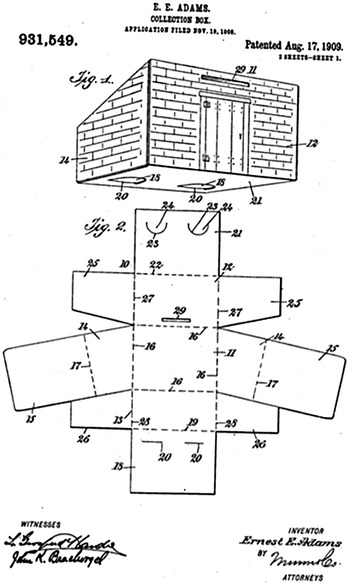
The wide dispersal of boxes across the country and into people's homes was also facilitated by a material innovation. Cardboard was first patented as a shipping material in 1871, two years after the WFMS was founded. In 1890, a Brooklyn-based paper-bag maker named Robert Gair introduced pre-cut cardboard, flat pieces manufactured in bulk, that could be folded into boxes.Footnote 49 Mite-gathering societies quickly adopted this lightweight material that was shipped cheaply without being crushed in transit. Inventors and entrepreneurs capitalized on it too. In 1909, for example, Ernest Eugene Adams of Manhattan patented a “one-piece blank” expressly for church mites. Its one-piece form was folded and secured with tabs for structural integrity, eliminating the added expense of glue or tacks (Fig. 2). Knowing mite societies’ preference for attractive designs, Adams noted that “the blank can be ornamented by printing, painting, or in any other suitable manner, so that . . . the representation presented is a natural and artistic one.”Footnote 50
Diagram from E. E. Adams's patent for a mite collection box filed in 1909. It could be shipped flat and the cardboard tabs eliminated the need for tacks or glue. Accessed July 12, 2015 through https://www.google.com/patents/US931549.

Adams was correct about the importance of aesthetics. However, mite-collecting societies did not necessarily opt for artistry. Some boxes were very plain, construed as giving them a humble, Christian appearance: “Within its plain brown covers are folded wings, waiting to carry glad news of Salvation to thirsty dying souls,” penned one WFMS writer with a flourish.Footnote 51 Other times, the most important aesthetic attribute was standardized seriality, where identical things that are multiplied and distributed reiterate a common bond across space.Footnote 52 It was especially critical during new ventures, such as in 1901 when the General Executive asked all affiliated churches to start children's auxiliaries called the King's Heralds, with a shared motto (“The King's business requireth haste”) and color scheme (silver and blue). The mite boxes furnished for each group had a uniform design in the official colors.Footnote 53 When standardized boxes arrived by post “from the east,” they materialized the united, nation-wide endeavour that linked recipients to each other and to the executive headquarters. Those far-flung districts without WFMS boxes even joined the collective effort by improvising their own. The young president of a small juvenile society in Iowa handcrafted twenty-two boxes out of paperboard. “They are one and one fourth inches square,” she wrote to her district secretary, “and real cute and pretty; covered with silver or gilt paper, with an embossed picture on them. The children have asked for them. They are to take part in a public anniversary in June and I am impatient to see the result.”Footnote 54
Like these Iowa boxes, many mite boxes did sport elaborate designs, printed on cardboard or embossed. The wooden mite box pictured (Fig. 3) was decorated with colorful images on each side showing female missionaries with children in India. Such an intricate box was meant to be kept and it was fitted with a removable piece of wood from which to empty its pennies. With each reuse, a sheet of paper was pasted across the bottom upon which the owner's name was printed, with blank spaces for the amounts she had raised in each quarter of the previous year, perhaps as a point of comparison to spur greater giving. Designs became even more varied and representational as tin and plastic came into use. Boxes to raise money for World War I orphans looked like miniature baby's cradles. Others were shaped like loaves of bread for famine relief, or like a globe, placing givers in the God-like position of hovering over the world and contributing to its welfare.Footnote 55
Methodist mite box circa 1900, made of light wood with scenes from the mission field. The words “Woman's Work for Women” appear on the top near the slot. Photographed by the author in 2014. Courtesy of the General Commission on Archives and History at Drew University (Madison, N.J.).

Mite boxes were more than just receptacles. As scholars of materiality have shown, things intervene in human space and thereby supplement our cognitive capacity by bringing up recollections and emotional associations.Footnote 56 The home mite box is a quintessential example since, unlike church boxes or collection plates where one placed a donation after a ritual act, it was meant to continually intrude upon one's thoughts in the midst of mundane activities and in the private spaces away from the encouragement (or oversight) of one's church sisters. Things, notes sociologist Madeline Akrich, are “relentlessly moral” compared to our own fallibility: they never waver in their proscriptions on human behavior.Footnote 57 The mite box slot, which was often likened to a mouth in WFMS literature, called to women and constrained them. No (human) words were necessary, as Lina Kummer knew, to feel its moral weight.
Highly aware of the mite box's capacity in this regard, promoters counseled women to display it at home in the rooms they frequented most. Mrs. M. C. Lindquist's “The Sorrows of a Mite Box,” a popular pamphlet distributed in the 1890s, illustrates the importance of daily visual and physical contact. It begins with a box lamenting, “Oh dear, oh dear, I do believe I am the most lonesome mite box on this continent!” The box recounts how at first its mistress gave it a place of honor in the kitchen, where she prepared supper every night, but later moved it to a dark drawer where it was left “barely gasping” for air beneath some quilting pieces. No longer visible, the pennies stopped and it became lonely and useless.Footnote 58
At the most basic level, as mnemonic devices, the boxes were expected to recall Methodist missions and related charitable endeavors, prompting the absent-minded to drop a coin into the slot. Every woman, noted a WFMS annual report, should also be “constantly reminded of the neglected, suffering, ignorant, degraded, superstitious idolatrous women whose, existence forms so great a contrast to the hopeful, loving, cheerful, cultivated, blessed life we enjoy through knowledge of the Lord Jesus Christ.”Footnote 59 At another level, then, the boxes were meant to continuously recall for Methodist women that they were especially blessed because of their adherence to Protestant Christianity. In this sense, possessing and handling a beautiful, gilt-covered box full of pennies produced an emotional counterbalance to the economic anxiety noted above when middle-class women felt “haunted” by the ghost of future poverty: the boxes materialized U.S. Protestant (spiritual and material) wealth, with its attendant feelings of well-being, power, and protectedness.
The boxes also inculcated emotionally resonant feelings of presence. In his study of mid-nineteenth century revivals in Boston, John Corrigan argues that antebellum Christians essentialized emotion as a thing that could be circulated, traded, given, or withheld. Inciting strong emotions, especially love, was no longer viewed as unhealthy but, properly channeled, could be the basis for Christian action, and even essential to the production of a Christian self. Women were thought to be more inherently emotional than men and thus powerful conduits of feelings. They could stoke the fires of revival or reform; they could also withhold or lavish affection to train their children as proper Christians.Footnote 60 This gendered circulation of emotion was essential to the mite box. However, the boxes also occupied a particular niche beyond the societal relationships most studied by historians: they were incorporated into imaginative practices that created sensory connections to physically absent beings.
Over the 1880s and 1890s, mite boxes were often used as an interactive memento mori, particularly if they had once belonged to children. In Baltimore in 1881, for example, Mrs. Edwin King continued to add to, and annually send in, the contents of “Mamie's box,” which had belonged to her beloved daughter who died at age fifteen. In Wisconsin, an elderly minister kept his deceased wife's mite box standing where she left it and at each opening it was found to contain the sum she used to give. “Money, like many a little gift that comes to our treasury, is sacred,” wrote the district secretary, “not only to the salvation of heathen women, but also to the memory of one, being dead, yet speaketh on behalf of her pagan sisters.”Footnote 61 Through the boxes, the living carried on relationships with the dead, who thereby retained a voice for years after they were gone. By refilling the mite box, one symbol of the deceased's Christian virtue, grieving relatives also reiterated for themselves (and others) their assurance that their loved ones were indeed in heaven.
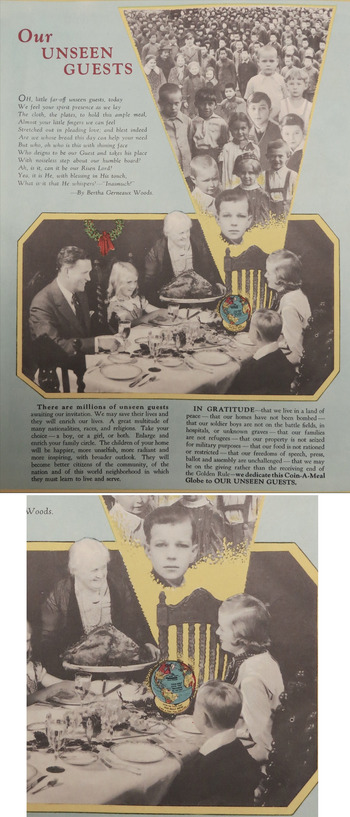
Mite boxes made tangible another kind of present/absent human too—the Christian missionaries and heathens (Christians-in-the-making) who were supposed to be loved as sisters and brothers yet, through their physical absence, remained troublingly indistinct. An advertisement from 1940 (Fig. 4), though it slightly postdates the period under study, offers a useful illustration of the emotion-laden imaginative practices that sought to address this gap between ideal and reality. Produced by an interdenominational mainline Protestant association called the International Golden Rule Fellowship, it portrays an American family enjoying an ample supper with their “Coin-A-Meal,” a globe-shaped mite box at the head of the table. It reiterates familiar messages about American gratitude for blessings and plenty, and the necessity of training children to be “happier, more unselfish, more radiant and more inspiring.”
“Our Unseen Guest,” International Golden Rule Fellowship 7 no. 5 (1940): inside back cover, J. Calvitt Clarke, Founder & International Director, 1938–1964, Archival Materials, box IB23, folder 7, ChildFund International, Richmond, Va.

More pertinent here, however, are the multiple presences at the table. The box itself is accorded human-like qualities: it sits next to a chair seemingly reserved for it and the family smiles at it solicitously. But it also enfolds humans within it, as from it burst forth the faces of thousands of children from around the world who are present-but-absent as they hover over the table, connected to the Americans by the coins that pass through the box.Footnote 62 The image is framed with a poem by Bertha Gerneaux Woods, an early twentieth-century author of sentimental Christian poetry, reading in part:
The mite box compels the almost physical sensation of being touched by faraway fingers in an emotional request for love and pity. To this, Woods's poem adds one more layer to the encounter with ‘unseen guests,’ in the presence of Jesus Christ. With shining face and noiseless tread, this guest of honor “deigns” to join the family at their “humble board,” arriving “with blessing in His touch.” The production of Christian emotions through this multisensory experience of touch, taste, and sound reiterates themes above regarding American gratitude and obligation: however blessed the family may be compared to other people, their meal is but “humble board” compared to the spiritual riches of heaven. Yet as always, humility is entwined with feelings of security, power, love, and connectedness characterized by an American family enjoying a lavish holiday meal at home. Ideally, the mite box inculcated and channelled all these emotion-laden imaginings, making unseen others momentarily present with the comfortable diners.
III. Sensory Interactions and Connections
Mite boxes not only mediated relationships with dead kin, faraway heathens, or Jesus Christ. As religious objects, they were also pictured in relationship with the women whose homes they inhabited, one part of a co-productive and often sensory relationship between humans, things, and the divine. Scholars have typically viewed it as counterintuitive that something like a factory-made cardboard box could be filled with spirit. Marxist cultural critics, in particular, argued that humans are alienated from industrial consumer goods. Something of a thing's aura, famously wrote Walter Benjamin, is lost through mechanical reproduction.Footnote 64
No one in the WFMS denied that mite boxes were mass-made. This mode of production was essential, in fact, since it allowed for the standardization of large numbers of boxes, a valued aesthetic attribute, and made them sufficiently inexpensive to ship across the United States. Yet givers understood the boxes as having spirit regardless of how they were made, since God could use anything in his service; objects are like humans (and humans like objects) in the sense that both are instruments of his power. “God can use both you and me, Frail and humble though we be,” rhymed one mite box poet.Footnote 65 Like humans, the boxes were also sometimes pictured as ascending to their ‘true’ heavenly home once they had successfully championed God's will on earth. The KCNTS mite box, for example, expected to find itself before the throne of Jesus in the next world.
Importantly, mite boxes had a liveness that is rare in things, exemplified by how they featured in an object-oriented genre of literature where things speak, see, and do. Similar stories in which an object, such as a coin, shoe, or pincushion, narrated its life for an adult audience had gained popularity in eighteenth-century English-language media. While these tales and those about mite boxes shared an emphasis on tactility, sensory experience, and object-voice, the former were meant to introduce readers to the intricacies of city life.Footnote 66 By contrast, mite boxes always spoke with a moral object in mind. Returning to Mrs. Lindquist's “Sorrows of a Mite Box,” the box embarks on a tell-all exposé of the inner workings of its mistress's home. It describes how at first she was excited and sang hymns with the other churchwomen as the boxes were distributed. Then shortly after, she turned cold. When the box fell off the shelf onto the floor, it recounts, she returned it with “such a thump that I ached for a week and trembled with fear every time she opened the window.” Nevertheless, the box remained its mistress's devoted friend and prayed that her heart would be softened. “And while I am praying for my mistress,” it concludes, “I am going to pray too for all the other women who have empty, shaky mite boxes.”Footnote 67
Paradoxically, mite boxes were at times chatty divulgers of private information about what happened behind closed doors, and at other times were “voiceless monitors” or “silent gatherers” that gazed at their mistresses to remind them of their pledge of daily sacrifice. Women gazed back at their boxes and prayed for their well-being too.Footnote 68 The WFMS characterized the resulting relationship variously as a bosom friend, a servant or, most often, a “heaven-sent spy.” Each one was associated with divergent emotions, ranging from comforting companionship to unpleasant surveillance. In the latter case, the box watched and weighed human activity and, like a biblical prophet, issued warnings to repent. This oversight was meant to bring about the kind of discipline for which true Christians should strive, however in mite box tales it is never clear whether humans could ever be sufficiently self-disciplined that the boxes would lose their prophetic voice; certainly, there is no intimation this will happen any time soon. The female protagonists are especially far from this ideal, remaining deaf to the box's warning words and losing something of their humanity in the process. Indeed, in “Sorrows of a Mite Box” the box is narrator and subject while its mistress remains a nameless, voiceless object lesson for readers to contemplate.
Such stories also highlight the importance of the boxes’ physical form: they were lightweight receptacles delivered empty for women to fill. As a result, mite box sensations, such as fear or hunger, were repeatedly embodied through shaking—the movement produced when an empty cardboard box is hit with wind from an open window, as in Mrs. Lindquist's tract. Descriptions of a box's hunger or pain were meant to elicit feelings of concern, and of course guilt if it had been neglected. As was typical in such stories, Mrs. Lindquist's mite box describes its bodily needs and exertions in great detail. For weeks, it notes, it was fed twice daily: “Really, it was astonishing how I took on weight.” Then its mistress took it to church where it was “operated on” to remove its innards (the coins). “I felt skinny and weak that night with my innards gone—you would too, I reckon. I got so starving and was so weak that I took cold and shivered and shivered.” To be physically stable, it of course needed to be fed regular pennies—the essential economic principle associated with systematic charity. In emotional terms, however, such appetites linked the boxes with the daily mothering and care Christian women were supposed to provide, an association reinforced by how women were counseled to keep the boxes in the kitchen or dining room—spaces where they fed their own kin.
Not surprisingly, the boxes were often pictured as entwined with the human bodies that women birthed and nurtured at their tables. In 1884, for example, Sister Higgins at Hamline Church in Minnesota made each of her fourteen children add cents totaling their age on the day of their births. Filling her box was a joyful thank offering to the Lord for each added year as her children grew up. Mite box ‘health’ was thus directly correlated to her children's physical health, having survived another year, and their spiritual health, since giving pennies would bring the “blessedness of thankful giving into the donor's heart.”Footnote 69 At another level, mite box hunger connected WFMS women to the bodies of hungry people far away—both literally, since mites were often donated to aid famine victims, and metaphorically. Dropping pennies into the box, donors “put the bread of life into the souls of hungry and benighted heathen,” where coins were transmuted into the spiritual sustenance found in Jesus Christ.Footnote 70 In images like the Coin-A-Meal advertisement (Fig. 4), the box itself is included in the family meal—seemingly offered turkey by the grandmother with the serving plate—which then vicariously feeds the present/absent children hovering above the table through the coins it collects.
A related facet of the box's sensory capacity was its ability to physically travel, coming from far-off production lines, pausing in women's homes, and continuing on to mission fields. The boxes were pictured soaring on wings or being scattered like seeds, a freedom of movement that eluded their mistresses and was thus a valued projection of women's hopes, prayers, and money into the world beyond their homes. Addressing her mite box, one woman wrote in the 1890s:
The boxes transported money and prayers and were also pictured as tangible points of contact between people in different places. “How blessed it is to be able to touch hands with our workers across the sea,” enthused the secretary of the WFMS Pacific branch, referring to how a shared box imaginatively linked American hands and foreign ones.Footnote 72 As scholar of religion David Morgan has noted, many nineteenth-century Protestants also viewed God's hand at work in the new communication and printing technologies that facilitated the movement of missionary objects (such as mite boxes, Bibles, or tracts). Indeed, the objects themselves were often viewed as propelled by greater forces, relying on their human progenitors merely to put them into circulation.Footnote 73 Extending his argument regarding missionary tracts in this period, one could likewise argue that mite boxes were implicated in a modern metric of globalization whereby the seemingly limitless multiplication and circulation of Protestant objects was portrayed as a divinely-directed response to the existence of millions of heathen souls. Thus each donor could picture her box as a point of direct contact with its heathen or missionary recipient, while at the same time WFMS women as a whole could picture thousands of boxes setting out “across the foam” as a concrete example of U.S. Protestants’ (divinely-mandated) power to intervene abroad.
Not all mite boxes were physically sent to the mission field and in such cases women sometimes developed deep affective bonds with the boxes they nurtured over time. Mrs. J. P. Magee, writing in 1890, described one such relationship that lasted more than half a century. As a girl in the 1830s, she joined the youth missionary society at the Bedford Street Methodist Church in New York City. The group had the distinction of supporting Ann Wilkins, the first single female missionary in Africa. On Sundays, they passed around their box to collect each child's penny. When a new church building was constructed in 1840, the box was placed near the altar in the vestry and one member deposited their cumulative contribution each week. It then served as the mite box at Jane Street School until 1858 when Mrs. Magee, now married, left New York for Boston. Knowing that the box had been laid aside, she sought it out at the school and “took charge of it.” For the next twenty-eight years, she kept it at home as her family's contribution box for missions until 1879 when she was elected treasurer of the WFMS New England Branch and seized the opportunity to bring the box “back into the work.” Each evening, Mrs. Magee carefully placed in it the day's receipts, checks and money orders, before endorsing and depositing them in the morning. It was “not always convenient” to use the box, perhaps because it was difficult to fit checks and money orders into a receptacle meant for pennies, but she kept it up regardless. She proudly noted that at least $200,000 “passed through” it during the 1880s, destined for twenty-eight missions in twelve different countries. She credited God for the box's steadfastness and dependability: “‘He who sat over against the Treasury’ has blessed the mites, and guarded the precious gifts, and not one dollar has been lost.” Finally, in 1890, when Mrs. Magee was wrapping up her affairs, and likely retiring from the WFMS, she decided to bring the “venerable Missionary Treasurer” back to its “old home” at Bedford Street, where it had started life so long ago. She carried it back to New York and consigned it to the care of the church's current WFMS circle, “hoping and praying it may still be used in this work which has been so marvelously owned and blessed by the Master.”Footnote 74
In the archives, this document is labeled “The Story of Ann Wilkins' Missionary Box” after the famous African missionary. Yet Ann Wilkins only comes up in passing. In fact, it is the story of a woman's sustained relationship with a deeply meaningful object, about which she still remembers the dates of its removals and replacements even decades after the fact. She carried the box with her to Boston rather than let it be forgotten, brought it “back into the work” when she could, and then returned it “home” to New York. From the vantage point of Mrs. Magee we glimpse how women created emotional bonds with the boxes that lived with them and which they viewed as their co-workers in fund-raising for the Lord.
IV. Mite Box Openings
Mite boxes were “simple in principle,” writes historian R. Pierce Beaver, and this was a major part of their appeal.Footnote 75 However, the promise of simplicity masked a serious theological question regarding Christian charity, which was especially evident in the ubiquitous public events devoted to opening the mite box. In Mrs. Lindquist's story from the 1890s, women brought their boxes to church to be opened in front of their peers. In the mid-1920s at KCNTS, the mite box was opened in a yearly celebration in the campus chapel. Such events could be more elaborate too. In spring 1882, for example, the Busy Bees, a group of thirty girls from Madison Avenue Methodist Church in Baltimore, staged a lengthy bee-themed ceremony for their parents. The performance closed when a man from the audience was invited on stage to demolish their “bee hives” (earthen jar mite-boxes) and pour out the “honey” (copper pennies) to make visible the collective product of their sacrificial giving.Footnote 76
The WFMS organ, Heathen Woman's Friend, first reported mite-box openings in the mid-1870s. As the boxes spread, the ceremonies were often preceded by a Methodist love feast and included processions, hymns, and speeches. In the late 1880s, the WFMS Executive Board introduced a script for a recommended prayer service (including a section called, “The Missionary Box and What It Has to Say for Itself,” where the box addressed women directly). They suggested that, as each box was opened, the name of its owner and amount given should be stated aloud, accompanied by a scripture verse or hymn. Each woman should then state the blessings she was commemorating, what sacrifices the pennies represented, and the methods she had employed to secure them. The sonority of hymns and speeches was then joined by the clatter of pennies being poured out or the crack of smashing ceramic (and then light plastic) boxes, such as those employed by the Busy Bees of Baltimore. In each case, human hopes and prayers were externalized and then refracted through the sounds produced by the boxes: the emotionally satisfying resonances of hundreds of pennies or the humiliatingly tinny reverberations of a few cents landing on the communal table. Such ceremonies echoed what women heard during their months of contributions: the sound of one penny hitting another in a full box or the thump of copper hitting the wood or cardboard bottom of an empty one.
Whether or not auxiliaries followed the precise guidelines laid out by the WFMS Board, such events reinforced the regularized, even ritualized, rhythm of systematic giving. At home, women were counseled to select a particular time of day or week to contribute their ‘pennies with a prayer.’ At church, the boxes were opened and displayed on appointed dates. In the 1890s and 1910s, the Board recommended that auxiliaries observe an even more standardized annual order of donations, with the last yearly quarter devoted to opening mite boxes.Footnote 77 This schedule meant that women shared their boxes whether or not they had actually filled them. In 1876, Mary B. Muffley, the WFMS Mite Agent in Des Moines, chastised her Western Branch sisters for failing in their task. The Branch was collecting a paltry sum of less than fifteen cents for each of the 4,000 boxes in circulation. Nevertheless, she counseled each auxiliary to open them “however little they contain” and to do so publicly: each woman must show her self-denial and physically measure (against others’ contributions) what she had surrendered for Christ's sake.Footnote 78 In this sense, the boxes could be viewed as proxies of the body's relationship to the soul. Most American Christians in this period believed that one's physical body could reflect the purity or degradation of one's soul,Footnote 79 hence the keen interest in documenting the skin color, clothing, and bodily practices (for example, foot-binding) of heathen women. A hypocrite could mask inner corruption with a well-groomed exterior, just as a beautiful box could hide one's lack of Christian constancy and conviction—but only for so long. Cracking open and pouring out a box's “innards” revealed what was truly inside.
Opening ceremonies also revealed who prayed faithfully and for what, since participants were often expected to state their prayers aloud. As noted above, poor women augmented the value of their donations by ‘covering’ their pennies in prayers. In the auxiliary circles, the relationship between prayers and pennies was generally portrayed as very direct: each coin represented a plea to God. Women who prayed faithfully amassed a larger mound of pennies to be poured out in front of their peers. The general content of these prayers was occasionally reported in Heathen Woman's Friend. In February 1888, for example, the women of Connersville, Indiana recounted how their pennies represented special answers to prayer, providential interpositions, and deliverances in trial, especially the restoration of friends from severe illness and the preservation of life after accidents.Footnote 80 Thus Methodist women's giving moved well beyond a concern for personal salvation, the vertical construction most commonly associated with Protestant charity. Instead, their penny-prayers were meant to accrue tangible results in their lives and the lives of others, at home and in the missions.
The very publicness of these events, however, raised a concern. Was giving out of sacrificial obligation to God nullified if one accrued social benefit? It cut to the quick of debates about voluntary (or “free-will”) charity. For Protestants, the problem was that idealizations of Christian charity viewed it as reinforcing the primacy of the human-divine relationship, rather than a horizontal human-human one: it should be a “free gift,” in the Maussian sense, shorn of social entanglements and worldly reward.Footnote 81 Problems of publicity are especially evident in debates about whether to print donors’ names. Famed nineteenth-century English fundraiser Thomas Barnardo pronounced it unscriptural, “leading as it must do to giving ‘to be seen by men’ and to the entire disobedience of the exhortation, ‘But when thou doest alms, let not the right hand know what the left hand doeth; that thine alms may be in secret, and thy Father, which seeth in secret, shall reward thee openly.’” Because donors wanted to track whether their funds had been received, however, Barnardo did consent to print initials prefaced with Miss, Mr., Mrs., Dr., or Rev.Footnote 82 One presumes that society people could still decipher who had given and how much.
Many early nineteenth-century American mission societies used initials for the same reason. Yet, as John Corrigan has shown, publicly acknowledging transactions with God through acts such as praying aloud, was also understood to circulate emotion and thereby encourage others; as great an authority as Jonathan Edwards remarked on the curious fact that God's purpose—in this case, revivals—seemed to spread by word of mouth.Footnote 83 The rub of the issue, then, was the democratization implied in subscription charity. Printing the names of elite patrons was understood to encourage smaller givers and offer assurance of good oversight. Some pastors even preached that charity positively benefited bourgeois men by earning them the esteem of their fellows.Footnote 84 But should every widow who scraped together a few cents get to see her name in print? Would it not lead her into vainglory? Repeatedly, the WFMS encouraged circles to share their pennies publicly in their local context, yet omitted details in accounts for a national audience, cautioning women that faith's mites must be given covertly to be blessed by the Lord.Footnote 85
Exceptions proved the rule. Reports in Heathen Woman's Friend about mite-box openings that specified an individual's name and the precise amount she raised were nearly always limited to the dead, which encouraged the living, but alleviated concerns about self-aggrandizement. A particularly affecting example was ten-year-old Hattie Hall of Reynoldsburg, Ohio who died a lingering death in the summer of 1879. During her last months, blind and frail, she kept a mite box by her bedside so visitors could contribute. At first she handed it to them and then could only gesture as she weakened. At her funeral, her contributions were counted at more than a dollar; the box was then passed around and reopened, having gained two more dollars. At a children's memorial service a few weeks later, the box again “[spoke] its mute appeal” and was passed around. “‘She being dead yet speaketh’ was the thought in many hearts” as her friends added four more dollars. Thus Hattie's voice lingered on, mingled with her box's appeal, and echoed in the pages of Heathen Woman's Friend, which printed both her name and the amount raised.Footnote 86
Although openings likely created certain divisions by publicly praising those who had filled their boxes and shaming those who had not, less cynically, one could argue along the lines of Laura M. Stevens, in her work on fundraising for colonial missions to American Indians, that “money [became] the medium of, and a metaphor for, mutual redemption.”Footnote 87 This idea is echoed in how the dead and living cooperated, such as when Hattie's box was passed from hand to hand at her memorial. Or how opening ceremonies often included the physical pooling together of coins from separate boxes, which may have enacted an idealized Christian communalism where the financially (and/or spiritually) stronger buttressed their weaker sisters. Through these public events, American Protestants enacted a kind of communion that reinforced Christian mutuality, while also mingling human voices, refracted through the sound of pennies pouring out or receptacles being smashed, with the mite box's “mute appeal.”
V. Mite-Box Capitalism in the Late Nineteenth Century
Traditional work on capitalism has often assumed the inevitable rise of modern rational (and not supernatural) economic principles. A growing subfield in religion and market capitalism addresses this issue, yet, as Kathryn Lofton notes, is faced with another potential landmine: scholars’ unwitting complicity in reproducing neoliberalism's own vision of its triumphant ascendancy.Footnote 88 At their most compelling, studies of religion cut across both of these assumptions by producing careful portraits of Christians actually ‘doing’ capitalism in ways that acknowledge multivocality and ambiguity.Footnote 89 Contributing to this ongoing project, this article emphasizes the key role of emotion and sensory practices in the history of U.S. religion and market capitalism, highlighting in particular the experience of Christian women in the late-nineteenth and early-twentieth centuries.
Following talking mite boxes as they entered Christian homes across the country reveals a few important things. The first concerns the movement of money, which is an essential precondition for modern market capitalism. Specifically, the period under study saw the more complete institutionalization of systematic saving and giving, especially among the middle classes. My contention is that, to understand why money is accumulated and circulated, we must attend to emotional investments in objects (that comfort, counsel, shame, and even spy on their “mistresses”) and to physical sensations, such as hearing the clink of pennies, feeling the weight of a box, or enjoying the physical pleasure of running one's fingers through mounds of coins. These dispositions and practices motivate monetary accumulation by acting as an imaginative bridge between the immediacy of a specific sensory experience and the projections of social policies or Christian prayers—the future that WFMS women envisioned when their pennies reached the mission field. My argument in this regard borrows from historian Sarah Lloyd, who calls attention to “moral imaginations,” culturally resonant sets of ideas and practices that make the future seem vividly real. It is one basis, writes Lloyd, for humans’ otherwise irrational investments in desired outcomes through, say, speculation, accumulation, or charitable giving. Mite boxes were thus “ideal/idea” objects, to paraphrase theorist Kathleen Stewart: materializations of latent possibilities lodged in the dense space between interpretation and sociality.Footnote 90
Mite boxes remind us, too, that motivations for monetary accumulation are often grounded in imagining something beyond one's own stockpiled resources. The thousands of coins pictured passing through a single object, and then poured out together in an opening ceremony, could produce an emotional connection to the aggregate efforts of people across social classes and even across generations, as Mrs. Magee's story shows. The boxes also materialized relationships that were meant to be present, but were not tangible. They were understood to be physical points of contact between people at home and abroad, the living and the dead, and humans and God. For the women involved, mite boxes participated in new forms of circulation that cemented the reality of far-flung networks of people, prayers, and money, thereby undergirding capitalism and its attendant forms of organization, including colonial and missionary institutions.
Last, and importantly, the emotions mite boxes engendered were often paradoxical: they amplified anxiety and guilt, as well as pleasure and comforting well-being. Rather than view these feelings as indicative of a transition from older forms of religious giving (associated with guilt) to secular philanthropy (associated with pleasure), I emphasize the coexistence of such tensions as U.S. Christians retained ideas about blessings, obligations, and holding wealth in trust for God. The WFMS women never explicitly connected spiritual superiority with wealth; they never said that good Christians get rich.Footnote 91 Yet they clearly expected that one could not keep wealth without sacrificing part of it for God's creation, which is the message the boxes continually reiterated for their mistresses. Thus the boxes were capacious objects that contained economic anxieties, as well as positive feelings of protectedness associated with the abundance of American wealth. For every shaky mite box “spying” on its mistress, there was a plump and happy box, sitting at the head of a bounteous family dinner table. We must take both into account if we are to understand the relationship between mite boxes and the women who nurtured them, and the various emotional registers of capitalism in this period.