

Introduction
Tobacco use is the major cause of preventable death in the US and elsewhere, (Garrett, Dube, Trosclair, Caraballo, & Pechacek, Reference Garrett, Dube, Trosclair, Caraballo and Pechacek2011; Jha, Peto, Zatonski, Boreham, Jarvis, & Lopez, Reference Jha, Peto, Zatonski, Boreham, Jarvis and Lopez2006; Kanjilal et al., Reference Kanjilal, Gregg and Cheng2006; Mokdad, Marks, Stroup, & Gerberding, Reference Mokdad, Marks, Stroup and Gerberding2004; Pierce, Fiore, Novotny, Hatziandreu, & Davis, Reference Pierce, Fiore, Novotny, Hatziandreu and Davis1989) and socioeconomic disadvantage is strongly associated with risk for smoking (Centers for Disease Control and Prevention, 2015; U.S. Department of Health and Human Services, 2014). Smoking among low-income individuals is currently more than three times higher than that of higher-income individuals (Centers for Disease Control and Prevention, 2015; U.S. Department of Health and Human Services, 2014). Neighbourhood socioeconomic disadvantage has also been linked with subsequent smoking behaviours (Halonen et al., Reference Halonen, Pulakka and Stenholm2016). Evidence indicates that low- and high-income individuals have similar levels of motivation to quit smoking and similar probability of making a quit attempt in the past 12 months, but low-income smokers are less likely to achieve smoking abstinence (Fu et al., Reference Fu, Kodl, Joseph, Hatsukami, Johnson and Breslau2008; Lebrun-Harris, Fiore, Tomoyasu, & Ngo-Metzger, Reference Lebrun-Harris, Fiore, Tomoyasu and Ngo-Metzger2015).
Pharmacological treatment in the form of nicotine replacement therapy (NRT) has been shown to improve cessation success rates and has been recommended as an important treatment modality (Baker et al., Reference Baker, Piper, Stein, Smith, Bolt and Fraser2016; Lindson-Hawley, Hartmann-Boyce, Fanshawe, Begh, Farley, & Lancaster, Reference Lindson-Hawley, Hartmann-Boyce, Fanshawe, Begh, Farley and Lancaster2016). Compared with the general population of smokers, evidence-based smoking cessation treatments, such as NRT are less likely to be used by individuals of low income and racial and ethnic minority (Cokkinides, Ward, Jemal, & Thun, Reference Cokkinides, Ward, Jemal and Thun2005; Fu et al., Reference Fu, Sherman, Yano, van Ryn, Lanto and Joseph2005; Robles, Singh-Franco, & Ghin, Reference Robles, Singh-Franco and Ghin2008; Ryan, Garrett-Mayer, Alberg, Cartmell, & Carpenter, Reference Ryan, Garrett-Mayer, Alberg, Cartmell and Carpenter2011; Shiffman, Brockwell, Pillitteri, & Gitchell, Reference Shiffman, Brockwell, Pillitteri and Gitchell2008; Trinidad, Perez-Stable, White, Emery, & Messer, Reference Trinidad, Pérez-Stable, White, Emery and Messer2011).
Most of the data on use of NRT among low-income smokers has been derived from general population surveys and studies in which education and/or income are treated as one of a number of correlates (Cokkinides, Ward, Jemal, & Thun, Reference Cokkinides, Ward, Jemal and Thun2005; Fu et al., Reference Fu, Sherman, Yano, van Ryn, Lanto and Joseph2005; Robles, Singh-Franco, & Ghin, Reference Robles, Singh-Franco and Ghin2008; Ryan, Garrett-Mayer, Alberg, Cartmell, & Carpenter, Reference Ryan, Garrett-Mayer, Alberg, Cartmell and Carpenter2011; Trinidad, Perez-Stable, White, Emery, & Messer, Reference Trinidad, Pérez-Stable, White, Emery and Messer2011). Accordingly, few clinical studies have undertaken analyses to determine which factors are associated with NRT use specifically among low-income smokers. To address this knowledge gap, we analysed baseline data on self-reported NRT use within the past year among low-income smokers living in public housing who had enrolled in a smoking cessation intervention trial. For this current study on NRT use, we were most interested in the broadest population reach, that is individuals who we thought would be using the most common form of treatment, the patch or gum.
Methods
Design and Setting
‘Kick it for Good’ was a randomised smoking cessation intervention study (Brooks et al.) conducted among residents of the Boston Housing Authority (BHA) – the chief provider of subsidized rental housing in Boston, Massachusetts. A total of 506 smokers living in 26 public housing sites completed the baseline questionnaire in 2011–2013. The median annual household income of BHA residents is $10,582. The goal of the parent study was to test the effectiveness of public housing residents trained as tobacco treatment advocates (TTAs), who counselled smokers to motivate them to quit smoking and to increase utilization of services, such as quitlines and clinic-based cessation programmes. The study was approved by the Boston University Medical Center Institutional Review Board, and is registered with ClinicalTrials.gov (NCT01651611). The current study is focused on analysis of baseline data only.
Participants
We used flyers and door-to-door contact to recruit participants, who were provided with $25 in gift cards or cash voucher for completion of the baseline questionnaire. Residents were interviewed in their homes or a designated common area within their development.
The survey was verbally administered by a trained survey team using prompts to assist residents with questions that had multiple response items. Inclusion criteria were: aged 18–79, smoked ≥100 cigarettes in lifetime, current smoker (defined as smoking every day or some days and having smoked within the past 7 days), planning to quit smoking in 30 days or thinking about quitting in next 6 months, speak English or Spanish, and plan to live in public housing for the next 12 months. Exclusion criteria included current use of pharmacological treatment for smoking cessation, currently engaged with the Smokers Quitline or other clinic-based cessation programme, and cognitive/psychiatric conditions that would preclude participation in the study.
We restricted analyses for this study to smokers who reported making a quit attempt in the past 12 months (n = 234). We further excluded 12 individuals who reported current use of Chantix, Wellbutrin, or Zyban but not NRT, leaving a total of 222 participants available for analysis (distribution by site: median = 7, range = 1–34).
Measures
The primary outcome measure was use of NRT during a quit attempt in the past 12 months, defined as any self-reported use of nicotine patch, gum, lozenge, nasal spray, or inhaler. First, respondents were asked if they ever used any of these products. If they said yes to this question, they were asked when was the most recent time used and the response items were 12 months or less, 1–2 months, 2–3 months, 3–5 months, and >5 months.
A quit attempt was defined as not smoking for at least one full day and deliberately stopping smoking because of wanting to quit, not because of illness, hospitalisation, or some other reason that one could not smoke. Factors evaluated for their association with recent NRT use included:
• Demographics: age, gender, ethnicity, education (at least some college vs. high school or less), income (>$10,000 vs. ≤$10,000), number of years living in public housing (≤10 years vs. >10 years), and smokers ≥18 years apart from oneself living in the home (≥1 vs. 0).
• Tobacco use: number of cigarettes smoked daily (>10+ vs. ≤10), 10-point Fagerstrom Test for Nicotine Dependence (≥5 vs. <5) (Etter, Duc, & Perneger, Reference Etter, Duc and Perneger1999), whether a loved one had asked the participant to quit smoking in the last 12 months, and the number of lifetime quit attempts (defined as a deliberate period of abstinence for at least 24 h) (>1 vs. 1).
• Cessation intervention knowledge and experiences: Self-reported receipt of advice by a primary health care provider (defined as having a primary care doctor or regular health care provider, such as a nurse or medical assistant) to stop smoking in the past 12 months; self-report of whether the participant asked their provider about ways to quit smoking in the previous 12 months; perception of extent of support to quit by health care provider (a lot or moderate vs. little or not at all); awareness of Medicaid coverage (government-funded US health care programme that assists low-income individuals in paying for medical care costs) for smoking cessation counselling, patches, or other medications; awareness of smoking cessation programmes at health centres or hospitals; and ever having received a referral to the Smokers’ Quitline or a clinic-based cessation programme.(Table 1)
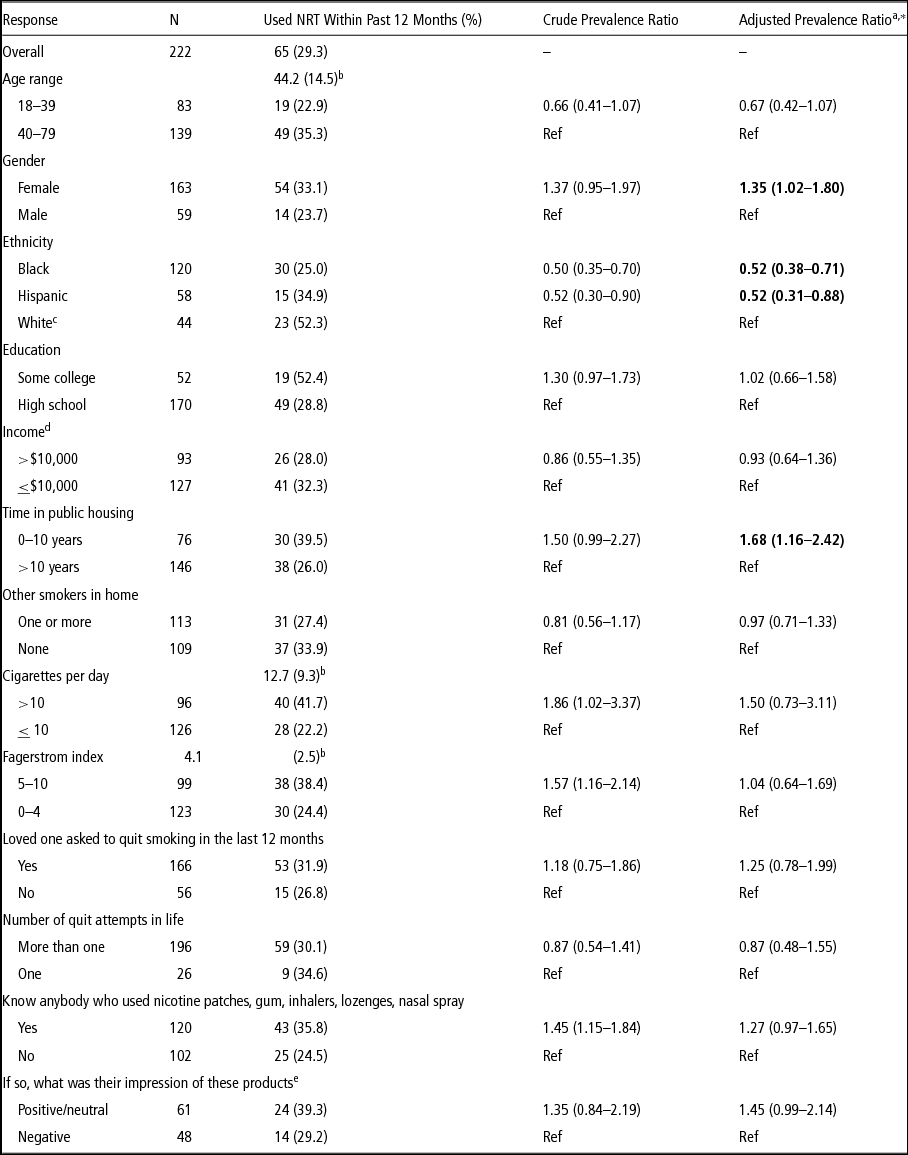
Sample characteristics (n = 222)

a Mean (standard deviation).
b Among participants who saw regular health care provider in past 12 months.
Data Analysis
We used generalized estimated equation (GEE) log-binomial regression models with an exchangeable correlation structure to calculate adjusted prevalence ratios for the association of each measure described in the previous section with recent NRT use. The models accounted for the cluster-randomized design and potential correlations in behaviour among participants at the same public housing site. All analyses controlled for gender, age (continuous), and ethnicity (Hispanic, Black non-Hispanic, and White non-Hispanic); four participants who reported Other race were combined with Whites for purposes of adjustment. We also adjusted for number of cigarettes per day (≤10, >10) with the exception of analysis of demographic measures, based on our assessment that cigarettes per day could be an intermediate factor on the causal pathway between measures, such as age, gender, and ethnicity and NRT use. We also did not adjust for cigarettes per day in the analysis of the Fagerstrom Index, which includes cigarettes per day as a component of the index. Analyses were conducted using SAS version 9.3 (SAS Institute, Inc., Cary, NC). Statistically significant values were set at p < .05 and are bolded in Tables 2 and 3.
Demographic information and smoking characteristics (n = 222)

a Multiple Log Binomial Generalized Estimating Equation (GEE) included age, gender, and ethnicity for all variables. Number of cigarettes smoked per day was included in models with the exception of demographics (age, gender, ethnicity, education, income, and time in public housing) and Fagerstrom index.
b Mean (standard deviation).
c White ethnicity includes four individuals with race recorded as other.
d 2 individuals with missing income information (n = 220).
e Restricted to individuals who answered yes to ‘Know anybody who used nicotine patches, gum, inhalers, lozenges, nasal spray’ (n = 109, 11 answered ‘Don't Know’).
* Statistically significant results (p<.05) are highlighted in bold.
Factors related to health care utilisation and use of NRT (n = 222)

a Multiple Log Binomial Generalized Estimating Equation (GEE) included age, gender, ethnicity, and cigarettes per day for all variables.
b Restricted to individuals who reported having a regular health care provider (n = 211).
c Restricted to individuals who reported seeing regular health care provider in past 12 months (n = 202).
*Statistically significant results (p<.05) are highlighted in bold.
Results
Women comprised the majority of participants (73%), consistent with the proportion of residents who were female. Ages ranged from 19 to 78, with 63% aged 40 years or older (Table 1). Also reflecting the population living in public housing, the distribution by ethnicity was 54% Black non-Hispanic, 26% Hispanic, 18% White non-Hispanic, and 2% other race. Seventy-seven percent had a high school education or less, and 58% had household income of ≤$10,000 per year. Fifty-seven percent smoked ≤10 cigarettes per day, and 51% lived in a household with at least one other smoker. There were no differences for any of these characteristics between the 222 participants included in the current analyses and the 506 participants who completed the baseline questionnaire in the parent intervention study.
Correlates of NRT Use
In this group of smokers who made a quit attempt in the past year, 29% reported using NRT (Table 2). Younger smokers were less likely and women were more likely to have used NRT in the past 12 months. Black (prevalence ratio, PR = 0.52, 95% CI: 0.38–0.71) and Hispanic (PR = 0.52, 95% CI: 0.31–0.88) participants were less likely to report use of NRT compared with Whites. As expected, use of NRT in the past year was more likely to be reported among heavier smokers (>10 cigarettes/day) than among lighter smokers (≤10 cigarettes/day) (PR = 1.50, 95% CI: 0.73–3.11) (Table 2). However, there were very different racial/ethnic patterns of NRT use among heavier and lighter smokers. Among heavier smokers, 50% of Whites used NRT in the past 12 months compared with approximately 40% of Black and Hispanic smokers. Among lighter smokers, the proportion who had used NRT was similar to heavier smokers among whites (57%) but much lower among Black and Hispanic smokers (18%).
Ninety-one percent of participants reported that they had seen their regular health care provider in the last 12 months, and 79% of these had been advised to quit smoking (Table 1). Sixty percent of smokers reported being engaged in discussion of smoking cessation defined as both asking for and receiving provider advice; smokers engaged in a two-way discussion were more likely to have used NRT than those who neither asked for nor received advice (PR = 1.90, 95% CI: 0.96–3.78), as well as those who reported only the doctor providing advice (Table 3). Sixty-five percent of respondents reported receiving moderate or a lot of support from their regular health care provider, which was also associated with greater use of NRT (PR = 1.82, 95% CI: 1.06–3.13).
Only 59% of smokers with past year quit attempts were aware that Medicaid (called Mass Health in Massachusetts) pays for counselling and prescription patches or other medications to help quit smoking; awareness of coverage was associated with greater recent NRT use (PR = 1.74, 95% CI: 1.09–2.76). Sixty-seven percent of respondents were aware that local hospitals and neighbourhood health centres had cessation programmes, while 19% had been referred by their provider and 7% had ever used a programme; 45% had heard of a telephone quitline, while 11% had been referred, and 14% had ever used the quitline. Referral to a clinic-based programme, but not referral to a quitline, was associated with higher rates of recent NRT use.
Discussion
Low use of NRT among low-income individuals is a key but often unrecognised roadblock toward smoking cessation (Cokkinides, Ward, Jemal, & Thun, Reference Cokkinides, Ward, Jemal and Thun2005; Fu et al., Reference Fu, Sherman, Yano, van Ryn, Lanto and Joseph2005; Robles, Singh-Franco, & Ghin, Reference Robles, Singh-Franco and Ghin2008; Ryan, Garrett-Mayer, Alberg, Cartmell, & Carpenter, Reference Ryan, Garrett-Mayer, Alberg, Cartmell and Carpenter2011; Shiffman, Brockwell, Pillitteri, & Gitchell, Reference Shiffman, Brockwell, Pillitteri and Gitchell2008; Trinidad, Perez-Stable, White, Emery, & Messer, Reference Trinidad, Pérez-Stable, White, Emery and Messer2011). To provide more effective cessation interventions for low-income smokers, it is critical to understand and resolve barriers to NRT use. The present analysis identified multiple predictors of NRT use among low-income smokers. Previous studies have identified educational attainment as one of many reported predictors (cost, access, physician–patient barriers) (Cokkinides, Halpern, Barbeau, Ward, & Thun, Reference Cokkinides, Halpern, Barbeau, Ward and Thun2008; Cook-Shimanek, Burns, & Levinson, Reference Cook-Shimanek, Burns and Levinson2013; Davis, Coady, Mbamalu, Sacks, & Kilgore, Reference Davis, Coady, Mbamalu, Sacks and Kilgore2013; Schauer, Malarcher, & Berg, Reference Schauer, Malarcher and Berg2014), and other factors related to NRT use have rarely been explored specifically among socioeconomically disadvantaged smokers.
In this analysis of smokers living in public housing, 29% had used NRT during a quit attempt in the past 12 months. This figure is within range of NRT use among smokers in the general population (Cokkinides, Halpern, Barbeau, Ward, & Thun, Reference Cokkinides, Halpern, Barbeau, Ward and Thun2008; Kruger, O'Halloran, Rosenthal, Babb, & Fiore, Reference Kruger, O'Halloran, Rosenthal, Babb and Fiore2016; Shiffman, Di Marino, & Sweeney, Reference Shiffman, Di Marino and Sweeney2005), although the rate may have been inflated in this analysis because the study was limited to those interested in quitting smoking and enrolled in a cessation intervention trial.
While it has previously been demonstrated that Black and Hispanic smokers are less likely to use NRT than White smokers, (Fu et al., Reference Fu, Sherman, Yano, van Ryn, Lanto and Joseph2005; Kruger, O'Halloran, Rosenthal, Babb, & Fiore, Reference Kruger, O'Halloran, Rosenthal, Babb and Fiore2016; Ryan, Garrett-Mayer, Alberg, Cartmell, & Carpenter, Reference Ryan, Garrett-Mayer, Alberg, Cartmell and Carpenter2011) our findings show that the same relationship holds even within a group of exclusively low-income smokers. Thus, low-income Black and Hispanic smokers may experience a double disadvantage in their use of NRT. Addressing this gap in NRT use is crucial as racial/ethnic minorities are as likely to quit smoking at a level similar to whites in specific situations when cessation treatment includes NRT (Fu et al., Reference Fu, Sherman, Yano, van Ryn, Lanto and Joseph2005; Robles, Singh-Franco, & Ghin, Reference Robles, Singh-Franco and Ghin2008).
Strikingly, there were also very different racial/ethnic patterns of NRT use among heavier vs. lighter smokers. Whites, who were heavier smokers, were more likely to use NRT in the past 12 months (50%) than Black and Hispanic smokers (40%). However, among lighter smokers, the proportion that had used NRT was similar to heavier smokers among Whites (57%) but much lower than among Black and Hispanic smokers (18%). One implication of this finding for cessation counseling would be to more actively discuss use of NRT with Black patients and encourage them to try first use of NRT regardless of the number of cigarettes smoked.
While NRT use was low among all smokers, it appears that lighter smokers were more likely to be undertreated with evidence-based counselling and pharmacotherapy (Cook-Shimanek, Burns, & Levinson, Reference Cook-Shimanek, Burns and Levinson2013; Schauer, Malarcher, & Berg, Reference Schauer, Malarcher and Berg2014), despite being amenable to further reducing or making a complete and successful quit attempt (Davis, Coady, Mbamalu, Sacks, & Kilgore., Reference Davis, Coady, Mbamalu, Sacks and Kilgore2013). The issue of under-treatment has grown in importance as the proportion of light smokers as a percentage of all smokers has increased. Most recent data from the California Tobacco Surveys (1990–2008) reveal that light and intermittent smoking has increased over time for male and female Black, Latino, and White smokers across various income levels (Pulvers, Romero, Blanco, Sakuma, Ahluwalia, & Trinidad, Reference Pulvers, Romero, Blanco, Sakuma, Ahluwalia and Trinidad2015). A recent study of public housing residents in Columbus, Ohio found that only 14.7% of all smokers smoked >10 cigarettes per day, of whom 64% were interested in using cessation aids; actual use of NRT was not reported (Hood, Ferketich, Klein, Wewers, & Pirie, Reference Hood, Ferketich, Klein, Wewers and Pirie2013). In our study, 57% of smokers with a recent quit attempt reported smoking ≤10 cigarettes per day.
While there are no clear guidelines regarding treatment of those who smoke <10 cigarettes per day, prescribing NRT for these individuals has become a more common practice. Earlier national studies have found that such smoking patterns are more common among ethnic minority smokers (Trinidad, Perez-Stable, White, Emery, & Messer, Reference Trinidad, Pérez-Stable, White, Emery and Messer2011), a pattern observed in our study. Notably, in this study, among lighter smokers, White smokers were three times more likely than Black and Hispanic smokers to have used NRT in the past 12 months, which largely accounts for the difference in the overall racial/ethnic disparity in NRT use observed in this population. Whether this lower rate of NRT use reflects greater personal reluctance to use NRT among Black and Hispanic public housing residents or fewer recommendations from their physicians requires further investigation.
After many years of media attention to tobacco cessation in Massachusetts, only 60% of respondents (almost all of whom were covered by Medicaid), reported being aware that insurance, including Medicaid, pays for counselling and provides prescription patches. Awareness was substantially higher than among Ohio public housing residents (a state with no concerted statewide media campaigns), where only 30% of residents knew that Medicaid covered inexpensive cessation medications (Hood, Ferketich, Klein, Wewers, & Pirie, Reference Hood, Ferketich, Klein, Wewers and Pirie2013), suggesting that past media campaigns support higher awareness. Nevertheless, the fact that 40% of smokers in Boston public housing who were interested in quitting smoking were unaware of the availability of these services speaks to the need for rejuvenated attempts to increase awareness among lower-income populations. This knowledge could be particularly important because the difference in price between prescribed and over-the-counter NRT is likely a substantial obstacle to use. In our study, awareness of Medicaid coverage was associated with recent use of NRT, although this may have been a consequence of NRT use rather than a predictor of NRT use.
Few studies have examined the association between recent use of NRT and physician recommendations. Using the 2010–11 Tobacco Use Supplement of the Current Population Survey (TUS-CPS), Agaku, Ayo-Yusuf, & Vardavas (Reference Agaku, Ayo-Yusuf and Vardavas2014) found that individuals with more than 12 years of education were more likely to have received advice to use medication (40.8%) versus those with less than 12 years of education (35.4%) (Agaku, Ayo-Yusuf, & Vardavas, Reference Agaku, Ayo-Yusuf and Vardavas2014). These differences are quite modest and may reflect the fact that low-income smokers may be in poorer health, thus lending themselves to more visits, and thus higher rates of recommendations to use medication. In fact, rates of having and seeing a regular health care provider in the past year and being advised to quit smoking were higher for BHA residents compared with smokers in the general population (Agaku, Ayo-Yusuf, & Vardavas, Reference Agaku, Ayo-Yusuf and Vardavas2014). This suggests that public and professional communication strategies that encourage patients and their health care providers to discuss NRT use may be particularly relevant for low-income smokers.
The cross-sectional nature of the baseline questionnaire leads to two important limitations in this study. The first concerns uncertainty about the temporality of the association between many of the measures in this study and NRT use. While not affecting demographic and other measures that clearly pre-date past-year NRT use, certain measures may have been affected by, rather than predict, NRT use, including for example, the relationship between being aware of Medicaid coverage and use of NRT. Secondly, cross-sectional studies do not account for people who have left the population; in this case, persons who successfully quit in the past year, some of whom may have used NRT, are not included in the study population. Factors that are associated with successful use of NRT will tend to be under-represented among those who continue to smoke. In contrast to most cross-sectional studies of factors associated with NRT use, our study focused on use within the past 12 months rather than ‘ever use’ as the outcome measure. Neither issue is eliminated by focusing on recent use, but their magnitude may be decreased. Nevertheless, caution in interpretation of the results is warranted. A further limitation is that the study was nested within a larger study of smokers who were interested in quitting. Therefore, the results likely differ to some unknown extent compared to those that would have been seen in a study of all smokers in public housing. Finally, when there are fewer than 40 clusters, as in the present study, GEE logistic regression may somewhat underestimate the variance (Huang, Fiero, & Bell, 2016).
Lower use of NRT may also be accounted for in part by factors unexplored in the current analysis. For example, African American and other ethnic minority patients have been found to receive poorer interpersonal communication in the clinical setting, including lower levels of affective behaviours, such as rapport-building and overall affective tone, and greater physician verbal dominance, less patient-centeredness, and shorter visits, compared with white patients (Martin, Roter, Beach, Carson, & Cooper, Reference Martin, Roter, Beach, Carson and Cooper2013). A systematic review indicated that higher income is repeatedly associated with increased overall physician–patient communication and provision of information (Willems, De Maesschalck, Deveugele, Derese, & De Maeseneer, Reference Willems, Maesschalck, Deveugele, Derese and Maeseneer2005).
There is also the possibility that physicians may spend less time on smoking cessation with low-income and racial/ethnic minority patients because of more complex medical problems.
This study provides important insights into factors associated with NRT use among low-income public housing residents who made a quit attempt in the past year. NRT – an effective and inexpensive treatment for tobacco dependence – remains widely underused, especially for socioeconomically disadvantaged smokers. In the United States, there is the potential for greater opportunity to systematise engagement of low-income patients around NRT use, as the Patient Protection and Affordable Care Act and Accountable Care Organizations progress toward system-wide enhancements, such as chart and electronic reminder systems, incentivizing systems that comply with federally endorsed guidelines for recommending NRT, awareness-raising campaigns for patients, providers, and policy makers, and training to motivate physicians and other health care providers to encourage use of proven treatments (DiGiulio et al., Reference Digiulio, Haddix, Jump, Babb, Schecter and Williams2016). Renewed efforts to promote knowledge of access to NRT, and to engage patients on the benefits of NRT use and optimal use strategies, may yield long-sought improvements in smoking cessation outcomes among socioeconomically disadvantaged smokers.
Acknowledgements
None
Financial Support
National Cancer Institute/NIH grant #1R01CA141587-05 (Brooks, D).
Conflicts of Interest
None
Ethical Standards
The authors assert that all procedures contributing to this work comply with the ethical standards of the relevant national and institutional committees on human experimentation and with the Helsinki Declaration of 1975, as revised in 2008.