INTRODUCTION
In recent years, fish parasites attain increasing interest from an environmental point of view (Sures, Reference Sures2006, Reference Sures2008). Many studies demonstrate the close relationship between parasitism and ecological conditions in a given environment and describe how parasites can be used to enlarge knowledge on ecosystem function and integrity (Hudson et al. Reference Hudson, Dobson and Lafferty2006; Lafferty et al. Reference Lafferty, Allesina, Arim, Briggs, De Leo, Dobson, Dunne, Johnson, Kuris, Marcogliese, Martinez, Memmott, Marquet, McLaughlin, Mordecai, Pascual, Poulin and Thieltges2008). Pollution with toxic substances such as metals or polychlorinated biphenyls (PCBs) as well as an enrichment of nutrients (eutrophication) may affect the occurrence and physiology of parasites. The effects of toxic pollutants and eutrophication on parasites can be direct (e.g. by reduction of the number of free living stages or intermediate host) or indirect (e.g. host immunosuppression) depending on the pollution type and parasite life cycle (Sures, Reference Sures2008). Various studies demonstrate, for example, that toxic pollution reduces the diversity of heteroxenous parasites, whereas parasites with direct life cycles (monoxenous) are less affected. The latter are often ectoparasites which are in direct contact to the surrounding water and are thus adapted to changes in environmental conditions (Valtonen et al. Reference Valtonen, Holmes and Koskivaara1997; MacKenzie, Reference MacKenzie1999; Perez-del Olmo et al. Reference Perez-del Olmo, Raga, Kostadinova and Fernandez2007). Concerning toxic pollutants it emerges that certain substances such as metals or PCBs cause immunosuppression in the fish host and thus may increase parasitism by a reduced host defence (Hoole, Reference Hoole1997). The resulting numerical changes (increase or decrease of abundance and intensity) of aquatic parasites leading to changes in structure and diversity of parasite communities as a response to different forms of pollution may be used for bio-indication purposes (MacKenzie et al. Reference MacKenzie, Williams, Williams, McVicar and Siddall1995). Accordingly, the occurrence and diversity of parasites stand as a measure of ecosystem health even if the underlying functional chains are often unknown.
In order to use fish parasites as pollution indicators, the fish host must be widely distributed and easily sampled (Kennedy, Reference Kennedy1997). Therefore, in the present study we focused on barbel (Barbus barbus) and its parasite communities at different sampling sites along 3 lower reaches of the Danube River. The barbel is the second largest native cyprinid fish species in Europe, being widespread in major European river systems. Although many studies on the parasite fauna of B. barbus have been published from selected localities of the Danube basin, data from east Europe and especially from the Balkan Peninsula and the Danube delta are scarce. Only few studies on parasites of barbel in the Danube River in Bulgaria (Kakacheva-Avramova, Reference Kakacheva-Avramova1962, Reference Kakacheva-Avramova1977, Reference Kakacheva-Avramova1983; Margaritov, Reference Margaritov1959, Reference Margaritov1966; Nedeva et al. Reference Nedeva, Atanassov, Karaivanova, Cakic and Lenghardt2003) and in Romania (Roman, Reference Roman1955) exist, whereas most information on barbel parasites is delivered from Central Europe (Michalovič, Reference Michalovič1954; Moravec and Scholz, Reference Moravec and Scholz1991; Moravec et al. Reference Moravec, Konecny, Baska, Rydlo, Scholz, Molnar and Schiemer1997; Laimgruber et al. Reference Laimgruber, Schludermann, Konecny and Chanovec2005). Until now, the complete endohelminth fauna of B. barbus reported for the Danube drainage system in Central Europe consists of 43 species with 22 trematodes, 9 cestodes, 7 nematodes and 5 acanthocephalans (Moravec et al. Reference Moravec, Konecny, Baska, Rydlo, Scholz, Molnar and Schiemer1997). In contrast, the list of barbel endohelminths in the Bulgarian section of the Danube River (Kakcheva-Avramova, Reference Kakacheva-Avramova1977) includes only 6 species, but there are a few unpublished studies, which describe up to 11 species.
The aim of the present study was to obtain a more complete picture of the endohelminth fauna of B. barbus and to study the composition and diversity of parasite communities with respect to the environmental conditions of the habitats. It is expected that the structure and diversity of parasite communities over consecutive years at sites that differ in their degree of eutrophication and in their concentration of toxic metals reflect the ecological conditions.
MATERIALS AND METHODS
Sampling sites
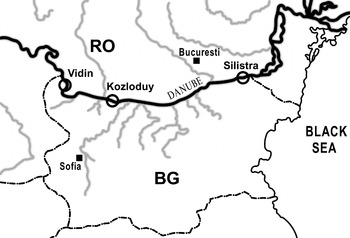
The study was carried out in a seasonal manner (April, July and October) ranging from summer 2004 to summer 2007 at 3 different localities of the Bulgarian part the Danube River. The sampling sites (see Fig. 1) were selected on the basis of different degrees of eutrophication and toxic pollutants, as the main objective of the current research was to check whether parasite communities reflect the environmental conditions of their habitats. The first sampling site is located near Vidin (river kilometre 834), about 10–15 km away from the inflow of the river Timok (845 km), which is one of the biggest metal pollution sources downstream in the Danube. The second sampling site was selected near the town of Kozloduy (685 km), approximately 160 river kilometres downstream from Vidin. The third site was on the border between Bulgaria and Romania near the town of Silistra (375 km) that represents the last Bulgarian locality in an eastward direction of the river. The sampling stretches covered approximately 5 river kilometres at each sampling site (Fig. 1).
Location of the sampling sites along the Danube River in Bulgaria. BG – Bulgaria; RO – Romania.

Fish sampling
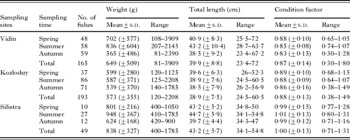
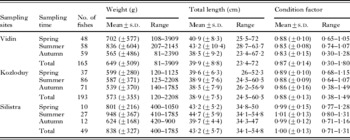
In total 407 barbels were collected by fishermen, using drift nets. The number of individuals with a minimum total length of 20 cm varied between 10 and 35 fishes per sampling site and season (Table 1). During the whole sampling period a total of 165 fish were caught in Vidin and 193 in Kozloduy. Sampling continued for only 2 years in Silistra, where 49 barbels were sampled between 2006 and 2007. Additionally, spring sampling at all sites was performed only in the years 2006 and 2007. After catching, the fish were frozen at −15°C and transported to the laboratory, where total length (TL), standard length (SL), body weight (BW), sex and age for each fish was determined. The condition factor (K) was calculated as follows K=100∗BW∗TL−3 (Schäperclaus, Reference Schäperclaus1990). The fish were subsequently dissected and analysed for parasites using standard parasitological techniques. The skin, scales, fins, gills, eyes, gut, cavities and organs were examined using a stereomicroscope (magnification ×8 to ×50). Nematodes were fixed in 70% ethanol and mounted in glycerine for further identification whilst all other parasites could be identified directly.
Morphological parameters and characteristics of collected fish material
Determination of helminth community structure and statistical treatment
Parasitological parameters used followed those suggested by Bush et al. (Reference Bush, Lafferty, Lotz and Shostak1997) – prevalence (P, %), intensity range (IR), abundance (A) and mean intensity (MI) of the infection. The following diversity indices were calculated to describe the richness and diversity of the parasite communities: Brillouin's index (HB), Shannon-Wiener index (HS), Shannon-Wiener evenness (E), Simpson's index (D) and Berger-Parker index (d) according to Magurran (Reference Magurran1988) and Sures et al. (Reference Sures, Knopf, Würtz and Hirt1999).
Correlations between intensity and fish weight were checked using Spearman's rank correlation coefficient. A one-way ANOVA was employed to determine significant differences in the diversity characteristics of the intestinal infra-community and to compare the number of each parasite species between sampling sites. For estimating differences in fish condition factors between sampling sites, the Mann-Whitney U-test was applied.
Water quality
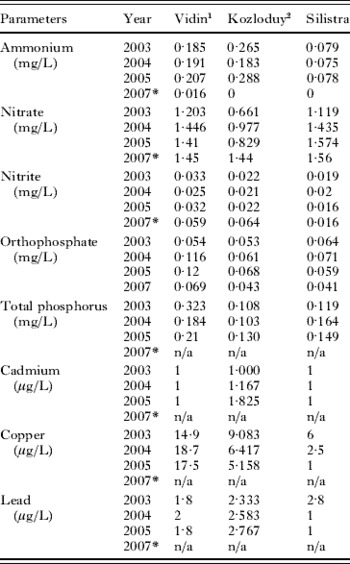
Water quality data for sites adjacent to our fish sampling sites (see Table 2) were obtained from the technical reports published by the Joint Danube Survey (ICPDR, 2002, 2008a, c) and annual reports and the database of TNMN (Trans National Monitoring Network, ICPDR, 2004, 2005, 2008b). These research programmes and activities are initialized by the International Commission for Protection of the Danube River (ICPDR). The available data were used as a basis to interpret the composition and richness of helminth communities at the same localities.
Data on selected aqueous nutrient and pollution parameters according to ICPDR (2008b) for upper and lower sites of the Bulgarian part of the Danube River

1 Sampling site Novo Selo, 1 km away from Vidin.
2 Sampling site Iskar–Baikal, 40 km away from Kozloduy.
* Data delivered by 2nd Joint Danube Survey – Onboard results (ICPDR 2008a).
n/a, Data not available.
RESULTS
Total parasite fauna
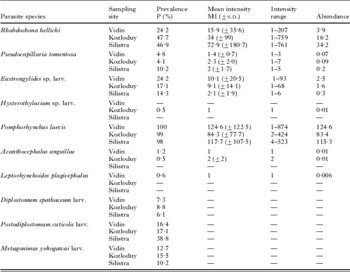
In total 10 endohelminth parasite species were recovered, including 3 trematodes (Dipostomum spathaceum (metacercariae) in the eye lens, Posthodiplostomum cuticola (metacercariae) on the skin, Metagonimus yokogawai (metacercariae) on the scales), 3 acanthocephalans (Pomphorhynchus laevis, Acanthocephalus anguillae, Leptorhynchoides plagicephalus in the intestine) and 4 nematodes (Rhabdochona hellichi, Pseudocapillaria tomentosa, Hysterothylacium sp. (larvae) in the intestine and Eustrongylides sp. (larvae) in the body cavity) (Table 3). One acanthocephalan species (L. plagicephalus) and 2 nematodes (larvae of Eustrongylides sp. and Hysterothylacium sp.) were recorded for the first time for barbel. Only 1 fish from the sampling site Vidin was infected with a single adult male of L. plagicephalus, which is thus considered an accidental infection. Larvae of Hysterothylacium sp. were found in the gut of 1 barbel collected at the sampling site Kozloduy. Eustrongylides sp. occurred at all sampling sites during the entire period. This nematode, together with the nematode R. hellichi, was the second most widely distributed parasite species at the sampling site Vidin (P, 24·2%; MI, 10·1). Also at the sampling sites Silistra and Kozloduy it occurred with high prevalence and intensity (Kozloduy P: 17·1%; MI: 9·1; Silistra P: 14·3%; MI: 2·1). The pattern of infection presents a clear correlation between fish size, prevalence and intensity of infection. The highest prevalence was found in barbels with a length between 40 and 60 cm. Infection intensity increased significantly (Spearman correlation, P<0·05) with body size (Vidin: r=0·32; Kozloduy: r=0·39; Silistra: r=0·34).
Prevalence, mean intensity and mean abundance of the parasites of barbel from three sampling sites along the Danube River in Bulgaria

Total species richness ranged between 9 worms for Vidin and Kozloduy and 7 for Silistra. The most abundant parasite was the acanthocephalan P. laevis. At the sampling site Vidin 100% of the fishes were infected with this acanthocephalan and the mean intensity was 124·6 worms per fish. Only 2 fishes from Kozlduy (P, 99%; MI, 84·3) and 1 from Silistra (P, 98%; MI, 117·7) were not infected with P. laevis. The second most frequent species at all sampling sites was R. hellichi. The number of R. hellichi individuals showed significant differences between Vidin and Kozloduy (P=0·029, F=4·795), and Vidin and Silistra (P=0·003, F=8·78), whereas no differences were detected between Kozloduy and Silistra.
The trematodes were the third group in terms of prevalence. Metacercariae of P. cuticola were most frequently found, followed by M. yokogawai and D. spathaceum at all sampling sites. There are no data available concerning the intensity of infection, since only the presence of metacercariae was recorded. The nematode P. tomentosa was present in all Danube sites during the whole sampling period. Whilst the prevalence was similar (4·8% and 4·1%) at the sampling sites Vidin and Kozloduy, it was more than 2 times higher in Silistra.
Diversity of helminth communities
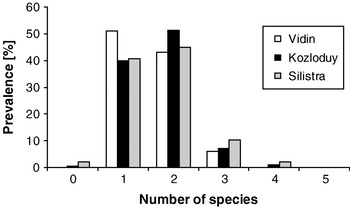
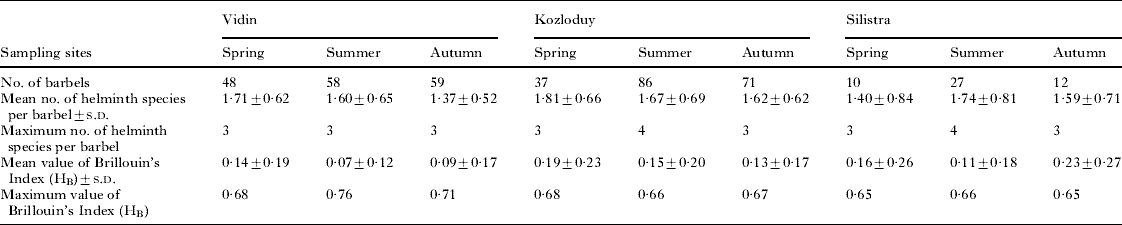
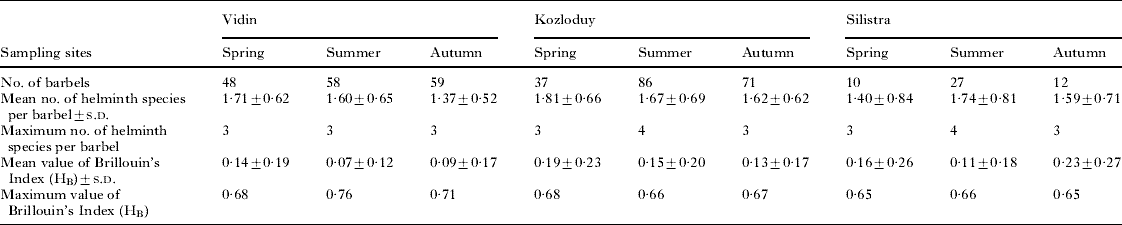
Diversity and dominance indices were calculated without considering trematodes as they were not counted individually. Diversity characteristics of the infra-community are presented in Fig. 2 and Tables 4 and 5. Most of the fish were infected with either 1 or 2 parasite species simultaneously (Fig. 2). At Vidin more than 50% of all fish were infected with 1 species only, whereas at Silistra 10% of the barbels were co-infected with 3 species. A clear increase in average diversity in downstream direction is reflected by the Brillouin index, which showed the highest value at Silistra. Statistical analyses revealed significant differences for the Brilliouin index between Vidin and Kozloduy (P=0·005, F=8,101) and Vidin and Silistra (P=0·038, F=4,375), whereas no difference was found between the sampling sites Kozloduy und Silistra (P=0·853, F=0·034). Concerning seasonal differences highest infracommunity diversity was found in spring and autumn for 2 sites, only Kozloduy showed a higher Brillouin index in summer than in autumn.
Prevalence of coexistent helminth species of barbel from three sampling sites of the Danube River.

Average diversity characteristics of the infra-community of helminths of barbel from the Danube River

Seasonal profile of the diversity characteristics of the infra-community
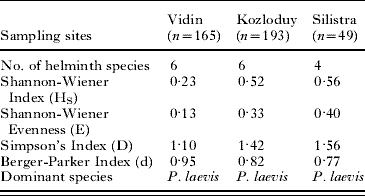
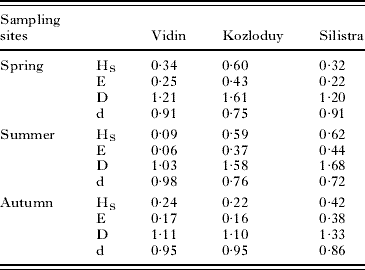
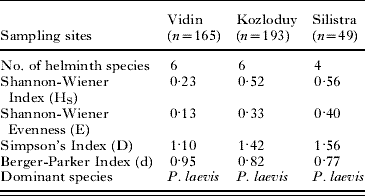
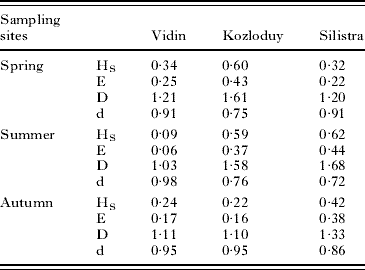
Similarly, component community diversity (Table 6) was also found to be higher downstream (Silistra) than upstream (Vidin). This tendency is also reflected by the Berger-Parker dominance index, for which highest values were found in Vidin and lowest in Silistra. Kozloduy showed medium values compared to the other sampling sites. The highest seasonal diversity was found in spring in Vidin and Kozloduy and in summer in Silistra (Table 7).
Comparison of the average richness and diversity characteristics of the total component community of helminths of barbel
Seasonal profile of the diversity characteristics of the total component community
Water quality classification
The mean values of nutrient and heavy metal concentrations for the period 2003–2005 adjacent to our sampling sites are summarized in Table 2. Nutrients such as ammonium-N, nitrite-N, ortho-phosphate and total phosphorus were lowest at the downstream site. Similarly, concentrations of copper (Cu) and lead (Pb) in the upper Danube sites were higher in the period 2004–2005 (ICPDR, 2008b), whereas no significant difference occurred for cadmium (Cd). Results obtained from the second Joint Danube Survey (JDS2) performed in autumn 2007 revealed the same pattern of pollution and eutrophication parameters between the sampling sites (ICPDR, 2008a). Accordingly, no significant change in nutrient and heavy metal levels occurred during our sampling period. Although no taxa lists are available for macrozoobenthos communities all sampling sites were categorized to class II according to the saprobic index (ICPDR, 2002).
DISCUSSION
The composition of endoparasite communities at the investigated Danube sites were principally similar but showed differences which can be attributed to the local ecological conditions. In general, 10 endohelminth species were identified, none of which is a barbel specialist. The dominant parasite species at all sampling sites was the acanthocephalan P. laevis. Similar results were obtained in the upstream part of the Danube River (Moravec et al. Reference Moravec, Konecny, Baska, Rydlo, Scholz, Molnar and Schiemer1997; Schludermann et al. Reference Schludermann, Konecny, Laimgruber, Lewis, Schiemer, Chovanec and Sures2003; Laimgruber et al. Reference Laimgruber, Schludermann, Konecny and Chanovec2005). However, the parasite list of B. barbus published by Margaritov (Reference Margaritov1966) and Kakacheva-Avramova (Reference Kakacheva-Avramova1977) for the Bulgarian section of the Danube River differs greatly from the parasite fauna detected in the present study. During our study period no cestodes were recovered, although Margaritov (Reference Margaritov1966) and Kakacheva-Avramova (Reference Kakacheva-Avramova1977) reported 3 cestode species (Caryophyllaeus brachycollis, C. laticeps, C. fennica) for barbel. The absence of cestodes during our sampling period could be explained with high P. laevis infection levels, which result from the barbel's preferred diet consisting of amphipods and small fishes. The feeding habits of barbel and its diet are influenced by the available local invertebrate fauna, which itself is determined by the water quality and habitat composition. A major characteristic of the principal invertebrate fauna in the Danube River is the high abundance of gammarids, from which some species are known to be appropriate intermediate hosts for P. laevis (Rumpus and Kennedy, Reference Rumpus and Kennedy1974; Marshall, Reference Marshall1976; Moravec and Scholz, Reference Moravec and Scholz1991; Dezfuli et al. Reference Dezfuli, Giari and Poulin2000). Preferred feeding of fish on amphipods results in high abundance of P. laevis, which obviously reduces the diversity of parasite communities (Kennedy et al. Reference Kennedy, Bush and Aho1986; Moravec et al. Reference Moravec, Konecny, Baska, Rydlo, Scholz, Molnar and Schiemer1997).
The second most frequent parasite at all Danube localities, R. hellichi, occurred at the sampling site Vidin with a prevalence of 24·2%. The prevalence was about 2-fold lower compared to the data obtained from the other 2 sampling sites. According to Moravec and Scholz (Reference Moravec and Scholz1995) trichopteran larvae from the genus Hydropsyche serve as intermediate hosts for the transmission of R. hellichi (see, for example, Moravec, Reference Moravec1995). Thus, the lower prevalence at Vidin can be explained with a lower abundance of the intermediate host, which could be correlated to a higher eutrophication and pollution level in this part of the river. The larvae of Hydropsyche sp. are well-established indicators which are used to assess the water quality (Moog, Reference Moog1995). For example, the saprobic index of trichopteran larvae varies between 2·1 and 2·3 and corresponds to water quality class 2.
Moreover, the prevalence recorded for the nematode Eustrongylides sp. in Vidin was the highest at all sampling sites. This supports the pollution hypothesis, since the first intermediate host described for Eustrongylides sp. are aquatic oligochaetes such as Lumbriculus variegatus (Lumbriciidae), Tubifex tubifex and Limnodrilus sp. (Tubificidae) (Moravec, Reference Moravec1994). All these oligochaete species indicate disturbed aquatic habitats (saprobic index over 3, pollution with chemicals) where they are highly abundant.
The results of the present study correspond very well with data of Valtonen et al. (Reference Valtonen, Holmes and Koskivaara1997) who also correlated the occurrence of single parasite species in fish with the abundance of intermediate hosts from lakes with differences in trophic status and degree of pollution. For example the acanthocephalan Acanthocephalus lucii showed the highest prevalence in perch (Perca fluviatilis) from a eutrophic and polluted lake. The intermediate host of A. lucii, Asellus aquaticus, is known to be pollution tolerant and is highly abundant under contaminated conditions (Murphy and Learner, Reference Murphy and Learner1982). Not only the occurrence of a single parasite species can be related to environmental parameters but also the composition and diversity of whole parasite communities is determined by environmental conditions such as eutrophication, pollution and changes in substrate composition. These conditions can either directly affect the parasite (e.g. toxic effects on free-living stages) or indirectly by affecting the abundance and distribution of the respective intermediate and final hosts (Sures, Reference Sures2004). Evidence from the field revealed the composition of fish helminth communities being largely dependent on the benthic invertebrate fauna, which itself is directly dependent on water quality and benthic habitats (Sures and Streit, Reference Sures and Streit2001; Laimgruber et al. Reference Laimgruber, Schludermann, Konecny and Chanovec2005; Thielen et al. Reference Thielen, Münderle, Taraschewski and Sures2007).
In the present study the lowest value for the Brillouin index and the Shannon-Wiener diversity was recorded for Vidin. As parasite diversity is considered a measure of ecosystem health (Hudson et al. Reference Hudson, Dobson and Lafferty2006), the higher diversity at Silistra gives evidence for better environmental conditions in the lower river stretch. This is confirmed by hydrochemical data, which indicate a higher level of pollution and eutrophication at Vidin compared to Silistra. Eutrophication might favour the occurrence of intermediate hosts known to be tolerant against high nutrient concentrations such as annelids and crustaceans. Additionally, the presence of toxic metals supports the occurrence of parasites transmitted by anneldids or crustaceans, for example, by compromising the immune system of the definitive host. Thus, the combined effects of high nutrient and pollutant concentrations represent favourable ecological conditions especially for the dominant occurrence of P. laevis. This dominance also negatively affects infracommunity and component community diversity as it leads to lower values for the Shannon-Wiener and Simpson index. Our results therefore provide good evidence that aquatic ecosystem health could be assessed by investigating the composition and diversity of fish parasite communities which, also due to their position in food webs (Lafferty et al. Reference Lafferty, Allesina, Arim, Briggs, De Leo, Dobson, Dunne, Johnson, Kuris, Marcogliese, Martinez, Memmott, Marquet, McLaughlin, Mordecai, Pascual, Poulin and Thieltges2008), represent an integrative measure of the overall ecological conditions.
Thanks are due to the LGFG Stiftung (Landesgraduiertenförderunggesetz, Baden-Württemberg) for the financial support to M. N.