INTRODUCTION
We report on an investigation into the phonetic motivation of s-retraction in American English, with emphasis on the relevance of the data to the actuation problem in the theory of sound change. We show that the phonetic motivation for s-retraction can be demonstrated generally, and that the sound change can be explained as phonologization of coarticulation. This merely illustrates and accentuates the actuation problem, however, because it creates the opposite problem of predicting that s-retraction should occur in all speakers, whereas in fact it does not. We are able to propose a solution to the problem, however, by considering speaker-specific variation in the phonetic data. We follow Janda and Joseph (Reference Janda, Joseph, Blake and Burridge2003) in understanding the initiation of sound change as a phonetically abrupt event rather than a gradual one. We further propose that sound change can be initiated when a hearer interprets an extreme instance of a phonetic effect as a distinct production target, an exaggeration of the normal coarticulation. If the speaker adopts the new production target, the sound change has begun to propagate around the speech community. Because the distribution of extreme coarticulation in a way that favors its interpretation as a distinct target is predicted to be rare, sound change is correctly predicted to be a rare occurrence.
We take as uncontroversial that properties of a language user's phonological system are largely driven by facts about his/her social network and the social meaning associated with phonetic variables. In this article paper, we are concerned specifically with how a production target can start to shift. By the actuation of sound change, we refer specifically to the inception of a change from below.Footnote 1 We have nothing to say about language changes that can be understood in terms of language contact or pre-existing social meaning.
We examine the actuation problem particularly in relation to English s-retraction. This is a well documented sound pattern found in several varieties of spoken English, in which /s/ takes on a more [ʃ]-like pronunciation, generally in the vicinity of /ɹ/ (Armstrong, Reference Armstrong2003; Durian, Reference Durian2007; Janda and Joseph, 2003; Janda, Joseph, & Jacobs et al., Reference Janda, Joseph, Jacobs, Lima and Iverson1994; Labov, Reference Labov, Baugh and Sherzer1984; Lawrence, Reference Lawrence2000; Rutter, Reference Rutter2011; Shapiro, Reference Shapiro1995). S-retraction is observed in varieties of English spoken in New Zealand, the United Kingdom, and the United States. It is possible that the sound change giving rise to s-retraction has occurred more than once, in parallel.Footnote 2 The most frequently encountered pattern involves the realization of /s/ as an [ʃ]-like sound in the /stɹ/ cluster: ‘street’ sounds more like [ʃtɹit] than [stɹit]. In word-initial consonant clusters, s-retraction occurs less frequently in /skɹ/ clusters, and even less frequently in /spɹ/ clusters (Shapiro, Reference Shapiro1995).Footnote 3 Retraction can also occur in word-medial /sɹ/ (in words such as ‘grocery’), and marginally in some other phonetic contexts (Janda and Joseph, 2003). In this paper, we limit our investigation to word-initial consonant clusters. Note that although s-retraction introduces an allophonic alternation, there is no phonemic consequence for the change.
We show that s-retraction, like many other phonological patterns, is paralleled by coarticulatory effects present in the speech of speakers of English varieties that have not undergone the sound change or participated in its spread (henceforth “non-retractors”).Footnote 4 We also show that phonetic motivation for s-retraction has two components. The greater part of this phonetic motivation is common to all speakers, but there is in addition a narrower coarticulatory motivation that varies by speaker. These facts bear significantly on the actuation problem, a challenge for theories of language change first posed by Weinreich, Labov, and Herzog in their landmark 1968 theoretical work. The actuation problem concerns the initiation of sound changes. It is difficult for a theory to include a mechanism of change that does not underapply (failing to predict cases where change occurs) or overapply (failing to predict cases where change does not occur). For well over a century, linguists have espoused the position that sound change is the gradual accommodation of language to the needs of speakers and hearers. Numerous such approaches—which we will refer to as accumulation-of-error theories are to be found in the literature. Whitney is typical in presenting such a view:
The first and most important principle [of linguistic change] that we have to notice, the one which lies at the bottom of nearly all phonetic change in language, is the tendency . . . to make the work of utterance easier to the speakers, to put a more facile in the stead of a more difficult sound or combination of sounds. . . . . All articulate sounds are produced by effort, by expenditure of muscular energy, in the lungs, throat, and mouth. This effort, like every other which man makes, he has an instinctive disposition to seek relief from, to avoid: we may call it laziness, or we may call it economy . . . . (1896, 69–70)
The idea of a gradual accumulation of errors in speech is an intuitive one, and has been adopted implicitly or explicitly by many subsequent researchers. We use the term ‘error’ here very generally, including minor changes in language that could be considered functional or teleological. Our critique of these approaches (“The Actuation Problem in s-retraction”) does not require that these changes be intentional or unintentional. Ohala has probably been the most significant exponent of the accumulation-of-error view, explaining sound changes variously as accumulated errors in production (e.g., Ohala, Reference Ohala1993; Ohala and & Ohala, Reference Ohala and Ohala1991a; Ohala, Reference Ohala1993) or perception (e.g., Ohala, Reference Ohala, Masek, Hendrick and Miller1981, Reference Ohala and MacNeilage1983). Ohala and Ohala (Reference Ohala and Ohala1991b) describe this research focus as follows:
[I]t is probably not possible to explain why a given sound change happens in one language but not another and it is generally not a fruitful question to pursue. Phonetics can at best explain a sound change by showing, first, that precursors to it are found widely in languages spoken today . . . and, second, that there is a phonetic basis for these precursors.
The work on the historical basis for synchronic sound patterns has focused in particular on the types of changes that are observed, and why those changes, instead of other changes, are more frequent. The related questions, such as why changes are rare, even though phonetic precursors are common, and why changes happen where and when they do, even though similar conditions exist in other places and at other times, have been met with more pessimism. This has produced a situation where work on sound change either implicitly or explicitly treats accumulation of error as the mechanism by which a phonetic variable is selected to become a sound change,Footnote 5 or more frequently, sidesteps the question entirely.Footnote 6
It is within the context of one accumulation-of-error theory—specifically that of the Neogrammarians—that Weinreich et al. (Reference Weinreich, Labov, Herzog, Lehmann and Malkiel1968) describe the actuation problem.
[I]f the pursuit of ease is the cause of sound change in idiolects, the fundamental questions arise: why do not speakers go about it more quickly, and why do Language Customs split in that some speakers set out on a particular ease-seeking path whereas other retain their less comfortable pattern?. . . . For even when the course of a language change has been fully described and its ability explained, the question always remains as to why the change was not actuated sooner, or why it was not simultaneously actuated wherever identical functional properties prevailed. The unsolved actuation riddle is the price paid by any facile and individualistic explanation of language change. It creates the opposite problem—of explaining why language fails to change. (Weinreich et al., Reference Weinreich, Labov, Herzog, Lehmann and Malkiel1968, 111–112).
As we shall discussed further below, the difficulty lies in creating a theory in which sound change can plausibly occur, but without making sound change inevitable. As an example, the development of Proto-Indo-European witnessed two developments of the labiovelar stop. In Cumbrian, *kʷ changed to p, while whereas Latin *kʷ remained kʷ.Footnote 7 The challenge posed by the actuation problem is to determine a theory of sound change where the change *kʷ > p is a possible outcome—because *kʷ can change to p—but not an inevitable outcome, because a language can remain unaffected. The actuation problem has long plagued accounts of sound change.; Labov (Reference Labov2001, 466) calls called the problem “unsolved.” The data from English s-retraction cast the actuation problem in sharp relief, because even non-retractors display a strong coarticulatory tendency towards retraction. Given these facts, theories that represent sound change as the accumulation of error have difficulty explaining how any speaker can fail to participate in s-retraction.
The phonologization of coarticulation occurs when a phonetically motivated effect is so strong that it is interpreted as a distinct phonetic target. It is already known that phonologization depends on imitating a distinct phonetic target (e.g., Janda, Reference Janda1999, Reference Janda, Joseph and Janda2003; Janda and & Joseph, 2003), but that in most cases, there is not sufficient exaggeration to produce the novel targets that can spur a sound change. It is clear that once a phonetic effect has been so interpreted, it may then be imitated by other speakers, leading to the spread of sound change. However, if every speaker produces essentially the same amount of coarticulation, then there is nothing to imitate in the first place. We propose that inter-speaker differences in the degree of a phonetic effect facilitate identification of new targets. Specifically, we argue that coarticulation patterns that already vary from speaker to speaker for purely phonetic reasons can create the situation of extreme articulation that gets interpreted as a distinct phonetic target. That is, the potential for sound change arises when inter-speaker variability is so great that some speakers actually produce a sound that can be perceived as a distinct target. Given the appropriate social conditions, this potential can be realized through another speaker adopting the novel target in his/her speech.
In the case of s-retraction, the source of phonetically motivated variation in /s/ is variation in the production strategy used to produce the /ɹ/ that conditions retraction. A listener who hears tokens of /s/ that have been produced with a relatively high degree of retraction (for idiosyncratic phonetic reasons that are unknown to him/her), may interpret these tokens as the target, and may potentially shift his/her production target to involve a degree of coarticulation that was not actually motivated by his/her own idiosyncratic phonetic motivations.
Although the magnitude of phonetically motivated coarticulation is dependent on internal factors, the likelihood of a speaker with extreme coarticulation being imitated by other speakers depends on social factors. Importantly, not all members of a speech community are equally influential, and we argue that the ability of phonetically motivated coarticulation to lead to sound change depends on the chance alignment of extreme coarticulation with extreme influence. Labov (Reference Labov2002) decribes described a typical leader of linguistic change as follows:
More detailed studies of the social characteristics of the leaders of linguistic change show that they are female members of the highest status local group, upwardly mobile, with dense network connections within the local neighborhood, but an even wider variety of social contacts beyond the local area (Labov, Reference Labov2002, Ch. 11).
Moreover, these leaders of change show a history of nonconformity in other respects, and show a life-long history of resistance to repressive or unjust authority (Labov, Reference Labov2002, Ch. 12).
Although there is little evidence that speakers use social meaning to guide their production of variables that have not already achieved a high degree of social salience, we are not in a position to rule out the possibility that imitation is unconsciously guided by a speaker's social estimation of other community members. For instance, Babel (Reference Babel2009) has recently reported that subjects in an imitation experiment exhibit more imitation of speakers with whom they identify. If future research shows evidence that social identity is relevant for the spread of change from below, then we would add that sound change should be more likely in cases where a phonetic variable happens to coincide with a social variable. Another possibility is that a listener would mistakenly interpret as socially meaningful a variable that has not achieved salience in the community at large, because of the way it happens to be distributed among speakers, and imitate it on that basis. Because change from below is not believed to involve social factors until after it has propagated, this small-scale perceived confluence of phonetic and social factors would probably not be directly related to any social value that the new variant might acquire if it does eventually spread through the community. The point here is that there are many possible ways in which spurious correlations between phonetic and social factors could conceivably occur, but for our present purposes, we are only concerned with how the overall measure of a speaker's influence coincides with phonetically-motivated variability.
The idea that non-contact-induced change is dependent at least in part on pre-existing phonetically motivated inter-speaker variability has implications for the predicted frequency of sound change. This would be a step toward a theory that correctly predicts sound change to be sporadic and rare, rather than an inevitable consequence of the accumulation of error. Sound change is predicted to be rare and sporadic because change depends on how the necessary excessive variable phonetic variants happen to be distributed in the speech community, and most of the logically possible distributions do not seem likely to favor adoption of a new sound pattern. An additional prediction is that phonetic effects that lack noticeable inter-speaker variability would be poor candidates for sound change. That is, for change to occur, the range of the inter-speaker variability must be so great that at one extreme the result can be interpreted as a new target.
Coarticulation is largely language-specific (Beddor, Brash, & Narayan, Reference Beddor, Brasher, Narayan, Solé, Beddor and Ohala2007; Beddor, Harnesberger, & Lindemann, Reference Beddor, Harnsberger and Lindemann2002a; Ladefoged, Reference Ladefoged, Van den Broecke and Cohen1984), and this is seen in the fact that languages with similar coarticulation patterns exhibit them to different degrees. This suggests that conventionalized coarticulation (as opposed to the bare minimum of phonetically-determined coarticulation) is probably the norm rather than the exception. Our claim does not require the starting point to be strictly phonetically determined coarticulation, as the our results below will show that inter-speaker variability in coarticulation degree is present even among individuals with s-retraction. Even if word-internal coarticulation is completely encoded in the lexicon (Coleman, Reference Coleman, Broe and Pierrehumbert2000), inter-speaker variability still provides the opportunity for excessive productions, if other conditions are right.
This proposal is closely related to a recent study by Beddor (Reference Beddor2009) that the phonologization of coarticulation is facilitated by covariance between the cause and effect of coarticulation. Beddor showeds that in the case of coarticulatory vowel nasalization, the duration of the nasalized portion of the vowel is inversely correlated with the duration of the nasal consonant. This variation provides an opportunity for listeners to interpret nasalization as a property of the vowel instead of as a property of the consonant, and speakers vary in the timing of their velum lowering and listeners vary in their interpretation of other speakers' productions.
The proposal that inter-speaker phonetically motivated variation is crucial allows us to make clear predictions about the role of phonetic effects in initiating sound change. Specifically, we claim that under standard assumptions, phonetic effects that are shared by all the members of a community—however large—should not be expected to produce sound change because, by their very commonness, they are not good candidates. Further, phonetic effects that occur to the same degree across speakers should be easier to perceptually compensate for. We argue instead that speaker-specific phonetic motivations are favored to be identified as novel targets, and can thus actuate sound change.
We begin by presenting the phonetic data pertinent to our claims about the actuation problem in the discussion section. The goal of this section is to demonstrate clearly: (i) that in the speech of people who do not exhibit the s-retraction change, there is nevertheless a bias toward retraction, (ii) that this bias parallels the phonetic environments in which s-retraction occurs, and—crucially for our subsequent argument—(iii) that the magnitude of the phonetic effect varies between speakers. We then review the actuation problem as it relates to the facts of English s-retraction (“The Actuation Problem in s-retraction”). In so doing, we set the phonetic data to one side, and argue from logic and mathematical probability. The assumptions behind accumulation-of-error theories yield themselves readily to basic mathematical analysis, and we use this to uncover their fundamental flaw: that they predict sound change to be too likely to occur.Footnote 8 We present our solution in the discussion section, noting that some standard assumptions in the field suggest a solution to the actuation problem, along the lines that we have already outlined above. Following consideration of some final issues, we conclude.
PHONETIC MOTIVATION FOR S-RETRACTION
In order to determine the extent of phonetic motivation for s-retraction, we collected data from both retractors (people who tend to say things like [ʃtɹit]) and non-retractors (people who tend to say things like [stɹit]). We treated present-day non-retractors as models of past “pre-retractors”: the speakers in the past, before the sound change began. This allowed us to study the phonetic properties of s-retraction in isolation of other confounding factors, namely the confound of retractors having a different production target.
METHODS
Subjects
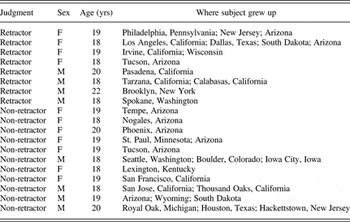
Subjects were undergraduates from the University of Arizona who received extra credit for participating in the experiment. 32 Thirty-two subjects were recorded, though 4 were discarded due to technical difficulties. The remaining subjects were 18–22 years of age (mean 18.6 years). Two experiments were run simultaneously, drawing from the same subject pool. Retractors were in relatively short supply, so retracting speakers were identified by having them read a short word list, and were selectively assigned to the present experiment. Additionally, subjects from regions where s-retraction was thought to be more prevalent were assigned to this experiment. Consequently, the proportion of retractors to non-retractors that we report should not be taken to be representative of any population of speakers. For each subject included in the experiment, Table 1 shows sex, age, and where the subject grew up. After data collection, speakers were reclassified as retractors or non-retractors according to a procedure described in “Protocol”; the preliminary classification was not carried forward into subsequent analysis.
Self-reported information from subjects included in the analysis

Note: Self-reported information from subjects included in the analysis. “Judgment” indicates whether the subject was classified as a retractor or non-retractor; see “Protocol” section for more on this classification. The order of subjects from top to bottom in this table corresponds with the order of subjects from left to right in Figure 3.
Experimental materials
Items consisted of monosyllabic words with sibilants in word-initial position. Items were collected with initial /s/, /sC/, /sCɹ/, /ʃ/, and /Sɹ/ (C = {p,t,k}), with following vowels /æ, i, ɪ, u/. Two words from each phonetic context were included, and four tokens of each item were collected. Items are listed in the appendix, along with filler words.
Protocol
After filling out a language background and speech pathology questionnaire, subjects were seated in a comfortable chair in front of a computer screen, with a microphone placed about 6 inches in front of the mouth. A simultaneous ultrasound recording of the tongue was also made, with an ultrasound transducer placed under the chin. The subject also wore a pair of sunglasses with head-tracking markers on them. The articulatory data provide an account for the interspeaker variation, but they are not analyzed in depth here. See Mielke, Baker, and Archangeli (Reference Mielke, Baker, Archangeli and Kühnert2010) for a more complete articulatory analysis. Tokens were presented on the computer screen in the frame “Please say [token] again.” Subjects read the entire frame sentence, advancing through the series of prompts at their own pace by clicking a mouse button.Footnote 9 The order of the stimuli was random, with the items occurring four times apiece. Subjects were encouraged to read quickly, though the actual rate of speech varied noticeably between speakers.
Speakers were classified as either retractors or non-retractors after the experiment, based on a classification of their tokens as retracted or non-retracted. Two of the authors independently listened to each /stɹ/ token in the context of the frame sentence and judged the token to be either retracted or non-retracted. The first round of identification produced agreement between the experimenters for 83.8% of the tokens. To improve this figure, each experimenter judged the disputed tokens a second time. In the second round of identification, each experimenter knew that the token was disputed, but was not aware of his earlier choice. After the second round, there was agreement for 94.7% of the stimuli. The remaining stimuli, which had produced disagreement twice, were discarded from the study.
Previous studies of s-retraction have identified categorical intraspeaker variation in s-retraction (e.g., Durian, Reference Durian2007); this was our finding as well. Although there were instances of speakers who always retracted or never retracted, there was variability in the speech of most subjects. A break occurred in the data between the 35.48% and 62.50% rates of retraction (number of retracted /stɹ/ tokens divided by the total number of /stɹ/ tokens), and we treated this as the threshold for classifying a speaker as a retractor or non-retractor. Of the 28 subjects, 8 were retractors and 20 were non-retractors. Our goals for the study were to identify the phonetic correlates of retraction in retractors' speech, and to look for coarticulatory antecedents to retraction in non-retractors' speech. As such, we were interested in tokens in which retractors were retracting. It is not helpful to examine a non-retracted token to discover the phonetic correlate of retraction. Therefore, we discarded the tokens in which retractors did not retract. There is also a possibility that speakers who retract for a minority of tokens would have an affected pronunciation in their non-retracted tokens as well. We therefore, we also discarded data from non-retractors who exhibited variable behavior, limiting the non-retractor data to the 11 subjects who were judged never to have a retracted token.Footnote 10
Acoustic analysis
For acoustic analysis, the boundaries of each fricative were determined manually, using both the waveform and a spectrogram as a guide. Fricatives were characterized by their centroid frequencies, a measure commonly used to describe sibilants (e.g., Baum and & McNutt, Reference Baum and McNutt1990; Jesus and & Shadle, Reference Jesus and Shadle2002; Jongman, Wayland, & Wong, Reference Jongman, Wayland and Wong2000; Nittrouer, Studdert-Kennedy, & McGowan, Reference Nittrouer, Studdert-Kennedy and McGowan1989). The centroid frequency of /s/ is characteristically high, whereas the centroid frequency of /ʃ/ is lower. Because s-retraction involves the change of /s/ into an [ʃ]-like sound, this measure was expected to be appropriate for quantifying the sound change, and the retracted allophone of /s/ is expected to have a lower centroid frequency than an unaffected /s/ production. The spectrum from the middle half of each fricative was calculated, and the center of gravity of each spectrum was computed as the average frequency, weighted by the power at each frequency. Tokens were averaged across item before statistical analysis.
RESULTS
Test of centroid frequency as a measure of s-retraction
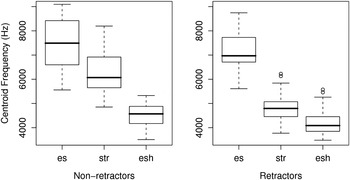
To verify that the centroid frequency is an appropriate measure for s-retraction, the centroid frequencies of [s], [ʃ], and [s] from the /stɹ/ context (henceforth, [s]tr) were compared for both retractors and non-retractors. A plot is shown in Figure 1. Consistent with previous research, [s] and [ʃ] were well-differentiated by their centroid frequencies, with [s] having the higher centroid. As was expected, retractors' [s]tr had lower centroid than non-retractors' [s] in the same context. This confirms the auditory impression that retracted [s] is more [ʃ]-like than plain [s], and validates centroid frequency as a measure of s-retraction.
A comparison of the sibilants of non-retractors (left) and retractors (right). The [s]tr of retractors is noticeably lower, both in absolute frequency, and in its relative position between [s] and [ʃ].

Phonetic effect of a following stop and [ɹ]
To assess the phonetic effect of a following consonant and a following [ɹ] on the centroid frequency of [s], the speech of non-retractors was investigated. A within-subjects analysis of variance was performed on tokens of [s] from the sC and sCɹ clusters. The dependent variable was the centroid frequency of the fricative, with independent variables ConsonantContext (p, t, k) and presence (whether [ɹ] was present or not present). There was a significant main effect of ConsonantContext (F(2,36) = 22.3, p < .0001) and of presence (F(1,16) = 66.5, p < .0001). The interaction of the two factors was also significant (F(2,38) = 19.7, p < .0001). The data were therefore broken across the factor ConsonantContext. The effect of presence was significant for each of /p/, /t/, and /k/ (respectively, F(1,19) = 29.8, p < .0001; F(1,19) = 43.3, p < .0001; F(1,19) = 55.5, p < .0001).
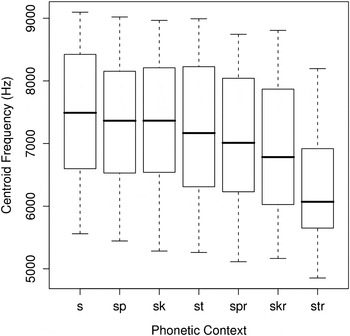
The data are presented graphically in Figure 2. The [s] from a simple onset had the highest centroid frequency. Next were consonants with a following stop with a following vowel (and not a following [ɹ]), in descending order: [sp], [sk], and [st]. Finally, the lowest centroid frequencies were those of [s] followed by both a consonant and [ɹ]. Of these, [s]tr clearly has the lowest centroid frequency; it is the most [ʃ]-like of all.
Realizations of [s] in initial clusters, in non-retractors. The presence of a consonant has a depressing effect on the centroid frequency, and the presence of [ɹ] in the cluster depresses the centroid frequency even more. [s]tr is most heavily affected.

The presence of [ɹ] clearly has a depressing effect on /s/, then, which indicates a potential phonetic motivation at the initiation of the sound change. It is of interest to know whether [ɹ] would exert similar phonetic pressure throughout the course of the sound change, that is, after /s/ had taken on a more [ʃ]-like pronunciation. Although we cannot test this directly with the data we collected, we can compare the productions of a simple [ʃ] with those of an [ʃ] that precedes [ɹ]. From this basis. we can generalize reasonably safely: if a following [ɹ] depresses both /s/ and /ʃ/, then it is quite plausible that it would depress intermediate sibilants as well (and the current non-retractors may well already be at an intermediate stage). To see whether this is indeed the case, a post hoc one-tailed t-test was performed comparing tokens with initial ʃ and those with initial ʃɹ. The test indicated at p < .004 that the centroid frequency of /ʃ/ is lower when an [ɹ] follows. We therefore conclude that the presence of [ɹ] would motivate the sound change not just at its initiation, but also at every subsequent stage of the change.
Speaker-specificity of the phonetic motivation
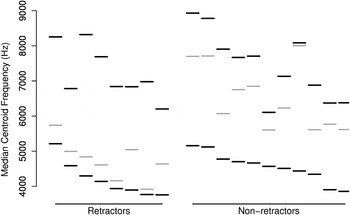
The final empirical point to be emphasized is the speaker-specificity of the phonetic motivation for s-retraction: non-retractors exhibit varying phonetic tendencies toward s-retraction. Figure 3 presents a condensed overview of the data. The median centroid frequencies for three allophones of plain [s], [s]tr (light graey), and the plain [ʃ], are shown for each speaker. It is evident that there is variation in the centroid frequencies of [s]tr, both in absolute and relative terms. Absolute variation is readily apprehended from the graph. Relative variation can also be observed. A typical non-retractor has an [s]tr that is closer to plain [s] than it is to plain [ʃ]; in contrast, a typical retractor's [s]tr is closer to plain [ʃ]. Clearly then, even speakers who appear not to have retracted [s] as a production target exhibit a phonetic tendency towards s-retraction. There is also a substantial range of variation among non-retractors, however, both in relative and absolute terms.Footnote 11
Median centroid frequencies from all subjects: each column represents one subject. In each column, the top bar represents the median centroid frequency of plain [s], the middle gray bar the median centroid frequency of [s]tr, and the lowest bar the median centroid frequency of plain [ʃ]. In the speech of non-retractors, there is wide variation in the centroid frequency of [s]tr, both absolutely, and in its relative position between [s] and [ʃ].

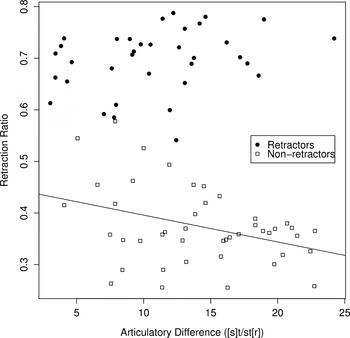
Mielke et al. (Reference Mielke, Baker, Archangeli and Kühnert2010) attributed inter-speaker variability in s-retraction to inter-speaker variability in /ɹ/ production strategy. In brief, American English /ɹ/ is known to have several articulatory allophones, which for the production of /ɹ/ itself have minimal acoustical and perceptual consequence (e.g., Delattre and & Freeman, Reference Delattre and Freeman1968). Although many speakers produce distinctly different versions of /ɹ/ in different segmental contexts (Mielke et al., Reference Mielke, Baker, Archangeli and Kühnert2010), /stɹ/ strongly favors a bunched /ɹ/ over a retroflex /ɹ/ and all of the subjects in this study produced a bunched /ɹ/ variant (Delattre and Freeman's types 3–6) in /stɹ/ clusters. Nevertheless, the subjects did show variation within this broad category of bunched /ɹ/ types, and different articulatory allophones of /ɹ/ do in fact cause different degrees of coarticulatory retraction of /s/ when it occurs in the /stɹ/ cluster. Specifically, more similarity between a speaker's [s] and [ɹ] tongue shapes was found to be associated with more coarticulation between those segments when they co-occur in /stɹ/ clusters. Figure 4 shows the relationship between [s]-[ɹ] similarity and retraction ratio, which is defined as the position of [s]tr along the scale from [s] (ratio = 0) to [ʃ] (ratio = 1). This 0–1 range corresponds to the interval between each pair of black lines in Figure 3, and the location of the gray lines in that figure matches the retraction ratio for each speaker. Non-retractors whose canonical [s] and [ɹ] involve more similar tongue shapes exhibit more coarticulation and hence more coarticulatory s-retraction. Retractors do not show a significant effect of articulatory similarity on s-retraction, apparently because their retraction is due to a distinct production target and is not dependent on coarticulation. The higher retraction ratio of retractors indicates that their [s] centroid frequency is close to [ʃ] and not influenced by [s]-[ɹ] distance, whereas non-retractors have an [s] that is less similar to [ʃ] and whose centroid frequency is affected by [s]-[ɹ] distance. This speaker-specific variation in /ɹ/ tongue shape is the cause of the interspeaker variability in s-retraction.
S-retraction ration plotted against [s]-[ɹ] articulatory difference (Mielke et al., Reference Mielke, Baker, Archangeli and Kühnert2010).

SUMMARY
The preceding findings contain three important facts about the phonetic motivation for s-retraction in American English, which are pertinent to the subsequent discussion.
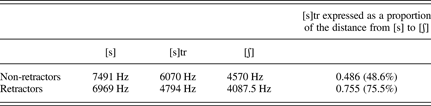
First, non-retractors as a whole have a substantial coarticulatory bias toward s-retraction, which is shared by all speakers. The speaker-specific portion of the variation is much smaller. From Figures 1 and Figure 3, it is evident that even in the speech of non-retractors, there is a substantial bias toward retraction. The bias toward s-retraction can be quantified either with absolute measurements, or with a relative measure. We quantify s-retraction by calculating the position of [s]tr between [s] and [ʃ]. The pertinent numbers are provided in Table 2. A retracted [s] is characterized by a centroid frequency that is 75.5% of the distance from [s] to [ʃ]. But in non-retractors, [s]tr is already 48.6% of the way to [ʃ]. Expressed as a ratio, based on coarticulation alone, non-retractors are about 65% of the way to being retractors (48.6%/75.5% = 64.6%). This effect of /ɹ/ on /s/ could be purely phonetic or it could be phonological:, i.e., the result of a production target that is distinct from /s/ in other contexts, more than is mandated by articulatory demands. The negative correlation between retraction ratio and articulatory distance suggests that at least some of the coarticulation is phonetic.
The values in the first three columns represent the median centroid frequencies of [s], [ʃ], and [s]tr for non-retractors and retractors. The rightmost column shows and the distance of [s]tr from [s], as a percentage of the distance from [s] to [ʃ]. A greater percentage value means closer to [ʃ] and further from [s]
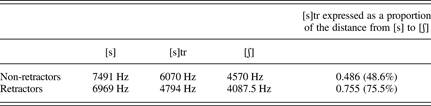
Note: The values in the first three columns represent the median centroid frequencies of [s], [ʃ], and [s]tr for non-retractors and retractors. The rightmost column shows the distance of [s]tr from [s], as a percentage of the distance from [s] to [ʃ]. A greater percentage value means closer to [ʃ] and further from [s].
Secondly, the coarticulatory effect observed in non-retractors parallels the retracted /ɹ/ in retractors. A following consonant depresses the centroid frequency of [s], but the presence of /ɹ/ depresses the centroid frequency further. This is consistent with the s-retraction pattern, where /ɹ/ is a crucial element of the conditioning environment.Footnote 12 The case for the presence of phonetic motivation is made stronger when we consider the specific effects of following consonants. As noted previously, s-retraction is most common in /stɹ/ clusters, less common in /skɹ/ clusters, and less common still in /spɹ/ clusters (Shapiro, Reference Shapiro1995; also the present study). This mirrors precisely the pattern of coarticulation in Figure 2. The coarticulatory effect is greatest in the /stɹ/ cluster, lesser in the /skɹ/ cluster, and least in the /spɹ/ cluster. These facts support the claim that s-retraction has a clear phonetic motivation.
The final important fact is that the phonetic motivation for s-retraction is variable across speakers (Figure 3). Non-retractors have individualized phonetic biases toward s-retraction, which is true if we consider the data in absolute or relative terms. Structured heterogeneity is indeed the norm for language data, but we call attention to the speaker-specific coarticulatory effects here because this heterogeneity is critical, in our view, to solving the actuation problem.
The phonetic effects observable in the speech of non-retractors admit an elegant accumulation-of-error account of the s-retraction sound change. Such an account would resemble the following: speakers begin with a characteristic [s] target in the /stɹ/ cluster. Coarticulatory influence from the /ɹ/, however, lowers the centroid frequency of [s] in the actual production. Those listening to the speaker hear a more [ʃ]-like production of /s/ and may adjust their own production targets slightly in response. Over time, these adjustments accumulate and are eventually recognized as a sound change. S-retraction is expected to be most common in the /stɹ/ context because the phonetic motivation for retraction is strongest there. These same phonetic facts about s-retraction, however, also form a particularly pointed illustration of the actuation problem, which we discuss in the next section.
THE ACTUATION PROBLEM IN S-RETRACTION
In presenting the actuation problem specifically for the s-retraction sound change, we repeat the question asked by Weinreich et al. (Reference Weinreich, Labov, Herzog, Lehmann and Malkiel1968): “why do Language Customs split in that some speakers set out on a particular ease-seeking path whereas other retain their less comfortable pattern?” In the present day, a population of speakers remains in which the s-retraction sound change has not taken hold. A split has occurred in English dialects. In spite of this, the speech of today's non-retractors exhibits a clear tendency toward s-retraction. It was remarked in the last section that, taken as a whole, non-retractors' [s]tr is already more than half of the way to the retractors' [s]tr. Why do these speakers not become retractors themselves, in the face of such a strong phonetic motivation to do so? If sound change consists in the gradual accumulation of production error, why does production error not accumulate in non-retractors? Accumulation-of-error theories offer no answers to these questions. Rather, they predict that sound change should occur for all speakers, because all speakers have similar phonetic biases. This is the actuation problem. The main argument of this section is that the actuation problem can be expressed in terms of the probability of change, that is, the probability of a given change occurring in a given time period. A theory of change which that predicts change to be likely runs afoul of the actuation problem. A theory of change which that predicts change to be unlikely escapes the problem of actuation. We demonstrate that accumulation-of-error theories always predict change to be likely. To solve the actuation problem, a mechanism of change is required that is rare this is proposed in the next section.
In this section, we consider below the statistical properties of some models of sound change. We note that the probability of a sound change occurring, P C, influences not only the likelihood of a sound change, but also the likelihood of splits in speech communities. We then consider the statistical properties of accumulation-of-error theories, to create a rigorous description of why they overpredict sound change. At this point in our argument, we leave off arguing from our specific empirical facts, and argue instead from logic and probability. There are two other ways the argument might have progressed, by providing evidence either through either additional empirical data, or through computer simulations. The methodological issues involved in being able to observe the initiation of a real sound change are clearly prohibitive. An alternative would be to create computer simulations of populations of speakers whose speech may or may not change, given certain simulation parameters; Baker (Reference Baker2008a) explores the actuation problem with this method. Since the assumptions involved in theories of sound change are at this level of analysis very basic, however, a computer simulation is something of an overkill. We can obtain the same results with a few basic statistical equations.
Calculating the probability of the change of a given sound change at a given time is a fraught problem. A particular sound change occurs under conditions that probably arise only once in history, given the possible variations in linguistic and social factors. How can a probability estimate be calculated? Instead of going down this road, we follow Weinreich et al. (Reference Weinreich, Labov, Herzog, Lehmann and Malkiel1968) in examining splits in language communities, from which we can draw conclusions about how probable sound change must be, without having specific probability estimates in hand. We consider the simple scenario in which a single speech community divides into two, Group A and Group B, with each daughter community developing independently. Such a scenario is probably the minority in history—perhaps arising only through abrupt population splits due to migration—but it serves as a useful starting point for the present discussion assuming independent development permits simple mathematical comparisons to be made. In such a scenario, a split must be predicted to be the more likely outcome, in which one group undergoes the change and the other does not. For two groups (A and B) and one sound change, there are four possible outcomes: both Group A and Group B change, only Group A changes, only Group B changes, or neither group changes. If we suppose that the probability of sound change is high—say, PC = .95—then the probabilities of the possible outcomes are those given in Table 3. The typical scenario is the one in which both groups undergo the sound change; this is predicted to occur 90.25% of the time. The next most likely scenario is that one group would change but not the other (9.5%), followed by the scenario in which neither group changes (0.25%). If sound change is very likely to occur, then it should be (1) initiated promptly, (2) very likely to occur in both groups, and (3) very unlikely to occur in neither group. This is clearly the incorrect prediction because, among other reasons, it is simply not the case that every language undergoes almost every possible sound change, all of the time.
Probabilities of sound change scenarios if the probability of change (PC) is high

Conversely, if we suppose a low probability of sound change (P C = .05), then the situation is reversed, as shown in Table 4. The most common outcome (90.25%) is that sound change does not occur; although sound change is reasonably probable to occur in only one group (9.5%), it is very unlikely to occur in both groups (0.25%). This is the familiar scenario languages usually do not undergo a particular change, splits do occur, but parallel development is very unlikely. To avoid predicting across-the-board sound change, then, the predicted probability of change (P C) needs to be small. If P C is high (as in Table 3, above), then (1) sound change is expected to be initiated frequently (i.e., immediately), and (2) parallel development between language groups that have no contact is predicted to be the rule rather than the exception.
Probabilities of sound change scenarios if the probability of change (PC) is low

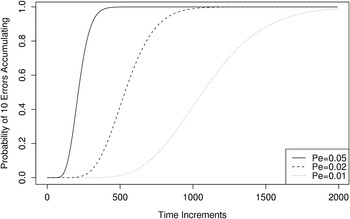
Having established that an adequate theory of sound change must predict that the probability of change be low, we can give a more mathematically precise formulation to the problems that accumulation-of-error theories run into. The incorrect predictions of accumulation-of-error theories derive from the high probability of change that they produce. This fact can be illustrated with reasonably simple statistics. Suppose that the accumulation of k errors in a speech community is sufficient to complete a sound change. Then the probability of change (P C) is equal to the probability of k errors accumulating. We specify further that the probability of an error occurring within a given time increment is P e, and that each error occurs independently of other errors.Footnote 13Figure 5 shows the probability that a particular number of errors (in this case, ten10) will have accumulated, as a function of the number of time increments.Footnote 14 Curves are shown for different values of Pe: .01, .02, and .05. The more likely the error is to occur, the more quickly the sufficient number of errors are accumulated. Even if P e is just .01, still after 2000 time increments, the probability of there being a sufficient number of errors to induce change is P C = .9895. The errors inevitably accumulate, as long as there is some probability of an error occurring (P e > 0). Plugging this value of P C into the calculations shown in Tables 3 and 4, this means that the chances of change occurring in both groups after 2000 time increments is nearly 98%, the chance of a split is 2.18%, and the chance of the change not occurring in either group is less than 2 in ten thousand.
Probability over time of 10 errors accumulating, for various values of P e.

These calculations illustrate mathematically the empirical weaknesses of an accumulation-of-error approach. Over time, the probability of change (P C) is high even if the probability of an error occurring (P e) is low. Therefore, sound change is predicted to occur nearly across the board, and splits between languages are consequently predicted to be extremely rare. The overwhelming probability is that both groups will undergo the sound change. Consequently, it is appropriate to note that accumulation-of-error theories of sound change tend to be just that: theories that explain why languages change. The neglected question, of why languages fail to change, is just as significant in historical phonology. A theory that predicts sound change across the board is of no greater explanatory adequacy in this regard than a theory that permits no sound change at all. An adequate theory of sound change must allow for cases where a sound change does and does not occur. In the next subsection, we propose the alternative: a theory of the actuation of sound change in which change is expected to be very infrequent. We propose that sound change is not initiated by the gradual accumulation of error over time, but rather by a single, rare event.
DISCUSSION
Toward a solution to the actuation problem
The challenges posed by the actuation problem can be addressed by considering the importance of inter-speaker variation that exists prior to the start of a sound change. We claim that sound changes are initiated when there is a spurious correlation between a phonetic variable and a social variable, and a speaker adopts the change into his/her own speech. If the exaggerated form continues to propagate through the speech community, a new change will have been initiated.
Because different degrees of coarticulation are expected only rarely to be distributed in a community in a way that facilitates change from below—and because of other conditions on the spread of a change, which are we will discussed below—this account of the mechanism of the initiation of sound change meets the crucial criterion of predicting sound change to be a rare event, and thus offers a solution to the actuation problem. Our claims about the initiation of sound change are very nearly corollaries to the first and third principles outlined by Weinreich et al.
“1. Linguistic change is not to be identified with random drift proceeding from inherent variation in speech. Linguistic change begins when the generalization of a particular alternation in a given subgroup of the speech community assumes direction and takes on the character of orderly differentiation.
….
3. Not all variability and heterogeneity in language structure involves change; but all change involves variability and heterogeneity.” (Weinreich et al., Reference Weinreich, Labov, Herzog, Lehmann and Malkiel1968, 187, 188).
The contribution of the present paper is to suggest a mechanism by which phonetic variation “assumes direction.” Following Weinreich et al. (Reference Weinreich, Labov, Herzog, Lehmann and Malkiel1968), we do not identify sound change with an accumulation over time of production or perception errors (e.g., contrary to Paul, Reference Paul1880; Whitney, Reference Whitney1896, etc.). We also follow them in emphasizing the heterogeneity of the speech community and assert that sound change is facilitated by particular random distributions of variants. Earlier we described the speaker-specific variation that can be observed in [s]tr. Depending on a speaker's idiosyncratic articulatory behavior, the coarticulatory effect of [ɹ] onto [s] can be larger or smaller. Members of a speech community are obviously also heterogeneous with respect to social position, and, crucially, this heterogeneity should not be expected to correlate with articulatorily-motivated speaker-specific variation in coarticulation.
The distribution of degrees of coarticulation in a way that favors exaggeration is not expected to arise very frequently. Therefore, this account of sound change meets the critical desideratum of the previous section: predicting that sound change is infrequent. (We consider factors that might affect the frequency of change in the discussion.) Consequently, this account is able to explain why sound change is relatively rare, and why splits occur between speech communities.
In placing the emphasis on the outset of sound change, we are closely following Janda and Joseph (Reference Janda, Joseph, Blake and Burridge2003), who make made a clear distinction between the factors that cause a sound change to be initiated, and the factors that cause the change to be propagated. In broad strokes, Janda and Joseph claimed that sound change is initiated by phonetic factors, but it is spread primarily by social factors. They claim that the phonetic factors in sound change, as identified by the Neogrammarians, hold necessarily at the outset of sound change, but not necessarily during the spread of the sound change. We do not believe that isolated phonetic factors have any bearing on sound change. Indeed, every word uttered by a speaker is influenced by coarticulation, and every word perceived is subject to coarticulatory effects; these phonetic factors overwhelmingly do not give rise to sound change. Rather, it is when phonetic factors are arranged in a way that facilitates a wide range of speaker variability that sound change is more likely to be initiated. In fact, our proposal makes the testable prediction that not even every phonetic variable is a good candidate for sound change, but only those with substantial phonetically-motivated speaker-specific variation.Footnote 15
How do these claims relate specifically to s-retraction? What is the relationship between the phonetic precursors to retraction that we see in non-retractors, and the sound change? Emphatically, we reject as empirically inadequate the suggestion that s-retraction came about as the gradual incorporation of production error. The phonetic facts we describe in the results section make this a possible way to explain the change, but it is not possible to explain how the change could ever have failed to have occurred. Instead, we consider the crucial phonetic condition to be the existence of speaker-specific tendencies toward s-retraction (also described in the results). It is only speaker-specific effects that have the potential to be correlated to social variables (see the discussion in the next section). Note, however, that even then there is not a guarantee of change, but merely the possibility. This description of the initiation of sound change arises from the phonetic facts, but relies on probabilistic argument. Experimental testing of the proposal must await future work, though undoubtedly observing the initiation of a sound change in the very first speaker will be very difficult.
We now consider some implications of the proposed solution, particularly with regard to the role of speaker-specific phonetic variation and some factors influencing the probability of sound change under the current proposal.
Sources of sound change: Speaker-specific phonetic variation
This theory of sound change has implications for the role of phonetic bias in producing sound change. Contrary to previous explanations of sound change, notably the Neogrammarian accumulation-of-error accounts, phonetic variables are expected to play a role only to the extent that they can become exaggerated. A corollary of this principle is that phonetic factors owing to coarticulation and perceptual effects are not predicted to be involved in sound change at all, except to the extent that these effects vary in magnitude across speakers.
There are other reasons not to expect larger phonetic effects to lead more frequently to sound change. Perceptual compensation for coarticulation (e.g., Beddor, Harnsberfer, & Lindemann, Reference Beddor, Harnsberger and Lindemann2002b; Ohala, Reference Ohala1993; Lotto and Kluender, Reference Lotto and Kluender1998; Ohala, 1993, inter alia) is one way that a phonetic effect can remain stable without being exaggerated and phonologized. Ohala (Reference Ohala1994) suggesteds that larger phonetic effects may be less likely to lead to sound change, because they may be easier for listeners to compensate for.Footnote 16 We suggest that interspeaker variability may favor the phonologization of a phonetic effect, no matter the magnitude. In this regard, recall the interspeaker variability of [s]tr among non-retractors, seen in Figure 3. In addition to creating the possibility of exaggeration, interspeaker variability may also render the task of perceptual compensation for coarticulation more difficult, thus making the phonetic effect more noticeable in the first place. This more complicated perceptual compensation task is closely related to the effect of variability in the magnitude of the coarticulatory cause and effect that is reported by Beddor (Reference Beddor2009).
We have noted that all non-retracting speakers produce [s]tr with substantial coarticulation (almost two-thirds of the way to [ʃ]), relative to simple [s]. But since as this coarticulatory bias is common to all speakers, it is not likely to result in a sound change. If everyone produces [s]tr clusters in the same way, the coarticulation cannot be a target for sound change because no speaker appears to have a particularly different amount of coarticulation. Moreover, because the coarticulation is predictable, it is easy to perceptually compensate for. Therefore, the presence of a stable coarticulatory pattern, which creates a difficulty for accumulation-of-error theories, is expected. The speaker-specific component of coarticulation also provides a candidate for a sound change. Knowing that no two speakers, or indeed two productions, are exactly alike, we might further stipulate that only speaker-specific patterns that vary noticeably from one another are candidates for sound change. It is not the case that all measurable phonetic detail is perceptible, and consequently, we should not expect all speaker-specific coarticulatory patterns to be so. How common are such perceptibly different patterns? To our knowledge, studies of speaker-specific coarticulatory effects are rare. As discussed previously, Mielke et al. (Reference Mielke, Baker, Archangeli and Kühnert2010) examined the causes of speaker-specific motivation for s-retraction, specifically with reference to speaker-specific articulatory allophones of /ɹ/. Sound change is of course not limited to contexts that involve such exceptional segments, but it remains to be seen how widespread speaker-specific phonetic effects actually are.
A commonly recognized property of sound change is that, on the whole, sound changes favor the development of phonetically natural productions. This was one of the early intuitions of the Neogrammarians, and has found empirical support in a variety of studies. Word-final devoicing, for instance, is a common sound change, and has straightforward articulatory and perceptual motivations (Blevins, Reference Blevins2004). We associate the initiation of sound change with an accidental distribution of phonetically-determined variants. We have no reason to expect a priori, however, that social organization is related to phonetic variables in a way that encourages sound changes that favor phonetic ease. For example, we do not expect it to be true that speakers who are socially situated to be leaders in change are naturally inclined to more coarticulated productions. In isolation, this leads to the incorrect prediction that the direction of sound change should not be biased toward phonetically natural changes. The accidental distribution of speakers who produce a relatively high degree of coarticulation in a way that favors exaggeration in the direction of more coarticulation is just as likely as the accidental distribution of speakers who produce a relatively low degree of coarticulation in a way that would favor exaggeration in the opposite direction (less coarticulation). A variant with low coarticulation, however, would sound more similar to the norm for the same sound in contexts that do not induce coarticulation, or in more hyperarticulated speech. For this and probably other reasons, it seems reasonable that variants with more coarticulation are more likely to get exaggerated than variants with low coarticulation, which is consistent with the observed asymmetric tendency of sound change.
Difficulties in quantifying the likelihood of sound change
We have claimed that under the current proposal, sound change is predicted to be unlikely. But exactly how rare is sound change expected to be? Establishing a quantitative probability would be quite difficult, but we can note that three conditions must be met, which intuitively seem as if they would be unlikely to co-occur within a given time period.
First, a certain phonetic variable must be spuriously related to a socially relevant factor. Although one might imagine that this would be rare, a quantitative answer would be difficult to give. In order to do so, we would have to know how much speech data a speaker typically evaluates, and how he/she evaluates it.Footnote 17 Next, it would be necessary to determine how likely a speaker is to change his/her behavior, once a sufficient number of apparently innovative tokens have been encountered. This might have to do with the speaker's willingness or aversion to risking innovative behavior—however unconscious—in a social context. If these two conditions are met, the speaker will change his/her behavior. Thus, an apparent case of exaggeration will have led to a real case of exaggeration, and, in an important sense, a sound change will have occurred. Generally the sound changes that linguists study are evidenced in the speech of many or all speakers of a community, however. For that purpose, we can consider the probability of a sound change being propagated in a social network. We might simply evaluate this as the probability of a given person's being in an appropriate social position to initiate change. A more complex analysis might consider the decision of each subsequent speaker in the community—which might involve a calculation of the probability of that speaker detecting the shift in the production target, and perhaps a calculation of that speaker's relationship to his/her interlocutors.
If these probabilities are considered to be independent, then the probability of sound change would be the product of the three probabilities mentioned earlier. Even if these probabilities were relatively large (say, one in twenty 20), the probability of sound change occurring would become quite small (P C = .05 × .05 × .05 = .000125). Therefore, despite a clear need for further research into the probability of sound change, we are nevertheless confident in asserting that the proposed limitation on sound change predicts that sound change will be quite rare.
We also may wish to consider the possibility of other speaker-specific factors that are related to an individual's likelihood of participating in the actuation of a sound change. Babel (Reference Babel2009) reported that speakers are more likely to imitate (subconsciously) speakers with whom they identify, but little is known about speaker-specific differences in the tendency or ability to imitate the speech of others. Further, Yu (Reference Yu2010) found that females who exhibit the fewest autistic-like traits are less likely to perceptually compensate for coarticulation. This result indicates that cognitive factors may also play a role. If the actuation of sound change relies additionally on the confluence of cognitive factors with social and phonetic factors, it is predicted to be an even rarer event, but much more research is required in this area.
CONCLUSION
We have presented evidence from American English s-retraction, which suggests a solution to the actuation problem, a long-standing problem in historical linguistics. The s-retraction data cast the actuation problem into sharp relief, because there is a clear phonetic tendency toward retraction in the speech of speakers who have not undergone the sound change. The actuation riddle of s-retraction is why any group of speakers would not undergo the sound change, in spite of clear phonetic pressure to do so.
In addressing the problem, we emphasized the role of the speaker-specific phonetic variation that is present in our data. Following the work of other researchers, we also emphasize the difference in factors that drive the initiation and propagation of sound change (Janda and Joseph, 2003). In our view, sound change can be initiated when phonetically-determined inter-speaker variation happens to result in variants being distributed in a community in a way that favors the interpretation of extreme phonetically-motivated coarticulation as an exaggeration beyond the phonetic motivation. If the speaker adopts a new production target, and this propagates around the speech community, then a sound change is born. Phonetic variables that exhibit inter-speaker variation—in this case, a variable tendency toward s-retraction—have an advantage. Consequently, phonetic effects which that vary between speakers are more likely candidates for new sound changes.
This proposal avoids the problems created by accumulation-of-error theories of sound change. Such theories overpredict the occurrence of sound change, and do not predict the occurrence of splits in communities, because they predict sound change to be so frequent. The present proposal predicts sound change to be far less common, because several events that are themselves low-probability are required to coincide for the sound change to be successfully initiated.
The proposal, that sound change depends on phonetically-motivated inter-speaker variation that precedes socially motivated inter-speaker variation, permits a solution to the actuation problem. Because sound change is expected to be a rare occurrence, it is predicted that possible sound changes typically will not occur, and that splits in speech communities can happen in the rare instances where a sound change does occur. In general terms, then, our empirically motivated model makes correct predictions about the frequency of occurrence of sound change, by looking at the conditions necessary for the exaggeration of a phonetic effect at its initiation.
APPENDIX
Stimuli
/s(C)/

/s∫(ɹ)/

/sCɹ/

/(C)ɹ/

/∫ C(ɹ)/ & /sɹ/

Filler