In the context of increasingly daunting environmental challenges, considerable attention has been drawn toward the use of innovative policy instruments. One intriguing array of such policy options is that of so-called “voluntary” or “consensus-based” instruments, a relatively new class of instruments that has spread rapidly during the last two decades (Weidner and Jänicke Reference Weidner and Jänicke2002) One or another type of such instruments has been adopted in many national settings, and some reports suggest that under certain circumstances such alternative forms of policy might be as or even more effective than traditional top-down regulation. Advocates suggest that such approaches may be highly effective, while skeptics are dubious (for analysis see de Bruijn and Norberg-Bohm Reference Bruijn and Norberg-Bohm2005; deLeon and Rivera Reference deLeon and Rivera2007, Reference deLeon and Rivera2008; Khanna, Koss, Jones and Ervin Reference Khanna, Koss, Jones and Ervin2007; Koehler Reference Koehler2007; and Fiorino 2006).
More likely than any such simple answer, the empirical reality can be expected to be complex. In many European countries and beyond, environmental policies built around these kinds of efforts have been employed for a number of years. It is clear that broad generalizations cannot be validly made about how all variety of such instruments perform, and that the details of instrument design and context matter (for an explication of many types of voluntary instruments see OECD 1999 and for a taxonomy Morgenstern and Pizer Reference Morgenstern and Pizer2007). Indeed, even for a particular type of instrument, efficacy is likely to vary considerably. Accordingly, a sensible approach to making progress is to examine and try to explain the variance in performance for specific varieties of such instruments. This article offers such a systematic test, one designed to explain the variance in performance across a number of such instances, for one category of instruments – negotiated agreements – in one national setting: the Netherlands. Negotiated agreements consist of a target and timetable for attaining the agreed-upon environmental objectives and are developed between government authorities and firms and/or a sector of industry (Morgenstern and Pizer Reference Morgenstern and Pizer2007). We select the Dutch set of cases for reasons based in that country's extensive experience with innovative approaches and the large number of such efforts that have already been adopted and implemented.
The Dutch set of cases is particularly interesting for another important reason: the broadly positive assessment of covenants’ performance offered by informed observers. The OECD, which has generally been rather critical of how environmental agreements have fared, has expressed a preference for economic instruments but has also identified the Dutch example as an interesting and positive instance: “Overall, industry has been responsive and often proactive in improving its environmental performance, particularly through environmental agreements (e.g. covenants) and environmental management and auditing.” And “the characteristically Dutch ‘polder model’ approach of dialogue between the government and stakeholders to develop environmental policy has been successful” (OECD 2004: 1, general conclusions 7). A recent memo of the Dutch Ministry of Housing, Spatial Planning and the Environment (2010) acknowledges the broad success of the covenants. It is therefore worthwhile to investigate the factors that contribute to the efficacy of a portion of Dutch negotiated agreements.
Covenants: Negotiated Agreements in the Netherlands
Policy innovations involving some degree of reliance on agreement among the targets of policy have been the subject of an expanding literature, and experience has been developed in a number of countries, including the Netherlands. Much of the relevant research, however, has consisted of essays, theoretical arguments absent systematic data, or case studies (see, for instance, Carraro and Lévêque Reference Carraro and Lévêque1999; Croci Reference Croci2005; Delmas and Terlaak Reference Delmas and Terlaak2001; European Environmental Agency 1997; Mol et al. Reference Mol, Lauber and Liefferink2000; OECD 2003; Orts and Deketelaere Reference Orts and Deketelaere2001; Rennings et al. Reference Rennings and Brockman1997; Ten Brink Reference Ten Brink2002). Using the term “consensual” instruments is itself a somewhat misleading practice, since purely voluntary activity is rare and since subtle combinations of discretion and pressure are likely to be involved. Such is the case with negotiated instruments, with the set of Dutch covenants as a leading and important type.
The key feature of such an instrument in the Netherlands is that it is negotiated between the Dutch environmental ministry (or other such public entity) and the “sector” (often an industry) organization representing the relevant businesses or other such organizations; and this negotiation process is built upon the prior establishment of an explicit so-called National Environmental Policy Plan. Quantitative targets are part of the mix, and these are derived from the Plan and imposed by government. Industry and governments then collaborate to find effective ways to reach these goals. The negotations, therefore, focus on implementation rather than on goal-setting.
Covenants involve whole business sectors developing explicit understandings with governments about time-dependent pollution-reduction targets. They are built upon the assumption that the private sector can and should assume clear responsibility for broader societal, environmental objectives, and that in exchange for this assumption of a broader duty, the industrial sector will be granted the advantages of flexibility and discretion to innovate and self-police its own operations, along with some degree of predictability while the covenant remains in force. As with many approaches to negotiation-based policy, covenants are premised on the assumption that such approaches are likely to reduce the transaction costs of conventional top-down regulation, increase the incentive and capacity of firms and sectors to innovate, and begin to encourage a sharing rather than shirking of responsibility.
The Dutch approach developed gradually, after earlier, heavily regulatory emphases fell short of policy objectives. In the newer approach a particular premium was placed on inducing so-called target groups to assume more responsibility for the environment. In the Dutch context, the term target group is widely used and denotes any collectivity, whether comprised of individual or corporate (organizational) members, that share some characteristics for purposes of policy and that are the focus of policy efforts to effect behavioral change.
This enhanced-responsibility theme was developed in particular in the Dutch target group policy. The objectives of the successive Plans have been taken as starting points for consultations with representatives of almost all the main branches of industry. When agreement is reached on the contribution that the branch in question has to make to achieve its objectives, this agreement is usually recorded in a covenant.
These covenants are intended, first, to influence directly the behavior of the firms involved and, second, to serve as a guideline for licensing at a later stage, especially in situations where progress falls short of the goals. Therefore, Dutch covenants serve as an instrument that is effectuated in combination with, rather than instead of, regulatory policy. Often therefore, (an) additional type of organization(s) representing the potentially implementing body (for instance, the Association of Dutch Municipalities, the Association of Provinces and the Association of Water Boards) is included as well. Once a covenant is agreed to, the sector organization and its membership are thus formally obligated to abide by its stipulations – for example, a certain quantitative amount of pollution reduction. For most of these covenants, the membership of the sectoral association, typically consisting of a set of firms, is included in the discussion by means of rounds of consultation. (For industries with many small firms, an established, written set of guidelines and stipulations replace the individual, quantitative, firm-by-firm agreements.) In this process, the obligations entailed by covenants are further distributed in quite specific terms to the individual firms. Importantly, the agreement stipulated in the covenant is not decoupled from the legal-regulatory system of the country. Once the commitment is agreed to at the sectoral level, and then its set of commitments are allocated in specific amounts to individual firms and incorporated into their permits, these become binding. Individual firm efforts at free riding, therefore, can be sanctioned. This is a distinction from otherwise comparable approaches in, for instance, Canada, France, Germany and the United Kingdom (Glachant Reference Glachant2007). Technically, firms can refuse to participate in the agreement rather than subject themselves to it, but in so doing they forego the flexibility and predictability afforded the others (that is, the default is reversion to traditional regulation), they will be regarded negatively by the other firms in the sector, and they will undoubtedly be subjected to new restrictions via the more conventional regulatory (permitting) process – a process in which regulators in any case will look to the covenants for guidance about what such a firm should or should not be allowed to do. Consequently, the great majority of eligible firms choose to participate. Covenants are thus negotiated, with flexibility regarding positions taken during negotiations; the formal position of the sectoral organization and its membership, in other words, is substantially greater than what is conventionally seen in a standard regulatory, rule-setting process, wherein interested parties can seek to influence authoritative actors but cannot stop action by withdrawing from or resisting the process. On the other hand, if and when an agreement is reached, it is in principle enforceable. This design clearly demonstrates that crude distinctions between “voluntary” and “coercive” approaches are misleading.
Negotiated agreements as one class of policies have been discussed in the literature, with some studies reaching discouraging conclusions (Morgenstern and Pizer Reference Morgenstern and Pizer2007), others pointing to nuanced motivations driving the behavior of firms on environmental protection (Gunningham, Thornton and Kagan Reference Gunningham, Thornton and Kagan2005), and others pointing to the promise of and prospects for negotiated instruments (Fiorino 2006). Arentsen (Reference Arentsen2001; see also Gunningham and Sinclair Reference Gunningham and Sinclair2002; Hofman and Schrama Reference Hofman and Schrama2005) has described Dutch covenants but did not provide a systematic empirical analysis. Only de Clercq (Reference Clercq2002) thus far has included an effort to conduct a quantitative comparison of effectiveness; unfortunately, that study was based on only 12 cases.
Covenant arrangements are now in place in many countries, including in several European countries – most prominently, Denmark, Germany, and especially the Netherlands. Certain other nations have also begun to experiment with covenants, including countries as unlike those in Western Europe as China. Covenants, in short, are not simply and necessarily bound to the standard set of corporatist nations.
In the Dutch context, it is undeniable that the covenants have had some practical influence. The yearly monitoring reports in many industrial fields show that many of the ambitious policy objectives established as a part of the Plan are now feasibly within reach. Additionally, Hofman and Schrama (Reference Hofman and Schrama2005: 60) conducted a study several years after the introduction of the target group policy and demonstrated that the approach results in technical adaptation of a number of production processes and that the target-group policy can contribute to a larger constellation of policies that can facilitate progress toward more sustainable production and consumption. Still, it would be an overstatement to call the target group policy of the Netherlands a straightforward success. Most interestingly, knowledgeable observers agree that the Dutch covenants vary considerably in the extent of their success, if by success we mean the degree to which they have been concretely implemented and the extent to which they are viewed as having increased pollution reduction beyond what would have been experienced had there been continued reliance merely on top-down regulation. Consequently, we turn now to an effort to analyze the varying success across the set of covenants.
Explaining the Performance of Dutch Covenants
Theoretical expectations
In seeking to explain the variation in performance of such covenants, we structure the analysis around a set of theoretical expectations, while also bearing in mind the exploratory nature of the investigation. Although several literatures offer partial theoretical perspectives on how one might explain variance across types of policy instruments, we are on much less well-developed ground when trying to explain the variance across different cases of the same instrument type, and particularly so for a relatively novel form like covenants as a particular type of negotiated agreement. We rely on theoretical notions about policy implementation to develop expectations about determinants of success for covenants.
The field of implementation research suggests that to achieve “success” in shaping outcomes during the execution of policy instruments, two components would seem to be essential: ambition, or the stipulation of ambitious objectives that could produce real change in behavior, and compliance, or the extent to which implementers including target groups work to follow the stipulated requirements. Of course, for covenants the stipulations have to do with targeted reductions rather than specifically designated behaviors, and that is part of their expected appeal. But compliance in this broader sense is still part of the necessary (even if insufficient) determinants of success. So from a straightforward top-down implementation perspective the basis assumption would be:

Beyond ambition and compliance, we look to two broad classes of supposed benefits of covenants as policy instruments. One is “efficiency,” generally conceived, and the other has to do with some anticipated or expected side effects of the use of covenants – in particular, those related to the building of resources that themselves can be converted over time into effort on behalf of the policy's objectives. The point here is also straightforward, but from a somewhat different implementation perspective, one that includes the lessons from bottom-up and third generation implementation studies – namely, that policy results are best produced in settings and with communicative strategies that stimulate productive relationships and learning processes between the stakeholders involved (Goggin et al. Reference Goggin, Bowman, Lester and O'Toole1990; see also O'Toole Reference O'Toole2000; Ostrom Reference Ostrom2005). We expect covenants to be more (or less) successful to the extent that they are developed and carried out so as to generate their putative advantages over conventional regulation.
By efficiency we are referring to both narrow cost saving (or avoidance) and also flexibility during execution, which – by allowing the use of context-specific discretion to adapt to conditions that cannot always be anticipated ahead of time – creates the opportunity for efficient operations. This extended notion of efficiency is often touted as a key advantage of covenants as instruments (Glachant Reference Glachant2001; Leveque Reference Leveque1996). So to the extent that these efficiencies are in fact present rather than simply hoped for in some general sense, we can expect more success to be observed.
Covenants are also claimed to generate additional, or side, effects that could contribute over time to the process. To the extent that these are produced, we would also expect the covenant to be more successful. These include enhanced knowledge, more positive attitudes on the part of target groups toward environmental issues, and better patterns of collaboration (or network relations) between government actors and target groups. These themselves could be considered performance criteria, of course, but if we focus upon the achievement of overall policy outcomes with respect to pollution reduction, they can be treated as items that likely vary across covenants and also can contribute to overall achievement (de Clerq Reference Clercq2002: 9–64, especially 43 and 57–59; Glasbergen Reference Glasbergen1998).
This implementation-based depiction thus offers four kinds of variables that may help explain the performance of covenants:

Eventually, it may be sensible to try to sort out the precise functional form of such a model. In this initial investigation, however, we model the relationships in a straightforward linear fashion and test for the effects of this set of independent variables in that combination.
Data and measures
The focus of our analysis is on environmental covenants. During 2002–3, a study commissioned by the Dutch Ministry of the Environment (VROM) assessed the overall effectiveness of the array of covenants that had been developed to that point.Footnote 1 Those data are relied upon in the analyses reported in this article. We devote particular attention here to a multivariate model aimed at explaining the variance in results across the set of Dutch covenants.
We identified 20 Dutch covenants with private parties that had already expired by 2002, and another 39 that were still valid. Covenants are our units of analysis. We attempted to include all 59 agreements in this analysis, although missing data reduced the number of cases somewhat for particular analyses. The most important limitation of this sort was that 11 (mainly older) agreements could not be examined, since it turned out to be impossible to find a satisfactory respondent or contact in the environmental ministry. Still, this investigation constitutes for the Netherlands nearly a population-based examination, rather than one designed around a sample. Nevertheless, we report the results of inferential statistical analyses in the conventional fashion.
We used multiple methods to gather data about the nature of the covenant in question, its adoption, its implementation, its context, and its effectiveness. The initial step was telephone interviews with “the most neutral insider” (almost always the professional mediator hired to guide and organize the negotiation process). In cases where there was no such neutral insider, we arranged two interviews: one on the side of the public authorities, and one with a representative of business. Fifteen cases of covenants were handled in this fashion.
We supplemented these interviews with telephone and in-person interviews with others who are familiar with or expert in one or more of the cases. The total number of interviews was 70 in the data set. We asked a range of questions about characteristics of the agreements, the processes of negotiation and implementation, and the outcomes of the covenants themselves. We also content-analyzed the covenants directly and scored them on a number of criteria, including clarity and level of ambition. Further, we reviewed extant evaluation studies, implementation analyses, and monitoring reports regarding the various negotiated agreements; these documents often contain concrete quantitative data on target achievement. The findings reported below from the analyses of perceptual data are also consistent with the information we could gather via other means.Footnote 2 Finally, to add context we observed workshops organized to discuss whether eight covenants added practical value beyond what could have been expected from other policy instruments. In total, 60 people participated in these sessions. Among these were representatives of all relevant parties: various government agencies, industry, trade associations, independent mediators, environmental non-governmental organizations, and others.Footnote 3
The agreements themselves range widely. Some concern a specific issue – for instance, the kind of paint to use for indoor staircases. Others concern the full range of goals from the National Environmental Policy Plans. Covenants also vary in terms of the initial motivation for their development. In a number of cases, the main impetus was the anticipation of regulation. In other cases, the government did not have sufficient operational knowledge to issue regulations; the covenant, in such cases, would be a route to gain the required information to allow eventually for regulatory standards. In general, most of the covenants arose in contexts in which both target groups and also governmental actors saw the development of a covenant as necessary and inevitable; 74 percent of respondents indicated that there was “great societal pressure” on behalf of such action, and 77 percent agreed that there was “great pressure from the government.”
How to measure the “success” of covenants is a difficult question. Normally, comparing quantitative data would seem ideal. In our case, however, we need data that are comparable over the cases. Since the content of the measures are by nature very diverse between the different covenants we need to work with another indicator. Because it is the best metric available, we rely here on the perceptions of those who are highly familiar with the industrial sector and with the covenant itself. Perceptual measures of success have disadvantages, or course, but they are the only feasible option for comparing change processes in different fields and sectors, with greatly differing production functions and varying slopes of difficulty for accomplishing any given amount of (for instance) pollution reduction. Comparing such measures as quantitative amounts of pollution reduction would amount to comparing apples and oranges.Footnote 4 It might be supposed that reverse causality could be at work with perceptual measures, if for example observers were to adjust their perceptions of the features of covenant negotiations and processes as outcomes become more evident. The data show, however, that even when observers are rather positive regarding covenants, the cases score differently regarding measures of success. Note also that the dependent variables tapped in our analysis are not highly correlated, thus further reducing the likelihood of reverse causality. Finally, by the perceptual measures there is a substantial variance to be explained across the covenants. Even if observers were to be modestly biased in a positive direction, it can be highly informative to explain the observed variance. In other words, modeling covenants’ performance should still be able to test theory and identify the key elements making for greater or lesser success.
In a study based heavily on perceptual data of both the putative determinants of success and also the results of such efforts, one needs to be alert to the possibility of common-source bias. To check, we asked about respondents’ general attitude toward negotiated agreements. These answers proved to be uncorrelated with their specific responses to questions about the covenant about which they had considerable knowledge, thus indicating that they responded independently on the questions and with their specific negotiated agreement in mind.
Assessing the set of covenants as a group of innovations requires, first, that we identify criteria for evaluation. We gathered data systematically on how participants assessed the direct and indirect impacts of the adoption and implementation of the covenants. Four general dimensions were tapped, and for each respondents were asked about several sub-criteria:
• Achievement of environmental outputs and outcomes. Respondents were asked to rate the extent of success achieved via the covenant in reaching the stipulated environmental objectives, the extent to which performance fundamentally improved through the covenant mechanism, and the extent to which relevant new technologies were catalyzed by the covenant instrument.
• Additional, or side, effects. Covenants could be directly instrumental to the achievement of environmental results, and they could also contribute to other impacts that themselves might assist in the eventual achievement of such results. We asked respondents in particular about their perspectives regarding changed attitudes among members of the target groups, the extent of new knowledge developed that could in turn help to achieve ambitious policy objectives, and the extent to which collaboration improved between governments and target groups.
• Effectiveness of covenants. We sought information in particular on the extent to which the covenants themselves produced results, and a comparison of the environmental results obtained with the covenant with those that respondents attributed or would have attributed to regulation.
• Efficiency of covenants. As explained earlier, voluntary agreements like covenants are often considered to offer the prospect of reducing the costs accrued in producing desired outputs and outcomes. We asked the Dutch respondents to assess the extent to which distributional, phased, and total costs had been trimmed under the covenant regime.
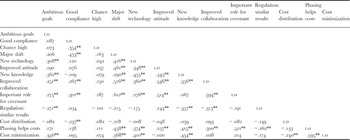
All these survey items were structured as five-point Likert-scale questions, with five indicating maximum impact (for a correlation matrix of the principal measures, see Table 1). Analyzing a number of these possible effects could be useful, but we concentrate here on explaining the extent of success in achieving environmental outputs and outcomes. We do so for reasons of space and also importance. Three relevant dependent variables could be used: the extent of success achieved in reaching the stipulated environmental objectives, the extent to which performance fundamentally improved through the covenant mechanism, and the extent to which relevant new technologies were catalyzed by the covenant instrument.Footnote 5 We focus here on what many would regard as the most important, bottom-line measure: the extent to which performance fundamentally improved via the covenant. This dependent variable is the mean score of the respondents for each covenant.
Intercorrelation of survey itemsFootnote *

* Full phrasing of items included in Table 2 and in the same order. Spearman's rho reported. N varies across cells due to some non-responses.
** p < .05.
We model our estimation by building upon the theoretical exposition sketched earlier, and in particular by considering measures of the four kinds of variables hypothesized to explain the extent of success. Our data include a number of more specific measures of each of these variable clusters – ambition, compliance, efficiency enhancements, and resource-building side effects; we asked our respondents to provide five-point Likert-scale responses to these as well. Preliminary analysis identified approximately 15 of these as having significant bivariate correlations (Spearman's rho) with the dependent variable. Our approach was to try to identify a parsimonious model that accounts for much of the variance across the performance of these covenants. We analyzed the data via regression techniques.
Findings
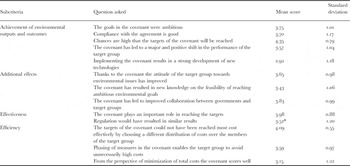
Mean scores on virtually all criteria of evaluation were above three across the full set of respondents (see Table 2). (The score for stimulation of new technologies was the one exception.) Fundamentally, therefore, covenants are seen as offering a set of specific and considerable benefits, although they are clearly not seen as magic bullets for any or all environmental challenges. The endorsements are by no means superficial, nor are they universal. Aspects of the agreements and their implementation are criticized by the people who know them best, and there is a variance to be explained regarding their impacts.
Assessment of Covenants’ Success on Various Criteria
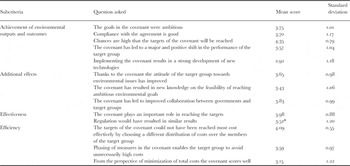
*The scores have been reversed to allow easy reading.
Given the relatively small number of cases, albeit virtually the full population of them, and the relatively large number of potential explanatory items, we employ backward regression in the exploratory analysis and then check the robustness of these results against alternative formulations. The findings reported here are indeed robust. We then seek to dig a bit further behind the results to seek to explain, in turn, some of the explanatory variables. Here in particular we must be cautious, since the data were gathered only once and we cannot definitively sort out causality. Still, the additional analysis provides information that may be particularly relevant to the question of whether the findings from the Dutch data have the potential to be generalizable to other settings in other countries.
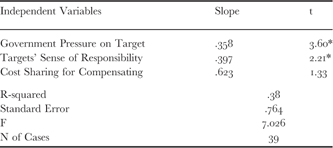
The regression results for the core dependent variable on whether the negotiated agreement led to a positive break from the previous period with regard to environmental performance are shown in Table 3. Two models are displayed: one containing four independent variables and the other with three. Essentially no additional explanatory power is achieved by extending beyond four independent variables.
Explaining Covenants’ Degree of Success Dependent variable = covenant led to positive shift in performance

*=significant p < .05, one-tailed test.
Compliance by the target group is clearly and positively related to higher performance. This variable has the largest effect size of any. Additional positive contributions are made by an attitudinal measure that taps a resource-enhancing side effect: improvement in the perspective on environmental affairs of business. When involvement in the covenant enhances a target group's perspective on the environment, performance in terms of outcomes is also higher. Another variable of interest – with one-tailed tests it is statistically significant in both models – is one tied to efficiency: the extent to which attention was given to individual efforts of target group members to keep total costs as low as possible. All these results are consistent with our theoretical expectations. The fourth variable in the model listed on the right of Table 3 taps the extent to which the negotiated agreement enacted ambitious objectives – objectives clearly beyond business as usual. Here the coefficient is in the expected direction, although the variable is not statistically different from zero.
Changing behavior in environmentally beneficial directions on the part of industrial target groups, therefore, appears to be related to aspects of compliance, resource-enhancing side effects (in particular, improved attitudes on the part of members of the target group) and efficiency enhancements. Two of these three measures refer to relationships specifically hypothesized as a result of the asserted possible benefits possible via covenants. In future research on negotiated policy instruments like covenants, it may also be worth investigating the degree of ambition imbedded in the enforceable agreement. The models in Table 3 explain a substantial portion of the variance in performance across covenants, and the basic findings are robust to alternative estimation techniques.
To pursue the matter more thoroughly, we next treat two of these explanatory variables as dependent variables. This step can help probe further the causal story. These further analyses need to be treated as exploratory and interpretation should be approached with caution. Since all the measures were developed simultaneously (and after the fact), in some cases there is no way to be certain about which variables shape others, nor about the possible presence of reciprocal causality. But it can be worthwhile to model possible determinants of “ambition” (objectives in the negotiated agreement clearly beyond business as usual) and “compliance” (extent of implementation of the negotiated agreement). We treat the question of ambition first, followed by that of compliance.
To seek an explanation for the extent of ambition embedded in the covenants, we identified possible explanatory variables as tapped in the survey of knowledgeable insiders. Only a relatively small subset of items qualify even as potential determinants, simply because several items focused on potential consequences of (for instance) ambition, rather than possible determinants. Of the possible explanatory variables, we tested for seven. These were selected on the basis of theoretical plausibility and results of bivariate correlations. We employed them in an initial full specification and worked via backward regression for the most appropriate model. The most parsimonious model that also provided the most explanatory power is presented in Table 4. Three items are included: (1) the pressure of the government on the target group prior to the signing of the covenant was strong; (2) the target group was prepared to take on its own responsibility (for making the covenant work); and (3) a form of cost sharing has been included among members of the target group to compensate the firms that would have to make disproportionate efforts. The first two of these are statistically significant, and the initial one – governmental pressure – is especially so, and with the largest effect size. It is easy to understand how both of these variables should matter in explaining the extent of ambition included in the negotiated agreements. The extent to which the target group was prepared to take on responsibility should clearly presage ambitious objectives. And it is particularly interesting that perceived governmental pressure should be important. Sometimes ostensibly “voluntary” policy instruments are contrasted with mandatory governmental ones, but it may well be that the “stick behind the door,” or the possibility that mandatory instruments like regulation may be imposed as a default in the case of weak negotiated agreements, can be a principal catalyst for enacting ambitious objectives into covenants.
Explaining Covenants’ Extent of Ambition Dependent variable = covenant goals were ambitious
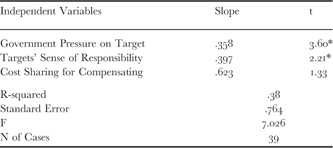
*=significant p < .05, one-tailed test.
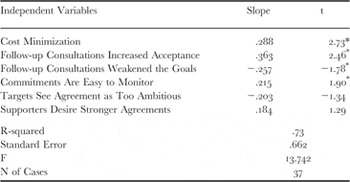
Finally, we sought to develop a model that helps to explain the extent of compliance, or the degree of implementation, of the agreements. Here we followed a similar process, one beginning with theoretically plausible relationships supplemented with bivariate correlations to identify candidate independent variables to introduce into possible multivariate models. We then proceeded to remove some to produce the most complete, yet parsimonious, theoretically sensible explanation. We also tested for a number of alternative explanatory models to ensure that stronger explanations were not obscured by the process of narrowing among the independent variables. Numerous aspects of follow-up negotiations – post-agreement – were considered as possible candidates. In addition, some target group characteristics were included, along with various aspects of the positions the parties took during the negotiations, and a number of characteristics of the actual text of the covenants. These measures reflect variables identifiable in the general research literature on policy implementation. We pared the candidates to a reasonable number that made theoretical sense and also seemed to “behave” in accord with what reasonable expectations would lead one to predict. We performed backward regression to optimize the model. The analytic results are displayed in Table 5.
Explaining Covenants’ Degree of Compliance Dependent variable = good compliance with the covenant

*=significant p < .05, one-tailed test.
It is clear that certain features are associated with successful compliance with negotiated agreements. In particular, devoting considerable attention to how target group members can minimize costs, as well as using follow-up consultation to build acceptance of environmental goals for the target group, are features of the implementation process related positively to compliance success. On the other hand, when consultation during implementation dilutes the force of the original commitments, compliance tends to weaken. Agreements that are seen as containing commitments that are easy to monitor are more likely to be implemented successfully. Two other variables are included in the model and have coefficients working in the expected directions, albeit without attaining statistical significance. The slope for members of “target groups feel the agreements actually go too far” is negative regarding compliance, while that for “supporters of the involved governments feel the agreements do not go far enough” is positive. The degree of explained variance for the model is substantial.
It appears to be the case, in other words, that attention to building and maintaining agreement, avoiding dilution of objectives during implementation, and taking care to keep costs down during execution can go a long way toward encouraging compliance success for negotiated agreements.
Implications and Conclusions
Negotiated agreements to protect the environment are a frequently used instrument in the Netherlands; the unique features of the Dutch setting, including its corporatist norms, might suggest that covenants cannot be simply and successfully transplanted wholesale from the Netherlands to any and all other countries. Indeed, one implication is that covenants as instruments stand a better chance to the extent that other settings have more similarities with these features of the Dutch sociopolitical context. Certainly, transplantation is an inappropriate notion, but superficial dismissals of the Dutch experience should also be avoided. For example, we find that for environmental covenants in that setting, a history of trust among the parties is unrelated to the core performance of the negotiated agreements. So it is appropriate to note that understanding how these covenants work – and sometimes how they do not work – can provide insights regarding the potential use of such approaches more broadly. Considering covenants as they have been developed and implemented in that country may be particularly apropos now, given that voluntary or consensual instruments of various forms have been or are being developed in many other contexts, from Mexico to China.
It is clear from the experience with negotiated agreements in the Netherlands, and from the results of this analysis, that some of the lessons from Dutch covenants have the potential to improve performance on environmental policy objectives in some other industrial settings. The Dutch case is special, but it offers contextual features that apply more broadly. The Dutch setting entails an advanced industrial democracy, a highly developed economy with serious stresses on the environmental setting, and a history of using policy tools that are largely similar to those adopted in many other countries. Indeed, the target groups involved in the development of negotiated agreements in the Netherlands operate and compete in an increasingly globalized economy, and in some sectors the firms themselves are multinational. So this set of cases does not constitute a collection of experiences and results devoid of connection to environmental policy challenges elsewhere. If Dutch negotiated agreements can often succeed, it is worth exploring the determinants of that success and use that information as similar instruments are considered and applied in other countries as well.
Aside from the general point that negotiated agreements are often seen as effective, what conclusions can be drawn from the use of covenants? Two general points are of particular note. First, the experience of the Netherlands suggests that policy instruments that provide flexibility within a context ensuring that action – including possibly regulatory action – will develop offer a more promising prospect than do purely voluntary policy options. Covenants as negotiated instruments are unusual among putatively consensual options precisely because they entail also the very real and predictable invocation of regulation as a default (for an analysis of why combinations of instruments and instrument features can be important see Bressers and O'Toole Reference Bressers and O'Toole2005). Second, the research literature on policy implementation, especially that tapping both top-down and bottom-up insights, offers promising theoretical ideas that can make sense of the varying results experienced with Dutch covenants and that may carry lessons for other settings.
The more detailed findings on this latter point are worth attention. In this study the measure of instrument effectiveness examined in detail is the extent to which the negotiated agreement is seen to have led to a positive break from the earlier period with regard to environmental performance. This measure is designed to take into account – and exclude – trends underway from other sources of influence, so as to focus exclusively on the effect of the covenant itself. The evidence indicates that attitudes of decision makers in the businesses themselves – the industrial sector and the individual firms – shape the results of negotiated agreements. Attention to cost minimization among the members of the target group also appears to contribute, presumably by making feasible the changes in behavior and processes that ultimately lead to success. So both the perspective of the participants and efforts to reduce concretely the costs of change help to drive the results of successful covenants. The degree to which the agreement itself contains sufficiently ambitious objectives may also matter positively for success. These findings are consistent with both theoretical expectations and also lessons learned in some other research, yet it is significant that they hold across virtually a whole population of cases in a country widely regarded as a leader in innovative environmental policy instruments.
We have conducted additional analysis to explore possible determinants of both the ambition imbedded in negotiated agreements and also the extent of compliance during implementation. In the case of ambition, for instance, it is unlikely that aggressive targets will be set merely because evidence suggests that such targets may be related to better environmental outcomes. The evidence from the Netherlands supports the notion that the drivers of ambitious objectives include both governmental pressure and also a target group's own sense of responsibility for the matter. The former finding rebuts the idea that successful covenants are purely voluntary instruments and supports the notion that governmental priority setting, and pressure, may be able to catalyze important action. The latter point carries implications for practice as well, since it suggests that initial efforts to stimulate negotiated agreements elsewhere might productively start in industrial sectors with higher levels of environmental consciousness and greater sense of individual and collective responsibility. The distribution of costs within the target group might also matter as well, although the relationship did not attain conventional levels of statistical significance in this analysis. The overall theme regarding costs from the Dutch covenants experience, nonetheless, is clear: attention to the costs of change is important, and in some industrial sectors it may also be helpful to develop mechanisms of cost sharing so that the distributional impacts of such costs do not derail overall performance of the target group (cf. Khanna, Koss, Jones and Ervin Reference Khanna, Koss, Jones and Ervin2007).
What of compliance during execution? Specialists in policy implementation will be surprised neither at the importance of compliance in driving results nor in the variables that appear to influence the extent of implementation. Once again, the cost issue appears to be crucial. Beyond the hard realities of costs, the perspective of the target group is key. Those who wish to draw practical lessons from the Dutch experience should note that building and maintaining agreement within the target group during the crucial follow-up process, as well as preventing backsliding toward less ambitious objectives during implementation, can drive successful execution. So can crafting agreements that are easy to monitor. These findings imply the value of investing in some process-oriented measures – perhaps the employment of a facilitator or manager of the process of developing the covenant itself, as well as in assisting the group in focusing on the objective and remaining relatively unified in its behalf. Ideally such an actor would probably be someone(s) technically well-versed in the field and respected by those in the target group. An implementation “manager” has been shown to be valuable in other implementation settings (see O'Toole Reference O'Toole2000), and the same may be true here. Facilitating a virtuous cycle with regard to compliance can also be supported by the structure of the situation, since the implementation of a covenant involves an ongoing process in which all parties remain in joint discussion and a continuing monitoring cycle; the various actors know that they will be continuing to deal with each other for the foreseeable future. Both game theory and also the inductive results of systematic institutional analysis show that the likelihood of defection is lessened under such circumstances.
The findings also suggest that getting the right balance of commitment and ambition may call for care and nuance. While ambitious objectives help, and while consultation during implementation that dilutes objectives hinders compliance, some evidence suggests that compliance may be also hindered if the target group feels that the objectives are unduly ambitious, even if neutral observers would not assess them as particularly so. Dealing with the perceptions of target groups and the associated affect, particularly on a key matter such as the kinds of responsibilities that seem to be placed on the shoulders of target group actors as covenants are developed, may be one of the keys in achieving success with negotiated agreements.
All in all, the evidence from the Dutch covenants experience indicates that appropriate goal setting, attention to the costs issue, and finding ways of keeping focus and agreement among target groups matter considerably. Governmental pressure is a key part of securing successful results from negotiated agreements. The full set of findings, therefore, should put to rest the notion that spontaneous collective action, or for that matter merely good will, can generate covenants that work. Pressure, and the right level of ambition, and managing the processes of developing and maintaining agreement as well as consulting during implementation, and practical attention to costs incurred by target group members – these would seem to be the ingredients of success. As “consensual” instruments of various sorts are developed in settings far from the Netherlands, and especially as instruments involving some essential pattern of negotiation are launched, the evidence from the Dutch experience can be considered as potentially instructive. As more governing systems seek to address the challenges of sustainable development, the interest in innovative instruments and their execution is likely to grow considerably.