


Introduction
Anxiety disorders are among the most prevalent psychological disorders. The most effective psychological treatments for anxiety, trauma and obsessive disorders come from the cognitive behavioural therapy (CBT) paradigm (e.g. Bradley et al., Reference Bradley, Greene, Russ, Dutra and Westen2005; Eddy et al., Reference Eddy, Dutra, Bradley and Westen2004; Fedoroff and Taylor, Reference Fedoroff and Taylor2001; Hofmann and Smits, Reference Franklin, Foa and Barlow2008; Norton and Price, Reference Norton and Price2007; Otto et al., Reference Otto, Pollack and Maki2000; Westen and Morrison, Reference Westen and Morrison2001). However, labelling therapy as ‘CBT’ does not mean that the client actually receives effective or evidence-based CBT. If CBT is delivered inadequately or inappropriately, there is a risk of prolonged suffering for clients who receive such treatment for these disorders.
Such therapist drift (Waller, Reference Waller2009) can occur in the selection of treatments and in their delivery. Stobie et al. (Reference Stobie, Taylor, Quigley and Ewing2007) found evidence of both of these phenomena in a study of ‘treatment refractory’ clients suffering from obsessive compulsive disorder (OCD). They found that 60% of the initial sample had received sub-optimal treatments, which were likely to be less effective than the evidence base would suggest could be achieved. Furthermore, of the 40% who were offered the most effective treatments, only 40% received a minimally acceptable dose of therapy, due to key elements being omitted. In other words, only approximately 16% of the original sample had received a full evidence-based treatment. This report and others (e.g. Hansen et al., Reference Hansen, Lambert and Forman2002; Waller et al., Reference Waller, Stringer and Meyer2012) indicate that what goes on in the therapy room is commonly sub-optimal, at least in the treatment of OCD and some other disorders.
There are many potential reasons for therapy techniques not being adequately delivered, which have been explored over the years (see Meehl, Reference Meehl1986; Waller, Reference Waller2009). These factors include issues related to both professional and personal characteristics. Professional characteristics in this situation include: level of training; core profession; and work environment (e.g. number of hours in contact with clients with anxiety disorders, amount of supervision received). Personal characteristics include the therapist’s own levels of anxiety and self-esteem. However, neither element exists in a vacuum and the two elements may influence each other. Therefore, these two factors need to be explored jointly. As such professional attitudes, which may derive from both personal and professional characteristics, need to also be considered.
Considering professional characteristics, Waller (Reference Waller2009) pointed out that therapists may make mistakes due to context-driven behaviours. Such behaviours may include being fatigued due to being overworked. Another professional characteristic that may play a role is training. As indicated by Becker et al. (Reference Becker, Zayfert and Anderson2004), a significant proportion of psychologists working with post-traumatic stress disorder did not have training in exposure. A lack of initial training, mixed with personal beliefs (discussed below), may further push a psychotherapist from correcting their misconceptions (Olantunji et al., Reference Olantunji, Deacon and Abramowitz2009; Parker and Waller, Reference Parker and Waller2017). However, it is important to note that Becker et al. (Reference Becker, Zayfert and Anderson2004) conducted their research with a US sample and this study involves a UK sample. In addition, no similar study has been conducted looking at training of CBT therapists in the UK. However, it is important to note that research (Brosan et al., Reference Brosan, Reynolds and Moore2006) suggests that therapists with additional post-qualification training may perceive their own skills, abilities and limitations more accurately.
Considering personal characteristics, anxiety (Koch et al., Reference Koch, Gloster, Waller, Richard and Lauterbach2007; Levita et al., Reference Levita, Salas Duhne, Girling and Waller2016; Parker and Waller, Reference Parker and Waller2017) appears to be the primary factor that causes therapists to avoid key CBT techniques. For example, when asking a client to engage in exposure a therapist has no idea how a client may respond. Being unable to see into the future, a therapist may experience anxiety in the form of prospective anxiety that may inhibit their behaviours. Prospective anxiety and behavioural inhibition are key aspects in tolerance of uncertainty (Carleton et al., Reference Carleton, Norton and Asmundson2007; Dugas et al., Reference Dugas, Fresston and Ladouceur1997; Ladouceur et al., Reference Ladouceur, Gosselin and Dugas2000). Having a lower tolerance of uncertainty may drive therapists to engage in safety-seeking behaviours to avoid negative responses (Waller, Reference Waller2009) and their own negative emotions (Ladouceur et al., Reference Ladouceur, Gosselin and Dugas2000). Therefore, psychotherapists with a greater intolerance of uncertainty may be less likely to use certain CBT techniques, such as exposure.
Considering self-esteem, it is unclear how a therapist’s own levels of self-esteem influence their work. Self-esteem can be considered in relation to two factors: cognitive vulnerability–stress interactions, and self-assessment of skill and outcome. Considering the former, intolerance of uncertainty (and anxiety overall) is greatly influenced by cognitive schemas and core beliefs (Hawkes and Provencher, Reference Hawkes and Provencher2011); key components in the cognitive vulnerability–stress theory. From this perspective, therapists with greater self-esteem may be more likely than those with lower self-esteem to use challenging techniques (such as exposure). However, Metalsky et al. (Reference Metalsky, Joiner, Hardin and Abramson1993) suggest that higher self-esteem may buffer against cognitive vulnerability–stress interactions. This buffer means that therapists may be less likely to blame themselves for poor therapeutic outcomes as they are less likely to attribute these failures to internal traits. However, as indicated by previous research (e.g. Stobie et al., Reference Stobie, Taylor, Quigley and Ewing2007), therapists may incorrectly then attribute these failures to the client. Considering self-assessment, therapists may use higher levels of self-esteem to protect their professional identities (Parker and Waller, Reference Parker and Waller2015). As a result, psychotherapists may not accurately understand their own abilities and how their skills relate to client outcomes (Brosan et al., Reference Brosan, Reynolds and Moore2006; Brosan et al., Reference Brosan, Reynolds and Moore2008; Parker and Waller, Reference Parker and Waller2015). Therefore, more data are needed to better understand the interaction of self-esteem on technique use.
Finally, considering professional attitudes, therapists’ own internal factors influence which techniques therapists are likely to employ. These factors include negative attitudes to manuals and protocols (Addis and Krasnow, Reference Addis and Krasnow2000; Addis et al., Reference Addis, Wade and Hatgis1999; Becker et al., Reference Becker, Zayfert and Anderson2004; Deacon et al., Reference Deacon, Farrell, Kemp, Dixon, Sy, Zhang and McGrath2013; Olantunji et al., Reference Olantunji, Deacon and Abramowitz2009; Parker and Waller, Reference Parker and Waller2017). It is unclear what the source of these belief systems and attitudes may be. However, it is clear that many therapists hold false beliefs about key techniques around exposure (Olantunji et al., Reference Olantunji, Deacon and Abramowitz2009). It is also clear that even amongst CBT therapists, negative attitudes towards CBT have an impact on technique use (Parker and Waller, Reference Parker and Waller2017). However, it is likely that we do not yet have an adequate understanding of those therapist factors.
Therefore, this paper aims to determine what CBT techniques CBT therapists report using when treating anxiety disorders. In achieving this aim, this paper aims to determine the frequency of technique use and which professional and personal characteristics influence the use of these techniques. Considering professional characteristics, this paper looks to explore potential differences based on professional characteristics. With regard to personal characteristics, this paper will explore internal traits (i.e. anxiety). In addition, this paper will explore the relationship between attitudes (which in professionals may be derived from personal beliefs) and technique use.
Methods
Ethics
This study received ethical approval from the University of Sheffield, Department of Psychology Research Ethics Committee. It met the criteria of the Ethical Principles of Psychologists and the Code of Conduct (American Psychological Association, 2003).
Design
This was a cross-sectional study of mental healthcare providers whose primary theoretical orientation was CBT and who worked with anxious clients. The study was conducted using a survey and self-report inventories. Data were analysed using correlational and comparative methods.
Participants
The sample consisted of 173 UK therapists who reported their primary theoretical orientation as CBT and that they worked with clients with anxiety disorders. A total of 1965 therapists were approached directly to participate in this study, via four workshops and two online databases. The email approaches were made to 1286 therapists from the British Psychological Society and 537 therapists from the British Association for Behavioural and Cognitive Psychotherapies. Of those approached in this way, 280 therapists began the survey. Of those, 146 did not complete enough of the measures for inclusion. Most of them stopped at or during the Therapy Methods Questionnaire (TMQ). Of the remaining 134 responses, 90 reported that CBT was their primary theoretical orientation. Of those at the workshops, 82 therapists started the paper version of the measures. All 82 responses were included in analysis. Four more therapists were approached via snowball methods, but only one reported CBT as their primary theoretical orientation, and could be included. Thus, 173 UK therapists who primarily used CBT and reported on their use of CBT techniques for anxiety disorders were included in analysis.
Sample characteristics
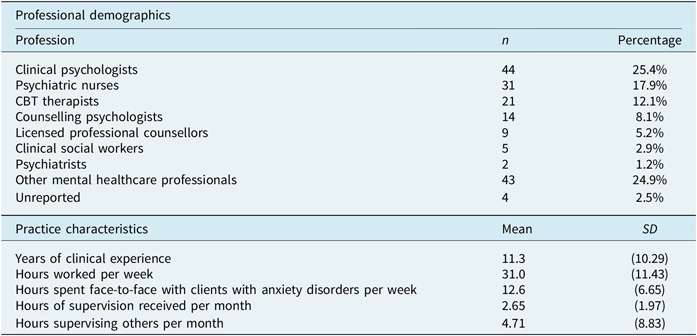
The mean age of the sample was 45.4 years (SD = 11.15), and 68.2% were female. Table 1 presents the sample professional demographics, including core profession and professional characteristics.
Sample (n = 173) professional demographics

Considering their practice with clients with anxiety disorders, therapists reported a mean of 11.5 sessions (SD = 5.61; range 4–60) before treatment was completed. The modal session length was 45–90 minutes (94.8%). The second most frequent session length was under 45 minutes (4.6%). The least frequent session length was greater than 90 minutes (0.6%).
Measures
Demographics
All participants were asked to report their general demographic details (age, gender and ethnicity) and information about their clinical characteristics [core profession; theoretical orientation; professional accreditation; hours worked per week; hours spent with anxious clients per week; hours spent in supervision (giving and receiving) per month; average session length; and approximately how many sessions were delivered before treatment was completed].
Therapy Methods Questionnaire
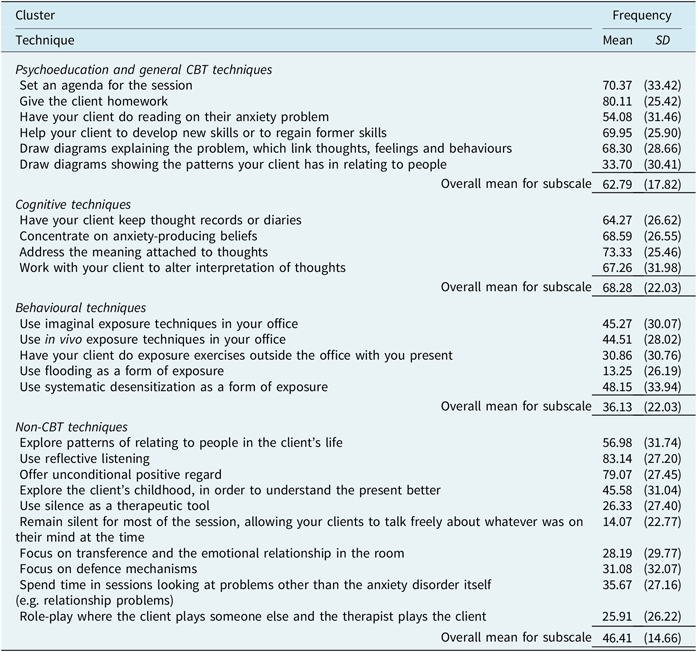
The TMQ consists of 26 therapy techniques. Therapists rated (on a 0–100% scale) how often they used those techniques in clinical practice with anxiety disorders (0%: never used; 50%: used in half of such sessions; 100%: used in every session). Techniques on this scale (see Table 2) were grouped a priori into clusters (i.e. psychoeducational and general CBT techniques, cognitive techniques, behavioural techniques, and non-CBT techniques). Previous research (Parker and Waller, Reference Parker and Waller2017) has used the same grouping of techniques, and found that they had strong internal consistency (Cronbach’s alpha = .71 to .87).
Mean levels (0 to 100) of use of each therapy technique reported by therapists (grouped by subscale)

The scale was derived from the current literature and from treatment manuals (Abramowitz et al., Reference Abramowitz, Taylor, McKay and Steketee2012; Clark, Reference Carleton, Norton and Asmundson2007; Clark and Beck, Reference Clark and Beck2010; Craske and Barlow, Reference Craske, Barlow and Barlow2008; Franklin and Foa, Reference Hofmann and Smits2008; Kearney, Reference Kearney2005; Martin, Reference Martin2013; Resick et al., Reference Resick, Monson, Rizvi and Barlow2008; Turk et al., Reference Turk, Heimberg, Magee and Barlow2008; Whittal and Robichaud, Reference Whittal, Robichaud and Steketee2012). The items were classified based on core elements for treating anxiety disorders. Some items (e.g. ‘Give the client homework’) were left vague and open to interpretation by the therapist and to allow for more freedom in response (although following up on homework may be a more important factor to consider). The a priori grouping was established for another study and may pose some issues (discussed below). For further details on the creation of this scale please see Parker and Waller (Reference Parker and Waller2017).
Intolerance of Uncertainty Scale – Short Form (IUS-12)
The IUS-12 (Carleton et al., Reference Clark2007) is a 12-item self-report measure of intolerance of uncertainty with two subscales – inhibitory anxiety and prospective anxiety. Intolerance of uncertainty is a core component of anxiety. The measure has strong psychometric properties and has been used in a range of studies (Carleton et al., Reference Clark2007; Khawaja and Lai, Reference Khawaja and Lai2010). Higher scores indicate greater levels of anxiety.
Rosenberg Self-Esteem Scale (RSES)
The RSES (Rosenberg, Reference Rosenberg1965) is a 10-item self-report measure of global self-worth. The RSES has strong psychometric properties (Schmitt and Allik, Reference Schmitt and Allik2005; Sinclair et al., Reference Sinclair, Blais, Gansler, Sandberg, Bistis and LoCicero2010). Higher scores indicate greater self-esteem.
Negative Attitudes towards CBT Scale (NACS)
The NACS (Parker and Waller, Reference Parker and Waller2017) is a 16-item self-report of therapists’ negative attitudes to CBT. The NACS is a unitary scale, with strong internal consistency and validity. Higher scores indicate more negative attitudes towards CBT. The overall Cronbach’s alpha for the scale is reported at .95 (Parker and Waller, Reference Parker and Waller2017). In addition, this measure has also displayed strong predictive validity with regard to technique use on the TMQ and other similar measures.
Procedures
Each participant completed self-report measures of demographic details, which therapy methods they employed, anxiety, self-esteem, and negative attitudes towards CBT. Responses were included for analysis if participants reported on therapy methods employed. Any answers given as a range were averaged (e.g. ‘2–3’ was treated as 2.5). If a written response was unreadable, the item was treated as having a missing value.
Data analysis
SPSS version 22 was used throughout. To determine the frequency of technique use, a repeated measures ANOVA was conducted. Considering the impact of professional characteristics on technique use, multiple approaches were used. First, one-way ANOVAs were conducted to test for differences between professional groups and their use of each of the technique groups. Second, practice characteristics were assessed in relation to technique use with the use of linear regressions. To finish assessing this aim, an independent samples t-test was conducted to assess differences between those with additional professional accreditation and those without. To assess personal characteristics in relation to technique use, a linear regression was conducted.
Results
Use of techniques
Table 2 shows how often therapists reported using specific techniques while treating anxiety disorders. The techniques were grouped as described in the Method section.
A repeated measure ANOVA revealed a significant difference in the frequency with which therapists used different types of technique when delivering CBT (Wilks’ lambda = .396, F (3,158) = 79.42, p < .001). Cognitive techniques (mean = 68.42, SD = 22.00) were the most frequently used. General and psychoeducational techniques (mean = 62.63, SD = 17.91) were the second most commonly used. The next most frequently used set of techniques were non-CBT techniques (mean = 46.16, SD = 14.52). Finally, behavioural techniques (mean = 35.82, SD = 21.64) were used the least. The means reported here vary slightly from those reported in Table 2, as cases with missing values were excluded for the repeated measures analysis. Bonferroni corrected t-tests showed that there were significant differences in the frequency of delivery between all therapy techniques (p < .001 in all cases).
Relationship between demographic factors and technique use
Profession
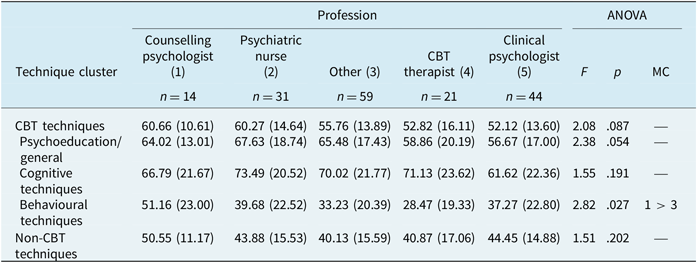
Table 3 shows the results of one-way ANOVAs assessing the association between the use of techniques and therapists’ core profession. Counselling psychologists were most likely to use behavioural techniques. There were no other such differences.
Technique clusters associated with core profession

Multiple comparison (MC) tests used Bonferroni corrections.
Considering professional accreditation, multiple independent samples t-tests were conducted to look for differences between professional with post-qualification accreditation on the use of each technique cluster. In all cases, no differences were found (p > .150, in all cases).
Practice characteristics
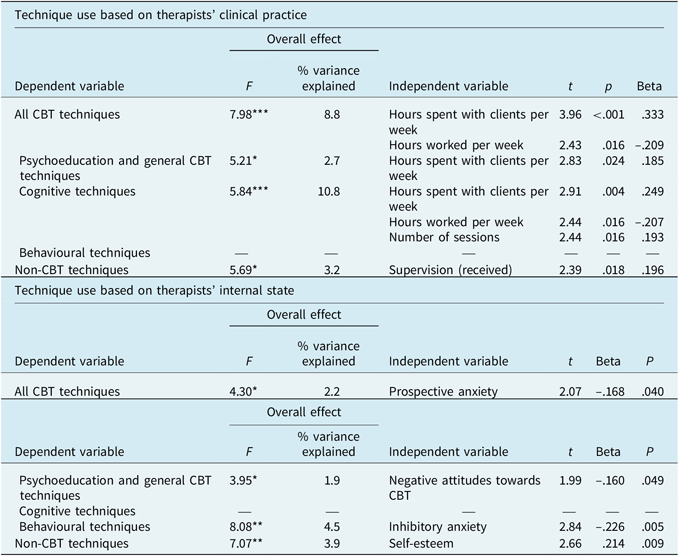
Table 4 presents the findings of multiple (stepwise) linear regressions examining the associations of therapists’ practice characteristics [i.e. hours worked per week, hours spent with clients (with anxiety disorders) per week, average number of sessions when treating a client with an anxiety disorder, and supervision given/received per month] with the use of different types of technique (i.e. general and rapport techniques; cognitive techniques; behavioural techniques; non-CBT techniques). These analyses were preceded by preliminary correlations. No analysis is reported regarding the use of behavioural techniques, as there were no significant associations between therapists’ demographics and the use of behavioural techniques (r < .128 in all cases). In the regressions, the demographics associated the most often with techniques used were hours spent with clients with anxiety disorders per week and hours worked per week. However, the number of hours of supervision that a therapist received per month was positively associated with their use of non-CBT techniques.
Multiple (stepped) linear regression modelling for prediction of technique use based on therapists’ clinical practice characteristics and internal states

* p < .05;
** p < .01;
*** p < .001.
Therapist mood and beliefs
Table 4 presents the findings of multiple linear regressions (stepwise) examining the association between therapists’ internal characteristics (i.e. anxiety, self-esteem and attitudes) with therapists’ use of the different technique groups (i.e. general and rapport techniques; cognitive techniques; behavioural techniques; non-CBT techniques). No analysis is reported regarding cognitive techniques, as there were no significant associations between therapists’ internal characteristics and their use of cognitive techniques in preliminary correlational analyses (r < –.111 in all cases). Therapists’ own levels of anxiety (inhibitory and prospective) and their attitudes towards CBT were negatively associated with the use of CBT techniques, while self-esteem was positively associated with the use of non-CBT techniques.
Discussion
The aim of this study was to determine patterns of use of CBT techniques in the treatment of anxiety disorders and the therapist factors that might influence those patterns of use. The most noteworthy point was that the most effective, evidence-based cluster of techniques (i.e. behavioural) were the least commonly used. Behavioural techniques were more likely to be used by counselling psychologists than any other professional groups. However, overall, and supporting the broader literature (e.g. Levita et al., Reference Levita, Salas Duhne, Girling and Waller2016; Stobie et al., Reference Stobie, Taylor, Quigley and Ewing2007), behavioural methods were used less by therapists who were more anxious. Finally, the level of experience of working with patients with anxiety disorders seems to be related to a greater use of CBT techniques overall.
These findings support previous research regarding the role of therapist characteristics. For example, the role of therapist anxiety in this study replicates the finding that therapists who are anxious are less likely to use behavioural techniques, such as exposure (Meyer et al., Reference Meyer, Farrell, Kemp, Blakey and Deacon2014; Levita et al., Reference Levita, Salas Duhne, Girling and Waller2016; Turner et al., Reference Turner, Tatham, Lant, Mountford and Waller2014; Waller et al., Reference Waller, Stringer and Meyer2012). Similarly, the role of therapists’ negative attitudes to CBT is compatible with prior findings that therapists who hold more negative attitudes to a therapeutic method are more likely to under-utilize or leave out key techniques (Deacon et al., Reference Deacon, Farrell, Kemp, Dixon, Sy, Zhang and McGrath2013).
The clinical implications from these findings reveal an interesting pattern with regard to each of the technique clusters. Considering behavioural techniques, these techniques were used the least, and therapists with greater inhibitory anxiety were less likely to employ this group of techniques. The under-utilization of this technique is particularly problematic amongst therapists treating anxiety, obsessive and trauma disorders. Such techniques, particularly exposure, have been shown to be the most influential component in treating clients suffering from one of these disorders, with better outcomes and maintenance than other approaches that do not include exposure (Barlow et al., Reference Barlow, Craske, Cerny and Klosko1989; Clark et al., Reference Clark, Ehlers, Hackmann, McManus, Fennell, Grey and Wild2006; Cottraux et al., Reference Cottraux, Note, Yao, Lafont, Note, Mollard, Sauteraud, Bourgeois and Dartigies2001; Feske and Chambless, Reference Feske and Chambless1995; Foa et al., Reference Foa, Dancu, Hembree, Jaycox, Meadows and Street1999; Foa et al., Reference Foa, Hembree, Cahill, Rauch, Riggs, Feeny and Yadin2005, Öst, Reference Öst1989; Sánchez-Meca et al., Reference Sánchez-Meca, Rosa-Alcázar, Marín-Martínez and Gómez-Conesa2010; Zlomke and Davis, Reference Zlomke and Davis2008). The results do not indicate any other internal state or practice characteristic that is associated with an increased use of behavioural techniques.
Considering cognitive techniques, CBT therapists who held more negative views of CBT were less likely to employ these techniques. In contrast, cognitive techniques were likely to spend longer delivering a course of therapy and to work more hours in the week. It might take some therapists longer to feel comfortable enough to employ key therapeutic techniques and challenge client cognitions. Alternatively, they might be using fewer behavioural techniques, and hence being less effective.
CBT therapists who received more supervision or had greater levels of self-esteem were more likely to use these non-CBT techniques. These findings might imply that supervisory drift is occurring (Simpson-Southward et al., Reference Simpson-Southward, Waller and Hardy2016; Simpson-Southward et al., Reference Simpson-Southward, Waller and Hardy2017), and that therapists have greater self-belief and do not see as strong a need to focus on evidence-based approaches.
These findings require elaboration in future research. It is possible that some therapists had positive and justifiable reasons for deviating from evidence-based practice, although it is unlikely that this could have been the case for so many individuals. However, as this study did not assess why therapists under-utilized techniques, there may have been reasons that satisfactorily address why these sets of techniques were the least used. In addition, supervision might not be as effective as therapists expect in helping adherence to CBT protocols when CBT is the prescribed treatment. Other research (i.e. Simpson-Southward et al., Reference Simpson-Southward, Waller and Hardy2017) has highlighted a number of issues regarding the adequacy of clinical supervision models. This study builds on and extends those conclusions by indicating a positive association between supervision and the use of non-CBT techniques amongst CBT therapists.
This study has a number of limitations. As this study uses self-report measures, the level of use of clinical techniques has not been ascertained concretely, and further research using observational methods is needed to confirm these findings and their implications. An alternative approach to addressing this limitation may be to use a more direct line of questioning (e.g. ‘reflecting on the last 10 sessions you have had with a client with an anxiety disorder’). Another limitation might be the length of the TMQ, as many therapists stopped at or during this portion of the study. Not only is there the issue of self-selection bias, but a large proportion of the therapists were engaged in training – both factors that might have skewed the findings. In addition this post-qualification training has not been assessed to determine if exposure was included, nor has pre-qualification been assessed similarly. Therefore, it is unclear if UK therapists are experiencing the same issues with training as therapists in the US (see Becker et al., Reference Becker, Zayfert and Anderson2004). Finally, some of the measures require refinement. For example, the TMQ would benefit from questions regarding graded exposure, interoceptive exposure, and non-exposure-based behavioural techniques. In addition to this issue, while exposure is the most supported approach to treating anxiety disorders, CBT therapists may be relaying up other forms of behavioural experiments. Therefore, future iterations of the TMQ may reflect a different practice outcome if a question on behavioural experiments in general was included. In addition, these refinements may need to include looking at the grouping of the techniques. Fortunately, those that may be considered part of CBT (or therapy overall, such as reflective listening) are not part of the elements that CBT research indicate as driving forces (e.g. exposure) in addressing anxiety disorders and, therefore, should not skew the results of this current research. In addition, the vagueness on some items could have potentially skewed the results either way, although these items (e.g. giving of homework) were relatively minor compared with the more explicitly addressed items (e.g. in vivo exposure).
Further research is needed to find ways to ensure optimal delivery of CBT. In particular, it will be important to determine the impact of factors such as clinician anxiety and clinical practice features on therapeutic outcomes, using actuarial data (e.g. outcome reports, observation of therapy sessions). Furthermore, it is necessary to assess CBT therapists’ rationales regarding their use (or omission) of techniques when treating anxiety disorders. As therapist drift occurs without evidence supporting therapists’ deviations from protocols (Waller, Reference Waller2009), future studies should take into account the justifications that therapists advance for the decisions that they make. In addition and in light of these findings, the study of Becker et al. (Reference Becker, Zayfert and Anderson2004) should be replicated in the UK to identify potential issues in training that lead to the under-utilization of these core techniques.
To conclude, many CBT therapists do not employ key CBT techniques (e.g. exposure). Appropriate education, training and supervision are needed to ensure competence and adherence (Waller and Turner, Reference Waller and Turner2016). For example, training for therapists could be adapted to address their anxiety and negative attitudes towards CBT (Farrell et al., Reference Farrell, Deacon, Dixon and Lickel2013; Meyer et al., Reference Meyer, Farrell, Kemp, Blakey and Deacon2014), and supervision could focus explicitly on client outcomes (Simpson-Southward et al., Reference Simpson-Southward, Waller and Hardy2017).
Author ORCIDs
Zachary Parker, 0000-0002-8349-2172; Glenn Waller, 0000-0001-7794-9546
Acknowledgements
None.
Financial support
This research received no specific grant from any funding agency, commercial or not-for-profit sectors.
Conflicts of interest
Zachary Parker and Glenn Waller have no conflicts of interest with respect to this publication.
Ethical statement
This study received ethical approval from the University of Sheffield, Department of Psychology Research Ethics Committee. It met the criteria of the Ethical Principles of Psychologists and the Code of Conduct (American Psychological Association, 2003).
Key practice points
(1) CBT clinicians appear to under-utilize behavioural techniques for anxiety disorders.
(2) That under-utilization is related to clinician anxiety and negative attitudes to CBT.
(3) Supervisors need to attend to how well clinicians are adhering to the principles and practice of CBT.



Comments
No Comments have been published for this article.