




No CrossRef data available.
Shared or conflicting working models? Relationships in postdivorce families seen through the eyes of mothers and their preschool children
Published online by Cambridge University Press: 01 September 2004
Abstract
Marvin and Stewart and Byng–Hall proposed that effective family collaboration requires family members to construct “shared family working models,” and that the renegotiation of these working models during family transitions is facilitated by family members' “interactional awareness” (ability to be perceptive observers of family relationships). We apply these constructs to data collected from 71 mothers and their 4.5- to 5.0-year-old preschool children, 2 years after parental divorce. Maternal representations of the father as coparent and ex-spouse, and of father– and mother–child relationships were assessed via two interviews. A family story completion task captured child representations of mother–child and father–child, coparental and ex-spousal interactions. Maternal accounts of mother–child conversations illustrated the negotiation of shared working models. Primarily qualitative analyses contrasting maternal and child perspectives are presented in the first section. Then we use regression analyses to predict children's story themes from maternal representations of flexible, sensitive, and effective discipline-related interactions; maternal depressive symptoms; and perception of the child's father. Finally, we identify gender differences in children's enactments of divorce-related and child-empathy themes. We conclude by considering how our findings could be used to assist postdivorce families in constructing shared rather than conflicting working models of family relations.This research was funded by Grant R01 HD267766 awarded to the first author by the NICHD. Additional support was received from the University of Wisconsin Graduate School Research Committee, the Waisman Center, and the Vilas Trust. We express our deep appreciation to the mothers and children who participated in this study. We also thank Barbara Golby, Angel Gullon–Rivera, Patti Herman, Chris Halvorsen, Vicky Lenzlinger, Kristine Munholland, Reghan Walsh, and Laura Winn for assisting with data collection and analysis and acknowledge helpful advice from John Byng–Hall, Robert Emery, Paul Amato, and Daniel Veroff.
Information
- Type
- Research Article
- Information
- Copyright
- © 2004 Cambridge University Press
Ideas from the family systems and family therapy literature (e.g., Bateson, Jackson, Haley, & Weakland, 1956; Wynne, Ryckoff, Day, & Hirsch, 1958) inspired John Bowlby's (1973) notion that children's representations, or as he termed them internal working models, of self with attachment figures are a function of the quality of interaction and emotional openness children have experienced in attachment relationships with parents. Specifically, he claimed that (Bowlby, 1973, pp. 322–323)
The family experience of those who grow up to become relatively stable and self-reliant is characterized not only by unfailing parental support when called upon but also by a steady yet timely encouragement toward increasing autonomy, and by the frank communication by parents of working models—of themselves, of child and of others—that are not only tolerably valid but are open to be questioned and revised [italics added].
In contrast, when parents are not reliably supportive, when they discount or reject a child's attachment experiences, and place a taboo on discussion of painful or traumatic experiences, children may “adopt, and thereby confirm, a parent's false models—of self, of child, and of relationship” (Bowlby, 1973, p. 323). As a result, the child is likely to construct confused, defensive, and internally inconsistent working models of self and relationships that can impede both constructive communication and reflection. Bowlby further proposed that parents tend (often unwittingly) to emulate the parental behavior they have experienced in childhood, thereby transmitting across generations not only relationship patterns (working models) but also a predisposition toward mental health or mental ill health.
Attachment studies, pioneered by Main, Kaplan, and Cassidy (1985) lent substantial support to Bowlby's intergenerational proposals, although with an additional twist. It was parents' current ability to reflect openly and coherently about attachment in the family of origin that was associated with secure attachment patterns in the Strange Situation (see the meta-analysis by van IJzendoorn, 1995). Such parents and their infants were more responsive to each other's signals (Ainsworth, Blehar, Waters, & Wall, 1978), developing what one might call a shared working model of a trusting relationship.
The construct of “shared working models” emerged, however, not from intergenerational attachment studies, nor from more recent research documenting linkages between the quality of marital and parent–child relationships (e.g., Cowan, Cohn, Cowan, & Pearson, 1996), but from the collaboration of attachment and family systems theorists who became interested exploring the extent to which both fields could benefit from greater integration (in order of publication: Minuchin, 1985; Marvin & Stewart, 1990; Cox & Paley, 1997; and Byng–Hall, 1999). One of the notions that both fields have in common is that clear interpersonal communication is associated with well-functioning relationships as well as individual mental health, although family theorists focus on more complex relationship constellations, such as triads and larger family groups that attachment researchers have largely neglected.
In a seminal paper, attachment theorists Marvin and Stewart (1990) argued that interaction patterns among family members and family subsystems (the purview of family systems theoreticians) may be regulated by shared working models that govern family members' anticipations, interpersonal attributions, and plans. These ideas were taken up and further elaborated by family therapist Byng–Hall (1995, 1999) who maintained that without adequate shared working models family members would not be able to anticipate and adapt to each other's behaviors and plans in the pursuit of common goals. By “sharing” Byng–Hall implied much more than that each family member had learned his or her lines in a common family script. Sharing, he claimed, means that family members can adequately assess each other's working models of intrafamilial relationships, including working models of self, self-with-other, and others with third parties, integrated into a systemic model that includes triadic and higher order family relationships. Byng–Hall further maintained that, to develop and update this kind of systemic working model, family members must possess a capacity for interactional awareness or insight into how “unfolding family scenarios may be affecting all those involved,” (Byng–Hall, 1999, p. 635). Without such awareness and without open communication, especially during family transitions, family members may develop incompatible, contradictory working models of their relationships, leading to misunderstandings that render family collaboration difficult, if not destructive. The concept of interactional awareness resembles self-reflectiveness, that is, the ability to reflect on one's own and others' mental states, believed to underlie the construction of adequate, well-adapted internal working models of dyadic attachments and foster mental health (Fonagy, Steele, Steele, Moran, & Higgitt, 1991).
The dual notions of shared family working models and interactional awareness are especially relevant to postdivorce families with children in which former spouses no longer share the same residence. Not only is development and revision of shared family working models bound to become more challenging when family members do not live together, but potentially more serious obstacles are presented for many families by interparental conflict, resentment, and competition for the child's love. For example, one parent may deliberately or unwittingly undermine or marginalize the other parent in the eyes of the child, and/or elevate the child into the role of quasi-spouse or attachment figure (parentification). Children in such situations often learn to become manipulative or experience loyalty conflicts, and girls, in particular, may assume caregiver roles (Hetherington, 1989).
Such problems are typically compounded for young children because their communicative, representational, and reflective abilities are still developing. The complexity of well-functioning shared family working models described by Byng–Hall (1999) seems to call for a level of metacognition that preschoolers may not yet have attained. To explore whether Byng–Hall's ideas of shared family working models and interactional awareness can shed light on family relations in postdivorce families, we applied these constructs to our study of mothers and children 2 years after the parents' divorce decree was finalized, a period typically when families tend to have stabilized new routines (Hetherington, 1989).
We use the term shared family working models for good reason. Most divorced parents remain connected to each other through children, and thus still constitute a family. Other adults (grandparents, new stable or temporary partners) are also likely to be recruited as subsidiary attachment figures for the child and sources of emotional support for the parents, creating further complexity (Bretherton, Walsh, Lependorf, & Georgeson, 1997). In this study, however, we focus on data collected from mothers and children. It is a limitation of our investigation that we cannot also include the father's perspective; however, the shared working models we investigate include perceptions of the father's role in the family held by the mothers and their children.
Our source material consists of two structured but open-ended maternal interviews and a child story completion task. In one interview, mothers offered appraisals (working model) of the father–child relationship and the father's behavior as coparent; in the other, they offered accounts of mother–child dialogues about divorce and father-related issues. These narratives provided an opportunity to examine how working models of dyadic and triadic family interactions in postdivorce families may come to be shared. In this interview mothers also reflected on their relationships with their children as attachment and authority figures.
Systematic assessments of how young children perceive the divorce of their parents are rare (an exception is found in Wallerstein & Kelly, 1975). This is surprising, because these children may be especially at risk for problematic postdivorce adjustments (Emery, 1999; Wallerstein & Kelly, 1975; Wallerstein, Lewis, & Blakeslee, 2000). To gain insight into children's representations of their relationships with divorced parents we used a story completion task informed by established protocols (e.g., the Attachment Story Completion Task [ASCT] by Bretherton and Ridgeway, 1990; doll stories by Cassidy, 1988; and the MacArthur Story Stem Battery [MSSB] by Bretherton, Oppenheim, Buchsbaum, Emde, & The MacArthur Narrative Work Group, 1990/2003). In studies based on these tasks, preschool children's constructive story resolutions, positive parent representations, and coherence of narrative were predicted by assessments of actual family relationships (e.g., Bretherton, Biringen, Ridgeway, Maslin, & Sherman, 1989; Bretherton, Ridgeway, & Cassidy, 1990; Cassidy, 1988; Gloger–Tippelt, Gomille, Koenig, & Vetter, 2002; Miljkovitch, Pierrehumbert, Bretherton, & Halfon, in press; Oppenheim, 2003; Oppenheim, Emde, & Warren, 1997; Solomon, George, & De Jong, 1995; Verschueren, Marcoen, & Schoefs, 1996; Waters, Rodrigues, & Ridgeway, 1998). This method has also proven helpful in the study of maltreated children (Toth, Cicchetti, MacFie, & Emde, 1997). In a longitudinal study, Toth, Cicchetti, MacFie, Maughan, and VanMeenan (2000) documented negative changes in the stories of maltreated children in contrast to positive changes in nonmaltreated children. Most impressively, perhaps, a study using the MSSB to compare the relative efficacy of two interventions with maltreated children, revealed significant positive changes in parent representations in one of the two interventions, but no change in the comparison intervention or a nonmaltreated control group (Toth, Maughan, Manly, Spagnola, & Cicchetti, 2002).
For the purposes of this study, we selected ASCT and MSSB story stems without altering their basic content. However, to reflect the postdivorce situation, the two parental figures were presented as living in different “houses,” a setup that enabled children to create dyadic, triadic, and whole family relational patterns in their story completions.
To explore the development of shared or conflicting dyadic and family working models in postdivorce families, we examined similarities and differences between issues addressed in mother's interviews and children's story completions. We did so qualitatively by comparing and contrasting divorce-related family themes as portrayed by mothers and children, and quantitatively by using regression analyses to predict children's story representations of parents as attachment and authority figures from mothers' descriptions of mother–child interactions. We expected that mothers' accounts of effective, flexible, and authoritative parenting would predict their children's corresponding story portrayals of authoritative and secure mother–child relationships and that mothers' perception of fathers' supportiveness as coparent would be a strong positive predictor of how children portrayed the father as authority and attachment figure in their stories. We further hypothesized that mothers' depressive symptoms would be inversely associated with positive story representations of both parents. A second set of regressions was motivated by unexpected findings in an earlier analysis that examined associations between teacher ratings of children's social competence with peers and story completions (Page & Bretherton, 2001). For girls only, stories in which a child figure behaved empathically toward a parent predicted lower ratings of peer social competence. A post hoc exploration of the story transcripts showed that girls enacted these themes in the context of family reunifications and divorce-related themes, leading us to suggest that girls' stories may have reflected worries about, and possibly feelings of responsibility for, parents' and the family's well-being. This is in line with findings that some girls respond to postdivorce stresses with heightened caring (e.g., Hetherington, 1989; Emery, 1999). For the present study we were, therefore, also interested in how the formation of shared working models involving children and both parents in postdivorce families may be influenced by the gender of the child.
Method
Participating families
Seventy-one divorced mothers and children were recruited as participants. Families were eligible if parents had been legally separated or divorced for at least 2 years, the mother had not remarried, and they had a child who was 4.5–5 years of age. Only mothers who were employed outside the home or pursued a degree (or both) were included in the study to eliminate severe poverty as an additional stressor. Most of the families were identified through a search of public court records. Of the 151 families that appeared to fulfill eligibility criteria, 41 could not be contacted (letters were returned or phone numbers not listed). Of the 110 families whom we were able to contact, 54% (N = 59) agreed to participate in the study. The other 12 families were recruited through local preschool directors.
Mothers
The mothers' ages ranged from 23 to 47 years, with a mean of 33 years. All 71 mothers had graduated from high school, 44% had 2-year degrees or had attended college without graduating. An additional 29% had obtained bachelor or higher degrees. Mothers' occupation levels ranged from level 2 (unskilled workers) to level 9 (higher executives) on the Hollingshead Occupational Scale (1978). Seventy percent of the mothers had occupations ranging between level 5 (clerical and sales workers) to level 7 (managers and minor professionals). Mothers' average reported income, including child support and adjusted for number of individuals in the family, was 211% of federal poverty guidelines, with seven families reporting incomes below and 12 families reporting incomes above 300% of these guidelines. Most of the mothers with incomes below poverty guidelines were students working part-time who received various forms of assistance from parents and other sources.
Children
The focal children (41 boys, 30 girls) ranged from 4 years 5 months to 5 years 0 months in age, with a mean of 4 years 8 months. Thirty-four percent were only children, 49% had one sibling, and 17% had two or more siblings. Thirty-eight percent of the focal children were firstborns. All but two of the children were European American, one was biracial (European American mother, African American father), and one had a mother who identified herself as Hispanic. Fifty-six percent of the children attended (33 different) preschools, 27% attended (15 different) daycare centers, while 17% were in family day care.
Fathers
The fathers' education and occupation levels were very similar to the mothers', r (70) = .59, p < .0001 and .49, p < .0001, respectively. Eighty-three percent of the fathers lived in the same town or in close vicinity, 6% lived in the same state but at some distance, and 11% lived outside the state. Mothers mentioned that 28% of the fathers had serious drinking or drug problems.
Custody and contact arrangements. Seventy-six percent of the mothers shared legal custody with the father, the remainder had sole legal custody (this did not preclude contact with the father). The mother had primary physical custody in 92% of the families and shared it equally with the father in 8%. According to maternal report, 70% of the children stayed overnight at their father's residence every other weekend, and half of these saw him weekly. Six percent spent time with the father every 4–6 weeks, 11% three to four times a year, and 3% twice a year, but 10% of the children had not seen their fathers for a year or more, although there was some contact between the parents. Many fathers who saw their children three to four times a year or less either lived outside the state or were reported to have alcohol or drug problems.
Procedure
In this article we include data from the first two of our five contacts with the family. During the first meeting the mother responded to a social network interview (SNI) at a location of her choice. The SNI lasted about 1 hr and was audiotaped. The second session took place in a university playroom. After a brief introduction, the mother played with the child for 5 min and then remained present while the child interviewer engaged the child in play to create rapport. When the child seemed comfortable, usually after about 10 min, another interviewer guided the mother to a separate room for the Parent Attachment Interview (PAI; Bretherton, Biringen, & Ridgeway, 1989). The PAI lasted about 1–1.5 hr and was audio taped. Concurrently, the child interviewer administered the story completion task (videotaped), and the Peabody Picture Vocabulary Test (PPVT) to the child. This was followed by joint play until the mother returned. At the end of the study, the family received a check for $75.00 as a token of appreciation.
Instruments and coding
Mothers.
The SNI. This structured interview was adapted from Cochran, Larner, Riley, Gunnarsson, and Henderson (1990). Unlike a questionnaire, the SNI is not based on a set of ready-made items but requires the interviewee to offer reasons why each network member he or she named is important or a source of stress. For this article, we only present data pertaining to children's fathers (findings regarding the mothers' other social network members can be found in Bretherton, Walsh, & Lependorf, 1996, based on the first 50 families from our study).
To analyze mothers' SNI responses about the child's father in greater detail, research assistants iteratively sorted positive (why important) and negative (why stressful) statements, yielding 26 negative and 14 positive categories whose definitions are listed in the Results section. There was no double coding.
Accuracy. On completion of the initial sort, an additional research assistant checked whether each statement was fully consistent with the category into which it had been placed. Discrepancies were resolved by discussion, and led to clarifications in the definition of some categories. A third coder, using these refined definitions, then resorted the statements.
Quantitative scores. No mother used all of the 26 negative and/or 14 positive categories that emerged from our analysis of father-related SNI statements, taken collectively. However, in the assumption that a higher number of positive and/or negative statements reflected the mother's general appraisal of the father as parent and coparent, we created two global scores: one for father support (the sum of all reasons why the father was an important network member), and one for father problems (the sum of all reasons why the father was a source of stress). Confirming our assumption, mothers' SNI scores were significantly correlated with other maternal assessments of the father (for more details, see Bretherton, Walsh, Lependorf, & Georgeson, 1997).
The PAI The PAI (Bretherton, Biringen, & Ridgeway, 1989) is based on 23 structured, open-ended questions designed to probe a parent's representation of her or his attachment relationship with a target child. An insight/sensitivity scale applied to the PAI in a previous study of married families was significantly correlated with observational and representational attachment measures (Bretherton, Biringen, Ridgeway, et al., 1989).
After a warm-up question, mothers are asked to characterize the child with five adjectives or phrases and support these with specific memories. They then reply to questions about many aspects of the relationship (e.g., enjoyable and close times, disappointments, positive and negative emotions, discussing difficult topics, negotiation of different goals, and separations). Throughout the interview, mothers are encouraged to recall specific episodes describing the child's and their own behavior and feelings, and not to limit their responses to generalities such as “He gets angry when he does not get his own way.” The audiotaped interview is transcribed verbatim, including pauses, chuckles, and sighs.
Two aspects of the PAI analysis are included in this study: (a) the mother's discussion of her conversations with the child about divorce-related issues and the child's father, illustrating ways in which mothers and children communicate about their working models of the father's role in the family; and (b) their descriptions (working models) of mother–child interactions that involve parental discipline and guidance (see Bretherton, Golby, & Cho, 1997).
Mother–child conversations about divorce and father-related issues. The PAI questions do not refer to divorce, but 87% of the mothers mentioned conversations with the child about divorce and father-related issues. Mothers offered these accounts primarily but not exclusively in response to two interview questions that had been included because open communication is considered to be one of the hallmarks of secure attachment (Bowlby, 1973; Bretherton, 1990). They focused on topics mothers would find difficult or inappropriate to discuss with the child. We provide a detailed account of these conversions, but because of the diverse topics addressed we did not attempt to create quantitative scores. Verbatim quotes from the first 50 mothers in the study can be found in Bretherton, Golby, and Cho (1997).
Mother–child guidance measures. The primary aim of the PAI was to gain insight into the mother–child attachment relationship, but mothers also reflected extensively on issues related to guidance, authority, cooperation, and conflict. Because these issues were often intertwined with attachment and caregiving topics, and because Bowlby (1973) held authoritative (democratic) guidance as described by Baumrind (1971) to be consonant with secure attachment, we decided to analyze this material from an attachment perspective (Bretherton et al., 1997; Golby & Bretherton, 1999).
After extracting all relevant vignettes from the transcripts, a second coder checked that no relevant segments had been overlooked. Next, each vignette was printed on a separate slip of paper with a brief descriptive heading (case number omitted). Based on an adaptation of the grounded theory method of qualitative data analysis developed by Glaser and Strauss (1967; see also Strauss & Corbin, 1990), vignettes were iteratively sorted into emergent categories. A second researcher resorted the vignettes, guided by the category descriptions. For this study three vignette categories, representative of authoritative and effective guidance, were combined. For the combined vignettes, the one disagreement between sorters was resolved by discussion.
A quantitative variable, “Maternal Effectiveness,” was created by reuniting each vignette with its case number, and then summing across vignettes labeled “Flexible,” “Sense of Effectiveness,” and “Sensitive in Communication about Feelings.” Flexible vignettes described compromises that produced win–win situations and/or indicated mothers' willingness to adapt demands and disciplinary practices to the child's state and developmental level. In vignettes conveying a Sense of Effectiveness mothers spoke confidently about engaging their child's cooperation, either by creating workable rules, or by reflecting on and successfully adopting new strategies. In vignettes labeled Sensitive in Communication about Feelings, mothers showed their acceptance and understanding of a child's negative feelings (such as anger) by discussing and explaining difficult situations or finding ways to help the child cope rather than denying the child's feelings or treating them as misbehavior to be punished. The resulting scores for sensitive and flexible Maternal Effectiveness ranged from 0 to 13, with a mean of 2.83 (SD = 2.84). Extensive verbatim examples of all vignette categories can be found in Bretherton, Golby, and Cho (1997) and Golby and Bretherton (1999).
The Beck Depression Inventory (BDI). The BDI is a 21-item, self-administered measure with well-established reliability (Beck, 1976; Beck & Beamesderfer, 1974). Each item consists of four statements that describe levels of a particular manifestation of depression. Scores per item range from 0 to 3. The mean of maternal BDI scores was 7.2. The clinical cutoff for moderate depression (a score of 16 or more) was reached or exceeded by 13 of the 71 mothers. None had scores in the severe range (above 30).
Children.
The Expanded ASCT (E-ASCT). The E-ASCT used in this study (see Table 1) included 10 story stems. We combined the 5 original ASCT stems (Bretherton & Ridgeway, 1990) with 4 stems from the MSSB (Bretherton et al., 1990, 2003), supplemented by one story developed by Zahn–Waxler, Cole, Richardson, Friedman, Michel, and Belouad (1994).
The expanded attachment story completion task: Summary of story stems

E-ASCT administration. The stories were presented with a small bear family (mother, father, two siblings of the same gender as the subject, a grandmother, the family dog and two friends) and story-relevant simple props (see Bretherton & Oppenheim, 2003, for detailed guidelines). The task was adapted for children of divorce by using two felt squares as parental houses, and placing them to the right and left of the child, at opposite corners of the small table at which the task was administered.
A warm-up birthday story (not coded) acquainted the child with what was expected during the task. The 10 subsequent stems (see Table 1) portrayed an accidental mishap, pain, fear, separation and reunion, loss, authority, cooperation, empathy, and competence, and were intended to activate thoughts and feelings about attachment and socialization topics. The last story (family activity) was used to create a relaxing ending to the session (not coded).
Only one of the story stems (Hurt Knee) was presented with the father figure as parent protagonist. In eight other story stems the mother was the central parent, while one stem included only child figures. However, whenever a parent figure was not included in the story stem he or she remained standing on his or her “house” to be used as the child wished.
After presenting each story stem, the male interviewer invited the child to “show me and tell me what happens next,” using prescribed nonleading prompts and criteria for ending the story, unless the child did so spontaneously.
The E-ASCT coding system. The coding system for the E-ASCT (Page & Bretherton, 1993) reflects constructs from attachment and family systems theory. The manual was developed by examination of 20 videotaped story completions of preschoolers from another study with nondivorced families. The codes were further refined and supplemented through observation of a small subset of the study participants' videotapes. The manual contains definitions and examples over 90 codes.
Table 2 shows the major themes and codes used in this article, grouped into the following categories: (a) caregiving attachment and authority-related parent–child interactions; (b) family reunifications, family boundary themes, and ex-spousal interactions; and (c) a child caring for parents or siblings. For each code we noted agent and recipient (if applicable) and tallied themes across the 10 stories.
Reliability. The second author, ignorant of other study data (except having administered, but not scored, the PPVT), prepared transcripts that captured children's videotaped narrations and enactments in sequential order. A research assistant, also not familiar with other study data, checked these transcripts against the videotapes for accuracy, and made a small number of corrections and additions after consultation with the second author. The second author coded all transcripts by entering the appropriate code numbers from the manual on the relevant transcript lines. The research assistant then carefully checked these codes against the manual, discussing and resolving disagreements (omissions and differences in interpretation) with the second author. To check the reliability of this procedure, the first author independently coded nine randomly chosen transcripts (disguised case numbers), yielding kappa coefficients between .82 to 1.00 for the themes listed in Table 2. Kappas of 1.00 (i.e., 100% agreement) were obtained for some of the less frequently observed themes, and would most likely be lower if reliability were calculated for a larger number of transcripts.
The PPVT. To ascertain whether verbal ability could account for children's responses to the E-ASCT, the second author administered the PPVT (Dunn & Dunn, 1981).
List of basic story codes and aggregate themes used in analysis of E-ASCT

Results for Qualitative and Group Data
In this section we offer qualitative and group data from two maternal interviews and child story completions, providing two separate perspectives on the father's role in these postdivorce families. We begin by examining mothers' SNI comments as reflections of their working model of the father as parent, coparent, and former spouse. Next, we present a brief account of mother–child conversations about divorce issues, based on the PAI. We regard such conversations as important opportunities for mother and child to coconstruct shared representations. In the third section we explore children's story completions as a window into aspects of their working models of parent–child attachment, authoritative guidance and postdivorce family life.
Mothers' perception of postdivorce family relationships
During the SNI, mothers discussed: (a) the father–child relationship, (b) their own relation to the father as coparent and ex-spouse, and (c) the child's relationship with the father's new partner. Mothers' made many more statements about the father as a source of stress than as an important, supportive network member (M = 1.5, SD = 2.0, vs. M = 5.6, SD = 3.6, respectively), t (70) = 7.1, p < .0001. Only one mother spoke in exclusively positive terms about the child's father.
Father as important social network member
Table 3 shows the percentage of mothers who offered positive statements in major and subsidiary categories.
Maternal reasons why father is important social network member

Father–child relationship. Almost a quarter of the mothers commented on the father's interest in, love for, or closeness to the child. Many of the same mothers judged the father to have become more involved in parenting since the divorce. Remarkably, given the reputation of divorced fathers as “Disneyland daddies” (Emery, 1999), only one mother praised the father for activities in which he involved the child, perhaps because this paternal behavior declines over time (Hetherington, Cox, & Cox, 1982).
Coparenting. Mothers appreciated the father's willingness to care for the children at unscheduled times. In addition, some felt able to ask the father for instrumental or monetary help, or were certain he would offer such support spontaneously. Mothers also commented positively on being able discuss childrearing problems with him (e.g., “I vent all the frustration on him and he listens,” or “We work things out”).
New partners and family of origin One mother was grateful to the father for respecting (postdivorce) family boundaries and discouraging his girlfriend from assuming a mother role toward the children. Other mothers were pleased that the father's girlfriend was making it “funner for the kids to be at Dad's” or provided better supervision than the father had done by himself (both left-handed compliments).
Father as a source of stress
The percentages of maternal statements about the father as a source of stress in major and subsidiary categories can be found in Table 4.
Maternal reasons why father is source of stress (SNI)

Father–child relationship Over three quarters of the mothers saw the father as insufficiently available to the child, and when available, not sufficiently attentive. Many considered his behavior to be unreliable, selfish and insensitive vis-à-vis the child, and worried about the children's safety or inappropriate experiences at the father's residence, including alcohol or drug-related problems, children being left alone, failure to attend to children's health problems, or children witnessing sexual behavior between the father and his “girlfriend” or new wife.
Coparenting. Almost half the mothers disapproved of the father's parenting practices (mostly as overly lax), but one mother criticized him for “putting on a good show,” because this made her feel guilty. Some mothers were upset when children relayed the father's offensive remarks (e.g., “Dad said he doesn't like you because you took me away from him”).
Ex-spousal relationship. Negative comments about the father qua ex-spouse focused on lack of trust, feeling harassed, and spied upon. Some mothers characterized him as “con-artist,” “habitual liar,” or “playing mind games.” Over one fifth felt pressured because he wanted “to get back together,” and almost one third complained of financial problems, such as “We split the doctor bills and he won't pay his half.”
Father's partner and family of origin. Some mothers expressed negative feelings about their own or their child's relationship with the father's “girlfriend” or with former in-laws.
Mother–child conversations about divorce issues and the child's father (PAI)
Reports in the literature suggest that mothers and children rarely talk about divorce (e.g., Wallerstein et al., 2000), but during the PAI, 79% of the mothers talked about questions asked or comments made by their children about such issues. Mothers differed in how they responded.
Divorce and reunification
Children commonly wanted to know why the parents were not married (28%) and/or whether they loved each other and would live together again (24%). Some mothers (28%) refrained from giving reasons because they felt a child “should not have to worry about his mother” or was still too young to understand. Of those who answered (also 28%), some provided simple explanations (“We don't get along”) or reassured the child that the divorce was not their fault. Yet others spoke straightforwardly and quite bluntly to their children even if this caused distress (e.g., “You still love him, but I don't”). One mother, disillusioned that her own divorced mother had not given her honest information, decided to do otherwise. Another strove for “for honesty, no matter what,” because she did not want the child to think it was morally right that her former husband had told her to move out with a very sick infant. “Daddy,” she said, “was very cruel, very, very cruel.”
Current contact
Thirty-two percent of the mothers mentioned that children expressed sadness about not being able to see the father when they wanted, missing him or wanting to live with him. Some mothers responded by comforting the child or allowing the child to telephone the father (validating the child's feelings for the father), others asked themselves what they were “doing wrong” if the child longed for the father.
Despite their generally negative opinions of the child's father, 35% of the mothers said they tried to make the child feel positive about spending time with the father when the child resisted scheduled weekend transitions. Several others said they “covered” for fathers who broke appointments by telling their child (untruthfully) that he was busy or sick, although they resented having to do this.
One issue that all mothers found upsetting was when a child reported a father's insulting comments about her such as “bitch” or “mommy dearest” (10%) or relayed unfair statements (“Daddy says he can have a girlfriend, but you can't have a boyfriend;” 15%). Some mothers also felt intensely hurt when their children (23%) talked of liking their father's new partner or called her “Mom,” but said they tried to cover up these feelings.
Overall, expressions such as “swallow hard,” “bite my tongue,” and “conceal frustration” were common when mothers described efforts at hiding their distress and/or anger about the father's behavior in an effort to protect the child.
Postdivorce family life reflected in children's story completions
Portrayals of father and mother by boys and girls
Both girls and boys depicted themes of adaptive parent–child relationship themes (caregiving–attachment and authoritative discipline–respect) far more often than themes of hostility, aggression and violence (see Page & Bretherton, 2001, 2003a, 2003b). That the father figure was present, but not a major protagonist in 8 of the 10 story stems did not seem to discourage children from incorporating him into their stories as caregiver, authority figure, companion or spouse, or less commonly in other roles (e.g., monster, priest, little boy).
As in many other studies using story tasks (for a review, see Bretherton & Oppenheim, 2003), girls enacted significantly more instances of caregiving and authoritative parental behavior than boys, although in our study this applied only to the mother figure, for example, M = 7.5 versus 3.1, t (one tailed) = 4.1, p < .001, for caregiving. Boys, in contrast, portrayed parental and other figures in hostile and violent roles significantly more often than girls. Indeed, very few girls enacted physical violence between the parental figures.
Divorce-related story themes
Other than placement of mother and father figures in different “houses,” the story stems had no divorce-related content. Nevertheless, many children wove divorce-related themes into their stories. Table 5 shows the percentage of children who enacted such explicit or implicit themes.
Percentage of children's divorce-related story themes enacted once or more

Family reunifications were extremely common, and a substantial of these were accompanied by explanations like “He lives with them now.” On some occasions the father figure joined the mother and children, at other times the mother and children walked to the father's house, as in the following Spilled Juice Story:
[The mother and children go to the father's house]. Mother and children address the father: “Could you live with us?” Father replies: “Yes.” [father figure is placed with the mother and children in the mother's house]. Narration: “So they left his house here.”
Representing family reunifications metaphorically, many children pushed the two houses (felt squares) together, and some explicitly transformed them into two rooms in the same house. A variant on this theme was to hand one of the houses to the interviewer or declare it as superfluous, as in the example above.
Not all reunifications had favorable outcomes. In a number, chaos ensued after the father figure was moved close to mother and child. As in Wallerstein and Kelly's (1975) accounts of clinical play interviews with preschoolers from divorcing families, some of these disruptions occurred after initially idyllic scenes as if the children telling these stories could not sustain the hopeful image they had created.
Related to family boundaries, some children showed an awareness that the divorced father figure no longer had unquestioned access to the mother's house (making him knock on the imaginary front door, or ask: “Can I come in?”). A related theme was to return the father to his own house after reunification. Although such reseparations might indicate the child's acceptance that parents lived in two places, this did not preclude sad feelings. One child became concerned about the father figure's isolation, and asked: “Why doesn't the daddy have a family?” Another, claiming the father felt cold, used his house (felt square) as a blanket to cover him.
Finally, many children experimented with various rearrangements of the family constellation, as if not quite certain who belonged with whom. Particularly common was the assignment of one child to each parent, explained by one boy as “They both need sons.” Less common was the separation of adults and children to different houses, with each group living “by theirselfs,” an arrangement that left the children abandoned.
Ex-spousal interactions. In contrast to studies of children from married families (Bretherton, Prentiss, & Ridgeway, 1990), children in this study depicted many interactions between the parents that did not involve the child figures (see Table 5), including affectionate hugging and kissing, eating and sleeping together, as well as dramatic rescues (e.g., a father lifting the trapped and helpless mother out of bubble-gum spewed by the monster). In the departure story, approximately half of the children made the mother and father figures take an overnight trip together, although the story stem had mother take the trip alone.
Negative interparental behaviors such as arguing, nonphysical hostility, or physical violence were less common. In one story mother figure deliberately drove over the father's “house” as she returned from her trip. In another, the father threw the mother and child in the garbage. Representing parental discord symbolically, one child placed both parental figures in the departing car, but very deliberately arranged them to face in opposite directions. Unrealistic positive ex-spousal themes, we speculated, may reflect children's wishes for parental and family unity, while violent ex-spousal interactions may represent the child's fear of parental conflict.
Loss. In one story stem the mother says she is very sad “because Uncle Fred has died,” while the child figure stands at some distance. In their completion of this story, about 20% of the participant children used the father figure to represent the imaginary Uncle Fred, or transformed the story into one about the father's death (Herman & Bretherton, 2001), indicating perhaps that they may have been worrying about loss of or loss of access to their actual father. One girl who made mother and child figures cry together, commented quietly and in a sad voice: “She's just waiting for the dad to come but he's never gonna come 'cause he died. That's the end.” Related themes of missing the father occurred in other stories. In the Monster story, for example, one boy “secretly” moved the father figure into the child's bedroom and constructed a dialogue that resembles those described by mothers in the PAI:
Child: “Now who is that?” [Recognizing that what seemed to be a monster was the father] “Daddy, now how did you get in my room?” Father: “Time for you to go to bed.” Child, in disappointed voice: “I wanna talk to you, dad. Why do you have to live in a different house?” Father, slightly scolding: “Now good night!” [Father turns off the light and returns to his “house”].
Alliances and loyalty conflicts. Although our original codes did not include triadic situations, the transcripts revealed a number of such scenarios. In one story, the mother figure argued with the father, and then (held above him) proclaimed: “these are my daughters.” A child–father alliance was suggested in a version of the Uncle Fred story in which child figure kicked the mother off the table, blaming her for the death of “the best dad.” A particularly elaborate example occurred at the end of the “Hurt Knee” story when the father had gone back “home” after having taken the hurt child to the mother to be cared for.
Mother to father: “Never, ever, ever take that little bear to the park again.” Narration: Then the dad goes back home. [Dad placed on his “house”] Narration: And he takes the phone call, ring, ring, ring, ring. He calls the sister bear. And she (older sister) says: “Do never take Jane to the park again!” Then he calls mama bear, and she (mother) says: “Do never take the baby bear to the park again.” Then he calls baby bear and she says: “Do never take me to the park again! I don't like you dad.”
Serving as go-between and assuming adult responsibility. In one Uncle Fred scenario, a letter arrived after Dad (alias Uncle Fred) had died, announcing that he had just been sleeping. The mother figure, however, refused to accompany the child to check on the father, leaving the child to do this by herself. In another story, a child figure crept under the father's house to put it back, “like it was supposed to be, like it was before.” In both stories a child was made to assume adult-like responsibilities for repairing the family.
Results of Regression Models Predicting Children's Story Themes From Maternal Variables
In this section we present two sets of regression analyses to predict children's story themes from maternal variables. To assess statistical associations between mothers' and children's representations of postdivorce family relations, we performed multiple regressions using three control variables (maternal education, occupational status, and child gender) and three predictors (maternal effectiveness, maternal depressive symptoms, and father support). The PPVT scores were not related to children's story performances and were not used as a control variable.
The first set of regressions focused on authoritative guidance and attachment, and the second on divorce-related scenarios. Based on previous findings using the story data from this study (Page & Bretherton, 2001), we also entered gender interaction terms for depressive symptoms and father support, using the procedure recommended by Aiken and West (1991).
Correlations among demographic and predictor variables
Before conducting regression analyses, we examined correlations among the three control variables and the three maternal predictors. Table 6 shows that the two maternal socioeconomic status variables were highly correlated, and that both covaried positively with Maternal Effectiveness. Mothers' occupational status and BDI scores were inversely correlated. Perceived Father Support and child gender showed no associations with any of the variables in Table 6. Except for the correlation between the two socioeconomic status variables, all significant correlations were quite moderate.
Zero-order correlations among control variables and predictors

Prediction of authoritative guidance and attachment E-ASCT themes
In the first set of multiple regressions, we used Maternal Effectiveness scores (PAI) to predict corresponding themes in children's family story completions (i.e., mother– and father–child discipline and attachment relationship themes).
As expected, Maternal Effectiveness strongly predicted story themes of authoritative maternal discipline and child respect for the mother, in accord with the notion that mothers and children have developed a shared working model of their relationship (see Table 7). In addition, Maternal Effectiveness contributed unique variance to the prediction of father authoritative discipline and child–father respect.
Multiple regressions predicting story themes from mother effectiveness (PAI), the Beck Depression Inventory (BDI), and Father Support (SNI)

That is, when mothers described themselves as flexible, effective, and sensitive in engaging their children's cooperation, their children created stories in which both parental figures exercised effective authoritative discipline. Unexpectedly, girls enacted more themes of child respect for father when their (actual) mothers had higher depression scores. That we obtained similar findings for story father and mother figures was not an artifact of their acting in unison or collaboratively. Such scenarios, although they did occur, were much less frequent than each parent acting separately or in sequence.
We expected Maternal Effectiveness to predict mother–child caregiving themes, but obtained this result only for representations of father caregiving (there was only a trend for mother caregiving). The prediction of mother and father caregiving themes by maternal BDI scores was not anticipated. The finding that none of the three predictors contributed unique variance to the prediction of child–mother and –father attachment themes was also unanticipated, given that these very themes were predicted by teacher-ratings of peer social competence in a previous study (Page & Bretherton, 2001). Father Support was not associated with any attachment or authority themes.
Predicting divorce-related E-ASCT themes
As already noted, analyses conducted during a previous study (Page & Bretherton, 2001) had alerted us to the possibility that divorce-related themes might have different meanings for boys and girls. We were particularly interested in whether maternal BDI scores and perceptions of Father Support would predict divorce-related themes differentially for boys and girls. As Table 7 shows, the interactions of BDI scores and/or Father Support scores with child gender made unique contributions to the prediction of almost all divorce-related and child-empathy themes. One of these themes, coparenting, was the only one that was also predicted by Maternal Effectiveness (it included collaborative caregiving and authority).
Maternal depressive symptoms
If their mothers had higher BDI scores, girls produced the divorce-related and child-empathy themes more frequently, with the exception of family reunifications per se. This includes both positive and negative parental interactions. The transcripts showed, however, that parental empathy often consisted of a father figure rescuing a helpless or injured mother figure.
Table 8 shows partial correlations separately for both genders (controlling for maternal socioeconomic status). For boys, family boundaries were inversely correlated with maternal BDI scores, whereas for girls all themes except reunifications were positively correlated with the BDI.
Partial correlations for boys and girls among divorce-related story themes, maternal BDI, and father support, controlling for maternal education and occupational status

Father support
When mothers reported more father support, girls enacted more family boundary themes and empathy by a child figure to other family members. We suspect that girls who contributed unique variance to these regression coefficients are not the same girls who contributed to the BDI by gender predictions of divorce-related themes. As Table 8 also shows, perceived Father Support was not even marginally predictive of divorce-related themes for boys.
Intercorrelations
For girls the divorce-related and child-empathy themes were highly intercorrelated. If a girl performed one of these themes more frequently, she was highly likely to perform others more frequently also. This was not the case for boys.
Discussion
We are now ready to consider whether the shared family working model construct as applied to our data yields new insights. As noted in the introduction, sharing of working models as defined by Byng–Hall (1999) occurs when each family member develops convergent representations of intrafamilial relationships, including working models of triadic and higher order family interaction patterns. These working models are developed or coconstructed through interaction, observation, and dialogue, but can be conflicting if two family members have different interpretations of similar interpersonal events. During family transitions when relationships need to be renegotiated, the adequate revision of working models is fostered by a capacity for shared interactional awareness or the ability by all family members, but particularly by adults, to support each other's ability to stand back and evaluate relationships from a bystander perspective (Byng–Hall, 1999, p. 635).
This approach differs from examinations of concordances between global relationship classifications or ratings (e.g., mother's AAI classifications and infant Strange Situations; marital assessments, and infant Strange Situations). In this article we are not merely asking whether the quality of one relationship is associated with or impinges on the quality of another, but how two family members (mother and preschool child) represent aspects of their mutual relationship and relationships with other family members, specifically the child's father.
Shared family working models of the father–mother and father–child relationships?
Even though mothers described actual family life in response to open-ended interviews and their preschool children portrayed imaginary family situations in a story completion task, both mothers' and children's accounts of the father's role in the postdivorce family touched on very similar issues. Mothers' and children's accounts differed in emotional tone, however. A majority of mothers commented on the father as an inadequate, self-centered attachment and authority figure, and saw coparenting as problematic, whereas children's stories depicted both mother and father figures as predominantly caregiving and authoritative.
Mothers who assessed coparenting as positive during the SNI were in a minority (percentages were similar to reports by Hetherington & Kelly, 2002, and Maccoby & Mnookin, 1992). Truly collaborative parenting in children's stories was also relatively infrequent. The children enacted far fewer scenes of parental discord, however, than mothers' comments would lead us to expect. The many reunification scenarios or even reconciliations (e.g., “Daddy will live with us now. He won't be mean anymore”), and depictions of the parents as loving spouses suggest that children harbored the hope that the divorce might be undone. In the “Uncle Fred” story a substantial number of children enacted themes suggesting fear of losing the father. In contrast, a substantial minority of mothers resented pressure from the child's actual father to “get back together,” sometimes relayed via the child. However, even though story family interactions were predominantly positive, the enactments of triadic situations (e.g., one parent undermines the other, or a child allies with one parent against the other parent) revealed children's budding ability to understand the dynamics of such complex familial patterns. Mother's accounts of such situations (e.g., the child reporting paternal insults) were more one-sided, placing blame for parenting and coparenting problems on the father.
The mother–child conversations seemed to offer opportunities for the revision and coconstruction of shared family working models, but mothers' expressions (“swallow hard,” “bite my tongue”) indicate how emotionally difficult many mothers found it to enter into such dialogues without exposing the child to negative feelings about the father.
Given that mothers and children, taken as a group, tend to have divergent working models of the father's place in the postdivorce family we are faced with the question of whether and how to apply Byng–Hall's (1999) construct of interactional awareness in postdivorce situations, where parents have not been able to develop a respectful relationship. Open communication is considered the hallmark of healthy family functioning because it creates common understandings, the foundation for interactional awareness. Many researchers and clinicians, however, recommend parental self-restraint rather than openness in talking to children about divorce-related feelings (Emery, 1994; Grych & Fincham, 1992, 1997; Hetherington et al., 1982; Hetherington & Kelly, 2002), to avoid causing them distress. Some recent reports, however, suggest that children are more distressed in the absence of explicit discord (Amato & Booth, 1997). Byng–Hall advises parents to tell children what is happening “because otherwise they fantasize about what it is that is so unspeakable” (personal communication, February 2004).
Shared working models of authoritative relationships
The discussion now shifts to dyadic family relationships. Our findings suggest that authoritative mothers and their children have developed a shared or congruent understanding of how discipline functions in the family. The Maternal Effectiveness variable was based on vignettes illustrating creative, workable, and flexible strategies intended to persuade children rather than coerce them and designed to turn incipient power struggles into more positive situations. They captured not so much a personal style, but a type of relationship. Hetherington and Kelly's (2002) definitions of authoritative parental behavior, derived from their longitudinal studies, are remarkably similar: supportive and authoritative parents know when to soothe and when to push, foster mutual trust and encourage self-regulation. Thus, they “earn the respect that makes a ‘no’ stick” (Hetherington & Kelly, 2002, p. 128). Hetherington et al. (1982) found that such parenting, particularly by the residential parent, had a buffering effect against the deleterious effects of postdivorce parental conflict.
Authoritative vignettes (flexibility, considering what worked, thoughtful sensitivity) also revealed mothers' interactional awareness and presumably fostered this ability in their children. Although children are not (usually) as cognitively sophisticated as adults, many of their stories indicate considerable insight into empathic and authoritative parenting, as when a mother figure accepted a child figure's plea that breaking a promise “not to touch anything on the bathroom shelf” in the mother's absence had to be broken when a sibling was hurt and needed a band aid. Byng–Hall (1999) suggests that children sometimes come to share family working models through family stories. Our study shows that children also convey such understanding through the stories they create.
That Maternal Effectiveness also predicted children's story representations of authoritative father–child relationships was interesting because many mothers considered their former husbands to be too lax. Observational data from Hetherington et al.'s (1982) study of divorced families with 6-year-olds suggest that this may be an accurate perception. Our Father Support variable did not predict children's representations of authoritative fathers, however, as we had hypothesized. This result led us to wonder whether children's portrayal of authoritative father–child relationships was colored by their experience of the mother–child relationship, but absent the paternal perspective we cannot be sure.
Attachment themes
Our finding of associations between maternal depression and children's enactments of maternal and paternal caregiving are puzzling. A post hoc analysis of the data suggests that deeply ambivalent feelings were revealed in most of these children's stories. One boy, for example, enacted the child stomping on the mother, saying “I'll throw you in the dust and bury you,” when she did not give in to his wishes. This boy's actual mother mentioned that she received no support from the father, and described her son as “full of anger.” Of the only two girls in this group whose stories lacked ambivalent and conflicting elements, one had a caring mother who was recovering from a substance abuse problem, and received considerable support from the child's father. In her PAI this mother said about her child: “When I feel down I feel close to her and thank God that I have her … she's my motivating force.” This seems to suggest that for some children with depressed mothers, support by the father and mothers' commitment to being good parents can help counteract the effects of depressive symptoms, even if they are in the moderate clinical range.
Gender differences in divorce-related themes: Influences of maternal BDI and father support
As anticipated on the basis of prior analyses (Page & Bretherton, 2001), maternal depressive symptoms were associated with girls' divorce-related and child-empathy story themes. An opposite trend for boys was only suggestive. Two of these themes, family boundaries and child empathy for parents and siblings, on the other hand, were also predicted by Father Support (variance contributed by the “spousal” variables did not reach significance), and again only for girls.
We wondered whether girls' divorce scenarios indicated worries about the well-being of the postdivorce family. In the Hetherington et al. (1982) study a substantial number of children (primarily girls) were identified as “competent-caregiving,” designated as winners in the process of postdivorce adaptation. Their mothers, who were not always physically or emotionally available, were generally supportive. In contrast, following Boszormenyi–Nagi and Spark (1973), family therapists have associated children's caregiving as intergenerational boundary violations or a parent assigning parental or even spouselike responsibilities (parentification), and Bowlby (1980) referred to such phenomena as inverting the relationship (a child insufficiently cared for being burdened with the role of attachment figure). More recently, Jurkovic (1997) made a useful distinction between adaptive and destructive parentification. Adaptive parentification is defined as a child (often a girl) acting parentally during a family member's temporarily illness, performing manageable chores for the family, or taking care of siblings. This type of parentification can foster competence (Byng–Hall, 2001). Destructive parentification, in contrast, consists of a child being drawn into providing adultlike advice on dating and other emotional issues to a parent or responding to consistent, overwhelming demands to fulfill caregiving roles.
The constructs of adaptive and maladaptive parentification may be helpful in interpreting findings from this study, especially if they are seen as opposite ends of a continuum. Girls who, in addition to family boundaries and child-empathy themes, enacted romantic and argumentative quasispousal interactions and portrayed the father as coming to the rescue of a helpless mother may have been responding to maternal depression by becoming preoccupied with their parents' relationship and the father's role in the postdivorce family. These representations seemed less adaptive that those depicting frequent family boundaries and child-empathy themes, predicted most strongly by Father Support. Further studies are necessary to untangle these issues, but we regard our findings as sufficiently consistent, and the story completion procedure as sufficiently fruitful to make such studies worthwhile.
Our study, especially in conjunction with others reporting similar results (see Murray, Woolgar, Briers, & Hipwell, 1999; Steele, Steele, Woolgar, Yabsley, Fonagy, Johnson, & Croft, 2003) underscores the importance of probing what appear to be substantial differences in girls and boys' responses to maternal stress and parental divorce that need more systematic exploration.
Limitations and strengths
Before discussing practical applications and implications of this study, we must acknowledge a number of limitations. Our relatively small sample size placed a limit on the exploration of subgroup differences, and the fact that the families were not racially or ethnically diverse limits the generalizability of our findings. Because our data are not longitudinal, we cannot say whether our findings have longer term implications. Regarding method-related limitations, we translated qualitative data from two instruments into quantitative scores in previously untried ways, and we created an adaptation of the story-completion task for children of divorce that had not been used before. In addition, the use of two parental houses, while productive in this study, means that the story task in this form cannot be used for comparison samples of children from married families. The coding system is similar, but not identical to those used by other researchers. Last, but most importantly, the father's perspective is only indirectly represented.
The study also had strengths, however. Although participating families did not include the lowest income levels, the sample was economically diverse. Families were primarily identified through divorce records, not advertisements or clinics. We saw mothers and children 2 years after the divorce decree was finalized, when previous research suggested substantial restabilization of family routines was likely to have occurred. The mean of maternal BDI scores was in the nonclinical range, and teachers rated children's behavior in the preschool as as similar to national norms (Page & Bretherton, 2001). During the SNI and PAI mothers were invited to provide their own perspective rather than asked to respond to a readymade questionnaire. We hope the categories and variables we developed will enable future instrument development in this field. The E-ASCT, we believe, has shown its potential for eliciting young children's thoughts and feelings about divorce, and further development of useful instruments in this area is badly needed. Our coding system has proven useful in capturing some of the complexity of the stories, especially gender differences, but we suggest that triadic codes be developed if the story-task is used in the future. Classification systems are also useful, but would not have allowed us to detect some of the gender-related patterns that emerged.
Concluding Remarks: Resilience is Not Invulnerability
Research on children and families of divorce tends to be presented in two seemingly contradictory ways. Taking a resiliency approach, some point out that most children emerge from the divorce of their parents as competent individuals, especially if certain protective factors are present (e.g., Hetherington & Kelly, 2002). This point of view is supported by many studies and meta-analyses showing that differences between married and divorced families, while favoring married families, tend to be small (Amato, 2001; Amato & Keith, 1991). The second approach cautions parents not to minimize children's short-term and long-term distress (e.g., Wallerstein et al., 2000).
As Laumann–Billings and Emery (2000) have pointed out, these two perspectives are not incompatible. The first emphasizes the relatively low incidence of clinical disorders in children of divorce while the second focuses on inner turmoil or distress experienced by many resilient children who do not show clinical levels of depression or anxiety. Given that 1,000,000 children experience the divorce of their parents annually (US Bureau of the Census, 1999), however, there seems to be a great need for effective intervention and prevention programs. The continual improvement of such programs could also benefit the well-being of children in postdivorce families who are not regarded as highly disturbed but many of whom remain highly distressed even into adolescence (Laumann–Billings & Emery, 2000; Wallerstein et al., 2000). In concluding, we briefly discuss how insights from our study could be used in education programs for divorcing and parents engaged in custody battles.
Our study highlights the difficulties faced by divorced mothers and, as Arendell (1995) has shown, fathers in coconstructing a shared (concordant) family working model that will allow the family to collaborate successfully rather than create maladaptive alliances. Many mothers in our study mentioned being “ripped up inside” or “biting their lips” when talking to their child about their former spouse, feelings that Emery (1994) interprets as evidence for continuing, albeit highly ambivalent spousal attachment that parents often do not recognize as such. How to untangle the former spousal bond while continuing to engage in constructive coparenting is, unfortunately, not a topic that is well understood.
The present study suggests that adding a training component in interactional awareness to parent education classes that most divorcing parents are now encouraged to attend might be helpful. There is evidence from our study and others that lack of interactional awareness is common in postdivorce parents' relationship with each other, but that its presence makes greater collaboration possible (Arendell, 1995). For example, mothers may resent, as many in our study did, that the father does not put sufficient effort and commitment into caregiving while the child lives with him during weekends, but may have no understanding of or ignore the difficulties a father faces in reestablishing the relationship with his child every few weeks (Arendell, 1995). Fathers, in contrast, may be aware of their sense of loss and feel angry at the mother for taking the children away from him (as one mother in our study reported), but have no understanding or ignore that she feels overwhelmed by carrying the brunt of parenting. Encouraging parents to consider the coparenting role from both sides might make it somewhat easier for each to find ways to communicate with the other.
At the same time mothers and fathers must realize that taking turns at parenting, rather than parenting together (even if discordantly), means that each has diminished influence over the behavior of the other (Emery, 1994). To underscore this point, Byng–Hall tries to persuade each divorcing parent to support the other in his/her way of parenting rather than attempt to control the other (personal communication, February 2004), although this, of course, would not be useful when one parent is unable to fulfill a parenting role. Interactional awareness training could even be helpful, however, for parents whose former spouses are very uncooperative (where a coparenting working model is not possible), if they learn how to “fight fair” and deflect conflict escalations, as Huber (2003) showed in his innovative curriculum for a divorce education class. Part of this learning involves the awareness that spouse-deprecating attributions are often counterproductive, as well as incorrect.
Divorcing parents could also benefit from becoming more aware of the child's perspective (Emery, 1994). Our story data suggest that even at this young age, children are striving for an understanding of the meaning of divorce and the role the father in their lives. The ubiquity of reunification fantasies serves as a reminder that young children are trying to make sense of their reorganized family. Mothers showed some awareness of this in their accounts of children's questions about these topics, but not all had come up with honest but sensitive ways to help children gain a clearer understanding. Research on this topic is sorely needed. That girls' stories, in particular their portrayals of positive, romantic and argumentative spousal interactions, seem to be influenced by maternal depression, goes counter to the notion that girls are less affected by divorce than boys. Parents could be alerted to this possibility and to the fine line between adaptive and maladaptive parentification. In our study, incidentally, maternal depression was counteracted by support from the extended family and friends, not by mother's appraisal of father support.
There is substantial agreement that parental conflict, particularly conflict about children, is damaging to them (Grych & Fincham, 1992, 1997), and this is an issue often addressed in parent education. However, it should also be stressed that encapsulation of conflict, which was recommended by Hetherington et al. (1982), does not mean that parents should not discuss their differences, merely that restricting them to times when the children are not present is helpful. In addition, we know that resolving arguments in front of children or even merely telling the child that they have been resolved (Cummings & Davies, 1994; Davies, Harold, Goeke–Morey, & Cummings, 2002) averts some of the distress that such arguments can produce, and may teach children that problems can be solved (Camara & Resnick, 1988). Findings by Amato and Booth (1997) show that children of divorced parents find total lack of conflict even harder to understand than severe conflict.
In discussions of parenting in divorce education classes it may also be important to stress that flexible, sensitive, and effective socialization strategies (described by mothers in our study) are a type of relating rather than a collection of recommended behaviors. Hetherington and Kelly (2002) have shown that this way of relating to a child is particularly effective in fostering optimal child development in postdivorce families. Interactional awareness training would help parents realize that authoritative parenting cannot be based on a recipe, but calls for creativity and empathy as well as experimentation with what works (Dix, 1992). Teaching both parents that an authoritative relationship will not make the child love them less, but may, in fact, buffer the relationship even against conflict with the other parent could be helpful. That children whose mothers describe such relationships also depict similar relationships in their stories should also be reassuring to divorced parents.
The constructs of interactional awareness and shared family working models provide a relationship-oriented rather than individual approach to understanding the functioning of postdivorce families. As such, they highlight that parental collaboration is vital for the psychological well-being of these families. Societal institutions have not always ameliorated, and have often exacerbated parental conflict. It is therefore encouraging that use of mediation has shown itself helpful even years after the divorce (Emery, Laumann–Billings, Waldron, Sbarra, & Dillon, 2001). More encouraging still is the emergence of a new strategy in collaborative family practice, begun by attorneys who felt uncomfortable with adversarial dispute resolutions. In this approach two lawyers (one for each parent) act as advisors and model mutual respect and civil behavior, help parents to generate options, overcome impasses and develop a win–win solutions (MacDonald, 2004). If this promising approach proves successful, it will limit the adversarial legal processes that can prevent mothers and fathers from developing shared working models of coparenting and acting in the best interest of their children.
References
REFERENCES
Aiken, L. S., &
West, S. G.
(1991).
Multiple regression: Testing and interpreting interactions.
Newbury Park, CA:
Sage Publications.
Ainsworth, M. D. S.,
Blehar, M. C.,
Waters, E., &
Wall, S.
(1978).
Patterns of attachment: A psychological study of the strange
situation.
Hillsdale, NJ:
Erlbaum.
Amato, P. R.
(2001).
Children of divorce in the 1990s: An update of the Amato and Keith
(1991) meta-analysis.
Journal of Family Psychology
15,
355–370.Google Scholar
Amato, P. R., &
Booth, A.
(1997).
A generation at risk.
Cambridge, MA:
Harvard University Press.
Amato, P. R., &
Keith, B.
(1991).
Parental divorce and the well-being of children: A meta-analysis.
Psychological Bulletin
110,
26–46.Google Scholar
Arendell, T.
(1995).
Fathers after divorce.
Newbury Park, CA:
Sage.
Bateson, G.,
Jackson, D. D.,
Haley, J., &
Weakland, J.
(1956).
Toward a theory of schizophrenia.
Behavioral Sciences
1,
251–264.Google Scholar
Baumrind, D.
(1971).
Current patterns of parental authority.
Developmental Psychology Monographs
4,
1–103.Google Scholar
Beck, A. T.
(1976).
Cognitive therapy and the emotional disorders.
New York:
International Universities Press.
Beck, A. T., &
Beamesderfer, A.
(1974).
Assessment of depression: The depression inventory. In
P. Pichot (Ed.),
Psychological measurements in psychopharmacology: Modern problems
in pharmacopsychiatry
(vol. 7, pp.
151–169).
New York:
S. Karger.
Bowlby, J.
(1973).
Attachment and loss: Vol. II. Separation: Anxiety and anger.
New York:
Basic Books.
Bowlby, J.
(1980).
Attachment and loss: Vol. III. Loss: Sadness and depression.
New York:
Basic Books.
Boszormenyi–Nagi, I., &
Spark, G. M.
(1973).
Invisible loyalties: Reciprocity in intergenerational family
therapy.
New York:
Harper & Row.
Bretherton, I.
(1990).
Open communication and internal working models: Their role in the
development of attachment relationships. In
R. A. Thompson (Ed.).
Nebraska Symposium on Motivation: Vol. 36. Socioemotional
development (pp.
59–113).
Lincoln, NE:
University of Nebraska Press.
Bretherton, I.,
Biringen, Z., &
Ridgeway, D.
(1989).
Parent attachment interview.
Unpublished manuscript,
University of Wisconsin–Madison.
Bretherton, I.,
Biringen, Z.,
Ridgeway, D.,
Maslin, C., &
Sherman, M.
(1989).
Attachment: The parental perspective.
Infant Mental Health Journal
10,
203–221.Google Scholar
Bretherton, I.,
Golby, B., &
Cho, E.
(1997).
Attachment and the transmission of values. In
J. Grusec &
L. Kucszynski (Eds.).
Parenting and children's internalization of values (pp.
103–134).
New York:
Wiley.
Bretherton, I., &
Oppenheim, D.
(2003).
The MacArthur Story Stem Battery: Development, directions for
administration, reliability, validity and reflections about
meaning. In
R. N. Emde,
D. P. Wolf, &
D. Oppenheim (Eds.),
Revealing the inner world of young children: The MacArthur Story
Stem Battery (pp.
55–80).
New York:
Oxford University Press.
Bretherton, I.,
Oppenheim, D.,
Buchsbaum, H.,
Emde, R. N., &
The MacArthur Narrative Group
(1990/2003).
The MacArthur Story Stem Battery. In
R. N. Emde,
D. P. Wolf, &
D. Oppenheim (Eds.),
Revealing the inner world of young children: The MacArthur Story
Stem Battery (pp.
381–396).
New York:
Oxford University Press.
Bretherton, I.,
Prentiss, C., &
Ridgeway, D.
(1990).
Children's representations of family relationships in a story
completion task at 37 and 54 months. In
I. Bretherton &
M. Watson (Eds.),
Children's perspectives on the family. New directions in child
development series
(Vol. 48, pp.
85–105).
San Francisco, CA:
Jossey–Bass.
Bretherton, I., &
Ridgeway, D.
(1990).
Story completion task to assess young children's internal
working models of child and parents in the attachment
relationship. In
M. T. Greenberg,
D. Cicchetti, &
E. M. Cummings (Eds.),
Attachment in the preschool years: Theory, research, and
intervention (pp.
300–308).
Chicago:
University of Chicago Press.
Bretherton, I.,
Ridgeway, D., &
Cassidy, J.
(1990).
Assessing the internal working models of the attachment
relationship: An attachment story completion task for
3-year-olds. In
M. T. Greenberg,
D. Cicchetti, &
E. M. Cummings (Eds.),
Attachment in the preschool years: Theory, research, and
intervention (pp.
273–308).
Chicago:
University of Chicago Press.
Bretherton, I.,
Walsh, R., &
Lependorf, M.
(1996).
Social support in postdivorce families: An attachment
perspective. In
G. Pierce,
B. Sarason, &
I. Sarason (Eds.),
Handbook of social support and families (pp.
345–373).
New York:
Plenum Press.
Bretherton, I.,
Walsh, R.,
Lependorf, M., &
Georgeson, H.
(1997).
Attachment networks in postdivorce families: The maternal
perspective. In
L. Atkinson &
K. J. Zucker (Eds.),
Attachment and psychopathology (pp.
97–134).
New York:
Plenum Press.
Byng–Hall, J.
(1995).
Rewriting family scripts.
New York:
Guilford Press.
Byng–Hall, J.
(1999).
Family and couple therapy: Towards greater security. In
J. Cassidy &
P. R. Shaver (Eds.),
Handbook of attachment (pp.
625–645).
New York:
Guilford Press.
Byng–Hall, J.
(2001).
Relieving parentified children's burdens in families with
insecure attachment patterns.
Family Process
41,
375–389.Google Scholar
Camara, K. A., &
Resnick, G.
(1988).
Interparental conflict and cooperation: Factors moderating
children's post-divorce adjustment. In
E. M. Hetherington &
J. S. Arasteh (Eds.),
Impact of divorce, single parenting, and stepparenting on children
(pp.
169–195).
Hillsdale, NJ:
Erlbaum.
Cassidy, J.
(1988).
Child–mother attachment and the self in six-year-olds.
Child Development
59,
121–134.Google Scholar
Cochran, M.,
Larner, M.,
Riley, D.,
Gunnarsson, L., &
Henderson, C. R.
(1990).
Extending families.
New York:
Cambridge University Press.
Cowan, P. A.,
Cohn, C. A.,
Cowan, C. P., &
Pearson, J. L.
(1996).
Parents' attachment histories and children's
externalizing and internalizing behaviors: Exploring family systems
models of linkage.
Journal of Consulting and Clinical Psychology
64,
53–63.Google Scholar
Cox, M., &
Paley, B.
(1997).
Families as systems.
Annual Review of Psychology
48,
243–267.Google Scholar
Cummings, E. M., &
Davies, P. T.
(1994).
Children and marital conflict: The impact of family dispute and
resolution.
New York:
Guildford Press.
Davies, P. T.,
Harold, G. T.,
Goeke–Morey, M. C., &
Cummings, M. C.
(2002).
Child emotional security and interparental conflict.
Monographs of the Society for Research in Child Development
67(3, Serial No. 270).Google Scholar
Dix, T.
(1992).
Parenting on behalf of the child: Empathic goals in the regulation
of responsive parenting. In
I. E. Sigel,
A. V. McGillicuddy, &
J. Goodnow (Eds.),
Parental belief systems (pp.
319–346).
Hillsdale, NJ:
Erlbaum.
Dunn, L. M., &
Dunn, L. M.
(1981).
Peabody Picture Vocabulary Test–Revised.
Circle Pines, MN:
American Guidance Service.
Emery, R.
(1999).
Marriage, divorce, and children's adjustment
(2nd ed.).
Thousand Oaks, CA:
Sage.
Emery, R. E.
(1994).
Renegotiating family relationships: Divorce, custody, and
mediation.
New York:
Guilford Press.
Emery, R. E.,
Laumann–Billings, L.,
Waldron, M. C.,
Sbarra, D. A., &
Dillon, P.
(2001).
Child custody mediation and litigation: Custody, contact, and
coparenting 12 years after initial dispute resolution.
Journal of Consulting and Clinical Psychology
69,
323–332.Google Scholar
Fonagy, P.,
Steele, M.,
Steele, H.,
Moran, G., &
Higgitt, A.
(1991).
The capacity for understanding mental states: The reflective self
in parent and child and its significance for security of
attachment.
Infant Mental Health Journal
12,
201–218.Google Scholar
Glaser, B. G., &
Strauss, A. L.
(1967).
The discovery of grounded theory.
Chicago:
Aldine.
Gloger–Tippelt, G.,
Gomille, B.,
Koenig, L., &
Vetter, J.
(2002).
Attachment representations in 6 year olds: Related longitudinally
to quality of attachment in infancy and mothers' attachment
representations.
Attachment and Human Development
4,
318–339.Google Scholar
Golby, B. J., &
Bretherton, I.
(1999).
Resilience in postdivorce mother–child relationships. In
H. M. McCubbin,
E. A. Thompson,
A. I. Thompson, &
J. Futrell (Eds.).
The dynamics of resilient families (pp.
237–265).
Newbury Park, CA:
Sage.
Grych, J. H., &
Fincham, F. C.
(1992).
Marital conflict and children's adjustment: A
cognitive-developmental framework.
Psychological Bulletin
108,
267–290.Google Scholar
Grych, J. H., &
Fincham, F. C.
(1997).
Children's adaptation to divorce: From description to
explanation. In
S. A. Wolchik &
I. N. Sandler (Eds.),
Handbook of children's coping: Linking theory and intervention
(pp.
159–193).
New York:
Plenum Press.
Herman, P., &
Bretherton, I.
(2001).
“He was the best Daddy”: Postdivorce
preschoolers' representations of loss and family Life. In
A. Gonçü &
E. Klein (Ed.),
Children in play, story, and school (pp.
177–203).
New York:
Guilford Press.
Hetherington, E. M.
(1989).
Coping with family transitions: Winners, losers, and survivors.
Child Development
60,
1–14.Google Scholar
Hetherington, E. M., &
Kelly, J.
(2002).
For better or for worse: Divorce reconsidered.
New York:
Norton.
Hetherington, E.M.,
Cox, M., &
Cox, R.
(1982).
Effects of divorce on parents and children. In
M. E. Lamb (Ed.),
Nontraditional families: Parenting and child development (pp.
233–288).
Hillsdale, NJ:
Erlbaum.
Hollingshead, A. B.
(1978).
The Four-Factor Index of Social Status.
Unpublished manuscript.
Yale University.
Huber, D. L.
(2003).
Teaching divorcing parents to encapsulate their conflicts: The
development, field testing, and evaluation of an experimental
curriculum.
Doctoral dissertation,
University of Wisconsin–Madison.
Jurkovic, Gregory J.
(1997).
Lost childhoods: The plight of the parentified child.
New York:
Brunner–Mazel.
Laumann–Billings, L., &
Emery, R. E.
(2000).
Distress among young adults from divorced families.
Journal of Family Psychology
14,
671–687.Google Scholar
Maccoby, E. E., &
Mnookin, R. H.
(1992).
Dividing the child: Social and legal dilemmas of custody.
Cambridge, MA:
Harvard University Press.
MacDonald, J. C.
(2004).
Collaborative family practice.
Retrieved from
http://www.familylawcentre.com/macdonald.html, February 1,
2004.
Main, M.,
Kaplan, K., &
Cassidy, J.
(1985).
Security in infancy, childhood and adulthood: A move to the level
of representation. In I. Bretherton & E. Waters (Eds.), Growing
points of attachment theory and research.
Monographs of the Society for Research in Child Development
50(1–2, Serial No. 209),
66–104.Google Scholar
Marvin, R. S., &
Stewart, R. B.
(1990).
A family systems framework for the study of attachment. In
M. T. Greenberg,
D. Cicchetti, &
E. M. Cummings (Eds.),
Attachment in the preschool years (pp.
51–86).
Chicago:
Chicago University Press.
Miljkovitch, R.,
Pierrehumbert, P.,
Bretherton, I., &
Halfon, O.
(in press).
Intergenerational transmission of attachment representations.
Attachment and human development.
Minuchin, P.
(1985).
Families and individual development: Provocations from the field of
family therapy.
Child Development
56,
289–302.Google Scholar
Murray, L.,
Woolgar, M.,
Briers, S., &
Hipwell, A.
(1999).
Children's social representations in dolls' house play
and theory of mind tasks, and their relation to family adversity and
child disturbance.
Social Development
8,
179–200.Google Scholar
Oppenheim, D.
(2003).
Children's emotional resolution of MSSB narratives: Relations
with child behavior problems and parental psychological distress. In
R. N. Emde,
D. P. Wolf, &
D. Oppenheim (Eds).
Revealing the inner world of young children (pp.
147–162).
New York:
Oxford University Press.
Oppenheim, D.,
Emde, R. N., &
Warren, S. L.
(1997).
Children's narrative representation of mothers: Their
development and association with child and mother adaptation.
Child Development
68,
127–138.Google Scholar
Page, T., &
Bretherton, I.
(1993).
Manual for coding the expanded attachment story completion task
adapted for children of divorce.
Unpublished manuscript,
University of Wisconsin–Madison.
Page, T., &
Bretherton, I.
(2001).
Mother– and father–child attachment themes in the story
completions of preschoolers from postdivorce families: Do they predict
relationships with peers and teachers?
Attachment and Human Development,
3,
1–29.Google Scholar
Page, T., &
Bretherton, I.
(2003a).
Representations of attachment to father in the narratives of
preschool girls in post-divorce families: Implications for family
relationships and social development.
Child and Adolescent Social Work Journal
20,
99–122.Google Scholar
Page, T., &
Bretherton, I.
(2003b).
Gender differences in stories of violence and caring by preschool
children in post-divorce families: Implications for social competence.
Child and Adolescent Social Work Journal,
20,
485–508.Google Scholar
Solomon, J.,
George, C., &
De Jong, A.
(1995).
Children classified as controlling at age six: Evidence of
disorganized representational strategies and aggression at home and at
school.
Development and Psychopathology
7,
447–464.Google Scholar
Steele, M.,
Steele, H.,
Woolgar, M.,
Yabsley, S.,
Fonagy, P.,
Johnson, D., &
Croft, C.
(2003).
An attachment perspective on children's emotion narratives.
In
R. N. Emde,
D. P. Wolf, &
D. Oppenheim (Eds.),
Revealing the inner world of young children (pp.
163–181).
New York:
Oxford University Press.
Strauss, A. L., &
Corbin, J.
(1990).
Basics of qualitative research: Grounded theory procedures and
techniques.
Newbury Park, CA:
Sage.
Toth, S. L.,
Cicchetti, D.,
MacFie, J., &
Emde, R.
(1997).
Representations of self and other in the narratives of neglected,
physically abused, and sexually abused preschoolers.
Development and Psychopathology
9,
781–796.Google Scholar
Toth, S. L.,
Cicchetti, D.,
Macfie, J.,
Maughan, A., &
VanMeenan, K.
(2000).
Narrative representations of caregivers and self in maltreated
preschoolers.
Attachment and Human Development
2,
271–305.Google Scholar
Toth, S. L.,
Maughan, A.,
Manly, J. T.,
Spagnola, M., &
Cicchetti, D.
(2002).
The relative efficacy of two interventions in alterning maltreated
preschool children's representational models: Implications for
attachment theory.
Development and Psychopathology
14,
877–908.Google Scholar
US Bureau of the Census.
(1999).
Statistical abstracts of the United States: The national data book.
Retrieved February 22, 2004, from
http://www.census.gov/prod/99pubs/99statab/sec02/pdf.
Van IJzendoorn, M.
(1995).
Adult attachment representations, parental responsiveness, and
infant attachment: A meta-analysis on the predictive validity of the
Adult Attachment Interview.
Psychological Bulletin
117,
387–403.Google Scholar
Verschueren, K.,
Marcoen, A., &
Schoefs, V.
(1996).
The internal working model of the self, attachment and competence
in 5-year-olds.
Child Development
67,
2493–2511.Google Scholar
Wallerstein, J. S., &
Kelly, J. B.
(1975).
The effects of parental divorce: Experiences of the preschool
child.
Journal of the American Academy of Child Psychiatry
14,
600–616.Google Scholar
Wallerstein, J. S.,
Lewis, J., &
Blakeslee, S.
(2000).
The unexpected legacy of divorce: A 25 year landmark study.
New York:
Hyperion.
Waters, H.,
Rodrigues, L. M., &
Ridgeway, D.
(1998).
Cognitive underpinnings of narrative attachment assessment,
Journal of Experimental Child Psychology
71,
211–235.Google Scholar
Wynne, L.C.,
Ryckoff, I. M.,
Day, J., &
Hirsch, S. I.
(1958).
Pseudomutuality in the family relations of schizophrenics.
Psychiatry
21,
205–220.Google Scholar
Zahn–Waxler, C.,
Cole, P. M.,
Richardson, D. T.,
Friedman, R. J.,
Michel, M. K., &
Belouad, F.
(1994).
Social problem solving in disruptive preschool children: Reactions
to hypothetical situations of conflict and distress.
Merrill–Palmer Quarterly
40,
98–119.Google Scholar
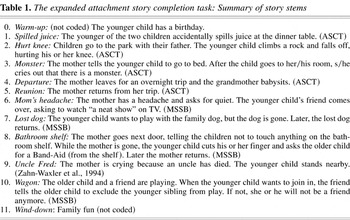
The expanded attachment story completion task: Summary of story stems
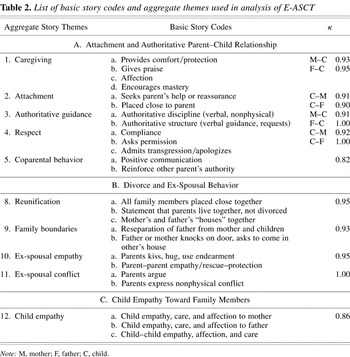
List of basic story codes and aggregate themes used in analysis of E-ASCT
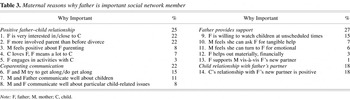
Maternal reasons why father is important social network member
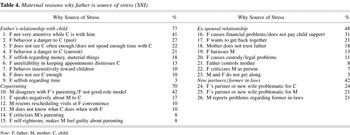
Maternal reasons why father is source of stress (SNI)
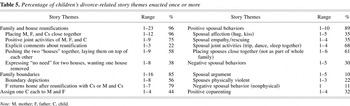
Percentage of children's divorce-related story themes enacted once or more
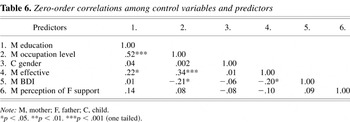
Zero-order correlations among control variables and predictors
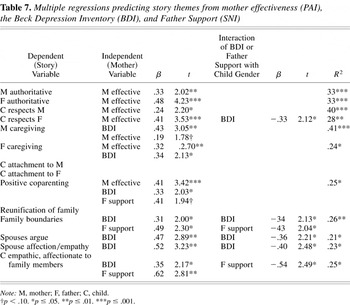
Multiple regressions predicting story themes from mother effectiveness (PAI), the Beck Depression Inventory (BDI), and Father Support (SNI)
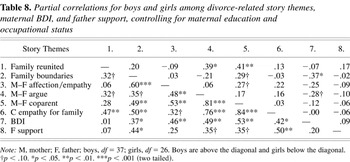
Partial correlations for boys and girls among divorce-related story themes, maternal BDI, and father support, controlling for maternal education and occupational status
 You have
Access
- 25
- Cited by