1 Introduction
The present perfect (PP; have + past participle) has never ceased to be a ‘hot’ topic in English linguistics – be it from a historical, a purely theoretical or an empirical perspective (see e.g. the contributions in Werner, Seoane & Suárez-Gómez Reference Werner, Seoane and Suárez-Gómez2016). We are also not short of comparative analyses that contrast PP and Simple Past (PT) usage in American English (AmE) and British English (BrE; see e.g. Elsness Reference Elsness1997; Schlüter Reference Schlüter2002; Hundt & Smith Reference Hundt and Smith2009). But only lately have we witnessed a surge in corpus-based publications that try to locate a third variety with respect to these two reference varieties (see e.g. Yao Reference Yao2014 for Australian English; Roy Reference Roy2014 for Canadian English) or that address the issue of the PP in varieties of English from a broader perspective (e.g. Davydova Reference Davydova2011; Yao & Collins Reference Yao and Collins2012; Werner Reference Werner2013, Reference Werner2014; Fuchs Reference Fuchs and Werner2016). The latter set of studies provide converging evidence that variety type (first-language vs second-language varieties) as well as text type differences are important determining factors as regards variation between the PP and the PT.
While East African and Black South African English have received some scholarly attention (see Van Rooy Reference Van Rooy2009, Reference Van Rooy and Werner2016), research on the PP in Nigerian English (NigE) is comparatively scarce. This lack of studies, especially of those with a quantitative approach, may be related to the fact that adequate and comparable data for NigE has only become available recently (see section 2). From a more general perspective, the underresearched status of NigE (see Fuchs & Gut Reference Fuchs and Gut2015 for an exception) is surprising in view of the fact that it represents the variety of English in Africa with the highest number of speakers. To our knowledge, at present the only information on the PP and the PT in NigE on which the generation of hypotheses can be based stems from a limited set of sources. The first one is eWAVE (Kortmann & Lunkenheimer Reference Kortmann and Lunkenheimer2013), where it is stated that leveling in terms of PT use for PP, as illustrated in (1) exists, but is rare (rated C), while other nonstandard features in the domain of perfect contexts (apart from the use of the simple present and already as a perfect marker, see section 3.1) are thought to be absent (rated D).Footnote 2
-
(1) Were you ever in Kano? (ewave-atlas.org/sentences/3105)
Other sources containing relevant quantitative findings are Werner (Reference Werner2013; Reference Werner2014: 341; Reference Werner, Seoane and Suárez-Gómez2016; forthcoming), where the data indicate that NigE is a variety with a reduced PP-friendliness (PPF). That is, it shows an overall higher proportion of PT forms, and lower co-occurrence values with the PP in variable contexts (see below). For instance, among the thirteen varieties of English studied in Werner (Reference Werner, Seoane and Suárez-Gómez2016) it emerges as the variety with the second lowest PPF score (only Singapore English has a lower value). However, these results were of a preliminary nature, as only written data were available for these investigations.
In the first study to describe PP usage in NigE in detail, we tackle the issue of the competition between the PP and the PT in this variety with the help of a corpus-based approach. Specifically, patterns in variable contexts and the influence of text types are investigated. The present analysis can therefore also be seen as a contribution toward broadening the scope of other recent studies discussing variation between the PP and PT in varieties of English in general (such as Hundt & Smith Reference Hundt and Smith2009), and we specifically aim at widening the perspective on the variation between the competing time-reference forms (TR forms)Footnote 3 in indigenized varieties of English, also known as ‘New Englishes’ (such as Yao & Collins Reference Yao and Collins2012; Seoane & Suárez-Gómez Reference Seoane and Suárez-Gómez2013; Werner Reference Werner2013, Reference Werner, Seoane and Suárez-Gómez2016). Simultaneously, we offer a contrastive perspective with BrE as the colonial ‘parent variety’ and a discussion of potential linguistic and sociolinguistic factors influencing the PPF of NigE.
The structure of the article is as follows: After some thoughts on data and methodology (section 2), we develop different approaches of how to contrast the PP and the PT in NigE and BrE and further varieties. We proceed from an investigation of temporally specified variable contexts (section 3.1) to an analysis of register effects (section 3.2). In the concluding part (section 4) we discuss, summarize and contextualize the results, and offer potential motivations for the reduced PP rates in NigE as well as some remarks on methodological aspects and areas of further research.
2 Data and methodology
The present study makes use of the recently completed Nigerian component of the International Corpus of English (ICE-NIG; Wunder et al. Reference Wunder, Voormann and Gut2010; Gut Reference Gut2012), which provides the first computer-searchable corpus of NigE freely available for research purposes. ICE-NIG is part of the growing family of ICE components and is compatible with the general layout principles established for ICE (see ice-corpora.net/ice/design.htm). Accordingly, ICE-NIG consists of approximately 1,000,000 words (while the spoken part totals approximately 600,000 words and the written one approximately 400,000 words; see Gut Reference Gut2014 for exact token counts for the individual registers).
One helpful property of ICE is the comparability of its components, which allows us to conduct cross-variety analyses and comparisons with reference varieties. For the present study, data from the British component (ICE-GB) are used as the main point of reference. This choice is motivated by the fact that BrE can be viewed as the colonial ‘parent’ of NigE, so that divergences between the modern forms of these two varieties serve to illustrate differences in the development of variety types. Some caveats apply: note that in practice there are some differences between corpus components (e.g. as to the sampling period), which, depending on the focus of the investigation, may influence results. We submit, though, that the ICE family can still be viewed as state-of-the-art for the corpus-based linguistic study of contemporary worldwide varieties of English (see also contributions in Hundt & Gut Reference Gut2012 or Collins Reference Collins2015), as recent additions such as the Corpus of Global Web-based Englishes (Davies & Fuchs Reference Davies and Fuchs2015) are restricted to cross-variety analyses of electronically mediated communication.Footnote 4
We apply a range of quantitative and qualitative methods to assess the data. As a preparatory step, the corpus data were part-of-speech tagged with the CLAWS tagger (ucrel.lancs.ac.uk/claws; Garside & Smith Reference Garside, Smith, Garside, Leech and McEnery1997), using the CLAWS7 tagset. Subsequently, two types of searches were conducted.
First, we consider variable contexts in terms of instances where both PP and PT can be used without any resulting shift in terms of truth-conditional semantics. Following Hundt & Smith (Reference Hundt and Smith2009: 53) and Yao & Collins (Reference Yao and Collins2012: 398–9), Werner (Reference Werner2013) has shown that a suitable method is to rely on contexts where TR forms appear in combination with indefinite temporal adverbials (also sometimes called ‘± current relevance’ adverbials). This method provides a good approximation and a feasible task for a corpus-based search, as these adverbials serve as adequate indicators for the variable contexts that are tackled.Footnote 5 While indefinite temporal adverbials are typically associated with the PP, they also may occur in combination with the PT without the violation of grammatical constraints (Markus Reference Markus1977: 57; McCoard Reference McCoard1978: 130), as shown in examples (2) to (5).
-
(2) And you never yet said it right. (ICE-GB S1A-027)
-
(3) It's not clear whether the message ever reached President Hussein (ICE-GB S2B-008)
-
(4) I got into this school two thousand and five and since then studied English (ICE-NIG bnew_32)
-
(5) during your service to ANON law agency did you ever come in contact with the property or monies of ANON law chamber (ICE-NIG cr_06)
Previous research (e.g. Quirk et al. Reference Quirk, Greenbaum, Leech and Svartvik1985: 194; Huddleston & Pullum Reference Huddleston and Pullum2002: 143; Miller Reference Miller, Fischer, Norde and Perridon2004: 244; Yao & Collins Reference Yao and Collins2012: 397; see further Elsness Reference Elsness1997) has also shown that the alternation between the forms may be influenced by pragmatic notions such as speaker focus on past or present, and is sensitive to regional and register effects. For instance, AmE has been claimed to be less PP-friendly than BrE in general (Algeo Reference Algeo2006: 26). Therefore, an increased relative frequency of PT tokens (in contrast to BrE) in indefinite contexts as defined above may also be interpreted as a sign of the ‘Americanization’ of a variety.Footnote 6 This tendency has been found to be strongest in informal registers – hence Vanneck's (Reference Vanneck1958) label ‘colloquial preterit’.
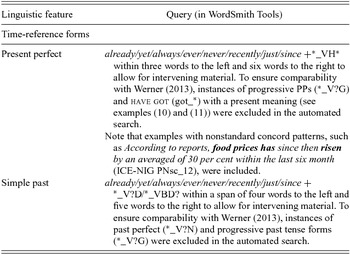
Specifically, for the corpus search for the data analyzed in section 3.1 we focused on combinations of the PP and the PT with a list of indefinite temporal adverbials. To ensure comparability with the results for a set of worldwide varieties of English, which are used as a second point of reference, we opted for using the same software (WordSmith Tools; Scott Reference Scott2011) and a corpus query (see Appendix A) reproducing the one outlined in Werner (Reference Werner2013: 208).Footnote 7 Our list of indefinite adverbials can be categorized into the following:
-
– state/resultative adverbials: already (assertive) and yet (non-assertive);
-
– frequency adverbials:Footnote 8 always (assertive), ever (non-assertive) and never (negative);
-
– time-position adverbials: recently, just and since + X.
Even though it may be argued that examples such as since 1995 refer to a definite point in time in some respect, this group of adverbials generally merits the label ‘indefinite’ as (i) the end of the time period (as a rule, the present) is merely implicitly assumed (Biber et al. Reference Biber, Johansson, Leech, Conrad and Finegan1999: 468) or (ii) the reference to a point in time usually remains vague (cf. definite temporal adverbials such as in 1995). These items were chosen (i) as they represent the most typical adverbials fulfilling the criterion of principal association with the PP as well as potential use with the PT (see above; Algeo Reference Algeo2006: 26), and (ii) to maximize the comparability with earlier studies focusing on British and American English (e.g. Algeo Reference Algeo2006; Hundt & Smith Reference Hundt and Smith2009) or those comparing multiple varieties of English (e.g. Yao & Collins Reference Yao and Collins2012; Werner Reference Werner2013), which also considered all or most of these adverbials.
The corpus query returned a number of false positives, such as instances of since or just with a (potential) non-temporal meaning, as exemplified under (6), or false starts/self-corrections, such as (7) or (8), which did not allow unequivocal categorizations and therefore had to be manually deleted. Tagging errors (potentially due to inaccuracies in the transcription), as shown under (9), occasionally also led to misclassifications, and had to be manually corrected. After these corrections, the dataset comprised a total of 511 examples.Footnote 9
-
(6) Here, we learnt, was the temporary headquarters of our Brigade since Umuagbai was wrenched from us by the enemy. (ICE-NIG nov_06)
-
(7) that was just that's just been presented to us (ICE-NIG btr_03)
-
(8) since its creation Bayelsa state had has had the following chief executives (ICE-NIG btal_26)
-
(9) I I hope youve_VVB [correct: you_PNP ’ve_VHB] never told him anything, have you?! (ICE-NIG nov_04)
We used the data to determine the proportion of co-occurrence with either the PP or the PT for each individual adverbial in each variety. In accordance with Werner (Reference Werner2013: 211; see also Yao & Collins Reference Yao and Collins2012: 393), the co-occurrence value with the PP is labeled ‘PP-friendliness’ (PPF), ranging from 0% (fully PT-friendly) to 100% (fully PP-friendly).
Section 3.2 broadens the analysis and considers the frequency of the PP in different registers of ICE-NIG and ICE-GB, both in terms of normalized frequency per million words (pmw) and as a percentage of all past references under investigation, that is, the percentage of the sum of PP and PT tokens (PP ratio). Thus, further PPF measures complementing the picture from the analysis of variable contexts (see above) are established. We determined the frequency of the PP by searching for a regular expression that matches forms of have followed by a past participle (using the concordancing software AntConc; Anthony Reference Anthony2011) with intervening noun and adverbial phrases (see Appendix A).Footnote 10 Forms of possessive and deontic have got (see (10) and (11), were excluded, as in the first type of search (see Appendix A and above).
-
(10) a man who [. . .] has got a job (ICE-NIG con_02)
-
(11) each of us has got to do it three times (ICE-GB S1A-067)
TR forms involving modal verbs are not matched by the search syntax. This is intentional, as most modal verbs can only occur with the PP, but not the PT. However, we included complex forms such as the present perfect progressive and the present perfect passive for the PP, and the past progressive and past passive for the PT.
A similar search syntax was applied by Hundt & Smith (Reference Hundt and Smith2009) and Yao & Collins (Reference Yao and Collins2012), who found it to be very accurate. We performed random checks on the search results, and determined that the inclusion of the tags UH and FU, for interjections and unclassified words, respectively, increased the recall of the search syntax (lower percentage of tokens incorrectly classified as not being PP) without affecting its precision (similar percentage of tokens correctly classified as being PP). The same search expression has been used previously in Fuchs (Reference Fuchs and Werner2016).
The frequency of the PT was determined by searching for the regular expression ‘V.D.?’, which matched all verbs tagged for past tense. In addition, occurrences of the past perfect are also covered by this search syntax. We therefore searched for all occurrences of the past perfect by adapting the search syntax for the PP, once again following previous research by Hundt & Smith (Reference Hundt and Smith2009), Yao & Collins (Reference Yao and Collins2012) and Fuchs (Reference Fuchs and Werner2016). The actual frequency of the PT was then calculated by subtracting the number of past perfect tokens from the search result for the PT.
In summary, this approach allows us to measure the frequency of the PP in two ways: (i) by dividing the absolute PP frequency by the number of words in that section of the corpus, and (ii) by calculating the PP ratio as the percentage of all references to the past expressed by the PP, i.e. PP ratio = PP/(PP+PT)*100. These measures were calculated independently for all registers included in the two corpora in order to account for stylistic variation in the use of the PP in NigE.
3 Present perfect and simple past
In what follows, we will consider the PP and PT as competing constructions. When speakers and writers want to refer to an event in the past, these are the two main morphosyntactic choices that are available (Biber et al. Reference Biber, Johansson, Leech, Conrad and Finegan1999: 467). While there are other alternatives occurring in perfect contexts, such as the past perfect (Jowitt Reference Jowitt1991: 119), the simple present (as in (12) or (13)) as well as a number of nonstandard surface realizations (as in (14); see Davydova Reference Davydova2011 for other varieties), variation between the two TR forms under discussion is commonly described as the most pervasive one (eWAVE features 99, 100).
-
(12) Mister Speaker honourable colleagues there are precedents all over the all over the place since nineteen nine till date that erm erm councils are at the whims of the governor (ICE-NIG parl_02)
-
(13) since I start work here I didn't get leave (ICE-NIG con_60)
-
(14) actually Togolese football Ø been on the rise for quite some time since qualifying for the two thousand six world cup but then they didn't win any game there (ICE-NIG com_54)
3.1 Variable contexts
As stated above, it is a well-known fact that leveling between the PP and the PT (both PT used for PP and vice versa) occurs in varieties of English (Lunkenheimer Reference Lunkenheimer and Hickey2012). At the same time, it is clear that there are no hard-and-fast rules that specify a preference for one TR form over the other in particular environments, but that the choice between PP and PT is rather a matter of statistical tendency and influenced by various factors (see below). In this section we will show one approach of how to tackle the issue of variation by way of probing variable contexts in the narrow sense, as specified in section 2.
3.1.1 Global perspective
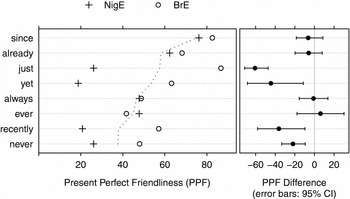
Figure 1 shows the PPF values (left panel) for the individual indefinite temporal adverbials in terms of relative proportions of co-occurrence with the PP in the NigE (crosses) and BrE (circles) data. A PPF value of 60 on the x-axis translates to 60 percent of all tokens of the respective item co-occurring with the PP (and 40 percent with the PT), for instance. The grey dotted curve connects the average PPF values across the set of twelve varieties (based on Werner Reference Werner2013),Footnote 11 and serves as a baseline against which the NigE and BrE values can be compared. The individual items are ordered according to this average PPF descending from the top to the bottom. The right panel of figure 1 shows differences in PPF between the ICE-NIG and the ICE-GB data, and includes 95 percent confidence intervals calculated from absolute token numbers. With the help of these confidence intervals we predict that the actual population value is within their range at a probability of 95 percent. Like above, a value of 40 on the x-axis would translate to a difference of PPF values between NigE and BrE of 40 percent. The closer the dots are to the grey vertical line, the smaller the difference between the two varieties.
PP-friendliness (left panel) of NigE and BrE. The dotted curve shows the average across 12 varieties (values for BrE and average from Werner Reference Werner2013). The right panel shows the PPF difference between the two varieties.Footnote 12

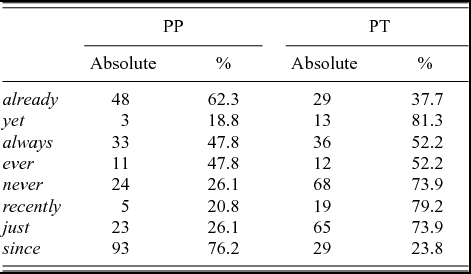
The results displayed in figure 1 confirm the view of NigE as a variety with a reduced PPF, both in contrast to BrE and when the average PPF values across the twelve varieties are taken as a baseline, but also illustrate internal variation (see below). In the micro-perspective that considers the individual adverbials, the NigE values are consistently smaller than the ones found for BrE for all items except ever. A similar picture emerges when the average PPF values across the twelve varieties are taken as a baseline, where the NigE values exceed the average only for always, ever and already. The clear split between BrE and NigE can also be seen from the finding that none of the BrE values falls below the 40 percent level. That NigE has a reduced PPF further becomes clear from the overall PPF value across the eight adverbials (not shown in figure 1) for NigE (41 percent), which is exceeded both by the values for BrE (62 percent) and the average for the twelve varieties (51 percent).
Against the backdrop of an overall reduced PPF in NigE, the patterns for the individual items also show that there is internal variation as their values are by no means uniform. There are merely minor differences between NigE and BrE for some items (since, already and always), while clear (i.e. statistically significant) contrasts in terms of PPF emerge for a set of others (just, yet, never and recently). Ever seems to represent an outlier as it is the only item where the order of PPF values is reversed. However, this difference in PPF between NigE and BrE is still comparatively small and not statistically significant. A similar picture emerges when the average PPF values across the twelve varieties are taken as a baseline, where the NigE values exceed the average only for always, ever and already.
A second result that emerges from figure 1 is that whenever the PPF values for NigE and BrE are close (group 1: since, already, always and ever), they are also close to the average PPF across all varieties. In contrast, whenever they diverge (group 2: just, yet, never and recently), they also diverge considerably from the average PPF. To some extent, the large divergence for group 2 can be explained by the higher variability of the PPF score for these items across all varieties (average SD = 16.7), which reaches twice the value for group 1 (average SD = 8.0). This finding indicates that the PPF values for NigE and BrE in some cases (group 2) are located toward the two poles of the range of values that is available in the system of worldwide varieties of English, while in other cases (group 1), they can be found within the middle of that range, arguably tending toward a more standard(izing) usage.
3.1.2 State/resultativeness adverbials
Some results for a number of individual items merit further comment. While the state/resultativeness adverbials already/yet were analyzed as one group and were globally found to be typical indicators of a PP context in Werner (Reference Werner2013: 217), this view can now be refined with the full ICE-NIG dataset being available. Figure 1 shows that already can indeed count as an item with a high PPF (> 60 percent in both NigE and BrE, and above the value for the average across twelve varieties). That both varieties behave similarly for this item can also be determined by a look at the difference in PPF values, which is small and not statistically significant, as is shown by the overlap of the error bars with the vertical line and the closeness of the respective dot to the vertical line in the right panel of figure 1.
In contrast, the values for yet diverge considerably (by more than 40 percent) and NigE is much less PP-friendly in this variable context. An interpretation of the low PPF value for yet as a sign of Americanization of NigE stands on somewhat shaky empirical grounds, however, for two reasons: ICE-NIG contains only a restricted number of relevant occurrences (n = 16). Thus, we have to be cautious when generalizing from this small sample. In addition, Hundt & Smith (Reference Hundt and Smith2009) have found low PP co-occurrence rates of this item in written AmE, but nearly categorical PP co-occurrence in their spoken corpus data, so we do not have an unambiguous result against which we could compare our findings. As mode appears to be a decisive interacting factor, we would need more corpus data to obtain conclusive evidence. In any case, the two items of this semantic/functional group seem to behave differently and – keeping the limitations mentioned in mind – it may tentatively be argued that the low PPF value for yet is a characteristic feature of NigE. What also may play a part here is that sentence-final occurrences of yet, in standard(izing) varieties typically restricted to PP questions and negative statements (see (15) and (16)), feature in affirmative statements with the PT in NigE (with the meaning ‘still’), as shown in (17).
-
(15) Have you heard from the British Council yet? (ICE-GB W1B-001)
-
(16) I think I'm going to have some diarrhoea but I haven't found the food checks yet (ICE-GB S1A-070)
-
(17) though one thing that – they have in the north is – they have constant power supply – but when you talk of – the setting is very rural – very rural indeed – we were in the headquarters of the local government yet – we needed to go to Hadejia – that's the headquarters of the emirate (ICE-NIG con_06)Footnote 13
The difference in PPF of these functionally related items may further be motivated by the fact that in NigE, similarly to the situation in other varieties (Werner Reference Werner2014: 223, 366–7), already can function as an additional marker of completion (implying ‘before’ or ‘previously’; cf. eWAVE feature 109),Footnote 14 and that use of such markers is in some cases extended to a use as a general perfect marker in PP contexts, also in standard(izing) data of the ICE type. Complexification of this type (‘redundant’ grammatical marking through both morphosyntactic and lexical means or through the use of additional surface variants without any added functional value) has also been found for other features in New Englishes (see e.g. Kortmann & Szmrecsanyi Reference Kortmann and Szmrecsanyi2009: 272–3; Van Rooy Reference Van Rooy, Mukherjee and Hundt2011: 195).
3.1.2 Frequency adverbials
Some internal variation also occurs within the group of frequency adverbials. The right panel of figure 1 shows that PPF differences for always and ever are not pronounced. In NigE, both items are neutral in their preference of either PP or PT and thus follow the pattern established in Werner (Reference Werner2013: 221). In the light of these findings, the NigE example for the illustration of feature 99 in eWAVE (leveling: PT for PP; see section 1), repeated here for convenience as (18), seems an infelicitous choice. Instead of being an example of a nonstandard feature or leveling toward the PT, it should be viewed as illustrative of free variation (see below) between PP and PT.
-
(18) Were you ever in Kano? (ewave-atlas.org/sentences/3105)
As noted above, ever is the only item where the NigE data yields a higher PPF value than the BrE data. However, as indicated in the right panel of figure 1, this difference is negligible. Thus, the long-established variability in co-occurrence patterns for this item (see e.g. Miller Reference Miller, Fischer, Norde and Perridon2004: 244) can be extended to NigE. In contrast to the BrE data, the PPF of the negative variant never is reduced both for the average across the twelve varieties, and even more constrained (< 30 percent) for the NigE data.
3.1.3 Time-position adverbials
Turning to the inhomogeneous group of time-position adverbials, we will first consider just and recently, which express recency. Comparable to the statement in Werner (Reference Werner2013: 225–6), figure 1 shows that PPF values for both adverbials are comparatively high for BrE, while PP use is nearly categorical for temporal just. In contrast, co-occurrence with the PT is clearly preferred in NigE and also still marked in contrast to the reduced PPF value for the average across the twelve varieties for recently, the item that emerges from the analysis with the smallest PPF value overall. Under the assumption of low PPF values as a sign of Americanized usage (see above; cf. Werner Reference Werner2013: 225), the recency adverbials can be seen as a set illustrating this development.
Since (+ X), the continuative temporal adverbial, covers a special position. This item is the one with the highest PPF on average, and differences between BrE and NigE are small. In both varieties, the PPF exceeds 75 percent. That since appears quite removed from the remaining items in figure 1 in terms of the average PPF across all twelve varieties (note the long distance to the second most PP-friendly item already in the dotted grey curve) may also have to do with the fact that since is predominantly used in more formal contexts (see (19)) where a higher co-occurrence rate with the PP is likely.Footnote 15
-
(19) Since the inception of BFHI in 1991, a series of programmes, seminars, workshops and conferences aimed at promoting breastfeeding practices have been organized. (ICE-NIG ASsc_06)
3.1.4 Interim summary
We can conclude that all of the indefinite temporal adverbials in NigE allow for variation between the PP and the PT, although the dispersion of the PPF values is considerable across the analyzed set. While NigE in general is a variety with a reduced PPF, there appears to be no evidence of an unequivocal Americanization in the variable contexts investigated (neither of complete leveling toward the PP for any of the items). Therefore, we suggest that in NigE, as in other varieties, we can assert a situation of free variation between the two TR forms, and different patterns of variability for the individual adverbials (see also Hundt & Smith Reference Hundt and Smith2009; Werner Reference Werner2013). One potential explanation for the latter is register differences (see below), for instance as to the high PPF of since in contrast to the remaining items.
In addition, we can establish the PPF hierarchy shown under (20) for the individual adverbials based on the ICE-NIG data, with the differing hierarchy for BrE under (21).
-
(20) [since > already] > [always, ever] >> [[just, never] > [recently, yet]]
-
(21) [just > since] > [already > yet > recently] > [[always, never] > ever]
Note that the NigE ranking also clearly differs from the one across twelve varieties of English established in Werner (Reference Werner2013: 211), which is testimony to the specificity of NigE. Rather than a continuum, it can best be conceived as a three- or four-way grouping as indicated by the brackets. Since and already form a group that, as in BrE and on average, is clearly PP-friendly, while always and ever are neutral. The remaining indefinite adverbials evidently yield a reduced PPF, or, in other words, are PT-friendly, while two subgroups (below or above 25 percent PPF) may be established among the latter. When we compare these results with the ones from Werner (Reference Werner2013), we find that some associations between items of the same semantic category are equally traceable (e.g. between always and ever), while others (e.g. between just and recently) could not be expected, again supporting the notion of characteristic NigE patterns on this level of analysis.
3.2 Differences between registers
The analysis above has shown that most of the time adverbials studied are less frequently used with the PP in NigE than in BrE. Nevertheless, this analysis considered both varieties as a whole, which leaves open the possibility that in certain registers the PP is less frequent in NigE than in BrE.
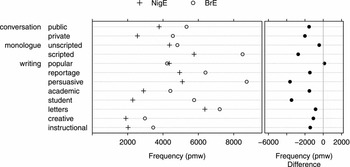
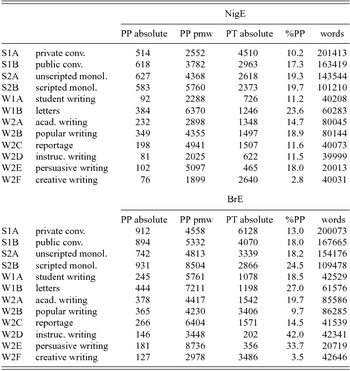
As figure 2 shows (see also Appendix C), when the frequency of the PP is measured per million words (pmw) it is less frequent in NigE than in BrE in all but one register. G² tests (Evert Reference Evert2005: 83–4)Footnote 16 with Holm-Bonferroni correction to control for familywise error rate reveal that this difference is highly significant (p<0.001) in eight out of twelve registers, and significant (p<0.01) in another register. The difference is particularly pronounced in private conversations (second row of figure 2), where the PP is roughly half as frequent in NigE compared to BrE (2,552 vs 4,558 pmw). Conversely, in unscripted monologues (NigE 4,368; BrE 4,813 pmw) and letters (NigE 6,370; BrE 7,211 pmw) the PP occurs only slightly less frequently in NigE than in BrE, and differences are not significant. Popular writing is the only register with a higher PP
Frequency of the PP (per million words) across registers in NigE and BrE. The right panel shows the difference between the two varieties.

frequency in NigE than in BrE, although the difference is not significant (4,355 vs 4,230 pmw, n.s.).Footnote 17
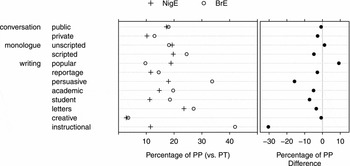
A comparison of the frequency of the PP to the frequency of the PT (PP ratio) shows an overall similar picture (see figure 3). By this measure, too, the PP is less frequent in NigE than in BrE in almost all registers, but the differences are somewhat smaller. In spoken language, the PP ratio is significantly smaller in NigE than in BrE in private conversations (10.2% vs 13.0%, p<0.001) and scripted monologues (19.7% vs 24.5%, p<0.001), while in public conversations the difference is not significant (17.3% vs 18.0%, n.s.). In unscripted monologues, the PP is slightly, and insignificantly, more frequent in NigE than in BrE (19.3% vs 18.2%, n.s.).
Frequency of the PP (vs PT) across registers as a percentage of all past references (PP + PT). The right panel shows the difference between the two varieties.

Differences between the two varieties are more pronounced in some written registers. The most extreme difference occurs in instructional/administrative writing, where the PP ratio in NigE is less than a third than in BrE (11.5% vs 42.0%, p<0.001), and persuasive writing (editorials), where it is around half as high as in BrE (18.0% vs 33.7%, p<0.001). The major exception to this trend is popular writing, where the PP accounts for 18.9 percent of all reference to past events in NigE, but only 9.7 percent in BrE. This is also the only register where the PP is significantly more frequent in NigE than in BrE by this measure (p<0.001).
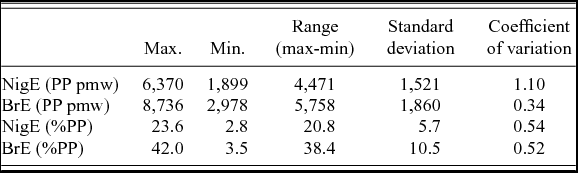
Overall, this seems to suggest that the frequency of the PP is much less register-dependent in NigE than in BrE. Table 1 shows that the range of differences in PP frequency across registers is smaller in NigE than in BrE, both when measuring PP frequency per million words and when measured as a percentage of all references to the past. Moreover, the standard deviation and range of PP frequencies across registers is also smaller in NigE than BrE by both measures. However, the coefficient of variation (defined as the standard deviation divided by the mean), shown in the right-most column in table 1, may be a more reliable measure of register differences given the fact that the PP is much less frequent in NigE compared to BrE. Since the coefficient of variation is almost the same in NigE and BrE for the PP ratio, and substantially larger in NigE than in BrE when the frequency of the PP is measured pmw, we conclude that the frequency of the PP is not more register-dependent in NigE than in BrE.
Style-dependence of the PP measured as difference between highest and lowest frequency in any given register (range), standard deviation, and coefficient of variation of frequencies across registers

4 Conclusion
In the first detailed study of PP usage patterns in NigE, the main focus of the analyses was on the variation between the PP and the PT as the two main options for creating past time reference. In addition, we proposed one way in which NigE can be located relative to BrE, its colonial parent, and other varieties of English. Analyses revealed that the comparison of the PP and the PT yielded complex patterns of variation in various respects.
4.1 Summary discussion
First, we considered variable contexts in terms of co-occurrence patterns of the PP and PT with a set of indefinite temporal adverbials and established present perfect friendliness (PPF) scores (section 3.1). BrE data and the results for a set of worldwide varieties of English served as points of reference. NigE emerged as a variety with lower PPF scores than BrE for all but one item (ever) and also than the average across twelve varieties for all but three items (already, always, ever). In addition, it has to be noted that differences between BrE and NigE were not uniform across all items and that a characteristic hierarchy of PPF could be established for groups of temporal adverbials in NigE. Within this hierarchy, since and already clearly favored the PP, always and ever were flexible in their preference, and the remaining adverbials favored the PT. In the general picture, NigE emerged as a variety with a reduced PPF, but variation between PP and PT could be observed for all contexts. Therefore, we propose that the situation in current NigE can be described as one of free variation with specific NigE patterns being traceable.
The analysis of register differences in terms of (i) the normalized frequency of the PP and (ii) the ratio of the PP compared to the PT (PP ratio) revealed that the general finding of the reduced PPF of NigE (compared to BrE) also holds across most registers. In particular, the analysis of the PP ratio showed that the PP is overall much rarer in NigE when compared to BrE. This also becomes clear when looking at particular registers. Notably, the registers showing the greatest differences between NigE and BrE (administrative/instructional writing and persuasive writing) are those where BrE uses the PP particularly often, also compared to other registers in BrE. Viewed from this perspective, it is not NigE that uses the PP very rarely in these registers (given the average frequency of the PP in NigE), but it rather is BrE that uses it more often than expected (given its average frequency in BrE).
4.2 Sources of the low frequency of the present perfect in Nigerian English
In what follows we discuss possible sources of these patterns and explanations for their occurrence. Specifically, we consider the extent to which (i) an orientation toward BrE or AmE, (ii) substrate influence, (iii) general mechanisms of second language acquisition and (iv) influence from varieties other than Southern BrE might have contributed to the low frequency of the PP in NigE.
The complex situation described in the foregoing may be broadly interpreted in terms of a ‘growing bidialectism [involving] American and British norms’ (Awonusi Reference Awonusi1994: 75) in NigE. However, so far this hypothesis has only been tested in detail for phonological and lexical features (Igboanusi Reference Igboanusi2003; Kperogi Reference Kperogi2015) and still needs further research in the domain of lexicogrammar in order to be universally validated. The present study has provided some evidence supporting Awonusi's statement. To truly determine the actual degree of Americanization of NigE on an empirical basis, and to determine whether (persisting) BrE norms (i.e. tendency toward PP) occur in writing and AmE norms (i.e. tendency toward PT) in speech (as indicated in section 3.2), it would be necessary to have a complete version of the ICE-USA component – which currently is under compilation – as a means of comparison (see also below).
Apart from the competing influences of BrE and AmE on NigE, another explanation for the patterns revealed in the analysis might be expected in substrate influence from Nigerian languages, in parallel to the results of Gut & Fuchs (Reference Gut and Fuchs2013) for the progressive, and Fuchs, Gut & Soneye (Reference Fuchs, Gut and Soneye2013) for the use of focus particles in NigE. If Nigerian languages lacked the morphosyntactic category of perfect, this might have led to substrate influence during the formation of NigE, thus contributing to a decrease in the frequency of the PP in NigE. However, the major Nigerian languages actually have aspect markers for completive aspect (sometimes also called perfective; for Yoruba, see Awoyale Reference Awoyale1991: 200–1; for Hausa, see Aliyu Reference Aliyu1991: 74–7; for Igbo, see Emenanjo Reference Emenanjo1991: 133–4; see section 3.2). Although detailed contrastive analyses are not available, anecdotal evidence indicates that these completive aspect markers can be used in most contexts where the BrE PP would be used.Footnote 18 Even if there are exceptions, it is doubtful whether they could account for the rarity of the PP in NigE. In consequence, it appears that substrate influence cannot explain why the PP occurs less frequently in NigE compared to BrE, in contrast to previous research on other syntactic and pragmatic features where substrate influence is more probable (Gut & Fuchs Reference Gut and Fuchs2013; Fuchs, Gut & Soneye Reference Fuchs, Gut and Soneye2013).
An alternative explanation might be sought in general language learning mechanisms. An extensive body of evidence shows that the PP is a ‘learner-hard’ feature. L2 learners acquire it later than the PT (see e.g. Bardovi-Harlig Reference Bardovi-Harlig1999: 350, Reference Bardovi-Harlig, Han and Tarone2014: 130; Shirai Reference Shirai, Klein and Li2009: 167; Zhang & Widyastuti Reference Zhang and Widyastuti2010: 2–3), and even after successful acquisition of the category of the PP, its frequency remains lower than in the input variety for a considerable amount of time.
This is true even in advanced learners, and regardless of whether a structurally similar category exists in the learners’ L1 (Davydova Reference Davydova2011; Rogatcheva Reference Rogatcheva2014; Fuchs, Götz & Werner Reference Fuchs, Götz, Werner and Werner2016). Previous research has been unable to identify with certainty the reasons for the delayed acquisition of the PP and its low frequency in learner language, but the likely cause appears to be a combination of several factors: (i) its lower frequency in the input compared to the PT, (ii) the fact that references to the past can be (functionally) adequately expressed with the PT (see sections 2 and 3.1), which makes the acquisition and use of the PP functionally ‘superfluous’, and (iii) the relative structural complexity of the PP (auxiliary + past participle) compared to the PT (inflected main verb; see Fuchs, Götz & Werner Reference Fuchs, Götz, Werner and Werner2016 for a more detailed discussion). The fact that the PP is a learner-hard feature might well have contributed to its lower frequency in NigE compared to BrE. However, it is unlikely to be the only factor, given that there are vast differences in the frequency of the PP across New Englishes, that is former or current second-language varieties of English (Werner Reference Werner2014; Fuchs Reference Fuchs and Werner2016).
Another factor that may also have contributed to the low frequency of the PP in NigE is the heterogeneous superstrate that served as its input variety. Nigeria, like many other countries where New Englishes are spoken, was a British colony from the late nineteenth century until its independence in 1960. Some of the colonizers most likely spoke the Southern British standard of the time, with a PP frequency that was higher than in today's BrE (Elsness Reference Elsness1997). However, NigE also received a certain amount of input from non-Southern BrE varieties, specifically Irish English (IrE; see Awonusi Reference Awonusi1986; Kenny Reference Kenny and Kenny2004: 116–21).Footnote 19 Various studies have shown that both in historical varieties of IrE and in present-day IrE the PP is much less frequent than in present-day BrE, mainly due to the fact that a multitude of alternative surface variants have existed (Filppula Reference Filppula1999: 90; Van Hattum Reference Van Hattum2014; Werner Reference Werner2014: 330–4; Fuchs Reference Fuchs and Werner2016). Speakers of IrE may thus have contributed to a heterogeneous superstrate, consisting of varieties with a comparatively high (Standard BrE) and a relatively low frequency of the PP (IrE). In consequence, historical influence from IrE may have contributed to the comparatively low frequency of the PP in NigE, just as in Singapore English (Davydova Reference Davydova, Duarte and Gogolin2013).
While IrE has arguably influenced NigE in its formative period in the nineteenth century and perhaps the early twentieth century (Gut Reference Gut, Kortmann and Schneider2004: 814–15), later influence from AmE could have further, and on a smaller scale, contributed to the low frequency of the PP. In the 1960s, hundreds of American Peace Corps volunteers stayed in Nigeria (Awonusi Reference Awonusi1994: 76). Even though models of the genesis of postcolonial varieties of English attribute greater importance to the input that was available during the formative period of a new variety (the ‘founder effect’; see Mufwene Reference Mufwene1996; Trudgill Reference Trudgill2004) – and, therefore, later influence might have been relatively modest – the impact of AmE as modern global ‘hub’ (Mair Reference Mair2013: 260), potentially influencing all other varieties of English through various channels, cannot be discounted.
In summary, while substrate influence cannot account for the relatively low frequency of the PP in present-day NigE, a mix of forces in terms of a combination of (i) general learning strategies in the second-language acquisition of tense and aspect, and (ii) the heterogeneous superstrate, with a significant input from IrE and potential later and continuing influence from AmE, might provide a viable explanation for the partly ‘Americanized’ (that is, less PP-friendly) patterns of this variety.
4.3 Outlook
On a more general note, we hope to have shown what can be gained (i) from working with carefully compiled and highly structured corpus data as offered by ICE-NIG and (ii) from assessing these data by way of a variety of (mostly) quantitative approaches and related visualizations. We are aware that it has become a truism in linguistics that the explanatory power of analyses greatly benefits from using multiple methodologies and comparing various types of measurements (of PPF, in our case). Nevertheless, we would like to emphasize that this is the sole route to approximate a complete picture (however idealized that may be). We illustrated this approach in the present study by applying dot plots as an alternative to more traditional bar charts and related statistical calculations to explore frequency data for specific contexts and registers, establishing three types of PPF measurement. A complementary perspective to be taken is a global comparison of multidimensional data as developed in Werner (Reference Werner, Seoane and Suárez-Gómez2016).
We do not, however, claim to have exploited all options and are also well aware that a look at additional corpus data (e.g. the Nigerian section of GloWbE; Davies & Fuchs Reference Davies and Fuchs2015) and other data types (e.g. in the form of a questionnaire study with elicitation tasks or through observation; see e.g. Adejare Abonego Reference Adejare Abonego2014) as well as an in-depth consideration of potential effects of substrate languages beyond the aspects mentioned above will provide further valuable insights. Our analysis has further shown that an expansion of the empirical basis would be highly desirable for the further investigation of low-frequency items such as yet. Another aspect largely neglected in the present study (but see section 3.1) was forms other than the PP and the PT that may occur in perfect contexts. As some of these (e.g. present tense for present perfect of the type I come here since three months; see examples (12) and (13) above) are described as non-marginal features of NigE (eWAVE feature 101), they constitute an area where future studies may be well worth pursuing.

For section 3.2
(Format: One line per word form, with word form, lemma and parts of speech tagseparated by tabs)

Absolute and relative frequencies for PP/PT co-occurrence with indefinite temporal adverbials in ICE-NIG

Frequency of the PP and PT in NigE and BrE