More than a century has passed since the fictional Mr. Dooley declared in his rich Irish brogue that “The Soopreme Court follows the illiction returns,” but until now no hard evidence has existed of just how fixated the Court is on presidential elections [but see Flemming and Wood 1997; Mishler and Sheehan 1993]. Fortunately, now we have proof positive, which we serendipitously unearthed from its resting place in the Library of Congress, where it was entombed deep in the personal papers of Justice Harry Blackmun.
The smoking gun is a four-page tally sheet that Chief Justice William Rehnquist circulated to five of his Court colleagues on Thursday, November 5, 1992, two days after the presidential election. (A page of the tally sheet is reproduced in Figure 1.) On what the Chief described as this “rather lucid summary” were inscribed state-by-state forecasts of the election outcome that had been submitted by six members of the Court—Rehnquist himself (“CJ” on the tally sheet), Blackmun (“HAB”), John Paul Stevens (“JPS”), Sandra Day O'Connor (“SOC”), Anthony Kennedy (“AMK”), and Clarence Thomas (“CT”)—along with a payoff matrix. Rehnquist, it turns out, was engaged in an activity familiar to most Americans but hitherto not recognized as one of the functions that a Chief Justice is supposed to perform: running an office pool.1
Although Rehnquist circulated the memo, we do not know who actually drafted the tally sheet—presumably not Rehnquist, given his flattering description of it. Was it thus the work product of a clerk or some other Court employee? That hardly seems likely, for delegating oversight of a gambling operation to an underling could easily foster an appearance of impropriety—hardly an impression that one as famously fastidious as Rehnquist would have been eager to create.
Mr. Dooley was literally correct: the Supreme Court does follow the election returns.
Page 2 of the 1992 Presidential Election Tally Sheet
The 1992 pool is the only direct evidence we have of the justices' election night fun, though rumors persist that the election pool is a quadrennial favorite of the justices. But that single pool provides a unique opportunity to explore the justices' political acumen in one of their favorite pastimes. Who bets, who wins, and who loses? And what are the consequences for the Court—and for the rest of us?
Placing Bets
Wagering, it appears, is a routine feature of life on the Court. From betting on how much snow has fallen on the Court steps to participating in a monthly penny-ante poker game, a Washington Post reporter has observed that it “seems that they'll bet on just about anything up at the U.S. Supreme Court” (Mulligan 1987; see also Kennedy 2003; Nusbaum 2003; Taylor 1988). Among the justices, Rehnquist is reputed to be the Court's most enthusiastic gambler. Indeed, one participant in his monthly poker sessions has noted that “The Chief Justice really keeps everybody moving fast. If people start telling jokes and talking politics and things like that, he says, ‘Come on, let's move things along and play poker and stop the folderol’” (Taylor 1988).2
Notwithstanding Rehnquist's focus on the game, business does sometimes come first. One regular participant in the monthly poker game complained: “Every time you play, the phone rings about 10 p.m. with a death-penalty appeal, and Rehnquist and Scalia go off to confer” (Eisler 1996).
Although the Chief organized the 1992 election pool, Justices Byron White, Antonin Scalia, and David Souter all recused themselves. Why? White, an erstwhile All-American and professional athlete, may have been schooled in the necessity of avoiding associations with gamblers;3
An alternative hypothesis would be that White didn't enter the pool because he didn't need the money. In 1938, he had the most lucrative contract in the history of the National Football League. Unfortunately for his heirs, though, his salary for the season—$15,800—was a pittance by today's standards.
Scalia, a strict constructionist, may have been dissuaded by a recognition that gambling on the outcome of “contests” is illegal in the District of Columbia;
4 Section 22-1708 of the District of Columbia Official Code holds that “It shall be unlawful for any person, or association of persons, within the District of Columbia to purchase, possess, own, or acquire any chance, right, or interest, tangible or intangible, in any policy lottery or any lottery, or to make or place a bet or wager, accept a bet or wager, gamble or make books or pools on the result of any athletic contest. For the purpose of this section, the term ‘athletic contest’ means any of the following, wherever held or to be held: a football, baseball, softball, basketball, hockey, or polo game, or a tennis, golf, or wrestling match, or a tennis or golf tournament, or a prize fight or boxing match, or a trotting or running race of horses, or a running race of dogs, or any other athletic or sporting event or contest. Any person or association of persons violating this section shall be fined not more than $1,000 or imprisoned not more than 180 days, or both.” Whether a presidential election is considered a “sporting event or contest” is a matter of statutory interpretation, meaning that the Court itself would have the last say on that subject. Alternatively, Justice Scalia may simply prefer to save his spare change for his favorite game—poker (Shipp 1986; Eisler 1996; Geracimos 1998; Grove 2001).
and Souter, who lives a sheltered life, may not even have realized that a presidential campaign was going on.
The six members of the Court who did participate in the pool each anted up $1 on whether Bill Clinton or George H. W. Bush would win each of the 50 states and the District of Columbia—a commitment of $51 per justice. The rules were simple. Every justice who correctly predicted the winner in a state would share equally in the $6 pot for that state. Thus, if all six justices got the winner of a particular state right, each would receive $1. If the bench was divided on a state's outcome, the money wagered would be split among those correctly forecasting the result. For example, as shown in Figure 1, Justice Thomas and the Chief incorrectly predicted that President Bush would carry Kentucky. As a result, the four justices who correctly predicted that Clinton would win Kentucky each earned $1.50 on that outcome.
Who Won?
Justice O'Connor was the big winner in the pool; as the Chief put it in the cover memo that accompanied the results, “The net result is that Sandra has won $18.30, Harry has won $1.70, John and I have lost $6.30, Tony has lost $2.30, and Clarence has lost $5.10.” That affirmed the widely held impression that O'Connor, the reputed swing voter on the Court, has sharper political instincts than any of her fellow justices.
To help us understand this outcome, we used the scientific method5
The scientific method consists of five steps:
- Carefully examine the data and take note of any clear-cut patterns therein.
- For each such pattern, formulate a hypothesis that you can test statistically.
- To avert suspicion, throw in a couple of extra hypotheses that you know are wrong.
- Using the data from Step 1, test these hypotheses statistically.
- Based on the results of Step 4, proclaim that your main hypotheses have been upheld.
to determine whether forecasting success was related to:
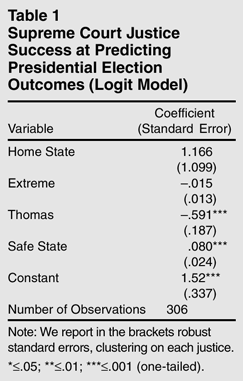
- A justice's general attentiveness to the news, the idea being that accurate forecasting depends on solid information. The key to testing this hypothesis is Justice Thomas, who “reads no morning newspaper; he canceled his subscription to the Washington Post, and no longer reads the Washington Times either. He rarely watches TV news, depending largely on his assistants and friends for verbal news briefings” (Fisher 1995). According to Thomas's close friend Paul Weyrich, “When I mention to him things in the news, he just evidences no knowledge of it. He's just totally unaware of news events” (Fisher 1995). To be sure, Thomas does listen to Rush Limbaugh—“one of his few mass media sources” (Fisher 1995)—but his disinclination to keep abreast of the news prompted us to create a dummy variable (THOMAS) distinguishing his forecasts from those of the other pool participants.6
That Thomas would even participate in gambling seems surprising, given his general aversion to risk-taking. For example, although he delights in cruising I-66 in his black Corvette IROC, he never exceeds the speed limit; in the words of a friend, “He drives like a turtle” (Fisher 1995).
- The justice's first-hand familiarity with the political dynamics of a state. To test this hypothesis, we created a dummy variable (HOME STATE) indicating for each observation whether the justice in question had grown up, attended school, or practiced law in the state (Epstein, Segal, Spaeth, and Walker 1996, Tables 4–2, 4–4, 4–6).
- The justice's ideological extremism, the idea being that a moderate would be less reluctant than an extremist to project the candidate he or she did not favor as the winner of a state. To test this hypothesis, we determined the relative frequency with which a justice had voted on the liberal side in cases that came to the Court before the 1992 term (Spaeth 1999), and used the absolute difference between that number and 50 to gauge his or her ideological extremity (EXTREME).
- The political competitiveness of the state. The more dominant either the Democrats or the Republicans had been in a state, the easier it should have been for a justice to forecast the 1992 outcome for that state. To create a SAFE STATE variable, we subtracted 50 from the winning candidate's vote share in the state in the 1988 presidential election.
Of the justices' 306 predictions,7
The six participating justices made 51 forecasts apiece, resulting in 306 predictions.
261 (85%) proved correct.
Table 1 indicates that two of the four hypotheses were borne out. The significant SAFE STATE coefficient means that, as expected, the wider the margin by which a state went for Bush or Dukakis in 1988, the easier it was for the justices to predict the outcome there in 1992; indeed, the justices were 23% more prescient in states with landslide electoral results in 1988 than they were in other states. The THOMAS dummy variable also registered a significant effect, with Thomas's colleagues on the bench being 10% more likely to call a race correctly than he was,
ceteris paribus; clearly, bets made by a justice who relies on Rush Limbaugh for his news are less accurate than those cast by a more typical justice. The other two hypotheses were not borne out—par for the course, given our adherence to step 3 of the scientific method (see footnote 5).
Should We Care that Justices Gamble?
Evidence of gambling on the Court raises questions about the propriety and broader significance of the justices' behavior. To be sure, friendly bets are commonplace among politicians.8
And our fellow social scientists enjoy no immunity from this malady. Some have even written how-to manuals on election forecasting (Fair 2002; Lewis-Beck and Rice 1992), and others have gone to the extreme of maintaining a web site for the explicit purpose of enabling gambling on election outcomes (www.biz.uiowa.edu/iem).
For example, before a 2003 NFL playoff game between the Green Bay Packers and Philadelphia Eagles, the governors of Pennsylvania and Wisconsin wagered Philly cheese steaks versus brats and cheese on the outcome (“State Foods Wagered In Playoff Bets”
2004). Surely the justices are entitled to share in the fun.
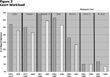
Although it is tempting to excuse gambling on the U.S. Supreme Court as a harmless diversion from the grim, life-and-death business that the justices are called upon to consider, the issue is not nearly that clear-cut. The business consulting firm of Challenger, Gray, & Christmas has estimated that office pools cost U.S. employers billions of dollars per year in lost worker productivity (Dybis 2004). With that in mind, Figure 2 charts the number of signed opinions that the Court issued during the last seven presidential election cycles. The solid bars show opinions during the three years preceding the election, while the striped bars show opinions during the presidential election year, when the justices (with the obvious exception of Clarence Thomas) were preoccupied with cramming for the office pool. Clearly, the Court's productivity sags during election years. Skeptics may dismiss this as a coincidence, but closer examination of Figure 2 suggests otherwise. For one thing, the only time there was no productivity dropoff was 1996—an exception that helps prove the rule, because forecasting the 1996 outcome couldn't have been very time-consuming, given Bob Dole's stillborn candidacy. Moreover, the largest productivity decline occurred in 2000— hardly surprising, given the obvious difficulty of accurately forecasting such a tight race. Finally, note the sharp decline in productivity since Rehnquist's elevation to Chief Justice, consistent with his proclivity for getting his colleagues involved in gambling operations.
Of course, some might say that having this Supreme Court decide fewer cases would not be such a bad thing. Still, there are other reasons for concern. For example, having the Court rule on cases that involve gambling (e.g., Chickasaw Nation v. United States 2001) is like assigning a fox to guard the henhouse. Likewise, if the Court were ever called on to pass judgment in a case that could decide a presidential election—a remote, science-fiction scenario,9
For other social science-fiction fictions, see Polsby (1982).
of course—justices who had their money and their pride riding on the outcome might be swayed. Fortunately, we can be reassured (or can we?) by Justice Scalia's comment that “If it is reasonable to think a Supreme Court Justice can be bought so cheap, the nation is in deeper trouble than I had imagined” (
Cheney v. United States District Court for the District of Columbia 2004, 20).
Finally, the outcome of the pool may influence the justices' sociability. During an election night party in 2000, Justice O'Connor apparently became upset when CBS anchor Dan Rather called Florida for Vice President Gore. She exclaimed, “This is terrible!” and then proceeded, “with an air of obvious disgust,” to walk off to get a plate of food (Thomas and Isikoff 2000). Speculation abounded at the time about why O'Connor was so distraught,10
O'Connor's husband told the guests at the party that she was upset because she had been planning to retire and a Gore presidency meant she would have to wait another four years because she did not want a Democrat to name her successor. Given that O'Connor went and got a plate of food immediately after her outburst, we think it is unlikely she was merely complaining about her host's cooking.
but our revelation of the operation of a Supreme Court gambling ring opens up a new possibility: If, as she had done in 1992, O'Connor predicted that Florida would go Republican in 2000 (an outcome she subsequently helped to assure), then her outburst probably stemmed from dismay at the prospect of falling behind in the election pool.
Should the justices cease and desist from gambling? As mere empiricists, we are ill-equipped to address this normative question. Perhaps William J. Bennett, an acclaimed arbiter of America's moral values, could be persuaded to address this question in the next edition of his Book of Virtues (1993)— though the fact that Mr. Bennett regularly lays his royalties on the line in a poker game with Justice Scalia and Chief Justice Rehnquist (Kennedy 2003) may lead some cynics to question his moral authority on this issue.
Should Political Scientists Write Articles Like This?
Finally, should we, as political scientists, really be devoting ourselves to the collection, analysis, and distribution of information that some might disparage as gossip best suited for the “Drudge Report?”
We consider our research an important public service, for we are providing information that citizens want and need. Consider the following: Woodward and Armstrong's (1979) The Brethren, a tellall, behind the scenes, gossip-filled page-turner about the Court, was a #1 national bestseller. Maltzman, Spriggs, and Wahlbeck's (2000) Crafting Law on the Supreme Court, a theoretically sophisticated and impeccably researched social scientific analysis of decisionmaking on the Court, is currently languishing at #1,152,180 on the Amazon. com sales list. QED.