Introduction
The lichenized fungus genus Bryoria Brodo & D. Hawksw. (Parmeliaceae) consists of c. 70 filamentous, much-branched species, most of which are epiphytic and greyish, brownish or blackish in hue. While most Bryoria species have their centres of diversity in boreal-arctic regions, a few occur in the southern Appalachians in North America and in mountainous regions of South-East Asia, Australasia and Africa (Brodo & Hawksworth Reference Brodo and Hawksworth1977; Thell et al. Reference Thell, Crespo, Divakar, Kärnefelt, Leavitt, Lumbsch and Seaward2012).
Species delimitation in Bryoria has often proved challenging, owing in part to extreme morphological plasticity, but also, in many cases, to a general absence or scarcity of fungal sexual fruiting structures (Brodo & Hawksworth Reference Brodo and Hawksworth1977). Recent studies in other Parmeliaceae genera have shown that molecular data are essential for assessing species boundaries in groups with a high level of phenotypic homoplasy (see Divakar et al. Reference Divakar, Kauff, Crespo, Leavitt and Lumbsch2013). In some groups available data have shown morphological variation is not linked to genetic variability, while in other groups phenotypically cryptic or semi-cryptic species have been discovered within morphologically more or less uniform species (Leavitt et al. Reference Leavitt, Johnson and St. Clair2011; Molina et al. Reference Molina, Del-Prado, Divakar, Sánchez-Mata and Crespo2011; Alors et al. Reference Alors, Lumbsch, Divakar, Leavitt and Crespo2016; Mark et al. Reference Mark, Saag, Leavitt, Will-Wolf, Nelsen, Tõrra, Saag, Randlane and Lumbsch2016). Additionally, DNA based phylogenies have been helpful in identifying suitable morphological and chemical characters for species delimitation (Divakar et al. Reference Divakar, Figueras, Hladun and Crespo2010; Truong et al. Reference Truong, Divakar, Yahr, Crespo and Clerc2013; Ferencova et al. Reference Ferencova, Cubas, Divakar, Molina and Crespo2014).
The first essentially modern treatment of the genus Bryoria appeared in 1977 under the title ‘Alectoria and allied genera in North America’ (Brodo & Hawksworth Reference Brodo and Hawksworth1977). Now widely regarded as a classic work of lichenology, this monograph effectively laid the groundwork for our present understanding of Bryoria and other Alectorioid lichens worldwide, with special emphasis on secondary chemistry.
More recently, Bryoria has been subject to ongoing re-evaluation using molecular methods (Velmala et al. Reference Velmala, Myllys, Halonen, Goward and Ahti2009, Reference Velmala, Myllys, Goward, Holien and Halonen2014; Myllys et al. Reference Myllys, Velmala, Holien, Halonen, Wang and Goward2011, Reference Myllys, Velmala, Lindgren, Glavich, Carlberg, Wang and Goward2014). While these studies have contributed to a deeper understanding of relationships in the genus, the taxonomy of Bryoria is still hardly settled. In part this is owing to low phylogenetic resolution and/or support for certain critical clades (Velmala et al. Reference Velmala, Myllys, Goward, Holien and Halonen2014), but it is also the case that a number of distinctive species still remain to be described. The purpose of the present contribution is to provide formal descriptions for two Bryoria species in light of our recent field and laboratory studies.
Materials and Methods
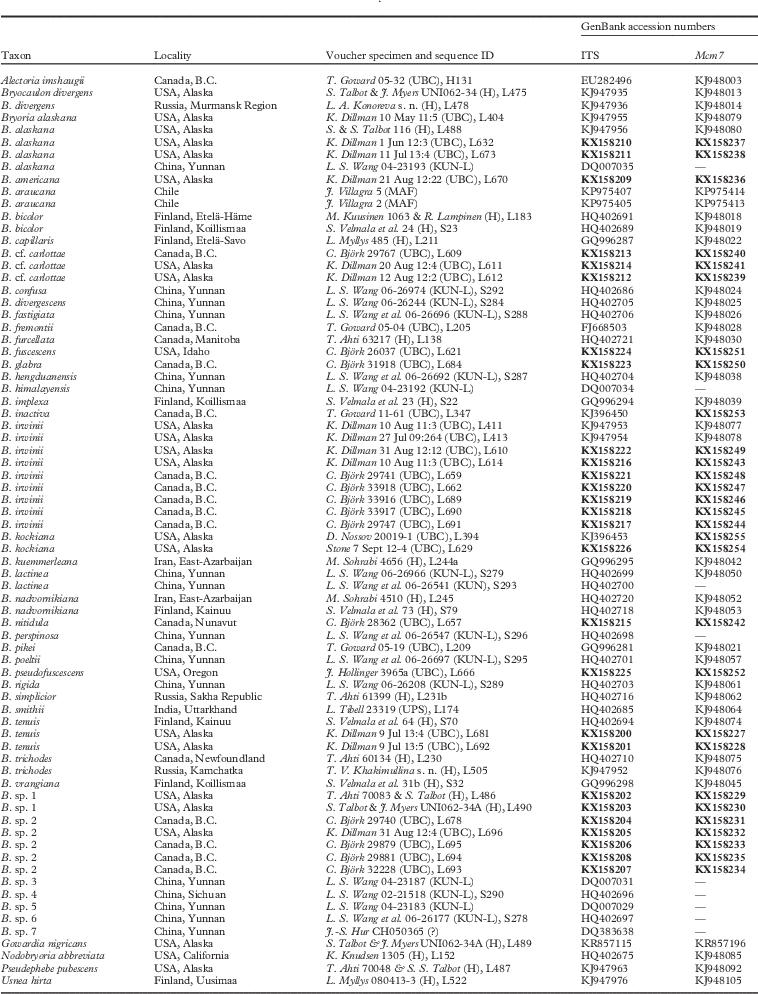
Our study comprised 74 specimens (Table 1), including 40 ingroup taxa selected as representatives of the five Bryoria sections recognized by Myllys et al. (Reference Myllys, Velmala, Holien, Halonen, Wang and Goward2011). All specimens recently collected from the USA and Canada were examined under a dissecting microscope and tested for secondary compounds with thin-layer chromatography (TLC) using solvents A and B (Orange et al. Reference Orange, James and White2001). Voucher specimens are deposited in H and UBC.
Specimens used in this study with locality, voucher information and GenBank accession numbers. Sequences generated for this study in bold
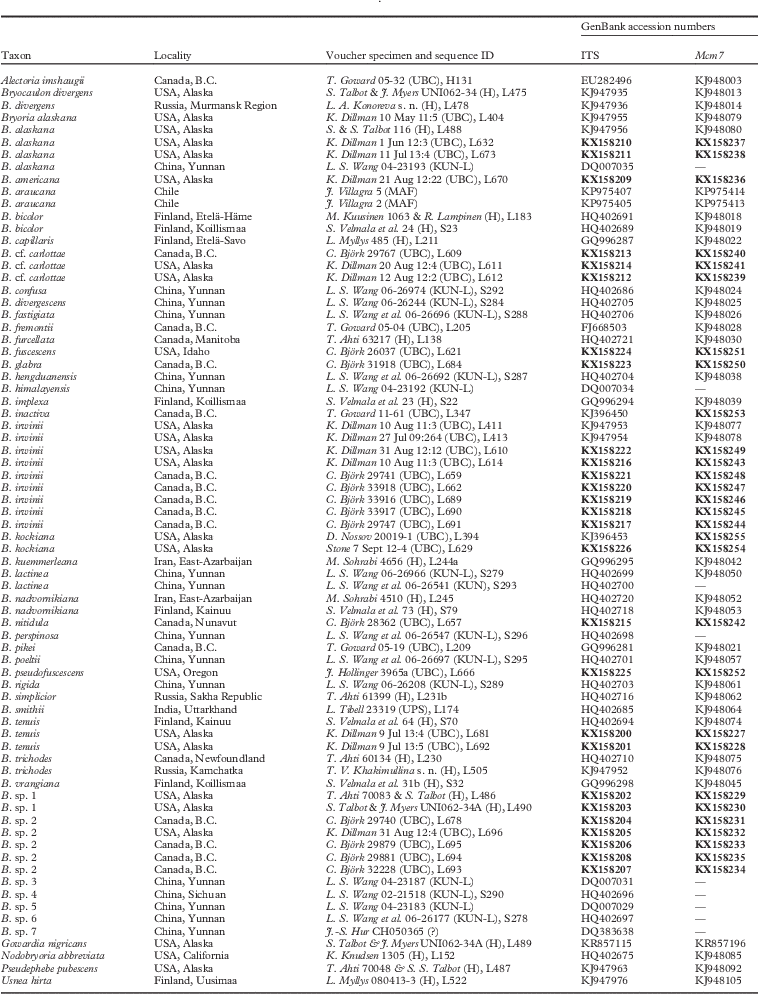
Total genomic DNA of the freshly collected material was extracted using the methods described in Myllys et al. (Reference Myllys, Velmala, Holien, Halonen, Wang and Goward2011). Sequences from two loci were generated for this study: the complete nuclear ribosomal internal transcribed spacer region (ITS), and c. 0·6 kb of the minichromosome maintenance protein 7 gene (Mcm7). PCR for ITS regions was performed under conditions described in Myllys et al. (Reference Myllys, Velmala, Holien, Halonen, Wang and Goward2011), while PCR of Mcm7 followed the procedure described in Schmitt et al. (Reference Schmitt, Crespo, Divakar, Fankhauser, Herman-Sackett, Kalb, Nelsen, Nelson, Rivas-Plata and Shimp2009). The PCR products were cleaned and sequenced by Macrogen Inc. (www.macrogen.com).
We generated 27 ITS sequences and 29 Mcm7 sequences from 29 specimens. The rest of the sequence data were obtained from the National Center for Biotechnology Information (NCBI) database (http://www.ncbi.nlm.nih.gov) and originated mostly from our previous studies (i.e., Myllys et al. Reference Myllys, Velmala, Holien, Halonen, Wang and Goward2011, Reference Myllys, Velmala, Lindgren, Glavich, Carlberg, Wang and Goward2014). Our DNA sequences of the ITS regions and a partial Mcm7 gene region were aligned separately with MUSCLE v.3.8.31 (Edgar Reference Edgar2004) using EMBL-EBI’s freely available web service (http://www.ebi.ac.uk/Tools/msa/muscle/). Phylogenetic relationships were inferred using maximum parsimony and maximum likelihood as optimality criteria. The single gene trees did not show any strongly supported conflicts according to the method of Kauff & Lutzoni (Reference Kauff and Lutzoni2002) (≥75% bootstrap values) and the two matrices were combined into a concatenated matrix in MacClade 4.08 (Maddison & Maddison Reference Maddison and Maddison2005). Usnea hirta (L.) F. H. Wigg. from the Usneoid clade (see definition in Thell et al. Reference Thell, Crespo, Divakar, Kärnefelt, Leavitt, Lumbsch and Seaward2012) was used as an outgroup taxon. Representatives of the genera Alectoria Ach., Bryocaulon Kärnefelt, Gowardia Halonen et al., Pseudephebe M. Choisy, and Nodobryoria Common & Brodo from the Alectorioid clade sensu Divakar et al. (Reference Divakar, Crespo, Wedin, Leavitt, Hawksworth, Myllys, McCune, Randlane, Bjerke and Ohmura2015) were included in the analysis to test the monophyly of the ingroup. Maximum likelihood analysis was performed with RAxML v.8.1.15 (Stamatakis 2014) assuming a GTRGAMMA model. The combined data set was analyzed using two different partition approaches: 1) assigning four partitions, ITS as a single partition and each of three codon positions of Mcm7; 2) assigning seven partitions, ITS1, 5.8S, ITS2 and each of three codon positions of Mcm7. Both analyses yielded trees with the same topology. Node support was estimated with 1000 bootstrap replicates using the rapid bootstrap algorithm. Parsimony analysis was performed in TNT version 1.1 for Windows (Goloboff et al. Reference Goloboff, Farris and Nixon2008) using the option Traditional Search with the following settings: random addition of sequences with 100 replicates and TBR branch swapping algorithm. Ten trees were saved for each replicate. The bootstrapping method as implemented in TNT was used with 1000 replicates to estimate node support.
Based on the combined ITS+Mcm7 data set with 65 terminals, the new species occurred in two different lineages in the phylogenetic tree. We further examined the phylogeny of these lineages with extended taxon sampling and performed two separate analyses using the ITS sequences already included in the combined analysis completed with the ITS sequences, for which Mcm7 data were not available (see Table 1). The following data sets were analyzed: 1) 18 specimens from section Bryoria and one specimen of B. americana (Motyka) Holien from section Americanae, with B. fremontii (Tuck.) Brodo & D. Hawksw. from section Tortuosae as an outgroup taxon; 2) 21 specimens from section Bryoria. Bryoria glabra (Motyka) Brodo & D. Hawksw. from section Implexae was used as outgroup. Sequence alignments and phylogenetic analyses were performed as above for the combined data set. The alignments have been deposited in TreeBASE (submission ID 19175).
Results and Discussion
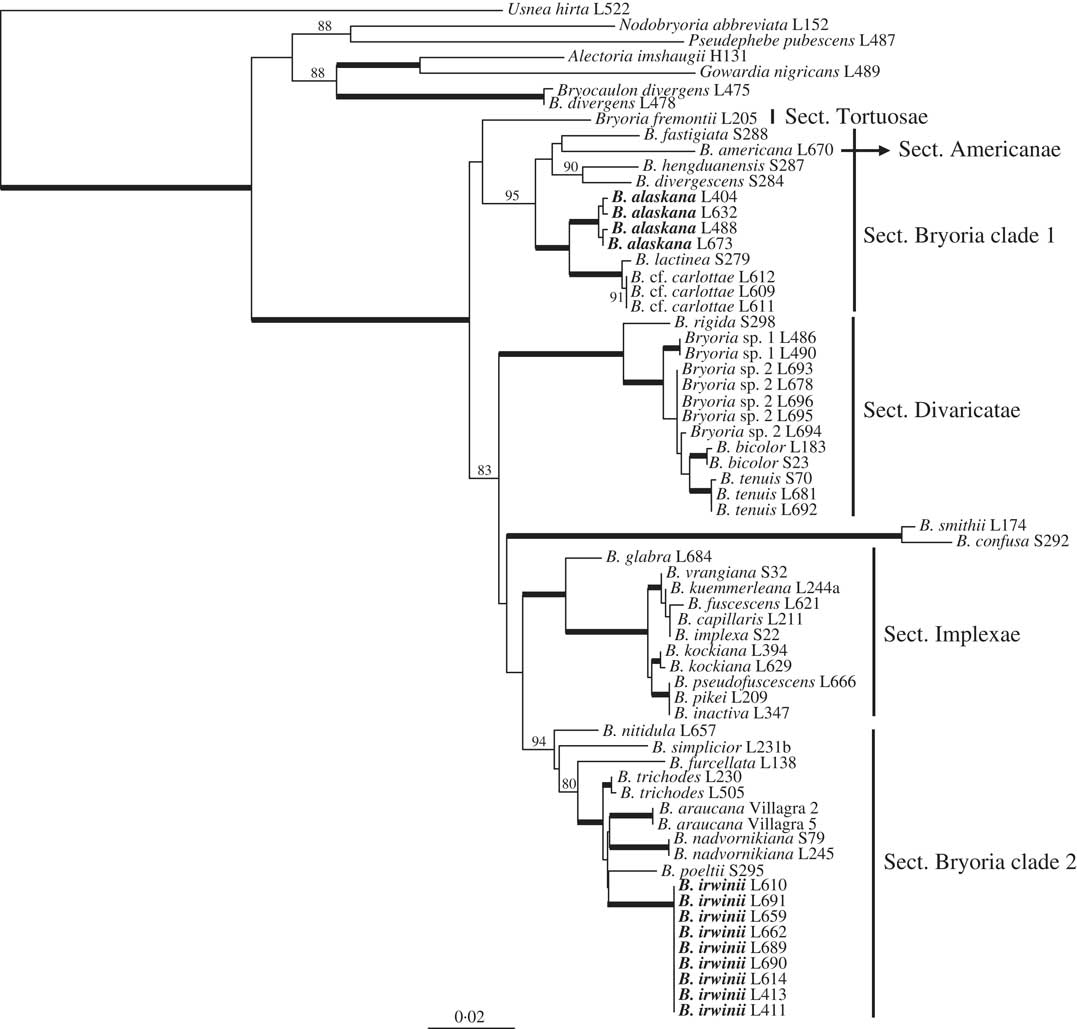
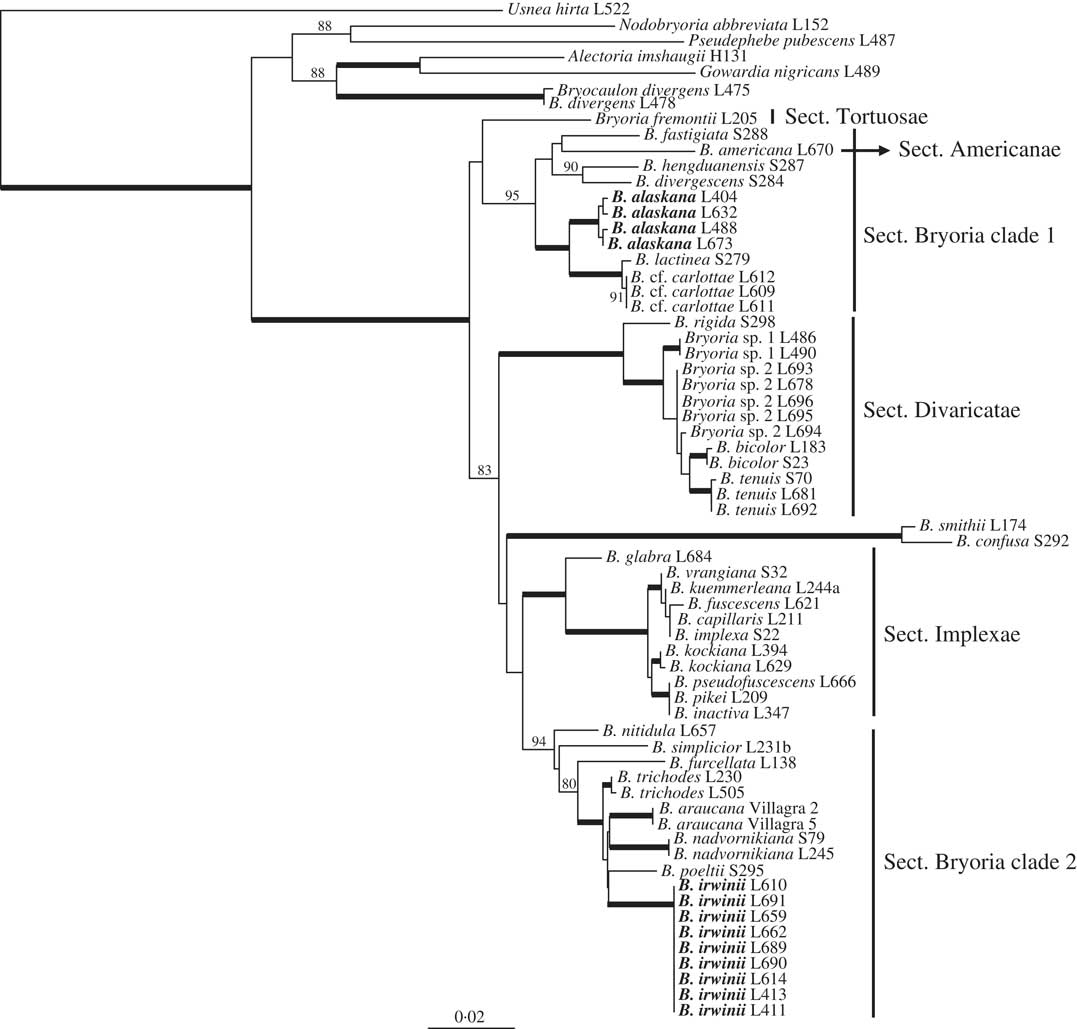
Since the topologies of the maximum likelihood and parsimony analyses did not show any strongly supported conflicts, only the trees obtained from the maximum likelihood analyses are shown (Figs 1–3). The phylogeny obtained from the combined ITS+Mcm7 data set mostly agrees with that already presented in our previous studies (Myllys et al. Reference Myllys, Velmala, Holien, Halonen, Wang and Goward2011, Reference Myllys, Velmala, Lindgren, Glavich, Carlberg, Wang and Goward2014) and will not be discussed here in detail (see Fig. 1). We note, however, that in none of our phylogenies did Bryocaulon divergens group with Bryoria, contrary to Miadlikowska et al. (Reference Miadlikowska, Kauff, Högnabba, Oliver, Molnár, Fraker, Gaya, Hafellner, Hofstetter and Gueidan2014). Furthermore, the monophyly of section Bryoria as defined by Myllys et al. (Reference Myllys, Velmala, Holien, Halonen, Wang and Goward2011) could not be recovered in our analysis. As a result, the two subclades previously recognized in this section must now be kept separate and are referred to here as section Bryoria clade 1 and section Bryoria clade 2. Bryoria clade 1 also includes a monotypic section Americanae and forms an unsupported sister group with B. fremontii, while Bryoria clade 2 is most closely related to section Implexae. The non-monophyly most probably stems from the different combination of the gene regions used: in Myllys et al. (Reference Myllys, Velmala, Lindgren, Glavich, Carlberg, Wang and Goward2014) section Bryoria was paraphyletic in the tree obtained from ITS+Mcm7 data, while in the ITS+GAPDH+Mcm7 tree it was recovered as monophyletic (though without any support). Clearly more than two loci are needed to reliably resolve the infrageneric relationships of the genus.
Phylogenetic position of Bryoria alaskana sp. nov. and B. irwinii sp. nov. (shown in bold). A maximum likelihood phylogram obtained from RAxML analysis based on the combined ITS and Mcm7 data set. Branches supported with bootstrap values ≥75% in both analyses (RAxML and TNT) are indicated in bold. Bootstrap values ≥75% only supported in maximum likelihood analysis are shown above nodes.
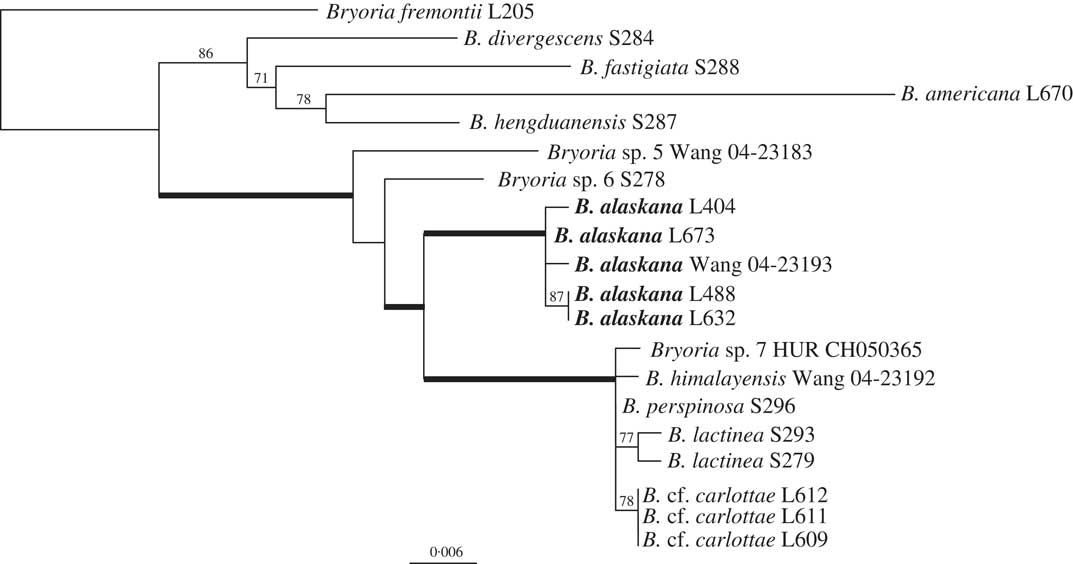
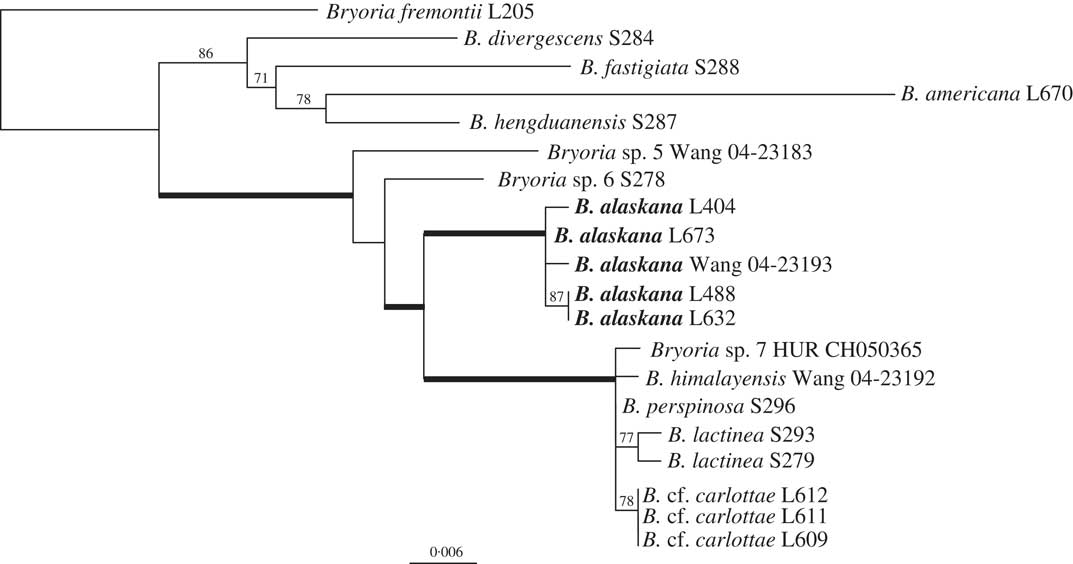
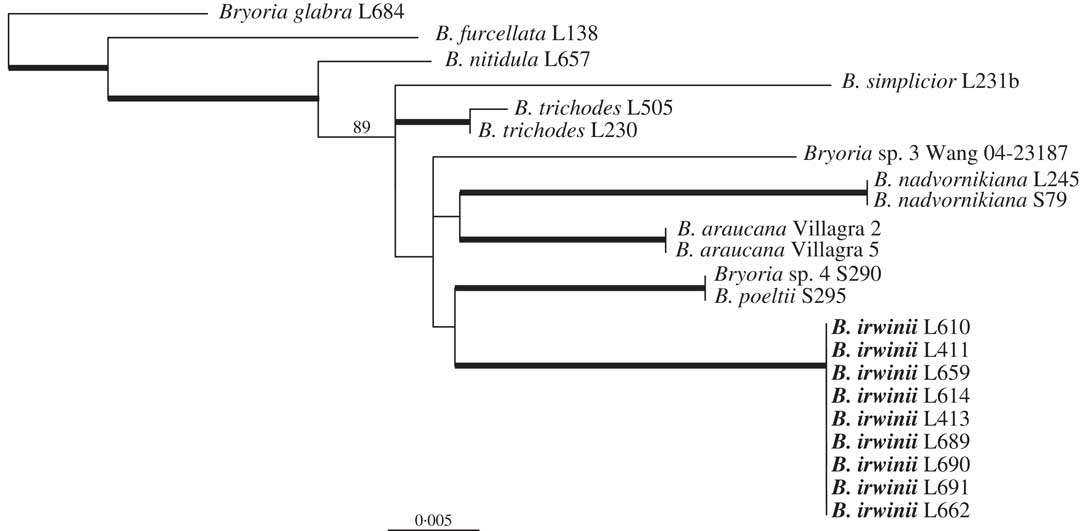
Molecular phylogeny of section Bryoria clade 1 including Bryoria alaskana sp. nov (in bold). Branches supported with bootstrap values ≥75% in both analyses (RAxML and TNT) are indicated in bold. Bootstrap values ≥75% only supported in maximum likelihood analysis are shown above nodes.
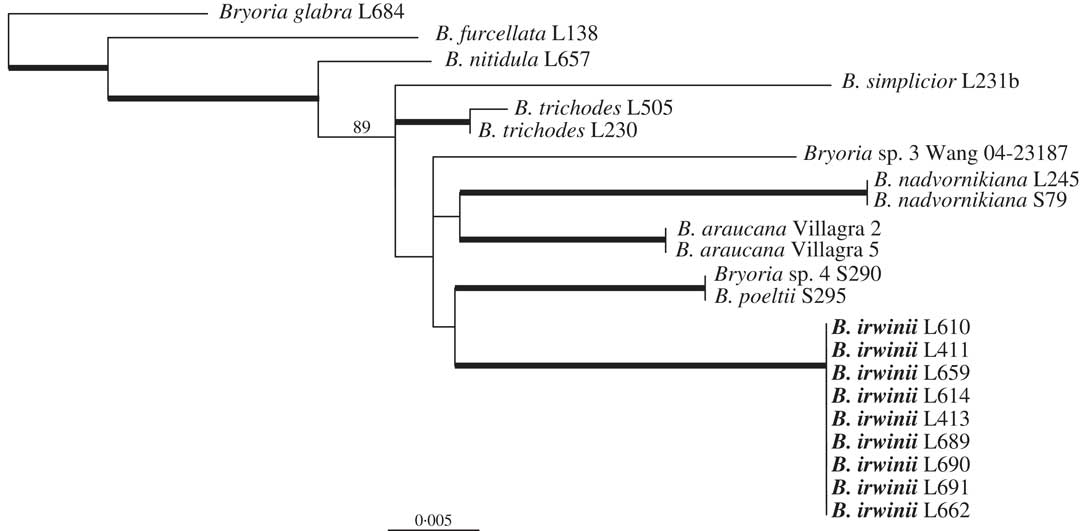
Molecular phylogeny of section Bryoria clade 2 including Bryoria irwinii sp. nov (in bold). Branches supported with bootstrap values ≥75% in both analyses (RAxML and TNT) are indicated in bold. Bootstrap values ≥75% only supported in maximum likelihood analysis are shown above nodes.
The sequences obtained from our new Bryoria species were recovered in two strongly supported monophyletic groups. Bryoria alaskana sp. nov. was represented by four Alaskan specimens in the combined analysis, and additionally by one Chinese specimen based on the analysis obtained from ITS data set 1; both belong in section Bryoria clade 1 (Figs 1 & 2). Unlike most species belonging in Bryoria clade 2, which are broadly distributed, species in clade 1 are amphi-Beringian, that is, endemic to East Asia and/or western North America. A similar pattern of distribution has recently been reported in other Parmeliaceae by Leavitt et al. (Reference Leavitt, Esslinger, Divakar and Lumbsch2012, Reference Leavitt, Divakar, Ohmura, Wang, Esslinger and Lumbsch2015), who attribute the current amphi-Beringian distribution of Melanohalea Blanco et al. and Montanelia Divakar et al. to the existence of an ice-free land bridge between the highlands of Asia and North America during the Pleistocene.
In the ITS+Mcm7 analysis, B. alaskana formed a strongly supported sister group to a clade consisting of three specimens collected in north-west North America: two from Alaska (specimens L611 and L612) and one from British Columbia (L609). We tentatively place these three specimens in B. carlottae Brodo & D. Hawksw., although with some hesitation. Originally described from the Queen Charlotte Islands (now Haida Gwaii) in coastal British Columbia, B. carlottae is characterized by its uniformly olivaceous hue, its submonopodial branching with frequent perpendicular side branches 2–4 mm in length, and its production of fumarprotocetraric acid (Brodo & Hawksworth Reference Brodo and Hawksworth1977). Our specimens have shorter, perhaps more copious side branches, but otherwise closely match the holotype of B. carlottae (CANL-38266). It is worth noting, however, that B. carlottae groups with the Asian species B. lactinea (Nyl.) Brodo & D. Hawksw. and, based on the ITS data set, with B. himalayensis Motyka and B. perspinosa (Bystrek) Brodo & D. Hawksw., all of which share its anisotomic, almost submonopodial ‘fish bone’ branching, though they differ in other characters, such as the frequent production of lobaric acid and the presence of isidioid soralia (B. perspinosa) or apothecia (B. lactinea) (Awasthi & Awasthi Reference Awasthi and Awasthi1985; but see Wang & Harada Reference Wang and Harada2001). Further work is needed to clarify the relationships between B. carlottae and its Asian counterparts.
Nine specimens representing B. irwinii sp. nov. belong in section Bryoria clade 2 and form a strongly supported group (94%) with B. furcellata (Fr.) Brodo & D. Hawksw., B. nitidula (Th. Fr.) Brodo & D. Hawksw., B. trichodes (Michx.) Brodo & D. Hawksw., B. araucana Boluda et al., B. nadvornikiana (Gyeln.) Brodo & D. Hawksw., B. simplicior (Vain.) Brodo & D. Hawksw. and B. poeltii (Bystrek) Brodo & D. Hawksw. (Fig. 1). Based on the separate ITS analysis, two unidentified Bryoria specimens collected in China also belong in this clade but are genetically clearly distinct from B. irwinii (Fig. 3).
In addition to our two new species, we uncovered a degree of unexpected genetic variation in section Divaricatae. All seven members of this section examined by us are closely related to B. bicolor (Ehrh.) Brodo & D. Hawksw. and B. tenuis (Å. E. Dahl) Brodo & D. Hawksw., yet did not group together with either species (Fig. 1). Two specimens (L486 and L490) resemble B. bicolor morphologically while five specimens are closer to B. tenuis. Additional sampling is needed to test whether these specimens represent cryptic species hidden within the B. bicolor/B. tenuis group.
New Species
Bryoria alaskana Myllys & Goward sp. nov.
MycoBank No.: MB 816884
Thallus pendent, esorediate, reacting PD+ (fumarprotocetraric acid), branching isotomic, pseudocyphellae abundant, whitish, predominantly fusiform, perpendicular side branches short, sparse. May resemble B. americana or B. trichodes but lacks black emorient (= dying) patches.
Type: USA, Alaska, Alexander Archipelago, Kuiu Island, Tebenkof Bay, 56·46728°N, 134·07814°W, alt. 2 m, beach fringe forest with Tsuga heterophylla and Picea sitchensis, on Malus fusca, 2013, K. Dillman 11 Jul 13:4 (UBC—holotype; H—isotype). GenBank accession numbers: KX158211 (ITS), KX158238 (Mcm7).
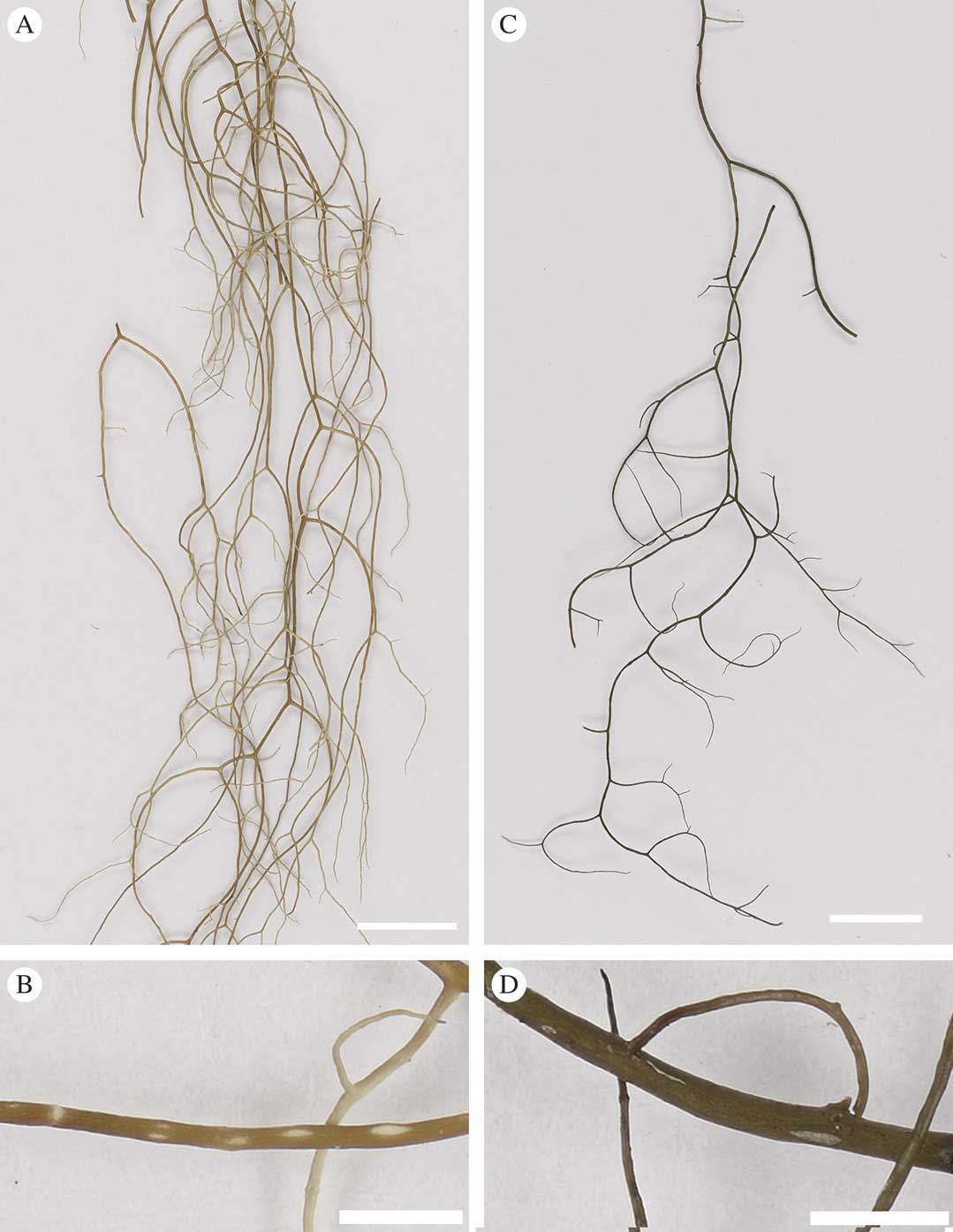
A & B, Bryoria alaskana, holotype; A, general habit with isotomic branching and sparse, perpendicular side branches near the apices; B, detail of branches showing whitish fusiform pseudocyphellae. C & D, Bryoria irwinii, holotype; C, general habit with anisotomic branching and numerous short side branches; D, detail of branches showing brownish fusiform pseudocyphellae. Scales: A & C=5 mm; B & D=1 mm.
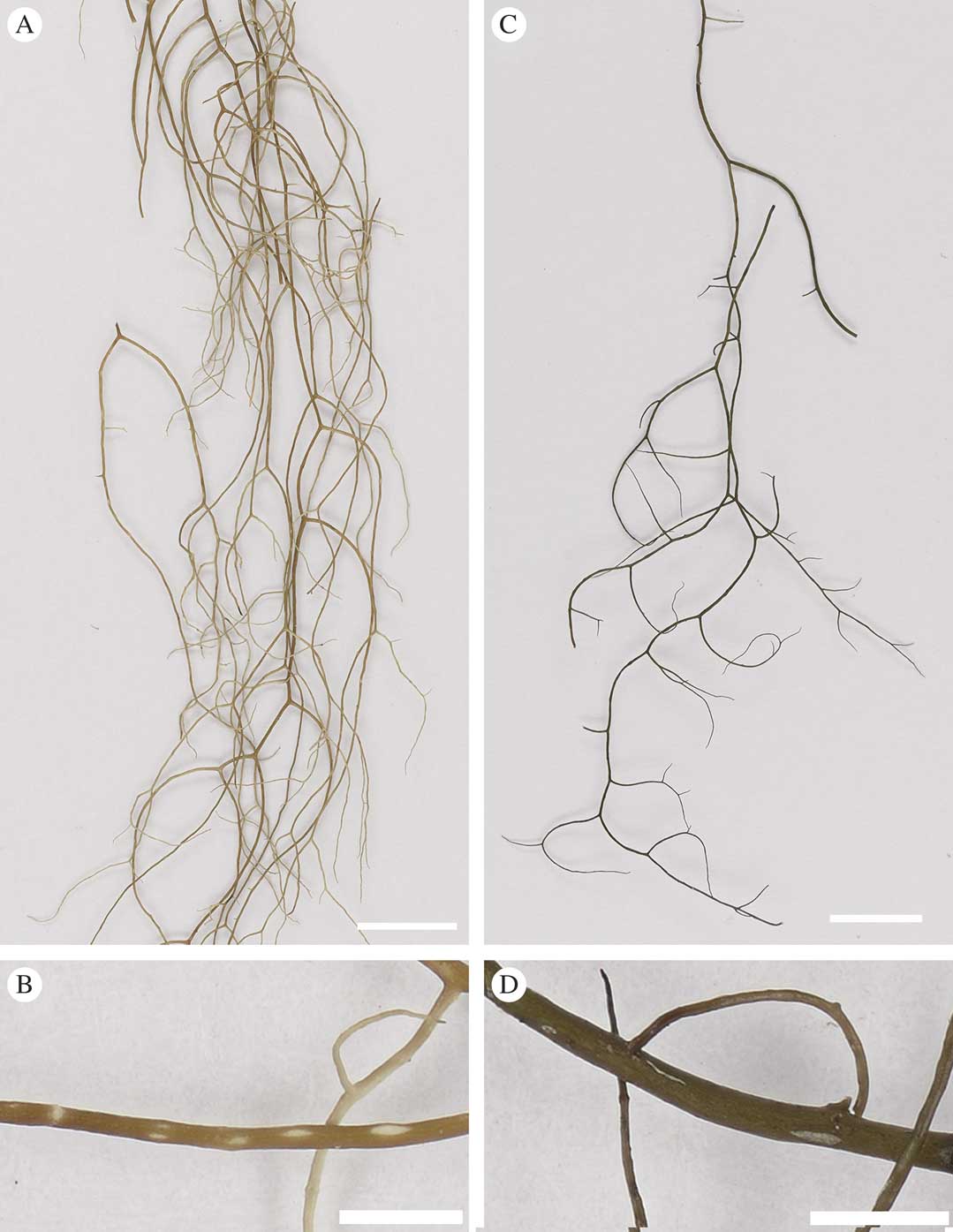
Highly variable. Thallus up to 6–10(–15) cm long, subpendent to more often pendent, branches uniform in hue or sometimes weakly two-toned, main branches pale greyish brown to more or less reddish brown, secondary branches concolorous or paler, often pale creamy, lacking black emorient patches, dull to rather shiny, brittle, uniform in width, 0·15–0·25 mm diam., except sometimes broader in basal portions. Branching mostly isotomic dichotomous, except often weakly submonopodial in apical portions, angles between the main branches acute to weakly U-shaped, toward apices often bearing sparse perpendicular, spinulose side branches up to 2–4 mm long, these broadest at the base or at least not basally constricted. Soralia, isidia and true spinules absent. Pseudocyphellae more or less abundant, inconspicuous to conspicuous, white, slit-like to narrowly or broadly fusiform or sometimes almost oval, plane to weakly bulging, often in part crowded, 0·1–0·7(–1·0) mm long by 0·03–0·10 mm wide.
Conidiomata and apothecia unknown.
Chemistry. Cortex and medulla Pd+ red, containing fumarprotocetraric acid and often protocetraric and confumarprotocetraric acids.
Distribution and habitat. Bryoria alaskana is possibly much overlooked, having so far been recorded from only a few collections. In North America it appears to be restricted to cool, hypermaritime localities in south-east Alaska, though we have seen one specimen also from the Sino-Himalayan Mountains of Asia. The Alaskan material was collected from the branches of conifers and deciduous shrubs (Malus) in open beach forests consisting of Tsuga heterophylla and Picea sitchensis. The Asian specimen was collected from Abies sp.
Comments. Bryoria alaskana is a pendent, esorediate hair lichen that reacts PD+ red. Usually it can be recognized by the combination of isotomic branching, abundant, whitish, predominantly fusiform pseudocyphellae, and sparse, short perpendicular side branches (check towards branch tips). The thallus, however, varies considerably in hue and can range from reddish brown to pale creamy white. The pseudocyphellae are also highly variable, ranging from slit-like and depressed to broadly fusiform and plane, even within the same thallus. Some thalli recall B. americana (reddish and with slit-like pseudocyphellae) and B. trichodes (pale brownish and with fusiform pseudocyphellae), both of which also have pendent, isotomic branches and contain fumarprotocetraric acid. Those species, however, produce shiny black emorient patches, a feature lacking in B. alaskana.
The closely related species B. carlottae, B. lactinea, B. perspinosa and B. himalayensis differ from B. alaskana for instance by their anisotomic branching pattern, while B. divergescens (Nyl.) Brodo & D. Hawskw. and B. fastigiata Li S. Wang & H. Harada are erect in growth form, and B. hengduanensis Li S. Wang & H. Harada has spiralling pseudocyphellae (Wang et al. Reference Wang, Harada, Narui and Culberson2003, Reference Wang, Harada, Koh and Hur2006). Three unidentified specimens, all originating from SE Asia, belong in the same strongly supported clade with B. alaskana (Fig. 2). Specimen Wang et al. 06-26177 (S278; see Table 1) contains lobaric acid and has isidioid soredia. Specimen Wang 04-23183 is erect in growth form and has ciliate apothecia. Specimen Hur CH050365 lacked herbarium information in GenBank and therefore was not available to us.
Additional specimens examined. See Table 1.
Bryoria irwinii Goward & Myllys sp. nov.
MycoBank No.: MB 816885
Thallus subpendent, esorediate, branching predominantly anisotomic, colour strongly olivaceous with black emorient patches, pseudocyphellae conspicuous, pale brownish, fusiform, side branches numerous, perpendicular, more or less basally constricted.
Type: Canada, British Columbia, Prince Rupert, Mt. Hayes, 54·27500°N, 130·34361°W, alt. 400 m, in sloped bog on twigs of dwarfed Pinus contorta, 6 September 2012, C. Björk 29741 (UBC—holotype; H—isotype). GenBank accession numbers: KX158221 (ITS), KX158248 (Mcm7).
Moderately variable. Thallus up to 5–10(–12) cm long, tufted to more often subpendent, branches pale olivaceous to dark olivaceous throughout except with scattered black emorient patches up to 5–10(–15) mm long, more or less shiny, uneven to more often even in diam., 0·1–0·2 mm diam. except broader toward base. Branching anisotomic dichotomous to often in part submonopodial, in the latter case readily divisible into primary and secondary branches, angles between branches mostly acute; also bearing numerous perpendicular spinulose or flexuous side branches to 3–5(–7) mm long, these often in part somewhat constricted at the base. Soralia, isidia and true spinules absent. Pseudocyphellae more or less abundant, conspicuous, pale brownish white on pale branches, darker on dark branches, fusiform, plane to weakly raised, 0·2–0·4(–1·0) mm long by 0·03–0·14(–0·20) mm wide.
Conidiomata and apothecia unknown.
Chemistry. Cortex and medulla PD+ red, containing fumarprotocetraric acid and often protocetraric and confumarprotocetraric acids; or PD−, lacking secondary substances.
Etymology. We name this species in honour of Dr Irwin Brodo, CANL, in recognition of his important contributions to our current understanding of Bryoria and other Alectorioid lichens.
Distribution and habitat. Though apparently rather frequent within its range, B. irwinii is narrowly endemic to coastal north-west North America, where it ranges south to central British Columbia and northward to south-east Alaska. Here it grows in cool, hypermaritime regions on the trunks and branches of conifers, especially Pinus, in open, well-ventilated localities.
Comments. Bryoria irwinii is a subpendent, esorediate species most reliably recognized by its predominantly anisotomic branching, strongly olivaceous hue, black emorient patches, conspicuous pale brownish, fusiform pseudocyphellae and, in particular, its numerous perpendicular, more or less basally constricted side branches. Similar species within its range include: B. americana (also with black emorient patches but otherwise more or less reddish, and with slit-like pseudocyphellae and non-constricted side branches) and B. carlottae (also olivaceous but distinctly submonopodial and with copious short side branches mostly broadest at the base). The two species are not related to B. irwinii but are both clustered in Bryoria clade 1 in the phylogeny (Fig. 1). Other similar esorediate species include: 1) B. trichodes, occasionally sorediate and with, at most, sparse lateral side branches; 2) an unidentified Chinese specimen (Wang 02-21518, S290; see Table 1); 3) the recently described South American species B. araucana (Boluda et al. Reference Boluda, Divakar, Hawksworth, Villagra and Rico2015). Both of the latter species belong in the same clade as B. irwinii, but lack numerous side branches. Closely related species B. furcellata, B. simplicior, B. poeltii and B. nadvornikiana have soredia and are not pendent in growth form.
Additional specimens examined. See Table 1.
We thank Ms Laura Häkkinen for help with laboratory work, Dr Wang Li-Song for loan of South-East Asian material, and Prof. Teuvo Ahti for valuable comments on the manuscript. Curators of CANL are thanked for loaning the type material of B. carlottae. The study was financially supported by the Academy of Finland (grant 1133858).