Introduction
Population ageing is an increasing reality that healthcare systems face in the twenty-first century. It is estimated that, in 25 years’ time, adults aged over 65 years old will make up 20 per cent of the US and European population.Reference Boi, Racca, Cavallero, Carpaneto, Racca and Dall'Acqua1 Hearing loss and dysphonia are two of the most common complaints in the geriatric population.Reference Rutherford, Brewster, Golub, Kim and Roose2,Reference Pessin, Gramuglia, de Carvalho and Martins3
Voice complaints may affect up to 35 per cent of the ageing population.Reference Santos, Freitas, Dias, Costa, Coutinho and Sousa4 The presence of structural and functional changes caused by the ageing process of the larynx (presbylarynx) has been widely documented in several studies.Reference Pontes and Behlau5–Reference Vaca, Mora and Reyes7 These changes are caused by loss of reticular fibres and hyaluronic acid in the connective tissue and atrophy of thyroarytenoid muscle, leading to a vocal fold approximation deficit.Reference Pontes and Behlau6–Reference Bloch and Behrman8 The most frequent complaints arising from this are loss of vocal power, reduced vocal range, tremor, increased breathiness, asthenia, instability and reduced maximum phonation time.
Presbycusis, or age-related hearing loss, is a progressive, symmetric, sensorineural hearing loss, usually with a descending audiometric configuration, that primarily affects high frequencies. It causes symptoms starting in the fifth decade of life (most often with difficulties in sound localisation), and it tends to worsen with age. Presbycusis mainly occurs as a result of degenerative changes of the inner-ear structures, though defective neural processing of auditory input may contribute to this as well.Reference Rutherford, Brewster, Golub, Kim and Roose2 About 25 per cent of adults aged 50–60 years have age-related hearing loss.Reference Boi, Racca, Cavallero, Carpaneto, Racca and Dall'Acqua1,Reference Teixeira, Gonçalves, Freitas, Soldera, Bós and dos Santos9
Several studies have documented that the presence of presbylarynx and/or presbycusis leads to significant communication problems, which can be associated with social withdrawal, isolation, anxiety and depression.Reference Rutherford, Brewster, Golub, Kim and Roose2,Reference Mirza, Ruiz, Baum and Staab10 However, most of the studies only focus on one of the two deficits, and it is well known that presbylarynx and presbycusis are both quite common in the elderly and, furthermore, voice and hearing operate jointly in the communication process. Thus, the present study used a multidimensional assessment, including objective and subjective measures, to examine the potential influence of presbylarynx and presbycusis on the Voice Handicap Index and emotional status of the elderly.
Materials and methods
A case–control, prospective, observational, cross-sectional study was carried out on 209 consecutive subjects observed in an ENT department at a tertiary centre from January to September 2020. This study was conducted in accordance with the Declaration of Helsinki guidelines for human studies. Patients were not compensated for their participation in this study.
Most patients had been referred to our department because of hypoacusis or dysphonia. The inclusion criteria were: the ability to report an accurate medical history and age of 65 years or older. The exclusion criteria were: neurological diagnoses, such as dementia, Parkinson's disease or essential tremor; speech disorders (dysarthria, speech sounds disorder, stuttering); autoimmune disease; history of thoracic or head and neck surgery; history of cancer or neck irradiation; thyroid pathology; previous laryngeal procedures; vocal fold lesions or sulci; laryngitis, laryngopharyngeal reflux or vocal fold paralysis; pre-lingual hearing loss; and hearing aid use prior to assessment. Based on these criteria, 15 patients were excluded.
All patients underwent a complete otorhinolaryngological examination. The presence of presbylarynx and/or presbycusis, emotional status, and Voice Handicap Index were assessed as detailed below.
Diagnosis of presbylarynx
Each subject underwent fibre-optic videolaryngoscopy with stroboscopy (EndoStrob E, type CD11F/R; Xion, Berlin, Germany). Video recordings were obtained with a charge-coupled device camera, and the videolaryngoscopic images were evaluated independently by two experienced otorhinolaryngologists. No information regarding the demographics or clinical complaints was provided to the evaluators.
Presbylarynx was considered when both observers identified two or more of the following endoscopic findings: vocal fold bowing, prominence of vocal processes in abduction, and a spindle-shaped glottal gap.Reference Pontes and Behlau5,Reference Takano, Nito, Imagawa, Sakakibara and Tayama11 Twenty patients were excluded because of discrepancy among judges.
Diagnosis of presbycusis
Audiological evaluation (GSI 61™ clinical audiometer) consisted of pure tone and vocal audiometry in a soundproof booth, measuring pure tone hearing thresholds by air (0.25–8 kHz) and bone (0.5–4 kHz), and speech recognition thresholds for disyllables. The average speech recognition threshold was calculated from both ears. We calculated a speech frequency pure tone average (PTA) using audiometric thresholds at 0.5, 1, 2 and 4 kHz in both ears. Acoustic immittance measurements (tympanometry and acoustic reflex) were performed using the GSI TympStar middle-ear analyser.
Presbycusis was diagnosed when patients met the following criteria: symmetrical increased hearing threshold (PTA of more than 25 dB hearing loss); minimal conductive hearing loss (10 dB or lower); presence of a type A curve on the tympanogram (according to the Jerger classification); normal ipsilateral and contralateral acoustic reflexes; no signs of middle-ear disease on otoscopy; and the absence of previous pre-lingual hearing loss, use of ototoxic medications or previous ear surgery.Reference Kim and Chung12
Voice Handicap Index
Each subject completed the 30-item Voice Handicap Index for examination of the perceived impact of voice on quality of life.Reference Jacobson, Johnson, Grywalski, Silbergleit, Jacobson and Benninger13 The Voice Handicap Index-30 is divided into three subdomains (functional, physical and emotional); each subdomain has 10 questions, with each question contributing 0–4 points.
Emotional assessment
The Geriatric Depression Scale is a self-report measure of depression in older adults. Users respond in a ‘yes/no’ format. A 15-item shortened form was used.Reference Sheikh and Yesavage14 These 15 items were chosen because of their high correlation with depressive symptoms in previous validation studies.Reference Sheikh and Yesavage14 Responses to the Geriatric Depression Scale were interpreted as follows: fewer than 5 points = no depressive symptoms; 5–10 points = mild to moderate depressive symptoms; and 11–15 points = moderate to severe depressive symptoms.
Statistical analysis
All statistical analyses were performed in SPSS software, version 24 (IBM, Armonk, New York, USA). Categorical variables are presented as frequencies and percentages, and continuous variables as means and standard deviations (SDs), or as medians and interquartile ranges for variables with a skewed distribution. Normal distribution was verified using skewness and kurtosis values. Differences among paired groups were evaluated using a paired student's t-test for normally distributed data and the Wilcoxon test non-normally distributed data. A p-value below 0.05 was considered statistically significant. Scores in the Voice Handicap Index-30 and Geriatric Depression Scale were compared according to presbylarynx and presbycusis status. Correlations between age, Voice Handicap Index-30 and Geriatric Depression Scale scores were assessed with Pearson's correlation coefficient. We used a multiple linear regression to analyse how age, gender, and presbylarynx and presbycusis status affected Voice Handicap Index-30 and Geriatric Depression Scale scores.
Results and analysis
Study population
The study population comprised 174 White European subjects (60 males and 114 females), with a mean age of 73.99 years (SD = 6.37 years; range, 65–95 years).
Age was statistically significantly correlated with total Voice Handicap Index-30 scores (p < 0.001, r = 0.321), as well as with functional (p < 0.001, r = 0.321), physical (p < 0.001, r = 0.322) and emotional (p = 0.003, r = 0.230) Voice Handicap Index subdomains. A statistically significant correlation was also found between age and Geriatric Depression Scale scores (p < 0.001, r = 0.297).
Voice Handicap Index-30 scores were not influenced by gender. However, the Geriatric Depression Scale scores of female patients were slightly higher than those of male patients (average score of 6 (interquartile range = 2) vs 5 (interquartile range = 4); p = 0.009).
In this study population, there was a positive correlation between Voice Handicap Index-30 and Geriatric Depression Scale scores (r = 0.632, p < 0.001).
Presbylarynx and non-presbylarynx patients
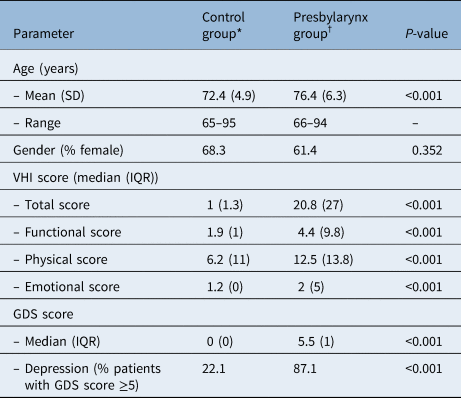
Presbylarynx was identified in 70 patients (40.2 per cent), with no statistically significant predilection according to gender (Table 1). The mean age of patients with presbylarynx was statistically higher (76.4 years; SD = 6.30 years) (p < 0.001) than that of patients without presbylarynx. Among patients with presbylarynx, a glottal gap was identified in 23 patients (32.9 per cent).
Demographic characteristics, and VHI-30 and GDS outcomes according to presbylarynx status

*n = 104; †n = 70. VHI-30 = 30-item Voice Handicap Index; GDS = Geriatric Depression Scale (short-form); SD = standard deviation; IQR = interquartile range
The Voice Handicap Index-30 scores were statistically higher (p < 0.001) for patients with signs of presbylarynx compared to those without presbylarynx. In addition, the presence of presbylarynx was associated with higher Geriatric Depression Scale scores, as well as a higher percentage of depression according to the Geriatric Depression Scale (22.1 per cent vs 87.1 per cent; p < 0.001). In this group, there was a statistically significant correlation between Geriatric Depression Scale and total Voice Handicap Index values (p < 0.001, r = 0.492).
Among patients with presbylarynx, those with a spindle-shaped glottal gap had higher total Voice Handicap Index scores (average score of 36 (interquartile range = 18) vs 10 (interquartile range = 11); p < 0.001), as well as higher Voice Handicap Index subdomain scores (functional score of 10 (interquartile range = 1) vs 0 (interquartile range = 3) (p < 0.001); physical score of 30 (interquartile range = 3) vs 8 (interquartile range = 7.5) (p < 0.001); and emotional score of 5 (interquartile range = 4) vs 0 (interquartile range = 2) (p < 0.001)). In addition, a higher percentage of these patients presented with depression according to the Geriatric Depression Scale (score of 5 or higher) (100 per cent vs 80.9 per cent; p = 0.02).
Presbycusis and non-presbycusis patients
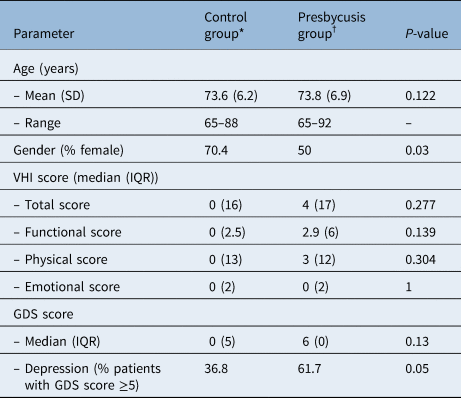
Presbycusis was identified in 79 patients (45.47 per cent). The mean age of patients with presbycusis was slightly higher (73.8 years (SD = 6.9 years) vs 73.6 years (SD = 6.2 years)) than that of patients without presbycusis (Table 2). Gender distribution was different between the groups, with a lower percentage of female patients in the presbycusis patient group (70.1 per cent vs 48.6 per cent; p = 0.02).
Demographic characteristics, and VHI-30 and GDS outcomes according to presbycusis status

*n = 95; †n = 79. VHI-30 = 30-item Voice Handicap Index; GDS = Geriatric Depression Scale (short-form); SD = standard deviation; IQR = interquartile range
The Voice Handicap Index-30 total scores and subdomain scores did not differ significantly between groups. However, patients with presbycusis had higher Geriatric Depression Scale scores, as well as a higher percentage of depression according to the Geriatric Depression Scale (36.8 per cent vs 61.7 per cent; p = 0.05).
The mean PTA in presbycusis patients was 37.9 dB (SD = 13.3 dB) hearing loss, and mean speech recognition threshold (averaging both ears) was 29.8 dB SPL (SD = 13.8 dB SPL). Neither average PTA nor average speech recognition threshold correlated with Voice Handicap Index-30. However, there was a statistically significant correlation between Geriatric Depression Scale scoring and both average PTA (r = 0.239, p = 0.04) and average speech recognition threshold (r = 0.236, p = 0.05).
Multivariate analysis of factors influencing scores
In total, 22.8 per cent of patients had both presbylarynx and presbycusis, whereas 31.6 per cent had neither deficit, and 45.6 per cent had either presbycusis or presbylarynx. In order to evaluate the effect of age, gender, presbycusis and presbylarynx on Voice Handicap Index-30 and Geriatric Depression Scale, we performed a multivariate linear regression.
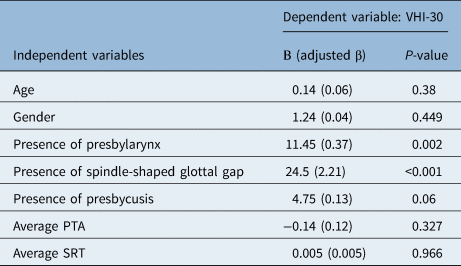
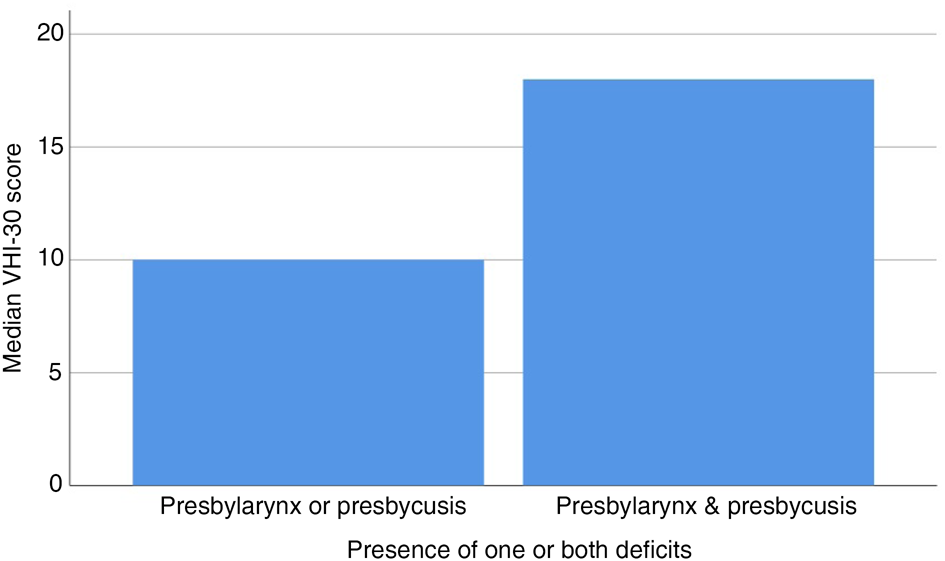
Regarding Voice Handicap Index-30, in this model (r 2 = 0.934, adjusted r 2 = 0.872) both the presence and the severity of presbylarynx (i.e. the presence of a spindle-shaped glottal gap) influenced Voice Handicap Index-30 scoring (p < 0.01) (Table 3). Neither age, gender, presence of presbycusis or average PTA, nor average speech recognition threshold values affected Voice Handicap Index-30 scoring. However, if one compares patients with both presbycusis and presbylarynx to patients with only one of the two conditions, the former group had higher Voice Handicap Index-30 scores (average score of 9 (interquartile range = 18) vs 17.5 (interquartile range = 36); p < 0.001) (Figure 1).
Multivariate linear regression model for VHI-30*

r 2 = 0.934; adjusted r 2 = 0.872. *n = 174. VHI-30 = 30-item Voice Handicap Index; PTA = pure tone average; SRT = speech reception threshold
Thirty-item Voice Handicap Index (VHI-30) median values in patients with presbylarynx or presbycusis versus patients with both deficits.

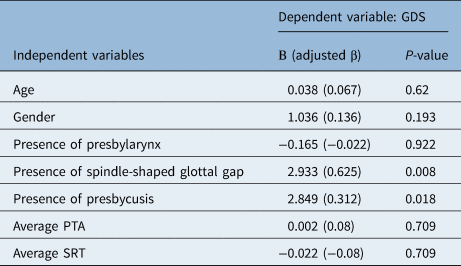
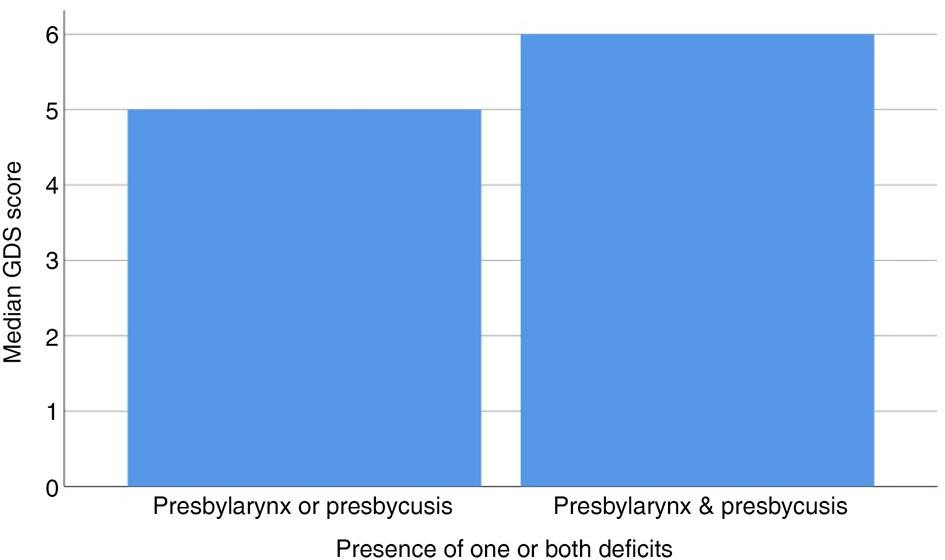
Regarding Geriatric Depression Scale scoring, in this model (r 2 = 0.479, adjusted r 2 = 0.420), though the presence of presbylarynx did not affect scoring, its severity did (β = 2.933, adjusted β = 0.625, p = 0.008). Furthermore, although the presence of presbycusis affected Geriatric Depression Scale scoring (β = 2.849, adjusted β = 0.312, p = 0.018), neither average PTA nor average speech recognition threshold influenced scoring on multivariable analysis (Table 4). If one compares patients with both presbycusis and presbylarynx to patients with only one of the two conditions, there was a statistically significant difference between the two groups (average score of 6 (interquartile range = 5) vs 5 (interquartile range = 2); p = 0.015) (Figure 2).
Multivariate linear regression model for GDS*

r 2 = 0.479; adjusted r 2 = 0.420. *n = 174. GDS = Geriatric Depression Scale (short-form); PTA = pure tone average; SRT = speech reception threshold
Short-form Geriatric Depression Scale (GDS) median values in patients with presbylarynx or presbycusis versus patients with both deficits.

Discussion
The main objective of this study was to objectively characterise presbycusis and presbylarynx, and to correlate their presence and severity with the self-perceived impact of voice on quality of life (Voice Handicap Index-30) and depressive complaints (Geriatric Depression Scale). It has been suggested by several studies that both deficits affect these outcomes. However, most literature only focuses on one of these diagnoses, and, as we have shown, presbycusis and presbylarynx often co-exist in the same patient. Thus, our secondary objective was to evaluate whether the co-presence of presbylarynx and presbycusis was associated with higher Voice Handicap Index scores and depressive symptoms.
In our study, 22.8 per cent of patients had both presbylarynx and presbycusis, and often one of the two conditions was present (45.6 per cent had presbycusis or presbylarynx). To our knowledge, the only available study that had investigated the co-prevalence of presbylarynx and presbycusis was conducted by Park et al., who reported co-prevalence in 45.6 per cent of their patients, which is a higher percentage than in our study.Reference Park, Chae, An, Shim and Kwon15
Several studies have documented the presence of specific structural laryngeal changes in the elderly population, such as vocal fold bowing, prominence of vocal processes in abduction, and a spindle-shaped glottal gap.Reference Pontes and Behlau5,Reference Pontes and Behlau6 However, until now, there has been no agreement on how these findings correlate with vocal complaints. Pontes et al. and Yamauchi et al. did not find a definite correlation between the presence of presbylaryngeal features and dysphonia, while McGarey et al. failed to demonstrate a correlation between glottic gap area and Voice Handicap Index-10.Reference Pontes and Behlau5,Reference Yamauchi, Sakakaibara, Yokonishi, Ueha, Nito and Tayama16,Reference McGarey, Bitar, Hughes, Hodson, Harris and Dominguez17 Our results showed that patients with presbylarynx had higher Voice Handicap Index-30 total scores, as well as higher functional, physical and emotional subdomain scores, which was also reported by Santos et al.Reference Santos, Freitas, Dias, Costa, Coutinho and Sousa4 Moreover, if a spindle-shaped glottal gap was present, Voice Handicap Index scores were even higher. Our study eliminated all other laryngeal pathological abnormalities that might influence Voice Handicap Index-30 scores. Studies conducted by Vaca et al. suggested that vocal complaints may be due to other concomitant laryngeal pathology (such as pharyngolaryngeal reflux), or to other issues that may hinder phonation, such as pulmonary or neurological pathology.Reference Vaca and Cobeta18 Crawley et al. showed a correlation between voice-related quality of life and Voice Handicap Index-10 scores in elderly patients with dysphonia, but they failed to show any association with any respiratory measurement.Reference Crawley, Dehom, Thiel, Yang, Cragoe and Mousselli19 We did not assess this in our study. Finally, the perception of dysphonia may also be influenced by social status, educational level, work environment and occupational voice demands, vocal needs, and general health status, which we again did not account for.
Normal hearing seems to play an important role in monitoring and controlling speech, because patients with hearing loss have increased difficulty in controlling subglottal pressure level, fundamental frequency, and vowel and consonant production.Reference Aghadoost, Moradi, Dabirmoghaddam, Aghadoost, Naderifar and Dehbokri20 Perkell et al. described how continuous hearing feedback is essential to revalidate speech production patterns already present in the central nervous system.Reference Perkell, Matthies, Lane, Guenther, Wilhelms-Tricarico and Wozniak21,Reference Madeira and Tomita22
Though most studies of hearing loss and speech production focus on pre-lingual hearing loss, Aghadoost et al. and Madeira et al. showed increased total Voice Handicap Index-30 scores in adults with hearing loss (aged less than 60 years old).Reference Aghadoost, Moradi, Dabirmoghaddam, Aghadoost, Naderifar and Dehbokri20,Reference Madeira and Tomita22 Specifically in elderly individuals, Park et al. found higher Voice Handicap Index-10 scores in patients with both presbyphonia and presbycusis. This is supported by studies conducted by Baraldi et al. and Hengen et al., though these did not objectively evaluate hearing or voice production.Reference Park, Chae, An, Shim and Kwon15,Reference Baraldi, Almeida, Calais, Borges, Gielow and De Cunto23,Reference Hengen, Hammarström and Stenfelt24 As age-related hearing loss mainly affects higher frequencies (which are not directly involved in speech production), we included vocal audiometry and speech recognition threshold values in our analysis. Our results not only failed to show an association between presbycusis and voice complaints, but also did not show any correlation between average PTA or average speech recognition threshold and Voice Handicap Index-30 scoring.
Our failure to link presbycusis to the impact of voice on quality of life may be because, contrary to other studies suggesting this association, we simultaneously evaluated the influence of presbylarynx and presbycusis on the self-perceived impact of voice on quality of life. We showed that presbycusis often presents with presbylarynx (22.8 per cent of our patients had both deficits), and it is the latter, not the former, that is responsible for higher Voice Handicap Index-30 scores in such patients. In addition, the Voice Handicap Index-30 assesses the impact of voice on quality of life, and does not evaluate objective voice quality. Thus, we cannot exclude the possibility that presbycusis does have an impact on voice and speech production in the elderly. A questionnaire evaluating hearing-related quality of life would have been useful to account for this as a confounding variable for the score obtained in the Voice Handicap Index-30 (which is a quality-of-life questionnaire).
Depression is one of the most common mental disorders in the elderly; approximately 30 per cent of elderly individuals show symptoms of depression, and the prevalence is higher in female patients.Reference Teixeira, Gonçalves, Freitas, Soldera, Bós and dos Santos9 It has been suggested that presbycusis increases the risk of depression because of social isolation and reduced communication with family and friends. In addition, hearing loss may accelerate cognitive decline through degraded and decreased sensory input to: the primary auditory cortex, prefrontal cortex, anterior cingulate cortex and limbic system structures.Reference Rutherford, Brewster, Golub, Kim and Roose2 Most studies focus on the cognitive decline associated with hearing loss; few studies link cognitive decline to depression, and in most of these, hearing loss status is based on self-reporting.Reference Hengen, Hammarström and Stenfelt24–Reference Brewster, Ciarleglio, Brown, Chen, Kim and Roose26 In our study, patients with presbycusis had higher Geriatric Depression Scale scores and a higher percentage of depression (according to the Geriatric Depression Scale). Furthermore, Geriatric Depression Scale scoring was affected by both average PTA (r = 0.239, p = 0.04) and average speech recognition threshold (r = 0.236, p = 0.05). Teixeira et al. and Contrera et al. reported higher Geriatric Depression Scale values and lower emotional vitality in presbycusis patients.Reference Teixeira, Gonçalves, Freitas, Soldera, Bós and dos Santos9,Reference Contrera, Betz, Deal, Choi, Ayonayon and Harris27 However, these studies, as well as our own, did not account for confounding factors that may affect the presence of depressive symptoms, such as social status and overall general health.
Patients with presbylarynx had higher Geriatric Depression Scale scores and a higher percentage of depression (according to the Geriatric Depression Scale). We also observed a significant positive correlation between Voice Handicap Index-30 and Geriatric Depression Scale scoring. This is corroborated by other studies that show an association between dysphonia in elderly patients and depressive symptoms, though most of them are based on self-reporting, and they do not exclusively address patients with presbylarynx or base diagnoses on videolaryngoscopy with stroboscopic examination.Reference Marmor, Horvath, Lim and Misono28,Reference Martinez and Cassol29
Our multivariate linear regression model for predicting Geriatric Depression Scale scoring revealed that the severity of presbylarynx (i.e. the presence or absence of a spindle-shaped glottal gap on videolaryngoscopy with stroboscopy) and the presence of presbycusis showed strong and positive associations with Geriatric Depression Scale scoring. This is, to our knowledge, the first study to indicate a cumulative effect of presbylarynx and presbycusis on the presence of depressive symptoms.
Our study presents some limitations. First, the perception of voice characteristics and its impact on quality of life probably depend on other factors besides hearing loss and difficulties in phonation, such as social and economic status, and the presence of co-morbidities, which are frequent in this population. This limitation highlights the importance of further studies, namely future research to evaluate the potential influence of hearing aids on the voice and quality of life, and on the emotional status of the elderly. Second, objective laryngeal evaluation was not complemented with voice evaluation. Third, our sample may not be representative of the entire elderly age group, because they had been referred to an otolaryngology department. Finally, the small number of patients with only presbycusis may mean that an evaluation of its effects on Voice Handicap Index-30 has limited statistical significance.
• The relationship between presbylaryngeal findings and voice complaints remains controversial
• Presbylarynx and presbycusis often co-exist in the elderly population
• The presence and severity of presbylarynx influences the impact of voice on quality of life
• Neither the presence nor the severity of hearing loss associated with presbycusis seem to have a relevant effect on voice complaints
• Presbylarynx and presbycusis have a cumulative effect on emotional status
Nevertheless, to the best of our knowledge, this is the first study to simultaneously evaluate the effects of two common deficits in elderly people, presbycusis and presbylarynx, and examine how these interact to influence the self-perceived impact of voice on quality of life and emotional status.
Conclusion
Our study revealed that presbycusis and presbylarynx often co-exist in the elderly, and this combination affects their emotional status. It is possible that presbycusis affects Voice Handicap Index scores, the voice and quality of life. However, the presence and severity of presbylarynx have a greater influence on Voice Handicap Index scores than the presence or severity of presbycusis.
Competing interests
None declared