

Introduction
The Road Safety Authority (RSA) in collaboration with the Royal College of Physicians of Ireland (RCPI) has published practical guidelines to guide and support medical practitioners in advising their patients on fitness to drive based on current medical evidence and best international practice (Slainte agus Tiomaint, 2013). The majority of adults drive, thus as health professionals we should routinely consider the impact of a patient’s condition on their ability to drive safely. The primary causes of road collisions, deaths and injuries are speed, impaired driving through alcohol, drugs (prescription or non-prescription) and fatigue. As of 31 December 2013, there have been 181 fatal collisions, which have resulted in 190 fatalities on Irish roads. This represents 29 more collisions, and 28 more deaths compared to the same period in 2012. Of the 190 fatalities, there were 31 pedestrians killed, 95 drivers, 32 passengers, 27 motorcyclists and five cyclists (Road Safety Authority Strategy, 2013).
Drivers with mental illness are at increased risk of road traffic accidents. This is particularly the case for alcohol related disorders, with weaker associations for affective and schizophrenic illnesses (Elwood, Reference Elwood1998). According to Elwood a considerable proportion (about 40%) of psychiatric patients drive. Over half of patients with neurotic or alcohol related disorders are drivers. In the case of major mental illness about a quarter of patients with a psychotic disorder and a half with manic depression are drivers. Side effects of psychotropic medication were considered to have a potential adverse effect on driving ability for 49% of drivers.
It has been shown that doctors are generally poor at giving advice to their patients regarding the effects their illness would have on their ability to drive (Humphreys & Roy, Reference Humphreys and Roy1995; Rowe & Owen, Reference Rowe and Owen2001; Baker & Rogers, Reference Baker and Rogers2005). Previous studies have shown that many practitioners are unaware of the regulations regarding psychiatric illness, medication and driving (Thompson & Nelson, Reference Thompson and Nelson1996; Rowe & Owens, Reference Rowe and Owen2001; Wise & Watson, Reference Wise and Watson2001). Licence holders have a legal responsibility to inform the Driver Licensing Authority (DLA) if they have an illness or disability that might affect their ability to drive (Slainte agus Tiomaint, 2013). The recent RSA guidelines provide guidance to assist doctors in advising patients whether or not they should inform the DLA of their medical condition and what the outcome may be. These guidelines stipulate that drugs affecting the Central Nervous System can impair alertness, concentration and driving performance. Alcohol will potentiate these effects further.
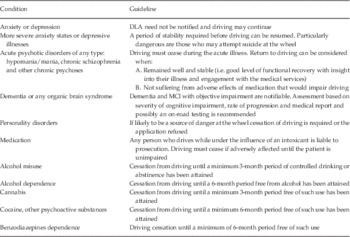
Support for the approach of using evidence based guidelines is provided by evidence of a significant drop in crashes among drivers when such guidelines are systematically applied (Redelmeier et al. Reference Redelmeier, Yarnell, Thiruchelvam and Tibshirani2012). Although the guidelines do not represent a legal requirement for doctors, it is part of a doctor’s duty of care to advise patients who fail to meet the standards of fitness to drive to stop driving and notify the DLA. In addition, doctors should advise patients of side effects of medication likely to interfere with driving. Doctors can be questioned in court over advice given to patients (Elwood, Reference Elwood1998). Table 1 summarises the RSA guidelines in relation to mental health diagnoses.
Summary of RSA guidelines 2013

RSA, Road Safety Authority; DLA, Driver Licensing Authority; MCI, mild cognitive impairment.
The General Medical Council advises doctors that although a driver is legally responsible for informing the DLA if they have a condition that may impair their driving, the doctor must explain this to the patient. If the patient refuses to accept the diagnosis or the effect of the condition on their driving and continue to drive, the doctor should contact the DLA and disclose the condition. The doctor should inform the patient before doing so, in writing (General Medical Council, 2009). The aim of this audit is to assess if the new guidelines, as issued by the RSA and RCPI, have been adhered to.
Methods
A retrospective review of 100 charts of inpatient admissions to the adult mental health unit in Mayo General Hospital, Castlebar between 15 February 2012 and 14 February 2013 was performed. As this was a clinical audit, ethical approval was not deemed to be a requirement. Charts from all inpatient consultant teams were examined. Data collected included primary diagnosis, age, gender, alcohol and substance misuse and whether the patient’s fitness to drive was discussed and documented. Information was collated about whether they had been asked if they were driving and whether any advice had been given. It was also noted if the impact of their psychiatric condition or treatment on their ability to drive been recorded in their medical notes.
In the first audit cycle, case records of 100 consecutive inpatient admissions over the stated time period were examined. The RSA guidelines had not been published during the first cycle of the audit and the current practice of documentation was assessed during this phase. Following the audit the findings were presented to the teams with a teaching session on the RSA guidelines and responsibilities of health professionals. A leaflet containing the relevant guidelines was circulated to all the doctors. The audit cycle was then repeated from April 2013 to June 2013 following publication and discussion of the RSA guidelines at an educational event. Case records were reviewed in the same fashion as the first cycle.
Results
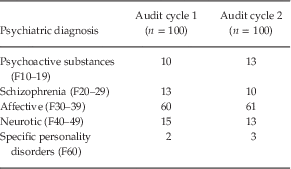
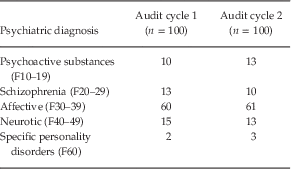
Of the 100 charts reviewed in the first audit cycle, 56 were female and 44 were male. Seven had documented alcohol use with two of the seven having alcohol misuse. Diagnosis included schizophrenia, depression, bipolar affective disorder, psychotic episodes and mixed anxiety and depression (Table 2). On analysis of the patients’ case notes there was no documented evidence of the adverse effects of psychotropic medication on driving. The further potentiating effects of alcohol on medication and driving were also not recorded, even though one of the participants in this study was off the road for driving under the influence of alcohol.
Psychiatric Diagnoses
In the second cycle, 100 patients were again included; 48 female and 52 male. There was documented evidence of the adverse effects of psychotropic medication on driving found in seven cases. Only seven had clear documentation relating to their driving status. The impairing effects of alcohol on medication and driving were also recorded in these cases. The seven patients with documentation regarding driving were well known to the mental health service with three having multiple admissions. Two were female and five male. All seven patients were under care of the General Adult Psychiatric Service with ages ranging from 19 to 66 years. Four had diagnoses of depression with two of these having documented alcohol misuse. Other diagnoses included personality disorder, bipolar affective disorder and mixed anxiety/depression. The majority (58%) were unemployed and unmarried. For the remaining 93 patients there was no documentation of driving status or advice given about driving.
Discussion
The recently published RSA guidelines were circulated to all medical practitioners. In light of these guidelines the effects of medication and the patients’ fitness to drive must be discussed with the patient. This must also be documented clearly in the patients’ case notes and if necessary discussed with the driving licensing authority. Several studies have shown lack of knowledge in practitioners of existing guidelines and a reluctance to advise patients to inform the DLA (Humphreys & Roy, Reference Humphreys and Roy1995; Rowe & Owen, Reference Rowe and Owen2001) A recent and large survey on general practitioners reveals only one-third often used the RSA 2010 guide and a further 14% were unaware of its existence (Omer et al. 2013). Langan (Reference Langan2009) reported no evidence of any documented discussion regarding the potential effect of a patient’s illness on their driving ability. A similar analysis of case notes in the United Kingdom found that the level of documented advice given to patients concerning driving was quite small, with advice given in only four cases out of 45 (Rowe & Owen, Reference Rowe and Owen2001). A larger scale Canadian postal questionnaire reported that only 18% of psychiatrists were always aware of whether their patients were active drivers (Menard et al. Reference Menard, Korner-Bitensky, Dobbs, Casacalenda, Beck, Dippsych, Gelinas, Molnar and Naglie2006).
Giving advice to patients and documenting the advice accurately in the notes is of great importance, as it would appear that legal precedent in the United Kingdom will establish medical negligence when doctors fail to have documentary evidence as proof of advice given (Morgan, Reference Morgan2000). Reasons for not advising patients on driving status was examined with 84% of practitioners concerned it would have a detrimental effect on the doctor/patient relationship (Humphreys & Roy, Reference Humphreys and Roy1995). Elwood (Reference Elwood1998) found the major reason for disregarding the DLA guidelines appeared to be that psychiatrists questioned their validity either considering the patient to be clinically fit to drive or the guidelines to be too harsh. In a survey of general practitioners, Omer et al. (2013) concluded that 76% of respondents felt mandatory reporting of unsafe drivers has negative impacts on doctor–patient relationship. These factors may contribute to the slight improvement of 7% in this study. Orr & Elworthy (Reference Orr and Elworthy2008) examined documentation of driving advice in the medical notes of patients admitted with an acute psychotic episode and found a slight improvement in documentation after DLA guidelines were circulated to medical staff but this was only from 0% to 11%. This compares with no improvement following an educational programme (Rowe & Owen, Reference Rowe and Owen2001; Curwan & Jebreel, Reference Curwen and Jebreel2012). Langan (2009) found all of the clinicians surveyed reported that they would benefit from receiving more training in this area. While these guidelines are not mandatory, it could be seen as good practice for psychiatrists to follow them.
Following implementation of a simple questionnaire in a Day Hospital setting discussion and documentation of advice regarding driving increased from 23% to 95% (Baker & Rogers, Reference Baker and Rogers2005). A more successful intervention may be indicating driving status as part of the admission pack as detailed by Pretorius & Khurmi (Reference Pretorius and Khurmi2013). Orr & Elworthy (2008) suggest that the introduction of a standard discharge letter with relevant prompts may ensure that patients are discharged with appropriate advice. It is important to note that the degree of discussion actually occurring during the consultation may not be reflected adequately and comprehensively in the case notes, often due to time constraints or interruptions during the documentation process (Langan, Reference Langan2009).
Conclusion
In the current audit, it was assumed that the medical practitioner was aware of the guidelines for driving with psychiatric illness following the educational intervention; however, there was not a significant difference in the documented evidence on re-audit. An increase of 7% is nonetheless encouraging, when other studies where no change was evident are considered. Future re-audit should be considered as there is little published evidence of such studies in Ireland. Information concerning driving should be a standard part of advice given to all psychiatric patients. Any prescription of psychotropic medication should be accompanied by advice regarding driving. Failure to share the information with our patients may have lasting consequences; for the patient, the health professional and the general public as outlined above. It is therefore important to highlight this issue and to incorporate it into clinical governance.
Acknowledgement
The authors wish to thank the staffs of Department of Psychiatry, Mayo General Hospital.