Introduction
Asterozoans are constructed of small, articulated skeletal elements that are readily scattered upon death, which leads in turn to a poor fossil record and ultimate disagreement in the literature on morphology, taxonomy, and phylogenetic interpretation.
Significant class-level diversity long has been recognized among ancient echinoderms (e.g., Ubaghs, Reference Ubaghs and Moore1967, p. 3) whereas in subdividing asterozoans, authors for the most part have assigned fossils to one of two surviving class-level taxa, the Asteroidea and Ophiuroidea. W.K. Spencer (Reference Spencer1914–1940, p. 19–20), in his monumental monograph, hypothesized the existence of a major asterozoan group stemward of the surviving classes, but because of limitations of the fossil record as then understood, he was unable to identify a precursor stemward to the known classes. Beginning with the work of Thoral (Reference Thoral1935), Spencer (Reference Spencer1951) described the class Somasteroidea, finding that “members show the first stages in the differentiation of a starfish” (p. 87), the word ‘starfish’ used as a collective. Spencer (p. 110) also recognized the ‘order Stenurida’ for a diverse suite of unusual early asterozoans; the order was assigned to the Ophiuroidea.
Spencer and Wright (Reference Spencer, Wright and Moore1966) retained stenuroids at the ordinal level, whereas in reevaluating the higher taxa of Asterozoa, Blake (Reference Blake2013, Reference Blake2018) recognized stenuroids at the class level; these discussions are not reviewed in detail here, but in brief, somasteroids have a series of small, rod-like, so-called ‘virgalia’ or ‘virgals’ that extend laterally from each ambulacral, whereas the virgal series is argued (Blake, Reference Blake2013, Reference Blake2018) to have been reduced to one (asteroids, ophiuroids), two, or three (stenuroids) ossicles in the derived classes. No such ossicles are found in Falloaster anquiroisitus new genus new species. Ambulacral series are vaulted to form a furrow only in F. anquiroisitus and asteroids; however, the ambulacral ossicular form of F. anquiroisitus and other characters preclude its assignment to the Asteroidea.
A comprehensive interpretation of asterozoan diversification based primarily on Ordovician exemplars was proposed by Shackleton (Reference Shackleton2005), and recent reviews of phylogenetic treatments are available (Blake and Guensburg, Reference Blake and Guensburg2015; Blake et al., Reference Blake, Zamora and García-Alcalde2015; Villier et al., Reference Villier, Brayard, Bylund, Jenks, Escarguel, Loivier, Stephen, Vennin and Fara2017). Although the four skeletonized asterozoan classes (Somasteroidea, Asteroidea, Ophiuroidea, Stenuroidea) are first known from the Early Ordovician, trace fossils suggestive of the Asterozoa are known from the Cambrian (e.g., Mikulás, Reference Mikulás1992).
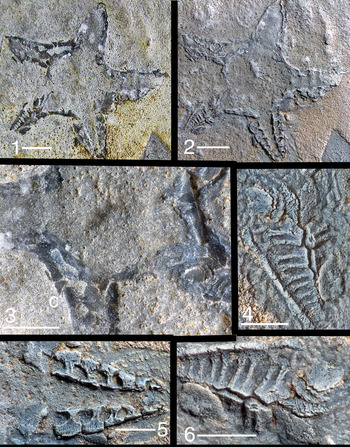
Herein, a new genus and species of asterozoan, Falloaster anquiroisitus from the Early Ordovician of Idaho, is described and illustrated (Figs. 1, 2, 3.2). Falloaster anquiroisitus cannot be assigned to any known class as currently recognized (Blake, Reference Blake2013, Reference Blake2018), but its strongest similarities lie with the class Asteroidea. Paleozoic asteroids were subdivided among three new ordinal-level taxa (Blake, Reference Blake2018), and F. anquiroisitus is diagrammatically compared with the order Euaxosida (Fig. 3), judged to lie closest to the Somasteroidea among asteroid orders. Given its early occurrence and peculiar construction, the new genus and species is interpreted as a member of a previously unrecognized branch of early asterozoan diversification.
Falloaster anquiroisitus n. gen. n. sp., holotype and only known specimen, Idaho Museum of Natural History IP-276/849; Garden City Formation, Early Ordovician, Idaho. (1, 2) Complete specimen before (1) and after (2) preparation with pin vise. Sediment surface weathered and pitted, weathering of individual ossicular surfaces differs, reflecting in part variable density of skeletal meshwork. (3) ‘Northwest’ interbrachium of (1) is to ‘southwest’; interbrachia to ‘southwest’ and ‘east’ differ, potentially one exposing dorsal disk edge, the other the ventral; intervening interbrachium poorly preserved. (4, 6) ‘Southwest’ arm of (1) (cf. Fig. 2.4); vaulted ambulacrals abutted at arm midline and recurved abradially to support abactinal series. No virgal-series or marginal ossicles occur. (5) ‘Southeast’ arm of (1) (cf. Fig. 2.3); water vascular radial channel splayed by compaction. Hourglass-shaped ambulacrals defined by podial pores; ossicles weathered, but resistant abradial edge remains. c = contact as preserved between ambulacral and interbrachial rod-like ossicle. (1–3) Scale bars = 2.0 mm; (4–6) scale bars = 1.0 mm.

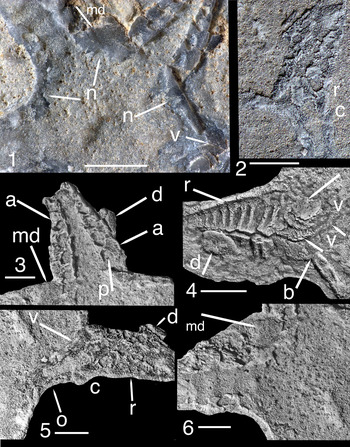
Falloaster anquiroisitus n. gen. n. sp., holotype, IP-276/849. (1) ‘Southeast’ arm of Figure 1.1 to ‘northeast.’ (2, 5) Arm to ‘northwest’ of Figure 1.1, ambulacral ossicles meeting at arm midline indicating dorsal exposure weathered deeply enough to show podial pores inside recurved ambulacral edge (r); one displaced dorsal arm ossicle (d) remains; a foreign particle within interbrachial edge (o) aids orientation between images. (3) Arm in ‘ventral’ aspect (see Fig. 1.5); lateral margins of ambulacral were resistant to weathering as compared to material within rims. (4) Arm in dorsal aspect (see Fig. 1.4, 1.6). (6) ‘East’ arm of Figure 1.1; undulations of sediment surface represent likely impressions of ambulacral series, abradial remnants appearing to abut interbrachial rod-like ossicles. a = ambulacral; b = boundary as preserved between vaulted abactinal and interbrachial rod-like ossicle; c = contact as preserved between ambulacral and interbrachial rod-like ossicle (cf. Fig. 1.3); d = plate-like arm abactinal; md = madreporite(?); n = notch in enlarged, rod-like interbrachial ossicle; p = podial pore; o = outer margin of disk, foreign particle within margin for orientation; r = recurved abradial edge of ambulacral; v = vaulted dorsal ossicular pair (see abbreviation ‘d’). (1) Scale bar = 2.0 mm; (2–6) scale bars = 1.0 mm.

Semi-diagrammatic cross sections of arms of (1) generalized Ordovician early asteroid, order Euaxosida sensu Blake (Reference Blake2018) and (2) Falloaster anquiroisitus. Ambulacral of euaxosidan abuts adambulacral, which in turn abuts marginal, whereas ambulacral of F. anquiroisitus occupies full ventral and lateral arm margins. Podium outline of euaxosidan roofed by solid skeletal surface, a ‘podial basin,’ whereas large pores occur in F. anquiroisitus. Podial pore size in F. anquiroisitus might suggest presence of ampullae but awaits verification (see text on interpretation of water vascular tissues). Radial water vascular channel shown as small in euaxosidan, and although eroded, it might have been large in F. anquiroisitus, as in probable ancestral somasteroids.

Geologic setting
The single available specimen was recovered from the Early to Middle Ordovician Garden City Formation of the Bear River Range, Franklin County, Idaho. It was collected from near the top of an approximately 35 m interval dominated by thin- to medium-bedded carbonate mudstones and intraclastic packstones. At least five thrombolitic mound horizons occur in the sequence. The upper surfaces of the mounds are draped by fine mudstones. The mounds together with the mud drapes preserve a diverse assemblage of crinoid, blastozoan, edrioasteroid, asterozoan, and homalozoan echinoderms. Articulated trilobites occur, the assemblage seemingly most consistent with the Strigigenalis plicolabeona Zone of Adrain et al. (Reference Adrain, McAdams and Westrop2009), thereby indicating a Floian (earliest Blackhillsian) age.
Material
Repository and institutional abbreviation
The single known specimen of Falloaster anquiroisitus n. gen. n. sp. is housed at the Idaho Museum of Natural History, Pocatello, Idaho, IP-276/849. The specimen is small (diameter ~10 mm, arm radius R ~5.5 mm, disk radius [partially collapsed] ~2.5 mm), and it was buried largely intact with limited sign of postmortem disarticulation. The ontogenetic stage of the individual is unknown because only a single specimen is available. This limitation is exacerbated by the uncertainty of the relationship of Falloaster to other asterozoans, its position early in the history of asterozoan skeletal diversification, and the fact that certain extant asteroids reach only small adult sizes (e.g., Korethrasteridae).
The specimen and the carbonate surface on which it is preserved are weathered and pitted (Fig. 1.1, 1.2, lower right; also pitting of ambulacral ossicles, Figs. 1.4–1.6, 2.3–2.6). As typical of many Garden City echinoderms from this interval, the fossil calcite is soft relative to the surrounding matrix, accelerating natural degradation of fossil material and hindering preparation. Diagenetic overgrowth of many individual ossicles (Figs. 1.3, 2.1, 2.2) has further obscured ossicular morphology.
The specimen was photographed using a series of stacked and merged images, an approach retaining focus through the specimen at some cost to the sense of depth visible with a microscope.
Systematic paleontology
Terminology
Terminology follows Spencer and Wright (Reference Spencer, Wright and Moore1966) and Blake (Reference Blake2018).
Caveats
Falloaster anquiroisitus is known from a single small specimen, the disk largely missing and the arm remnants disrupted and variably weathered. In one sense, only a single surface is exposed, but crucial to evaluation, aspects of both dorsal and ventral features are observable because weathering at the outcrop differentially removed overlying sediment to reveal some ossicles essentially in dorsal aspect (Fig. 1.4, 1.6) while others were being eroded to a submedial interval to expose aspects of morphology nearly as would be seen in ventral view (Fig. 1.5). Still other ambulacrals were completely lost, leaving only ossicular impressions on the underlying sediment (Fig. 2.6, to left). Because the specimen was eroded down from above, as is documented by exposure of intact, complex dorsal surfaces of the ambulacrals (Fig. 1.4), the false ventral exposures are placed in quotes for convenient reference, as ‘ventral.’
Given the rarity of articulated echinoderms in the Garden City Formation, discovery of addition specimens in the near future is unlikely, and therefore F. anquiroisitus is documented here despite availability of only a single specimen.
The core significance of F. anquiroisitus is not its morphologic novelty, striking though it is, but rather the additional evidence it provides for early asterozoan diversification that has sometimes only been implicitly recognized by earlier authors (e.g., Schöndorf, Reference Schöndorf1910; Spencer Reference Spencer1914–1940; Schuchert, Reference Schuchert1915; Blake, Reference Blake1995, Reference Blake2013, Reference Blake2014; Mooi and David, Reference Mooi and David2000; Blake and Guensburg, Reference Blake and Guensburg2015).
Subphylum Asterozoa Zittel, Reference Zittel1895
Class and Order incertae sedis
Remarks
Although Falloaster is judged to lie outside of asterozoan class-level taxa as formulated by Blake (Reference Blake2013, Reference Blake2018), the new genus is recognized only at the family level and below because the state of knowledge is insufficient to justify new higher-level terminology.
Family Falloasteridae new family
Type and only-known genus
Falloaster n. gen.
Diagnosis
As for the type species, by monotypy.
Genus Falloaster new genus
Type species
Falloaster anquiroisitus n. gen. n. sp., by monotypy.
Diagnosis
As for the type species, by monotypy.
Etymology
Latin, fallo, deceive (at casual inspection, the only known specimen of Falloaster n. gen. appears to be a peculiar asteroid, but perhaps so only because poorly preserved) and Latin, aster, star.
Holotype
IMNH IP-276/849.
Diagnosis
Asterozoan with ambulacral dorsal surfaces traversed by two prominent lateral ridges separated by medial depressed area, together yielding bilateral ossicular shape. Lateral ridges together with upturned abradial and adradial margins of successive ambulacrals form elliptical surface leading to enlarged podial pore; pore not partially roofed by ledge. Ambulacral in ‘ventral’ aspect of ‘hourglass’ shape; pore where best-preserved edged by continuous circular rim. Abradial ambulacral margin sharply upturned to rim and support abactinal ossicles. No adambulacral or other virgal-series derivatives present. No ambital framework series, represented by marginal ossicles among asteroids, present. Dorsal arm surfaces on each side of arm midline formed by single series of enlarged, oblique rectangular, plate-like abactinals abutted at arm midline; configuration suggests carinal series absent. Skeleton of central portion of disk unknown. Remaining disk-edge ossicles consisting of two series, differing appearances suggesting possible partial exposure of both dorsal and ventral ossicles. Remaining arm-base ossicles similar to enlarged arm abactinals. Enlarged, semicircular madreporite(?) at disk edge.
Occurrence
Garden City Formation, Early Ordovician (Floian/Blackhillsian), Strigigenalis plicolabeona Zone (Adrain et al., Reference Adrain, McAdams and Westrop2009), Bear River Range, Bear Lake County, Idaho. Further locality data available from the Idaho Museum of Natural History.
Description
Disk large relative to arm length, although specimen distended with compaction, partially obscuring shape. Disk apparently domal in life and arms subcylindrical, on the basis of probable loss of dorsal disk ossicles with retention of some interbrachial-edge ossicles and overall arm configuration. Interbrachial arcs probably narrowly rounded in life. Arm outline weakly rounded to nearly straight-sided, outline curving toward more abruptly rounded arm tips; overall outlines of arms suggest flexibility in life.
Dorsal skeletal morphology of entire arm length unavailable. Single series of enlarged, oblique rectangular, plate-like ossicles extends from arm midline to arm margin. Two arm-to-disk junctions retain similar plate-like, vaulted ossicles; abutment line aligned with arm midline, pair vaulted and aligned at arm midline, overlapped laterally by two or three similar ossicles (Fig. 2.4, ‘v’). Positioning of plate-like ossicle at arm midline supports inferred absence of carinal series.
As preserved, ossicles of successive interbrachial arcs differ: three interbrachia edged by robust, approximately rectangular ossicle with triangular reentrant opening toward disk interior (Fig. 2.1, ‘n’). Possible madreporite (‘md’) enlarged, irregular, semicircular, distal to and abutting adjacent interbrachial ossicle. One interbrachium exposes double, separated rows or cycles of multiple? robust rectangular ossicles of slightly irregular outline; one interbrachium appears to retain portion of cycle toward disk center (Fig. 1.3). Disparity of interbrachial ossicles arguably represents both dorsal and ‘ventral’ disk margins, but identification of surfaces is unclear because vaulted arm base abactinals abut both interbrachial ossicular types (Fig. 1.3, ‘southeast’ interbrachium).
Ambulacral ossicles vaulted; ossicles on opposite sides of arm midline slightly offset; cross-furrow articulation surfaces at most finely pitted, suggesting soft tissue linkage rather than interlocking skeletal tooth-and-socket arrangement as typical of asteroids. Ambulacrals robust, hourglass-shaped in overall outline; shape defined by enlarged podial pores. Sequential ambulacrals appear to have abutted along upright edges rather than overlapped. Dorsal surfaces of ambulacrals bordered laterally by transverse ridges that merge toward arm midline; abradial margins of ambulacrals upturned; depressions between transverse ridges of each ossicle floored by ossicular material. In ‘ventral’ aspect, remaining ossicular material largely leached, but thickened abradial edge suggests denser skeletal material at ossicular margin (Fig. 2.2, 2.4, 2.5, ‘r’); pores bordered by semicircular rim that together with transverse ridges and upturned edges of dorsal surfaces likely supported podial tissues. In ‘ventral’ aspect, margins of podial pore forming walls of large water vascular radial channel; degree of ‘ventral’ closure of channel in life unknown due to sediment compaction, splaying of channel, and outcrop weathering. No indication of transverse channel to podium, as in Asteroidea, remains. No adambulacral or other virgal series ossicles or ambital framework ossicles developed. No accessory ossicular material (e.g., granules, spinelets) preserved.
Etymology
Latin, anquiroisitus, seek on all sides, inquire into; in reference to the new species anthropomorphically ‘seeking’ an asteroid organization that it did not attain.
Remarks
Among classes, morphology of F. anquiroisitus is deemed most suggestive of that of the Asteroidea, although the evolutionary significance of the similarities, whether plesiomorphic or homoplastic, is not known. It is also unknown whether similarities might have emerged before or after evolution of robust, readily preserved skeletons within the asterozoan complex (Blake and Guensburg, Reference Blake and Guensburg2015, p. 484). Exemplifying morphologic complexities and uncertainties, absence of virgal-series derivatives and marginals is emphasized for Falloaster, although virgal derivatives were not recognized in problematic Catervaparmaster Blake, Reference Blake2000 (see also Blake and Guensburg, Reference Blake and Guensburg2015), and among Paleozoic asteroids, marginals are not recognized in Illusioluidia Blake and Guensburg, Reference Blake and Guensburg1989, although because of the proportionately small, uniform ossicular sizes, final determination is difficult for that genus.
Falloaster anquiroisitus is diagrammatically compared with the order Euaxosida sensu Blake (Reference Blake2018) (Fig. 3). Unless genuinely absent in life, central disk ossicles were lost from the F. anquiroisitus specimen, and evaluation of ossicles of the interbrachial rim is problematic. The two arms of Figure 1.1, 1.2, pointed ‘southeast’ and ‘southwest,’ appear contradictory; however, both ‘ventral’ and dorsal ossicular morphologies are exposed, as noted, the appearances resulting from specimen undulation at the time of burial, sediment compaction, and differential weathering, the differences in horizon in the living individual perhaps as little as a millimeter (see figure scales). The arm pointing ‘southeast’ is weathered deeply enough to expose the splayed water vascular radial channel as well as the hourglass-shaped ambulacrals, which are to the ‘southwest’ and ‘northwest’ of the dorsal surfaces of the ambulacrals, whereas most ossicles were lost from the remaining two arms. The areas both within the specimen periphery and beyond expose sedimentary matrix.
In life, the dorsal disk of many asteroids is a granular mosaic of many ossicles that in fossilization can yield a texture at least superficially suggestive of that of the F. anquiroisitus specimen; however, the pitted appearance of the matrix beyond the specimen is similar to that of the interior, indicating that the pitted surface is a product of weathering rather than skeletal remnants or impressions of remnants. Although the disk edge of the F. anquiroisitus specimen retained some ossicles, any central disk ossicles were lost. Many asterozoans are domal in life, as probably was F. anquiroisitus, which could have led to taphonomic loss of dorsal ossicles. Alternatively, the disk might have collapsed toward the mouth frame, where ossicles might remain hidden by sediment. This interpretation is deemed less probable because at the time of death, the sediment was firm enough to retain ambulacrals in a vaulted position. A third possibility is that the dorsal disk was at most only weakly calcified, but this interpretation is not favored because of the overall robust nature of the remaining skeleton.
Because of preservational limitations, interpretation of F. anquiroisitus ultimately must emphasize the two best-preserved arms, and absence of both virgal-series derivatives (e.g., adambulacrals) and of ambital framework series in the arms is important. Although much has been lost, much remains, with neither arm configuration nor skeletal fragments providing suggestion of either adambulacrals or marginals. Configuration of the arm margins provides positive data. There are no suggestions of flattening or faceting of the recurved abradial surfaces of ambulacral ossicles that would argue the presence of a marginal series. In addition, among asteroids, articulation structures between ambulacrals and adambulacrals are always differentiated, but the narrow, resistant (denser stereom?) ‘ventral’ abradial ambulacral edges here provide no such suggestion. Podial openings are readily recognized in ‘ventral’ aspect (Figs. 1.5, 2.3) although in dorsal aspect (Figs. 1.6, 2.4), sediment fill is similar to that found in the floored spaces between the transverse ridges of the ambulacral, thereby obscuring the pores in this view. Overall configuration of both ambulacral ossicles and what remains of the disk edge is not found elsewhere among Asterozoa.
Although ambulacral ossicles are paired across the arm midline in later asteroids, pairing is weak in somasteroids, in earlier asteroids, and in Falloaster.
All known asterozoans share a central ventral mouth frame. Although the disk skeleton of the F. anquiroisitus is incomplete, there is no reason to argue any departure from the norm. The abradial edges of ambulacral ossicles appear to closely abut the disk-margin ossicles in at least two places (Figs. 1.3, 2.2–2.6), thereby arguing continuity in life; however, such continuity would imply a construction otherwise unknown among asterozoans, requiring assignment of ambulacral and body wall ossicles to a single ossicular series. Thus, taphonomic displacement is the likely cause of observed ossicular positioning.
Ambiguity also surrounds interpretation of the plate-like ossicles at the disk edges of two of the arms (Figs. 1.3, 1.4, 1.6, 2.1, 2.4, 2.5). The ossicles are similar in form and orientation to the single ossicle that remains in place more distally on one arm (Fig. 2.4, ‘d’), and two or three similar ossicles overlap the two at the disk edge (Fig. 2.4, the paired ‘v’). Nevertheless, as preserved, they are also overlapped by the edges of the adjacent ambulacral ossicles, the abactinal ossicular interpretation demanding their deflection beneath the ambulacrals, which is judged reasonable given specimen flattening with sediment compaction. Ossicles of the adjacent arm, although less complete, are similar, their position more in accord with interpretation as part of the dorsal skeleton. An alternative explanation, that the pair are mouth-angle ossicles, is rejected in part because of the arguments presented and because the pair are at the disk/arm juncture, not at the asterozoan mouth-frame site medially on the disk. Further, the two ossicles are enlarged, whereas mouth-angle ossicles of asteroids typically are proportionately small. Vaulting orientation is incorrect for a mouth-angle ossicle pair, and there is no suggestion of the mouth-edge podia found in many asteroids.
The preceding treatment has stressed direct and comparatively narrow comparison of ossicular appearances, but a second approach to two problematic aspects of the morphology of Falloaster begins with the echinoderm skeletal analyses developed by Mooi and David (Reference Mooi and David1998, Reference Mooi and David2000, Reference Mooi and David2008) in which the axial skeleton, consisting of the ambulacral sequence, is fundamentally distinct from the remainder, the various extraxial elements.
At the interbrachial arcs of the Falloaster, ambulacrals now physically abut the interbrachial arc ossicles (Fig. 2.2, 2.5), suggesting a single ossicular series, which in turn would argue that the arc ossicles are a part of the axial series. Because disk ossicles of the Falloaster are so incompletely known, and Falloaster is argued to be a representative of a clade aside from the four recognized classes, such a hypothesis cannot be simply or wholly dismissed. Nevertheless, treatment of the occurrences as products of taphonomic alteration is both reasonable and in accord with axial-extraxial separation. (However, ossicular juxtaposition raises unresolved questions concerning Falloaster skeletal and body configuration in life: What was overall life configuration such that the ambulacral ossicles were preserved aligned with disk edge ossicles?)
Second, the vaulted plates at the disk edge (Fig. 2.4, ‘v’) are similar in form to the remnant dorsal arm ossicle (Fig. 24, ‘d’), and one of the group also abuts an interbrachial arc ossicle (Fig. 24, ‘b’), thereby also arguing an extraxial rather than an axial status for these ossicles.
Discussion
The overall shape and five flexible arms of Falloaster anquiroisitus n. gen. n. sp. are similar to corresponding occurrences of many members of the class Asteroidea, as is the presence of vaulted ambulacral ossicles to form an ambulacral furrow. Weakly offset positioning of ambulacrals across the arm midline and the presence of apparent weak cross-furrow articulation faceting are also suggestive of early asteroids. The apparent position of the inferred madreporite, at the edge of the body, would be atypical for an asteroid, although taphonomic alteration is possible.
Among extant asteroids, construction of the water vascular system within the arms is intricate but comparatively uniform, consisting of a radial tube with lateral transverse branches leading to a single podium between each successive ambulacral pair, the podium extended upward between the ambulacrals to one or two bulbous ampullae. Although determination of original soft-tissue details from skeletal remnants is difficult, the overall skeletal configuration of Ordovician asteroids is strikingly similar to that of extant exemplars (Blake, Reference Blake2018) except that podial receptacles among the earlier taxa are solid ‘podial basins’ (better would be ‘podial roofs’); openings, or pores, are lacking. Both podial basins and spaces above the podial pores and within the arms of certain later Paleozoic species are ample, allowing space for differentiated internal features of unknown nature.
Water vascular skeletal configurations in the somasteroids Chinianaster Thoral, Reference Thoral1935 and Villebrunaster Spencer, Reference Spencer1951 differ from those typical of the early asteroids in that the radial passageways are enlarged, transverse linkages to enlarged podial basins are obscure, and large plated tube feet have been recorded in Chinianaster (Blake and Guensburg, Reference Blake and Guensburg2015). Spencer (Reference Spencer1951, figs. 9, 10) and Smith and Jell (Reference Smith and Jell1990, fig. 41) recorded commodious, rimmed ambulacral ossicular openings suggestive of those of Falloaster in larger individuals of the later somasteroid Archegonaster Jaekel, Reference Jaekel1923 although adjacent first virgals appear to bear a ledge projected to form a partial roofing over the opening. Openings are apparently less clearly defined toward arm tips and in smaller individuals (Smith and Jell, Reference Smith and Jell1990, figs. 40D, 49C). Interpretations of the significance of the ledges and proportionate aperture size are debatable, but apparently, potentially smaller sizes as well as the ledges could indicate ‘podial basin’ closure surfaces, thereby precluding the presence of water vascular features inside the arm. Other aspects of Archegonaster morphology, including ambulacral shape and presence of a robust marginal series, differ from equivalent expressions in F. anquiroisitus.
No ledges are discernable in the ambulacral openings of Falloaster, and distal openings appear large (Fig. 1.5), but data are limited. The proportionately large, doubly ridged ambulacrals with recurved abradial margins are unlike those of all somasteroids and asteroids. Although seemingly indicative of podial presence, differences in skeletal expressions apparently related to the water vascular system of the arms of earlier asterozoans preclude any simple inferences of water vascular homology. Significance of podial size is unclear because the comparatively small tube feet of extant asterozoans are both strong and extensible.
In lacking both a virgal-series derivative (i.e., the asteroid adambulacral and the ophiuroid lateral) and marginals, the robust arm construction typical of asteroids was not developed in F. anquiroisitus. Although not well preserved, ossicles of the interbrachial disk periphery do not extend along the arm, and in that way interbrachial arrangement is reminiscent of the interbrachia of ophiuran Encrinasteridae (e.g., Spencer and Wright, Reference Spencer, Wright and Moore1966, p. 83).
A comparison of the incomplete inner-disk ossicular arc with the distinctive primary circlet of many asteroids is forced because primary circlets are constructed of comparatively few ossicles located near the disk center. By contrast, the arc of F. anquiroisitus is near the disk margin. The inner skeletal arc has no recognized equivalent in any echinoderm, including asterozoans.
The adambulacral series of asteroids and the lateral series of ophiuroids are the argued derivatives of the virgal series of the Somasteroidea (e.g., Blake, Reference Blake2018). Therefore, the absence of a possible virgal derivative from F. anquiroisitus might be argued as a relatively minor phylogenetic step away from an ancestry within the Asteroidea (Asteroidea in part because of presence of an ambulacral furrow). However, such interpretation is in conflict with the other aspects of morphology, including specifics of ambulacral form, presence of podial pores, and absence of a marginal framework. The early stratigraphic occurrence of F. anquiroisitus might also challenge an asteroid interpretation in that ambulacral ossicular form, absence of marginal series, and disk margin construction depart significantly from corresponding expressions known among early asteroids (Blake, Reference Blake2018), thereby calling for very early major evolutionary divergence among any such posited skeletonized asteroid lineages.
Conclusions
Among asterozoan classes as currently recognized, overall body configuration and ambulacral form of Falloaster anquiroisitus n. gen. n. sp. are most suggestive of corresponding features among the Asteroidea. However, the large rimmed podial pores, recurved abradial ambulacral edges that supported a single abactinal series of enlarged ossicles, and interbrachial margin ossicles are unlike corresponding expressions of other asterozoans. Further, unlike F. anquiroisitus, all asteroids have adambulacral ossicles, and all early and middle Paleozoic asteroids have marginal series, lacking from F. anquiroisitus. F. anquiroisitus differs from the Ophiuroidea and Stenuroidea in these expressions as well as in the presence of vaulted ambulacral furrows and other aspects of skeletal configuration.
The only known F. anquiroisitus specimen was collected from a sedimentary setting associated with a typical Early Ordovician fauna; form and occurrence suggest no unusual ecologic parameters. Its bedding-plane occurrence favors, but cannot prove, an epifaunal habit.
Acknowledgments
F.H.C. Hotchkiss and M. Fau reviewed the manuscript, and R. Mooi provided review and editorial services. S. Zamora provided field assistance on the day the Falloaster anquiroisitus specimen was collected. We are indebted to all.