In recent years, it has been increasingly recognized that information on the effects of disasters can contribute to a better understanding of the factors that increase resilience and vulnerability and improve the design of prevention strategies.Reference Castleden, McKee and Murray 1 However, the majority of studies on post-disaster psychological sequelae typically report only proportions of post-traumatic stress disorder (PTSD) diagnosis, while more recently some researchReference Bonanno, Rennicke and Dekel 2 , Reference Bonanno, Galea and Bucciarelli 3 has begun to investigate the survivors’ capacity to maintain good quality of life or to be resilient. The potential implications of the role of resilience in the aftermath of natural disasters, together with the limited available evidence on this topic, suggest a need for more research.
On April 6, 2009, at 3:32 AM, a severe earthquake (6.3 on the Richter scale) occurred in L’Aquila (central Italy), a town with a population of 72,000 inhabitants and with a local health unit (LHU) catchment population of more than 100,000 residents. The earthquake resulted in 309 deaths and more than 1600 injuries. L’Aquila historical center and some villages around the epicenter were destroyed, and approximately 66,000 inhabitants were displaced to temporary settlements.
This event provided an opportunity to examine a full range of earthquake reactions, including adaptive reactions to stress or trauma. We are able to meet this opportunity in the current exploratory study in which we retrospectively investigated the impact of the 2009 L’Aquila earthquake on a standardized self-reported measure of health-related quality of life (HRQoL) as collected by 2 surveys conducted among adults in L’Aquila in 2008 and 2010.
Methods
In this study we report and compare the results of 2 surveys that used the same instrument to measure HRQoL. Specifically, we used data collected by the Italian Behavioural Risk Factor Surveillance SystemReference Baldissera, Campostrini and Binkin 4 in L’Aquila area during 2008 and data collected in the same area more than 1 year after the earthquake (range, 14-19 months) for the purpose of the CoMeTeS (Conseguenze a Medio Termine del Sisma; in English: Medium-Term Consequences of the Earthquake) survey, which had as a main objective to investigate the prevalence of PTSD and major depression among adult survivors.Reference Gigantesco, Mirante and Granchelli 5
The Italian Behavioural Risk Factor Surveillance System (PASSI; www.epicentro.iss.it/passi/) is an ongoing surveillance system coordinated by the Italian National Institute of Health. It provides prevalence estimates for the main behavioral risk factors for noncommunicable chronic diseases and adherence to several important preventive measures, allowing geographic differences and time trends to be evaluated. The characteristics of the system have been described elsewhere.Reference Baldissera, Campostrini and Binkin 4 Briefly, the data collection unit for the system is the LHU. Each of the 21 Italian regions comprises between 1 and 22 LHUs that provide universal coverage curative service for populations ranging from 40,000 to over 1 million. Each participating LHU used the list of residents enrolled in the unit to select a monthly random sample of persons aged 18 to 69 years (at least 25 persons per month per LHU) stratified by sex and age groups, with the size of each stratum proportional to the percentage of the local population in each of the sex-and-age groups.
Specially trained personnel from the public health departments of all the Italian LHUs administered telephone interviews to the sampled persons with the use of a standardized questionnaire, which covered many topics related to health and prevention, including items on HRQoL, depressive symptoms, smoking habits, alcohol consumption, recommended cancer screenings, diet and nutritional status, physical activity, cardiovascular disease risk factors, adult vaccinations, prevention of traffic accidents, and domestic injuries. The depressive symptoms module used in the PASSI questionnaire corresponds to the Patient Health Questionnaire-2,Reference Kroenke, Spitzer and Williams 6 which evaluates the presence of depressed mood or anhedonia in the past 2 weeks. The most relevant demographic characteristics and information on financial resources were also recorded.
In 2010, more than 1 year after the earthquake, the CoMeTeS study was conducted on a sample of residents in L’Aquila aged 18 to 69 years.Reference Gigantesco, Mirante and Granchelli 5 The individuals initially sampled were selected in the same way as done for the 2008 PASSI surveillance except for the selection of a greater number of individuals (N=1090). The PASSI questionnaire was used to collect information among the study population.
The HRQoL measure corresponded to the measure developed by the Centers for Disease Control and Prevention,Reference Zack 7 which allows for the evaluation of many indicators, including the perceived health status and the number of total unhealthy days in the last 30 days (unhealthy days).Reference Zack 7 , Reference Hennessy, Moriarty and Zack 8 Specifically, HRQoL is based on the answers to the following questions asked during the interview:
-
1. How is your health in general? (very good - good - not bad - bad - very bad)
-
2. Now, thinking about your physical health, which includes physical illness and injury, for how many days in the last 30 days was your physical health not good?
-
3. Now, thinking about your mental health, which includes stress, depression, and problems with emotions, for how many days during the past 30 days was your mental health not good?
-
4. Now, thinking about your usual activities, in the last 30 days, for about how many days did poor physical or mental health keep you from doing your usual activities, such as self-care, work, or recreation?
Results
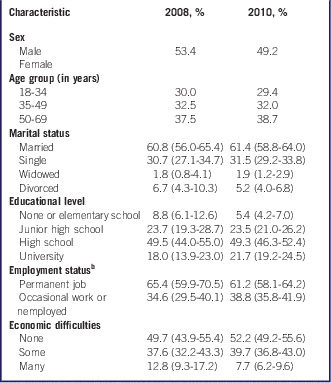
In 2008, within the Italian Behavioural Risk Factor Surveillance System, a random sample of 283 individuals from L’Aquila, aged 18-69 years, had been interviewed. In 2010, within the CoMeTeS study, 957 individuals were interviewed. Regarding sociodemographic characteristics, no significant differences were observed between the respondents of the 2 studies except for a slight difference in the distribution of sex (Table 1). According to the definitions of the American Association for Public Opinion Research,Reference Gigantesco, Mirante and Granchelli 5 , 9 assuming that all individuals who could not be contacted also met the inclusion criteria, the response rate was 84% in the 2008 surveillance and 91% in the 2010 study.
Sociodemographic and Medical Characteristics of 2 Random Samples of Adults in L’Aquila, ItalyFootnote a

a Data are from 2 surveys conducted in 2008 and 2010, before and after the earthquake that occurred in 2009. 95% confidence interval in parentheses.
b We considered only persons aged 65 years or less.
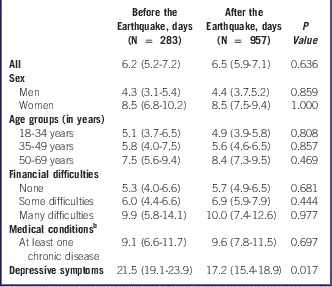
The percentage of respondents who reported bad or very bad health status was 38.2% in 2008, before the earthquake, and 33.6% in 2010, after the earthquake, with no statistically significant difference. Regarding unhealthy days, the average number of unhealthy days, for physical or mental problems or activity limitations, was 6.2 days of 30 before the earthquake and 6.5 days after the earthquake (Table 2), with no statistically significant difference. Consistently, no significant differences in unhealthy days were found with regard to the most important sociodemographic variables (sex, age, financial status) or presence of chronic disease (diabetes, chronic respiratory disease, cardiovascular disease, cancer, and renal insufficiency). Unexpectedly, however, among the individuals with depressive symptoms, as assessed with the Patient Health Questionnaire-2,Reference Kroenke, Spitzer and Williams 6 , Reference Lowe, Kroenke and Grafe 10 the average number of unhealthy days was about 17.2 of 30 after the earthquake and 21.5 before the earthquake, which was a statistically significant difference.
Differences in the Average Number of Unhealthy Days Between 2 Random Samples of Adults Living in L’Aquila, Italy, Before and After the 2009 Earthquake, by Sociodemographic and Medical CharacteristicsFootnote a

a 95% confidence interval in parentheses.
b Diabetes, chronic respiratory disease, previous heart attack or other cardiovascular disease, cancer, and renal insufficiency.
Discussion
The comparison between L’Aquila inhabitants before and after the earthquake showed that such a traumatic experience did not degrade HRQoL. Ultimately, we did not register a worsening of HRQoL after the earthquake and, importantly, even in subjects with depressive symptoms we observed higher HRQoL scores.
In our opinion, these data are compatible with the results of some research indicating that many and, in some cases, the majority of individuals exposed to the most pernicious and potentially traumatic events demonstrate resilience to such experiences. For example, recent studies have demonstrated widespread resilience among survivors of the September 11 terrorist attack in New York City.Reference Bonanno, Rennicke and Dekel 2
Our findings are also compatible with prior research in which people showed minimal negative responses 18 monthsReference Valenti, Masedu and Mazza 11 and 21 months after an earthquake,Reference Chou, Chou and Su 12 but they seem to contradict the findings of other studies showing that devastating natural disasters including hurricanes, floods, and earthquakes profoundly and persistently affect quality of life. For example, according to a study in which the 36-item Short-Form Health Survey (SF-36)Reference Ware and Sherbourne 13 was used, the quality of life 8 months after the 2008 Wenchuan earthquake in Sichuan (China) was worse among survivors than in the reference general population of Sichuan province and other parts of China.Reference Ke, Liu and Li 14 Another study conducted to examine the impact of recurrent floods on quality of life, as measured by the 12-item Short-Form Health Survey (SF-12),Reference Ware, Kosinski and Keller 15 showed that an affected population in the rural district of Bahraich, Uttar Pradesh, India, had significantly lower quality of life than another population in the same region that was not affected by floods.Reference Wind, Joshi and Kleber 16 It is worth noting, however, that the comparison of our findings with these studies is limited by differences in the interval between event and assessment and/or by the evaluation instruments used. Moreover, all these studies lacked comparable pre-event data for survivors, which further limits the comparison with our findings.
Findings of other studies with a pre-post disaster design are, at least in part, consistent with our findings. For example, a prospective study on changes in quality of life following a massive flood in the hamlet of Inje-gun, Gangwon-do (South Korea), on July 15, 2006, showed reduced physical and social functioning HRQoL but improved general health status, vitality, and role limitation due to physical conditions 18 months after the flood.Reference Heo, Kim and Koh 17 In the same way, a pre- and post-hurricane study of quality of life after Hurricanes Katrina and Rita among middle-aged and older adults showed declines in the physical component of quality of life (such as mobility) but not in disability in daily functioning nor in self-perceptions of general health 5 and 13 months after the hurricanes.Reference Brown, Cherry and Marks 18
Moreover, the higher scores that we observed in the individuals with depressive symptoms are compatible with preliminary research showing that resilience is not limited to individuals with exceptional emotional strength. For example, in a clinical study conducted at the Mental Health Department of L’Aquila, the authors observed that patients with mood disorders remained clinically stable and even showed a better subjective outcome after the L’Aquila disaster.Reference Stratta and Rossi 19
Recently, Stratta and RossiReference Stratta and Rossi 20 reported a reduction in suicide in the city of L’Aquila in 2009 when the earthquake struck the city. In our opinion, our data are consistent with what those investigators remarked, that is, people likely activate personal resources and protective social factors after a natural disaster. The initial research on resilience outlined the crucial role of multiple protective factors that can be drawn on as a buffer against adversities, including personal resources (e.g., personality trait, adaptive temperament) and sociocontextual factors (e.g., supportive relationships).Reference Bonanno, Galea and Bucciarelli 3 In particular, according to relevant research that has highlighted the importance of community resources,Reference Hobfoll 21 we suspect a strong link between resilience and perceived social cohesion. In other words, we retain that one of the reasons survivors were resilient in the aftermath of the L’Aquila earthquake was that during that disaster they viewed and perceived others as willing to offer help and support to them and developed strong and positive relationships that in turn resulted in better subjective outcomes.
However, it is worth noting that the early beneficial effects of perceived support may gradually weaken in the long term.Reference Cook and Bickman 22 Moreover, the absence of overt signs of grieving may manifest as delayed reactions that are characterized as subthreshold negative emotions that tend to worsen over time.Reference Andrews, Brewin and Philpott 23 Therefore, the finding of a stable HRQoL could be not confirmed from a long-term perspective. Additional studies are needed to more clearly investigate long-term effects of the earthquake on HRQoL and to better understand the factors that increase resilience and vulnerability.
Some limitations of the present study should be underscored. First, our knowledge of quality of life comes from cross-sectional surveillance surveys that provide rapid information about national or regional populations in Italy and allow inferences about changes in prevalence in subsequent surveys; thus, the resulting information is less accurate than the information obtained through a prospective cohort study in which quality of life may be first identified by the exposure to the disaster and followed in time until the change in quality of life occurs. However, to date, few cohort studies have examined changes in quality of life between pre- and post-disaster periods because natural disasters are difficult to anticipate and cohort studies need intensive resources.
A second limitation of this study is the lack of a more detailed and specific HRQoL measure that in our study may have resulted in an underestimation of the earthquake effects; among these measures are, for example, the Medical Outcomes Study Short Forms (SF-12 and SF-36),Reference Ware and Sherbourne 13 , Reference Ware, Kosinski and Keller 15 the Nottingham Health Profile,Reference Hunt, McKenna and McEwen 24 and the Quality of Well-Being Scale.Reference Kaplan, Sieber and Ganiats 25 In fact, our data were necessarily based on a global quality of life indicator (available in both the pre-disaster and post- disaster data collection cycles), which does not provide either the rich and varied information or normed comparison data or multidimensionality of other instruments such as the above-mentioned SF-36 and SF-12. In fact, the use of the SF-36 and SF-12 enabled us to explore 8 components of quality of life (physical functioning, role limitation due to physical problems, bodily pain, general health, vitality, social functioning, role limitation due to emotional problems, mental health); these measures also provided normed comparison data.
However, although all these measures have been widely used and extensively validated in clinical settings and special population studies, their length often makes them impractical to use in population surveillance. On the contrary, the HRQoL-4 instrument is a brief, quite satisfactory validated HRQoL measureReference Hagerty, Cummins and Ferris 26 and it does not require complicated scoring algorithms to derive a quality-of-life profile. These features may give the HRQoL-4 an advantage over other widely used and more accurate measures that cannot be easily added to health surveys to provide comparability with ongoing population HRQoL surveillance.
Acknowledgments
Special thanks goes to Isabella Cascavilla for her technical assistance and support in language editing.
Conflict of Interest
All authors declare that they have no potential conflicts of interest or any financial or personal relationships with other people or organizations that could inappropriately bias the conduct and findings of this study.