Introduction
Clinical observations and empirical studies suggest that exposure to trauma and the development of post-traumatic stress disorder (PTSD) are associated with profound and lasting changes in people's identity, that is in their experience of themselves as a person and their engagement with or alienation from society (Herman, Reference Herman1992; Janoff-Bulman, Reference Janoff-Bulman1992; Ehlers et al. Reference Ehlers, Maercker and Boos2000; Dunmore et al. Reference Dunmore, Clark and Ehlers2001; Brewin, Reference Brewin2003; Joseph & Linley, Reference Joseph and Linley2006; Rubin et al. Reference Rubin, Brewin, Greenberg, Hughes, Simpson and Wessely2007). Changes in identity are particularly relevant to members of the armed forces returning from active service, who may become alienated from the values of society and believe that their service was unappreciated (Shay, Reference Shay2002; Childers, Reference Childers2009). Such changes may be related to the increase in suicide rates among veterans in the USA (Kaplan et al. Reference Kaplan, Huguet, McFarland and Newsom2007) and among UK veterans aged 24 or younger (Kapur et al. Reference Kapur, While, Blatchley, Bray and Harrison2009), and to the problems with homecoming and readjustment experienced by UK reservists deployed to Iraq (Browne et al. Reference Browne, Hull, Horn, Jones, Murphy, Fear, Greenberg, French, Rona, Wessely and Hotopf2007). This is an urgent issue because after leaving the armed forces the gateway to health care is often through services largely designed for and operated by civilians. This study investigated changes in identity associated with PTSD arising from military service in previous conflicts in order to inform the process of reintegrating more recent returnees from Iraq and Afghanistan.
There are no established methods of measuring identity at this time, particularly for military samples. The concept of identity is closely related to that of appraisal or beliefs about the self and the world, although the term identity implies that such beliefs are relatively permanent and resistant to change. The Posttraumatic Cognitions Inventory (PTCI; Foa et al. Reference Foa, Ehlers, Clark, Tolin and Orsillo1999) includes 21 standardized items concerning negative appraisals of the self and seven items concerning negative appraisals of the world that can be answered with respect to beliefs since a traumatic event. To permit an evaluation of both perceived positive and negative changes in identity, and to allow a more detailed exploration of the specific content within our veteran sample, we used general stem questions previously used in a study of Londoners surveyed after the 2005 bombings (Rubin et al. Reference Rubin, Brewin, Greenberg, Hughes, Simpson and Wessely2007). This approach is more appropriate when the scope of the construct being assessed has not yet been established. We predicted that negative versus positive change in perceptions of the self and the world would be related to greater trauma exposure (hypothesis 1), to having PTSD rather than a physical disability (hypothesis 2), and to more suicidal behaviours (hypothesis 3). We used qualitative methods to further describe how veterans understood the changes to identity arising from their military service.
Method
Participants
To exclude uncertainty over whether PTSD was a result of military service, the sample consisted of veterans in receipt of a war pension specifically recognizing service-related psychological injury from the UK Service Personnel and Veterans Agency (SPVA). Because of the possibility that eligibility for a pension and recruitment through the SPVA may have introduced sample bias, we judged the most appropriate comparison group to be a matched sample of other war pensioners with service-related physical injuries, rather than the general veteran population. As the study was conducted in the context of an investigation of immediate- and delayed-onset PTSD in military veterans (Andrews et al. Reference Andrews, Brewin, Stewart, Philpott and Hejdenberg2009), the sample consisted of older service leavers.
Inclusion criteria were age <60 years, having experienced a traumatic event during military service, and having suffered from either PTSD or a physical disability as a result of military service. Of potentially eligible veterans successfully located and approached through this source, 51% agreed to an audiotaped interview, a response rate typical of military surveys (Fear et al. Reference Fear, Jones, Murphy, Hull, Iversen, Coker, Machell, Sundin, Woodhead, Jones, Greenberg, Landau, Dandeker, Rona, Hotopf and Wessely2010). An additional 20 veterans in receipt of SPVA pensions were recruited through the charity Combat Stress. Further details of the sampling strategy are available in Andrews et al. (Reference Andrews, Brewin, Stewart, Philpott and Hejdenberg2009).
Thirteen potentially eligible participants did not meet the inclusion criteria, and 25 others were excluded for the following reasons: the presence of ongoing PTSD from before military service, any other severe psychiatric disorder, an inability to remember key symptom, trauma and date information, and an unwillingness to disclose such information. The eventual sample consisted of 114 veterans with PTSD (mean age 36.54 years, 95% male, 96% white British) and 39 veterans with a physical disability but without co-morbid PTSD (mean age 35.64 years, 100% male, 100% white British). On average, veterans had joined up aged 17.6 years (s.d.=1.9 years) and served for 8.5 years (s.d.=4.4 years). Major conflicts served in included Northern Ireland, the Persian Gulf and Bosnia. This was the same sample described by Andrews et al. (Reference Andrews, Brewin, Stewart, Philpott and Hejdenberg2009) with the addition of 11 ‘mixed-onset’ PTSD cases omitted from the earlier article (at onset these had had intrusive memories relating both to recent military events and to military events that had occurred more than 6 months earlier, and hence could not be classified as immediate or delayed onset). Written informed consent was obtained from all participants.
Approval was received from Royal Holloway and University College London ethical committees.
Measures
Trauma exposure
War-zone stress was assessed with the combat experience and non-combat experience sections of the Deployment Risk and Resilience Inventory (DRRI; King et al. Reference King, King and Vogt2003). Responses (yes/no) were summed in the 15-item sections to give overall exposure scores.
Diagnoses
Lifetime diagnoses of PTSD, major depressive episode and alcohol abuse were obtained using the Structured Clinical Interview for DSM-IV (SCID-IV; Spitzer et al. Reference Spitzer, Gibbon and Williams1996). We followed previous research (Bliese et al. Reference Bliese, Wright, Adler, Cabrera, Castro and Hoge2008) in not requiring PTSD criterion A2 (subjective response to the trauma of fear, helplessness or horror) as this is less common in military samples and would lead to exclusion of cases of serious pathology. Servicemen meeting and not meeting criterion A2 suffered from PTSD to a comparable extent. Consistent with previous studies of war veterans (Keane et al. Reference Keane, Brief, Pratt, Miller, Friedman, Keane and Resick2007), the great majority of those with a PTSD diagnosis in our sample were also diagnosed with depression (97%), possible alcohol abuse (32.5%) or definite alcohol abuse (38.6%). Inter-rater reliability of diagnoses is reported in Andrews et al. (Reference Andrews, Brewin, Stewart, Philpott and Hejdenberg2009).
Suicidal behaviours
Information was taken from the SCID-IV and also from contemporaneous medical records of participants' period in service. Any positive indication of suicidal behaviour that occurred after the first service-related traumatic event was used to classify participants, whether or not it was corroborated from both sources. Participants were classified into three mutually exclusive groups: those who had made a suicide attempt (n=31), those who had at some point had definite suicidal ideation or plans (n=59), and those who did not seem to have had any significant suicidal ideation, plans or behaviours (n=51).
Identity
If participants had had more than one traumatic experience in service, they were asked to consider their most salient one when answering the identity questions. Using the same stem questions as Rubin et al. (Reference Rubin, Brewin, Greenberg, Hughes, Simpson and Wessely2007), they were asked, ‘Have you found that you see the world differently since the event, or has the event made no difference to how you see the world?’ and were prompted with: ‘For example, have you found that you now have different expectations of other people or the government? Do you feel like you cannot trust people or that people are out to get you? Do you feel you are part of society?’ Participants were then asked, ‘Have you found that you feel different as a person since the event, or has the event made no difference to how you feel as a person?’ and were prompted with: ‘Do you now have different priorities or values?’ To each question participants answered ‘No difference’, ‘a little difference’ or ‘a lot of difference’. This yielded two variables, degree of change in perception of the world (self), scored from 0 to 2. If they answered ‘a little difference’ or ‘a lot of difference’ they were then asked whether this change was positive, negative or a combination of positive and negative. This yielded two further variables, valence of the change in perception of the world (self), scored from −2 to +2. The valence measures were obtained by assigning a score of −2 to a large negative change, −1 to a small negative change, +1 to a small positive change, and +2 to a large positive change. All other participants reporting no change or a mixture of positive and negative change were assigned a score of 0.
Examples and more detailed responses given spontaneously by participants were noted by the interviewer. These were subsequently checked with the corresponding audiotape and transcribed. Inductive content analysis was conducted on 259 responses made by 99 participants, following methods described by Braun & Clarke (Reference Braun and Clarke2006) . This produced four themes related to the world and four related to the self. Inter-rater reliability was carried out on a subset of 50 items with a high level of agreement (92% agreement, κ=0.93, p<0.001).
Analysis plan
To test hypothesis 1, the continuous measure of trauma exposure was related to degree of change in world (self) using one-way ANOVAs, and to the valence of change in world (self) using Pearson correlations. To test hypothesis 2, the presence of PTSD versus physical disability was related to degree of change in world (self) using χ2 tests, and to the valence of change in world (self) using t tests. To test hypothesis 3, the presence of a suicide attempt versus suicidal ideation only versus no suicidal ideation was related to degree of change in world (self) using χ2 tests, and to the valence of change in world (self) using one-way ANOVAs.
Results
Quantitative analyses
Preliminary analyses revealed no significant differences in clinical or identity variables between participants with immediate-onset versus delayed-onset PTSD, who were therefore analysed as one group along with the mixed PTSD cases.
Trauma exposure
One-way ANOVA indicated that the greater the degree of change in perception of the world, the more combat trauma was reported (linear term: F 1,137=6.39, p<0.05), in addition to more non-combat trauma (linear term: F 1,137=5.32, p<0.05). When the analyses were repeated with PTSD status as a covariate; however, the effects of trauma were no longer significant (p>0.10). The valence of change in perception of the world did not correlate with either measure of trauma exposure (largest: r 138=0.02, p>0.10).
One-way ANOVA indicated that the degree of change in perception of the self was unrelated to the amount of combat trauma reported (linear term: F 1,137=2.17, p>0.05), and also to the amount of non-combat trauma (linear term: F 1,137=3.50, p>0.05). The valence of this change was measured in the same way as for the world, but again the valence of change in perception of the self did not correlate with either measure of trauma exposure (largest: r 138=0.01, p>0.10).
PTSD status
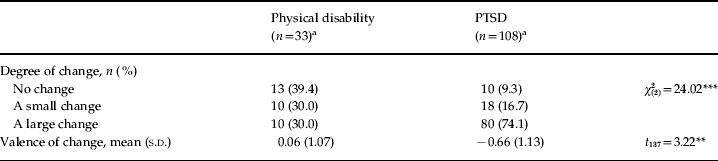
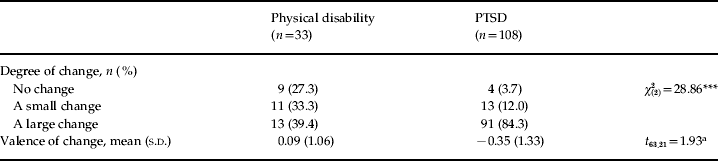
Almost three-quarters of participants with PTSD reported that their perception of the world had changed (Table 1). This was very much more likely than those without PTSD [χ2(2, n=141)=24.02, p<0.001], and the change was in a significantly more negative direction (t 137=3.22, p<0.01). Over 80% of participants with PTSD reported that their perception of themselves had changed (Table 2). This was very much more likely than those without PTSD [χ2(2, n=141)=28.86, p<0.001], but they did not report more negative change (t 63.21=1.93, p>0.05), after correction for unequal variances.
PTSD status and change in perception of the world

PTSD, post-traumatic stress disorder; s.d., standard deviation.
a Information on identity could not be collected from 12 participants.
*** p<0.001, ** p<0.01.
PTSD status and change in perception of the self

a Degrees of freedom corrected for unequal variances.
*** p<0.001.
Suicide attempts
Participants who had made a suicide attempt, had suicidal ideation or plans, and did not report suicidal ideation or behaviours did not differ in their degree of change in perception of the world [χ2(4, n=141)=2.08, p>0.10]. There was a significant effect for valence of change in perception of the world, however (F 2,136=5.06, p<0.01). Post-hoc tests indicated that the group without any suicidal ideation had a much less negative change than the other two groups, who did not differ from each other.
There was no significant association between suicidal thoughts or attempts and degree of change in perception of the self [χ2(4, n=141)=9.00, p>0.05]. One-way ANOVA indicated that the three groups did not differ in the valence of their change in perception of themselves (F 2,136 <1).
Finally, we used logistic regression to test the unique contribution of trauma exposure (combat and non-combat), PTSD status, and identity variables (degree and valence of change in perception of the world and the self) to suicidal behaviours. The group having definite suicidal thoughts, plans or attempts was contrasted with those who did not report any suicidal behaviours. The final model indicated that two variables, having a PTSD diagnosis (Wald=11.80, p<0.001) and reporting a negative change in perception of the world (Wald=6.43, p<0.02), made significant independent contributions to predicting the presence of suicidal ideation and behaviour.
Qualitative analyses
Analyses indicated four dominant themes reflecting changed perceptions of the world.
World revealed as malevolent
Veterans frequently repeated the belief that they were now seeing the world as it really was – ‘my blinkers have been taken off now’ – and that the reality is that the world is not benign. This clearly illustrated the theory that trauma shatters basic assumptions (Janoff-Bulman, Reference Janoff-Bulman1992). Many veterans described an awareness, which extended into an expectation, of brutality – ‘I'm not being funny, I can tell you now, I have never seen so much hate in a bunch of people in all my life: just vicious’ – and expressed an incredulity at human capacity for nastiness: ‘people, human beings, can actually do that to someone else, to each other basically!’ Many veterans expressed a new cynicism and suspicion about others' motives, illustrated by one veteran believing that ‘no-one cares about anyone anymore unless they're getting something out of it’, and another, ‘people won't do things that you perceive to be right, they'll cover up to save their own skin’.
Estrangement
A dominant theme was of being ‘out in the cold’ after leaving the forces and returning to civilian life. One veteran complained ‘our lives are completely alien to civilian lives. I think it always will be a them-and-us situation’. There was a common idea that life in the forces had irrevocably and fundamentally altered their identity and, as one veteran explained, ‘it's hard to fit back into Civvy Street. I've been out 18 years now. I'll never do it. It's just, y'know, I talk like a squaddie, I act like a squaddie.’ This feeling of isolation and strangeness was compounded by a feeling of there being a stigma to having been in the forces. The following comment was typical: ‘the only people I have any time for really are people of the ex-service community; I just feel as though they're the only people that I trust’.
Rejection of civvy street
The feeling of bewilderment and isolation was extended by many participants into a description of manifest hostility between the ex-service personnel and civilian. Several veterans demonstrated a contemptuous attitude towards civilians, a feeling of superiority. One veteran said, for example, ‘I don't like people who are inferior to me: I have no time whatsoever for people who are idiots. The army has done that.’ Some veterans described abandoning attempts to engage with society: ‘once upon a time, I used to try and fit in, whereas now I don't’. Associated with this lack of sociability, a substantial majority of veterans described a narrowing of focus away from the outside world, such that their circle of care was reduced. One veteran expressed it like this: ‘when I joined the army, I joined for God, Queen and Country; now, I do it for me. I do it for me, myself.’
Disillusionment: lack of appreciation
Many veterans expressed the feeling that the risks to life taken by service personnel are not appreciated by civilians. There was a common description of dismay and unhappiness about the perceived discrepancy between the pride and self-worth that was felt when in the forces and the esteem in which society in general holds ex-service personnel. The following quotes illustrate this: ‘You just don't count at all to anybody. You did a really important job, but then, once you finished doing that really important job, you're just put to one side and left to get on with it’; ‘I would have done anything for my country, anything, and I just think now, you're just a number … cannon fodder.’
An additional four themes were identified in relation to changed perception of the self.
Living deliberately
A new-found appreciation of the value of life characterized many veterans' interviews, representing a positive and optimistic reaction to confrontation with danger. In these interviews, life was described as being important above all else and should be lived to the full. Frequently, this sense of the importance of life was marked by a feeling of having been blessed by fate. One veteran remarked, ‘You try and think that life's been a lot better for you, because you are still here and a lot of them, very young and very dead unfortunately.’ Many described a renunciation of material values. Married to this liberation from mundane worries was, for some, a sort of defiance of death and a resilience and strength stemming from freedom from morbid fears: ‘I'm not so scared of danger, if that makes sense?’
Empathy
Many veterans seem to have found their experiences informative and have learned from them in a positive manner. This was demonstrated by a raised awareness about the feelings of other people, many expressing a deeper understanding and compassion for others. For some, this understanding and compassion translates to a respectful and sensitive approach to engagement with others. One veteran said that he tries to consider every day how his actions will affect others. Another explained how he had changed his ways: ‘Before, I used to be a Jack-the-lad, get out, pull a bird, and now, I just don't do that … there's this respect. I treat people with more respect now.’
Diminished self
Some veterans shared a sense of defeat and a loss of vitality, a lack of appetite for life. One veteran described himself as feeling as if he were dead. For some veterans, a loss of confidence and self-worth, disintegrating for a few into self-loathing, was evident. One veteran described how he found it difficult to look people in the eye, ‘because of my face, because my whole body's image and my facial image have been destroyed’. For several veterans there was the sense of having been changed fundamentally, as a person, for the worse: the idea of having been tainted and diminished morally. Some veterans complained of an emotional numbing, having less ability and volition to express emotion. For example, ‘Kissing the kids like, I can't kiss the kids. I can't hug my children; I find that difficult to be honest.’
Emotional fragility
Many veterans were characterized by descriptions of neurotic, anxious and watchful behaviours with a morbid awareness of the proximity of death and danger and a subsequent feeling of vulnerability and powerlessness. What are often thought of merely as symptoms of PTSD seemed to have become internalized as part of the personality. For example, many of these veterans talked in pessimistic terms about never knowing what is around the corner and about how they had seen how easy it is for a person to get hurt and die; one described how he felt as ‘very small, vulnerable; very protective towards the kids, overprotective I suppose’. Associated with this, there was tension, worry and a very serious approach to life, with many mentioning that they were carefree or happy-go-lucky before, but were now on edge, feeling they had a lot on their shoulders. One veteran described how he is ‘always prepared for the worst case scenario’ and has even made a CD of songs he wants to be played at his funeral.
Discussion
Identity may be regarded as involving that subset of beliefs about the self and the world that are experienced as self-defining. The description by Herman (Reference Herman1992) of identity change as the product of repeated or prolonged trauma has contributed to the concept of enduring personality change after catastrophic experience being a diagnostic category linked to PTSD within ICD-10. In our sample greater trauma exposure was associated with increased change in perception of the world but this was fully accounted for by PTSD status, exposure alone being unrelated to any measure of identity change. By contrast, PTSD was related to perceiving more change in the world and a greater likelihood that this would be experienced as negative rather than positive.
Whereas in civilian samples PTSD is generally associated with negative beliefs about the self (Ehlers et al. Reference Ehlers, Maercker and Boos2000; Brewin & Holmes, Reference Brewin and Holmes2003), and in our sample the vast majority of those with PTSD did report changed perceptions of the self, it was of interest that these perceptions were not found to differ systematically from those of controls in a negative direction. One possibility is that this finding is related to our identity measure, which is unusual in requiring respondents to consider simultaneously both positive and negative changes brought about by trauma. The scoring method, by which those reporting both positive and negative changes were scored 0, may also have been insufficiently sensitive. It will be important to examine how civilian samples with PTSD respond to this measure in future studies. Another possibility is that the absence of negative views of self is more characteristic of groups where trauma is encountered in an occupational context, and for whom successful performance involves mastering potentially traumatic experiences.
Our findings echo clinical observations concerning the alienation and disconnection from society experienced by trauma victims with more complex forms of PTSD (Herman, Reference Herman1992; Brewin, Reference Brewin2003; Ebert & Dyck, Reference Ebert and Dyck2004). Consistent with previous reports, suicidal ideation was not related to trauma exposure (Fontana & Rosenheck, Reference Fontana and Rosenheck1995a,b), but rather to post-traumatic symptoms (Tarrier & Gregg, Reference Tarrier and Gregg2004; Jakupcak et al. Reference Jakupcak, Cook, Imel, Fontana, Rosenheck and McFall2009). The additional role played by alienation and disconnection from the world seems to be very much in line with Joiner's (Reference Joiner2005) interpersonal-psychological theory of suicide, which identifies the perceived burdensomeness of the self, thwarted belongingness, and the acquired capability to enact lethal self-injury as the main determinants of suicidal behaviour.
The possibility that stressful and traumatic events may serve as a trigger towards positive and also negative changes in identity has become a focus for empirical research over the past decade (Joseph & Linley, Reference Joseph and Linley2006). Three broad dimensions of growth have been discussed and are echoed in our data. The first is that relationships may be enhanced, people valuing friends and family more and feeling increased compassion toward others. The second is that people change their views of themselves in some positive way. The third is a change in life philosophy, such as finding fresh appreciation for each new day, thinking about what really matters in the full realization that life is finite.
Feeling unappreciated by the people for whom one is risking one's life is conceptually similar to the experience of being ‘let down’ by significant others in a crisis, a factor previously found to provoke depression in women (Brown et al. Reference Brown, Andrews, Harris, Adler and Bridge1986). It may also be related to the finding of higher rates of PTSD in servicemen who perceived a discrepancy between their expected length of deployment and their actual deployment (Rona et al. Reference Rona, Fear, Hull, Greenberg, Earnshaw, Hotopf and Wessely2007). All seem to be examples of the central role played by disillusionment with the behaviour of others from whom one expected something different. The data may also help to account for previous findings (Iversen et al. Reference Iversen, Dyson, Smith, Greenberg, Walwyn, Unwin, Hull, Hotopf, Dandeker, Ross and Wessely2005) that ex-servicemen with mental health problems rarely receive the kind of specialist care recommended for conditions such as PTSD and depression within the National Health Service (NHS). Alienation from and rejection of civilian life are likely to create barriers to use of the most available sources of health care (Rosenheck & Fontana, Reference Rosenheck and Fontana1995). Worryingly, these same elements of alienation and perceived permanent change to the self have also been found to predict a poorer response to standard exposure treatment for PTSD in rape victims (Ehlers et al. Reference Ehlers, Clark, Dunmore, Jaycox, Meadows and Foa1998), probably due to issues with trust and difficulties in forming a strong therapeutic alliance.
Our findings imply that the transition from military to civilian life is crucial for veterans with mental health problems. Increased efforts at reintegration and recognition of service have recently been evidenced, for example by General Sir Richard Dannatt's call for more homecoming parades for British troops to be organized by local councils (Daily Telegraph, 22 September 2007), and by the Government Response to the Report of Inquiry into National Recognition of our Armed Forces from the Ministry of Defence (MoD, 2008). Our results underscore the potential value of these initiatives and suggest the need for more widespread efforts aimed at the recognition and integration of veterans, particularly within the NHS. The Veterans Mental Health Pilot scheme, a venture sponsored by the MoD and the NHS, is currently trialling this approach at six sites in the UK. The identified feelings of mistrust and rejection also indicate that, as noted by the National Institute for Clinical Excellence (NICE, 2005), treatment methods aimed at more complex post-traumatic disorders (Cloitre et al. Reference Cloitre, Stovall-McClough, Miranda and Chemtob2004) are likely to be necessary for veterans.
Among the limitations of the study is the use of war pensioners, who may not be representative of veterans more generally, and the cross-sectional design, which precluded a causal direction between identity and psychopathology being inferred. It also relied on retrospective reports of traumas and symptoms. However, the validity of these reports has been supported by a subsequent study of our respondents' military records that showed that the majority of participants reporting significant psychiatric symptoms had in fact come to the attention of medical personnel while in service (Andrews et al., unpublished data). A further limitation was that, because of the high levels of co-morbidity, the separate contributions of depression and PTSD to suicidal behaviour could not be quantified. Finally, the reliability of the identity measures was unknown, and it is not possible to draw conclusions about the permanence of the identity changes described. The validity of the measures was, however, supported by the qualitative analysis, UK war veterans articulating the changes in perceptions of themselves and others using concepts that are familiar from previous observations (Shay, Reference Shay2002; Childers, Reference Childers2009).
In summary, this study suggests that military veterans with PTSD report significantly more negative changes in their perception of the world but not necessarily of themselves. Our results also provide the first empirical support for an association between negative changes in perceptions of the world, PTSD and suicidal behaviour in this group. The implications are that, even in those whose disabilities have been recognized and compensated, alienation and the perception of being misunderstood and unappreciated may be specific risk factors for ex-servicemen failing to access mental health services and requiring more complex interventions when they do. The data underscore the importance of research into multi-faceted interventions, both individual and societal, to remedy these risk factors in maintaining veterans' psychological health.
Acknowledgements
The study was funded by the UK Ministry of Defence.
Declaration of Interest
None.