Introduction
The neurodevelopmental hypothesis (Weinberger, Reference Weinberger1987) has been widely supported as a primary etiopathogenesis process for schizophrenia (Ismail et al. Reference Ismail, Cantor-Graae and McNeil2000; Rosa et al. Reference Rosa, Fananas, Bracha, Torrey and van Os2000; Cannon et al. Reference Cannon, Caspi, Moffitt, Harrington, Taylor, Murray and Poulton2002; Lewis & Levitt, Reference Lewis and Levitt2002) and is being considered for other psychotic diagnoses, such as bipolar disorder (Sanches et al. Reference Sanches, Keshavan, Brambilla and Soares2008). In schizophrenia, pre- or perinatal events have been proposed as key moments in which the brain insult(s) associated with future abnormal brain maturation take place (Weinberger, Reference Weinberger1987; Walker et al. Reference Walker, Diforio and Baum1999). Early transient movement disorders have been identified in pre-schizophrenic subjects (Walker et al. Reference Walker, Savoie and Davis1994) and related to future illness phenomena, such as negative symptoms and neurological soft signs (Schubert & McNeil, Reference Schubert and McNeil2004). Cognitive divergence between pre-schizophrenic subjects and their classmates has been established at 13–14 years of age (Fuller et al. Reference Fuller, Nopoulos, Arndt, O'Leary, Ho and Andreasen2002), and the cognitive impairment characteristic of schizophrenia is already present at the first episode (Bilder et al. Reference Bilder, Goldman, Robinson, Reiter, Bell, Bates, Pappadopulos, Willson, Alvir, Woerner, Geisler, Kane and Lieberman2000; Addington & Addington, Reference Addington and Addington2002), remaining stable thereafter (Heaton et al. Reference Heaton, Gladsjo, Palmer, Kuck, Marcotte and Jeste2001; Szoke et al. Reference Szoke, Trandafir, Dupont, Meary, Schurhoff and Leboyer2008). Evidence of the abnormal neurodevelopment at the time this is happening, although not abundant (see Welham et al. Reference Welham, Isohanni, Jones and McGrath2009 for a review), suggests that developmental deviance in cognitive, motor, behavioral and intellectual measures of pre-schizophrenic subjects from their healthy peers occurs early in childhood and adolescence.
The longitudinal neuropsychological and comprehensive study of first-episode early-onset psychosis (EOP) patients, whose brain maturation is still in progress at the time of illness onset, provides a unique opportunity to compare the late phases of cognitive development in these patients with that of healthy subjects, in search of specific patterns resulting from the interaction between neurodevelopmental processes and the presence of psychotic disorders. Previous longitudinal neuropsychological studies of first-episode patients with schizophrenia and related illnesses have consistently reported stabilization (i.e. no further decline) of their cognitive functioning over the first few years of illness (Sweeney et al. Reference Sweeney, Haas, Keilp and Long1991; Hoff et al. Reference Hoff, Sakuma, Wieneke, Horon, Kushner and DeLisi1999; Addington & Addington, Reference Addington and Addington2002; Hill et al. Reference Hill, Schuepbach, Herbener, Keshavan and Sweeney2004). The vast majority of these studies included samples of adult subjects whose brain maturation had concluded, making it impossible to look into the impact of illness onset on brain maturation, or vice versa. However, the cross-sectional and longitudinal analysis of cognition on EOP subjects enables inferences about such interaction. Previous studies with first-episode EOP patients have concluded that cognitive impairment is already present at the time of illness onset, suggesting that at least part of the neurodevelopmental processes associated with EOP incidence occurred before that time (Kravariti et al. Reference Kravariti, Morris, Rabe-Hesketh, Murray and Frangou2003; Brickman et al. Reference Brickman, Buchsbaum, Bloom, Bokhoven, Paul-Odouard, Haznedar, Dahlman, Hazlett, Aronowitz, Heath and Shihabuddin2004; Fitzgerald et al. Reference Fitzgerald, Lucas, Redoblado, Winter, Brennan, Anderson and Harris2004); this is similar to conclusions about adult forms of psychoses. However, little is known about the interaction between neurodevelopment and illness onset in these subjects because of the lack of longitudinal studies with first-episode EOP patients.
To shed some light on this issue, we assessed longitudinally the cognitive functioning of EOP patients at their first episode and then 2 years later. We hypothesized that, as part of their normal cognitive development, cognitive functioning would improve in healthy adolescents over the 2-year follow-up, at least in their highest-order cognitive areas (i.e. executive functions and related processes). However, EOP patients could present four development patterns with differential conceptual implications. In the context of the neurodevelopmental theory, we hypothesized a lack of significant changes in the cognitive functioning of EOP patients during follow-up, suggesting that neurodevelopmental abnormalities leading to cognitive impairment had occurred earlier. Part of the abnormal neurodevelopmental process associated with psychotic disorders would consist of prematurely arrested and hence incomplete development in comparison to their healthy peers. Consequently, healthy subjects would have an increased cognitive advantage. Alternative results and associated hypotheses would include (a) a greater cognitive functioning increase during follow-up in EOP patients than in healthy adolescents, leading to less cognitive impairment at the end of follow-up, suggesting a delay in EOP neurodevelopment compared with their healthy peers; (b) similar cognitive development in both EOP and healthy adolescents, indicating that differentiation of cognitive maturation in both populations has concluded before illness onset, and runs parallel from then on; and (c) cognitive decline over the follow-up period in EOP patients, pointing to the neurodegeneration hypothesis as the main explanation for this finding.
Method
This study is part of the child and adolescent first-episode psychosis study (CAFEPS), a multicenter, longitudinal study to evaluate different clinical, neuropsychological and biological factors, in addition to treatment and prognostic factors, in these patients. The methodology of the complete study has been comprehensively described elsewhere (Castro-Fornieles et al. Reference Castro-Fornieles, Parellada, Gonzalez-Pinto, Moreno, Graell, Baeza, Otero, Soutullo, Crespo-Facorro, Ruiz-Sancho, Desco, Rojas-Corrales, Patino, Carrasco-Marin and Arango2007).
The study was approved by the Institutional Review Boards of all participating clinical centers. All parents or legal guardians gave written informed consent prior to enrollment in the study and patients agreed to participate.
Subjects
At baseline, 110 first-episode EOP patients with a first episode and 98 healthy subjects were recruited, although complete neuropsychological assessment was available only for 107 patients (three patients did not cooperate with the evaluation). A comparison of their neuropsychological functioning and other clinical data at baseline has been reported previously (Zabala et al. Reference Zabala, Rapado, Arango, Robles, de la Serna, Gonzalez, Rodriguez-Sanchez, Andres, Mayoral and Bombin2010). Patients were recruited from child/adolescent psychiatry units at six university hospitals and all presented a first psychotic episode. The inclusion criteria for patients were: age between 7 and 17 years at the time of the initial evaluation and the presence of positive psychotic symptoms (within a psychotic episode) of duration <6 months. Exclusion criteria included the presence of other concomitant Axis I disorders, mental retardation, pervasive developmental disorder, neurological disorders, history of head trauma with loss of consciousness, and pregnancy. Mental retardation was an exclusion criterion if IQ was <70 and there was significantly impaired pre-morbid functioning/adjustment, as measured by the Premorbid Adjustment Scale (PAS; Cannon-Spoor et al. Reference Cannon-Spoor, Potkin and Wyatt1982) and the short version of the World Health Organization Disability Assessment Schedule (WHO-DAS-S; Janca et al. Reference Janca, Kastrup, Katschnig, Lopez-Ibor and Mezzich1996). Occasional or regular substance use was not an exclusion criterion if positive symptoms persisted for more than 2 weeks after a negative urine toxicology test and a substance-induced psychotic disorder was not diagnosed.
Full neuropsychological assessment at both baseline and the 2-year follow-up was available for 75 patients and 79 healthy controls out of the original CAFEPS sample. DSM-IV criteria diagnoses for the 75 patients at 2 years were as follows: schizophrenia n = 35; bipolar disorder n = 17; and other forms of psychosis [psychosis not otherwise specified (NOS), schizo-affective disorder, major depression with psychotic symptoms, other affective disorders with psychotic symptoms, and obsessive–compulsive disorder with psychotic symptoms] n = 23. For five (6.7%) out of these 75 patients illness onset was before the age of 13 years. At baseline, all patients except one were on second-generation antipsychotic medication (mean dose chlorpromazine equivalents: 330.29 ± 641.83); and at the 2-year assessment 17 patients were not on medication and the remaining 58 were receiving second-generation antipsychotics (mean dose chlorpromazine equivalents: 235.22 ± 315.02). The inclusion criteria for controls were age and gender similar to patients, coming from the same geographic area and schools, and no psychiatric or neurological disorders, head trauma, pregnancy, or mental retardation. Exclusion criteria for controls were the same as for patients.
Clinical assessment
Diagnoses were established, or ruled out in the case of controls, according to the DSM-IV criteria (APA, 1994) using the Kiddie Schedule for Affective Disorders and Schizophrenia, Present and Lifetime version (K-SADS-PL; Kaufman et al. Reference Kaufman, Birmaher, Brent, Rao and Ryan1996). Psychotic symptoms were assessed in the patient sample by means of the Spanish version of the Positive and Negative Symptom Scale (PANSS; Peralta & Cuesta, Reference Peralta and Cuesta1994). Given that the PANSS was administered several times during follow-up, the PANSS scores reported here as baseline symptomatology were those administered 4 weeks after admission because it was the symptom assessment closest to the baseline neuropsychological assessment. At the 2-year follow-up, neuropsychological and symptom assessments were performed within a 2-week period.Within-class correlation coefficients of the different clinicians administering the PANSS were >0.80.
Neuropsychological assessment
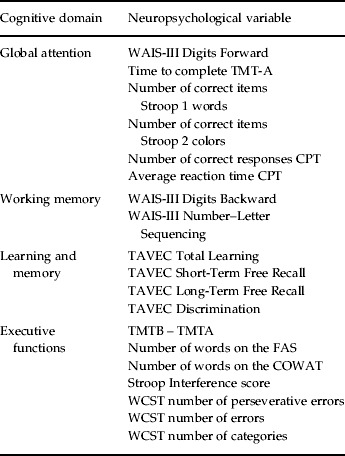
Cognitive assessment was performed by means of a neuropsychological battery designed to comprehensively assess attention, working memory, memory and executive functioning (Table 1). The baseline neuropsychological assessment was delayed until 4–8 weeks after admission to allow acute symptoms to stabilize. The follow-up neuropsychological and clinical assessment was performed 2 years after recruitment into the study.
Neuropsychological tests and variables grouped by cognitive domain

WAIS-III, Wechsler Adult Intelligence Scale, 3rd Edition; TMT-A, Trail Making Test, Part A; CPT, Conners' Continuous Performance Test; TAVEC, Spanish version of the California Verbal Learning Test; TMTB – TMTA, time to complete TMT-B minus time to complete TMT-A; FAS, verbal fluency test; COWAT, Control Oral Word Association Test (semantic category ‘animals’); WCST, Wisconsin Card Sorting Test.
Raw test scores were converted to z scores (mean = 0, s.d. = 1) based on the performance of the control group at the baseline neuropsychological assessment, to obtain a summary score for each cognitive domain at both assessment times, a global score for cognition (average of the five cognitive domains), and a measure of change at follow-up based on z scores. To minimize the effect of age and education, the sample was divided at baseline into three age groups (9–14, 15–16 and 17 years) when obtaining the z scores. The original three-group classification was maintained at follow-up to obtain the 2-year z scores. All z scores were calculated in such a way that higher scores always reflected better performance, by changing the z-score sign (from plus to minus and vice versa) of those tests where a higher raw score is indicative of poorer performance [i.e. time to complete the Trail Making Test, Part A (TMT-A) and Part B (TMT-B), Wisconsin Card Sorting Test (WCST) errors]. Z scores were truncated at ±4, to avoid outlying variables. To avoid data overload, results are only reported for cognitive area summary scores, which are the result of averaging the z scores provided by the neuropsychological test variables listed in Table 1 (results of single test variables available upon request).
IQ was estimated at baseline only using the Spanish versions of the Wechsler Adult Intelligence Scale, 3rd Edition (WAIS-III; Wechsler, Reference Wechsler1997) or the Wechsler Intelligence Scale for Children, 4th Edition (WISC-IV; Wechsler, Reference Wechsler1974) Block Design and Vocabulary subtests, in accordance with the method suggested by Sattler & Ryan (Reference Sattler, Ryan and Sattler2001) . Neuropsychological assessment was performed by seven neuropsychologists experienced in the pediatric population. Reliability in administering and scoring the neuropsychological tests was assessed prior to the baseline assessment in an independent sample of 10 subjects (inter-rater reliability >0.85 for all instruments).
Statistical analyses
Normal distribution of quantitative variables was assessed by means of a Kolmogorov–Smirnov test. All cognitive area summary scores and PANSS subscales had a normal distribution, therefore parametric statistical tests were chosen. To test for differences in demographic data between patients and controls, the Student's t or χ2 tests were used, depending on the type of variable.
Comparison of cognitive performance at baseline between patients and controls, and among the three patient diagnostic subgroups, has been reported elsewhere (Zabala et al. Reference Zabala, Rapado, Arango, Robles, de la Serna, Gonzalez, Rodriguez-Sanchez, Andres, Mayoral and Bombin2010). An identical comparison of cognitive functioning was performed by means of an analysis of variance (ANOVA). Potential associations between cognition, antipsychotic medication and symptoms were tested by means of Pearson's correlation tests.
To assess the changes in neuropsychological performance over the 2-year follow-up, and to study the time/group interaction, we used a repeated-measures ANOVA. The group variable took four values: healthy control, schizophrenia, bipolar disorder, and other psychoses. Finally, to control for the effect of psychotic symptom reduction on cognitive development, we performed a repeated-measures analysis of covariance (ANCOVA), with only EOP patients as a unique group, and entering changes (baseline scores minus longitudinal scores) in the PANSS positive, negative and general psychopathology subscales as covariates.
All statistical analyses were performed with SPSS version 13 (SPSS Inc., USA), and a two-tailed p value <0.05 was considered statistically significant.
Results
Cross-sectional comparisons and correlations
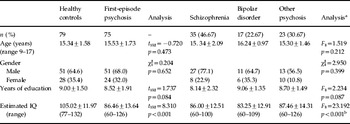
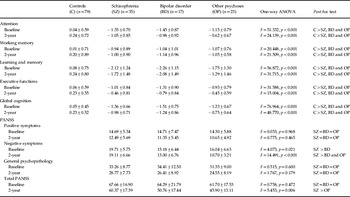
The healthy control group and the patient group had similar sociodemographic characteristics (Table 2). As at baseline, at the 2-year follow-up all EOP diagnostic subgroups showed poorer cognitive functioning than the control group in all cognitive areas (attention, working memory, verbal learning and executive functions), with no significant differences between diagnostic subgroups (Table 3).
Sociodemographic data for healthy control and patient groups at baseline

a Analysis comparing the four groups: healthy controls, schizophrenia, bipolar disorder, and other psychosis.
b Bonferroni post-hoc test for the ANOVA: healthy controls had higher IQ than schizophrenia, bipolar disorder and other psychosis.
Values given as n (%) or mean ± standard deviation.
Comparison of neuropsychological performance and psychotic symptoms between controls and the three patient subgroups at baseline and 2-year assessments

PANSS, Positive and Negative Symptom Scale.
No association between antipsychotic medication (in the form of chlorpromazine equivalents) and cognitive functioning was found at either of the two assessments (baseline: p > 0.634; 2-year: p > 0.512). At baseline, only executive functions showed a significant correlation with symptoms, specifically with the PANSS negative subscale (r = − 0.233, p = 0.037). At 2 years, no association was found between PANSS scores and any cognitive domain (p > 0.155).
Longitudinal results
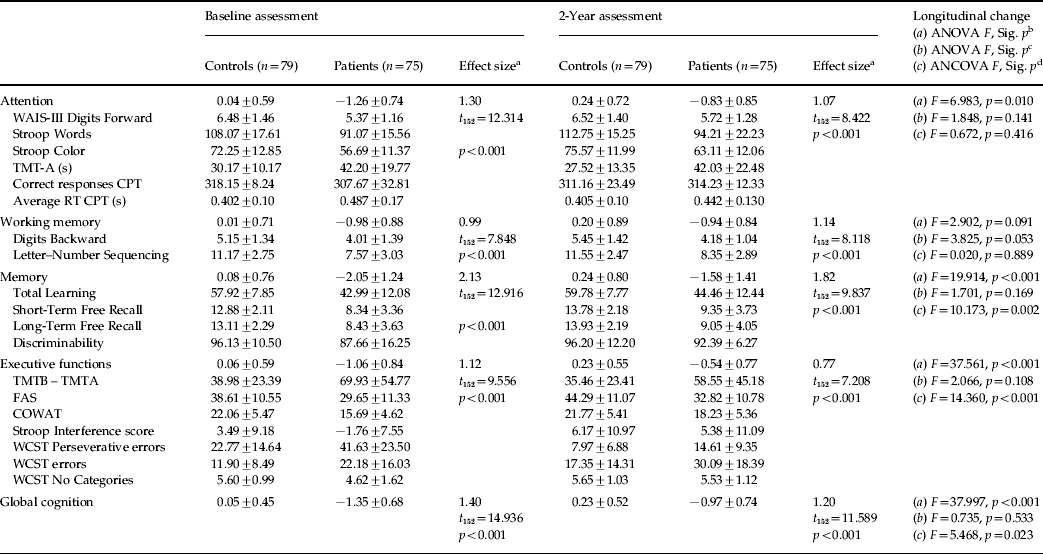
The main longitudinal results are presented in Table 4. Healthy controls and EOP patients both improved in all cognitive measures except for working memory, with no significant time/group interactions. However, for working memory, because the time/group interaction was close to significance and the z scores of both groups (patients versus controls) suggested different developmental patterns, a t test for repeated measures was performed for patients and controls separately, showing that only healthy controls improved in working memory (patients: t = − 0.364, p = 0.717; controls: t = − 2.220, p = 0.029).
Change in cognitive performance at follow-up in EOP patients and healthy controls
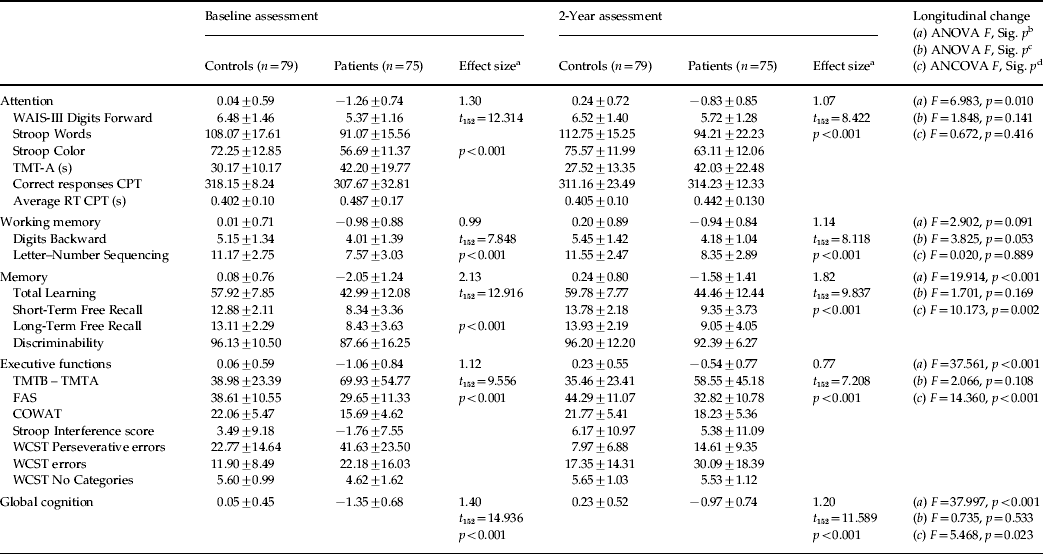
EOP, Early-onset psychosis; WAIS-III, Wechsler Adult Intelligence Scale, 3rd Edition; TMT-A, Trail Making Test, part A; CPT, Conners' Continuous Performance Test; RT, reaction time; TMTB – TMTA, time to complete TMT-B minus time to complete TMT-A; FAS, verbal fluency test; COWAT, Control Oral Word Association Test (semantic category ‘animals’); WCST, Wisconsin Card Sorting Test. Cognitive area summary scores are presented as z scores, and raw scores are presented for single test measures.
a Effect size of differences between healthy controls and EOP patients expressed as standard deviations.
b Repeated-measures ANOVA within-subjects effects.
c Repeated-measures ANOVA within-subjects effects: interaction time × diagnostic group (Group: healthy controls, schizophrenia, bipolar disorder, and other psychosis).
d Repeated-measures ANCOVA within-subjects effects for patients only, using symptom reduction at follow-up as covariate.
Among patients, improvements in attention correlated with a decrease in symptom severity (baseline PANSS minus follow-up PANSS): PANSS positive symptoms (r = 0.349, p = 0.008 and r = 0.318, p = 0.016 respectively), PANSS general psychopathology (r = 0.559, p < 0.001 and r = 0.492, p < 0.001 respectively) and PANSS total score (r = 0.478, p < 0.001 and r = 0.431, p = 0.001 respectively). A decrease in symptom severity did not correlate with changes in working memory, verbal memory or executive functions. Given the significant decrease in psychotic symptoms (t test for repeated measures = 3.587, p = 0.001) in patients over the follow-up and the fact that the decrease in symptoms correlated with improvement in attention, a repeated-measures ANCOVA was performed with symptom decrease (baseline positive, negative and general psychopathology PANSS subscales minus follow-up positive, negative and general psychopathology PANSS subscales respectively) as covariate. Improvements in attention in the EOP group lost significance (F = 0.672, p = 0.416) when doing so, because the reduction in the PANSS general psychopathology subscale fully accounted for the change in attention (F = 15.832, p < 0.001). Symptom reduction did not contribute significantly to changes in working memory (p = 0.188), learning and memory (p = 0.648) or executive functions (p = 0.095). No significant time/group interaction (schizophrenia, bipolar disorder, other psychoses) was found when controlling for symptom reduction (p > 0.405).
Discussion
Our results show that patients with EOP have significant cognitive impairment in attention, working memory, learning and memory, and executive functions at their first episode, and that the degree of such impairment remains stable over the first 2 years of illness. The difference (degree of impairment) between controls and patients mainly remained stable over the follow-up (see Table 4), and the slight decrease in the degree of impairment seems to be due to a magnifying effect of more severe symptomatology at baseline, as highlighted by the role of symptom decrease in the improvement in attention. After controlling for symptom reduction, patients did not show significant changes (for better or worse) in attention or working memory, although their memory and executive functioning improved at follow-up whereas the control group improved significantly in all cognitive domains. These results lead to the conclusion that cognitive impairment in EOP patients is complete at the first episode, with a lack of further progression (i.e. static) from then on. The neurodevelopmental hypothesis is thus the most plausible explanation of the etiopathogenesis of cognitive impairment in our patient sample.
To our knowledge, this is the first study to longitudinally address the development of cognition in a sample of first-episode patients with EOP, with the exception of a previous report by our group with a much smaller, non-overlapping EOP patient sample (Mayoral et al. Reference Mayoral, Zabala, Robles, Bombin, Andres, Parellada, Moreno, Graell, Medina and Arango2008), and one by Frangou et al. (2008), who followed 20 patients with early-onset schizophrenia (EOS) and 20 healthy subjects over a 4-year period. This approach is indeed novel, not only because of the methodological design but also because of the unique opportunity to look into the late cognitive developmental stages of both psychotic patients and healthy subjects, and thus to contrast some of the main postulates of the neurodevelopmental hypothesis. The main results suggest that the time of onset and the nature of the cognitive impairments inherent to psychotic disorders are strongly linked to cognitive development milestones, rather than to a deleterious consequence of the psychotic disorder. In other words, cognitive impairment in psychotic disorders is one of the phenomena resulting from the abnormal neurodevelopment processes associated with the origin of such disorders, in such a way that cognitive impairment in patients with psychotic disorders seems to reach its plateau at the time that their healthy peers approach their full cognitive development. This hypothesis would explain the repeatedly reported presence of cognitive impairment at the time of the first episode in adult forms (Bilder et al. Reference Bilder, Goldman, Robinson, Reiter, Bell, Bates, Pappadopulos, Willson, Alvir, Woerner, Geisler, Kane and Lieberman2000; Addington & Addington, Reference Addington and Addington2002) and early-onset forms (Brickman et al. Reference Brickman, Buchsbaum, Bloom, Bokhoven, Paul-Odouard, Haznedar, Dahlman, Hazlett, Aronowitz, Heath and Shihabuddin2004; Fitzgerald et al. Reference Fitzgerald, Lucas, Redoblado, Winter, Brennan, Anderson and Harris2004) of psychoses, and the fact that the degree and pattern of cognitive impairment in psychotic disorders remain stable over the course of illness (Heaton et al. Reference Heaton, Gladsjo, Palmer, Kuck, Marcotte and Jeste2001; Szoke et al. Reference Szoke, Trandafir, Dupont, Meary, Schurhoff and Leboyer2008).
The conclusions of the study by Frangou et al. (2008) are that their sample of 20 patients with EOS showed stability in most cognitive functions, deterioration in verbal memory and attention, and improvement in attention and processing speed, whereas their sample of 20 matched healthy subjects improved in several memory measures, and in attention and processing speed. The authors conclude, as we did, that overall cognitive impairment in EOS remains stable over time. On closer inspection there are some discrepancies in the results, mainly with respect to verbal memory and attention. These discrepancies seem to be the result of the different methodological approaches used to compare the longitudinal assessment. The study by Frangou et al. (2008) used the Wechsler Memory Scale – Revised (WMS-R) age-corrected scores to assess verbal memory and attention, the only two cognitive domains where they reported some degree of deterioration in patients. The use of these age-corrected scores (based on the age norms provided by the WMS-R manual) implies that subjects are being compared with two different age groups at both assessment times (baseline and follow-up) and, given the early age at follow-up (mean = 15.58 years), the age group to whom patients were compared at follow-up was very likely to show a higher average performance level than the age group to whom they had been compared at baseline. Thus, to obtain the age-adjusted scores, subjects were compared with more stringent age norms at follow-up than at baseline. This approach itself may explain the poorer performance at follow-up, and in fact explains why other measures of attention improved over time (i.e. TMT-A, reported in the form of raw scores) and the minimal improvement in the control group. Moreover, when comparisons were limited to raw scores, Frangou et al. (2008), like us, reported only stability or improvement. To avoid this methodological limitation, we adopted the strategy of calculating z scores based on the performance of our healthy group at baseline (n = 98), in a manner similar to the way age norms are developed. The key point was the use of the same reference data (i.e. performance of healthy subjects at baseline) to obtain z scores both at baseline and follow-up. As a result, changes in z scores can only be explained by changes in cognition during follow-up, discarding the confounding factor introduced by using different age groups at both assessment times. Additionally, we also controlled for the potentially confounding impact of using very heterogeneous age norms on their development and the psychometric properties inherent to the use of a neuropsychological battery composed of multiple tests.
The neurodevelopmental hypothesis seems the best conceptual framework to explain these and previously reported findings regarding the presence of cognitive impairment at the first episode, and the stability of such impairment from then on. Furthermore, our results suggest that the nature and etiopathogenesis of cognitive impairment in EOP is poor, prematurely arrested cognitive development, rather than a loss of previously developed cognitive functions (i.e. the neurodegenerative hypothesis). The time at which cognition deviates from normal development seems to interact closely with normal neurodevelopment milestones, in consonance with previous reports assessing the neurodevelopmental hypothesis and birth cohort studies (Walker et al. Reference Walker, Diforio and Baum1999; Ismail et al. Reference Ismail, Cantor-Graae and McNeil2000; Rosa et al. Reference Rosa, Fananas, Bracha, Torrey and van Os2000; Cannon et al. Reference Cannon, Caspi, Moffitt, Harrington, Taylor, Murray and Poulton2002; Welham et al. Reference Welham, Isohanni, Jones and McGrath2009). Such studies report that patient pre-schizophrenic cognitive and academic differentiation from their healthy peers begins at 13–16 years of age (Fuller et al. Reference Fuller, Nopoulos, Arndt, O'Leary, Ho and Andreasen2002; Caspi et al. Reference Caspi, Reichenberg, Weiser, Rabinowitz, Kaplan, Knobler, Davidson-Sagi and Davidson2003; Welham et al. Reference Welham, Isohanni, Jones and McGrath2009). Our results suggest that this differentiation process reaches its zenith when cognitive development approaches completion in normal subjects, remaining stable from then on. This different early developmental process may give the false impression of progressive deterioration in psychosis patients versus their healthy peers, when in fact patients remain stable while cognitive functions continue to develop in healthy subjects (discussed earlier); this has been supported in previous research with pre-psychotic samples (Kremen et al. Reference Kremen, Buka, Seidman, Goldstein, Koren and Tsuang1998; Cannon et al. Reference Cannon, Bearden, Hollister, Rosso, Sanchez and Hadley2000; Reichenberg et al. Reference Reichenberg, Caspi, Harrington, Houts, Keefe, Murray, Poulton and Moffitt2009). This seems to be the case in our sample for attention and working memory, which remained stable during follow-up, whereas healthy subjects showed further development. Other longitudinal studies with first-episode schizophrenia patients have also shown a stable course of cognition, with occasional improvements attributed to practice effects or symptom reduction (Heaton et al. Reference Heaton, Gladsjo, Palmer, Kuck, Marcotte and Jeste2001; Szoke et al. Reference Szoke, Trandafir, Dupont, Meary, Schurhoff and Leboyer2008).
Our hypothesis of lack of development in patient cognition, as a differential pattern from healthy controls, is only partially confirmed, given that this was the case for attention and working memory but not for learning and memory and executive functions. The fact that learning and memory and executive functions did improve in both healthy subjects and patients may be related to the fact that executive functions do not reach their maximum development potential until early adulthood (Luna et al. Reference Luna, Thulborn, Munoz, Merriam, Garver, Minshew, Keshavan, Genovese, Eddy and Sweeney2001; Waber et al. Reference Waber, De Moor, Forbes, Almli, Botteron, Leonard, Milovan, Paus and Rumsey2007), and thus the same applies to memory subprocesses dependent on executive or frontal lobe development (i.e. learning strategies and free recall). If cognitive impairment in psychotic disorders is characterized by both an early deviation from normality and premature arrest of cognitive development, it is reasonable to expect that those cognitive functions that reach maturation at an earlier age show more premature interruption of development in psychotic disorders. Thus it could be the case, at some point during the ensuing years, that memory and executive functions further develop in healthy subjects, but that such development is interrupted at an earlier time in the EOP sample. An extension of the follow-up period could test this hypothesis.
As to the degree of impairment, the difference (size effect) between EOP patients and healthy subjects remained stable, with subtle changes, and was essentially very similar to the degree of impairment shown in adult forms of psychosis (Heinrichs & Zakzanis, Reference Heinrichs and Zakzanis1998; Quraishi & Frangou, Reference Quraishi and Frangou2002; Buchanan et al. Reference Buchanan, Davis, Goff, Green, Keefe, Leon, Nuechterlein, Laughren, Levin, Stover, Fenton and Marder2005; Osuji & Cullum, Reference Osuji and Cullum2005). It has been argued that early-onset forms of psychoses could be a more deleterious than adult-onset forms. This does not seem to be the case, at least with respect to cognitive functioning, possibly because both adult and early-onset forms of psychoses show very similar (if not identical) neurodevelopmental disturbances. Rather than the onset of illness interrupting normal cognitive, functional and emotional development, it seems that abnormal neurodevelopment is the key to the onset of psychotic disorders and accompanying phenomena. The early onset may have been associated with greater deviation from normal neurodevelopment but, in any case, it would be a quantitative rather than qualitative difference.
Most of the literature discussed above is limited to schizophrenia, whereas our sample includes several clinical diagnoses under the umbrella of psychotic disorders. Previous literature shows that bipolar disorder has a similar pattern of impaired/preserved cognitive functions, but to a lesser degree (Daban et al. Reference Daban, Amado, Bayle, Gut, Willard, Bourdel, Loo, Olie, Millet, Krebs and Poirier2002; Sanchez-Morla et al. Reference Sanchez-Morla, Barabash, Martinez-Vizcaino, Tabares-Seisdedos, Balanza-Martinez, Cabranes-Diaz, Baca-Baldomero and Gomez2009; Bora et al. Reference Bora, Yücel and Pantelis2010). Furthermore, longitudinal reports suggest a progressive decline of cognition in these patients (Lewandowski et al. Reference Lewandowski, Cohen and Ongur2011), which may be considered a major differentiation from schizophrenia. Our sample, however, does not show significant differences among diagnostic categories in the degree of cognitive impairment at baseline or follow-up or, more interestingly, in the pattern of cognitive development. This may be due to specific characteristics of the early forms of psychosis, among which early-onset bipolar disorder may represent a form with poorer prognosis than adult-onset bipolar disorder, or to the fact that the entire sample was bipolar type I with psychotic symptoms whereas this is not usually the case in other bipolar disorder samples, which are usually composed of patients with and without psychotic symptoms. A higher degree of cognitive impairment has been reported in bipolar disorder patients with a history of psychotic symptoms than in those without such history (Albus et al. Reference Albus, Hubmann, Wahlheim, Sobizack, Franz and Mohr1996; Martinez-Aran et al. Reference Martinez-Aran, Vieta, Reinares, Colom, Torrent, Sanchez-Moreno, Benabarre, Goikolea, Comes and Salamero2004). Thus it could be argued that the pattern of cognitive impairment and development, in keeping with the neurodevelopmental theory, is a feature of early-onset patients with enduring psychotic symptoms, regardless of their diagnosis. The continuum concept of psychotic disorders is not new (Sanches et al. Reference Sanches, Keshavan, Brambilla and Soares2008), and cognitive impairment is thus considered a trait feature and consistent endophenotype.
Among the main limitations of the study, the most relevant are the small sample size of the diagnostic subgroups, the short follow-up period, and the potential interference of the practice effect with performance in neuropsychological assessment. Larger sample sizes of diagnostic subgroups could have revealed small to moderate effect size differences. A close look at the data reveals differences in raw or z scores that would potentially reach statistical significance with larger samples, at least for the other psychosis subgroup in comparison with both schizophrenia and bipolar disorder. In addition, some of the conclusions presented here are hypotheses whose testing would require an extension of the follow-up period. Specifically, contrasting the hypothesis of an earlier arrest of cognitive development in patients with EOP would require that, at some point in a further follow-up, EOP patients stop improving in memory and executive functions while the healthy sample continues to improve in such functions for a longer period. Another limitation is that minor changes in cognitive development at follow-up may have been mediated by formal schooling. We did not control for the potential role of this variable because schooling is mandatory in Spain until the age of 16. However, there may have been differences in school drop-out rates between patients and controls older than 16 years of age whose impact in cognitive development was not analyzed. Finally, the practice effect is a methodological limitation inherent to all longitudinal neuropsychological studies. However, the degree of its confounding role in the study seems minimal, considering the long period between assessments and the fact that working memory measures did not improve in patients. The practice effect is more marked in assessments repeated in short periods of time, and has been reported to be ubiquitous among neuropsychological tests (Goldberg et al. Reference Goldberg, Keefe, Goldman, Robinson and Harvey2010). As a caveat, hypothesizing about the potential neurobiological processes leading to premature arrest of cognitive development in EOP patients was not an objective of the present study, and the methodology we used did not allow us to address this issue. However, the role of interneuron dysfunction has been proposed as a potential pathway (Marín, Reference Marín2012).
Besides the theoretical aspects, these results may also have clinical derivatives, with potential roles in both neuropsychological remediation and antipsychotic treatment. As some cognitive areas are still developing in EOP patients (executive functions and memory), it could be that the implementation of neuropsychological rehabilitation programs together with an effective early symptom-reducing pharmacological strategy could improve the natural cognitive development of these patients.
Acknowledgments
This study received financial support from the Spanish Ministry of Science and Innovation, Instituto de Salud Carlos III (ISCIII), Redes Temáticas – ISCIII G03/032; RETICS (REM-TAP Network) – RD06/0011; Centro de Investigación Biomédica en Red de Salud Mental (CIBERSAM); and the Alicia Koplowitz Foundation.
Declaration of Interest
None.