Introduction
Poplar (Populus sp.) is one of the most widespread cultivated and adaptive tree species in the world. The wood is used for paper, plywood, and engineered lumber. Many countries support poplar breeding programs, so a growing amount of land is being used to plant poplars, especially in China, South Korea, and the USA (Boyle et al., Reference Boyle, Winjum, Kavanagh and Jensen1999). Micromelalopha troglodyta (Graeser) is an important foliar pest of poplar trees (Guo et al., Reference Guo, Ji and Zhuge2007) that can spread broadly and cause heavy losses to poplar production (Ren et al., Reference Ren, Zhou, Dong, Zhang, Wang and Yang2021), and their larvae usually damage the mesophyll, leading to balding of poplar branches and decreasing growth. Over the past years, the characteristics of M. troglodyta have been well studied (Fan et al., Reference Fan, Zhang, Liu, Yu, Kong, Wang and Zhang2014; Guo et al., Reference Guo, Liu, Zhang, Kong and Zhang2019). In recent years, to reduce the losses caused by M. troglodyta and the use of chemical pesticides, an increasing number of scientists have come to believe that plant secondary metabolites can be used as alternatives to chemical pesticides (Pang et al., Reference Pang, Chen, Wang, Gao, Li, Guo, Xu and Cheng2021).
Tannic acid, a plant polyphenol that is commonly produced in many plants, is an important plant secondary metabolite in poplars. Tannic acid, as a plant allelochemical, causes adverse effects in insects (Cheng et al., Reference Cheng, Tang, Li and Xu2015). Although tannic acid is very toxic to M. troglodyta, they also have a certain amount of survival under tannic acid stress. Our laboratory reported that the expression of cytochrome P450 in M. troglodyta was induced during tannic acid stress (Shi et al., Reference Shi, Fu and Tang2019). The activity of glutathione S-transferase (GST) in M. troglodyta was activated after treatment with tannic acid (Tang et al., Reference Tang, Tu, Shang, Gao and Liang2020). These studies have shown that the upregulation of detoxification genes in M. troglodyta increases resistance to tannic acid. MicroRNAs (miRNAs) are important posttranscriptional regulators of gene expression in organisms. Thus, we speculate that miRNAs play a significant role in regulating the expression of detoxification-related genes in M. troglodyta.
miRNAs, a kind of noncoding and small single-stranded RNA (approximately 18–24 nucleotides), can block the expression of target genes at the posttranscriptional level (Meijer et al., Reference Meijer, Kong, Lu, Wilczynska, Spriggs, Robinson, Godfrey, Willis and Bushell2013). In eukaryotes, miRNAs inhibit the translation of target mRNAs (messenger RNAs) by binding to 3′ untranslated regions (UTRs), 5′ UTRs, or coding sequences (Bartel, Reference Bartel2009; Rigoutsos, Reference Rigoutsos2009; Yokoi and Nakajima, Reference Yokoi and Nakajima2013). Previous studies have shown that miRNAs act as negative regulators of gene expression and are involved in regulating the balance of biological and physiological processes (Ambros, Reference Ambros2004; Bartel, Reference Bartel2004, Reference Bartel2009; Pillai, Reference Pillai2005; Kloosterman and Plasterk, Reference Kloosterman and Plasterk2006; Vasudevan et al., Reference Vasudevan, Tong and Steitz2007). In insects, numerous studies have proven that miRNAs are involved in regulating the immune system, wing disc development, neurogenesis, cell death and proliferation, and metamorphosis (Bartel and Chen, Reference Bartel and Chen2004; Asgari, Reference Asgari2013).
The precise identification and analysis of differentially expressed miRNAs under xenobiotic stress are well known to be essential steps to explore their important roles in resisting xenobiotic stress in pests. To acquire the miRNAs of insects, high-throughput sequencing is usually used to identify miRNAs. Ma et al. found that miRNAs played potential regulatory roles in the response of Aphis gossypii Glover (Hemiptera: Aphididae) to tannic acid and gossypol (Ma et al., Reference Ma, Li, Liang, Chen, Liu, Tang and Gao2017a). Ma et al. demonstrated that miR-656a-3p regulated the expression of CYP6J1 and improved the adaptation to plant allelochemicals in A. gossypii (Ma et al., Reference Ma, Li, Liu, Liang, Chen and Gao2017b). Let-7 and miR-100 were highly inversely correlated with the expression of CYP6CY3 involved in nicotine tolerance in Myzus persicae nicotianae (Peng et al., Reference Peng, Pan, Gao, Xi, Zhang, Ma, Wu, Zhang and Shang2016). Two novel miRNAs targeted CYP6ER1 and CarE1 coding regions which changed the susceptibility of Nilaparvata lugens to nitenpyram (Mao et al., Reference Mao, Jin, Ren, Zhang, Li, He, Ma, Wan and Li2021). The miRNAs regulate the expression of the ryanodine receptor gene and improve chlorantraniliprole resistance in Plutella xylostella (Li et al., Reference Li, Guo, Zhou, Gao and Liang2015). MiR-4133-3p was discovered to participate in the expression of CYP4CJ1, which mediated the tolerance to plant allelochemicals in A. gossypii (Ma et al., Reference Ma, Li, Tang, Liang, Liu, Zhang and Gao2019).
Although miRNAs play a significant role in the physiological regulation of insects, the function of miRNAs in M. troglodyta has not been explored. To advance the understanding of the role of miRNAs responding to tannic acid in M. troglodyta, six small noncoding RNA (sRNA) libraries of third-instar larvae midguts were sequenced to identify miRNAs in M. troglodyta. Through this study, we hope to reveal the complicated miRNA-mRNA network that potentially determines the tannic acid regulatory cascade in M. troglodyta. Therefore, this study increases our knowledge of how miRNAs regulate detoxification genes and would be useful for exploring novel methods for controlling M. troglodyta in the future.
Material and methods
Insect rearing and tannic acid treatment
Micromelalopha troglodyta larvae were collected from poplar trees in Nanjing, Jiangsu Province, China. The larvae were fed in a rearing box at 26 ± 1°C and a relative humidity of 70–80% for 16 h:8 h (light: dark) and fresh polar leaves were supplied to the larvae. Tannic acid was purchased from Sigma Company (Sigma Chemical, St. Louis, MO, USA). Tannic acid was dissolved in a small amount of ethanol and then diluted in sterilized water to concentrations of 0.1 mg ml−1.
Fresh poplar leaves were immersed in tannic acid solutions for 10 s and then dried naturally at room temperature. Treated leaves were placed into a plastic box with 20 third-instar larvae (treatment group, TT), and 20 third-instar larvae feeding on leaves treated with sterilized water were regarded as the control (control group, CK). The larvae were fed for 96 h and each treatment was repeated three times. The midguts of M. troglodyta were dissected on ice, and then every midgut was washed with 1.15% precooled KCl solution. All samples were stored at −80°C for sRNA sequencing.
RNA isolation and sRNA sequencing
Total RNA was extracted from M. troglodyta midguts using a TRIzol Total RNA Isolation Kit (Takara, Dalian, China) according to the manufacturer's protocol. The concentration and quality of total RNA were measured by a NanoDrop spectrophotometer (Thermo Fisher Scientific, Waltham, MA, USA), and the integrity of RNA was monitored using a 1% agarose gel.
After isolating the total RNA from the M. troglodyta midguts, the sRNAs (18–30 nt) were separated by 15% gel and purified (Tariq et al., Reference Tariq, Peng, Saccone and Zhang2016), and the 5′ RNA adapter and 3′ RNA adapter were ligated by using T4 RNA ligase and gel purification, respectively. Then these products were amplified by reverse transcription polymerase chain reaction (RT-PCR). Finally, PCR products were sequenced using Illumina HiSeq 2000 platform at the Beijing Genomics Institute (BGI, Shenzhen, China).
Bioinformatics analysis of sRNA sequences
The sRNA sequencing data were analyzed according to previous research (Huang et al., Reference Huang, Dou, Liu, Wei, Liao, Smagghe and Wang2014). To acquire clean reads, low-quality reads without 5′ adapters or without 3′ adapters, reads containing poly A, insert tag, and sequences (fewer than 18 nt) were removed from raw data reads. Then, the acquired high-quality reads were mapped into databases including RFAM10.1 (http://rfam.janelia.org/) and National Center for Biotechnology Information (NCBI, http://www.ncbi.nlm.nih.gov/) by Bowtie software to identify the possible small nuclear RNA (snRNA), transfer RNA (tRNA), ribosomal RNA (rRNA), small nucleolar RNA (snoRNA), and repeat sequences. To screen known miRNAs of M. troglodyta, we applied miRDeep2 software to examine the clean reads (remaining unmapped) against known animal miRNAs in miRBase version 21.0 (http://www.mirbase.org/; Friedländer et al., Reference Friedländer, Mackowiak, Li, Chen and Rajewsky2012). Finally, the residual reads were aligned with the M. troglodyta transcriptome to predict novel miRNAs. To verify the predicted novel miRNAs, MIREAP software (https://sourceforge.net/projects/mireap/) was employed to predict the secondary structure, dicer cleavage sites, and minimum free energy.
Differentially expressed miRNAs in M. troglodyta treated with tannic acid
To identify differentially expressed miRNAs in all M. troglodyta libraries, the expression of miRNAs in six libraries was normalized to transcripts per million (TPM) (Abdi, Reference Abdi2007). Then, we used DEseq2 software to perform a differential expression analysis of miRNAs (Love et al., Reference Love, Huber and Anders2014). In this study, DEseq2 software was employed to identify differentially expressed miRNAs, and a fold change > 2 and P values < 0.05 were set as the thresholds to search for significantly differentially expressed miRNAs between M. troglodyta treated with tannic acid and the control.
Target prediction and functional analysis
We used the same samples for small RNA sequencing and transcriptome sequencing. After generating high-quality clean data, de novo assembly was carried out using Trinity software (Grabherr et al., Reference Grabherr, Haas, Yassour, Levin, Thompson, Amit, Adiconis, Fan, Raychowdhury, Zeng, Chen, Mauceli, Hacohen, Gnirke, Rhind, di Palma, Birren, Nusbaum, Lindblad-Toh, Friedman and Regev2011). The transcriptome database of M. troglodyta (accession number: PRJNA843371) was aligned by miRNA sequences to determine potential target genes of differentially expressed miRNAs. Three software programs were selected to analyze the alignment results, including RNAhybrid (Krüger and Rehmsmeier, Reference Krüger and Rehmsmeier2006), miRanda (Enright et al., Reference Enright, John, Gaul, Tuschl, Sander and Marks2003), and TargetScan (Agarwal et al., Reference Agarwal, Bell, Nam and Bartel2015). To obtain more reliable results, we picked only those targets that were identified by all three methods. To obtain significantly enriched terms, these potential target genes were mapped to the Gene Ontology (GO) database, and the number of genes for each GO term was counted by using Blast2GO and a corrected P values (≤0.05) as thresholds (Conesa and Götz, Reference Conesa and Götz2008). KEGG pathway functional analysis was performed to identify significantly enriched pathways using KOBAS software and corrected P values (≤0.05) as the threshold (Mao et al., Reference Mao, Cai, Olyarchuk and Wei2005). The GO results were classified into three groups: cellular component, molecular function, and biological process. KEGG pathways were grouped into different metabolic functions and signal transduction pathway.
Real-time fluorescent quantitative PCR (qRT-PCR) validation
qRT-PCR analysis of ten differentially expressed miRNAs was performed to verify the expression levels of miRNAs shown by sequencing data. Total RNA was extracted from M. troglodyta as described earlier. One microgram of RNA was treated with DNase I following the manufacturer's guidelines, and complementary DNA was synthesized using a Mir-X miRNA First-Strand Synthesis kit (Takara). The primers applied for qRT-PCR experiments are listed in table S1, and the U6 sRNA was used as an internal reference. The qRT-PCR was carried out on ABI ViiA™ 7 real-time PCR Systems (Applied Biosystems, Foster City, CA, USA) following the manufacturer's protocol. To determine whether the primer can be used, Linreg PCR software was employed to analyze the qRT-PCR data to define the amplification efficiency of each pair of primers. The amplification cycling parameters were: 95°C for 10 s, 40 cycles of 95°C for 5 s, and 60°C for 20 s and a dissociation curve was generated (parameters were: 95°C for 60 s, 55°C for 30 s, and 95°C for 60 s) to confirm the purity of the PCR products. The relative expression of genes was indicated using the 2−ΔΔCt method (Livak and Schmittgen, Reference Livak and Schmittgen2001). Three replicates were conducted for each sample.
Results
Characteristics of sRNA sequencing data in M. troglodyta
Six small RNA libraries of M. troglodyta were constructed for the control groups (feeding on fresh poplar leaves immersed in sterilized water) and treatment groups (feeding on poplar leaves immersed in tannic acid solution), with three replicates per group. In total, 12,804,621, 12,135,506, 12,359,900, 12,574,423, 12,134,302, and 12,659,314 high-quality reads were obtained for each sample, respectively (table 1). After filtering out low-quality reads, including 5′ adapter-contaminants, 3′ adapter-null, insert-null, and reads shorter than 18 nt, 12,438,806 (97.14%), 11,833,024 (97.51%), 11,854,459 (95.91%), 12,347,075 (98.19%), 11,627,868 (95. 83%), and 12,228,722 (96.6%) clean reads were acquired for subsequent experimental analysis, respectively (table 1). The length distribution of the six libraries showed that most of the sRNAs ranged from 16 to 32 nt with two distinct peaks (one peak at 20–22 nt and another at 26–28 nt) (fig. 1). The Pearson correlation analysis showed correlation coefficients of 0.8–0.9 for these libraries (fig. S1).
Length distribution and abundance of combined small RNAs in M. troglodyta. Different colors represent different libraries. The x-axis represents the small RNA length distribution and the y-axis represents the frequency percentage. This length distribution was assessed using clean reads after filtering out the redundant small RNAs.

The classification of total small RNAs of M. troglodyta by sequencing

sRNAs annotation in M. troglodyta
After removing the low-quality reads, we obtained clean reads from sRNA libraries, which were used for mapping to the M. troglodyta transcriptome. As a result, 7,352,259, 8,227,455, 7,805,143, 8,085,023, 8,864,893, and 8,128,081 clean reads were extracted from the control group and treatment group, respectively (table 2). Approximately 59–76% of the clean reads accurately matched the M. troglodyta transcriptome. The annotation of sRNAs was executed following the rule of known miRNAs (rRNAs, tRNAs, snRNAs, etc.) > uncharacterized short RNAs (Calabrese et al., Reference Calabrese, Seila, Yeo and Sharp2007). The annotation of sRNA reads was categorized into six groups, including miRNA, rRNA, snoRNA, snRNA, tRNA, and unannotated (fig. S2). The composition and number of sRNA classes in each library are displayed in the Supplementary Material (fig. S3).
The mapping statistics of sRNAs from six libraries of M. troglodyta

Identification of known and novel miRNAs in M. troglodyta
In each library, known miRNAs of TPM higher than 1000 involved 249, 256, 221, 267, 282, and 218, respectively (table S2). Furthermore, the ten most abundant known miRNAs from each sample are also listed in table 3. Four of them (miR-541-3p, miR-7134-3p, miR-6497, miR-1229-5p) were abundant in all samples; however, five known miRNAs (miR-432, miR-222a-5p, miR-2527, miR-752-3p, and miR-81-3p) were only abundant in the treatment groups. In addition, the unmapped sequences were used to predict novel miRNAs. Forty-three novel miRNAs were identified in six libraries (table S3). Novel miRNA prediction of M. troglodyta was summarized according to the nucleotide bias on the first position from the 5′ end and nucleotide bias on each position (fig. S4).
The 10 most abundant known miRNAs in M. troglodyta treated by tannic acid and the control

Expression profiles of known miRNAs and novel miRNAs in M. troglodyta
The TPM values for each library of the known miRNAs are shown in Supplementary table S2. To better comprehend the differentially expressed miRNAs in M. troglodyta treated with tannic acid, differentially expressed miRNAs analyses were carried out using the sequencing data (fig. 2a). The analysis results showed that 312 known miRNAs were differentially expressed in the treatment group compared with the control group. Furthermore, these differentially expressed miRNAs target 1367 genes (table S4) and 1588 target sites (table S5). For novel miRNAs of M. troglodyta, differential expression analysis was performed using the sequencing data (fig. 2b). The results showed that a total of 43 novel miRNAs were differentially expressed.
Volcano plot of differentially expressed miRNAs in M. troglodyta treated with tannic acid compared to the control. (a) The volcano plot represents differentially expressed known miRNAs; (b) the volcano plot represents differentially expressed novel miRNAs. The x-axis shows the fold change in gene expression between the treatment groups and control groups, and the y-axis shows the statistical significance of the difference. A log2-fold change > 2 represents upregulated genes; a log2-fold change < 2 represents downregulated genes.

Validation of differentially expressed miRNAs by qRT-PCR
To confirm the expression levels of miRNAs in the sequencing results of M. troglodyta, ten differentially expressed miRNAs were randomly selected and analyzed by qRT-PCR (fig. 3). The U6 sRNA was used as the internal reference for qRT-PCR normalization. The expression patterns of these miRNAs in qRT-PCR were consistent with those in the sequencing data.
qRT-PCR validation of ten selected differentially expressed miRNAs to confirm the expression pattern detected by sRNA sequencing in M. troglodyta. Error bars represent ±standard deviation (SD) from three independent experiments. U6 was used as an internal reference.

Functional analysis of miRNA target genes in M. troglodyta
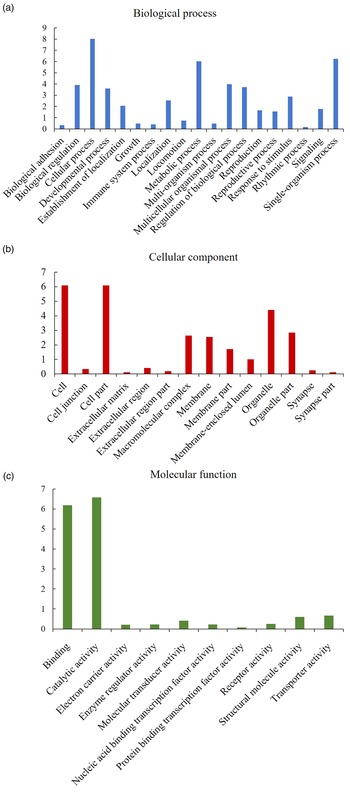
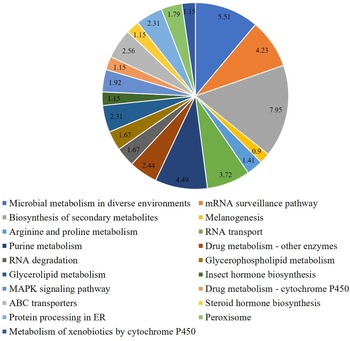
To explore the function of differentially expressed known miRNA, we employed the GO and KEGG databases to annotate their putative targets. For GO annotations, these target genes were divided into three gene ontology classes associated with molecular function, biological process, and cellular component (fig. 4). GO categorization showed that differential genes were most enriched in cellular process, metabolic process, single-organism process, cell, cell part, binding and catalytic activity. We focused on metabolic processes in M. troglodyta treated with tannic acid. Then KEGG pathway enrichment analysis revealed several important pathways that were significantly enriched in M. troglodyta in response to tannic acid. The enriched metabolic pathways included microbial metabolism in diverse environments, drug metabolism-cytochrome P450, metabolism of xenobiotics by cytochrome P450, and purine metabolism. The enriched cell growth and development pathways included insect hormone biosynthesis, steroid hormone biosynthesis, melanogenesis and mitogen-activated protein kinase (MAPK) signaling pathway. Other pathways were enriched including ABC transporters, biosynthesis of secondary metabolites, and mRNA surveillance pathways (fig. 5).
Gene Ontology (GO) categories for miRNA target genes in M. troglodyta. Target genes were classified into the categories biological processes (a), cellular components (b), and molecular function (c). Values on the y-axis are the percentage of target genes in different functional categories.

Annotation of miRNA targets based on Kyoto Encyclopedia of Genes and Genomes (KEGG) orthology in M. troglodyta. Values are the percentage of target genes in different functional categories.

miRNAs responding to tannic acid in M. troglodyta
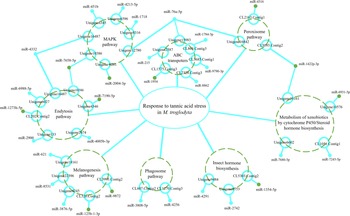
Further analysis revealed that some miRNAs were differentially expressed in M. troglodyta that fed on tannic acid-treated poplar leaves compared with M. troglodyta fed on untreated poplar leaves. From the KEGG pathway of target unigenes, we selected those miRNAs that have known or predicted functions in the host response mode against xenobiotics stress and visualized them in a miRNA-mRNA regulatory network (fig. 6).
Predicted interactions between miRNAs and target genes involved in the response to tannic acid stress in M. troglodyta. The figure displays a network of target genes for each miRNA. Green dots indicate decreased expression and blue dots indicate increased expression of the specific miRNAs in response to tannic acid stress. miRNAs and target genes shown in the Supplementary table S6.

For xenobiotic metabolism and steroid hormone biosynthesis, miR-7243-5p was predicted to target uridine diphosphate-glycosyltransferase 49 (UGT49) (CL1051.Contig1) and UGT35 (Unigene10576) were recognized as putative targets of miR-6931-5p. These differentially expressed detoxification genes were regulated by miRNAs to resist tannic acid in M. troglodyta. For insect hormone biosynthesis, miR-2742, miR-4291, and miR-1354-5p were found to target carboxylesterase 5 (Unigene8753), carboxylesterase 3 (Unigene9484) and carboxylesterase (CL5303.Contig2); in the MAPK pathway, miR-1718 and miR-7658-5p were predicted to target JNK-interacting protein 3 (Unigene8316) and adenylyl cyclase-associated protein 1 (Unigene10386). The MAPK pathway and insect hormone biosynthesis are two important pathways involved in development in insects, and several miRNAs target genes in the two pathways. Therefore, we think that tannic acid may affect the development of M. troglodyta. For the ABC transporter, multidrug resistance-associated protein 4-like (ABCC4) (CL2328.Contig3) were identified as a putative target of miR-8862. ABCC4 belongs to the ABC superfamily, and the interaction between miR-8862 and ABCC4 may improve the adaptation of M. troglodyta to tannic acid. For M. troglodyta immunity, we found some differentially expressed miRNAs in the phagosome pathway, endocytosis pathway, melanogenesis pathway and peroxisome pathway, which regulated these pathways by interacting with the target genes. In total, we obtained the miRNAs involved in resisting tannic acid stress in M. troglodyta by sRNA sequencing.
Discussion
Micromelalopha troglodyta has become the major foliar pest of poplar (Guo et al., Reference Guo, Ji and Zhuge2007). To resist damage from pests, plants protect themselves from herbivorous insects by producing allelochemicals such as tannins, phenolics, and flavonoids (War et al., Reference War, Paulraj, Ahmad, Buhroo, Hussain, Ignacimuthu and Sharma2012). Previous studies have shown that plant allelochemicals have a strong influence on insects. For instance, harmful effects were observed when H. armigera larvae were exposed to gossypol (Mao et al., Reference Mao, Cai, Wang, Hong, Tao, Wang, Huang and Chen2007; Celorio et al., Reference Celorio-Mancera, Ahn, Vogel and Heckel2011). Likewise, two polyphenolic flavonoids (quercetin and naringenin) have been reported to lead to adverse effects in A. pisum by influencing fecundity, mortality, and development (Goławska et al., Reference Goławska, Sprawka, Łukasik and Goławski2014). As an important poplar pest, M. troglodyta suffers a variety of plant allelochemicals in its life cycle, including tannic acid. There is no doubt that plant allelochemicals have strongly unfavorable effects on M. troglodyta; for instance, Tang et al. found that plant allelochemicals adversely affected the GSTs of M. troglodyta (Tang et al., Reference Tang, Zhang, Liu, Gao and Liu2014). In addition, tannic acid could induce the activity of the detoxification enzymes of M. troglodyta (Tang et al., Reference Tang, Tu, Shang, Gao and Liang2020). Therefore, we guessed that miRNAs may play a significant role in the interaction between tannic acid and detoxification enzymes in M. troglodyta.
The sRNAs include miRNAs, piwi-interacting RNAs (piRNAs) and small interfering RNAs according to previous research (Lucas and Raikhel, Reference Lucas and Raikhel2013). The length distribution of our small RNA libraries showed two peaks: one at 20–22 nt and the second at 26–28 nt (fig. 1), representing typical miRNAs and piRNAs. piRNAs are commonly identified in insects (Yu et al., Reference Yu, Zhou, Li, Luo, Cai, Lin, Chen, Yang, Hu and Yu2008; Cristino et al., Reference Cristino, Tanaka, Rubio, Piulachs and Belles2011; Zhang et al., Reference Zhang, Zheng, Jagadeeswaran, Ren, Sunkar and Jiang2012) and act as silencers by mapping specific sequences in many organisms (Kawaoka et al., Reference Kawaoka, Arai, Kadota, Suzuki, Hara, Sugano, Shimizu, Tomari, Shimada and Katsuma2011). The present study was conducted to identify the miRNAs of M. troglodyta and to explore the potential functions of miRNAs in the metabolism of tannic acid. miRNAs have been proven to participate in biological processes in the past few years. Therefore, it is rational to speculate that miRNAs potentially function in M. troglodyta responses to allelochemicals, including tannic acid. The identification and functional analysis of miRNAs in M. troglodyta treated with tannic acid can provide new insight into the mechanisms underlying the insect response to plant allelochemicals. Some conserved miRNAs, such as miR-432, miR-541-3p, miR-4448, miR-7134-3p, and miR-1229-5p (table 3), showed the most abundant expression in the six libraries, which indicated that these miRNAs may play vital roles in regulating the development of M. troglodyta or adaptation to stress. miR-432, as a highly expressed miRNA, has been shown to regulate myoblast proliferation differentiation and immunity in previous studies (Ren et al., Reference Ren, Liu, Zhao and Cao2016; Sharma et al., Reference Sharma, Kumawat, Rastogi, Basu and Singh2016); miR-541-3p was involved in the metastasis and epithelial-mesenchymal transition of hepatocellular carcinoma (Xia et al., Reference Xia, Ren, Li and Gao2019); miR-4448 participated in deltamethrin resistance by targeting CYP4H31 in the mosquito (Li et al., Reference Li, Hu, Yin, Zhang, Zhou, Sun, Ma, Shen and Zhu2021). In previous reports, miR-7134-3p and miR-1229-5p, as regulators of gene expression, were associated with diseases in mammals (Wang et al., Reference Wang, Li, Bai, Yang, Ling and Fang2017; Li et al., Reference Li, Yang, Yan, Xu, Ma, Shao, Cao, Wu, Qi, Wu, Chen, Hong, Tan and Yang2018). Combining the abovementioned results, we think that these miRNAs regulate the M. troglodyta genes in response to tannin stress and are worthy of further investigation.
High-throughput sequencing technology has accelerated the miRNA research in mammals or insects. Thus, this study intended to identify the miRNAs that respond to plant allelochemicals in M. troglodyta treated with tannic acid. Differential expression analysis showed that 312 known miRNAs and 43 novel miRNAs were differentially expressed compared to the control (figs 2a, b), indicating that tannic acid affects miRNA expression, thus implying an actual role for miRNAs in regulating the metabolism of tannic acid in M. troglodyta. In view of the results of the GO annotation and KEGG pathway analysis, we predicted that miRNAs were involved in the metabolism of tannic acid in M. troglodyta. For GO annotation, the predicted target genes were classified into three main categories: biological processes, cellular components, and molecular functions (fig. 4a). For the KEGG pathway, we focused on the pathways of the tannic acid response in M. troglodyta (fig. 4b), such as microbial metabolism in diverse environments, steroid hormone biosynthesis, metabolism of xenobiotics by cytochrome P450, ABC transporters, etc. Previously, similar GO and KEGG analyses of the predicted target genes were obtained in P. xylostella in response to chlorantraniliprole (Zhu et al., Reference Zhu, Li, Liu, Gao and Liang2017).
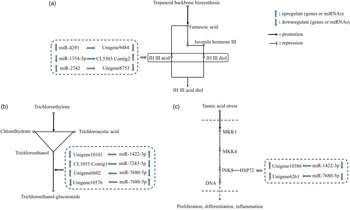
Many target genes associated with plant allelochemical resistance were discovered in our sequencing data (fig. 6), including UGTs, ABC transporter family members, carboxylesterases, JNK-interacting protein 3, importin-5-like (Unigene16487) and some other immune-related proteins. In a previous study, a member of the ABC transporter family was confirmed to be involved in the resistance to chlorantraniliprole in P. xylostella (Lin et al., Reference Lin, Jin, Hu, Chen, Yin, Li, Dong, Zhang, Ren and Feng2013). Carboxylesterase and UGTs, which are involved in insect hormone biosynthesis and metabolism of the xenobiotics pathway, have already been reported as important genes for adapting to tannic acid stress in M. troglodyta (Tang et al., Reference Tang, Wang and Gao2008; Feng et al., Reference Feng, Tang, Zhang and Nong2021). Several UGTs were found to participate in the detoxification process in humans, such as UGT2A1 (Perreault et al., Reference Perreault, Gauthier-Landry, Trottier, Verreault, Caron, Finel and Barbier2013). JNK-interacting protein 3 is an important component of MAPK, and MAPK relays exogenous stimuli to intracellular responses including environmental stress (Cargnello and Roux, Reference Cargnello and Roux2011; Horton et al., Reference Horton, Wang, Camp, Price, Arshi, Nagy, Nadler, Faeder and Luckhart2011; Ragab et al., Reference Ragab, Buechling, Gesellchen, Spirohn, Boettcher and Boutros2011). Then, the genes in the MAPK pathway can trigger the expression of detoxification genes upon selection (P450 genes) by xenobiotics (Wetzker and Böhmer, Reference Wetzker and Böhmer2003; Goldsmith and Dhanasekaran, Reference Goldsmith and Dhanasekaran2007; Li et al., Reference Li, Liu, Zhang and Liu2014; Hill et al., Reference Hill, Sharan and Watts2018). In this study, we also showed the interaction between miRNAs and target genes in three pathways including insect hormone biosynthesis, metabolism of xenobiotics by cytochrome P450, and the MAPK pathway (fig. 7). Furthermore, some miRNAs interacting with immune genes were identified in our study, such as genes in the melanogenesis pathway, endocytosis pathway, phagosome pathway, and peroxisome pathway (fig. 6 and table S6). Therefore, numerous miRNAs were conjectured to be involved in the tannic acid response in M. troglodyta according to the differential expression patterns of miRNAs and the prediction of target genes in this study. The research results have shown that many pathways may be involved in the detoxification of tannic acid in M. troglodyta. To further elucidate the function of these miRNAs in the tannic acid response, overexpression and knockdown expression experiments should be implemented in vivo.
Several pathways in response to tannic acid stress in M. troglodyta. (a) Diagram of insect hormone biosynthesis. (b) Partial metabolism of xenobiotics by cytochrome P450 diagrammatic sketch. (c) Diagram of a partial mitogen-activated protein kinase (MAPK) pathway.

Supplementary material
The supplementary material for this article can be found at https://doi.org/10.1017/S0007485322000359.
Acknowledgements
This work was supported by grant from the National Natural Science Foundation of China (31370652), Postgraduate Research & Practice Innovation Program of Jiangsu Province (No. KYCX21_0924), and a project funded by the Priority Academic Program Development of Jiangsu Higher Education Institutions.
Conflict of interest
None.