INTRODUCTION
Being the next of kin to an old person who is dying implies emotional stress due to the imminent loss of a loved one but also to the responsibility involved in participating in his or her care. The situation can be both practically and emotionally onerous, but it can also bring the satisfaction of being able to contribute in the last phase of life. The experience of being next of kin to an old person at the end of life has barely been explored and more knowledge is needed. Such knowledge is particularly important because the next of kin is often involved in the care of the person even when that person receives public care.
Being next of kin to an old person at the end of life might differ from being next of kin to someone younger, as death in old age is perceived as “natural” and the needs of the dying person are probably different. Older people at the end of their life have a long history and are often affected by several diseases and health complaints (cf. Andersson et al., Reference Andersson, Hallberg and Edberg2006) compared to younger people. Death in old age is also frequently preceded by a period of frailty and dependency (Andersson et al., Reference Andersson, Hallberg and Edberg2007). In Sweden, the municipalities are responsible for the provision of care and service to old people and 15% of those aged 65+ years receive such help and care. The older the person is the more help and service they receive (National Board of Health and Welfare, 2005). Apart from help from the municipality, informal caregivers provide a considerable amount of help for older people. A study by Hellström and Hallberg (Reference Hellström and Hallberg2001) among people aged 75 years and older living at home showed that the help they received was mainly provided by informal caregivers (84.1%) and, of the sample, 38.8% received such help in combination with public care. Older people at the end of life also receive a considerable amount of care from informal caregivers (Andersson et al., Reference Andersson, Hallberg and Edberg2007). A study in Holland by Visser et al. (Reference Visser, Klinkenberg and Broese Van Groenou2004) showed that among the informal caregivers (N = 56) tending dying people (mean age 79.3 years), most had been caregivers for a longer period, and almost half (26 of 56) for more than a year. Thus, although public help and care is provided, next of kin are heavily involved in the older person's care.
The help and care next of kin provide for older people approaching death might vary depending on whether or not they live with the person they help. The study by Visser et al. (Reference Visser, Klinkenberg and Broese Van Groenou2004) showed that the type of help and care provided by informal caregivers was household support, management care (such as visiting doctors and financial help), and personal care. When next of kin are not the main caregivers or not caregivers at all, they may still be affected by and involved in their relative's life situation. For example Janlöv et al. (Reference Janlöv, Hallberg and Petersson2006), explored the experience of family members' participating in a needs assessment when an older relative (mean age 83 years) reached the stage of needing public home help. The study disclosed the family's experience of being in transition, moving into a new phase, accompanied by an awareness of the countdown to the death of the relative. Knowledge about the experience of being the next of kin at the end of this phase and about the care received is, however, sparse.
From the next of kin's perspective the situation (i.e., being a caregiver) entails not only practical matters, but also emotional involvement, such as worry and limited freedom, but also satisfaction (Ekwall et al., Reference Ekwall, Sivberg and Hallberg2004; Ekwall & Hallberg, Reference Ekwall and Hallberg2007), and, with death as an imminent threat, the situation of the next of kin becomes even more vulnerable. In a study that aimed to develop a conceptual framework concerning the impact of cancer caregiving on informal caregivers, Nijboer et al. (Reference Nijboer, Temelaar and Sanderman1998) showed that caring for a family member could be regarded both as a burden and a challenge and that the type of help provided was a more salient predictor of burden than the actual number of tasks performed. Positive emotions, regarding the chance to show love for the relative through giving care, were revealed in the case of care of people with terminal cancer (Grbich et al., Reference Grbich, Parker and Maddocks2001). The involvement of the next of kin is important not only for the next of kin but also from the sick person's perspective. A study by Steinhauser et al. (Reference Steinhauser, Clipp and McNeilly2000), describing the attributes of a good death from the perspectives of patients, families, and health care providers derived from focus group discussions and in-depth interviews, showed that spending time with family and friends was part of completing the cycle of life and thus highly valued. As the next of kin's involvement is important for people at the end of life, knowledge about the next of kin's experience as a basis for providing support could have an impact on both parties.
As next of kin to older people at the end of their life are heavily involved in the care of their relatives, their relationship with health care professionals is important. Grbich et al. (Reference Grbich, Parker and Maddocks2001) showed that caregivers of patients with terminal cancer experienced a lack of emotional support from health professionals throughout the care period. Such involvement and support might also be important when the relative is in special accommodation or in a hospital, especially as there is then a risk of being excluded from the care or not actively participating. Being the spouse or child of an older person moving into special accommodation, for example, has been shown to be a stressful experience, as the transition implies adjustments for the next of kin (Sandberg et al., Reference Sandberg, Lundh and Nolan2001). The experience of being next of kin to a person at the end of life may be influenced by several factors, such as the care provided for the dying person and the support received from others. To achieve a better understanding of next of kin's experiences as well as their vulnerability, it seems important to explore their involvement, practically as well as emotionally, in the old person's last period of life. The aim of this study was to investigate the experience of being next of kin to an older person in the last phase of life, as narrated after the older person's death.
METHOD
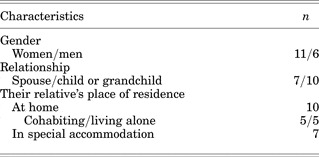
The study was qualitative, based on interviews with people who had been next of kin to an old person during the last phase of that person's life. The criterion for inclusion was having been next of kin to a person aged 75 years or older who received help and/or care during the last phase in life from a municipality in Southern Sweden with about 30,000 inhabitants. Additional criteria were that the informants should be able to communicate verbally and speak Swedish. To ensure variation in the material, the relationship (wife, husband, child, or grandchild), gender, and the old person's dwelling (special accommodation or at home) were taken into consideration during the course of data collection. The sample consisted of 17 people, 11 women and 6 men, of whom 7 were spouses, 9 were children and 1 was a grandchild. Seven of the old people had lived in special accommodation and 10 at home, with or without a cohabitee in their last phase of life (Table 1).
Descriptive information about next of kin (n = 17)

The informants were identified in two ways. Eight people were identified in connection with a previous study concerning older people's experience of what constituted a good life in the last phase of life (Andersson et al., Reference Andersson, Hallberg and Edberg2008). The remaining nine people were identified through registered nurses working in the municipality. The identification of the next of kin originated from the older person who had recently died, which meant that the informants could also live in other municipalities, but these were mainly in the southern parts of Sweden. The registered nurses who identified the informants received oral and written information about the study. They then asked possible informants who met the inclusion criteria whether they were willing to participate in a study concerning their situation as next of kin to a dying, old person. The time between the person dying and the next of kin being contacted was also a factor that the nurses took into account in the inclusion process (a minimum of 3 weeks had to elapse from time of death to time of contact and interview). Those who were included in the study were contacted by the first author and given more information about the study, and a time for the interview was arranged. The first author maintained regular contact with the registered nurses concerning questions regarding the study.
Interviews
The interviews were carried out by the first author at a place chosen by the informant, that is, in their own home or at their place of work, and lasted between 31 and 136 minutes (mean 69 minutes). The interviews took place between 1.5 and 13 months after the death of the old person (median 4 months). The interview started with an open invitation to the interviewee to start the narration from the time she or he understood that her or his next of kin was close to death. The interviewees were encouraged to talk about how they experienced their situation as next of kin, but also their experience of the care and help the dying person received, the relationship with the staff in the health and social care system, and their perception of the dying person's situation. The interviews were carried out as conversations jointly constructed by the informant and the interviewer (Mishler, Reference Mishler1986) and were audiotape-recorded and later transcribed verbatim.
Ethical considerations
It was emphasized that participation in the study was completely voluntary, both before and in connection with the interview, and both written and oral information was given about the right to withdraw from the study at any time, thus acknowledging the informants' autonomy. Consideration was taken of the principle of nonmaleficence in that the study was well motivated and the design was carefully prepared to minimize harm and discomfort to the participants (Medical Research Council, 2000). Data were, therefore, collected only when sufficient time had elapsed after the of the older person's death so that there should be less interference with crisis reaction, grief, and practical tasks such as the funeral. The Ethics Committee of the Medical Faculty at Lund University approved the study (LU 609-02).
Analysis
The interviews were analyzed using content analysis for interpretation of the meaning of the narratives (Baxter, Reference Baxter, Montgomery and Duck1994). The content analysis approach used in this article was further influenced by Berg (Reference Berg2004), who stated that content analysis contains both manifest and latent levels that can be used in combination whenever possible. The manifest level concerns the surface of the text, whereas the latent level embraces the deeper structural meaning conveyed by the message (Berg, Reference Berg2004). The analysis was carried out in several steps, the first of which included several readings of the text as a whole in order to arrive at overall understanding of the text. The first, second, and last authors carried out the overall readings independently of each other and then met and discussed their impressions of the text. In the next step, meaning units related to the aim of the study were identified and marked. The meaning units were then condensed and coded for content (cf. Graneheim & Lundman, Reference Graneheim and Lundman2004) by the first and last authors separately, and these were then discussed. The fourth step included a constant movement between the whole and the parts and between the text and the codes in order to identify patterns. In this step, categories were developed that embraced the experiences. The first, second, and fourth authors were involved in the process of developing categories whereas the third author confirmed the categories developed. All authors had experience in the care of older people through clinical work as well as through their research.
RESULTS
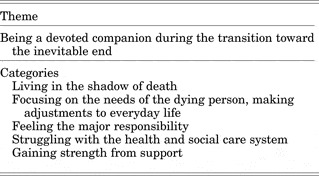
Being next of kin to an old person in the last phase of life meant being a devoted companion during the transition toward the inevitable end. Through being a companion, the next of kin participated in the transition toward death, which influenced them emotionally, physically, and socially. Being a companion also meant sharing aspects of the old person's everyday life during the last period as well as being present at the very last moment of life. It was apparent in the text that the next of kin devoted themselves to their assignment in an almost self-effacing way. The openness between the next of kin and the old person about the imminent end varied. In some cases they had spoken about death for a long time, whereas in other cases death had not been mentioned at all, not even during the last phase of life, which affected the openness of the communication. Having already spoken about death seemed to ease the companionship during this transition. The text could be understood as comprising five categories: living in the shadow of death, focusing on the needs of the dying person and making adjustments to everyday life, feeling the major responsibility, struggling with the health and social care system, and gaining strength from support (Table 2).
The experiences of being next of kin to an older person in the last phase of life

Living in the Shadow of Death
Living in the shadow of death meant that death was constantly present and related to in the next-of-kin's narratives. The text revealed that the death was expected and seen as natural, and the fact that they and the person had lived a long and rich life together was comforting. For some, death had been present for a long time, up to 10 years, whereas for others it came after a shorter period of increased frailty. Living in the shadow of death also implied witnessing physical, mental, and emotional changes as well obstructed communication. The physical changes during the very last stage, such as changes in breathing and in consciousness, were experienced as frightening. The transition toward death also evoked existential questions such as thoughts about their own death and the insight that each moment of life was precious.
Living in the shadow of death also included being present at the very last moment. This was sometimes the first time death had been closely experienced, which meant that death and dying became an inescapable reality. Being able to finish the journey together with the person they loved was extremely important as was that the last moment being peaceful and dignified. Death was mostly seen as a relief, as they had seen the old person suffer for a longer or shorter period. Sometimes a wish to accelerate the process, to reduce suffering, was even expressed. This view of death was also related to their knowledge of the expressed wishes of the old person, that they did not want to be “lying like a package.” Whether spoken by a spouse, child, or grandchild, the text conveyed that the experience of losing someone significant, sometimes their best friend or life companion, was a turning point, with no way back:
Respondent: [crying] That was the worst thing in my life. I am 78 years old but I have never been at someone's deathbed before, never. And I hope I do not have to do it again. (Husband of a woman who had lived in special accommodation)
Respondent: One has to think that she was a great age and the end was calm and peaceful, and the alternative would probably have been that she would have continued to decline. (Son of a woman who had lived at home)
Focusing on the Needs of the Dying Person, Making Adjustments to Everyday Life
The text showed that, during the period preceding the old person's death, the next of kin focused entirely on his or her needs and wishes and adjusted their own life to this new situation. The dying person's needs were the focus in everyday life, and the next of kin tried their very best to meet them. This could involve adjustment in practical matters, such as doing the ironing in the room next to the dying person instead of in the usual place so as to be constantly available if needed, but also changes in their entire life situation. Even if their own needs or wishes were in conflict with those of their relative, the relative's were accepted and obeyed, for example, concerning place of care or death.
In those cases where the next of kin lived far away, she or he still tried to focus on the old person's needs and wishes. The limited ability to participate, however, evoked anxiety, which they tried to assuage through regular phone contacts and frequent visits. Attempts to compensate for everyday absence by, for example, taking on more tasks when actually visiting the old person also brought relief, but also required personal planning and reorganization that involved their own family as well as work. The needs of the old person were met by organizing and sharing the responsibility for hospital visits and night duty among family members so that some could sleep at night or by being present but taking time to rest, asking the staff to wake them if anything happened. In some cases this presence was so extensive that they hardly managed to rest in between. The next of kin changed and adjusted their everyday life to fit in with the old person's situation to such an extent that their freedom became limited. Being in control of the situation entailed the next of kin being available at all times and in a sense imprisoned, as they did not want to leave the relative alone for more than a short time.
When the old person and the next of kin lived together, this meant limited and constantly interrupted sleep. The adjustments to everyday life meant that activities that had previously been enjoyed, for example, the pursuit of hobbies or meeting other people, were hampered or actively abandoned. They made this choice themselves, as such things were not enjoyed anyway, as they wanted to be close to the old person to the greatest possible extent.
Interviewer: She was never alone at home?Respondent: Never. I could not be in the garden without running all the time, looking in at the window and watching over. (Husband of a wife who had lived at home)
This involvement meant that both their work and their own family situations were affected. The combination of being next of kin to a dying old person, having a family of their own, and in many cases having a full time job was onerous; it drained energy and strength to such an extent that it was sometimes difficult to handle the situation. They did try to manage, however, but the effects were seen after the old person's death, when many had to take sick leave. The wish to be present became even more intense in the very last phase of the old person's life, meaning, for example, that several days could be spent at the hospital.
Feeling the Major Responsibility
The text indicated that the next of kin felt they had the major responsibility, as they were the ones who best knew the needs of their relative. This meant taking on responsibility for their care and place of residence. It also meant a struggle to do as much as possible by themselves, even if several tasks were difficult to manage. The feeling of bearing the main responsibility remained even when health care professionals took over. The text revealed that being able to participate in and contribute to the care engendered feelings of satisfaction and of being important. Although caring was sometimes physically demanding and stressful, especially for spouses, they strongly expressed that it was something they wanted to do. Being involved and taking responsibility was a way of dealing with time and worry, but also a way of remaining in control. However, just having the possibility to be close to the old person also induced satisfaction. The wish to be involved and to participate was present during the course of the illness and became even stronger closer to death, including a wish to be able to participate in the preparation of the body after death. When it was not possible to participate in the care, feelings of being unsatisfied and sometimes of guilt emerged.
The text also revealed a worry that if they were not present, there was a risk that the old person would not receive the care they were entitled to. As the next of kin often felt totally responsible, it was not easy for them to hand over the responsibility to the professionals. Next of kin saw the professionals as complementing the care provided by them, but stated that without help from the municipality they would not have managed.
Respondent: I almost felt that if me, my sister, or the daughter of my sister were not present [at the hospital] then she [the mother] would not get any food. (Daughter of a woman who had lived in special accommodation)
Bearing the major responsibility also implied that the roles of family members had to change, and there was a transition during this last period, when the next of kin gradually took over areas that the old person had earlier been responsible for, for example, household tasks, finances, gardening, and social responsibilities. This was sometimes facilitated when the old person gave advice or directions about how to do it. This phase also meant starting to prepare for being left behind, a process that seemed to start early on in the period of deterioration.
Respondent: She could both cook and more, she was out of bed, but rested at times and so … and I could already manage the cleaning and stuff like that [laugh]… . It was not as good as when she cleaned … but one grew into it a bit, being left by oneself. (Husband of a wife who had lived at home)
If the next of kin was a child of the old person, it entailed a gradual change of roles. This was a time when the children had the opportunity to repay some of what the parents or grandparents had given earlier on in life. Children took on the role of the link between the parent and the rest of the family, whereas others took on a larger, practical responsibility, also changing the roles among the children. Being a link was twofold responsibility: having to support both the frail parent and the rest of the family. The children also took on the responsibility of being companions for the surviving parent, working together to cope with the situation.
Struggling with the Health and Social Care System
The text showed that the contacts the next of kin had with the health and social care system were a struggle to receive proper help and care. This covered everything from obtaining additional practical help to changes of medication. The text also indicated that the next of kin felt that the professionals did not view the situation as being as serious as it really was. Pushing for more help was sometimes hard, with next of kin having to repeatedly contact and convince the professionals of the need for professional help for the old person. One example was a daughter who repeatedly struggled for more home help and then later different housing for her mother as the situation became intolerable, which was constantly neglected by the home-help officer. A district nurse made a home visit, saw the situation they were in, and immediately contacted the home-help officer who finally arranged special accommodation. The daughter felt that the home-help officer regarded the district nurse as more reliable, whereas her own story was not believed, arousing feelings of powerlessness and frustration.
The text indicated that next of kin wanted to be involved and take an active part in the care. Not being given the chance to participate and be involved engendered dissatisfaction. When the relative was cared for in a hospital or in special accommodation, the next of kin could feel they were ignored by the professionals, which in turn complicated communication. Lack of specific knowledge about the health care system brought with it an even more powerless position as a result of not knowing whom to contact in different situations or what to expect. The next of kin then had to rely on the staff, although sometimes they doubted the quality of the care provided but also used family or friends to confirm that the care provided was correct. The text also revealed that having experience of health care through their occupation meant that they were more acknowledged and confirmed as partners by professionals. Knowledge about the health care system implied confidence in their role and in approaching the professionals more directly, knowing what to demand. Being experienced in health care also meant taking on a more central role as a mediator between the professionals and the rest of the family:
Respondent: I do not think he [brother to the informant] understood it, nor noticed it so much. I just said that they had stopped giving him the medicine. … “Alright” … you see he had so many other thoughts so I do not think he realized what it meant. (Daughter of a man who had lived in special accommodation)
Being acknowledged as involved in the care in turn clearly influenced confidence in the professionals. The opposite, however, also occurred, for example, when the next of kin did not receive any or only ambiguous information about the planned or ongoing care for the old person, thus engendering feelings of being small, unimportant, and excluded. Some professionals dealt with the situation by being ingratiating, which reduced rather than increased confidence. Feelings of being alone in the situation were evident, even if many other people were involved in the care. The next of kin were also in a state of dependency on the professionals, and the text revealed that they were more positively acknowledged when they did not insist on getting anything from the professionals but were simply grateful.
Gaining Strength from Support
The text also revealed that receiving attention from others regarding their own situation confirmed and strengthened the next of kin, enabling them to endure the situation. Basic things such as being received kindly and being acknowledged and listened to led to feelings of being strengthened in the situation. Support was essential in this phase, as the next of kin could feel like “a seed in the wind” in a situation that was totally new to them. The support could be received from professionals and from others in the same situation, but also in the form of everyday concern from family and friends. This kind of support allowed them to be the recipient, which engendered a feeling of appreciation. To be confirmed in the choices made or to have the possibility to reflect together with others who were not involved in the care was strengthening. Attention paid to the old person by others outside the family was supportive and led to a feeling of relief.
Respondent: She [the mother] was lucky. A charming woman, a bit younger than mother, lived next door, an alert person, she had a key to mother's house, she did an enormous amount of work, she stopped by every morning, collected the mail and did her shopping, she was worth her weight in gold. (Daughter of a woman who had lived at home)
The text further showed that sharing the experience as a family gave them strength and also affected the bonding between family members. Being gathered together and sharing the same experience helped them to be present and produced a sense of stability and peace. Not being the only next of kin in this situation was a source of relief and reduced the burden. To share the experience and to have the possibility to talk a lot, with the family as well as with the old person, during the course of the illness was positive, despite all the sorrow, worries, and struggles. Sharing this unique experience brought the family closer together, taught them more about each other. The text also revealed that when the experience was not shared as a family, it engendered feelings of loneliness for those who were mainly involved in the care:
Respondent: Our father was with us all the time, he could not talk, but he could move his legs and so … we observed that he was conscious when I and my brother talked about when we were little and growing up, and we noticed that sometimes he even laughed. (Daughter of a man who had lived in special accommodation)
DISCUSSION
The study showed that being next of kin to an older person in the last phase of life meant being a devoted companion during the transition toward the inevitable end and that this could be understood in the categories living in the shadow of death, focusing on the needs of the dying person and making adjustments in everyday life, feeling the major responsibility, struggling with the health and social care system, and gaining strength from support.
Methodological Considerations
The findings from this study need to be evaluated in terms of trustworthiness, including credibility, dependability, conformability, and transferability (Lincoln & Guba, Reference Lincoln and Guba1985; Polit & Hungler, Reference Polit and Hungler1999). Credibility concerns whether the data are believable and whether the results present a faithful description of the participants' experiences (Guba, Reference Guba1981). The inclusion of participants of different gender, age, living conditions, and relationships to the dying person increased the possibility of shedding light on different meanings of the experience. The interpretation of the data was furthermore made visible to the reader through the presence in the text of quotations from the participants' narratives. Credibility also concerns whether there are sufficient data to answer the research question (Graneheim & Lundman, Reference Graneheim and Lundman2004). In total, 17 people were interviewed at a place and time chosen by the participants themselves in order to establish a situation that allowed them to feel comfortable about narrating their experiences. The mean length of the interviews was 69 minutes, and at the end of the interview the interviewer repeated the thematic areas in order to give the participants the possibility to add information. Another aspect concerning credibility was the time lapse between the relative's death and the time for the interview, which varied between 1.5 and 13 months. This meant that the next of kin were probably not affected by acute crises, but, on the other hand, there might be a risk that too much time had elapsed between the experience and the interview. The interviews were, however, rich and detailed, even after several months had passed. Dependability is closely related to credibility, but is even more closely related to whether the interpretation of the data is representative (Guba, Reference Guba1981). Having four researchers involved strengthened the confirmability in the form of investigator triangulation (Guba, Reference Guba1981), thereby reducing the influence of any one individual researcher's pre-understanding. Concerning transferability, that is, to what extent the findings can be transferred to others groups or settings (Polit & Hungler, Reference Polit and Hungler1999), the results of this study may be applicable to other next of kin to older people in the last phase of life receiving publicly financed help and/or care.
Discussion of Findings
The findings showed that next of kin were closely involved in the old person's transition from the time when he or she became ill until the very last moment of the old person's life. This was characterized as being a devoted companion in the transition toward the inevitable end, which implied both following the relative's decline closely and that death and dying became a reality. The concept of transition includes the universal properties of process, direction, and change in fundamental life patterns (Schumacher & Meleis, Reference Schumacher and Meleis1994) and involves basic changes in one's view of the self and the world, marked by a turning point (Schumacher et al., Reference Schumacher, Jones, Meleis, Swanson and Tripp-Reimer1999; Meleis et al., Reference Meleis, Sawyer and Im2000). In this study, the transition included a point in time when the next of kin understood that there was no way back, which seemed to be a unique moment when the next of kin realized that the transition would lead inevitably toward death. This is similar to findings by Waldrop et al. (Reference Waldrop, Kramer and Skretny2005), including family members of people who had received hospice care, showing that the awareness that their relative was soon going to die persuaded them to not leave their relative, but to stay for the rest of the journey into death. The journey toward death not only implied that the next of kin was in the phase where they were meeting death and of losing a loved one, but also in a transition that affected the roles within the family. Spouses who, for example, had not previously been responsible for housework had to learn new tasks that represented an additional challenge in this already vulnerable situation. On the other hand, this seemed to be an important part of their adaptation to the new situation, incorporating the changes in their life, which has been described as one component in the concept of transition (Kralik et al., Reference Kralik, Visentin and von Loon2006). Waldrop et al. (Reference Waldrop, Kramer and Skretny2005) also found that death's inevitability in the final transition became clearer as the caregivers witnessed changes in the patient's personality and family role, affecting their ability to fulfill spousal or parental roles. The role changes became clearer and served as a daily reminder of approaching death, and visualizing the future without the loved one increased their comprehension. Even if death at an advanced age is seen as natural, the journey conveys several transitions for next of kin themselves, and their experience must be acknowledged in order to ease their adaptation to the new situation.
Being next of kin meant assuming an active and self-imposed responsibility for the old person, a responsibility that was not forced on them by professionals. The next of kin did not question this responsibility but, rather, took on the role driven by a powerful inner force. This instinctive feeling of responsibility was also seen in a study by Sindings (Reference Sindings2003) among informal caregivers of relatives or friends with advanced breast cancer. The study showed that the informal caregivers felt responsible all the way to death. Being aware that the relative was going to die also endowed the caregiving with another quality: It became imperative to do whatever the person wanted, including ensuring that the person was never left alone (Sindings, Reference Sindings2003). This was also seen in a study by Aldred et al. (Reference Aldred, Gott and Gariballa2005), where informal caregivers for older persons with advanced heart failure adjusted their life to their relative's situation to the extent that they became isolated. The findings of our study showed that feeling the major responsibility in turn affected their own life situation and sometimes even their own health. The next of kin sometimes adjusted their own life to such an extent that they were prevented from participating in their ordinary work, family, and social life. It thus seems important to give next of kin the possibilities of maintaining a central role in the dying person's life and participating to the extent they wish, but also to ensure that the health care system provides resources when next of kin need respite. Knowing that one has access to support whenever needed might help next of kin to feel safe and secure and thereby able to save their energy to focus on their dying relative.
Having the main responsibility for an older person at the end of life implies a heavy burden, and there is a great need to be acknowledged by others. The next of kin did not explicitly speak about their need to be acknowledged or for support but described the positive impact it had when it was received. The findings point to next of kin needing to be acknowledged by the professionals as being an important to their relative, irrespective of where the relative receives care. The importance of support from the professionals, in order to be able to provide care for the dying person at home, was seen in a study by Grande et al. (Reference Grande, Farquhar and Barclay2004) including next of kin to people receiving hospice-at-home service. The study showed that one of the most important aspects was to have access to health care professionals, but that the possibility of having equipment and supplies also facilitated the care provided at home. A quantitative study by Brazil et al. (Reference Brazil, Bédard and Willison2003) showed that the physical demands of caregiving and their cumulative effect were associated with caregiver burden among informal caregivers for terminally ill people (mean age 71 years). The authors also suggested that interventions involving this group should place strong emphasis on reducing the amount of physical care provided by family caregiver. Our findings, however, suggest that caregiving involves important aspects other than the physical demands, such as the emotional and social burden of responsibility. Andershed (Reference Andershed2006) concluded, in a review concerning relatives' needs in end-of-life care, that professionals have a great responsibility for facilitating the involvement of next of kin and that the extent of this should be based on their own wishes. The review showed, moreover, that their satisfaction could depend on the quality of the communication and the information received from professionals. This result was also confirmed by the findings of this study. There is, however, a risk that next of kin do not express their needs explicitly, meaning that they remain undetected by the health care staff. This was, for example, seen in a study by Jo et al. (Reference Jo, Brazil and Lohfeld2007) including spousal caregiving among older people in home-based palliative care, where the spouses felt that their needs were not listened to but also that some of the caregivers said that it was difficult to ask questions. This highlights the need for systematic dialogues between health care providers and next of kin, giving the latter the possibility of reflecting on their situation. Another form of systematic dialogue that can be used as a support is support groups for family members (Milberg et al., Reference Milberg, Rydstrand and Helander2005). Stoltz et al. (Reference Stoltz, Udén and Willman2004) showed, in a systematic literature review, that family carers had wanted to participate in network groups with peers. This kind of support is not, however, well developed in the end-of-life care for older people receiving municipal care, in contrast, for example, to hospice care (cf. Mearns, Reference Mearns2000). Thus, the development of the concept of palliative care in municipal care, including structured and systematic support for the family, is of great importance if the situation of next of kin to an older person at the end of life is to be facilitated.
ACKNOWLEDGMENTS
We are most grateful to the participants in this study who were willing to share their experiences. We are also grateful for the support with data collection given by the nurses in the municipality, to the Department of Health Sciences, Faculty of Medicine, Lund University, and for financial support from Greta and Johan Koch's foundations, SSSH (Föreningen Södra Sveriges Sjuksköterskehem) and King Gustav Vs and Queen Victoria Foundation and to Patricia Shrimpton for revising the language.