1 INTRODUCTION: CONSERVING BIODIVERSITY AS THE CLIMATE CHANGES
The Earth is in the midst of a biodiversity crisis.Footnote 1 The current pace and scale of biodiversity loss indicate that the Earth is entering a mass extinction event of a magnitude unparallelled for 65 million years.Footnote 2 The Earth’s biological diversity, with its complex and life-sustaining interactions, is being irreversibly affected by human activities, including anthropogenic climate change.Footnote 3 Climate projections indicate that the ranges of many species will shift and already high extinction rates are likely to increase.Footnote 4 Species extinctions and redistributions will, in turn, trigger changes in the combinations of species and their interactions at any given location (‘species assemblages’).Footnote 5 Many species will be unable to adapt their behaviour or distributions in time, or survive extreme events such as bushfire and inundation within existing ranges.Footnote 6 Human intervention, to introduce species to new areas where they have never been found before but where they can survive as the climate changes (‘conservation introduction’), has been identified as an important climate adaptation strategy for biodiversity.Footnote 7
This article uses Australian conservation law and policy as a case study to demonstrate barriers to using conservation introductions for climate adaptation. The Australian context is a useful focus, as controversial strategies such as conservation introductions may need to be deployed there sooner and more often than in other jurisdictions. This is, in part, because Australia has an unenviably high rate of historical and ongoing biodiversity decline.Footnote 8 The Australian biota is also particularly susceptible to climate change with high rates of species endemism, narrow species ranges, and limited independent dispersal capacity.Footnote 9 Australian species also face significant topographical barriers to independent adaptation, including the need to travel vast distances across inhospitable terrain at a speed that is unlikely to be achievable for most species.Footnote 10
Australia also provides a useful case study because it is a federal system in which most environmental matters are governed by state law, and there is no formal guidance for negotiating cross-jurisdictional conservation introductions. As such, lessons for effective cooperation on conservation introductions within Australia may resonate with other federal regimes, and in regional collaborations such as the European Union (EU), and may inform the development of future bilateral and multilateral agreements for conservation introductions.
The article proceeds in four parts. Section 2 briefly summarizes recent scholarship on conservation introductions, explaining why this adaptation strategy is likely to become more important for conserving biodiversity as the climate changes. Section 3 provides an analysis of Australia’s existing legal and policy framework for conservation introductions. It finds little acknowledgement in existing law of the growing need to collaborate across political borders to address the effects of climate change. Section 4 identifies key reforms to support a more adaptation-oriented approach to conservation introductions under climate change. It critiques legal objectives in international and domestic laws that inform conservation approaches, and evaluates the potential for introducing new legal mechanisms to facilitate transparent and collaborative conservation introductions. Section 5 concludes with a call for more proactive engagement across national and subnational borders, supported by laws that seek to conserve nature, regardless of where it is located.
2 CONSERVATION INTRODUCTIONS: A CLIMATE ADAPTATION STRATEGY
Many well-accepted biodiversity management strategies will remain fundamental to conservation efforts as the climate changes. These include reducing the effect of existing, non-climatic stressors on biodiversity, such as land clearing and invasive species, and spatially defined conservation tools, such as formal protected areas.Footnote 11 Conservation tools that require more direct human intervention, such as reintroducing species to locations and habitats where they have been found in the past (their ‘historical distribution’), will also continue to be used to avoid the extinction of currently threatened species.Footnote 12 However, as the climate changes, these strategies may be insufficient to conserve biodiversity. Suitable habitats may no longer – or may not for long – be available within the boundaries of a species’ historical distribution. Indeed, suitable habitats may not exist within the political jurisdiction in which a species is considered native.Footnote 13 Further, ecological tipping points may trigger cascading effects through ecosystems that endanger a whole range of species and crucial ecosystem functions.Footnote 14 More proactive and controversial ex situ strategies, such as conservation introductions, are being recognized as crucial tools for responding to climate-related threats to biodiversity. These strategies aim to maintain ecological processes and prevent avoidable extinction of species as the climate changes.Footnote 15 This article explores the emerging legal and policy challenges to using conservation introductions to facilitate biodiversity adaptation.
A ‘conservation introduction’ is defined by the International Union for the Conservation of Nature (IUCN) as ‘the intentional movement and release of an organism outside its indigenous range’.Footnote 16 The IUCN recognizes two types of conservation introduction: assisted colonization, and ecological replacement.Footnote 17 Assisted colonization involves introducing species into new habitats when current or future climate change will make their conventional habitats unsuitable.Footnote 18 However, not every species at risk of extinction can be the subject of such time-consuming and costly interventions. Extinctions caused by climatic changes (such as sea level rise) or by compounding pressures (such as wildfire and urban development) may affect key ecological functions.Footnote 19 In such cases, introducing a species – or a suite of species – that is ecologically similar to extinct native species may help to restore lost ecological functions – a strategy known as ‘ecological replacement’. This technique might also prevent ecosystems from crossing thresholds into new, less desirable states.Footnote 20 In this way, ecological replacements prioritize conservation benefits for the ecosystem that receives the introduction (the ‘receiving location’).Footnote 21
Conservation introductions are already in use around the world, both under existing conservation lawFootnote 22 and in unregulated or unsanctioned contexts.Footnote 23 The literature on conservation introductions often features heated ecological and ethical debates about the significant risks that these strategies pose to target species and receiving locations. For example, an unsuccessful attempt to introduce a threatened species to a new habitat may exacerbate its extinction risk. Successful introductions may also create risks, illustrated by historical examples of species invasions,Footnote 24 such as the catastrophic introduction of cane toads to Australia. Broader ecological risks include the potential to interrupt healthy ecosystem functions in a receiving location. While less commonly discussed, the relative risk of failing to intervene – as species, ecological communities and ecosystems move or disappear under climate change – will become an increasingly significant factor in conservation decision making.Footnote 25 Conservation introductions also involve significant uncertainties concerning, for example, habitat requirements and species interactions (within both historical distributions and receiving locations).Footnote 26 Further uncertainties arise in relation to the short, medium and long-term effects of climate change on introduced populations and ecosystem functioning. This was a central concern in planning the assisted colonization of the critically endangered western swamp tortoise (Psuedemydura umbrina) in Western Australia.Footnote 27
Legal frameworks that implicitly allow or are silent on the deployment of conservation introductions will be less effective at mitigating these risks and reducing these uncertainties. Clear law and policy frameworks will be necessary to support rigorous assessment and accountability mechanisms for introduction strategies, and to facilitate adaptive management.Footnote 28 However, outside the United States (US) there has been limited analysis of the hurdles and opportunities posed by existing legal frameworks under which conservation introduction projects necessarily take place, or of the legal mechanisms that might support or promote more adaptation-focused conservation responses.Footnote 29 Domestic Australian laws and policies are also silent on how transboundary introductions of one or more species populations may need to be negotiated. This article aims to contribute to the development of a legal framework that promotes such assessment, accountability and transboundary mechanisms.
3 CURRENT LAW AND POLICY FOR CONSERVATION INTRODUCTIONS
This section starts by setting out the international context in which domestic laws for conservation introductions have developed. It then analyzes the Australian federal and state/territory framework as an example of a domestic approach. It finds that domestic law and policy for conservation introductions are closely tied to conservation laws governing threatened native species, in part as a result of a conservation paradigm that prioritizes preservation over adaptation.Footnote 30 This paradigm has been described as ‘stationarity’, which is the ‘idea that natural systems fluctuate within an unchanging envelope of variability’.Footnote 31 It is argued that the stationarity paradigm is apparent in international conventions and reinforced in the goals and legal mechanisms of domestic conservation laws, with significant implications for climate adaptation strategies such as conservation introductions.Footnote 32
3.1 Conservation Introductions in International Law
The Convention on Biological Diversity (CBD)Footnote 33 is the primary international instrument for species and habitat conservation. Article 8 establishes obligations for in situ conservation, defined as ‘[t]he conservation of ecosystems and natural habitats and the maintenance and recovery of viable populations of species in their natural surroundings’.Footnote 34 Article 9 establishes separate requirements for ex situ conservation, which is ‘[t]he conservation of components of biological diversity outside their natural habitats’, emphasizing that ex situ conservation should be ‘predominantly for the purpose of complementing in-situ measures’. It should be undertaken ‘preferably in the country of origin’ of the biodiversity sought to be conserved,Footnote 35 and should be ‘for the recovery and rehabilitation of threatened species and for their reintroduction into their natural habitats under appropriate conditions’.Footnote 36
While not decisive on the interpretation or application of domestic law, the IUCN has developed guidelines to support states party to the CBD in developing rigorous, justifiable, successful and principled conservation translocation law and policy.Footnote 37 The IUCN Guidelines explicitly acknowledge the unprecedented threat that climate change poses to biodiversity, recognizing that climate change ‘is the main force behind the proposition to move organisms deliberately outside their indigenous ranges’.Footnote 38
Some international legal instruments may be interpreted in a way that supports conservation introductions for adaptation, at least in some instances. For example, because the Convention on Wetlands of International Importance Especially as Waterfowl Habitat (Ramsar Convention)Footnote 39 directs conservation to the ‘ecological character’ of wetlands, non-native vegetation may be able to be introduced to a Ramsar site as an ecological replacement if doing so would help to maintain the wetland’s function or avoid its transition to a new, less desirable ecological state.Footnote 40 In contrast, the Convention concerning the Protection of the World Cultural and Natural Heritage (World Heritage Convention)Footnote 41 obliges state parties to ‘identify, protect, conserve, present, transmit to future generations and, if appropriate, rehabilitate’ the cultural and natural heritage of outstanding universal value within their borders.Footnote 42 World heritage areas must be protected for their current ecological and cultural form or characteristics, rather than for their ecological function or adaptive capacity.Footnote 43
A conservation introduction, therefore, is unlikely to be supported if it would affect the values for which a world heritage property was listed. Many locations recognized as representing the world’s most valuable places, including world heritage areas, are some of the least likely to allow the introduction of non-native species. However, as climate change interacts with existing threats such as fire regimes and invasive species, those protected values may be changed or lost unless ecological replacements are introduced or critical species are relocated from within those areas and introduced for their conservation elsewhere.
The way in which each instrument is implemented in domestic law will influence its role in facilitating strategies for biodiversity adaptation. Sections 3.2 and 3.3 below consider the Australian legal framework as an example of domestic conservation law and of the challenges and opportunities that may arise for conservation introduction law under climate change.
3.2 National Law and Policy for Conservation Introductions
Australia is a federation of six states and two self-governing territories. The states and territories share concurrent jurisdiction for environmental matters with the federal government. The federal government exercises jurisdiction over ‘matters of national environmental significance’ under the national Environment Protection and Biodiversity Conservation Act 1999 (EPBC Act),Footnote 44 while the states and territories are responsible for other environmental laws.Footnote 45
The EPBC Act implements Australia’s international conservation obligations, including those under the CBD, and emphasizes the protection of native species and ecological communities from extinction and the recovery of threatened species within their historical distribution.Footnote 46 Under the EPBC Act, the federal Environment Minister would be responsible for assessing and, if appropriate, permitting a conservation introduction in any of the following circumstances:
(a) the target organism is a matter of national significance, such as a nationally listed threatened species, or a listed migratory species;Footnote 47
(b) the location, of either the original or receiving environment, is a matter of national significance – for example, where an organism is introduced from or into a world heritage area or a Ramsar wetland, or if the introduction is likely to result in a significant impact on such a place because, for example, it occurs nearby;Footnote 48 or
(c) the conservation introduction is likely to have a ‘significant impact’ on the environment generally (when the project proponent is a federal agency).Footnote 49
In each case, the proposed conservation introduction may also be subject to assessment and approval processes by the relevant state government if the receiving location, or the environment from which the target species is removed, is located on state land.
In practice, assisted colonization projects may be triggered by the terms of a threatened species recovery plan.Footnote 50 Recovery plans are statutory instruments prepared by the federal government for nationally listed threatened species.Footnote 51 Recovery plans can be used to prioritize conservation management actions, and are required to detail ‘the research and management actions necessary to stop the decline of, and support the recovery of, the listed threatened species … so that its chances of long-term survival in nature are maximised’.Footnote 52
A party proposing to conduct an assisted colonization for a listed threatened species must typically prepare what is known as a ‘translocation proposal’. The activities outlined in this proposal must comply with any pre-existing recovery plans, relevant legislation, and any other translocation policies and procedures for the listed threatened species.Footnote 53 However, recovery planning processes at both federal and state levels currently would only permit a conservation introduction that targets an ecological function – that is, an ecological replacement – if it were also associated with a species-specific conservation goal. This is because recovery plans are linked to statutory listing and recovery of threatened species and communities rather than ecosystem or landscape-scale conservation.
The federal government has published a policy statement (Federal Policy Statement), which applies to proposed translocations of listed threatened species, including assisted colonization and ecological replacements.Footnote 54 However, it does not consider the potential need for, and the specific risks of, conservation introductions as distinct from other, less controversial forms of translocation, such as reintroductions. The Federal Policy Statement requires the translocation proposals to demonstrate that the impacts of the translocation are acceptable, by balancing the potential impacts of the introduction on the target plant or animal, the ecosystem from which it has been taken, and the receiving location.Footnote 55 Significantly, the likelihood of a target species becoming extinct if no action is taken – the key trigger for assisted colonization – is not identified by the Federal Policy Statement as a relevant issue. Further, any potential benefits for the receiving location – the key purpose of ecological replacements – are expressly excluded in assessing whether an application falls within the jurisdiction of federal government review.Footnote 56
There is no legal or policy guidance at the federal level in Australia for international conservation introductions. There is also no federal guidance for introductions across subnational borders. These are significant governance gaps, and they are likely to become more so as the climate changes and introductions across jurisdictional boundaries become more common.Footnote 57 In these circumstances, a federal policy for translocations, including conservation introductions, is needed. Such a policy could establish national guidance for a range of challenges. Firstly, a national policy could support the development of ecologically and socially sound balancing processes to guide the inevitable trade-offs between jurisdictions that are losing and/or gaining species. Secondly, this policy could establish a standard for acceptable levels of risk for conservation introductions under a changing climate, or a transparent process for guiding state agencies that must make such decisions. Thirdly, a national policy could provide a framework for interstate cooperation, to facilitate more climate-ready approaches to identifying and introducing target organisms or ecological communities for conservation.Footnote 58
3.3 Subnational Law and Policy for Conservation Introductions
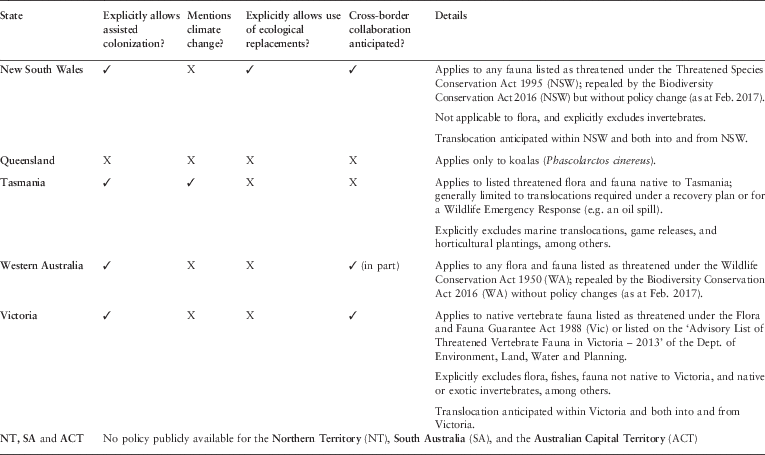
As noted above, state law may apply in addition to Australian federal law for conservation introductions, or on its own in situations where there is no federal legislative trigger. Relevant state laws include wildlife management legislation that imposes licensing or permit requirements for ‘taking’, ‘harming’, or ‘releasing’ native species and prohibiting the release of non-native species.Footnote 59 State translocation policies and procedural guidelines have also been developed under state-based conservation legislation (see Table 1).Footnote 60 State laws that govern the use of land, including protected area laws and land-use planning, may also play an important role in governing and constraining the use of conservation introductions for adaptation.Footnote 61
Features of Australian State and Territory Translocation Policies Relevant to Climate Adaptation

State-based conservation translocation policies are developed under threatened species legislation or general conservation legislation, and are generally triggered by the terms of recovery plans for threatened native species.Footnote 62 Common themes in these policies include licensing and permit requirements, which may involve multiple government agencies; emphasis on the extraordinary nature of translocation as a conservation strategy; and requirements for detailed risk analyses. These are valuable considerations that will continue to be important in adaptation-oriented conservation introduction law and policy.
Existing policies date from the 1990s and generally fail to acknowledge the novel challenges that climate change will create for conservation practice. Recognizing climate change as a trigger for conservation introductions will be essential if these strategies are to be used for climate adaptation. Only Australia’s most southern state, Tasmania, has a policy that acknowledges climate change as a potential trigger.Footnote 63 Released in 2011, Tasmania’s policy is comparatively new, and includes the following features:
(a) an explicit recognition of the impact of climate change on native species, including acknowledging climate change as a potential trigger for translocation in some cases;
(b) a requirement that regional benefits for biodiversity arising as a result of a translocation be identified, including ‘non-target positive spin-offs’,Footnote 64 thus demonstrating an awareness of the potential broader implications of assisted colonization outside the immediate receiving location;
(c) a requirement for broad consultation, and recognition that some human communities may oppose the introduction of new species. The policy thus calls for explicit identification of communication strategies, and any ‘[p]ublic relations issues for uncharismatic or [seemingly] unwelcome species’;Footnote 65 and
(d) a requirement that those attempting to implement conservation introductions in Tasmania demonstrate their long-term commitment to the translocation. This should include committing adequate staff, budget, contracts, agency support, monitoring, and knowledge management (such as training and documentation).Footnote 66
The Tasmanian Policy does not expressly acknowledge ecological replacement as a purpose for introductions.Footnote 67 Addressing policy silence or implicit acceptance of assisted colonization and/or ecological replacement could have significant benefits for the transparency of agency decision making. In particular, explicit policy can clarify the scope of conservation agencies’ mandate to investigate and, if appropriate, undertake such projects. It could also support agencies in rejecting inappropriate proposals, particularly those that demonstrate an unacceptably high level of risk or uncertainty in light of climate change projections and ongoing environmental change. Explicit acknowledgement of conservation introductions in policy could also support the development of more effective administrative arrangements to guide complex decision making about introduction assessments and approvals.
State policies generally prioritize reintroducing species within their historical distribution. They are typically silent on climate-specific challenges such as the complexity of identifying suitable future habitats as the climate changes. The policies also tend to neglect balancing the likelihood of endangered species extinction against the health, adaptive capacity and climate resilience of ecosystems in potential receiving locations.Footnote 68 This gap persists despite evidence that species are already independently shifting their distributions in response to climate change,Footnote 69 and evidence that long-term persistence of many species in situ is increasingly unlikely.Footnote 70 The Western Australian Policy, for example, explicitly states that ‘[a]s a general principle, introductions will not be approved if opportunities for reintroductions exist’.Footnote 71 Opportunities for reintroduction may continue to exist even as climate projections demonstrate that habitat within a species’ historical distribution will not be conducive to its survival in the medium to long term.
Existing policies focus primarily or exclusively on listed threatened species, and sometimes only on native vertebrates or fauna, as detailed in Table 1. A broader perspective will certainly be necessary as climate-related threats cause sudden or unexpected declines across ecosystems.Footnote 72 The legislative process for listing species as threatened and developing resource-intensive recovery plans will increasingly be too slow to establish the traditional trigger for conservation introductions.Footnote 73 Such introductions may also need to target organisms that are less often acknowledged, but critical for essential ecosystem functions, such as invertebrates or soil microbes.Footnote 74 Existing conservation laws are poorly equipped both to recognize these organisms as threatened and to support their ex situ conservation. Further, most state policies make no reference to the concept of ecological replacement as a strategy, let alone provide guidance for its effective, appropriate and adaptive use. Where keystone species – listed as threatened or not – become locally or globally extinct, ecological replacements may be essential, including to assist with stabilizing soil, preventing erosion or maintaining predation of a species that will otherwise become invasive.
Translocation policies developed under state legislation currently apply only within that state. Species and ecological communities will not be constrained by political boundaries as they seek to adapt to changing climates. Conservation strategies that seek to promote adaptation will also, increasingly, need to involve collaboration across political borders.Footnote 75 No Australian state policy currently anticipates conservation introductions from outside Australia. Only policies in New South Wales and Victoria anticipate collaboration with other states to undertake translocations into and out of the state. The New South Wales Policy, for example, ‘applies to all translocations of threatened fauna within, into or from NSW’.Footnote 76 The Western Australia Policy supports translocations from Western Australia to other states, but not vice versa. Other policies either do not acknowledge, or implicitly exclude, collaboration on interstate introductions.
For example, the Tasmanian Policy applies only to the translocation of Tasmanian native plants and animals, in Tasmania.Footnote 77 The Policy’s silence on whether and, if so, how introductions from outside Tasmania will be considered provides no guidance at all on what is likely to become an exceptional climate adaptation challenge for Australia’s southernmost state. Tasmania is an island state and climate projections indicate that the surrounding ocean will help to moderate some of the effects of climate change over coming decades.Footnote 78 As a result, the state has been identified as a critical climate refuge for many Australian species – that is, a place to which species may retreat and survive as the climate changes.Footnote 79 The absence of a clear, well-informed and strategic Tasmanian policy position on interstate conservation introductions represents a significant policy gap. In particular, failing to engage proactively with human communities about climate-related conservation introductions may restrict the availability of these strategies when they are most needed.
Table 1 compares the key components of existing state policies for enhancing the adaptiveness of conservation introductions under climate change.
This analysis demonstrates a failure of the existing law and policy governing conservation introductions to acknowledge the implications of climate change and, in particular, the growing need for regulatory guidance for conservation introductions as an adaptation strategy. Changes in species distributions, and ecosystem structures and functions, challenge presumptions in conservation laws about ecological equilibrium and ‘naturalness’, and cannot be ignored. Whether conservation introductions become a key adaptation strategy for biodiversity, or remain a strategy of last resort, existing legal and policy frameworks do not provide sufficient clarity to define their appropriate use, or adequately constrain inappropriate use, in a rapidly changing global climate.
4 REFORMING LAW AND POLICY FOR CONSERVATION INTRODUCTIONS
Reform proposals directed at improving the ‘adaptiveness’ of environmental laws more generally will also enhance the capacity of conservation law and policy to promote biodiversity adaptation.Footnote 80 However, specific reforms will also be necessary to enable conservation introductions to be used for biodiversity adaptation. To achieve this reform, this section proposes that conservation law goals be broadened. In particular, Section 4.1 proposes that law and policy for conservation introductions could be separated from the operation of threatened species law. Section 4.2 argues that new legal mechanisms need to be developed to assess risk effectively, and to support cross-scale and border conservation introductions under climate change. Section 4.3 demonstrates opportunities to adapt existing governance arrangements for continental corridors to inform and integrate regulatory processes for transboundary introductions. Changing conservation law from its ‘stationarity’ paradigm to an adaptation-oriented paradigm is an ongoing process.Footnote 81 However, these proposed reforms represent a starting point, and a chance to engage explicitly and proactively with the risks and opportunities of conservation introductions to enhance climate adaptation.
4.1 Broaden Legislative Goals
Concepts of historical integrity and ‘natural’ species distributions are linked to entrenched assumptions of nature as stationary, and represent a perspective that is both anthropocentric and short-term.Footnote 82 Adaptation-oriented conservation introductions will need to be supported by goals that are capable of accepting that climate change will trigger significant ecological change. For example, ecosystems are likely to experience ecological ‘shuffling’, as some species migrate out of their historical distributions, others move into those areas, and many species become extinct. Similarly, ‘novel’ ecosystems, made up of new assemblages of species with no historical analogue, may become more common.Footnote 83 Rapid climate change will reduce the success of traditional conservation law goals that seek to restore environments to their historical states, or render them unworkable. At the same time, the need for ‘interventionist’ and transformative management strategies, such as conservation introductions, will grow.Footnote 84
Existing goals for conservation law and policy have developed in the context of a dichotomy between biodiversity conservation conducted in situ and ex situ.Footnote 85 The significance of this distinction is made explicit in the Preamble to the CBD, which states that ‘the fundamental requirement for the conservation of biological diversity is the in-situ conservation of ecosystems and natural habitats and the maintenance and recovery of viable populations of species in their natural surroundings’.Footnote 86
Defining a species or assemblage as located in situ requires reference to a point in time at which nature was deemed to be ideal, or most worthy of protection. Species present at that time are defined as native or indigenous, and their management is prioritized over that of non-native (or ‘alien’) species.Footnote 87
The definition of the term ‘native’ is critical in the law for conservation introductions, especially across jurisdictional borders, where species may be wholly protected in one jurisdiction and targeted for eradication in another. For example, the Asian banteng (Bos javanicus) was introduced to Northern Australia in 1849 and, though endangered in its native range, is controlled as a pest species in Australia.Footnote 88 The IUCN defines a ‘native or indigenous species’ as a ‘species that is assumed to be intrinsically part of the ecosystem, owing to having developed there, having arrived in the area long before record of such matters was kept, having arrived by natural means (unaided by human action), etc.’.Footnote 89
The lack of clarity on ‘how far back in time’ one should look, for example, to determine whether a species is native to a particular territory may undermine the consistent application of international and regional legal instruments (such as the EU Habitats Directive) at the national level.Footnote 90 Moreover, the IUCN definition focuses attention on historical species assemblages, rather than on future suitable climates or on conservation management for ecosystem function and processes.Footnote 91
Strict reliance on a narrow definition of what is native may limit conservation introductions. It may restrict the range of potential target organisms and available receiving locations. This has already been the subject of judicial consideration in Finland, where a court prohibited the assisted colonization of a population of the threatened Barnacle goose (Branta leucopsis) to a location outside its historical distribution where it was more likely to persist under climate change.Footnote 92 The court held that the definition of ‘alien species’ in Finland’s Nature Conservation Act (1096/1996)Footnote 93 extends to native species introduced into a new habitat, even within Finland.Footnote 94 As a result, legislative reform will be required before conservation introductions can be undertaken within, or from another country into Finland.
The definition of what is native in legislation and policy should be flexible enough to facilitate adaptation, to include recognizing that ‘naturalness’ is subject to ongoing change.Footnote 95 To define a species as native based on historical records, and restrict its range to an environment that is no longer conducive to its survival, could operate as a barrier to actions that facilitate independent adaptation (let alone human-mediated conservation introductions).Footnote 96 Historical benchmarking also creates a conflict between conservation goals for protecting native species in situ and that of conserving species, habitats and ecological communities themselves (regardless of their geographical location).
Conservation emphasis on rare species, with those species closest to extinction receiving priority resources and management, is another example of a legal goal that should be broadened to facilitate climate adaptation. Preventing the extinction of threatened species is an important goal established under the CBD,Footnote 97 but it is not the only goal. The task of conserving threatened species should not be implemented in a way that marginalizes adaptation-oriented goals, such as conserving ecosystem functions and abundant, but ecologically critical, species.Footnote 98
The primary tools to implement threatened species goals in many jurisdictions are statutory lists of threatened speciesFootnote 99 and, as mentioned above, these lists are also often the primary trigger for species recovery planning, including conservation introductions. Threatened species lists already fail to represent the full spectrum of species that are actually at risk of extinction, and they are likely to become increasingly inefficient as existing stressors interact with climate change to push more species to the edge of their biological limits.Footnote 100 Breaking the link between conservation introductions and threatened species conservation could support a wider range of adaptation-oriented interventions. These could include conserving non-threatened but highly interactive species, and the functions and services produced by ecosystems.Footnote 101 Far from ‘abandoning’ threatened species and accepting avoidable extinctions, adaptation-oriented legal goals should strongly emphasize the value of conserving as much biodiversity as possible, explicitly including the ecological interactions that make up functioning ecosystems.
4.2 New Legal and Policy Mechanisms for Conservation Introductions
Reforming legislative goals to promote climate adaptation must be complemented by legal and policy reforms. In particular, these might operate at three distinct stages. The first might be in overarching guidance and policy, to promote consistent, cross-jurisdictional approaches to conservation introductions for climate adaptation. The second might be in legal tools for practical implementation, which would require proactive planning, removing maladaptive barriers, and new climate-adaptive risk assessment processes. The third might be in conflict-management tools that are required during or after a conservation introduction.
Firstly, overarching government guidance can help to mitigate the complexity of conservation in legal jurisdictions such as Australia, where environmental law is heavily fragmented across national, state, regional and local governance scales.Footnote 102 A new national policy framework could achieve greater consistency in decision making between state jurisdictions. It could also guide collaborative and landscape-scale approaches to complex issues such as competing state interests, gaps in the legal conservation status of target species and assemblages, and the involvement of multiple stakeholders across tenures and borders. Such a framework would need to be developed collaboratively with state and local governments and non-government stakeholders.Footnote 103 In the Australian context it would need to operate in addition to state translocation policies under state conservation laws. Multilateral conservation agreements for international conservation introductions would also be useful to overcome gaps in adaptation management for cross-border species,Footnote 104 and where independent migration is not an option.Footnote 105
Secondly, implementing adaptation-oriented conservation introductions will require new substantive and procedural legal tools. New tools may include a legislative duty to proactively identify potential targets – for example, species or assemblages with high adaptive capacity that cannot independently migrate to new habitats across barriers such as rivers or mountain ranges.Footnote 106 Such an obligation could be modelled on an existing requirement in the Western Australian Policy that the state agency proactively identify sites at which ‘vertebrate fauna [will be reconstructed] as far as is possible through predator control, habitat management and translocations’.Footnote 107 A climate version of this mechanism could integrate ‘ecological restoration’,Footnote 108 identifying sites where ecological functions (rather than specific species assemblages) could be restored through invasive species management and introducing ecological replacements.Footnote 109 This mechanism could also be used to trigger land-use planning obligations, to avoid, mitigate or offset harm to listed sites.
Thirdly, absolute legal barriers to conservation introductions should be reviewed to determine whether they are appropriate under climate change. For example, some statutorily protected area management plans in Australia expressly exclude conservation introductions, such as ‘[the] introduction of fauna or fish (including Tasmanian fauna or fish) not historically indigenous within the boundaries of the Park or Reserve will not be allowed’.Footnote 110 Legal and policy barriers to conservation introductions may prevent action to facilitate climate adaptation and, if so, they should be removed. For example, shifting climatic zones may trigger a need to introduce warm-adapted seedlings to protected areas from adjacent areas to enhance adaptive capacity. This will become particularly important as the conditions change in which native seeds germinate to replace and sustain existing plant populations. If these areas are not supplemented with young plants, some vegetation communities may be lost.Footnote 111
While maladaptive barriers should be removed, there may be a role for high conservation value, intact and ecologically resilient areas being declared ‘no-go zones’ for conservation introductions, particularly in the short term.Footnote 112 This could be implemented through a bioregional planning approach,Footnote 113 which identifies tenures or ecosystems as ‘red’, ‘green’ or ‘amber’ zones for conservation introductions.Footnote 114 Red, no-go zones could be applied to indigenous or culturally significant protected areas, to prohibit or severely restrict conservation introductions. Green, experimentation zones could be applied to highly disturbed areas such as rehabilitated mine sites or marginal or abandoned agricultural areas, permitting conservation introductions subject to compliance with risk assessment and ethics obligations.Footnote 115 Amber, conditional zones could be applied to, for example, large-scale private conservation reserves or restored land within designated conservation corridors. Amber zones could identify areas where conservation introductions may sometimes be permitted, subject to additional assessment obligations.
Fourthly, existing risk assessment processes, which are a procedural obligation in the translocation proposal processes, are not well suited to the complexity of adaptation-oriented conservation introductions.Footnote 116 While environmental law often seeks certainty in regulating risk, climate change will create ‘irreducible uncertainties’ that will need to be appropriately identified and managed.Footnote 117 Novel challenges that typically are not addressed in Australian risk assessment obligations for conservation introductions include accounting for the effects of future, rapid climate change on a target species or assemblage, and on the resilience of ecosystems in potential receiving locations.Footnote 118 Existing processes also fail to address how ecological, social, political and economic risks should be identified and managed in cross-jurisdiction introductions.Footnote 119 Harmonized or standardized risk assessment requirements across federal and all state governments in Australia could reduce duplication in assessments and provide important clarity on managing climate risks and competing values across governance scales and state borders.
Current legal frameworks emphasize case-by-case risk assessment for translocating individual species populations. However, single-species introductions are likely to be viable in the long term only for ‘generalist’ species that are able to survive in a wide range of environments without, for example, a specialist diet or restrictive habitat requirements.Footnote 120 As the climate changes, risk assessment tools will need to accommodate a wider variety of targets for conservation introduction, including species assemblages or ecological communities, or entire habitats or ecosystems.Footnote 121 Ecosystem and habitat translocation projects are already taking place in the context of biodiversity offsetting projects for land-use development and in mine site rehabilitation,Footnote 122 but may be regulated by different agencies for conservation introductions, and for legislative goals that may conflict with conservation outcomes.Footnote 123 Introducing multiple species and interacting ecological components will require a strong emphasis on transparency and accountability, including through enhanced peer review, public reporting and rigorous assessment processes. This emphasis can help to promote legitimacy, and to ensure that proposals deemed inappropriate can be prevented, while approved projects are closely monitored against new, climate-ready success criteria.Footnote 124
Finally, best practice approaches to conflict management will be fundamental for adaptation-oriented planning for conservation introductions.Footnote 125 Detailed ‘exit strategies’ in the event of project failure, communication channels for dealing with community concerns, and explicit conflict resolution procedures will be required.Footnote 126 Conservation introductions under climate change will exacerbate the complexity of environmental law decision making, requiring trade-offs between multiple competing values and greater attention to the interplay between societal values, project success or failure.Footnote 127 Existing Australian conservation laws and translocation policies lack guidance for managing these trade-offs and any resulting conflict between stakeholders, including across state borders or between state and federal governments. Further, no Australian policy establishes a proactive ‘problem-solving mechanism’ to anticipate and resolve potential community conflict, for example, in resisting a ‘new’ species being introduced to an area.Footnote 128
4.3 Adapt Existing Transboundary Collaborations for Conservation Introductions
Conservation introductions under climate change will sometimes involve multiple state or national jurisdictions. Cross-border collaboration may be required, for example, for ecosystems that cross political borders; where the rate of climate-induced habitat shift is particularly rapid; or where physical barriers impede independent migration, such as across mountain ranges, cities or seas.Footnote 129 However, no guidance exists in Australia (at the federal level) for interstate or international transboundary conservation introductions. Only the policies of three Australian states explicitly contemplate some level of cooperation with other states (see Table 1).Footnote 130 The lack of legal and policy guidance may result in introductions being attempted without legal oversight and without the associated accountability, transparency, community consultation and risk assessment processes. Well-documented examples include the introduction, by special interest group Torreya Guardians, of an endangered US conifer far north of its historical distribution;Footnote 131 and an ‘unofficial’ release of beavers in Scotland in a less desirable receiving location than the site of a government reintroduction trial that was taking place at the same time.Footnote 132 Unregulated introductions not only risk significant ecological harm, but also lost opportunities for learning and adaptive management, particularly given the ‘far-from-perfect predictive capabilities’ currently available for high-intervention strategies such as conservation introductions.Footnote 133
To mitigate this gap (particularly for ecosystem-oriented ecological replacements), current examples of integrated and cooperative governance arrangements across jurisdictional borders could provide a framework for assessing, conducting and monitoring transboundary conservation introductions. These include governance arrangements for transboundary and continent-scale corridors,Footnote 134 which are already considered to be important enabling tools for landscape-level conservation and climate adaptation.Footnote 135
Large-scale, transboundary, corridor restoration projects are under way in many parts of the world, including the US and Canada,Footnote 136 as well as across the Australian continent.Footnote 137 These projects seek to enhance landscape connectedness or ‘connectivity’ by restoring vegetation along important biodiversity corridors. Connecting these corridors at a continental scale (‘continental connectivity’) is promoted as a strategy to remove barriers to large-scale species movement as climate change triggers range shifts. Continental connectivity can also help to maintain or restore the integrity of natural ecological processes and overcome the ecological impacts of historical fragmentation.Footnote 138 Enhancing connectivity and undertaking conservation introductions share the fundamental goal of helping species populations or assemblages to move to more (climatically) suitable habitats.Footnote 139 They also share common threats, including the risk of facilitating the movement of invasive species, diseases, and pathogens.Footnote 140
Corridor initiatives operate within land-use planning processes, foster intergovernmental engagement, and embody cross-tenure and community participation governance models.Footnote 141 Such initiatives already engage with a range of conservation laws and policy goals, from site-specific restoration and habitat conservation obligations through to landscape connections across and between protected area networks. Governance frameworks for connectivity could also support strategic and landscape-scale community engagement and partnership approaches to climate adaptation strategies such as conservation introductions.Footnote 142 Integrating corridor planning and conservation introduction planning may also help to identify suitable migration corridors for ‘stepping stone’ introduction sites. Stepping stone sites may be necessary when an introduction is conducted in multiple stages, for example, because habitat is not yet available in a location that will be climatically suitable in the long term.Footnote 143 Further, integrated governance mechanisms could facilitate streamlined, climate-ready risk assessments and adaptive habitat restoration and design for both corridors and conservation introductions.
5 CONCLUSION
Over time, human influences on the environment have become more pervasive, and adaptation strategies such as assisted colonization and ecological replacements are expected to become more important for limiting extinctions and ecosystem decline. However, conservation legal frameworks are generally poorly prepared for the task of conserving species and ecosystems under rapid change, particularly where their future habitat is no longer located within their ‘native’ ecological range or legal jurisdiction.
This analysis of Australian law and policy demonstrates key barriers to these strategies in the current legal framework, including limited or no acknowledgement of climate change as a trigger for their use. Other observable barriers include heavy reliance on recovery planning under threatened species legislation to initiate conservation introductions, which has tended to limit the scope of the strategy to species-specific projects. Broader conservation goals are needed to facilitate adaptation-oriented conservation introductions, including by accommodating introductions that promote ecosystem function. Cooperation across governance scales is critical but will need to make inevitable trade-offs between competing conservation goals at each of those scales. Continental corridor initiatives are an existing mechanism that could support and inform the complex decision-making processes, and cross-border engagement that will often be necessary for adaptation-oriented conservation introductions. However, new legal mechanisms will also be needed to guide complex decision making, and to conserve species and ecosystems, wherever they have the best chance of surviving.