Introduction
Snails of the genus Lymnaea, the intermediate host of Fasciola hepatica, play an important role in the epidemiology of fascioliasis, which has been investigated in several countries (Ueno et al., Reference Ueno, Arandia, Morales and Medina1975; Gaasenbeek et al., Reference Gaasenbeek, Over, Noorman and DeLéuw1992). Lymnaeid snails have a wide geographical distribution in Brazil and Lymnaea columella ( = Pseudosuccinea columella) is the most frequent intermediate host of F. hepatica in southern and southeastern Brazil (Paraense, Reference Paraense1982, Reference Paraense1983, Reference Paraense1986; Amato et al., Reference Amato, De Rezende, Gomes and Freire1986). Some authors have suggested that geographical variation influences susceptibility to infection by F. hepatica or development of this parasite in the snail (Ueta, Reference Ueta1980; Dacal et al., Reference Dacal, Costa and Leite1988; Gasnier et al., Reference Gasnier, Rondelaud, Abrous, Carreras, Boulard, Diez-Bañoz and Cabaret2000; Goumghar et al., Reference Goumghar, Dreyfuss, Rondelaud, Benlemlih and Cabaret2001.) In the Brazilian state of Minas Gerais, prevalence of fascioliasis in cattle is highest in the south (Coelho & Lima, 2003).
Fascioliasis a serious threat both in terms of economic loss and transmission to humans in Minas Gerais, which is one of the main beef and dairy-producing areas in the country, with approximately 20 million cattle distributed over 586,000 km2 (Lima, Reference Lima1998). Population dynamics of L. columella and the occurrence of F. hepatica infection in the snails has been investigated in the state (Coelho & Lima, Reference Coelho and Lima2003), but some aspects of their infectivity remain unclear. The main objective of this study was to investigate the influence of shell size of these lymnaeids on the susceptibility to experimental infection with miracidia of F. hepatica. A secondary objective was to determine the length of time required for cercarial shedding in experimentally infected snails from Itajubá, Minas Gerais.
Materials and methods
Specimens of L. columella (n = 25) were collected in drainage ditches on seasonally flooded pastures in the municipality of Itajubá, Minas Gerais (22°25′33″S, 45°27′09″E). Snails were transported to the laboratory, placed in 50 × 20 × 12 cm plastic containers with 1 litre of dechlorinated water and fed on lettuce leaves. Styrofoam blocks (6 × 6 × 1 cm) were placed in the containers to provide substrates for oviposition. Egg batches thus obtained were placed in individual containers to rear miracidia.
Eggs of F. hepatica were obtained from faeces of naturally infected cattle from the same region, using the four sieve technique (Ueno et al., Reference Ueno, Arandia, Morales and Medina1975). Eggs were harvested with a Pasteur pipette and placed in Petri dishes with dechlorinated water, then incubated at 28°C for 14 days. Petri dishes with the eggs were then placed 50 cm from a 60 W lamp for 4 h to stimulate eclosion of the miracidia. These were collected using a Pasteur pipette under a stereomicroscope (10 × ) to infect L. columella.
Snails for the size group comparison test (n = 700) were infected after dividing them into seven groups of 10 each, with 10 replicates, according to shell size (in mm): 2–4 mm; 5–6 mm, 7–8 mm, 9–10 mm, 11–12 mm, 13–14 mm and 15 mm or more. Each snail was infected by placing it in a 20 ml glass tube containing 10 ml dechlorinated water, to which four miracidia obtained as previously described were added. The opening of each tube was sealed with gauze and snails maintained in these containers for 24 h. After this period, the snails were transported to a plastic container containing dechlorinated water and fed on lettuce, with water being changed weekly, and raised at temperatures of 20–21°C. After 31 days, the snails were sacrificed by crushing the shell with a glass rod on a Petri dish, and their organs examined under the 20 × objective of a stereomicroscope to look for immature stages of F. hepatica. When present, these were collected, identified based on morphological characters and counted.
Snails for the cercarial shedding test (n = 10) were infected and reared in the same way, but they were not sacrificed: instead, they were placed in another plastic container, with its bottom covered with a plastic film. These snails were examined daily under the 20 × objective of a stereomicroscope in order to verify cercarial shedding, and the plastic film was checked daily for metacercariae.
The model which was used for statistical analysis of the relationship between infection and shell size was logistical regression (by using the MINITAB 14 software).
Results
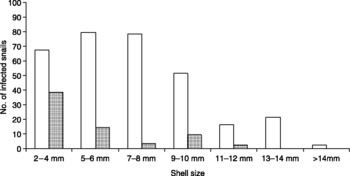
Frequencies of F. hepatica infections in relation to shell size of L. columella are presented in fig. 1. Snails with larger shell size showed a lower infection rate, the groups presenting the highest (79%) and lowest (2%) proportions of positives being those of 5–6 mm and 15 mm or more, respectively. Rediae were observed in all the positive snails, while immature cercariae were present in 21% of them at 31 days post-infection (DPI). Both the number of snails infected and the number of immature stages per snail were highest within the smallest size class, presenting a statistically significant (P < 0.05), non-linear negative association between size and infection; that is, the larger the snail the smaller the probability of infection and the number of rediae and cercariae per snail. The probability of infection with F. hepatica for a snail of a given size group can be calculated by the expression:

where P(I = 1) is the probability of infection occurring; S is the size group: S = 1 (2–4 mm)…S = 7 (>14 mm) and β0 and β1are regression coefficients.
Frequency of infections of Lymnaea columella of different sizes by miracidia of Fasciola hepatica. □, snails presenting rediae 31 days after infection;  , snails presenting cercariae 31 days after infection.

Table 1 shows the results of binary logistic regression test for the presence of rediae in snails of different size groups, and table 2 shows the results for the presence of cercarie. The coefficients found for rediae and cercariae were negative ( − 0.6668 and − 0.8877 respectively), which means that the higher the size of the shell, the lesser is the infection probability. Therefore, the probability of F. hepatica infection presenting rediae 31 DPI for a given size group can be calculated as:

Binary logistic regression results: rediae×size group.

Binary logistic regression results: cercariae×size group.

This means that a snail's probability of being infected with rediae is 0.51 the probability of a snail of a lower size group. The probability of a snail to present cercariae 31 DPI for a given size group can be calculated as:

Thus, the probability of a snail being infected and present cercariae is 0.41 the probability of a snail of a lower size group.
Cercarial shedding was observed for the first time in two snails of the cercarial shedding group at day 61 DPI, but mature cercariae were already found in a snail which died at day 47 DPI. When this snail's shell was crushed, the cercariae encysted in the bottom of the Petri dish.
Discussion
In this study, a statistically significant negative correlation was found between the shell size of L. columella from Itajubá, Brazil and infectivity of these snails with F. hepatica, and cercaria-harbouring snails were more frequent in the lower-size groups. Although this correlation is not linear, these results agree with those from studies by Hodasi (Reference Hodasi1972) with Lymnaea truncatula in England and Dreyfuss et al. (Reference Dreyfuss, Abrous and Rondelaud2000) with Lymnaea ovata in France, who observed smaller snails to be more susceptible to infection by F. hepatica. Previous studies have shown that when snails of different ages were tested, younger snails appeared to be more susceptible (Dacal et al., Reference Dacal, Costa and Leite1988; Dreyfuss et al., Reference Dreyfuss, Abrous and Rondelaud2000). Therefore, shell size influence on the susceptibility of L. columella infection may be interpreted as a consequence of age variation. A possible explanation for this may be that juvenile snails' weaker defence systems allow better development of larval phases of F. hepatica. Some authors have studied how the defence systems of lymnaeid snails react to trematode infections (Sminia & van der Knaap, Reference Sminia and van der Knaap1981; Riley & Chappell, Reference Riley and Chappell1992), but little is known about the influence of age in their effectiveness.
The geographical variation of Lymnaea species also influences their susceptibility to infection by F. hepatica or development of the rediae (Ueta, Reference Ueta1980; Dacal et al., Reference Dacal, Costa and Leite1988; Gasnier et al., Reference Gasnier, Rondelaud, Abrous, Carreras, Boulard, Diez-Bañoz and Cabaret2000; Goumghar et al., Reference Goumghar, Dreyfuss, Rondelaud, Benlemlih and Cabaret2001). This study was the first attempt to test the susceptibility of this strain. Thus, characteristics of the geographical strain of F. hepatica or L. columella present in Itajubá could have influenced the infection rate (44.85%). In Minas Gerais, L. columella specimens from Sete Lagoas, Santa Rita do Sapucaí, Viçosa and Belo Horizonte municipalities were found to be susceptible to experimental infection with F. hepatica miracidia (Dacal et al., Reference Dacal, Costa and Leite1988).
Immature cercariae could already be observed within the snail at 31 DPI and mature ones at 47 DPI. When removed, the latter transformed into metacercariae. Emergence of cercariae was only observed after 61 DPI. These results are similar to those of Ueta (Reference Ueta1980), who carried out experimental infections of L. columella with F. hepatica, obtaining spontaneous elimination of cercariae at 57–60 DPI. Rezende et al. (Reference Rezende, Araújo, Gomes, Nurenberg, Pimentel Neto, Oliveira and Mello1973) obtained cercariae from 44–58 DPI. These authors remarked on the lengthy period between development of cercariae and their emergence.
Acknowledgements
This work was partially supported by the Brazilian foundation FAPEMIG and the Brazilian agency CNPq.