In 2007, Homeland Security Presidential Directive 21 (HSPD-21) established a national strategy for public health and medical preparedness. This directive included a call for action to the nation to “support and facilitate the establishment of a discipline of disaster health” to provide a “foundation for doctrine, education, training, and research.” 1 The need for disaster health to become a formal discipline has long been recognized by leaders in the field, and considerable progress has been made toward its advancement. However, the disaster health community has not reached consensus on the complete body of knowledge needed by its professionals, a certification body, nor a process for credentialing. Consequently, disaster health workers are not held to a common standard based on a shared set of competencies, learning objectives, and performance metrics.
While most of the health-related disciplines that are part of the disaster health workforce are competency based, no standards regarding the disaster health-related competencies have been incorporated into the curricula of each discipline. Furthermore, the majority of responders in a local disaster will be health professionals not necessarily trained as response workers, so continuing education and training must also aim to augment their competence.
To better establish an objective basis for workforce competency development, a number of authors have described consensus-based recommendations regarding the areas of competence needed for specific subsets of potential disaster responders.Reference Lyznicki, Subbarao, Benjamin and James 2 – Reference James, Benjamin, Burkle, Gebbie, Kelen and Subbarao 12 Their work has contributed to the literature a wealth of disaster health competencies for a variety of audiences and settings. Disaster-related competencies are available for particular health professions and primary specialties; for those who want to include disaster health as a secondary specialty; and for professions within a particular organization or agency. Competencies related to specific subject areas such as weapons of mass destruction, mental and behavioral health, and pediatrics also exist. Navigating through these competency sets, however, can be challenging for disaster health educators wishing to develop courses or training materials. A clear understanding of how existing competency sets relate to one another and to the discipline is essential to ensure commonality of knowledge, procedures, and terminology across the many professions within the health sector.
In 2010, an interdisciplinary group of professionals worked together to examine available competency sets and draw from them a consensus set of core competencies that represent the baseline knowledge applicable to all responders in the health professions, regardless of their experience and background or previous roles in a disaster.Reference Walsh, Subbarao and Gebbie 11 A key outcome of this effort was the conceptualization of a hierarchical learning framework in the form of a pyramid model that summarizes and integrates the various existing disaster medicine and public health competency sets that were developed for different target audiences within the disaster workforce.Reference Walsh, Subbarao and Gebbie 11 The pyramid summarizes the different target audiences and subject areas encompassed in the discipline of disaster health and thus provides an integrated view of competency requirements in the disaster workforce. Individuals, regardless of profession or years of experience, could use this model to guide their own learning, e.g., by focusing on relevant competencies at the pyramid's base before integrating competencies from the three progressively higher levels. From there, the competencies each person might choose to develop would be influenced by several factors, including their particular role in a disaster, profession, specialization, and interests.
The progression in specialization of competencies seen as one ascends the pyramid should not be interpreted to represent a hierarchy of individuals, levels of leadership, or years of experience. Instead, the levels represent increasingly specialized competencies intended for different and distinct target audiences. Consequently, the pyramid can help in efforts to reduce redundancies, gaps, and inconsistencies in competency-based learning in disaster health. To our knowledge, however, this model has not been tested in practice. The present report attempts to move along the continuum from concept to practice by (1) examining whether, and how well, existing competency sets can be placed within the pyramidal framework and (2) illustrating how this exercise can guide curriculum developers in choosing competencies relevant to their learning audiences from among the numerous sets of available competencies in disaster health. It is our hope to continue to engage in a collaborative discussion surrounding disaster health education and training and to assist this emerging discipline in moving toward a more robust infrastructure for learning.
Methods
A total of 35 competency sets were identified by a literature search in PubMed, the National Library of Medicine's Disaster Information Management Research Center database, and Google Scholar. These databases were searched for the key words “disaster competency,” “disaster education,” “disaster health competencies,” “preparedness education,” and “preparedness competencies.” In addition, a Google search was performed to identify competency sets that may not have been published in the peer-reviewed literature. Cited sources in articles from both searches were also investigated. To be included for classification in this exercise, the document had to have enumerated specific competencies for learning in disaster health, be directed toward a health or health-related profession, and be written in English.
The authors independently categorized the 35 disaster health-related competency sets according to the 4 levels and criteria of the pyramid framework published by Walsh etal (Table 1).Reference Walsh, Subbarao and Gebbie 11 Then we met to discuss any discrepancies among them and any challenges that were encountered. All of us were involved in drafting the criteria of the framework, and were therefore familiar with the intent behind the pyramid structure and its potential use in practice. Furthermore, we all have been actively involved in using the core competencies and the published pyramid as a guide to develop education and training opportunities in disaster health. Two of us (R.V.K. and B.A.A.) also have expertise in adult learning and educational theory and practice.
Criteria for Classifying Competency Sets According to a Hierarchical Learning Framework of Competency Sets in Disaster Medicine and Public HealthReference Walsh, Subbarao and Gebbie 11

Results
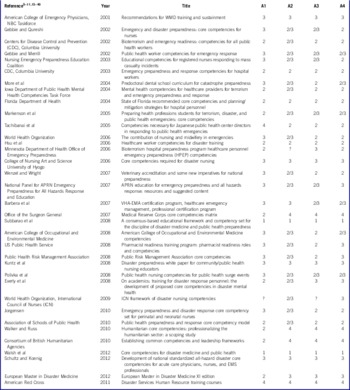
Using the pyramid's criteria as guidance, we classified with consistency only 10 of the 35 competency sets (Table 2). Competency sets categorized to level 1 were unanimously agreed on, but ambiguity in the definitions of the remaining 3 levels made it difficult for us to use the framework consistently and reach consensus on most of the remaining sets. In conducting this exercise, 3 main obstacles in using the pyramid as a classification scheme were identified.
Author Categorization of Competency Sets According to Pyramid FrameworkFootnote a
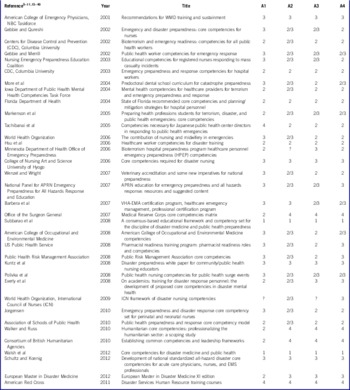
Abbreviations: APRN, Advanced Practice Registered Nurse; EMS, emergency medical services; VHA-EMA, Veterans Health Administration-Emergency Management Academy.
a Competency sets are listed by publication year. Question mark indicates the authors (A1-A4) could not agree on the classification of a competency set. Slash mark indicates the author thought the competency set could fit in either of 2 categories.
First, level 2 contains 2 distinct types of competency sets, which caused confusion when classifying sets that met just 1 of the criteria. According to the original framework, second-level competency sets are for “institutions, organizations, and agencies in which health professionals work,” but which “always relate to the provider role.” Often, a given competency set would fit just 1 of the criteria rather than both. For example, More etal's “predoctoral dental school curriculum for catastrophe preparedness” is meant for students of a specific health profession (dentistry). Because dentistry is a provider role, it would appear that this set would fit level 2; however, because the competencies are intended for all dentistry students, and are not “required by the institutions, organizations, and agencies in which health professionals [dentists] work” [italics added], it does not clearly fit the description for that level.
In contrast, some competency sets that clearly pertain to employees of a specific organization or agency, for example the “VHA-EMA [Veterans Health Administration-Emergency Management Academy] emergency response and recovery competencies” for all employees in the Veterans Health Administration system, do not include competencies specific to each professional role within that system. Thus, some competency sets are written by virtue of profession, whereas others are written by one's place of employment. Currently, both sets are categorized as level 2, which could mislead educators to believe they should choose one set or the other, while both may be relevant to the learner.
Second, the definition of professionals that may “require more specialized knowledge and skills in disaster-related medicine and public health” is very subjective. In attempting to classify each competency set, it has become apparent that a difference exists between competencies that are (1) generalized for a health profession that may not traditionally specialize in disaster or emergency health, but which may, by virtue of its education or training, be reasonably expected to play a role in disaster response, and (2) intended for those specializing in disaster-related medicine, nursing, public health, and the like. It could be argued that both sets “require more specialized knowledge and skills”; however, they are distinctly different groups requiring distinctly different levels of competence. The former refers to an augmentation of one's acquired professional skills and chosen specialization, whereas the latter refers to individuals who desire specifically to become disaster health specialists.
Finally, certain competency sets are defined for a specific scenario or event, or for a specific topic area, rather than characterizing a comprehensive all-hazards approach. Good examples of these are the “educational competencies for registered nurses responding to mass casualty incidents” from the Nursing Emergency Preparedness Education Coalition and “mental health competencies for healthcare providers for terrorism and emergency preparedness response” from the Iowa Department of Public Health. Under the current framework, it is not readily apparent whether these would be placed in level 2 or level 3.
Discussion
Proposed Modifications to the 2012 Hierarchical Learning Framework
Recognizing and appreciating the collaborative work that came before the present exercise, we present for discussion potential additions to the previous framework. Based on the inconsistencies identified here and to improve practical application of the pyramidal framework to educators and learners, we suggest the following modifications to the existing hierarchical learning framework (Table 1):
-
1. Separate level 2 into 2 distinct levels. The lower level would contain profession-specific competency sets, and the higher level would include organization, agency, or institution-specific competency sets. This split would allow competencies that are specific to an agency or organization and that apply to multiple professions within that agency (eg, VHA system) to clearly build on the competencies for unique professions within that agency, which would still build on the core competencies.
-
2. Clearly differentiate between competency sets that should be integrated into the basic training of health professions that do not specifically specialize in disaster or emergency and those that are intended for individuals who wish to specialize in disaster health or a closely related discipline.
-
3. Create a classification method for competency sets meant to cover only a specific topic or focal area (ie, mental health, pediatrics, or chemical, biological, radiological and nuclear defense) within each level of the pyramid.
A Revised Hierarchical Learning Framework
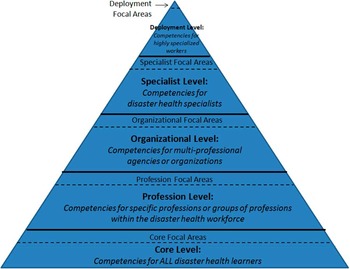
The modifications proposed would result in a slightly more detailed figure, but one with more practical utility as a framework for disaster health learning. The revised pyramid (Figure) would be analogous to a library of existing and future competency sets, where each shelf comprises a broad learning audience and contains different “books” of competencies relevant to a more specific subset of that learning audience. Similar to the 2012 pyramid, the modified hierarchical framework does not represent individuals and their progression upward through the pyramid, but instead represents a framework of competency sets that are meant for different target audiences at each level of the structure.
Revised Framework for the Articulation of Competency Sets for Disaster Health Professionals.
Core level: includes only competency sets targeted for all disaster health professionals. Profession level: includes disaster health competency sets specifically intended for any of the health professions that contribute to the disaster health workforce. Organizational level: includes competency sets for disaster health professionals linked by a multiprofessional organization such as a hospital, health care coalition, or nonprofit organization. Specialist level: includes competency sets targeted to individuals seeking advanced specialization in disaster health rather than looking to augment previous training with basic disaster health skills and concepts. Deployment level: highly specialized competency sets meant for regularly deployed disaster health responders. Focal areas: competency sets that are relevant to the learner described in each level, but which cover only a specific subject area within the cadre of topics that a learner may need to know.

Included in the revised competency pyramid are all professions that could reasonably be expected to play a health-related role in a disaster (or, even more broadly, any health professional with an interest in education or training in disaster health). Each of the 5 levels of the pyramid includes all competency sets targeted at a particular learning audience.
The core level at the base includes only competency sets targeted for all disaster health professionals. The profession level contains disaster health competency sets specifically intended for any of the health professions that contribute to the diverse disaster health workforce (eg, epidemiologists, nurses, emergency physicians, pharmacists, primary care practitioners, veterinarians). The organizational level competency sets are for disaster health professionals linked by a multiprofessional organization such as a hospital, health care coalition, or nonprofit organization; rather than being targeted at professions, these competencies are relevant to the context in which the professions work. Specialist level competency sets are targeted to individuals seeking advanced specialization in disaster health rather than looking to augment previous training with basic disaster health skills and concepts. Competency sets in the deployment level are highly specialized and meant for regularly deployed disaster health responders.
The competency sets included within each level of the pyramid can be either general (encompassing the full range of topic areas relevant to the target audience) or specific (covering just 1 subject area of particular interest to the learning audience). The specific focal areas are represented above each main level because they would ideally build on the general breadth of competencies written for that target learning audience. Focal areas may include competencies in discrete topics such as pediatric preparedness, veterinary medicine, ethics, or triage and could be taught to any of the identified target learning audiences in the pyramid. These competencies may be targeted to disaster health professionals without direct specialization in that focal area but who may work closely with the population of interest or otherwise want additional training in the subject. Therefore, the 5 main levels of the pyramid contain comprehensive competency sets covering the broad range of disaster health competencies needed for a particular audience, and the corresponding focal areas contain competency sets that are targeted to that audience but focused on particular areas within disaster health.
Classification of Competency Sets According to the Revised Hierarchical Framework
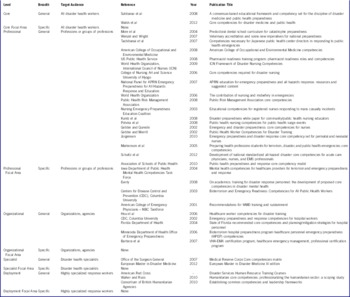
As shown in Table 3, published competency sets can be categorized in the revised framework according to both their target audience and the breadth (or specificity) of subject. Target audiences that have yet to be addressed are made more obvious, as are opportunities for improvement in the education and training of the disaster health workforce. Because specialization of the competencies increases with movement up the pyramid, it is not surprising that more competency sets exist at the professional and organizational levels than at the specialist and deployment levels. The lower levels of the pyramid focus predominantly on increased domestic resilience and integrating emergency preparedness principles into the general academic or professional training of health professions, whereas the specialist and deployment levels examine highly specialized domestic response, humanitarian assistance, and foreign medical teams. Thus, a greater number of individuals across a greater number of professions will require basic education and training in disaster health than will need specialty expertise in deployed disaster response.
Categorization of Existing Competency Sets by Targeted Learning Audience According to the Revised Framework

Abbreviations: APRN, Advanced Practice Registered Nurse; EMS, emergency medical services; VHA-EMA, Veterans Health Administration-Emergency Management Academy.
Conclusions
The goal of this organizing framework is to better understand and categorize the many published competency sets within the discipline of disaster health to identify opportunities for education and training and assist disaster health educators in selecting competencies appropriate to their learning audience. This framework is not intended to generate an additional competency set or represent an exhaustive list of all competencies for all people within the discipline.
The strength of this revised pyramid lies in its ability to clearly illustrate the different target audiences within the disaster health workforce and the breadth of subject matter taught within the discipline, thus eliminating ambiguity from the original framework and highlighting areas for additional competency development. This revision allows for a more useful comparison of the competency sets within each tier. It also helps educators visualize a layered approach to competency-based education and training, which begins with core competencies and then adds disaster health competencies relevant to one's profession. These levels are next followed by disaster health competencies related to one's organization or agency, before adding increasingly specialized competencies, with the transition from a general health care workforce to a specifically trained disaster health specialist or for response deployment. The revised framework can also help guide the necessary integration of competencies into a curriculum by allowing educators to select relevant competencies and use them to craft learning experiences suited to their target audience. 41
We believe that most, if not all, existing competency sets can be categorized according to this revised framework. However, within each level and within each competency set are opportunities for flexibility in the intensity and scope of training. Much discussion, for example, has centered on the competencies needed for humanitarian response professionals,Reference Walker and Russ 35 , Reference Archer and Seynaeve 42 – Reference Boelsche, Klumpp and Abidi 47 which has also used a pyramidal concept to show the need for increasing competence within their field.Reference Walker and Russ 35 The present pyramid framework does not imply static training and education requirements within each level; for example, humanitarian response professionals do not require the same competencies as national disaster medical system response teams, although they would be categorized alongside them. Rather, the humanitarian assistance initiative toward professionalization is a necessary and important step to further define education and training requirements for a very specific subset of professionals within the broader and more inclusive disaster health workforce.
The revised pyramid framework will allow curriculum developers and educators to select competencies relevant to the (1) core knowledge of the field or a particular focal area within it, (2) one's particular profession, (3) one's relationship to an organization, (4) a specialization and career focus in disaster health, and (5) deployed response. Competency sets can be adapted to meet the needs of the novice, intermediate, or advanced professional within each target audience. Furthermore, they can be selected to increase requirements for those who desire leadership or teaching positions and need a greater understanding and command of knowledge and skill. The framework is not intended to encompass competency-based education and training normally required of one's profession but to demonstrate increased mastery of that profession by integrating concepts of preparedness, response, recovery, and mitigation relevant to one's role. Although the organization can be modified, and is likely subject to change, the value of this design lies in depicting the relationship of existing sets to each other and to their respective disaster health audiences.
Improved education and training of all health professionals helps ensure our workforce is appropriately and adequately primed for its role in disasters. Under this framework, current and future competency sets can be catalogued and sorted based on one's interest or target audience. Such an approach allows improved understanding of the integration of all health-related roles in the disaster management system, and simplifies the task of selecting competencies relevant and necessary for any subset of the disaster health workforce. In this way, a progressive competency-based curriculum could be developed. Building all competencies from a common foundation and lexicon creates consistencies in their application, construction, and relevance in the framework, offering flexibility in education and training of the disaster health workforce, and ensuring a common foundation across all members of the workforce.
The competency sets shown in the tables represent a subset of those currently published in the peer-reviewed and gray literature. They are intended to initiate the use of the pyramid concept as a way of cataloguing the myriad disaster health competency sets that now exist. The placement of existing competency sets in Table 2 reflects our interpretation and not necessarily that of the researchers who published them. Because these authors were involved in the drafting of the original pyramid framework, their interpretations of the criteria for the classification of competency sets would differ from those of novice users. Future research in the application of the pyramid could include its use by trainers and educators. We hope that the organizational framework presented here will continue the movement toward the formation of the discipline and aid those who identify, teach, and perform the multifaceted competencies of disaster health.
Funding and Support
The Henry M. Jackson Foundation for the Advancement of Military Medicine, Inc supports the National Center for Disaster Medicine and Public Health through a grant sponsored by the Uniformed Services University of the Health Sciences. The views expressed here are those of the authors and do not reflect the official policy or position of the Uniformed Services University of the Health Sciences, the US Department of Defense, or the US Government.