INTRODUCTION
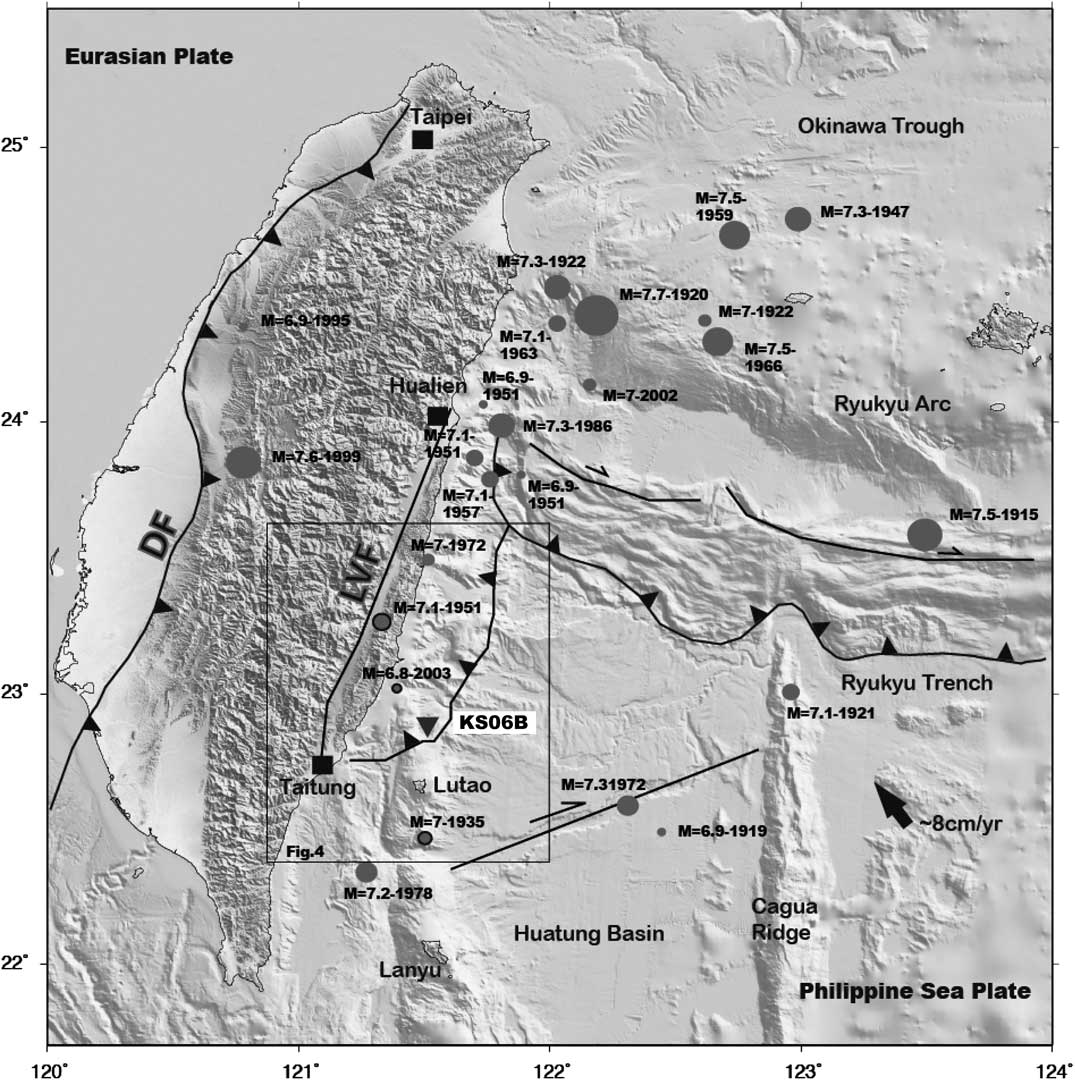
The Taiwan orogen is a young and active mountain belt resulting from the rapid collision of the Luzon arc, carried by the Philippine Sea Plate, and the Chinese continental margin (Figure 1) (Biq Reference Biq1972; Suppe Reference Suppe1984). In this region, plate convergence is extremely high, about 80 mm/yr (Seno et al. Reference Seno, Stein and Gripp1993). The seismicity rate is significant with more than 20 earthquakes M>7 recorded for the last 100 yr, the largest of which was recorded in 1920, with a revisited magnitude of M 7.7 (Theunissen et al. Reference Theunissen, Font, Lallemand and Liang2010). Submarine landslides, and the resulting mass transport deposits or turbidite deposits, have been recognized in the Taiwan margin area in seismic and coring data (Lehu et al. Reference Lehu, Lallemand, Hsu, Babonneau, Ratzov, Lin and Dezileau2015). Interpretation of sedimentary deposits on the eastern Taiwan submarine slope suggests a direct link between submarine gravity processes (submarine landslides and turbidity currents) and the occurrence of large earthquakes. In order to investigate the modern sedimentation (<150 yr) associated with recent seismic events in the eastern Taiwan margin, a sediment core was collected by a box corer for radiometric (14C, 210Pb, 137Cs, and 241Am) and sedimentological analyses.
Map of Taiwan showing geodynamical setting and strong magnitude earthquakes (M>6.8) over the last 100 yr. Two major on-land faults are represented: DF=Deformation Front; LVF=Longitudinal Valley Fault.

210Pb (T1/2=22.3 yr) is a widely used radiotracer in the study of sedimentary environments on a temporal scale of 100–150 yr (e.g. Nittrouer et al. Reference Nittrouer, Sternberg, Carpenter and Bennett1970; Robbins and Edgington Reference Robbins and Edgington1975). This naturally occurring radionuclide forms in sediments by the decay of 222Rn (T1/2=3.8 days) in the atmosphere and the water column (210Pb excess) and in situ decay of 226Ra (T1/2=1600 yr). Age models based on 210Pb activity profiles in sediment cores can be confirmed by independent time-stratigraphic markers, such as artificial radionuclides (e.g. 137Cs, 241Am), which allow us to discriminate the influence of postdepositional processes such as mixing. An increase in the amount of 137Cs in sediments corresponds to the beginning of atmospheric nuclear tests in the 1950s, and the highest concentrations correspond to the maximum atmospheric value reached in 1963.
An undisturbed sediment profile is characterized by an exponential decrease in 210Pb activity with depth. However, the presence of rapid/instantaneous sedimentation deposits in slow sedimentation deposits induces irregularities in 210Pb profiles. As this kind of deposit is of potential interest in paleoseismic studies, where turbidity flows can transport sediment from the margin slope, solving the problem of dating sediment records with nonlinear 210Pb profiles is of wide interest (Arnaud et al. Reference Arnaud, Lignier, Revel, Desmet, Beck, Pourchet, Charlet, Trentesaux and Tribovillard2002; Huh et al. Reference Huh, Su, Liang and Ling2004, Reference Huh, Su, Wang, Lee and Lin2006; Garcia-Orellana et al. Reference Garcia-Orellana, Gràcia, Vizcaino, Masqué, Olid, Martínez-Ruiz, Piñero, Sanchez-Cabeza and Dañobeitia2006).
The first aims of this paper are to date surface sediments from one station offshore east Taiwan, which revealed the presence of coarse-grained layers corresponding to turbidites by using the 210Pb constant flux, constant sedimentation (CFCS) model constrained by 137Cs and 241Am chronologies. It was important to determine whether these turbidite events correspond to instrumental and historical earthquakes generated in the eastern Taiwan margin.
To determine the Holocene timescale, the absolute chronology is usually based on 14C measurements of carbonaceous samples, allowing accurate paleoenvironmental interpretations. 14C ages of marine species must be corrected for differences between the 14C age of surface water and the contemporaneous atmosphere prior to calculation of a calendar age. This is because the waters of the ocean are out of equilibrium with respect to the atmosphere, causing marine carbon-containing material to appear older than material formed at the same time on land (in equilibrium with the atmosphere). The difference in 14C age of the global surface ocean compared to the atmosphere 14C is termed the global marine reservoir age R(t) (Stuiver and Polach Reference Stuiver and Polach1977). The preindustrial global reservoir age is estimated at R(t)=405±22 14C yr and a time-dependent correction is available by using the Marine04 calibration curve (Hughen et al. Reference Hughen, Baillie, Bard, Beck, Bertrand, Blackwell, Buck, Burr, Cutler, Damon, Edwards, Fairbanks, Friedrich, Guilderson, Kromer, McCormac, Manning, Bronk Ramsey, Reimer, Reimer, Remmele, Southon, Stuiver, Talamo, Taylor, van der Plicht and Weyhenmeyer2004). Several studies have suggested the possibility of significant deviations in regional marine reservoir signature from this average value (Goodfriend and Flessa Reference Goodfriend and Flessa1997; Ingram and Southon Reference Ingram and Southon1997; Siani et al. Reference Siani, Paterne, Michel, Sulpizio, Sbrana, Arnold and Haddad2001; Reimer and McCormac Reference Reimer and McCormac2002; Southon et al. Reference Southon, Kashgarian, Fontugne, Metivier and Yim2002; Fontugne et al. Reference Fontugne, Carré, Bentaleb, Julien and Lavallée2004). The second aim of this paper will be to estimate the modern reservoir 14C age by comparing AMS 14C ages with ages derived from corrected 210Pb profiles and historical accounts of identifiable seismic events.
SETTING AND ANALYTICAL METHODS
To study the recent sedimentary record, we collected a box-core sample during the OR1-1013 survey (Figure 1). Box-core KS06B (37 cm long) was collected in 1947 m of water depth in a small-perched basin on the slope of Luzon Arc, north of Green Island off Taiwan (Lehu et al. Reference Lehu, Lallemand, Hsu, Babonneau, Ratzov, Lin and Dezileau2015). Multidisciplinary analyses were performed, with particular attention given to grain-size variation and turbidite/hemipelagite differentiation. The sediment core was sampled at 1-cm intervals for grain-size analyses using a Coulter laser microgranulometer LS13 320 (size range from 0.4 µm to 2 mm). Chemical composition and X-ray images were acquired using an ITRAX core scanner at 2-mm intervals.
14C dating was performed on 10 mg of handpicked planktonic foraminifera (Globigerinae species). 14C analyses were conducted at the Laboratoire de Mesure 14C (LMC14) on the ARTEMIS accelerator mass spectrometer in the CEA Institute at Saclay (Atomic Energy Commission). These 14C analyses were done with the standard procedures described by Tisnérat-Laborde et al. (Reference Tisnérat-Laborde, Poupeau, Tannau and Paterne2001).
Dating of sedimentary layers was carried out using 210Pb, 137Cs, and 241Am methods on a centennial timescale. These nuclides together with U, Th, and 226Ra were determined by gamma spectrometry at the Géosciences Montpellier Laboratory. The 1-cm-thick sediment layers were finely crushed after drying, and transferred into small gas-tight polyethylene terephthalate (PETP) tubes (internal height and diameter of 38 and 14 mm, respectively), and stored for more than 3 weeks to ensure equilibrium between 226Ra and 222Rn. The activities of the nuclides of interest were determined using a Canberra Ge well detector and compared with the known activities of an in-house standard. Activities of 210Pb were determined by integrating the area of the 46.5-keV photopeak. 226Ra activities were determined from the average of values derived from the 186.2-keV peak of 226Ra and the peaks of its progeny in secular equilibrium with 214Pb (295 and 352 keV) and 214Bi (609 keV). In each sample, the 210Pb excess activities (210Pbex) were calculated by subtracting the (226Ra supported) activity from the total (210Pb) activity.
RESULTS AND DISCUSSION
Turbidite Layer Identification
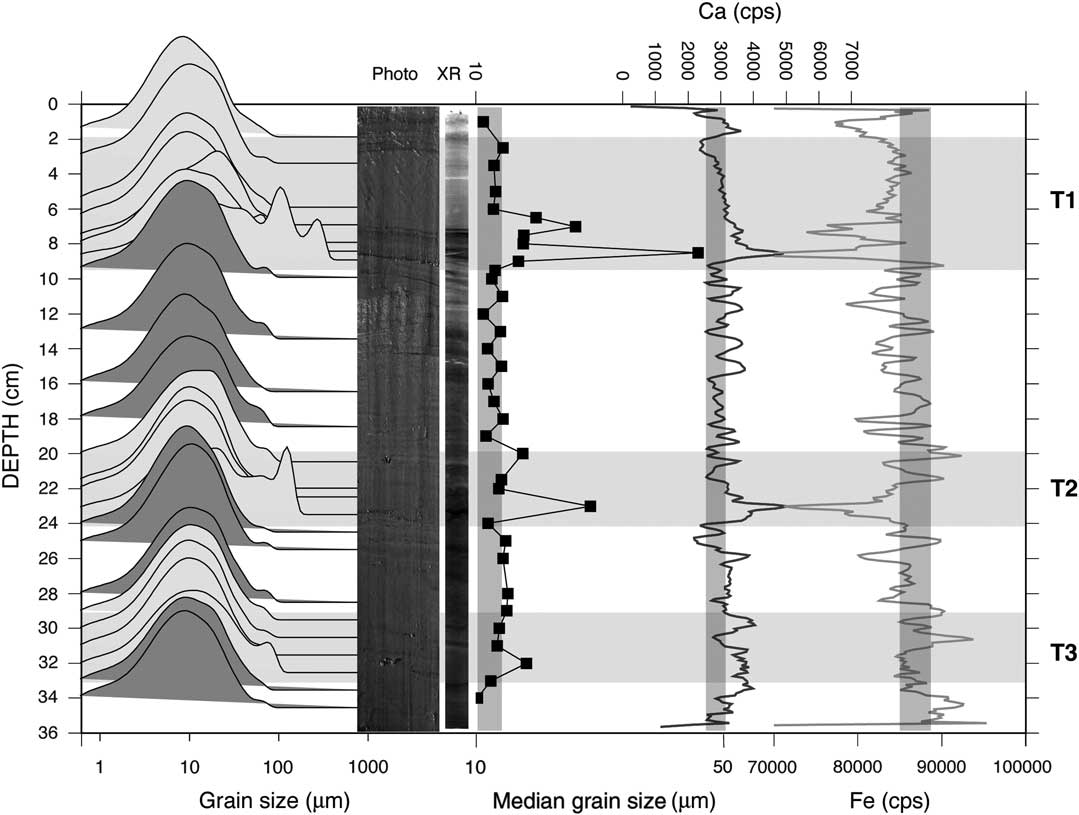
As discussed in the previous section, core KS06B is located in an intraslope basin north of the Lutao volcanic island (Figure 1). The whole core is composed of alternating hemipelagic sediment and fine-grained turbidite facies. The hemipelagite facies (HP hereafter) are characterized by homogeneous clay with a low lithic fragment content (<20%). In core KS06B, these facies are usually represented by a grain size that is typically <10 μm (Figure 2).
Sedimentological analysis of KS06-B and inferred turbidite events, based on grain-size distribution, photos, X-rays, median grain size, and chemical composition (Ca and Fe). Light horizontal bars highlight turbidite layers and light gray bars highlight the background signal of hemipelagic sedimentation.
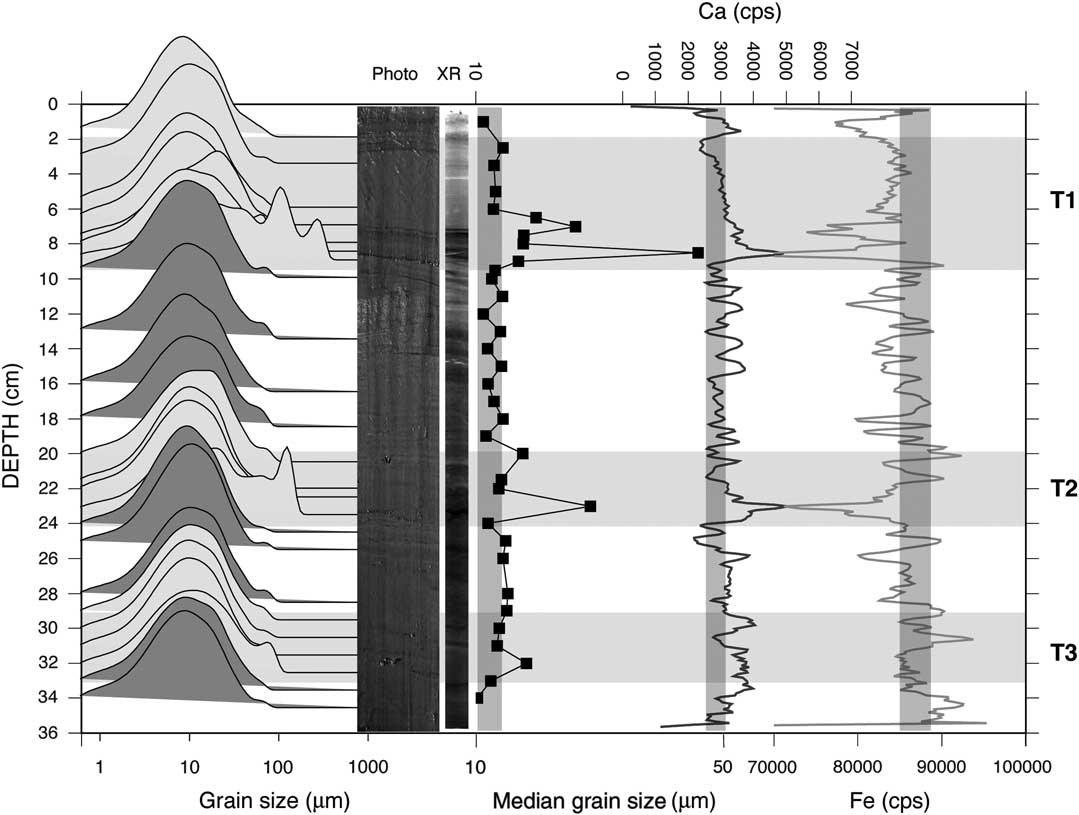
Turbidite facies are recognizable by their coarser grain size and characteristic fining upward structure (Figure 2), as defined by the Bouma (Reference Bouma1962) sequence. The coarser grain size usually indicates an “energetic” event in the sequence, relative to the background sedimentation (i.e hemipelagite facies). Turbidite facies are also characterized by geochemical anomalies relative to the background signal. Figure 2 shows Fe and Ca content, which are representative of both terrestrial and biogenic calcareous environments.
In KS06B, we identified three events, hereafter referred to as T1, T2, and T3 (from top to bottom). Event T1 corresponds to a fine-grained turbidite composed of an 8.5-cm-thick silty-clay sediment on the top of a coarser silty basal layer (median grain size ~35 µm). Geochemical proxies show positive Ca anomalies that are anticorrelated with Fe anomalies (Figure 2). Analysis of the coarser sand fraction revealed a high biogenic content mainly composed of planktonic foraminifera, sponge spicules, and benthic foraminifera (Lehu et al. Reference Lehu, Lallemand, Hsu, Babonneau, Ratzov, Lin and Dezileau2015). T2 is also interpreted as a fine-grained turbidite and is composed of a 4-cm-thick silty-clay sediment layer with a fine-silty basal layer (grain size ~20 µm). Their geochemical composition includes positive Ca anomalies that are anticorrelated with Fe anomalies. The sand fraction composition is characterized by a high proportion of biogenic material that reaches nearly 80% (Lehu et al. Reference Lehu, Lallemand, Hsu, Babonneau, Ratzov, Lin and Dezileau2015). T3 is also regarded as a fine-grained turbidite. It is composed of a 5-cm-thick fining upward silty-clay sequence (grain size ~15 µm) with a sharp basal contact (Figure 2). Geochemical analysis reveals a very slight positive Ca anomaly that anticorrelates with a Fe anomaly (Figure 2). The coarser fraction of T3 has a higher biogenic content than observed for T1 and T2.
Radiochemical Measurements and 210Pb Age-Depth Model
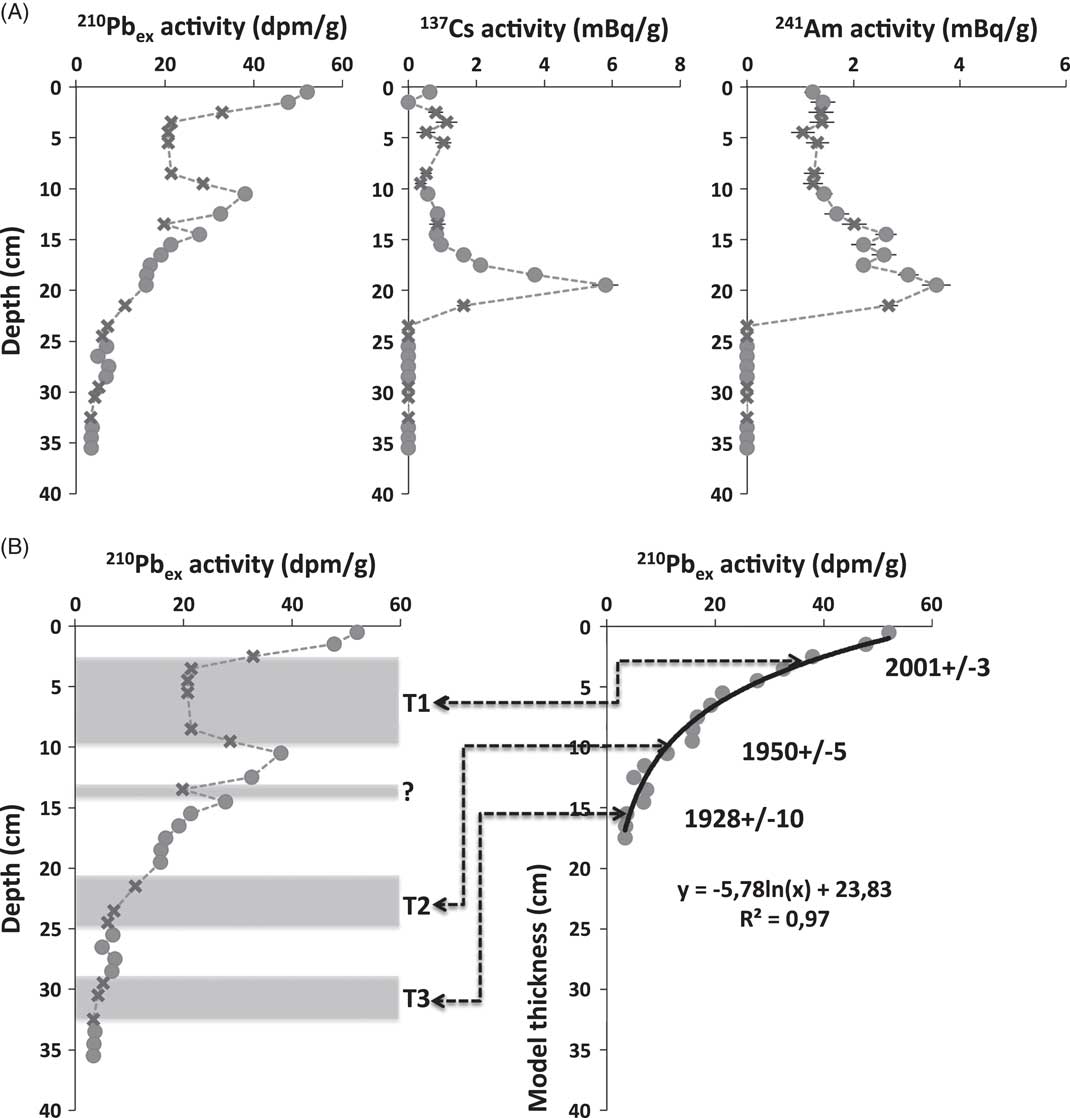
210Pbex, 137Cs, and 241Am activity profiles of core KS06B are shown in Figure 3. The maximum 210Pbex activity is observed at the top of the core (51.9 dpm/g) and decreases down to 35 cm depth (3.3 dpm/g). The 210Pb activity versus depth curve is nonlinear (Figure 3A) and thus cannot be explained by radioactive decay alone. The activity within turbidite layers is particularly low as compared with hemipelagic layers and seems to be linked to grain-size variations and sediment deposits that have been reworked (Arnaud et al. Reference Arnaud, Lignier, Revel, Desmet, Beck, Pourchet, Charlet, Trentesaux and Tribovillard2002; Huh et al. Reference Huh, Su, Liang and Ling2004, Reference Huh, Su, Wang, Lee and Lin2006; Garcia-Orellana et al. Reference Garcia-Orellana, Gràcia, Vizcaino, Masqué, Olid, Martínez-Ruiz, Piñero, Sanchez-Cabeza and Dañobeitia2006). This pattern is particularly evident in the sequences located between 2–9, 20–24, and 28–33 cm depth (Figure 3A). 137Cs and 241Am activity profiles present sharp peaks (5.8 and 3.6 mBq/g, respectively) at 19.5 cm and are near zero below 23 cm (Figure 3A).
(A) 210Pb, 137Cs, and 241Am activity profiles. Dots represent samples from continuous sedimentation (hemipelagite) whereas crosses represent samples from instantaneous sedimentation (i.e turbidite events). (B) Graphical representation of the methodology used to reconstruct a depositional model to estimate sedimentation rate and turbidite layer ages.
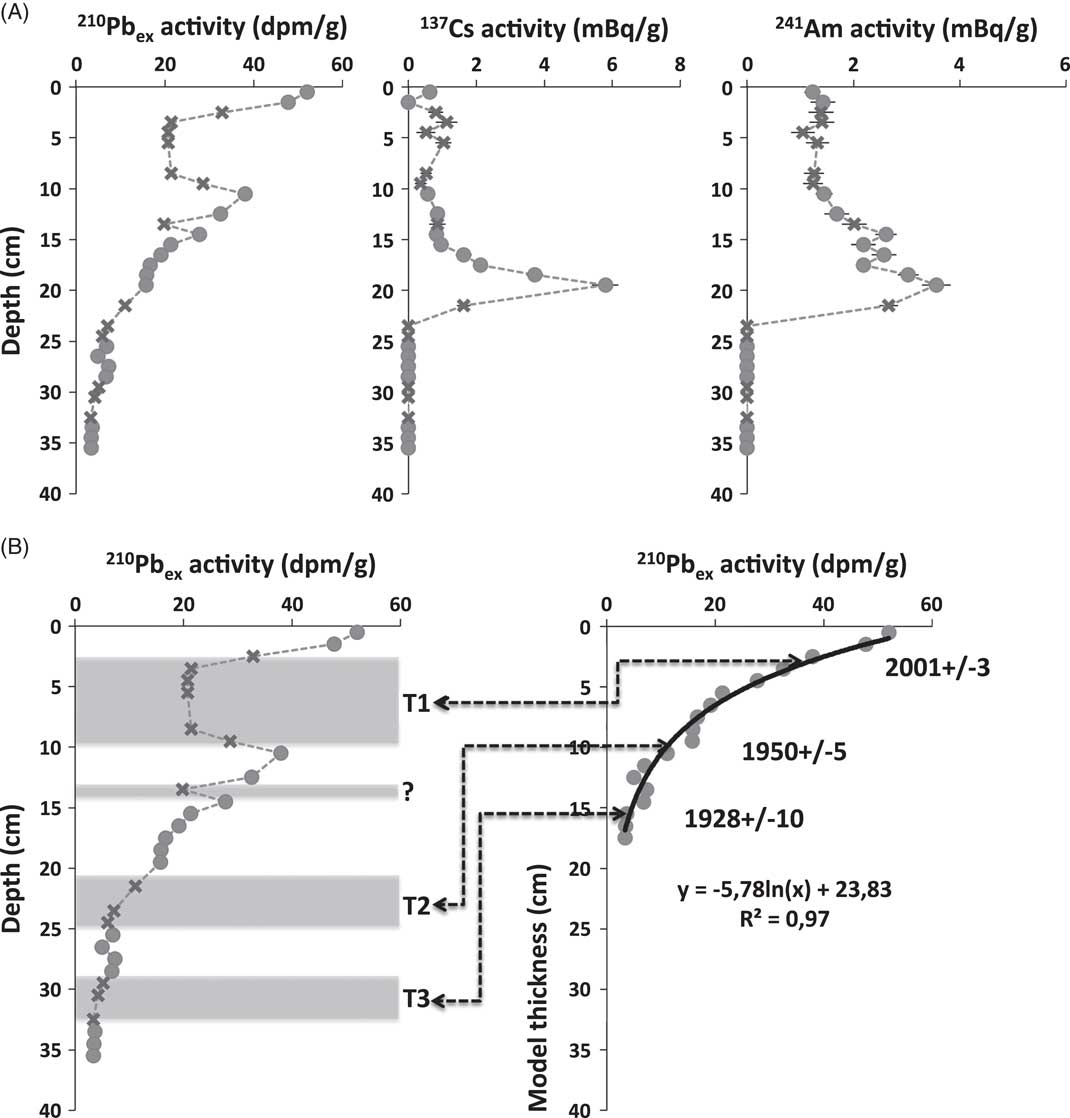
In order to understand and establish an age-depth relationship in the KS06B core, we used the approach adopted by Arnaud et al. (Reference Arnaud, Lignier, Revel, Desmet, Beck, Pourchet, Charlet, Trentesaux and Tribovillard2002) and assumed that hemipelagic sediments have been deposited with a constant accumulation rate and that turbidite layers represent instantaneous events. A synthetic sedimentary record is then built composed only of hemipelagic levels by removing the three turbidite events (T1, T2, and T3) from the sedimentary record (Figure 3B). This corrected 210Pbex profile follows a nearly exponential curve (determination coefficient of 0.97) with the slope of the activity versus depth curve equal to 0.18 cm–1. In this case, we can apply the CFCS model (Goldberg Reference Golberg1963; Krishnaswamy et al. Reference Krishnaswami, Lal, Martin and Meybeck1971), which calculates an accumulation rate (AR) of 1.8±0.2 mm yr–1 for all of the hemipelagic levels (Figure 3B). In order to determine the age of event T1 (2–9 cm), an AR of 1.8±0.2 mm yr–1 was used for the corrected depth of 2–3 cm (without T1). Therefore, the T1 event would have occurred in AD 2001±3. Using the same approach, event T2 (20–24 cm) corresponds to AD 1950±5 and event T3 (28°33 cm) corresponds to AD 1928±10, near the limit of the 210Pb method.
The most common dating method based on 137Cs and 241Am data (Robbins and Edgington Reference Robbins and Edgington1975) assumes that the depth of maximum 137Cs and 241Am activities in the sediment corresponds to the maximum atmospheric production by nuclear bomb testing in 1962–1964. Cs can be highly mobile in marine sediments, following a preferential downward diffusive transport in porewater (Radakovitch et al. Reference Radakovitch, Charmasson, Arnaud and Bouisset1999). Despite the potential Cs mobility by diffusive transport, leading to the spreading of the Cs peak, we can see in Figure 3 that the 137Cs profile shows a clear maximum (21 cm, which is equivalent to 10 cm in the corrected profile) corresponding to 1963. The 137Cs and 241Am activity depth profiles are highly consistent and both give an accumulation rate of 1.84 mm yr–1. This accumulation rate is in good agreement with 210Pb (1.8±0.2 mm yr-1) and confirms our age-depth relationship.
Linking Turbidites to Earthquake Events
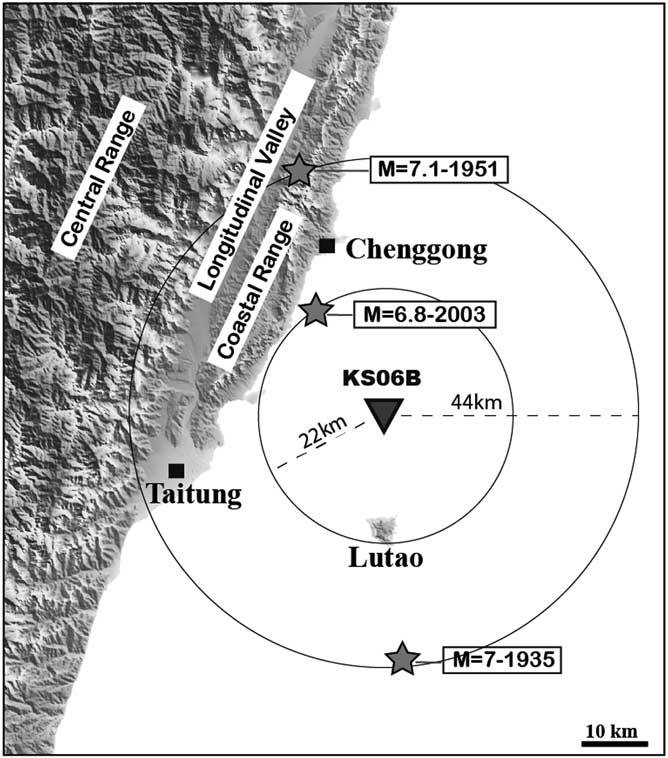
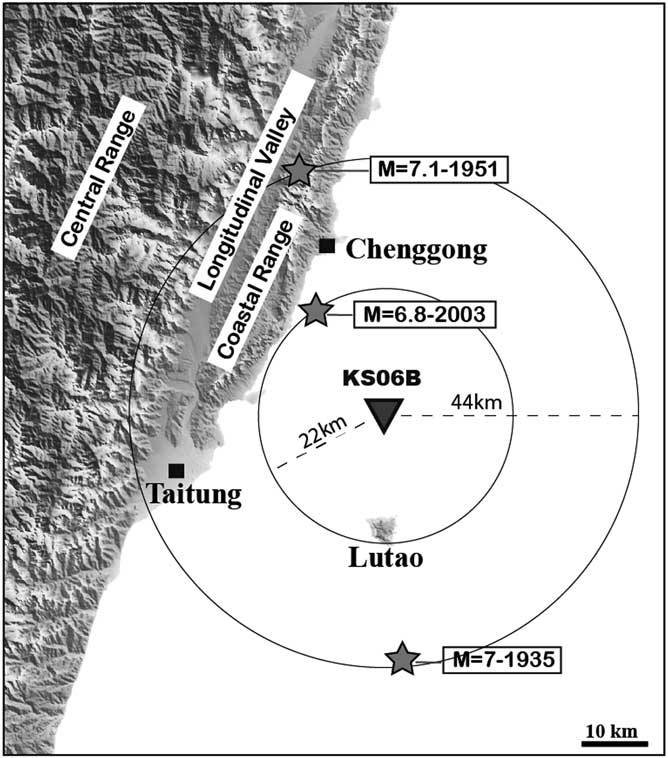
At site KS06B (Figures 1 and 4), earthquakes are the most likely explanation for triggering turbidity currents. The coring site is an isolated basin, without any sediment feeding from the continent. Hyperpycnal flows generated by typhoons cannot have an impact on this basin. Turbidite deposits likely are the result of local submarine instabilities of hemipelagic deposits generated by earthquakes. Moreover, in a previous offshore study from northeastern Taiwan, Huh et al. (Reference Huh, Su, Liang and Ling2004) have shown that turbidites can be used as a paleoseismicity marker. As regards the turbidite layers identified in core KS06B, the 210Pb age of the near-surface event T1 corresponds to AD 2001±3. An examination of the catalog of large earthquakes in the eastern Taiwan margin shows a good temporal correlation with the 2003 Chengkong earthquake of M 6.8. The epicenter of this earthquake was located offshore, on the slope of the Coastal Range (Figure 4), about 22 km north of the location where core KS06B was collected. Although the effect of the earthquakes that occurred in the western foothills in 1999 (Chi-Chi earthquake, M 7.6) and in the southern Ryukyu subduction zone in 2002 (M 7) (see Figure 1 for locations) also occur within the time frame of T1, their epicenters were too far away to alter the sediment record preserved in the KS06B core. According to the empirical relationships established by Chung (Reference Chung2013), ground motion caused by an M 7 earthquake is insufficient to trigger slope failures at a distance greater than 50 km (Lehu et al., unpublished data). Indeed, the critical peak ground acceleration from which a slope usually starts to be destabilized is set as 0.1 g (Dan et al. Reference Dan, Sultan, Savoye, Deverchere and Yelles2009; Pouderoux et al. Reference Pouderoux, Proust and Lamarche2014). Considering soft sediments conditions, these authors found that 0.1 g is reached at 50 km epicentral distance for an M 7 earthquake and at 100 km epicentral distance for an Mw 8 earthquake. The age of event T2 corresponds to AD 1950±5, which fits reasonably well with the 1951 Taitung earthquake of M 7.1. The epicenter of this earthquake was located on the emerged part of the Coastal Range, about 45 km north of the KS06B site. Finally, T3 corresponds to AD 1928±10 and can be correlated with a 1935 earthquake of M 7. The epicenter of that earthquake is located on the slope of the Luzon Arc south of Lutao Island, about 45 km from the coring site (Figure 4). It is worth noting that there is a remarkable correspondence between the only three M≥6.8 earthquakes that occurred within 50 km of the KS06B core and the three turbidites identified here.
Distance from earthquake epicenters correlated with turbidite events to site KS06B.
MODERN RESERVOIR AGE ESTIMATION
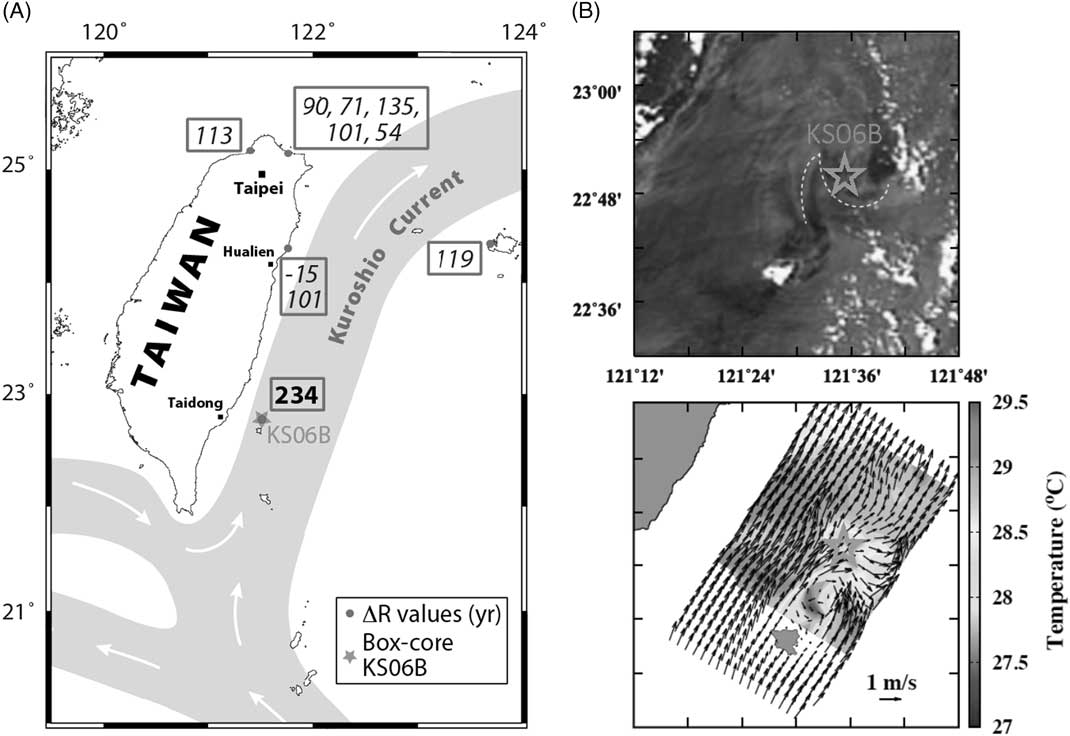
Species living in ocean surface waters show older 14C ages with respect to those living contemporaneously under atmospheric conditions. This difference, also known as the marine 14C apparent age, is due to (1) oceanic circulation processes that tend to advect intermediate and deep 14C-depleted water masses to the surface, (2) atmospheric 14C changes, (3) air-sea CO2 exchanges processes, and (4) hardwater effect due to the discharge of coastal rivers. Here, we present measurements of the reservoir ages of surficial waters in the Kuroshio Current (KC), which is still poorly known. Compared to the average modern 14C marine reservoir age of R(t)=405±22 14C yr, the KC 14C reservoir age close to Taiwan displays a higher R(t) value, with a deviance from the global mean sea surface reservoir age ΔR of 86±40 14C yr (Yoneda et al. Reference Yoneda, Uno, Shibata, Suzuki, Kumamoto, Yoshida, Sasaki, Suzuki and Kawahata2007; Yu et al. Reference Yu, Hua, Zhao, Hodge, Fink and Barbetti2010). The 14C depletion of the KC has been explained by the presence of water from the Pacific Equatorial Divergence with lower 14C content (Yoneda et al. Reference Yoneda, Uno, Shibata, Suzuki, Kumamoto, Yoshida, Sasaki, Suzuki and Kawahata2007; Yu et al. Reference Yu, Hua, Zhao, Hodge, Fink and Barbetti2010).
Here, we estimate the modern sea surface reservoir 14C age in KS06B by comparing 14C values of planktonic foraminifera (Globigerinae species) with the 210Pb chronology. As a reminder, KS06B was extracted in the eastern part of Taiwan and surface hydrographic conditions in that area are largely controlled by the KC. The first age on KS06B at 25 cm depth is 690±30 14C yr. This age corresponds to a date of AD 1950±5, derived from the 210Pb CFCS model (average sedimentation rate of 1.8±0.2 mm/yr). The second age on KS06B at 33.5 cm depth is 695±30 14C yr. This age corresponds to a date of AD 1928±10, also derived from the 210Pb chronology.
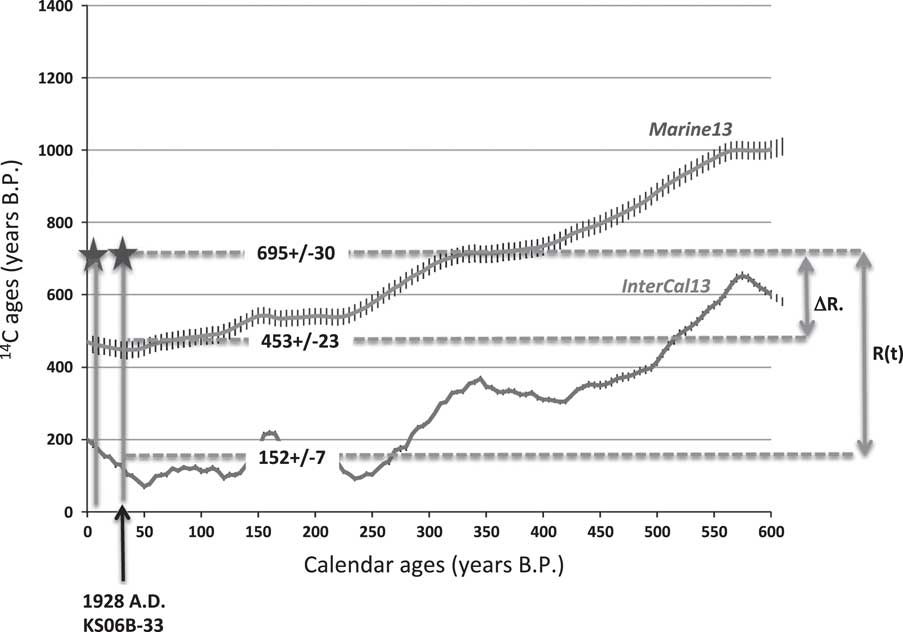
Sea surface reservoir 14C age R(t) at 25 cm in KS06B was calculated by subtracting the atmospheric 14C value estimated for the date of AD 1950 (199±8 14C yr, Reimer et al. Reference Reimer, Bard, Bayliss, Beck, Blackwell, Bronk Ramsey, Buck, Cheng, Edwards, Friedrich, Grootes, Guilderson, Haflidason, Hajdas, Hatté, Heaton, Hoffmann, Hogg, Hughen, Kaiser, Kromer, Manning, Niu, Reimer, Richards, Scott, Southon, Staff, Turney and van der Plicht2013) from the measured apparent 14C ages of the depth at 25 cm (690±30 14C yr, Table 1). This gives a R(t) value of 491±30 yr. The deviation from the global mean reservoir age (ΔR) is then obtained by subtracting the marine model age value estimated for AD 1950 (469±23 14C yr, Reimer et al. Reference Reimer, Bard, Bayliss, Beck, Blackwell, Bronk Ramsey, Buck, Cheng, Edwards, Friedrich, Grootes, Guilderson, Haflidason, Hajdas, Hatté, Heaton, Hoffmann, Hogg, Hughen, Kaiser, Kromer, Manning, Niu, Reimer, Richards, Scott, Southon, Staff, Turney and van der Plicht2013) from the measured apparent 14C age at depth of 25 cm (690±30 14C yr, Table 1). The ΔR value is thus estimated as 221±38 yr (Table 1). By adopting a similar approach for a depth of 33.5 cm from core KS06B, dated to AD 1928 by the 210Pb chronology (Table 1, Figure 5), we obtain R(t)=543±37 14C yr (ΔR=242 yr ±38, Figure 5). These two dated depths suggest that in the study area, the average reservoir age R(t) is 517±48 14C yr and ΔR=232±54 yr.
Sea surface reservoir 14C ages R(t) for modern samples on core KS06-B are calculated by subtracting the atmospheric 14C age estimated by 210Pb geochronology from the measured apparent 14C ages of foraminifera. The deviance from the global mean reservoir age ΔR is obtained by subtracting the marine model value from the measured apparent 14C age of the foraminifera.
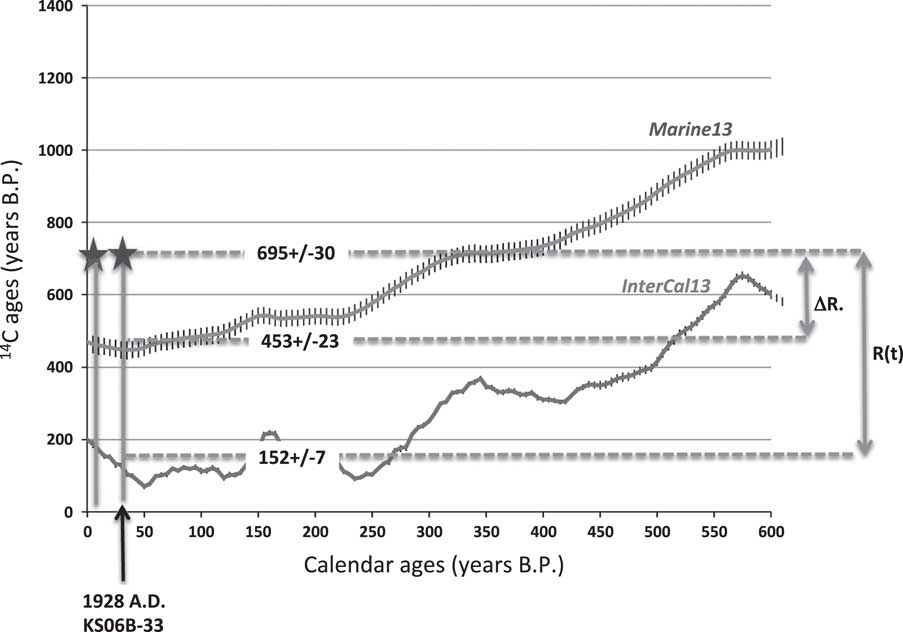
14C dates of modern pre-bomb foraminifera samples in KS06B and their reservoir ages.

This study gives a mean ΔR around 232±54 14C yr (n=2), which is substantially different from the previous estimation by using collections of pre-bomb shells, 86±40 14C yr (n=9; Yoneda et al. Reference Yoneda, Uno, Shibata, Suzuki, Kumamoto, Yoshida, Sasaki, Suzuki and Kawahata2007; Yu et al. Reference Yu, Hua, Zhao, Hodge, Fink and Barbetti2010). Our high ΔR value cannot be considered as a typical ΔR value for water belonging to the KC off Taiwan. On a local scale, different processes may increase ΔR values, such as hardwater effect or local upwelling. On a regional scale, a hardwater effect due to the discharge of coastal rivers was found to increase 14C ages by 600 yr in the Pierre Blanche lagoon in France (Sabatier et al. Reference Sabatier, Dezileau, Blanchemanche, Siani, Condomines, Bentaleb and Piquès2010). However, we consider that such a high ΔR value in our study area could not be due to the hardwater effect for the following reasons: (1) there are no limestone outcrops in the Taitung watershed, the most proximal watershed in the study area; and (2) a hardwater effect due to the discharge of coastal rivers is highly improbable because of the great distance of the KS06B from the nearest land of Taiwan (40 km away). In fact, the hardwater effect that affects terrestrial lakes, lagoons, and coastal areas has never been reported for the open marine environment, as mixing with seawater will quickly dilute any such effect—particularly here where the freshwater discharge from coastal rivers is deflected along the Taiwan coast by the strong Kuroshio Current.
Variations in regional oceanic activities, such as local upwelling, are most probably the cause of our high ΔR values. In our study area, an upwelling area in the KC has been identified north of Green Island off Taiwan. Vertical profiling with a shipboard lowered acoustic Doppler current profiler and a conductivity temperature depth profiler revealed sizable anomalies in flow and water characteristics in the lee of Green Island (Chang et al. Reference Chang, Tang, Ho and Chao2013). The presence of Green Island induces upwelling and turbulence in the KC (Figure 6). In these zones, the water is colder and higher in chlorophyll-a concentration (Chang et al. Reference Chang, Tang, Ho and Chao2013). These upwelling cells probably enhance the transport of relatively 14C-depleted water to the surface, resulting in a more positive ΔR value in our zone.
(A) General map of Taiwan showing the ΔR values around the Taiwan area (this study and Yoneda et al. Reference Yoneda, Uno, Shibata, Suzuki, Kumamoto, Yoshida, Sasaki, Suzuki and Kawahata2007). In light gray: the mean path of the Kuroshio Current (after Hsin et al. Reference Hsin, Wu and Shaw2008). The star shows the core location. (B) Upwelling zone north of Lutao Island evidenced by satellite image and seawater temperature (after Chang et al. Reference Chang, Tang, Ho and Chao2013).
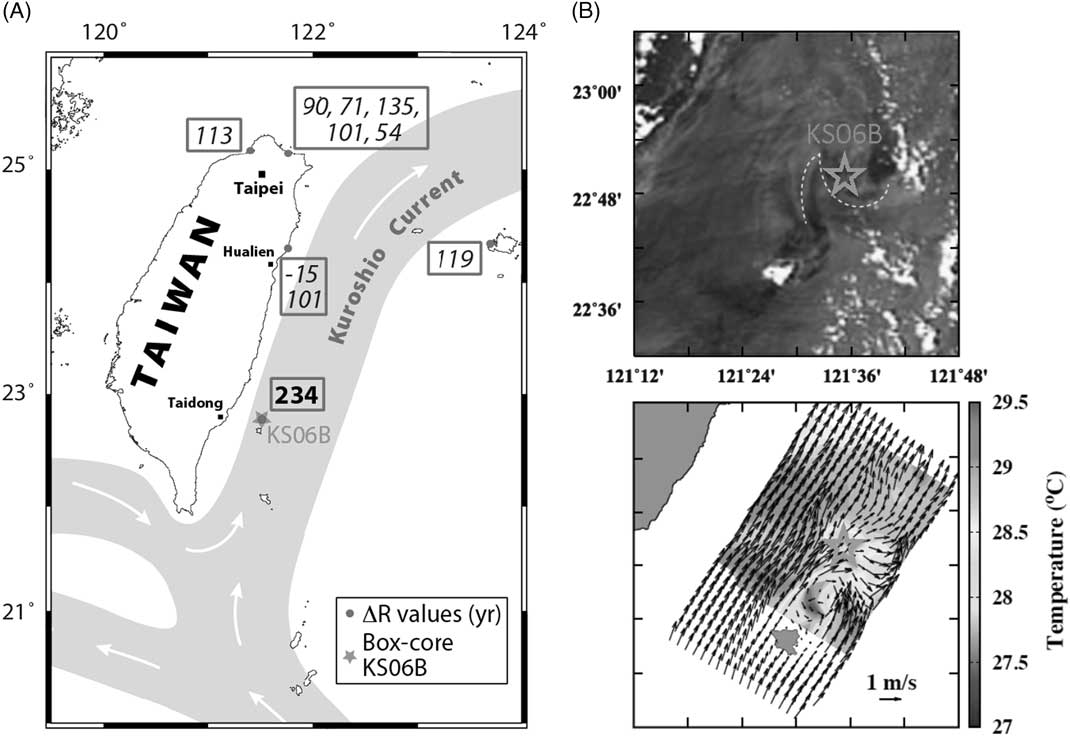
In summary, the high ΔR value in our study area probably reflects active upwelling and not a hardwater effect. Moreover, as upwelling cells are local, our high ΔR value (232±54 14C yr) must also be considered a local value. For water belonging to the KC off Taiwan, we consider the ΔR value of 86±40 14C yr (Yoneda et al. Reference Yoneda, Uno, Shibata, Suzuki, Kumamoto, Yoshida, Sasaki, Suzuki and Kawahata2007) to be more typical of the region.
CONCLUSION
Based on 210Pbex, 137Cs, and 241Am activity profiles in a box core collected east of Taiwan, three turbidite events dated to AD 2001±3, AD 1950±5, and AD 1928±10 have been identified. These ages correspond to three M≥6.8 earthquakes that occurred in the region (<50 km from the core site). These include (1) the 2003 Taitung earthquake (M 6.8), (2) the 1951 Chengkong earthquake (M 7.1), and (3) the 1935 Lutao earthquake (M 7.0). The good agreement between our estimated deposition time of the turbidites and the history of major local earthquakes suggests that the record of mass transport deposits can be used as a paleoseismic indicator in this high‐convergence area (Lallemand et al. in press; Lehu et al. in revision).
The modern reservoir 14C age (R) and the regional marine reservoir correction (ΔR) of the Kuroshio Current off Taiwan were estimated by comparing AMS 14C ages with ages derived from a corrected 210Pb profile. Our calculated mean ΔR value of 232±54 14C yr (n=2) is higher than the modern value of 86±40 14C yr (n=9, Yoneda et al. Reference Yoneda, Uno, Shibata, Suzuki, Kumamoto, Yoshida, Sasaki, Suzuki and Kawahata2007). This high value is likely controlled by upwelling activities rather than by a hardwater effect. Local upwelling cells in the Kuroshio Current north of Green Island probably bring more 14C-depleted water to the surface, resulting in a more positive ΔR value in that area.
ACKNOWLEDGMENTS
This project has benefited from the following financial support: National Central University (NCU) for ship time and analytical laboratory equipment, Institut National des Sciences de l’Univers (INSU-CNRS) in the frame of “Aléas” program in 2013 and 2014 and Joint Research Projects between NSC and CNRS, LIA ADEPT Bureau de Représentation de Taipei (BRT) in France and France-Taiwan Fundation, and the French Institute in Taipei. We thank the Laboratoire de Mesure 14C (LMC14) ARTEMIS in the CEA Institute at Saclay (French Atomic Energy Commission) for the 14C analyses.