INTRODUCTION
Serum biochemicals can be used for monitoring changes in the physiological conditions of fish, which can be useful indicators of water quality (Mohammadizadeh et al., Reference Mohammadizadeh, Afkhami, Bastami, Ehsanpour, Kazaali and Soltani2012). These biochemicals are affected by many endogenous and exogenous factors, such as water temperature, reproductive cycle and metabolic rate (Aras et al., Reference Aras, Bayir, Sirkecioglu, Polat and Bayir2008), disease (Chen et al., Reference Chen, Jin and Wang2005) and stress (Cnaani et al., Reference Cnaani, Tinman, Avidar, Ron and Hulata2004). Moreover basic ecological factors, such as feeding regime and stocking density, may have a direct influence on certain biochemistry parameters (Coz-Rakovac et al., Reference Coz-Rakovac, Strunjak-Perovic, Hacmanjek, Topic Popovic, Lipez and Sostaric2005). It has been shown that physiological values of blood parameters are species-specific and sex dependent and therefore its analysis is one of the most valuable modern methods (Asadi et al., Reference Asadi, Halajian, Pourkabir, Asadian and Jadidizadeh2006).
Fish culturists and fish biologists make use of blood chemistry indices for the evaluation of fish stress responses, nutritional condition, reproductive state, tissue damage due to handling procedures, and health status (Wagner & Congleton, Reference Wagner and Congleton2004).
In order to document and better understand the variability and dynamics of blood chemistry parameters, studies have been conducted on sea bass, Dicentrarchus labrax (Coz-Rakovac et al., Reference Coz-Rakovac, Strunjak-Perovic, Hacmanjek, Topic Popovic, Lipez and Sostaric2005), gilthead sea-bream, Sparus aurata (Coz-Rakovac et al., Reference Coz-Rakovac, Topic Popovic, Smuc, Strunjak-Perovic and Jadan2009), blue-fin tuna, Thunnus thynnus (Topic Popovic et al., Reference Topic Popovic, Strunjak-Perovic, Coz-Rakovac and Hacmanjek2006), mullets, Liza kluzignery (Mohammadizadeh et al., Reference Mohammadizadeh, Afkhami, Bastami, Ehsanpour, Kazaali and Soltani2012) and Kutum, Rutilus frisii kutum (Bastami et al., Reference Bastami, Shabani, Soltani and Afkhami2011). Although there is a lack of the basic data for the sobaity sea-bream, some baseline values of haematological parameters are available for other sport species (Bollard et al., Reference Bollard, Pankhurst and Wells1993; Carragher & Pankhurst, Reference Carragher and Pankhurst1993; Coz-Rakovac et al., Reference Coz-Rakovac, Strunjak-Perovic, Hacmanjek, Topic Popovic, Lipez and Sostaric2005, Reference Coz-Rakovac, Topic Popovic, Smuc, Strunjak-Perovic and Jadan2009).
Sobaity sea-bream Sparidentex hasta (Sparidae) is a marine protandrous hermaphrodite that occurs in shallow coastal to moderate depths in tropical marine and brackish water around the western Indian Ocean, such as the Persian Gulf and the coasts of India (Bauchot & Smith, Reference Bauchot, Smith, Fischer and Bianchi1984). The spawning season for this species is from January to March when the water temperature is between 17 and 19°C along the Iranian coast of the Persian Gulf (Saghavi et al., Reference Saghavi, Moazedi, Mazrae, Amiri and Zabayeh Najafabadi2002).
Since no data on the blood parameters of S. hasta have been published, this study determined some plasma parameters.
MATERIALS AND METHODS
Wild-caught fish that were then sampled (N = 30) by gill-net from Khore-khoran lagoon in Hormozgan Province (south of Iran) during the spawning season (January 2012). In order to establish reference ranges, the fish samples were subject to an external examination and only healthy fish were used. To minimize the effect of handling stress, blood samples were taken using heparinized syringes within three minutes of capture from the caudal vein, and then kept on ice. The samples were centrifuged at 4000 g for 10 minutes to obtain plasma which was stored at −20°C until assay (Mohammadizadeh et al., Reference Mohammadizadeh, Afkhami, Bastami, Ehsanpour, Kazaali and Soltani2012). Serum biochemistry determinations including cholesterol (CHOL), glucose (GLU), triglycerides (TRIG), aspartate aminotransferase (AST), alanine aminotransferase (ALT), lactate dehydrogenize (LDH), and total bilirubin tests were performed using an autoanalyser (Cobas Integra System, France) (Bastami et al., Reference Bastami, Shabani, Soltani and Afkhami2011). Hormonal data tests including cortisol and oestradiol (E2) were made by the Vidas Biomerieux System (Electroimmuno Analyzer, France) (Strik et al., 2007).
Statistical analysis
The normality of the data was evaluated by applying the Kolmogorov–Smirnov test. For each normally distributed parameter the mean and standard deviation were calculated. In addition, Pearson's coefficient was used for linear correlation (r) between variables at P < 0.01.
RESULTS
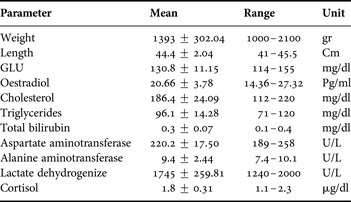
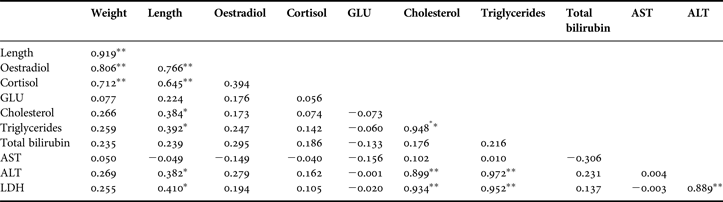
The average weight and total length of female fish samples were 1393 ± 302.04 g and 44.4 ± 2.04 cm, respectively (Table 1). The water temperature ranged between 17 and 18°C, pH was 8.3 and dissolved O2 was 6.8 mg.l−1. The mean and range of plasma parameters of Sparidentex hasta are given in Table 1. Correlations between these blood parameters are given in Table 2.
Biological and biochemical blood plasma parameters (mean ± standard deviation) and range in Sparidentex hasta.

Correlation between biological and biochemical blood plasma parameters in Sparidentex hasta.

AST, aspartate aminotransferase; ALT, alanine aminotransferase; LDH, lactate dehydrogenase; **, correlation is significant at the 0.01 level (2-tailed); *, correlation is significant at the 0.05 level (2-tailed).
DISCUSSION
One of the difficulties in assessing the state of health of natural fish populations has been the paucity of reliable reference ranges of the normal condition. In pursuance of this goal, many fish physiologists have turned to studies of haematology and serum biochemistry, probably because this area has proved to be a valuable diagnostic tool in evaluating health. The biochemical profile can also provide important information on the condition of the organism (Anver, Reference Anver2004). Accordingly, haematology and serum biochemistry data are important so that managers can monitor the health of either captive stocks (for aquaculture) or wild populations (for water quality assessment) of these species.
The liver plays an important role in several vital functions of basic metabolism and is also the major organ of accumulation, biotransformation and degradation of contaminants (Matos et al., Reference Matos, Fontaínhas-Fernandes, Peixoto, Carrola and Rocha2007). The evaluation of biochemicals in fish livers has become an important tool for monitoring environmental exposure of fish to such chemicals in experimental studies. Several investigations demonstrated that changes in the levels of antioxidant enzyme activities can be used as possible biomarkers in different aquatic organisms (Matos et al., Reference Matos, Fontaínhas-Fernandes, Peixoto, Carrola and Rocha2007). Aspartate aminotransferase (AST) and alanine aminotransferase (ALT) belong to the plasma non-functional enzymes which are normally found within the cells of liver, heart, gills, kidneys, muscle and other organs. Their presence in blood plasma may give information on tissue injury or organ dysfunction (Salah El-Deen & Rogeps, Reference Salah El-Deen and Rogeps1993). Beside AST and LDH are also useful indices of tissue damage because they may be released quite readily when only minor changes occur in the morphology and function of cells (Wagner & Congleton, Reference Wagner and Congleton2004). According to Shahsavani et al. (Reference Shahsavani, Mohri and Gholipour Kanani2010) LDH catalyses the conversion of lactate to pyruvate, which is an important step in energy production of cells. High levels of LDH could be connected with conditions such as hepatic necrosis, hepatic parenchyma lesions, fatty liver, skeletal muscle lesions, myocardial infarction and tumours (Topic Popovic et al., Reference Topic Popovic, Strunjak-Perovic, Coz-Rakovac and Hacmanjek2006). In Sparidentex hasta, average concentration of AST, ALT and LDH were 220.2 ± 17.50, 9.4 ± 2.44 and 1745 ± 259.81 U/L respectively. ALT concentration correlated positively with cholesterol and triglycerides (TRIG) (P < 0.01) and LDH correlated positively with ALT, cholesterol and TRIG.
In this study, cholesterol has a positive correlation with liver enzymes (P < 0.01). Accordingly, increase in the blood cholesterol concentration is used as an indicator of liver dysfunction because homeostasis of lipids is one of the principal liver functions (Kaplan et al., Reference Kaplan, Ozabo, Ophem and Febiger1988). Many studies have estimated the nature and degree of stress in fish (Mekkawy et al., Reference Mekkawy, Mahmoud, Osman and Sayed2010). The increase of cholesterol as a response to pollution could be related to excess energy reserves required by organisms to mediate the effects of stress (Lee et al., Reference Lee, Gerking and Jezierska1983). In the present work, the blood cholesterol level ranges were 112–220 mg/dl, respectively.
Glucose is a carbohydrate that has a major role in the bioenergetics of animals that is transformed in to chemical energy (ATP), which, in turn, can be expressed as mechanical energy (Lucas, Reference Lucas and Lucas1996). In sobaity sea-bream glucose averaged 130.8 ± 11.15, between 114 and 155 mg/dl.
The levels of TRIG are considered to be major indices of the health status of teleosts, but they are not a reliable indicator of fish nutritional status (Wagner & Congleton, Reference Wagner and Congleton2004). On the contrary, Kavadias et al. (Reference Kavadias, Castritsi-Catharios, Dessypris and Miliou2004) demonstrated that high concentrations of plasma TRIG depended on the feeding rate, while low levels could be explained by the low-energy diet of fish. The TRIG levels ranged between 71 and 120 mg/dl, which correlated positively with cholesterol in sobaity sea-bream (P < 0.01).
In the present study, cortisol correlated positively with weight, length and oestradiol (P < 0.01). Cortisol is widely used as a long and short term primary stress indicator (Pickering & Pottinger, Reference Pickering and Pottinger1985). Elevated plasma cortisol has caused declines in body size, gonadosomatic index, egg size and gamete quality (Kime & Nash Reference Kime and Nash1999). Increased cortisol can indicate stress conditions in fish and the biological effects of cortisol include suppression of immune system responses (Ross & Ross, Reference Ross, Ross and Ross1999).
Low levels of plasma sex steroids appear during previtellogenesis, 17ß-oestradiol (E2) begins to rise during endogenous vitellogenesis reaching high levels (as well as oestrogen and testosterone) during exogenous vitellogenesis, and there is a feedback inhibition mechanism between sex steroids and gonadotropin exit during oocyte maturation and ovulation (Scott & Sumpter, Reference Scot, Sumpter, Rankin, Pitcher and Duggan1983). Fostier et al. (Reference Fostier, Weil, Terqui, Breton and Jalabert1978) reported the highest levels of E2 a few weeks before spawning and a drop to basal levels prior to ovulation. Photoperiod altered the timing of spawning. The effects of photoperiod on spawning time are generally associated with changes in the levels and timing of peak values of plasma E2 and T (Dutson & Bromage, Reference Dutson and Bromage1987). In sea bream the liver responds directly to stimulation with recombinant sea bream growth hormone and a homologous pituitary homogenate, as well as E2 stimulation (Mosconi et al., Reference Mosconi, Carnevali, Habibi, Sanyal and Polzonetti-Magni2002). When E2 induces vitellogenesis, plasma total calcium levels rise as vitellogenin binds calcium and the vitellogenin concentration in plasma becomes significant (Yeo & Mugiya, Reference Yeo and Mugiya1997). In female sobaity sea-bream, E2 ranged between 14.36 and 27.32 Pg/ml in spawning season and had positive correlation with length and weight (P < 0.01).
CONCLUSION
This study is the first to characterize and provide a comparative physiological account of the wild population of female sobaity sea-bream in spawning season. There is an urgent need to make reliable normal databases available for this species. We established serum parameter values for S. hasta, which can be used as interpretative data obtained from this species in the Persian Gulf. Therefore, values reported here will be useful for the early detection, identification and monitoring of diseases and sublethal conditions in this species.
ACKNOWLEDGEMENT
The authors thank Dr Shohreh Montazeri and her colleagues in the Apadana Pathology Laboratory for blood analysis.