Introduction
Otitis media (middle-ear inflammation) affects up to 90 per cent of children in remote Indigenous communities in Australia.Reference Morris, Leach, Silberberg, Mellon, Wilson and Hamilton 1 Acute and chronic otitis media prevalence is significantly higher in Indigenous than non-Indigenous children.Reference Lehmann, Weeks, Jacoby, Elsbury, Finucane and Stokes 2 The conductive hearing loss associated with otitis media is linked to significant social, financial and educational disadvantage in Indigenous Australia.Reference Williams and Jacobs 3 A multi-factorial approach encompassing clinical, microbiological and social determinants is required to address otitis media in Indigenous children. An understanding of the complex microbiology underlying the disease is critical to achieving effective prevention strategies and therapeutic interventions.Reference Smith-Vaughan, Marsh and Leach 4
Otitis media describes a spectrum of disease from otitis media with effusion (OME), through to acute otitis media without perforation, to acute otitis media with perforation and chronic suppurative otitis media (CSOM, or ‘runny ears’). All of these conditions are associated with a degree of conductive hearing loss that may adversely affect child development.
The bacteriology of otitis media has been extensively researched in Australian and international studies, primarily using culture-based methods, as recommended by the World Health Organization (WHO) for nasopharyngeal carriage studies.Reference Satzke, Turner, Virolainen-Julkunen, Adrian, Antonio and Hare 5 Ideally, microbiological studies of acute otitis media without perforation and OME should be conducted on samples collected by tympanocentesis or myringotomy, in sterile conditions.
Recent articles commenting on the microbiology of otitis media in Indigenous children have reported general findingsReference Smith-Vaughan, Marsh and Leach 4 without providing a complete overview of the literature. This paper compliments our review ‘Otitis media in Indigenous Australian children: review of epidemiology and risk factors’,Reference Jervis-Bardy, Sanchez and Carney 6 presenting a comprehensive review of the literature reporting the otitis media microbiology in Indigenous children since 1985.
Materials and methods
The Google Scholar, Cumulative Index to Nursing and Allied Health Literature (‘CINAHL’), Medline, PubMed and Cochrane databases were searched for articles published between January 1985 and January 2015. References cited in relevant articles were also searched. Search terms included a combination of ‘otitis media’, ‘middle ear disease’, ‘Indigenous’, ‘Aboriginal’, ‘review’, ‘microbiology’ and ‘pathogenesis’. All peer-reviewed and grey literature reporting the microbiology of otitis media in Indigenous children were included.
Results
Middle-ear bacteriology
Large international culture-based studies of middle-ear fluid, collected by tympanocentesis or myringotomy, from children with otitis media with effusion (OME) and acute otitis media without perforation have identified Streptococcus pneumoniae, Haemophilus influenzae, Moraxella catarrhalis and Streptococcus pyogenes (group A streptococcus) as the most commonly detected pathogens.Reference Jacobs, Dagan, Appelbaum and Burch 7 – Reference Segal, Givon-Lavi, Leibovitz, Yagupsky, Leiberman and Dagan 9 Staphylococcus aureus is relatively rare.
Middle-ear fluid from children with acute otitis media with perforation can be sampled without a surgical procedure; however, potential contamination by ear canal flora can make findings difficult to interpret.Reference Leach 10 – Reference Mackenzie, Carapetis, Leach and Morris 12 Results from international studies have found H influenzae and S pneumoniae to be the most commonly isolated pathogens cultured shortly after or at the time of perforation.Reference Marchisio, Bianchini, Baggi, Fattizzo, Galeone and Torretta 13 However, these studies of acute otitis media with perforation have also isolated pathogens such as S aureus and S pyogenes in significantly larger proportions of cases than are seen in invasive studies of acute otitis media without perforation,Reference Marchisio, Bianchini, Baggi, Fattizzo, Galeone and Torretta 13 suggesting that these pathogens may increase the risk of transition from acute otitis media without perforation to acute otitis media with perforation. Alternatively, S aureus and group A streptococcus may gain access to the middle-ear fluid via the canal some time after the initial perforation. During the progression to CSOM, these and other opportunistic pathogens from the ear canal also gain access to the middle ear, leading to a more complex polymicrobial infection that responds poorly to treatment and progresses readily to chronic sequelae.Reference Bluestone 14 – Reference Leach, Wood, Gadil, Stubbs and Morris 16
International studies investigating CSOM have shown secondary pathogens such as Pseudomonas aeruginosa and S aureus to be the most commonly detected organisms, in addition to various anaerobes such as peptostreptococcus sp. and Fusobacterium nucleatum.Reference Brook 17 , Reference Daniel 18 Indigenous children with CSOM aged under six years tend to have a higher proportion of ear discharges positive for non-typeable H influenzae than is found in children aged over six years. This probably reflects the age-specific prevalence of nasopharyngeal carriage of non-typeable H influenzae, and may indicate that the nasopharynx remains a source of infection even after long periods of CSOM.Reference Leach, Wood, Gadil, Stubbs and Morris 16 In addition to topical treatments, these children may also benefit from systemic antibiotics to treat infection that is otherwise not addressed by topical therapy.Reference Couzos, Lea, Mueller, Murray and Culbong 19 This hypothesis is being addressed by a current clinical trial (ACTRN12614000234617).
Otitis media with effusion
There are limited data from aspirated middle-ear fluid studies involving Indigenous children. Performing invasive procedures such as tympanocentesis or myringotomy in children with intact tympanic membranes has not been well supported in Australia because of the high risk of CSOM in Indigenous children and the perceived additional risk that these procedures might contribute. No studies have assessed outcomes of tympanocentesis or myringotomy in children at increased risk of CSOM. In studies where middle-ear fluid has been collected from Indigenous children with OME, the purpose of gaining access to the middle ear has been for the provision of a myringotomy withReference Stuart, Butt and Walker 20 or withoutReference Dawson, Coelen, Murphy, Graham, Dyer and Sunderman 21 , Reference Ashhurst-Smith, Hall, Walker, Stuart, Hansbro and Blackwell 22 the insertion of tympanostomy tubes.
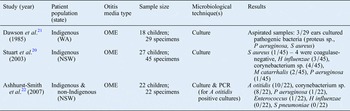
Three studies of middle-ear fluid from Indigenous children with OME have been reported (Table I).Reference Stuart, Butt and Walker 20 – Reference Ashhurst-Smith, Hall, Walker, Stuart, Hansbro and Blackwell 22 Dawson et al.Reference Dawson, Coelen, Murphy, Graham, Dyer and Sunderman 21 initially investigated the hypothesis that Chlamydia trachomatis caused OME in Indigenous children from areas where trachoma (chronic eye disease caused by C trachomatis) was endemic. Their results showed that 3 of 29 middle-ear aspirates (10 per cent) from 18 Indigenous children with OME were culture-positive, with proteus sp., P aeruginosa and S aureus being the organisms identified. Stuart et al.Reference Stuart, Butt and Walker 20 cultured 45 middle-ear aspirates from 27 Indigenous children with OME, identifying S aureus, corynebacterium sp. and H influenzae as the most commonly detected species, with a culture-positive rate of 42 per cent. Ashhurst-Smith et al.Reference Ashhurst-Smith, Hall, Walker, Stuart, Hansbro and Blackwell 22 cultured 22 aspirates from 22 Indigenous children with OME, identifying Alloiococcus otitidis and corynebacterium sp. as the most commonly detected species.
Middle-ear aspirate

WA = Western Australia; OME = otitis media with effusion; NSW = New South Wales; PCR = polymerase chain reaction
These studies create uncertainty regarding the bacteriology of OME in Indigenous children. In Dawson et al.Reference Dawson, Coelen, Murphy, Graham, Dyer and Sunderman 21 and Stuart et al.,Reference Stuart, Butt and Walker 20 the main pathogens isolated (P aeruginosa and S aureus) were common in the canal flora and in association with CSOM, raising the possibility of contamination. While these studies used techniques to sterilise the external auditory canal prior to specimen collection (povidone iodine (Dawson et al.Reference Dawson, Coelen, Murphy, Graham, Dyer and Sunderman 21 ) and aqueous betadine (Stuart et al.Reference Stuart, Butt and Walker 20 )), canal swabs collected after sterilisation and prior to incision were not obtained.
Acute otitis media with perforation
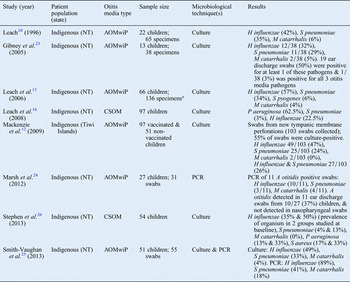
Most middle-ear fluid studies involving Indigenous children have analysed samples from discharging ears following spontaneous tympanic membrane perforation.Reference Leach 10 – Reference Mackenzie, Carapetis, Leach and Morris 12 Six of the studies reviewedReference Leach 10 – Reference Mackenzie, Carapetis, Leach and Morris 12 , Reference Gibney, Morris, Carapetis, Skull, Smith-Vaughan and Stubbs 23 – Reference Smith-Vaughan, Binks, Marsh, Kaestli, Ward and Hare 25 (see Table II Reference Leach 10 – Reference Mackenzie, Carapetis, Leach and Morris 12 , Reference Leach, Wood, Gadil, Stubbs and Morris 16 , Reference Gibney, Morris, Carapetis, Skull, Smith-Vaughan and Stubbs 23 – Reference Stephen, Leach and Morris 26 ) cultured middle-ear discharge from children with acute otitis media with perforation. In these studies, H influenzae was found to be the most commonly cultured organism (32–57 per cent), with S pneumoniae in a high percentage of specimens (4–35 per cent) and M catarrhalis in significantly lower proportions (0–6 per cent).
Middle-ear discharge

*Includes repeat otitis media episodes during study period. NT = Northern Territory; AOMwiP = acute otitis media with perforation; CSOM = chronic suppurative otitis media; PCR = polymerase chain reaction
Consistent with the international literature, higher numbers of pathogens are detected using polymerase chain reaction based methods. Smith-Vaughan et al.Reference Smith-Vaughan, Binks, Marsh, Kaestli, Ward and Hare 25 used quantitative polymerase chain reaction to analyse 55 ear discharge swabs (n = 51). These authors detected otopathogens in a significantly higher percentage of samples than culture (H influenzae (89 per cent vs 49 per cent), S pneumoniae (41 per cent vs 33 per cent) and M catarrhalis (18 per cent vs 4 per cent)). Smith-Vaughan et al.Reference Smith-Vaughan, Binks, Marsh, Kaestli, Ward and Hare 25 also found that 51 per cent of the ear discharge swabs were polymerase chain reaction positive for multiple otopathogenic species, confirming the polymicrobial nature of otitis media in Indigenous children.
A role for atypical otopathogens has also been considered in Indigenous children with otitis media. One example is A otitidis. This has been detected by culture and/or polymerase chain reaction in middle-ear specimens from Indigenous children with OMEReference Ashhurst-Smith, Hall, Walker, Stuart, Hansbro and Blackwell 22 and acute otitis media with perforation.Reference Marsh, Binks, Beissbarth, Christensen, Morris and Leach 24 Ashhurst-Smith et al.Reference Ashhurst-Smith, Hall, Burns, Stuart and Blackwell 27 cultured A otitidis in 10 of 22 middle-ear aspirates (45 per cent) collected from Indigenous children with OME undergoing myringotomy. Marsh et al.Reference Marsh, Binks, Beissbarth, Christensen, Morris and Leach 24 detected A otitidis in 35 per cent of middle-ear discharge swabs, but not from the nasopharynx, from 27 children with acute otitis media with perforation; however, it is unclear whether A otitidis detection indicates a primary role in acute otitis media pathogenesis or whether it reflects secondary infection following perforation. A otitidis has previously been detected in around 5 per cent of nasopharyngeal and ear canal swabs from 145 children with acute otitis media or OME,Reference Tano, Von Essen, Eriksson and Sjöstedt 28 , Reference Takada, Harimaya, Yamazaki and Himi 29 and can illicit an inflammatory response.Reference Ashhurst-Smith, Hall, Burns, Stuart and Blackwell 27 Further research is required to understand the role of atypical species in otitis media in Indigenous children, which may be slow-growing or fastidious under standard otopathogen culture conditions, and not currently reported in the literature.
Chronic suppurative otitis media
Despite documented high CSOM prevalence in Indigenous children,Reference Jervis-Bardy, Sanchez and Carney 6 there are minimal datasets describing the microbiology of this condition. This may be, in part, because of the use of otitis media terminology, where acute otitis media with perforation has been used to describe what could also be considered ‘early’ CSOM. The contemporary definition of CSOM according to the WHO is persistent otorrhoea for more than two weeks. 30 The CSOM definition applied in Australian studies of Indigenous children with ear discharge has been persistent otorrhoea for six weeks or more, in the presence of a perforation size of greater than 2 per cent of the pars tensa. A shorter duration or perforation size of less than 2 per cent is used to define acute otitis media with perforation.
Two of the studies reviewed cultured middle-ear discharge from Indigenous children with documented CSOM. Consistent with the proposed progression of acute otitis media with perforation to CSOM, involving the persistence of secondary pathogens and reduction in proportion with otopathogens, Leach et al.Reference Leach, Wood, Gadil, Stubbs and Morris 16 and Stephen et al.Reference Stephen, Leach and Morris 26 identified P aeruginosa to be the most commonly isolated pathogen (62.5 per cent and 13–33 per cent) from 97 and 54 children respectively. Both studies noted the persistence of non-typeable H influenzae in the ear discharge of children with unresolved CSOM, even after weeks of topical antibiotic therapy.
Progression to chronic suppurative otitis media
The microbiological progression of acute otitis media with perforation to CSOM has not been formally investigated in longitudinal studies. Such studies are of particular relevance to the therapeutic challenge of otitis media in Indigenous children. Current national guidelines recommend oral antibiotics (amoxicillin 50–90 mg/kg, 2–3 times daily, for 14 days) for Indigenous children with acute otitis media with perforation.Reference Mackenzie, Carapetis, Leach and Morris 12 This strategy is largely informed by the high prevalence and density of nasopharyngeal otopathogen carriage in Indigenous children, and the difficulty of inserting topical applications into the middle-ear space, particularly when perforations are less than 2 per cent. It may be that all children with ear discharge should receive both oral and topical antibiotics unless the perforation size is confirmed, in which case only one or other treatment continues (topical antibiotics alone if perforation size is greater than 2 per cent, and oral antibiotics alone if perforation size is less than 2 per cent). The national guideline recommendations for CSOM are for topical antibiotics alone (2–5 drops of ciprofloxacin, 2–4 times a day). 31
Nasopharyngeal bacteriology
Nasopharyngeal colonisation is the antecedent of otitis media.Reference Leach, Boswell, Asche, Nienhuys and Mathews 32 As such, where collection of middle-ear fluid by tympanocentesis is not possible, nasopharyngeal studies have been used to provide a surrogate microbiological measure to assess otitis media related bacteriology in Indigenous children. Studies with paired nasopharyngeal and middle-ear fluid microbiology support the value of nasopharyngeal carriage in predicting the effects of interventions on otitis media in clinical trials and at population level, but are not applicable to individual children.
Several nasopharyngeal studies have investigated the relationship between bacterial colonisation of the nasopharynx and the onset of otitis media in Indigenous infants. In arguably the most defining of these studies, Leach et al.Reference Leach, Boswell, Asche, Nienhuys and Mathews 32 showed that the early colonisation of the nasopharynx by common respiratory pathogens was an important risk factor for otitis media (acute otitis media, OME or tympanic membrane perforation) in Indigenous infants followed longitudinally from birth up to 180 days of age. The risk of otitis media was 33-fold higher in children with H influenzae and S pneumoniae co-colonisation compared to children colonised by M catarrhalis alone. Smith-Vaughan et al.Reference Smith-Vaughan, Byun, Nadkarni, Jacques, Hunter and Halpin 33 further showed that bacterial load of these organisms in nasopharyngeal samples can predict the ear state of Indigenous children.
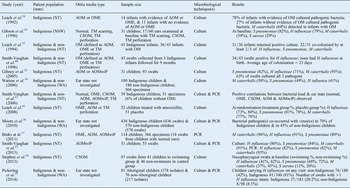
Thirteen studies investigating nasopharyngeal specimens from Indigenous children were included in this review (Table III).Reference Gibney, Morris, Carapetis, Skull, Smith-Vaughan and Stubbs 23 , Reference Smith-Vaughan, Binks, Marsh, Kaestli, Ward and Hare 25 , 30 , Reference Leach, Boswell, Asche, Nienhuys and Mathews 32 – Reference Leach, Morris and Mathews 41 Most of these studies included children with various forms of otitis media, including participants with clinically normal ears. Three Western Australian studiesReference Watson, Carville, Bowman, Jacoby, Riley and Leach 34 – Reference Moore, Jacoby, Taylor, Harnett, Bowman and Riley 36 did not report specific otitis media subtypes allowing for correlation with microbiological findings. Several of these studies also compared middle-ear fluid to nasopharyngeal microbiology. Smith-Vaughan et al.Reference Smith-Vaughan, Binks, Marsh, Kaestli, Ward and Hare 25 analysed 55 nasopharyngeal swabs from 51 children with acute otitis media with perforation, detecting significantly higher carriage of otopathogens in nasopharyngeal swabs compared to middle-ear discharge specimens from the same children (H influenzae (80 per cent compared to 49 per cent), S pneumoniae (84 per cent compared to 33 per cent) and M catarrhalis (91 per cent compared to 4 per cent)). Gibney et al.Reference Gibney, Morris, Carapetis, Skull, Smith-Vaughan and Stubbs 23 cultured 93 nasopharyngeal swabs from 31 Indigenous children followed for up to 56 days subsequent to a diagnosis of acute otitis media with or without perforation. Of the 93 swabs cultured, M catarrhalis was also the most common species identified (95 per cent), followed by H influenzae (71 per cent) and S pneumoniae (82 per cent). Stephen et al.Reference Stephen, Leach and Morris 26 cultured H influenzae (41 per cent and 62 per cent), S pneumoniae (68 per cent and 72 per cent), with lower rates of M catarrhalis (37 per cent and 43 per cent), in nasopharyngeal swabs from two groups (total n = 87) of Indigenous children with CSOM.
Nasopharyngeal analysis

NT = Northern Territory; AOM = acute otitis media; OME = otitis media with effusion; OM = otitis media; NSW = New South Wales; TM = tympanic membrane; CSOM = chronic suppurative otitis media; AOMwiP = acute otitis media with perforation; WA = Western Australia; PCR = polymerase chain reaction
Three polymerase chain reaction based studiesReference Smith-Vaughan, Binks, Marsh, Kaestli, Ward and Hare 25 , Reference Smith-Vaughan, Byun, Nadkarni, Jacques, Hunter and Halpin 33 , Reference Binks, Cheng, Smith-Vaughan, Sloots, Nissen and Whiley 37 investigated nasopharyngeal colonisation of Indigenous children with various forms of middle-ear disease (acute otitis media, acute otitis media with perforation, OME, CSOM) and a small proportion of clinically normal ears (Table III). Binks et al.Reference Binks, Cheng, Smith-Vaughan, Sloots, Nissen and Whiley 37 found M catarrhalis rates (96 per cent) similar to the traditional culture-based studies, and much higher rates of S pneumoniae (89 per cent) and H influenzae (91 per cent), confirming higher detection by polymerase chain reaction compared to traditional culture-based methods, as discussed below.
Prospective longitudinal studies have compared nasopharyngeal colonisation in Indigenous and non-Indigenous children living in the same community.Reference Watson, Carville, Bowman, Jacoby, Riley and Leach 34 , Reference Moore, Jacoby, Taylor, Harnett, Bowman and Riley 36 In Watson et al.,Reference Watson, Carville, Bowman, Jacoby, Riley and Leach 34 nasopharyngeal specimens were collected for culture from 100 Indigenous and 180 non-Indigenous children in Western Australia. Nasopharyngeal bacterial carriage was found to be significantly higher in the Indigenous cohort.Reference Watson, Carville, Bowman, Jacoby, Riley and Leach 34 Using polymerase chain reaction, Moore et al.Reference Moore, Jacoby, Taylor, Harnett, Bowman and Riley 36 further showed that viral and bacterial co-occurrence was higher (70 per cent vs 45 per cent) in nasopharyngeal specimens from Indigenous children (n = 436) compared to non-Indigenous children (n = 570). Indigenous children were also found to carry multiple strains of H influenzae in a study comparing nasopharyngeal H influenzae carriage between Indigenous and non-Indigenous children.Reference Pickering, Smith-Vaughan, Beissbarth, Bowman, Wiertsema and Riley 35
Virology of otitis media in Indigenous children
According to international reviews, most otitis media cases involve co-infection with bacterial and viral invasion of the middle ear.Reference Massa, Cripps and Lehmann 42 , Reference Vergison 43 Animal models have shown that a complex relationship exists between viruses and bacteria in otitis media, suggesting that viruses such as influenza A can induce middle-ear inflammation and facilitate bacterial replication.Reference Short, Diavatopoulos, Thornton, Pedersen, Strugnell and Wise 44 The international literature includes comprehensive viral studies of middle-ear aspirates utilising polymerase chain reaction technology. Heikkinen et al.Reference Heikkinen, Thint and Chonmaitree 45 identified respiratory syncytial virus, parainfluenza viruses, influenza viruses, enteroviruses and adenoviruses as the most commonly detected viruses in a large study of 465 Finnish children with acute otitis media.
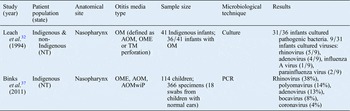
No studies have tested for viruses in middle-ear samples from Indigenous children with otitis media. Two studies have investigated viruses in the nasopharynx of Indigenous children (Table IV).Reference Leach, Boswell, Asche, Nienhuys and Mathews 32 , Reference Binks, Cheng, Smith-Vaughan, Sloots, Nissen and Whiley 37 While a causal relationship between otitis media and bacterial colonisation of the nasopharynx is accepted,Reference Wiertsema and Leach 15 the role that viruses in the nasopharynx play in the pathogenesis of otitis media remains controversial. Nasopharyngeal studies have detected viruses in children with and without acute otitis media,Reference Chonmaitree, Revai, Grady, Clos, Patel and Nair 46 although respiratory syncytial virus detection in the nasopharynx has been shown to predict acute otitis media.Reference Ruohola, Pettigrew, Lindholm, Jalava, Räisänen and Vainionpää 47
Virology

NT = Northern Territory; OM = otitis media; AOM = acute otitis media; OME = otitis media with effusion; TM = tympanic membrane; AOMwiP = acute otitis media with perforation; PCR = polymerase chain reaction
In Indigenous children, Binks et al.Reference Binks, Cheng, Smith-Vaughan, Sloots, Nissen and Whiley 37 used multiplex polymerase chain reaction to show that at least 1 of 17 viruses was present in 62 per cent of 366 nasopharyngeal samples collected from 114 children, followed from birth to 24 months, with OME, acute otitis media or acute otitis media with perforation (5 per cent of samples were collected from children with clinically normal ears). The principle viruses identified were rhinovirus (38 per cent), polyomavirus (14 per cent), adenovirus (13 per cent), bocavirus (8 per cent) and coronavirus (4 per cent).Reference Binks, Cheng, Smith-Vaughan, Sloots, Nissen and Whiley 37 Adenovirus was the only virus detected that independently correlated with middle-ear disease in that study. Children infected with adenovirus were found to be three times more likely to have acute otitis media or acute otitis media with perforation. Of note, influenza and respiratory syncytial virus were rarely identified (less than 9 per cent collectively). Consistent with the hypothesis that viruses in otitis media facilitate bacterial replication, Binks et al.Reference Binks, Cheng, Smith-Vaughan, Sloots, Nissen and Whiley 37 also found bacterial load of H influenzae to be significantly higher in the presence of multiple viruses. This finding may inform future studies considering the effects of vaccines targeting viruses on the burden of bacterial disease in Indigenous children.Reference Cripps and Otczyk 48
Culture versus polymerase chain reaction and emergence of biofilms
Culture has been the most commonly used method of bacterial identification in the studies reviewed and remains the ‘gold standard’ for the identification of specific species such as H influenzae.Reference Hare, Marsh, Binks, Grimwood, Pizzutto and Leach 49 DNA-based methods such as polymerase chain reaction and florescent in situ hybridisation have complemented these studies in recent times.Reference Feazel, Frank and Ramakrishnan 50 This has led to the identification of fastidious species such as A otitidis Reference Ashhurst-Smith, Hall, Walker, Stuart, Hansbro and Blackwell 22 , Reference Marsh, Binks, Beissbarth, Christensen, Morris and Leach 24 and the isolation of organisms refractory to culture because of the presence of biofilms.Reference Hall-Stoodley, Hu, Gieseke, Nistico, Nguyen and Hayes 51 – Reference Moriyama, Hotomi, Shimada, Billal, Fujihara and Yamanaka 53
As demonstrated above, polymerase chain reaction was more sensitive than culture in a number of studies of otitis media involving Indigenous childrenReference Smith-Vaughan, Binks, Marsh, Kaestli, Ward and Hare 25 , Reference Smith-Vaughan, Byun, Nadkarni, Jacques, Hunter and Halpin 33 and other cohorts.Reference Leskinen, Hendolin, Virolainen-Julkunen, Ylikoski and Jero 54 , Reference Post, Preston, Aul, Larkins-Pettigrew, Rydquist-White and Anderson 55 The increased sensitivity of polymerase chain reaction may be because of a number of factors. One hypothesis is that polymerase chain reaction detects remnant DNA from non-viable organisms. However, a study by Kaur et al.Reference Kaur, Adlowitz, Casey, Zeng and Pichichero 56 showed the presence of messenger RNA in polymerase chain reaction positive and culture-negative aspirated acute otitis media samples, demonstrating viable bacteria. That study also showed that non-viable DNA clears from the middle ear within 1–3 weeks, while Post et al.Reference Post, Aul, White, Wadowsky, Zavoral and Tabari 57 found clearance occurs within 3 days.
Clinical relevance of polymerase chain reaction
The increased sensitivity of polymerase chain reaction may also be shown in the context of biofilms, in a bacterial phenotype associated with increased antibiotic resistance that is recalcitrant to culture.Reference Hall-Stoodley, Hu, Gieseke, Nistico, Nguyen and Hayes 51 , Reference Hendolin, Markkanen, Ylikoski and Wahlfors 58 Florescent in situ hybridisation based studies have found that a high proportion of middle-ear specimens (60–92 per cent) from children and adults with otitis media contain bacterial biofilms produced by H influenzae, S pneumoniae and M catarrhalis. Reference Hall-Stoodley, Hu, Gieseke, Nistico, Nguyen and Hayes 51 – Reference Moriyama, Hotomi, Shimada, Billal, Fujihara and Yamanaka 53 , Reference Lee, Pawlowski, Luong, Furze and Roland 59 , Reference Thornton, Rigby, Wiertsema, Filion, Langlands and Coates 60 Thornton et al.Reference Thornton, Rigby, Wiertsema, Filion, Langlands and Coates 60 showed that all biofilms detected in mucosal biopsies from 11 of 17 non-Indigenous children with acute otitis media or OME contained multiple bacterial species, confirming that the middle-ear biofilms can be polymicrobial. The clinical importance of biofilms has been underlined by Hall-Stoodley et al.,Reference Hall-Stoodley, Nistico, Sambanthamoorthy, Dice, Nguyen and Mershon 61 who showed that pneumococcal biofilms have an increased resistance to azithromycin; this highlights the prospect of biofilms becoming a new target for novel therapeutic intervention. The emergence of technologies for biofilm analysis and understanding has led to greater opportunities to better understand and clarify their clinical relevance for otitis media pathogenesis in Indigenous Australian populations.
DNA-based analysis of polymicrobial middle-ear infections
Although polymerase chain reaction has consistently proved more sensitive than culture, it is clear that bacterial communities present in otitis media samples extend beyond pathogens traditionally targeted by polymerase chain reaction studies. Smith-Vaughan et al.Reference Smith-Vaughan, Binks, Marsh, Kaestli, Ward and Hare 25 recently estimated the abundance of individual species as a proportion of total bacterial load in 55 middle-ear discharge swabs from Indigenous children with acute otitis media with perforation. The relative abundance of H influenzae (2.8 per cent, range of 0–68 per cent), S pneumoniae (0 per cent, range of 0–12 per cent) and M catarrhalis (0 per cent, range of 0–1.8 per cent) indicated that a large proportion of bacterial load in the samples studied were not identified by specific polymerase chain reaction.
To overcome the limits of microbiological methods targeting specific pathogens (i.e. polymerase chain reaction), recent advances in genomic technologies now allow for the analysis of entire polymicrobial communities (‘microbiomes’). Bacterial community fingerprinting has been used to profile polymicrobial samples, providing insights into the bacterial richness of otitis media specimens.Reference Kasenõmm and Štšepetova 62 MarshReference Marsh 63 used terminal restriction fragment length polymorphism analysis to investigate middle-ear discharge in Indigenous children with acute otitis media with perforation for up to six weeks, and found significant differences between the bacterial communities of nasopharyngeal and middle-ear discharge specimens.
The emergence of next-generation gene sequencing technologies has now allowed for a more in-depth understanding of bacterial communities through 16S ribosomal RNA surveys of entire microbiomes. Jervis-Bardy et al.Reference Jervis-Bardy, Rogers, Morris, Smith-Vaughan, Nosworthy and Leong 64 recently surveyed the microbiome of adenoid tissue, the nasopharynx and middle-ear effusions (collected by myringotomy) from 11 Indigenous children with OME. They found that the microbiota in middle-ear fluid was dominated (more than 50 per cent relative abundance) by A otitidis, H influenzae and streptococcus sp. The absence of A otitidis in the nasopharynx of children studied suggests that infection of A otitidis in the middle ear of children with OME and an intact tympanic membrane may have been acquired via the ear canal during previous perforations.
Discussion
Where possible, otitis media microbiological studies in patients with an intact tympanic membrane should be undertaken on samples collected by tympanocentesis or myringotomy. Studies of aspirated middle-ear fluid in Indigenous children with otitis media with effusion (OME) who are undergoing surgical procedures such as adenoidectomy and tympanostomy tube insertion represent a minor component of the literature reviewed. The literature is more comprehensive in relation to the analysis of culture data from middle-ear discharge and nasopharyngeal specimens. Analysis of middle-ear discharge following tympanic membrane perforation (acute otitis media with perforation, CSOM) is important to the understanding of the progression of acute otitis media to CSOM. However, the limitations inherent in sampling middle-ear discharge, including difficulty differentiating canal contamination from secondary middle-ear infection, must be considered.
Nasopharyngeal studies are important for understanding the pathogenesis of middle-ear disease in Indigenous children, as nasopharyngeal colonisation is known to be an essential antecedent of acute otitis media.Reference Wiertsema and Leach 15 Additionally, nasopharyngeal specimens provide an accessible microbiological measure in children with otitis media and an intact tympanic membrane, where aspiration of middle-ear fluid is not possible. However, nasopharyngeal studies have inherent limitations, the most significant of which is the known difference in bacterial community profiles of the middle ear and nasopharynx.Reference Marsh 63 , Reference Liu, Cosetti, Aziz, Buchhagen, Contente-Cuomo and Price 65 The nasopharynx is also a reservoir for otopathogens present in children with healthy and diseased middle ears.Reference Watson, Carville, Bowman, Jacoby, Riley and Leach 34
Results from culture-based middle-ear discharge studies of acute otitis media with perforation are consistent with international literature, in which H influenzae and S pneumoniae are the most common organisms, with M catarrhalis isolated in a lower proportion of samples. Further studies have utilised polymerase chain reaction to analyse middle-ear discharge in acute otitis media with perforation. Using polymerase chain reaction, Smith-Vaughan et al.Reference Smith-Vaughan, Binks, Marsh, Kaestli, Ward and Hare 25 showed that acute otitis media with perforation specimens were polymerase chain reaction positive for multiple otopathogenic species, demonstrating the polymicrobial nature of otitis media in Indigenous children. Marsh et al.Reference Marsh, Binks, Beissbarth, Christensen, Morris and Leach 24 also utilised polymerase chain reaction to isolate A otitidis in a high proportion of acute otitis media with perforation samples. However, it remains unclear whether A otitidis plays a primary role in acute otitis media or whether it invades the middle ear following acute perforation.Reference Marsh, Binks, Beissbarth, Christensen, Morris and Leach 24
Nasopharyngeal studies have shown that early colonisation of the nasopharynx is an important risk factor for otitis media in Indigenous infantsReference Leach, Boswell, Asche, Nienhuys and Mathews 32 and that nasopharyngeal bacterial load can predict the ear state of Indigenous children.Reference Smith-Vaughan, Byun, Nadkarni, Jacques, Hunter and Halpin 33 Bacterial colonisation is also significantly higher in Indigenous children compared to non-Indigenous children, regardless of middle-ear pathology.Reference Watson, Carville, Bowman, Jacoby, Riley and Leach 34 , Reference Moore, Jacoby, Taylor, Harnett, Bowman and Riley 36 Generally, culture and polymerase chain reaction based studies of Indigenous children with all forms of otitis media found a significantly higher prevalence of bacteria in the nasopharynx compared to the middle ear.Reference Smith-Vaughan, Binks, Marsh, Kaestli, Ward and Hare 25 The most significant difference seen across studies of the nasopharynx and middle ear was the presence of M catarrhalis, which was isolated in higher proportions in nasopharyngeal studies.
While no studies of viruses in middle-ear fluid were identified in this review, two studies investigated viruses in the nasopharynx of Indigenous children. Although the role that viruses in the nasopharynx play in the pathogenesis of otitis media remains controversial, Binks et al.Reference Binks, Cheng, Smith-Vaughan, Sloots, Nissen and Whiley 37 found that children infected with adenovirus in the nasopharynx were three times more likely to have acute otitis media or acute otitis media with perforation.Reference Chonmaitree, Revai, Grady, Clos, Patel and Nair 46 , Reference Ruohola, Pettigrew, Lindholm, Jalava, Räisänen and Vainionpää 47 Recent animal studies suggest that a complex relationship exists between viruses and bacteria in the middle ear. Accordingly, studies of viruses in the middle-ear fluid of Indigenous children are required, to establish whether vaccines targeting viruses may be an approach to preventing bacterial otitis media.
With regard to the technologies used to study the microbiology of otitis media in Indigenous children, polymerase chain reaction has proved more sensitive than culture in a number of studies of otitis media involving Indigenous childrenReference Smith-Vaughan, Binks, Marsh, Kaestli, Ward and Hare 25 , Reference Smith-Vaughan, Byun, Nadkarni, Jacques, Hunter and Halpin 33 and other cohorts.Reference Leskinen, Hendolin, Virolainen-Julkunen, Ylikoski and Jero 54 The increased sensitivity of polymerase chain reaction may be due to a number of factors, such as the presence of non-viable DNAReference Kaur, Adlowitz, Casey, Zeng and Pichichero 56 , Reference Post, Aul, White, Wadowsky, Zavoral and Tabari 57 or fastidious species like A otitidis.Reference Ashhurst-Smith, Hall, Walker, Stuart, Hansbro and Blackwell 22 , Reference Marsh, Binks, Beissbarth, Christensen, Morris and Leach 24 The sensitivity of polymerase chain reaction may also be shown in the context of biofilms, which can be recalcitrant to culture.Reference Hall-Stoodley, Hu, Gieseke, Nistico, Nguyen and Hayes 51 , Reference Hendolin, Markkanen, Ylikoski and Wahlfors 58 Bacterial biofilms have not yet been studied in Indigenous Australian populations. Given the acknowledged resistance of biofilms to antibiotic treatment, further research is needed to understand the role of biofilm in otitis media in Indigenous children, which is also often resistant to standard therapies.Reference Leach, Wood, Gadil, Stubbs and Morris 16
Smith-Vaughan et al.Reference Smith-Vaughan, Binks, Marsh, Kaestli, Ward and Hare 25 recently showed that a large proportion of total bacterial load in middle-ear discharge samples is not isolated by targeted microbiological techniques such as polymerase chain reaction. Advances in genomic technologies are now allowing microbiologists to analyse entire mixed bacterial communities (‘microbiomes’), thereby overcoming the limits of methods targeting specific pathogens. Bacterial community fingerprinting was recently utilised by MarshReference Marsh 63 to describe significant differences between the bacterial communities of nasopharyngeal and middle-ear discharge specimens in Indigenous children. Next-generation sequencing of the 16S ribosomal RNA gene has provided further insight into microbial communities. Findings suggest that OME in Indigenous children involves pathogens from the nasopharynx interacting with ear canal flora, which gain access to the middle ear of children undergoing cycles of tympanic membrane perforation and healing.Reference Gibney, Morris, Carapetis, Skull, Smith-Vaughan and Stubbs 23
Conclusion
The middle-ear microbiology of otitis media in Indigenous children has been extensively researched over the last two decades. Most studies have used culture-based methods, and specimens from middle-ear discharge or the nasopharynx. Findings from these studies are consistent with international literature, but reliance on culture may incorrectly characterise the microbiology of this condition. With the introduction of affordable next-generation sequencing technologies, researchers can now fully explore the ‘microbiomes’ of ear discharge from Indigenous children.