Introduction
Executive functioning (EF) is probably the most extensively studied domain in attention deficit hyperactivity disorder (ADHD) (APA, 1994; Pennington & Ozonoff, Reference Pennington and Ozonoff1996; Clark et al. Reference Clark, Prior and Kinsella2000; Sergeant et al. Reference Sergeant, Geurts and Oosterlaan2002; Seidman et al. Reference Seidman, Doyle, Fried, Valera, Crum and Matthews2004; Boonstra et al. Reference Boonstra, Oosterlaan, Sergeant and Buitelaar2005; Willcutt et al. Reference Willcutt, Doyle, Nigg, Faraone and Pennington2005; Doyle, Reference `2006). EF has been defined as ‘those capacities that enable a person to engage successfully in independent, purposive, self-serving behaviour’ (Lezak, Reference Lezak1995). EF impairments have been reported in many studies with ADHD patients, with problems in inhibition and working memory being the most frequently replicated (Pennington & Ozonoff, Reference Pennington and Ozonoff1996; Clark et al. Reference Clark, Prior and Kinsella2000; Sergeant et al. Reference Sergeant, Geurts and Oosterlaan2002; Seidman et al. Reference Seidman, Doyle, Fried, Valera, Crum and Matthews2004; Boonstra et al. Reference Boonstra, Oosterlaan, Sergeant and Buitelaar2005; Willcutt et al. Reference Willcutt, Doyle, Nigg, Faraone and Pennington2005; Doyle, Reference `2006). EF impairments appear to be (partly) related to abnormalities in the frontal lobe and frontal-subcortical structures found in patients with ADHD (Castellanos & Tannock, Reference Castellanos and Tannock2002; Durston, Reference Durston2003), since frontal lesions sometimes produce symptoms as observed in patients with ADHD (i.e. distractibility, hyperactivity, and impulsivity) as well as deficits on EF tasks (Mattes, Reference Mattes1980; Stuss & Benson, Reference Stuss and Benson1986; Benson, Reference Benson1991; Heilman et al. Reference Heilman, Voeller and Nadeau1991; Fuster, Reference Fuster1997; Willcutt et al. Reference Willcutt, Doyle, Nigg, Faraone and Pennington2005).
An issue related to EF in ADHD is intelligence. Intelligence may be defined as ‘the aggregate or global capacity of the individual to act purposefully, to think rationally and to deal effectively with his environment’ (Wechsler, Reference Wechsler1944). Several parallels emerge between both domains. Like EF, a widespread finding across studies is a somewhat lower intelligence quotient (IQ) in children with ADHD (Mariani & Barkley, Reference Mariani and Barkley1997; Frazier et al. Reference Frazier, Demaree and Youngstrom2004; Kuntsi et al. Reference Kuntsi, Eley, Taylor, Hughes, Asherson, Caspi and Moffitt2004), having on average a 7- to 12-point lower full-scale IQ than controls with effect sizes being somewhat larger for verbal IQ (VIQ) than performance IQ (PIQ) (Frazier et al. Reference Frazier, Demaree and Youngstrom2004; Kuntsi et al. Reference Kuntsi, Eley, Taylor, Hughes, Asherson, Caspi and Moffitt2004). Furthermore, like EF, IQ seems to be (at least partly) mediated by frontal circuits (Duncan et al. Reference Duncan, Burgess and Emslie1995, Reference Duncan, Burgess and Emslie1996; Gray et al. Reference Gray, Chabris and Braver2003; Haier et al. Reference Haier, Jung, Yeo, Head and Alkire2004; Toga & Thompson, Reference Toga and Thompson2005). Both EF and IQ are substantially influenced by heritability (Doyle et al. Reference Doyle, Faraone, Seidman, Willcutt, Nigg, Waldman, Pennington, Peart and Biederman2005b; Plomin & Spinath, Reference Plomin and Spinath2005). Previous research has shown certain polymorphisms in genes that relate to ADHD (DRD4 and DAT1) that are also related to both EF and IQ (Kuntsi et al. Reference Kuntsi, Eley, Taylor, Hughes, Asherson, Caspi and Moffitt2004; Doyle et al. Reference Doyle, Faraone, Seidman, Willcutt, Nigg, Waldman, Pennington, Peart and Biederman2005b; Khan & Faraone, Reference Khan and Faraone2006; Mill et al. Reference Mill, Caspi, Williams, Craig, Taylor, Polo-Tomas, Berridge, Poulton and Moffitt2006; Boonstra et al. Reference Boonstra, Kooij, Buitelaar, Oosterlaan, Sergeant, Heister and Franke2007).
Unclear from the majority of studies reporting on EF and IQ in patients with ADHD is whether problems in EF and IQ are causally related to ADHD, or are merely associated with the disorder. From an aetiological perspective, EF and IQ impairments may give rise to behavioural symptoms of inattention and hyperactivity-impulsivity. However, the reverse is also possible: being more inattentive and hyperactive-impulsive may cause abnormal performance on tasks measuring EF and IQ. In the latter case, EF and IQ impairments may not shed light on the neuro(psycho)logical causes leading up to ADHD but merely reflect an association with the disorder.
Research into non-affected siblings may help distinguish between these two alternatives: non-affected siblings do not suffer from ADHD, which makes it unlikely that the possible neuro(psycho)logical dysfunctions observed in this group are a result of inattention and hyperactivity-impulsivity. If EF and IQ impairments are indeed found in non-affected relatives, it is possible that EF and IQ dysfunctions form endophenotypes of ADHD: heritable, vulnerability traits that heighten the risk for developing the disorder (Gottesman & Gould, Reference Gottesman and Gould2003; Waldman, Reference Waldman2005). Non-affected siblings share on average half of their genes with their affected sibling and will, therefore, probably carry some of the susceptibility genes for ADHD. This underlying susceptibility for the disorder expresses itself in subtle neuro(psycho)logical abnormalities that may be picked up by sensitive neuro(psycho)logical tasks but are not sufficient to cause the behavioural symptoms of inattention and hyperactivity-impulsivity. Such endophenotypes may be useful in genetic research, since it is theorized that they relate more strongly to susceptibility genes for ADHD than behavioural symptoms (Gottesman & Gould, Reference Gottesman and Gould2003; Waldman, Reference Waldman2005). Therefore, the first aim of our study was to investigate whether EF and IQ form candidate endophenotypes for ADHD. We limited our investigation of EF to inhibition and working memory, since deficits in these two functions are the most reliably replicated ones in ADHD and both functions have been put forward as the most likely endophenotypic candidates within the EF domain (Castellanos & Tannock, Reference Castellanos and Tannock2002). If EF and IQ impairments are indeed viable endophenotypic candidates, it may be expected that non-affected siblings portray problems in both domains and that siblings resemble each other in EF and IQ.
Few studies have targeted EF and IQ within ADHD families and results appear inconsistent. Two studies have failed to find neurocognitive impairments in parents of children with ADHD (Murphy & Barkley, Reference Murphy and Barkley1996; Asarnow et al. Reference Asarnow, Nuechterlein, Subotnik, Fogelson, Torquato, Payne, Asamen, Mintz and Guthrie2002). Another study found no impairment on isolated measures of EF in non-affected siblings of males with ADHD, although a composite of EF measures nearly (p=0.06) differentiated non-affected siblings from controls (Seidman et al. Reference Seidman, Biederman, Monuteaux, Weber and Faraone2000). Another study reported that a variety of EF measures was familial but only a minority of the measures demonstrated impairments in the non-affected relatives (Nigg et al. Reference Nigg, Blaskey, Stawicki and Sachek2004). More promising results have been reported by Waldman et al. (Reference Waldman, Nigg, Gizer, Park, Rappley and Friderici2006), showing that various EF measures are impaired in non-affected siblings and correlated between siblings; also, a study focusing on twins discordant for ADHD reported on various EF measures as endophenotypic candidates (Bidwell et al. Reference Bidwell, Willcutt, DeFries and Pennington2007). Studies that have specifically targeted inhibition as a cognitive endophenotype have also reported promising results: two studies reported non-affected siblings as performing intermediately between their affected siblings and controls (Slaats-Willemse et al. Reference Slaats-Willemse, Swaab-Barneveld, De Sonneville, Van der Meulen and Buitelaar2003; Schachar et al. Reference Schachar, Crosbie, Barr, Ornstein, Kennedy, Malone, Roberts, Ickowicz, Tannock, Chen and Pathare2005) and a third study reported that poor inhibition in children with ADHD was related to a higher prevalence of ADHD among their relatives (Crosbie & Schachar, Reference Crosbie and Schachar2001). Subtle problems in interference control have been reported in non-affected relatives of girls with ADHD (Doyle et al. Reference Doyle, Biederman, Seidman, Reske-Nielsen and Faraone2005a) and significant correlations have been found for inhibitory control between affected siblings (Slaats-Willemse et al. Reference Slaats-Willemse, Swaab-Barneveld, De Sonneville and Buitelaar2005). These findings suggest that inhibition may be a viable executive function to serve as an endophenotype, since it appears deficient (to a certain degree) in non-affected relatives of ADHD patients and correlates between siblings. No such data have been reported on working memory in non-affected siblings. With respect to IQ, two studies have reported lower IQ in relatives of ADHD patients (Faraone et al. Reference Faraone, Biederman, Lehman, Spencer, Norman, Seidman, Kraus, Perrin, Chen and Tsuang1993, Reference Faraone, Biederman, Lehman, Spencer, Norman, Seidman, Kraus, Perrin, Chen and Tsuang1996). These studies suggest that there may be some impairment in EF and IQ in non-affected relatives, though these impairments are not found on all EF tasks and the effect appears to be small. Clearly, research is needed to further explore the utility of EF and IQ as endophenotypes for ADHD.
An unaddressed issue in all these studies with ADHD patients and their relatives is the interrelatedness between EF and IQ. Although EF and IQ appear to bear some parallels at the behavioural, neurological, and genetic levels, the relationship between EF and IQ is a complex one. In various studies using ADHD patients and control subjects, a positive relationship has been found between EF and IQ (Bull & Scerif, Reference Bull and Scerif2001; Miyake et al. Reference Miyake, Friedman, Rettinger, Shah and Hegarty2001; Mahone et al. Reference Mahone, Hagelthorn, Cutting, Schuerholz, Pelletier, Rawlins, Singer and Denckla2002; Gray et al. Reference Gray, Chabris and Braver2003). Different explanations have been offered: EF underlies a lower IQ, or vice versa that IQ is at the heart of EF, or that there is no hierarchical relationship between both domains but both domains share common causes (Schretlen et al. Reference Schretlen, Pearlson, Anthony, Aylward, Augustine, Davis and Barta2000; Engle, Reference Engle2002; Conway et al. Reference Conway, Kane and Engle2003). In latter case, it is expected that problems in EF and IQ co-segregate within families. If so, data will indicate that (1) EF of a child will relate to IQ in their siblings and vice versa; (2) a principal component analysis on all measures will not reveal a clear independence of EF and IQ; (3) impairment in one domain is related to impairment in the other domain; (4) children selectively impaired in one but not the other domain will have siblings displaying generalized (but not specific) impairments across domains. Thus, this study will address two issues: (a) whether or not EF and IQ form viable endophenotypes of ADHD and (b) whether or not EF and IQ have shared underpinnings, in which case both functions will co-segregate.
Method
Participants
Families with at least one child with the combined subtype of ADHD (proband) and at least one additional sibling (regardless of possible ADHD status) were recruited in order to participate in the Dutch part of the International Multicenter ADHD Genes study (IMAGE). The IMAGE project is an international collaborative study that aims to identify genes that increase the risk for ADHD using QTL linkage and association strategies (Brookes et al. Reference Brookes, Xu, Chen, Zhou, Neale, Lowe, Aneey, Franke, Gill, Ebstein, Buitelaar, Sham, Campbell, Knight, Andreou, Altink, Arnold, Boer, Buschgens, Butler, Christiansen, Feldman, Fleischman, Fliers, Howe-Forbes, Goldfarb, Heise, Gabriels, Korn-Lubetzki, Marco, Medad, Minderaa, Mulas, Muller, Mulligan, Rabin, Rommelse, Sethna, Sorohan, Uebel, Psychogiou, Weeks, Barrett, Craig, Banaschewski, Sonuga-Barke, Eisenberg, Kuntsi, Manor, McGuffin, Miranda, Oades, Plomin, Roeyers, Rothenberger, Sergeant, Steinhausen, Taylor, Thompson, Faraone, Asherson and Johansson2006). Probands were required to have the combined subtype of ADHD, because this most severe subtype of ADHD would probably provide the best results for linkage and association. Additional control families were recruited from primary and high schools from the same geographical regions as the participating ADHD families. Controls and their first-degree relatives were required to have no formal or suspected ADHD diagnosis. All children were between the ages of 5 and 19 years and were of European Caucasian descent. Participants were excluded if they had an IQ<70, a diagnosis of autism, epilepsy, general learning difficulties, brain disorders or known genetic disorders, such as Down's syndrome or Fragile-X-syndrome. A total of 238 ADHD families and 147 control families fulfilled inclusion and exclusion criteria. Within the ADHD families, 238 probands (all with combined subtype ADHD), 112 affected siblings (64 with combined subtype, 28 with inattentive subtype and 20 with hyperactive-impulsive subtype) and 195 non-affected siblings participated. Control families consisted of 271 children. For 51 control children, no additional control sibling could be recruited for the study, because the sibling was either unwilling to participate or because the control family consisted of only one child.
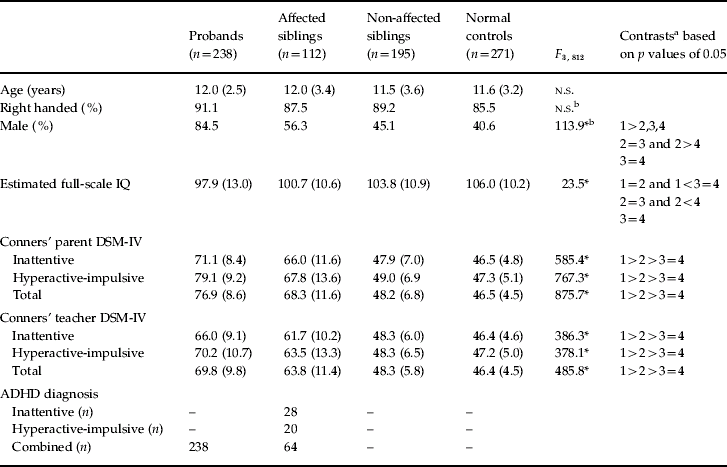
Both the children already clinically diagnosed with ADHD and their siblings were similarly screened using the standard procedures of the IMAGE project described fully elsewhere (Brookes et al. Reference Brookes, Xu, Chen, Zhou, Neale, Lowe, Aneey, Franke, Gill, Ebstein, Buitelaar, Sham, Campbell, Knight, Andreou, Altink, Arnold, Boer, Buschgens, Butler, Christiansen, Feldman, Fleischman, Fliers, Howe-Forbes, Goldfarb, Heise, Gabriels, Korn-Lubetzki, Marco, Medad, Minderaa, Mulas, Muller, Mulligan, Rabin, Rommelse, Sethna, Sorohan, Uebel, Psychogiou, Weeks, Barrett, Craig, Banaschewski, Sonuga-Barke, Eisenberg, Kuntsi, Manor, McGuffin, Miranda, Oades, Plomin, Roeyers, Rothenberger, Sergeant, Steinhausen, Taylor, Thompson, Faraone, Asherson and Johansson2006; Rommelse et al. Reference Rommelse, Oosterlaan, Buitelaar, Faraone and Sergeant2007). Briefly, parent and teacher screening questionnaires – Conners' long version (Conners, Reference Conners1996) and Strengths and Difficulties Questionnaire (Goodman, Reference Goodman1997) – and a semi-structured, ostandardized, investigator-based interview ‘Parental Account of Children's Symptoms’ (PACS) (Taylor, Reference Taylor1986) were used to identify children with ADHD symptoms [see Rommelse et al. (Reference Rommelse, Oosterlaan, Buitelaar, Faraone and Sergeant2007) for the standardized algorithm that was applied to the data to derive each of the 18 DSM-IV ADHD symptoms, providing operational definitions for each behavioural symptom]. The Conners' long version for both parents and teachers was completed for control children. Table 1 provides the characteristics of the four groups.
Sample characteristics

n.s., Not significant; DSM-IV, Diagnostic and Statistical Manual for Mental Disorders (4th edn); ADHD, attention deficit hyperactivity disorder; s.d., standard deviation.
Values are given as mean (s.d.) unless otherwise specified.
a Contrasts: 1=probands, 2=affected siblings, 3=non-affected siblings, 4=normal controls. b χ2 test.
* p<0.001.
Procedure
The tasks described in this study were part of a broader neuropsychological assessment battery used in the Dutch part of the IMAGE study (Rommelse et al. Reference Rommelse, Oosterlaan, Buitelaar, Faraone and Sergeant2007). Administration of the entire battery (including breaks) required about 3–4 h. Testing of children with ADHD and their siblings took place at the VU Amsterdam or at the Radboud University Nijmegen Medical Centre and was conducted simultaneously for all children within a family. Medication to reduce the symptoms of ADHD was discontinued for at least 48 h (stimulants) or longer (non-stimulants) to allow sufficient washout before testing took place (Pelham et al. Reference Pelham, Aronoff, Midlam, Shapiro, Gnagy, Chronis, Onyango, Forehand, Nguyen and Waxmonsky1999). Control children were tested in a similar way in a quiet room at their school. Children were motivated with small breaks. At the end of the session, a gift worth approximately €4 was given. Written informed consent was obtained from children aged ⩾12 years and the parents prior to the study. The study had medical–ethical approval.
Measures
Inhibition
The Stop task was used to measure speed and accuracy of inhibition of an ongoing response (Logan & Cowan, Reference Logan and Cowan1984; Logan, Reference Logan, Dagenbach and and Carr1994). Subjects were presented two types of trials: go-trials and stop-trials. Go-trials consisted of the presentation of a go-stimulus (drawing of a plane) that was either pointing to the right or to the left (Scheres et al. Reference Scheres, Oosterlaan and Sergeant2006). Children were instructed to press a response button that corresponded to the direction of the stimulus as quickly and as accurately as possible. Stop-trials were identical to the go-stimulus but in addition a stop-signal was presented (drawing of a cross that was superimposed on the plane). Children were required to withhold their response to the stop-signal. Go-stimuli were displayed for 1000 ms, preceded by a 500 ms fixation point. Stop-signals were displayed for 1000 ms minus delay time. Inter-trial intervals were 3000 ms. The delay between the go- and stop-signal was dynamically varied so that the child successfully inhibited 50% of the stop-trials and unsuccessfully inhibited the other 50%. At this point, the go-process and stop-process are of equal duration, which makes it possible to estimate the latency of the stop-process: the stop signal reaction time (SSRT) (Logan, Reference Logan, Dagenbach and and Carr1994). A total of two practice blocks and four experimental blocks were administered, each consisting of 60 trials. The first practice block consisted of only go-trials. The second practice block and the four experimental blocks consisted of 75% go-trials and 25% stop-trials. Go- and stop-trials were pseudo-randomly presented. Task administration took about 15 min. The SSRT and the percentage of commission errors (% commission errors) were used as dependent measures reflecting inhibitory processing.
Visuospatial working memory
The visuospatial sequencing task was used to measure accuracy of visuospatial working memory (De Sonneville, Reference Crosbie and Schachar1999). Stimuli consisted of nine circles symmetrically organized in a square (3×3). On each trial, a sequence of circles was pointed at by a computer-driven hand. Subjects were instructed to replicate the exact same sequence of circles, by pointing to them with the small, self-driven hand. There were no time constrictions. One practice trial and 24 experimental trials were presented. Every succeeding trial increased in difficulty level: an increase in the number of circles required to be remembered and/or an increase in the complexity of the spatial pattern (i.e. the trial consisted of circles that were spatially further removed from one another instead of being close to one another), hence manipulating working memory demands. Task administration took about 7 min. Two dependent measures were used: the total number of identified targets (NIT) and total number of identified targets in the correct order (NITco). The NITco is a stricter working memory measure, because it takes into account both the target identification as well as the order of the targets.
Verbal working memory
The maximum span of the digit span forwards and backwards of the WISC-III and WAIS-III (Wechsler, Reference Wechsler2000, Reference Wechsler2002) was used to obtain an indication of verbal working memory.
Intelligence
Full-scale IQ was estimated by four subtests of the Wechsler Intelligence Scale for Children, 3rd edition (WISC-III) or the Wechsler Adult Intelligence Scale, 3rd edition (WAIS-III) (Wechsler, Reference Wechsler2000, Reference Wechsler2002) (depending on the child's age): vocabulary, similarities, block design and picture completion. These subtests are known to correlate between 0.90 and 0.95 with the full-scale IQ (Groth-Marnat, Reference Gray, Chabris and Braver1997). As dependent measures in further analyses we used PIQ (summed scaled scores of block design and picture completion) and VIQ (summed scaled scores of vocabulary and similarities).
Statistical analyses
Due to technical problems, the Stop task was not administered to 63 children within the ADHD families (28 probands, 12 affected siblings, 23 non-affected siblings) and 12 control children. Furthermore, a slightly different version of the Stop task was administered to 31 children within the ADHD families (13 probands, five affected siblings, 13 non-affected siblings), in which control trials were implemented (stop-signal appeared before the go-signal). Data analyses were performed with and without including the data of these families, which revealed the same results. Therefore, results are reported including all of these families. The percentage of missing data for all other measures was random and less than 5% and missing values were replaced by multiple imputations using the expectation maximization algorithm (Tabachnick & Fidell, Reference Stuss and Benson2001). Measures were successfully normalized by applying a Van der Waerden transformation (SPSS version 14; SPSS Inc., Chicago, IL, USA). The z scores of the inhibition measures (SSRT and % commission errors) were mirrored, so that the z scores of all dependent measures would have the same meaning: a higher z score indicated better performance. Results were similar, when based on raw, unstandardized task measures and when based on normalized, standardized task measures. We set α at 0.05. Following Cohen's guidelines (Cohen, Reference Clark, Prior and Kinsella1988), effect sizes were defined in terms of the percentage of variance explained: 1%, 9% and 25% were used to define small, medium and large effects (these figures translate into η2 values of 0.01, 0.06 and 0.14).
The viability of the measures as endophenotypes of ADHD (first study aim) was tested by calculating group differences using a linear mixed model with group (four groups: proband, affected sibling, non-affected sibling, and control) and gender as factors, age as a covariate, and family as a random effect to account for within-family correlation. Group contrasts were calculated within the mixed model using pairwise comparisons with age as covariate. Sibling correlations (pairwise correlations) were calculated to investigate resemblance between siblings for the various measures [S.A.G.E. (Statistical Analysis for Genetic Epidemiology) 5.3.1, 2007; Case Western Reserve University, Cleveland, OH, USA; http://darwin.cwru.edu/sage/].
The co-segregation of EF and IQ (second study aim) was tested by calculating sibling cross-correlations in order to examine whether EF of a child would relate to IQ in his/her siblings and vice versa. This would suggest similar familial factors underlay both domains. Thereafter, a principal component analysis was run on the measures to examine whether or not it was possible to discriminate between two separate components (EF and IQ). These components were then used to test whether group differences in one domain would diminish/disappear, when corrected for group differences in the other domain. Last, a discrepancy score was calculated by subtracting the IQ component z score from the EF component z score. Sibling correlations for this discrepancy score were calculated to examine whether EF–IQ discrepancy was familial. Also, a subsample of probands was selected that was predominantly impaired in one but not the other domain (more than 1.5 s.d. difference between performances in both domains). It was analysed whether or not a similar domain discrepancy would be observed in their siblings.
Results
EF and IQ as candidate endophenotypes
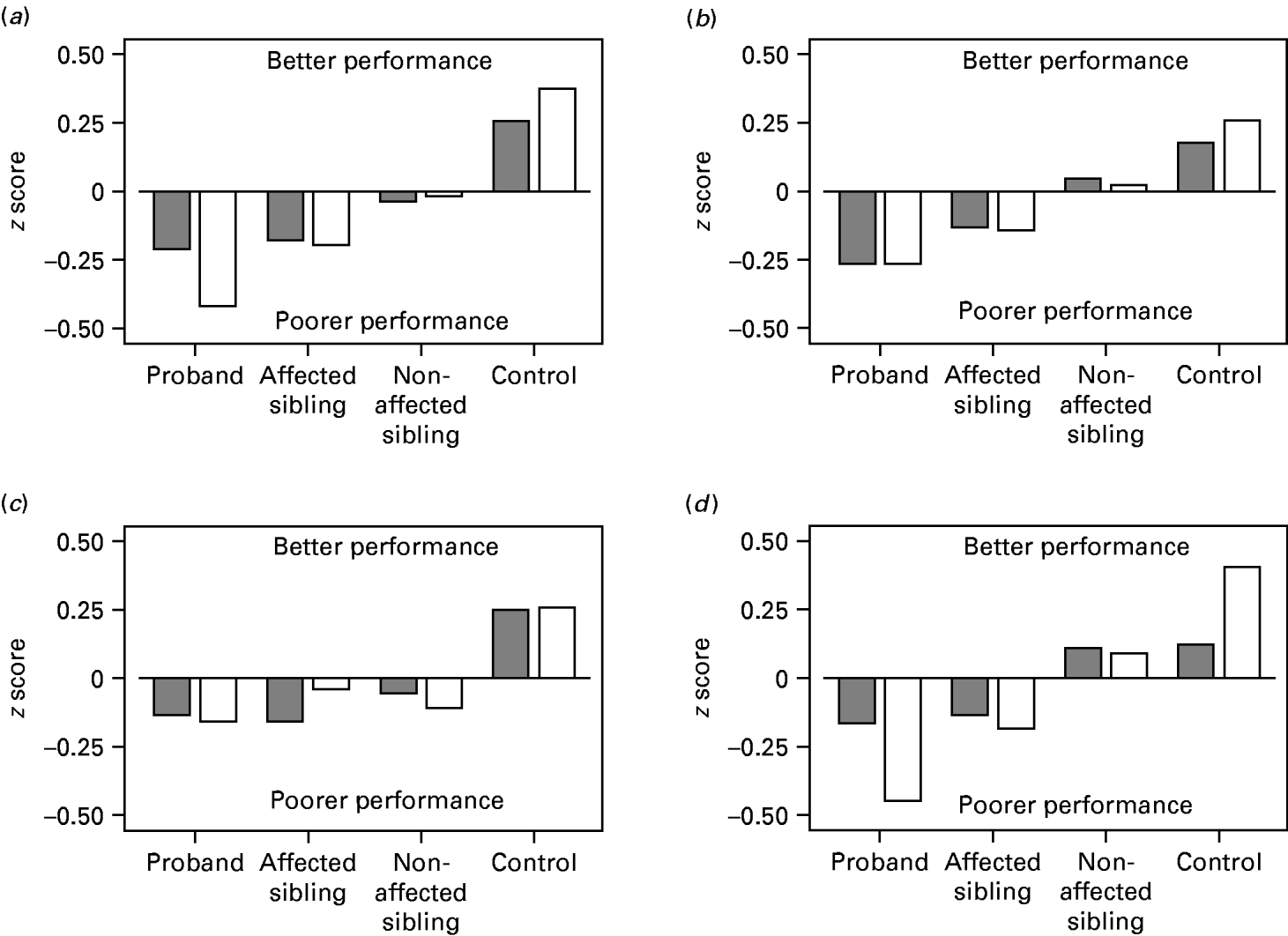
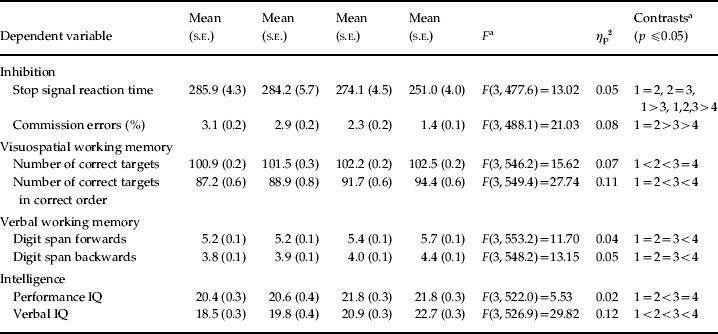
To test whether children with ADHD (probands and affected siblings) and, possibly, their non-affected siblings were impaired in inhibition, working memory and intelligence measures, linear mixed models were used (separately for each task measure) as described above. Results are presented in Fig. 1 and Table 2.
Differences between probands, affected siblings, non-affected siblings and controls on measures of (a) inhibition ( , stop signal response time; □, percentage commission errors); (b) visuospatial working memory (, number of correct targets; □, number of correct targets in correct order); (c) verbal working memory (, digit span forwards; □, digit span backwards); (d) intelligence (, performance intelligence quotient; □, verbal intelligence quotient).

Inhibition, working memory and intelligence

s.e., Standard error; IQ, intelligence quotient.
a Contrasts: 1=probands, 2=affected siblings, 3=non-affected siblings, 4=normal controls. Outliers (|z|>3) were removed. The F statistic and contrasts are based on a linear mixed model with group and gender as factors, age as covariate and family as random effect. Results are similar when based on raw, unstandardized task measures and when based on normalized, standardized task measures.
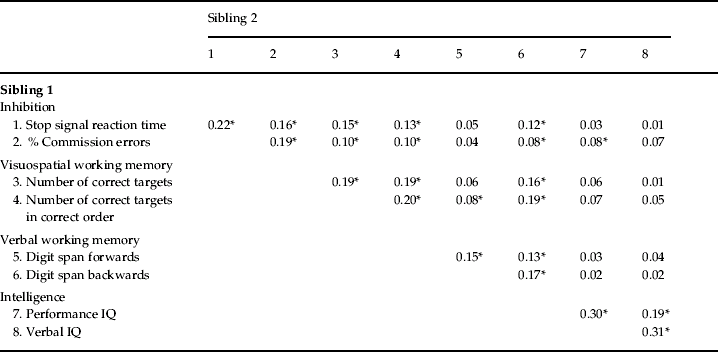
Group differences were found on all EF and IQ measures, with small to medium effect sizes. Probands and affected siblings performed overall very similarly on EF and IQ measures (except for NIT of visuospatial working memory and VIQ, on which probands performed worse than affected siblings) and both groups differed significantly from controls on all measures, indicating ADHD to be associated with generalized impairments in both EF and IQ. Non-affected siblings were impaired compared with controls on almost all measures, except on NIT of visuospatial working memory and PIQ. The first finding may indicate that the basic visuospatial memory span of non-affected siblings is normal, but if greater working memory demands are required (like on the NITco variable), deficits in visuospatial working memory will surface. The latter may indicate that PIQ is less suitable as an endophenotypic candidate than VIQ. On most measures, non-affected siblings performed in between their affected siblings and controls. Sibling correlations were calculated to examine whether siblings resembled each other in EF and IQ. As is shown in Table 3, all measures significantly correlated between siblings (between 0.15 and 0.30), suggesting EF and IQ to be familial.
Co-segregation of EF and IQ
Almost none of the sibling cross-correlations between the EF and IQ measures were significant, suggesting differential familial influences related to EF and IQ. However, the majority of sibling cross-correlations between the EF measures were significant (i.e. inhibitory measures in a child correlated with working memory measures in his/her siblings), suggesting similar familial influences affected both deficits in inhibition and working memory (Table 3). The same was true for VIQ and PIQ.
Cross-correlations between siblings for measures of executive and intellectual functioningFootnote a

IQ, Intelligence quotient.
a Correlations are based on all participants.
* Significant (p⩽0.05).
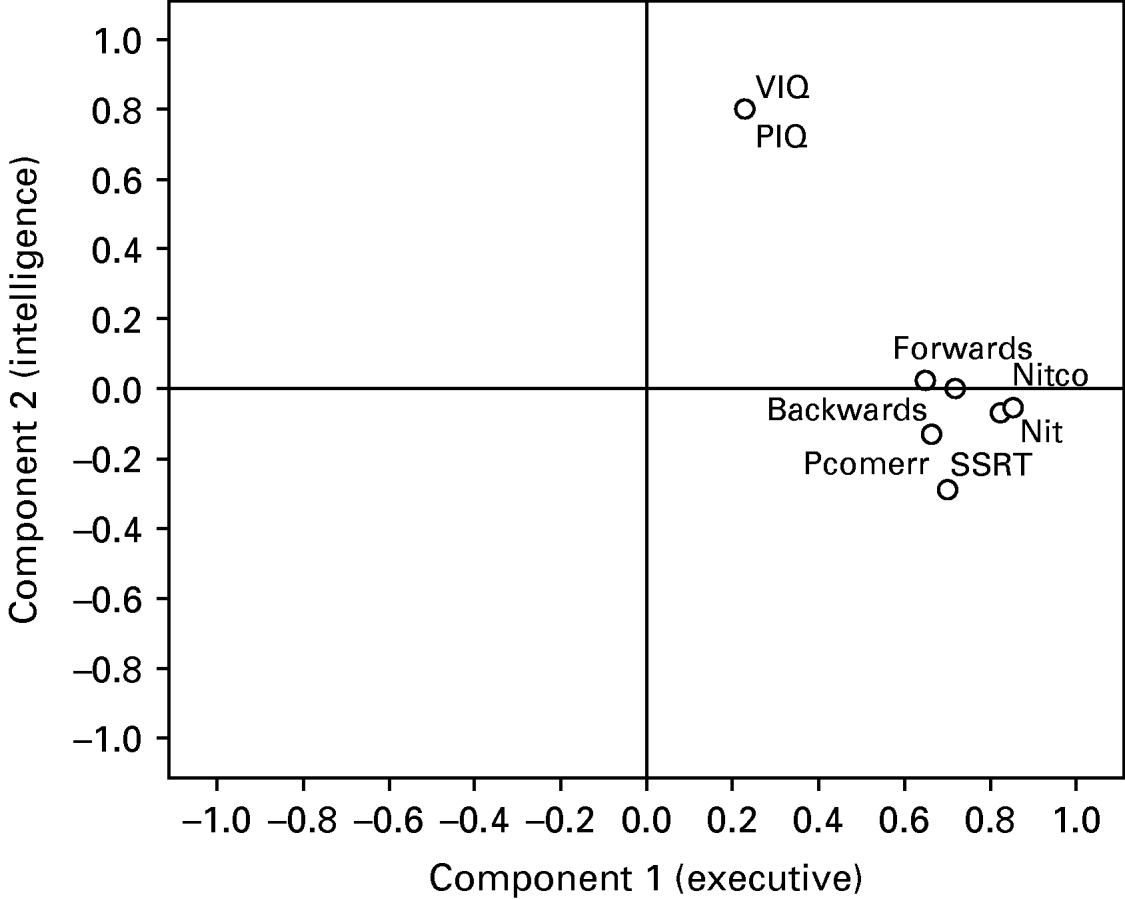
A principal component analysis revealed a two-component solution (see Fig. 2), with the first component explaining 42% of the variance on which all EF measures highly loaded (r between 0.65 and 0.85), but to a significantly lesser degree the IQ measures (both r=0.23). The second component explained 17% of the variance on which both IQ measures highly loaded (both r=0.81) but not or to a significantly lesser degree the EF measures (r between 0.01 and 0.29). The first component was labelled ‘EF component’, the second component ‘IQ component’. The components correlated modestly with each other (r=0.16). These findings indicate that EF and IQ are relatively independent of each other.
Correlation plot. Component plot revealing that executive and intelligence measures form two relatively independent factors. Measures of intelligence are verbal intelligence quotient (VIQ) and performance IQ (PIQ). Measures of visuospatial working memory are number of identified targets (Nit) and number of identified targets in correct order (Nitco). Measures of verbal working memory are digit span forwards (Forwards) and digit span backwards (Backwards). Measures of inhibition are memory stop signal response time (SSRT) and percentage commission errors (Pcomerr).

Group differences for the EF component remained significant, when the IQ component was implemented as covariate [F(3, 532.2)=37.70, p<0.001]: probands and affected siblings had a similar EF component (p=0.31), and both groups had a poorer EF component than non-affected siblings (p<0.001 and p=0.003, respectively) and controls (both p<0.001). Non-affected siblings also had a poorer EF component than controls (p<0.001). Group differences also remained for the IQ component, when the EF component was implemented as covariate [F(3, 499.0)=8.71, p<0.001]. Probands had a poorer IQ component than affected siblings (p=0.03) and both groups had a poorer IQ component than controls (p<0.001 and p=0.05). Non-affected siblings had a better IQ component than probands (p<0.001), but their IQ component did not differ significantly from affected siblings or controls (p=0.16 and p=0.44, respectively). These findings suggest that EF impairments found in children with ADHD, and in their affected and non-affected siblings are not attributable to IQ impairments or in the reverse direction.
To further examine whether EF and IQ co-segregate within families, we tested whether the discrepancy score between EF and IQ (z score of the EF component minus the z score of the IQ component) was unrelated between siblings. This was not the case (r=0.24, p<0.001), suggesting a specific pattern of EF and IQ segregation within families. Partly similar results were found when we analysed this discrepancy score for siblings of two selected subsamples of probands displaying a large discrepancy (>1.5 s.d.) between their EF and IQ. A total of 24 probands had an EF component score that was disproportionally worse compared with their IQ component score (i.e. EF<IQ) and 28 probands who displayed the opposite pattern (EF>IQ). We then tested whether their siblings displayed a less extreme discrepancy between EF and IQ by comparing the EF–IQ discrepancy score between the siblings and controls using the same linear mixed model described above. In contrast to expectations, the three groups differed significantly in the EF–IQ discrepancy score [F(2, 235.1)=8.15, p<0.001]. Siblings of EF<IQ probands showed a comparable EF<IQ score, when compared with controls (p<0.001). This EF<IQ score differed significantly from zero (t=4.19, p<0.001), suggesting that the disproportionate low EF score of the proband related specifically to a disproportionate low EF score (but not low IQ score) in the siblings. However, the opposite pattern (EF>IQ) was not significant, since the EF>IQ score of siblings of EF>IQ probands did not differ from controls (p=0.58) and did not differ significantly from zero (t=0.98, p=0.17). This may suggest that IQ impairments lead secondarily to EF impairments.
Discussion
We investigated whether measures of EF (inhibition, and visuospatial and verbal working memory) and IQ (PIQ and VIQ) would form candidate endophenotypes and if deficits in both domains co-segregate within families.
Our results indicate that all EF measures studied here appeared useful as endophenotypic candidates, since both probands, and affected and non-affected siblings showed deficits in the three EF domains studied and siblings resembled each other in EF. The findings of impaired EF in children with ADHD are in line with most previous studies on inhibition, visuospatial and verbal working memory in patients with ADHD (Oosterlaan & Sergeant, Reference Oosterlaan and Sergeant1996; Oosterlaan et al. Reference Oosterlaan, Logan and Sergeant1998; Nigg, Reference Murphy and Barkley1999; Martinussen et al. Reference Mariani and Barkley2005). Much less is known about EF in relatives of children with ADHD, but our results are in line with previous studies on EF and other cognitive difficulties in non-affected siblings (Crosbie & Schacher, Reference Conway, Kane and Engle2001; Slaats-Willemse et al. Reference Slaats-Willemse, Swaab-Barneveld, De Sonneville and Buitelaar2003; Doyle et al. Reference Doyle, Biederman, Seidman, Reske-Nielsen and Faraone2005a; Schachar et al. Reference Rommelse, Oosterlaan, Buitelaar, Faraone and Sergeant2005; Waldman et al. Reference Waldman2006; Rommelse et al. Reference Polderman, Gosso, Posthuma, Van Beijsterveldt, Heutink, Verhulst and Boomsma2007; Bidwell et al. Reference Bidwell, Willcutt, DeFries and Pennington2007). The results suggest that deficits in EF form key neuropsychological endophenotypic candidates, as has been previously suggested (Castellanos & Tannock, Reference Bull and Scerif2002). Similar group differences and sibling correlations were obtained for VIQ, suggesting that VIQ is an equally potent endophenotype. However, children with ADHD had only a slightly lower PIQ than controls in this study and non-affected siblings did not differ from controls in their PIQ. This suggests that VIQ may be more useful for genetic research than PIQ or a combination of these measures. Previous research has shown full-scale IQ to be genetically related to ADHD (Kuntsi et al. Reference Khan and Faraone2004; Doyle et al. Reference Doyle, Biederman, Seidman, Reske-Nielsen and Faraone2005a; Mill et al. Reference Mattes2006), but it remains to be determined whether this is true for both PIQ and VIQ.
All in all, with respect to the first aim of our study, both EF and IQ showed endophenotypic-like group patterns (with small to medium effect sizes) and familial resemblance. With respect to the second aim of our study, almost all our findings indicate that EF and IQ impairments do not co-segregate within families. For example, EF in children did not relate to IQ in their siblings and vice versa, suggesting that different familial factors (genetic and environmental) gave rise to problems in both domains. Moreover, a principal component analysis revealed that EF and IQ are relatively independent of each other in the same child. This contrasts with some previous studies (Bull & Scerif, Reference Brookes, Xu, Chen, Zhou, Neale, Lowe, Aneey, Franke, Gill, Ebstein, Buitelaar, Sham, Campbell, Knight, Andreou, Altink, Arnold, Boer, Buschgens, Butler, Christiansen, Feldman, Fleischman, Fliers, Howe-Forbes, Goldfarb, Heise, Gabriels, Korn-Lubetzki, Marco, Medad, Minderaa, Mulas, Muller, Mulligan, Rabin, Rommelse, Sethna, Sorohan, Uebel, Psychogiou, Weeks, Barrett, Craig, Banaschewski, Sonuga-Barke, Eisenberg, Kuntsi, Manor, McGuffin, Miranda, Oades, Plomin, Roeyers, Rothenberger, Sergeant, Steinhausen, Taylor, Thompson, Faraone, Asherson and Johansson2001; Miyake et al. Reference Miyake, Friedman, Emerson, Witzki and Howerter2001; Mahone et al. Reference Logan and Cowan2002; Gray et al. Reference Gottesman and Gould2003), but is in line with others (Welsh et al. Reference Wechsler1991; Ardila et al. 2000; Polderman et al. Reference Plomin and Spinath2006). The independence of both domains was further underlined, when group differences in one domain did not disappear when performance in the other domain was used as a covariate, as in other studies (Seidman et al. Reference Seidman, Doyle, Fried, Valera, Crum and Matthews1995; Barnett et al. Reference Asarnow, Nuechterlein, Subotnik, Fogelson, Torquato, Payne, Asamen, Mintz and Guthrie2001; Nigg et al. Reference Nigg2002; Oosterlaan et al. Reference Oosterlaan, Scheres and Sergeant2005) and suggests that EF impairments found in children with ADHD, and their affected and non-affected siblings are not attributable to IQ impairments or vice versa. Furthermore, the discrepancy between EF and IQ correlated between siblings, indicating siblings resembled each other in their EF–IQ discrepancy instead of having generalized impairments across both domains. This was also found when siblings of probands with EF (but not IQ) problems displayed the same selective EF (but not IQ) deficit, although the opposite pattern was not significant. The latter finding may suggest that even though EF–IQ discrepancy functioning correlates between siblings, extreme IQ impairment does not exist in the presence of normal EF in most siblings of such a proband. This may be explained as IQ impairments leading secondarily to EF impairments. Thus, a specific EF impairment in the absence of a lower IQ in a family appears supported by these findings, but when severe IQ impairments occur in a family, it is likely that some family members will also portray EF impairments. Overall, though, almost all findings support an independent segregation of EF and IQ.
The various measures within the EF domain were related to one another with correlations of medium size, suggesting the various constructs to be related, but not interchangeably, and this confirms previous findings (Miyake et al. Reference Mill, Caspi, Williams, Craig, Taylor, Polo-Tomas, Berridge, Poulton and Moffitt2000). Furthermore, most sibling cross-correlations for the EF measures reached significance, suggesting that problems in inhibition and working memory partly originate from the same familial sources. Similar results were found for both measures of IQ, suggesting VIQ and PIQ have similar familial underpinnings.
Limitations
Important aspects of EF, such as cognitive flexibility and planning, have not been assessed here. It may be possible, therefore, that our findings do not generalize across the entire EF spectrum, but relate only to working memory and inhibition. Besides that, working memory may also be classified as a memory function (Smith & Jonides, Reference Slaats-Willemse, Swaab-Barneveld, De Sonneville, Van der Meulen and Buitelaar1999) instead of an executive function. Furthermore, IQ, as measured here, is reduced to what is measured by Wechsler IQ subtests. Since only a few subtests were administered, it is not possible to discuss our findings in terms of crystalline and fluid intelligence (Duncan et al. Reference Duncan, Burgess and Emslie1996; Duncan, Reference Doyle, Faraone, Seidman, Willcutt, Nigg, Waldman, Pennington, Peart and Biederman2005), which would have made an interesting contribution to the study. It is possible that EF is related to fluid intelligence, but not necessarily as measured by the Wechsler IQ tests (Duncan et al. Reference Duncan1995).
Conclusions
The results supported the viability of EF and IQ as endophenotypic candidates, since children with ADHD, and their affected and non-affected siblings were all impaired on the EF measures and VIQ (though unimpaired in PIQ) and all measures correlated between siblings. However, difficulties in EF and IQ appear to exist relatively independently of each other and appear to originate from different familial sources. Within the EF domain, similar familial influences seemed to affect inhibition and working memory, suggesting that both functions have somewhat similar genetic and environmental underpinnings. Similar results were found for both measures of IQ, suggesting VIQ and PIQ have similar familial underpinnings.
Acknowledgements
This study was partly funded by a grant assigned to Professor Dr Faraone by the National Institute of Mental Health (NIH grant no. R01 MH62873-01A1). Some of the results of this paper were obtained by using the program package S.A.G.E., which is supported by a US Public Health Service Resource grant (RR03655) from the National Center for Research Resources. The authors thank all of the parents, teachers and children who participated.
Declaration of Interest
J.O. has been a member of the advisory board of Shire. J.B. has been a consultant to, member of advisory board of and/or speaker for Janssen Cilag BV, Eli Lilly, Bristol-Myers Squibb, UBC, Shire, Medice. J.A.S. has been a member of advisory board of Lilly, Shire, Janssen Cilag.