


Introduction
Vitamin D plays a crucial role in the growth and development of children, influencing both bone health and immune function.(Reference Munns, Shaw, Kiely, Specker, Thacher and Ozono1) The primary source of vitamin D is synthesis through exposure to UVB irradiation. However, achieving sufficient sun exposure is challenging during the winter months in Europe,(Reference Spiro and Buttriss2,Reference Braegger, Campoy, Colomb, Decsi, Domellof and Fewtrell3) including Switzerland.(Reference Religi, Backes, Chatelan, Bulliard, Vuilleumier and Moccozet4,5) Furthermore, children and adolescents in most European countries, except the Nordics,(Reference Spiro and Buttriss2) rarely consume more than 3 µg/day of vitamin D, far below the recommended 15 µg/day.(6)
Vitamin D deficiency remains widespread in Europe, particularly among children.(Reference González-Gross, Valtueña, Breidenassel, Moreno, Ferrari and Kersting7) Although definitions vary across studies and scientific societies, serum 25-hydroxyvitamin D concentrations below 50 nmol/L are frequently considered indicative of suboptimal vitamin D status, encompassing both insufficiency (25–50 nmol/L) and deficiency (<25 nmol/L).(Reference Sempos and Binkley8) In Switzerland, approximately 35–50% of children and adolescents have suboptimal vitamin D levels.(Reference Ramelli, Ramelli, Lava, Siegenthaler, Cantù and Bianchetti9–Reference Parel, Bochud, Rezzi, Chatelan and Jotterand Chaparro11) In the recent Swiss national survey menuCH-Kids, 32% of children aged 6–17 years had 25-hydroxyvitamin D levels below 50 nmol/L, including 4.6% below 25 nmol/L.(Reference Vincentini and Bochud12) Such low vitamin D levels can result in rickets, impaired bone mineralization, and long-term risks such as osteoporosis and fractures.(Reference Winzenberg, Powell, Shaw and Jones13) Beyond skeletal effects, vitamin D is involved in multiple physiological processes, and deficiencies may be associated with alterations in immune function, muscle function, and neurodevelopment.(Reference Martineau, Jolliffe, Hooper, Greenberg, Aloia and Bergman14,Reference Berger and Shenkin15)
While international guidelines for newborns and infants consistently recommend year-round vitamin D supplementation,(Reference Braegger, Campoy, Colomb, Decsi, Domellof and Fewtrell3,5,Reference Saggese, Vierucci, Prodam, Cardinale, Cetin and Chiappini16) recommendations for older children vary across countries and institutions.(Reference Randev, Kumar and in Childhood17) Some societies, such as in France,(Reference Bacchetta, Edouard, Laverny, Bernardor, Bertholet-Thomas and Castanet18) recommend systematic supplementation and/or promote food fortification strategies,(19) whereas others, including Switzerland,(5,Reference Quack Lötscher, l’Allemand, Bischoff-Ferrari and Burckhardt10) recommend supplementation only in cases of hypovitaminosis D or in the presence of risk factors.(Reference Saggese, Vierucci, Prodam, Cardinale, Cetin and Chiappini16,Reference Reinehr, Schnabel, Wabitsch, Bechtold-Dalla Pozza, Bührer and Heidtmann20) Paediatricians are therefore required to assess the need for supplementation on an individual basis. However, this task is challenging in routine care: no simple clinical indicator exists to assess vitamin D status,(Reference Davis, Aksornsri and Papachrisanthou21) serum 25-hydroxyvitamin D measurement is not recommended for routine screening,(Reference Saggese, Vierucci, Prodam, Cardinale, Cetin and Chiappini16,Reference Bacchetta, Edouard, Laverny, Bernardor, Bertholet-Thomas and Castanet18) and available screening questionnaires still require further validation in paediatric populations.(Reference Calcaterra, Cena, De Giuseppe, Biino, Grazi and Manuelli22)
These challenges are particularly relevant in Geneva, Switzerland, which has a heterogeneous paediatric population with a high prevalence of risk factors for vitamin D deficiency,(Reference Fahrni, Wilhelm-Bals, Posfay-Barbe and Wagner23) including overweight/obesity,(Reference Narvaez, Mahler, Baratti-Mayer and Jeannot24,25) migrant backgrounds and darker skin types.(26)
Given the variability in guidelines, paediatricians play a key role in navigating recommendations and preventing vitamin D deficiency in daily practice. While previous surveys have examined paediatricians’ knowledge on hypovitaminosis D (Reference Petrović, Runjić, Buljan, Jeličić Kadić and Markić27) and vitamin D supplementation practices,(Reference Santi, Janner, Simonetti and Lava28–Reference Pechabrier, Bacchetta, Tounian, Eddiry, Linglart and Edouard30) none have explored their approaches to assessing vitamin D adequacy (VDA) or their views on systematic supplementation. Such data are lacking not only in Switzerland but also across Europe, limiting understanding of how national recommendations translate into paediatric practice.
For the purposes of this survey, we used the concept of VDA, defined as the overall sufficiency of vitamin D based on diet, supplementation, and sun exposure. This pragmatic framework reflects clinical assessment practices rather than a validated clinical or epidemiological measure. This study therefore examined paediatricians’ reported practices and opinions on vitamin D management in children and adolescents aged 3–17 years in Geneva, focusing on assessment methods, deficiency management, and views on systematic supplementation.
Methods
Study design
This cross-sectional study was conducted through an online survey targeting paediatricians in the Canton of Geneva, Switzerland. The survey was conducted between February and August 2023.
This study was conducted according to the guidelines laid down in the Declaration of Helsinki. The study was not bound by the Swiss Federal Act on Research Involving Human Beings and the Ordinance on Human Research, as it focused on the opinions of health professionals and did not collect health outcomes. Written informed consent for data use in research was obtained as part of the survey process from all subjects; without consent, the survey could not proceed.
Target population and inclusion and exclusion criteria
The target population for this study included paediatricians practising in the Canton of Geneva, which served as the defined geographic area for participant recruitment and reflected a pragmatic and feasible sampling approach based on an established local professional network. The practice locations included the city of Geneva, peri-urban areas, and the countryside (which is relatively small), thus providing a relatively homogeneous environmental and geographic context, including similar patterns of sun exposure. Paediatricians were eligible regardless of their practice setting, whether in private practice or in public or private institutions (hospitals/clinics). Those who were certified abroad but were currently practising in Geneva were also eligible. There were no age or sex restrictions on participation.
Paediatricians were asked to report on their practices concerning children and adolescents aged 3–17 years. This age range was selected to reflect the typical scope of paediatric follow-up in Geneva, where paediatricians usually provide care until the transition to adult services at age 18. While the WHO defines adolescents as individuals aged 10–19 years,(31) adolescents beyond 17 are generally managed in adult medicine in the Swiss healthcare system. Children under 3 years were excluded, as vitamin D supplementation in this age group is well standardized and supported by consistent national and international recommendations. This focus allowed us to investigate practices in an age group where clinical decisions are more variable.
Participant recruitment
Two methods were employed to recruit the participants. First, the study project was presented during a paediatric meeting held via video conference and organized by the Geneva University Hospital in January 2023. The survey link and QR code were available during the meeting. Second, a mailing list of Geneva paediatricians listed in online directories (Tel Search and Local.ch) was compiled and verified by a member of the research team. The survey link and QR code were then emailed to 193 addresses on the list. The email invitation explained that the data would be treated anonymously and confidentially, with the purpose of the study being detailed.
Reminder emails were sent to the mailing list at the end of March 2023 and at the end of May 2023. Of the 193 paediatricians invited to participate, 59 (31%) responded to the survey. The reasons for non-participation were not determined.
Questionnaire development
Procedure and content
The questionnaire development followed a rigorous process, including a literature review (specifically incorporating a past survey on the prescription of vitamin D among paediatricians conducted in Switzerland(Reference Santi, Janner, Simonetti and Lava28) between 2016 and 2017), hypothesis formulation, and expert review to define objectives and thematic areas.
The questionnaire was developed in French and its content was structured into four sections, reflecting the main aims of the study: i) assessment of VDA including frequency and methods, ii) interventions used in children with serum total 25-hydroxyvitamin D concentration <50 nmol/L, equivalent to 20 ng/mL, iii) paediatricians’ opinions on systematic vitamin D supplementation in all children, and iv) participant characteristics. We used VDA as a pragmatic clinical construct reflecting overall exposure from diet, supplementation, and sun exposure, as well as individual risk factors, and extending beyond serum 25-hydroxyvitamin D concentrations, which are not recommended for routine screening.(Reference Saggese, Vierucci, Prodam, Cardinale, Cetin and Chiappini16,Reference Bacchetta, Edouard, Laverny, Bernardor, Bertholet-Thomas and Castanet18) This is not a validated clinical or epidemiological measure.
Item ideas were pooled from the team members, and response options were formulated. This was a multiple-choice questionnaire with predefined response options. All questions were formulated separately for children aged 3–10 years and those aged 11–17 years, as younger children mainly depend on adults for vitamin D intake through supplementation, diet, or sun exposure, whereas pre-adolescents and adolescents may make their own choices and not solely depend on adults.
To assess the frequency of VDA (section I of the questionnaire), assessment at every check-up referred to evaluation during routine follow-up visits, excluding emergency or unscheduled consultations. For this section, we designed distinct questions for general children and for those with risk factors of deficiency, that is, those with clinical signs or commonly known risk factors, such as skin colour, disabilities, long-term medication use, chronic digestive disorders, and overweight/obesity.(32,Reference Fiamenghi and Mello33)
In section I of the questionnaire, paediatricians were asked to estimate the proportion of their patients at risk of vitamin D deficiency without a predefined threshold, allowing for some variation in clinical interpretation. In section II, we asked paediatricians about their interventions in cases of serum total 25-hydroxyvitamin D concentrations <50 nmol/L (including insufficiency and deficiency, according to Swiss definitions (5,Reference Quack Lötscher, l’Allemand, Bischoff-Ferrari and Burckhardt10) ). The questionnaire did not distinguish between these categories in order to remain concise.
When asking the paediatricians’ opinions regarding systematic supplementation in all children (Section III of the questionnaire), we integrated a table summarizing the main recommendations on vitamin D supplementation in the countries surrounding Switzerland, as illustrated in the questionnaire available in Supplementary File I.
Questions on methods to assess VDA, types of interventions, and reasons for non-adherence to supplementation offered multiple-choice responses to capture paediatricians’ practices comprehensively. Where predefined responses could limit participants, an ‘other’ option was included for personalized answers.
Pre-testing and revision
Following the construction of the questionnaire, it underwent a pretest. One member of the research team (AC), experienced in survey implementation and not involved in the earlier stages, evaluated the questionnaire for potential inconsistencies, feasibility, and item comprehension. Additionally, two paediatricians (including JE) from another region in Switzerland, close to Geneva, analysed item comprehension, completion time, and question relevance within the clinical context. Based on their feedback, the average completion time was seven minutes, which met our expectations. Minor corrections were incorporated, specifically regarding the wording of some questions, and the questionnaire was refined accordingly. The final version of the questionnaire was structured into four parts and contained 24 questions (Supplementary File I). This version served as the basis for data collection in this study.
Survey development and distribution
The questionnaire, initially in Word format, was migrated to the LimeSurvey® by the research team. It comprised six pages on LimeSurvey®. Paediatricians accessed and completed an online survey using QR codes. LimeSurvey® stored responses anonymously, ensuring participant confidentiality and simplifying the data management.
Statistical analyses
Descriptive statistics were used to summarize the data. Frequencies and percentages were calculated for categorical variables. To compare categorical variables on paediatricians’ reported practices, chi-squared tests were performed. These tests were applied to predefined categorical variables, focusing on paediatricians’ reported practices across the overall patient population, particularly differences in VDA assessment frequency according to age groups and risk factors, as well as differences in assessment methods. Other variables, including reported interventions in children with serum 25-hydroxyvitamin D concentrations <50 nmol/L and paediatricians’ opinions, were analysed descriptively, as these were not intended for inferential comparison. Given the small expected cell counts in some categories, a Monte Carlo simulation was used to generate more reliable p-values for the chi-squared test. Adjusted residuals were examined to identify the categories that contributed to the observed differences. Statistical significance was set at p < 0.05. Analyses were conducted using IBM® SPSS® Statistics for Windows, version 26.0, and Stata/SE 17.0 (StataCorp, College Station, TX).
Results
Participants’ characteristics
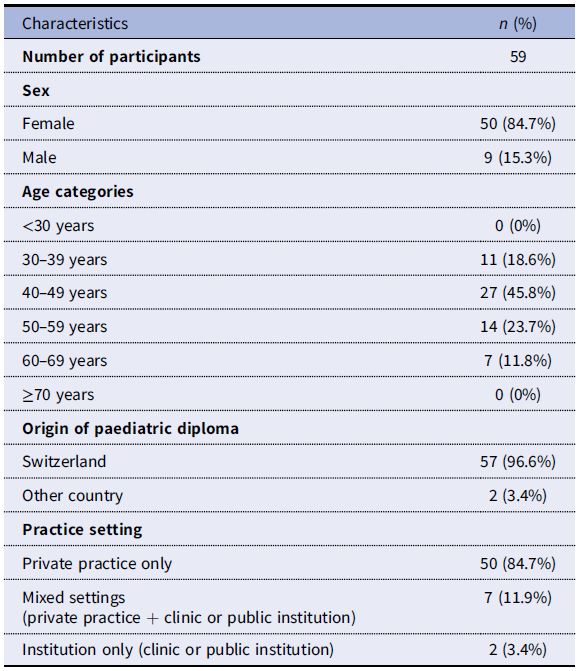
Table 1 presents the characteristics of the 59 paediatricians who participated in this survey. The majority of the respondents were female (n = 50, 84.7%), and most participants were aged between 40 and 49 years (n = 27, 45.8%). Nearly all paediatricians (n = 57, 96.6%) obtained their paediatric medicine diploma in Switzerland, with most working in private practice only (n = 50, 84.7%).
Characteristics of surveyed paediatricians

Table 1. Long description
The table presents the characteristics of 59 pediatricians who participated in a survey. It has 10 rows and 2 columns. The columns are labeled Characteristics and n (%). The rows are grouped into categories: Number of participants, Sex, Age categories, Origin of pediatric diploma, and Practice setting. Row 1: Number of participants, 59. Row 2: Sex, Female, 50 (84.7%). Row 3: Sex, Male, 9 (15.3%). Row 4: Age categories, <30 years, 0 (0%). Row 5: Age categories, 30-39 years, 11 (18.6%). Row 6: Age categories, 40-49 years, 27 (45.8%). Row 7: Age categories, 50-59 years, 14 (23.7%). Row 8: Age categories, 60-69 years, 7 (11.8%). Row 9: Age categories, >=70 years, 0 (0%). Row 10: Origin of pediatric diploma, Switzerland, 57 (96.6%). Row 11: Origin of pediatric diploma, Other country, 2 (3.4%). Row 12: Practice setting, Private practice only, 50 (84.7%). Row 13: Practice setting, Mixed settings (private practice + clinic or public institution), 7 (11.9%). Row 14: Practice setting, Institution only (clinic or public institution), 2 (3.4%).
Frequency of VDA assessment by paediatricians and methods
The frequencies of assessing VDA by paediatricians for children and adolescents with and without risk factors for deficiency are presented in Figures 1 and 2, respectively. For children and adolescents without specific risk factors, less than 50% of paediatricians assessed the VDA at every check-up (Figure 1). Significant differences in VDA assessment practices were found between children aged 3–10 years and those aged 11–17 years (χ 2 = [118.81], p < 0.001), especially for the response ‘rarely’ being cited more often by paediatricians for adolescents.
Frequency of vitamin D adequacy (VDA) assessment by pediatricians in children and adolescents without specific risk factors for vitamin D deficiency.

Frequency of Vitamin D adequacy (VDA) assessment by paediatricians in children and adolescents with specific risk factors for vitamin D deficiency.

For at-risk children and adolescents presenting with clinical signs, 76% of paediatricians reported assessing VDA at every check-up (Figure 2). For children and adolescents with skin colour, disability, chronic digestive disorders, or overweight/obesity, approximately 60% of paediatricians assessed the VDA at every check-up. Significant differences in VDA assessment practices were found across the risk factors. For instance, in children on long-term medication, only 45.8% of paediatricians reported assessing VDA at every check-up, 10.2% reported ‘never’ assessment, and 23.7% said they did not know (χ 2 = [37.39], p = 0.002).
The primary method used by paediatricians to assess VDA was to evaluate vitamin D supplementation intake, which was reported by 67.8% of paediatricians (n = 40), followed by dietary assessment (55.9%, n = 33). Sun exposure (n = 28, 47.5%) and blood tests (n = 22, 37.3%) were used significantly less frequently (χ 2 = [7.84], p = 0.005 and χ 2 = [8.58], p = 0.003, respectively).
Interventions used by paediatricians for children with serum total 25-hydroxyvitamin D concentrations <50 nmol/L
For children and adolescents with serum total 25-hydroxyvitamin D concentrations <50 nmol/L, the main intervention used by paediatricians was vitamin D supplementation, cited by 94.9% (Figure 3). Other recommendations included increasing daily sun exposure and dietary changes, such as consuming more dairy products or calcium-rich foods, although these were less commonly recommended. Approximately 20% of paediatricians have suggested increasing consumption of fatty fish.
Interventions used by paediatricians in children with serum total 25-hydroxyvitamin D concentrations <50 nmol/L.

Paediatricians ‘opinions on the prevalence of vitamin D deficiency among their patients
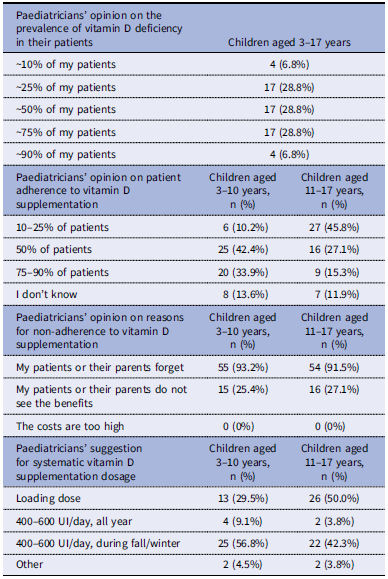
As summarized in Table 2, paediatricians’ estimates of the prevalence of patients aged 3–17 years at risk of vitamin D deficiency varied. Specifically, 28.8% of the respondents indicated that 25% of their patients were at risk, 28.8% indicated 50%, and 28.8% indicated 75%.
Paediatricians’ opinions on key aspects of vitamin D management

Table 2. Long description
A table summarizing pediatricians’ opinions on vitamin D management in children aged 3-17 years. The table has four sections with different focuses. The first section shows the prevalence of vitamin D deficiency among patients, with 28.8% of pediatricians indicating that 25%, 50%, and 75% of their patients are at risk. The second section details patient adherence to vitamin D supplementation, with 42.4% of pediatricians reporting that 50% of children aged 3-10 years adhere, and 45.8% reporting the same for children aged 11-17 years. The third section lists reasons for non-adherence, with 93.2% of pediatricians citing forgetfulness for younger children and 91.5% for older children. The final section outlines suggestions for systematic vitamin D supplementation dosage, with 56.8% recommending 400-600 UI/day during fall/winter for younger children and 42.3% for older children.
Paediatricians’ opinions on systematic vitamin D supplementation
When we asked paediatricians if they would recommend prescribing prophylactic vitamin D supplementation for all children and adolescents (aged 3–10 years and 11–17 years), considering the various vitamin D supplementation guidelines, the majority supported it (Figure 4). For children aged 3–10 years, 61% were rather or fully in favour of systematic supplementation (39.0% rather in favour; 22.0% in favour). For those aged 11–17 years, 76.3% were rather or fully in favour of systematic supplementation (49.2% rather in favour; 27.1% in favour).
Paediatricians’ opinions on systematic vitamin D supplementation in all children and adolescents.

The dosage recommendations for systematic supplementation also varied (Table 2). For children aged 3–10 years, 56.8% recommended 400–600 IU/day during fall/winter, whereas 29.5% suggested a loading dose. For children aged 11–17 years, 50.0% recommended a loading dose and 42.3% suggested 400–600 IU/day during fall/winter.
Paediatricians also had varying views on patient adherence to vitamin D supplementation (Table 2). For children aged 3–10 years, 42.4% estimated 50% adherence, whereas for those aged 11–17 years, 45.8% estimated only 10–25% adherence. The main reason cited for non-adherence was that the patient or parents forget (98.2%).
Reasons for not using systematic vitamin D supplementation in all children
Among paediatricians who were rather or fully against systematic vitamin D supplementation (n = 22 for children aged 3–10 years, and n = 13 for children aged 11–17 years), the reasons included a lack of clear Swiss guidelines, cited by more than two-thirds of the paediatricians (Figure 5). Approximately 50% of paediatricians mentioned increased healthcare costs and the impact on overall therapeutic adherence. Other reasons cited by a minority of participants included the burden on the patient’s entourage, increase in patients’ costs, and risk of vitamin D toxicity.
Reasons for not using systematic vitamin D supplementation in all children and adolescents.

Paediatricians’ opinions on other interventions to meet vitamin D needs in children without specific risk factors
Besides supplementation, paediatricians were asked whether they would recommend other methods to meet vitamin D needs in children without specific risk factors, aged 3–10 years and 11–17 years. Approximately one-third cited providing nutritional advice (64.4% for 3–10 years old; 61.0% for 11–17 years old), as well as guidance on sun exposure (62.7% for 3–10 and 11–17 years old).
Discussion
This study evaluated paediatricians’ reported practices and opinions regarding vitamin D management in children and adolescents aged 3–17 years in Geneva, Switzerland. The findings revealed notable variability, particularly in the assessment of VDA, with inconsistent practices reported even for children with clinical signs of deficiency. At the same time, most paediatricians supported systematic supplementation, while those opposed frequently cited the absence of clear Swiss guidelines, highlighting the urgent need for harmonized recommendations to support consistent practice.
Less than half of paediatricians reported assessing VDA at every check-up for children without specific risk factors, with adolescents receiving less consistent attention. For children with risk factors, this proportion ranged from 46% to 65%, depending on the condition. Only 76% of paediatricians reported assessing VDA at every check-up in children presenting with clinical signs of deficiency, a proportion lower than expected. These practices also reflected paediatricians’ perceptions of deficiency risk: one-third estimated that 25% of their patients were at risk, another third estimated 50%, and the remainder estimated 75%.
The prevalence of suboptimal vitamin D levels in Swiss children and adolescents is high (35–50%)(Reference Ramelli, Ramelli, Lava, Siegenthaler, Cantù and Bianchetti9–Reference Parel, Bochud, Rezzi, Chatelan and Jotterand Chaparro11) and aligns with European data.(Reference Braegger, Campoy, Colomb, Decsi, Domellof and Fewtrell3) The prevalence is even higher in subgroups of children with established risk factors for vitamin D deficiency and fractures, including overweight and obesity,(Reference Fiamenghi and Mello33,Reference Varkal, Gulenc, Yildiz, Kandemir, Bilgili and Toprak34) which affects around 15% of Swiss children and adolescents.(Reference Narvaez, Mahler, Baratti-Mayer and Jeannot24,25) In a Swiss study, nearly 90% of adolescents attending a reference centre for obesity had low vitamin D levels.(Reference Patriota, Borloz, Ruiz, Bouthors, Rezzi and Marques-Vidal35) Despite this, only 58% of paediatricians in our survey reported assessing VDA at every check-up for overweight or obese children. Similarly, a recent French survey found that only 40% of paediatricians recognized obesity as a risk factor.(Reference Pechabrier, Bacchetta, Tounian, Eddiry, Linglart and Edouard30)
We observed similar underassessment for children with dark skin, whereas studies have shown elevated deficiency rates in migrant children from African and also Eastern Mediterranean regions.(Reference Fahrni, Wilhelm-Bals, Posfay-Barbe and Wagner23,Reference Karagol and Duyan Camurdan36–Reference Lane, Nisbet, Whiting and Vatanparast38) Assessment was also inconsistent in other medical risk groups, including children receiving long-term corticosteroids and those with gastrointestinal disorders or disabilities, with only 46–64% of paediatricians reporting assessment at every check-up. These results may reflect uncertainties about which factors warrant evaluation, competing priorities, time constraints, or insufficiently standardized assessment methods. Although this study was conducted in a single canton, Geneva has a diverse paediatric population with recognized risk factors for vitamin D deficiency, including overweight/obesity and children from migrant backgrounds, which may reflect challenges encountered in other urban European contexts.
Regarding VDA assessment methods, paediatricians mainly evaluated supplementation (68%), dietary intake (56%), and sun exposure (48%). Only 37% used blood tests, consistent with guidelines that do not recommend routine testing.(Reference Saggese, Vierucci, Prodam, Cardinale, Cetin and Chiappini16,Reference Bacchetta, Edouard, Laverny, Bernardor, Bertholet-Thomas and Castanet18) A previous Swiss survey (2016–2017) reported that 88% of paediatricians ordered these tests when deficiency was suspected.(Reference Santi, Janner, Simonetti and Lava28) Our findings may reflect recent changes in Swiss reimbursement policies, which now restrict coverage for these tests to reduce costs .(Reference Folino, Durieux-Paillard, Biver, Ferrari and Richtering39) Indications for measuring serum vitamin D beyond symptoms of rickets vary widely across organizations and scientific societies, as do the serum 25-hydroxyvitamin D thresholds used to define vitamin D insufficiency and deficiency, which may contribute to variability in clinical practice.(Reference Saggese, Vierucci, Prodam, Cardinale, Cetin and Chiappini16)
Assessing dietary intake is also challenging, as vitamin D-rich foods such as fatty fish or fortified products are rarely consumed by most European children, resulting in low intake.(Reference Spiro and Buttriss2) In Switzerland, median vitamin D intake among adolescents is only 0.9 µg/day,(Reference Parel, Bochud, Rezzi, Chatelan and Jotterand Chaparro11) far below the recommended 15 µg/day.(6) Only 20% of paediatricians mentioned fatty fish when discussing dietary interventions. Although dairy products are more commonly consumed, they are rarely fortified with vitamin D in Switzerland. Calcium is essential for bone health, but its absorption depends on adequate vitamin D, reinforcing the importance of sufficient vitamin D intake.(Reference Fleet40)
Sun exposure assessment also presents challenges, as seasonal UVB variation makes vitamin D synthesis unreliable for much of the year at Swiss latitude. Although brief sun exposure (around 10–15 minutes) may be sufficient in spring and summer, endogenous synthesis is negligible between approximately October and March.(Reference Religi, Backes, Chatelan, Bulliard, Vuilleumier and Moccozet4) During this period, the duration required to achieve adequate vitamin D production would be considerably longer (up to 1.5–6.5 hours with face and hands exposed), making it largely impracticable and potentially associated with sunburn. Despite these constraints, two-thirds of paediatricians in our sample reported recommending sun exposure and dietary measures in addition to vitamin D supplementation. This suggests awareness of the multifactorial determinants of VDA, although these practical constraints further support the need for supplementation strategies.
For children with serum total 25-hydroxyvitamin D concentrations <50 nmol/L, nearly all paediatricians recommended supplementation, which is consistent with current scientific guidelines.(Reference Munns, Shaw, Kiely, Specker, Thacher and Ozono1) This finding is in line with a European survey conducted in 33 countries, where paediatricians demonstrated good knowledge of hypovitaminosis D and appropriate supplementation strategies.(Reference Petrović, Runjić, Buljan, Jeličić Kadić and Markić27)
Approaches to preventive supplementation in the general paediatric population vary substantially across countries.(Reference Randev, Kumar and in Childhood17) In Switzerland, supplementation is recommended only for children under three years or those with identified hypovitaminosis D or risk factors,(5,Reference Quack Lötscher, l’Allemand, Bischoff-Ferrari and Burckhardt10) whereas several European countries recommend broader year-round supplementation.(19) In our survey, 65% of paediatricians supported systematic supplementation for children aged 3–10 years and 76% for those aged 11–17 years, contrasting with the 2016–2017 Swiss survey, in which paediatricians rarely prescribed vitamin D for these age groups.(Reference Santi, Janner, Simonetti and Lava28) In countries with national recommendations for systematic supplementation, adherence is high,(Reference De Crem, Van Winckel, Vandenplas and Raaijmakers29,Reference Pechabrier, Bacchetta, Tounian, Eddiry, Linglart and Edouard30) with more than 90% of French paediatricians following these recommendations. These findings suggest that the absence of national recommendations for systematic supplementation may contribute to the variability in clinical practice observed in this study, where two-thirds of paediatricians opposed to systematic supplementation cited the lack of clear national guidelines as their main reason. Similar challenges may arise in other European countries without such recommendations.
Dosage preferences for supplementation also varied. Among paediatricians treating children aged 3–10 years, 57% recommended 400–600 IU/day during fall and winter, whereas 30% preferred a loading dose of 80,000–100,000 IU, increasing to 50% for adolescents. This may reflect concerns about poor adherence. Only one third of paediatricians considered that the majority of children aged 3–10 years were adherent, in line with studies reporting that fewer than 30% of infants comply with national vitamin D recommendations.(Reference Thia, Lorrain, Richard, Lapillonne and Iacobelli41,Reference Hemmingway, Fisher, Berkery, Murray and Kiely42) Among adolescents, nearly half of paediatricians estimated that only 10–25% adhered to supplementation, mainly due to forgetfulness, consistent with poor adherence reported in adolescent medicine.(Reference Nassetta, Hussain, Gambetta, Le, O’Dwyer and Badawy43) Although French guidelines recommend daily supplementation as first-line, they also allow intermittent high-dose regimens in selected cases of poor adherence, often administered during autumn and winter.(Reference Bacchetta, Edouard, Laverny, Bernardor, Bertholet-Thomas and Castanet18) Similarly, most European guidelines do not consider high-dose regimens standard prophylactic practice. Beyond dosing strategies, adherence improves when parents receive appropriate counselling from health professionals, highlighting the potential role of parental education.
Taken together, our findings highlight the need for targeted education for paediatricians, clearer Swiss national guidelines for children over three years, and standardized tools such as validated decision algorithms to guide the assessment of VDA. Guidelines should clarify how to identify at-risk children and assess dietary intake, supplementation, sun exposure, and adherence. Food fortification may also represent a complementary strategy.(Reference Cashman and O’Neill44) Some countries have adopted mandatory fortification,(Reference Itkonen, Erkkola and Lamberg-Allardt45) whereas Switzerland relies mainly on voluntary fortification.(5) Meta-analyses show that children with low vitamin D levels benefit most from supplementation, with positive effects on bone health and overall well-being.(Reference Winzenberg, Powell, Shaw and Jones13,Reference Martineau, Jolliffe, Hooper, Greenberg, Aloia and Bergman14) Standardizing practices could therefore reduce deficiency in childhood and contribute to preventing later-life complications, potentially lowering healthcare costs related to osteoporosis.(46)
This study has certain limitations. Some questions required paediatricians to estimate patient behaviours, such as adherence to supplementation, which may not fully reflect actual practices. In addition, paediatricians were asked to estimate the prevalence of children at risk of vitamin D deficiency in their practice without a predefined serum threshold. Different serum thresholds may therefore have been applied, contributing to the heterogeneity observed. The response rate of 30% may have introduced selection bias, as paediatricians more interested in vitamin D might have been more likely to participate. The self-reported nature of the survey also carries a risk of social desirability bias. However, if VDA is not assessed at every check-up even among paediatricians more engaged with the topic, practices in the broader paediatric community may be even less consistent. This underscores the need for clearer guidelines, strengthened training, and larger-scale investigations.
Despite these limitations, the study has several strengths. To our knowledge, it is the first to comprehensively examine paediatricians’ approaches to VDA in Switzerland and in Europe among children aged 3–17 years, an age group often overlooked in national prevention strategies. By including both private and institutional paediatricians, the survey captures diverse practices. The questionnaire, developed using current literature and expert input, ensures good content validity. By integrating the concept of VDA, which encompasses risk factors, diet, sun exposure, and supplementation, the study offers a broad and nuanced picture of how paediatricians in Geneva manage vitamin D in practice.
Conclusion
This study highlights substantial variability in how paediatricians in Geneva assess VDA, likely reflecting the absence of clear national guidelines for children over three years and adolescents. Practices remain inconsistent even among children with clinical signs of deficiency or recognized risk factors, underscoring the need for harmonized recommendations and targeted educational programmes. National guidelines, supported by training and decision aids, could help standardize practice and improve outcomes for vulnerable groups.
Supplementary material
The supplementary material for this article can be found at https://doi.org/10.1017/jns.2026.10137.
Acknowledgements
We sincerely thank all the paediatricians who participated in this survey for their valuable contributions. We also extend our gratitude to the paediatricians who pre-tested the questionnaire, whose feedback was instrumental in refining the survey. This article is partly based on the results of a Master thesis conducted within the joint Master of Science (MSc) in Health Sciences of HES-SO (University of Applied Sciences and Arts Western Switzerland) and University of Lausanne (UNIL), major in Nutrition and dietetics, at HES-SO Master. We used Paperpal Preflight (https://preflight.paperpal.com) and ChatGPT (OpenAI, 2025) to assist with language editing of the manuscript and phrasing improvements. After using these tools, the authors reviewed and edited the content as needed and take full responsibility for the content of the publication.
Author contributions
CJC and LMP conceived the study. CJC, LMP, VBM, and FR designed the study. AC and JE contributed to the pre-testing and refinement of the questionnaire. CJC and LMP led data acquisition, and FR and VBM conducted data collection. CJC and VBM performed the data analysis. All authors (CJC, LMP, VBM, AC, FR, and JE) contributed to the interpretation of the data. CJC drafted the manuscript. All authors critically revised the manuscript, approved the final version, and agreed to be fully accountable for the integrity and accuracy of the work.
Financial support
This research received no specific grant from any funding agency, commercial or not-for-profit sectors.
Competing interests
The author(s) declare none.




 Open access

