Introduction
Civil society is a ubiquitous and often ill-defined concept that varies greatly according to historical and cultural setting and academic discourse.Footnote 1 An ambiguous and much ‘used and abused’ term,Footnote 2 it has been interpreted widely to describe a distinct network of institutions and arrangements both in the public and private spheres, as well as the interaction between the two. However, although precise origin and meaning remain obscure, in academic circles civil society more commonly refers to ‘non-governmental bodies outside the centre, including those which are in partnership with the state and those opposed to the state’.Footnote 3 Often, it refers to spheres of accessible, public debate, commonly organized through an array of liberal voluntary associations, in which individuals make self-directed choices on issues related to the rule of law, the market economy and the limited role of the state.Footnote 4 However, its usefulness as an historical concept, and, in particular, its influence on shaping institutions and ideas, has recently been the focal point of historical and philosophical inquiry.Footnote 5 While some view civil society as being extremely important in illuminating the priorities and mindset of past societies,Footnote 6 and in assessing social and political relationships,Footnote 7 others argue that its usefulness as an historical concept is undermined given its lack of precision and the wide, and at times conflicting, ways it has been interpreted and applied.Footnote 8
Most scholarly work which has been produced on eighteenth- and nineteenth-century civil society in Britain has focused on associational culture and institutional developments. England is commonly portrayed as being at the centre of civil society, given the emergence in this period of a new ‘bourgeois political sphere’ in the form of an array of ‘self-governing voluntary associations distinct from government or the state’.Footnote 9 But, with the odd exception, the institution of ‘police’ has not been as well served as other public bodies by historians working in this field. What little has been produced on Scotland has suggested that there was a close relationship between police and civil society.Footnote 10 For instance, while largely ignoring the economic, social, political and intellectual pressures behind police reform in Scottish towns, Morton has argued that police legislation ‘gave Scotland's civil society its first layer of self-government’.Footnote 11
This interesting view is worthy of fuller investigation. Using how civil society was defined and applied in Enlightenment Scotland, this article will assess how far, and in what ways, the idea shaped urban police development, c. 1780–1833. It will also extend the parameters to incorporate the influence of the closely related, yet distinctive, ideal of ‘civic virtue’ – a concept which was often associated with voluntary, public service and municipal interventionism. This will be carried out by comparing the theoretical understanding of these ideals with detailed research on the police institution which emerged. It is important to emphasize that no attempt is made to offer new theoretical insights into these concepts, but rather to explore empirically their significance in shaping what was arguably the most important municipal institution to emerge in urban Scotland in the nineteenth century. In doing so, the article will shed light not only on police origins in Scottish towns, it will also propose an historically source-based understanding of the significance of civil society – a concept which has been explored extensively at a theoretical level, but which requires more detailed empirical investigation.Footnote 12
It will be argued that the police model which emerged bore a striking resemblance to how these concepts were perceived and constructed at the time. Many of the ideas which emanated from the Enlightenment – as well as the long-established notion of civic virtue – provided, to some extent, an intellectual justification and framework for the development of a new police model. That is not to say that there were not powerful economic, social and political pressures behind reform. By no means were the intellectual ideals of civil society or civic virtue the driving forces behind police development, much of which was rooted in pressing concerns with criminality, anti-social behaviour and the urban poor. Equally, there was much disparity between theory and practice. Nonetheless, these concepts provided a powerful dimension to the ensuing political discourse behind reform. In doing so, they reveal how the middle ranks both imagined and constructed notions of civil society and civic virtue during an era of considerable economic and social change.
Civil society and civic virtue in eighteenth-century Scotland
Although most commonly defined in modern circles as associational activity in opposition to, or independent from, the state,Footnote 13 ‘civil society’ was much more loosely and broadly defined in the late eighteenth century. To understand fully the concept's utility and relationship with the police institution which emerged in urban Scotland in the early 1800s, it is important to examine how it, and the notion of civic virtue, were categorized in this period. The police institution's relationship with associational activity will also be briefly examined in order to establish how it compares and contrasts with how civil society was later to be defined. But if links between the intellectual context and institutional developments in the late eighteenth and early nineteenth centuries are to be uncovered then it is essential first to ascertain what Georgians meant by these concepts, rather than imposing modern definitions.
Many of the leading figures of the Scottish Enlightenment made only sporadic reference to ‘civil society’ per se. Nonetheless, the idea marked ‘one of the faultlines running across the Scottish Enlightenment, at times in the open but more often under-ground’.Footnote 14 David Hume (1711–76), Adam Smith (1723–90), Adam Ferguson (1723–1816) and others drew heavily on the concept's theoretical traditions from mainland Europe and England. But, by making new use of established ideas, they helped transform its application from a basis of understanding legal theory and constitutional justification, into a ‘science of political economy and a theory of the modern state’.Footnote 15
It was, however, by no means a coherent intellectual movement. Eighteenth-century Scottish writings on civil society were characterized by divisions between those who located the concept within the context of the political economy and others who drew upon civic, republican terms. Hume and Smith were the first major Scottish figures to engage with it. Unlike the majority of their European predecessors, both perceived a civil society in which economic and social transactions were as important as political institutions.Footnote 16 In An Enquiry Concerning the Principles of Morals (1751) Hume used the term ‘civil society’ in the context of economic progress: ‘For enjoyments are given us from the open and liberal hand of nature, but by art, labour and industry, we can extract them in great abundance. Hence the ideas of property become necessary in all civil society.’ However, for civil society to progress, it was essential, argued Hume, for formal governing and lawmaking institutions to emerge, not just out of common interest, but as a form of collective security motivated out of self-interest. In Treatise on Human Nature (1739), it was contended that it was the duty of government to provide protection and justice through its authority. Ownership of private property was the best incentive for making improvements and encouraging industry. Only by creating the right environment and securing the rule of law would commerce and society flourish.Footnote 17
Hume's notion of civil society, therefore, was the result of human endeavour and practical utility and was embedded in notions of modernity, commerce and polite society. It involved the state administering justice to protect private property and safeguard commercial transactions between self-minded individuals. This, it was argued, would facilitate the move towards politeness, civility, refinement and, ultimately, the goal that so preoccupied the minds of Scottish Enlightenment thinkers – namely, the progress of society.Footnote 18 For Hume, therefore, civil society went hand-in-hand with good ‘government’, ‘police’ and ‘authority’, all of which were necessary in a modern, commercial society.Footnote 19
Other leading Enlightenment figures also used civil society in conjunction with law and government. Smith, for instance, linked the concept with the emergence of formal governing and lawmaking bodies and the growth in economic transactions. In Theory of Moral Sentiments, he argued that: ‘The public magistrate is under a necessity of employing the power of the commonwealth to enforce the practice of. . .[justice]. Without this precaution, civil society would become a scene of bloodshed and disorder, every man revenging himself at his own hand whenever he fancied he was injured.’Footnote 20
Drawing on Montesquieu's ‘four stages’ of human development in Esprit des lois, Smith argued that governing and lawmaking institutions were required in societies which recognized private property and inequality. In Wealth of Nations, he wrote that ‘the acquisition of valuable and extensive property. . .necessarily requires the establishment of civil government’.Footnote 21 In a commercial society, therefore, it is essential for governments and laws to evolve to defend property and social order:Footnote 22 ‘It is only under the shelter of the civil magistrate that the owner of that valuable property, which is acquired by the labour of many years, or perhaps of many successive generations, can sleep a single night in security.’Footnote 23 However, Smith also recognized that the political sphere could shape society only so far. An undercurrent in his writings was the notion of the ‘common good’ – namely, that moral citizens could promote ‘the welfare of the whole society of his fellow citizens’.Footnote 24
Drawing on the classical ideal of civic virtue, Adam Ferguson's notion of the concept offered an alternative to the commercial and jurisprudential perspective offered by his Scottish predecessors. Although Ferguson also recognized the importance of regular government and the rule of law, he advanced an alternative interpretation of the concept which was separate from the state and which had its own forms and dynamics.Footnote 25 In his classic study Essay on the History of Civil Society (1767), he argued that allowing men of property to engage in public life was an essential ingredient of political liberty and the development of civil society. Separation of government through public vigour and local action was not only an essential check to despotic rule, but also an important way in which men of property could fulfil their political aspirations and interact with public officials. More than any other Scottish Enlightenment figure, he equated the progress of society with active civic participation. While important, institutional defences against lawlessness were not in themselves sufficient, liberty and security could be assured only by reclaiming the Roman tradition of active, virtuous citizenship and applying it to present-day institutions.Footnote 26 Ferguson was, thus, within the Scottish civic humanist tradition which saw the rise of commerce and trade as a threat to social order and civic virtue – a challenge that could be met only by virtuous citizens engaging in public life for the common good. Drawing on the ideas of Montesquieu, the notion of civic virtue, or the civic tradition as it was commonly referred to, stressed that public-spirited citizens must participate voluntarily and actively in public life in order to safeguard individual liberty.Footnote 27 This notion, along with the view that government should become a mechanism for the common good, had grown in popularity in certain parts of Europe in the late seventeenth century, and was by no means a Scottish invention.Footnote 28 Nonetheless, the contribution of Scottish philosophers, from Andrew Fletcher (1653–1715), John Witherspoon (1723–94), Hugh Blair (1718–1800) and, most famously, Adam Ferguson, was to locate such notions more firmly in civic rather than republican terms and to extend their appeal.Footnote 29 In doing so, they provided the intellectual basis for the emergence of a new municipal model structured according to neo-classical notions of liberty which was dependent upon participation in civic affairs.Footnote 30
Yet, although Ferguson is the most celebrated of Scottish Enlightenment thinkers on civil society, the most common reference to it in the late eighteenth century was made in relation to Hume's and Smith's ‘political economy’.Footnote 31 In most Scottish Enlightenment texts, civil society referred to the realm of commerce or the development of polite culture, not voluntary participation outwith the sphere of government. More commonly, it was associated with safeguarding and promoting the interests of private property through governing institutions.Footnote 32 Indeed, Ferguson's notion of civil society initially made only a modest impact in Scotland.
Moreover, many of the leading Scottish Enlightenment thinkers, not least Hugh Blair and the moderate preachers, were far from being supporters of the tradition of civic virtue which was later developed by Ferguson.Footnote 33 While recognizing its moral qualities, many argued that private morality, rather than the public morality that was associated with civic virtue, was the better guarantee of public welfare and order.Footnote 34 These Scottish moralists ‘defined civil society more as a private rather than public ideal, moving virtue as an attribute of the public sphere to one of private morality’.Footnote 35 They advocated a different ideal of citizenship for the promotion of the common good which centred more on the personal mores rather than public commitments. Nonetheless, the notion of civic virtue had a deep-rooted tradition within Scottish society dating back to the twelfth century. Indeed, there was a stronger history of municipal interventionism in Scottish burghs than in England, largely due to the separate legal histories and distinct legislative traditions of both countries.Footnote 36 Presbyterianism also played an important part in encouraging local people's commitment to personal service to the community, with civic and religious leaders seeking to impose moral authority through municipal activism. Indeed, both Smith and Ferguson stressed the importance of ‘civic morality’, with the latter arguing that the progress of civil society would be determined by the morality of its citizens.Footnote 37
The fact that eighteenth-century Scottish philosophers were not in agreement about what constituted ‘civil society’ and ‘civic virtue’ needs to be borne in mind when examining the utility of these concepts, and, in particular, their relationship with institutional developments. However, although this somewhat blunts the significance of these ideals, it does not undermine them. Although there were many divisions over how these concepts should be applied as a model of citizenship, both also were identified with common ideals. By the late eighteenth century, they had become almost synonymous and were often used interchangeably with civility, civilization, the common good, the relationship between the citizen and the state, morality, governance and the contribution of human endeavour to the progress of society.Footnote 38 Both ‘civic virtue’ and ‘civil society’ were embedded within the political discourse and were to have a significant influence on Scottish society and municipal administration. As one scholar has noted, the civic tradition ‘provided the Scots with an accessible reservoir of concepts pre-supposing the interdependence of institutions and society in history’.Footnote 39 The police model which emerged throughout urban Scotland, and the rationale which underlay it, provides a compelling example of this.
The police modelFootnote 40
The notion of civic virtue had an association with ‘police’ that stretched back centuries. In ancient Greece and Rome, polis referred to the governance of the city state for the common good and was embedded in ideals of citizenship and public service.Footnote 41 ‘Police’ had a similar association in late eighteenth-century Scottish towns. In Lectures in Jurisprudence, Adam Smith referred to ‘police’ ‘as the second general division of jurisprudence. . .which properly signified the policy of civil government, but now means the regulation of inferior parts of government, viz.: cleanliness, security, and cheapness or plenty’.Footnote 42 As in England, the concept's application often involved the regulation and administration of local burghs for the common good, well-being and security.Footnote 43 However, the notion of ‘police’ as a broad mechanism of municipal government continued in Scottish towns long after it had taken on a specialist association with law and order in other parts of Britain. Throughout the nineteenth century, ‘police’ in urban Scotland continued to refer to the civil administration, regulation and organization of communities, largely due to the fact that local elites valued the wide-ranging improvement powers that were acquired under police legislation.Footnote 44 Police, in other words, was an integral component of the Scottish civil society envisaged by many of the great Enlightenment philosophers, in that it was – in theory, if not always in practice – associated with civic government for the public good, welfare, order and prosperity.
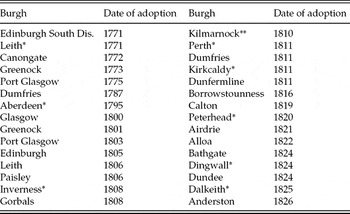
In Treatise of the Police of the Metropolis (1796), the former lord provost of Glasgow, Patrick Colquhoun, drew on his Scottish roots and Scottish Enlightenment thought by interpreting ‘police’ widely. He defined it as one branch of a wider municipal machine whose functions ‘relate to internal regulations for the well order and comfort of civil society’.Footnote 45 However, the most tangible evidence of ‘police's’ association with municipal governance was evident through local police legislation. In the late eighteenth century, many of the larger Scottish burghs acquired ‘police’ powers for lighting, cleansing and the removal of filth.Footnote 46 Initially, these were often obtained under council by-laws and were fairly modest in scope. However, as the century progressed, it became more common for towns to acquire statutory tax-raising powers for a wide range of municipal services (see Table 1). Although a number of burghs introduced improvement legislation in the late eighteenth century, Glasgow in 1800 was the first burgh successfully to petition parliament for a local police act per se. Others quickly followed suit. By 1833 – when parliament passed its first national burgh statute on Scottish policing – 23 Scottish towns, including all of the major urban centres, had introduced police acts. Indeed, the police powers which were acquired were so extensive and widely regarded that very few of those towns chose to adopt the 1833 Burgh Police (Scotland) Act, which permitted, but did not compel, local authorities to embrace reform.
Principal Local Police and Improvement (Lighting, Paving and Watching) Acts, 1770–1826

*Watching provisions not included, although it was common for these to be later added or to be financed by voluntary subscription.
**Watching provisions included but no watch force established.
Source: see David G. Barrie, Police in the Age of Improvement: Police Development and the Civic Tradition in Scotland, 1775–1865 (Cullompton, 2008), ch. 4.
The overwhelming majority of local police acts entrusted the administration of police affairs to directly elected police commissions. In terms of accountability, control and organization, these boards were similar to the statutory improvement and municipal police models of provincial England and continental Europe.Footnote 47 They were locally controlled and financed, accountable (in most burghs) to local ratepayers of sufficient property requirements, and responsible for administering and enforcing local police legislation. They were hugely important to the development of civic administration and municipal welfare. Aside from introducing a degree of community control over representatives, commissions were empowered to levy rates and borrow on future rateable income which helped finance a new range of essential services. In many smaller towns, such services were limited to lighting, paving, cleaning and sanitation, but most of the larger burghs also established full-time, salaried, uniform police forces under a disciplined hierarchical command structure. The newly established Glasgow Police Force in 1800, for instance, consisted of a master of police, 2 sergeants, 5 officers and 63 watchmen for a population in and around the city of 77,885.Footnote 48 Although such forces were established under police legislation in its widest sense, they were extremely important to the development of ‘police’ as an official body for the regulation, organization and administration of criminal as well as civil affairs. Indeed, much of the police's time was spent regulating the rougher elements of working-class culture, acting as an official bureaucracy of civic morality in a way envisaged by Colquhoun and other Enlightenment figures.
There were, however, important differences from the English model. Police commissions oversaw the management of a wider range of municipal services than was often the case in England, where it was not uncommon for multiple improvement trusts to exist.Footnote 49 Moreover, unlike in England, commissions in the larger towns continued to co-exist with reformed town councils after the reform of local government, which were indicative of ongoing suspicion towards town councils as well as the ‘self-governing principles of Scottish civil society’.Footnote 50 More importantly, police commissions in Scottish towns gave a greater level of community control than was often the case in England, where up to the 1820s it was common for commissioners to be appointed from prominent and affluent local citizens.Footnote 51 By contrast, the overwhelming majority of police commissioners in Scotland were directly elected from qualified ratepayers, with only a minority being appointed from the council, magistracy and other municipal boards. Moreover, the electoral and commissioner requirements of police commissions in Scottish towns were more uniform than in England. In the latter, the requirements varied from borough to borough, and could be based upon real estate, personal wealth and rentable property, which were usually set at fairly high levels in order to ensure a middle-class composition. In most Scottish towns, however, eligibility for elected representatives – all of whom had to reside in the ward which they represented – was overwhelmingly based upon property rentals.
Interestingly, electoral and commissioner qualifications were considerably lower than south of the Border, where electoral franchises before 1825 rarely fell below £10 annual rental. In contrast, £4–£5 electoral franchises were not uncommon in Scotland, with only the larger, more affluent, burghs having £10 voting qualifications. Moreover, in many burghs, eligibility was based solely on property, which meant that qualified female householders and property holders could, and did, participate in police elections.
However, the democratic tendencies of police commissions did not extend as far as some have claimed.Footnote 52 As with many forms of associational activity, boundaries were set to exclude those from less affluent backgrounds. Electoral requirements, for instance, were nearly always higher than the rating base, which ensured that many ratepayers were disenfranchised. An article in The Scotsman in 1822 estimated that more than a quarter of police ratepayers in Edinburgh did not have a say in the election of commissioners.Footnote 53 In Glasgow, it was predominantly a middle-class electorate, with working-class rentals in the 1830s being well below the £10 electoral requirement.Footnote 54 Moreover, in most burghs, commissioner qualifications were set much higher than electoral requirements (usually varying between £8 and £15 annual household rental). Not surprisingly, therefore, commissioners in the early nineteenth century were overwhelmingly drawn from the more affluent sections of society. In Glasgow, for instance, control lay firmly with the large business class, with merchants and manufacturers accounting for two-thirds of representatives between 1800 and 1805. In many burghs, councillors, magistrates and, indeed, many of the more affluent members of society, sought to keep property qualifications at a fairly high level in order to ensure that public office would remain as socially exclusive as possible.
Moreover, police commissions’ links with local government (in the form of magisterial ex officio representation) should caution against overstating ‘police’ as a form of associational activity. Police commissions were, in many ways, distinct from nineteenth-century voluntary clubs and societies,Footnote 55 not least in that they were financed not out of voluntary subscription, but through compulsory taxation. Indeed, the failure of voluntary initiatives to raise sufficient funds on a regular basis generally necessitated the need for statutory tax-raising policing powers. Taxes were often raised in the face of trenchant opposition from local communities, with the extent of non-payment and non-compliance highlighting that large sections of the community – especially from more humble backgrounds – either could not afford police services or did not perceive police commissions as being bastions of civic virtue.Footnote 56 Furthermore, police boards were created by acts of parliament and were dependent upon statutory approval. Collectively, these suggest that, in some ways, they were closer to other branches of municipal government than voluntary organizations distinct from the state.
Such factors, however, should not disqualify commissions as being important elements within civil society as it was defined in the eighteenth century or, indeed, much later as a form of associational activity. First, it would be over-simplistic to define the institutions of civil society as being characterized principally by their autonomy from both the local and national state. As has been pointed out elsewhere, the notion of civil society is difficult to distinguish from the state.Footnote 57 In many ways, the ‘state empowered civil society’ by creating ‘the legal framework and preconditions’ for civil society to emerge.Footnote 58
Secondly, leading eighteenth-century thinkers did not view municipal administration as being incompatible with civil society. Adam Ferguson, for instance, did not define civil society in opposition to the state, but rather viewed it in terms of participation in public life.Footnote 59 Moreover, as Smith implied, civil society in this period was widely defined as a product of the rule of law shaped by government, and as such was itself a product of state ordering.
Thirdly, the middle ranks did not perceive directly elected police commissions as being simply extensions of the local state. In framing local police legislation, men of property sought, with varying degrees of success, to establish commissions which were autonomous from council administration. Dividing lines between police commissions and councils were, admittedly, often blurred, as magistrates never ceded their role as guardians of law and order and sought to exert influence over police affairs. But in most burghs, it was commissioners who made the major policy decisions. Although magisterial ex officio representation on commissions ensured there were some ties with councils, the balance of power lay with elected rather than unelected representatives. Often, attempts were made specifically to exclude councillors from serving as commissioners and to restrict magisterial authority over police affairs, which implies that the middle ranks were seeking to establish a new form of civic governance, not simply to extend council administration.
Furthermore, although the democratic tendencies of police commissions did not extend to all ratepayers, their significance should not be understated. In the main, commissioners were drawn from a wider social group than councillors. They often represented the changing social make-up of towns and provided a voice to those who hitherto had been excluded from local government. Their establishment, admittedly, owed much to the hostile political climate prior to burgh reform in 1833, as men of property sought to establish a power base for themselves rather than hand over more control to unaccountable councils.Footnote 60 However, ideas of liberty, governance, civil society and the civic tradition also influenced the political discourse. A common argument among the propertied classes was that directly elected police institutions were an essential check against despotic municipal rule by self-selected councillors.Footnote 61 In 1806, for example, the Merchant Company of Edinburgh argued that the newly established police commission should be given the status of a local authority to balance ‘democratic government’ and prevent absolute rule.Footnote 62 Whereas in many parts of England, where discussions on police often centred on the threat a new model might pose to individual liberty, in urban Scotland, the creation of a directly elected police model was in keeping with notions of representative government and was portrayed as being an essential check to oligarchic local administration. And liberty under the rule of law, as Ferguson argued, would be best assured by allowing men of property to participate in public life.
Police commissions, in other words, were potent symbols of Scottish civil society as it was understood at the time. They were governing institutions that were symbolic of civic association in that they empowered men of property, gave them a voice in civic affairs and were forums for self-direction. The model which was established was structured according to neo-classical notions of liberty, civic engagement and civic virtue, as these were loosely defined in the eighteenth and early nineteenth centuries. The lecture notes of John Millar (1735–1801), Regius Professor of Civil Law at Glasgow University, give an insight into how far these ideas had permeated the mentality of late eighteenth-century Glasgow. He taught students in the late eighteenth century that in order to safeguard against arbitrary rule the legislature should be placed ‘in the great body of the people’ which would be ‘productive of public spirit’.Footnote 63 Although the social composition of commissions was fairly exclusive, property and wealth – even for Ferguson – constituted the basis through which civic governing institutions should be administered.Footnote 64
Significantly, commissions were designed to be non-political. Commissioners were to be above party politics and represent the interests of whole communities rather than align themselves to political parties.Footnote 65 Civic duty, rather than factional interest, was to be the defining characteristic of the new model of urban management. As The Scotsman in 1821 argued: ‘voting along party lines at police elections. . .[is]. . .something that “we do not allow”’.Footnote 66 In many burghs, commissioners did not put themselves up for election. They were instead elected by qualified voters, often after ward meetings, and were expected to serve whether they wanted to or not. Civic duty was an obligation and those who defaulted would often be fined.Footnote 67 Moreover, the notion of civic virtue ensured that most police constitutions included a residential qualification. Elected representatives were expected to live in the ward which they represented. This ensured that they would have a close understanding of local concerns and would be accountable to local people. Many police acts also made provisions for ward superintendents or ward commissioners to oversee day-to-day policing matters. In Glasgow in the late eighteenth century, men of property campaigned long and hard to have ward superintendents appointed. It was believed that the most effective policing model involved establishing a degree of community supervision over local residents.Footnote 68 Furthermore, in keeping with ancient principles of ‘watching and warding’, the position of commissioner and ward superintendent was to be unpaid. They were to serve their communities for the common good, not financial reward.
Significantly, although statutory policing initiatives heralded a transition towards greater collective responsibility and specialization in function, the ethos which underlay this was still very much grounded in the belief that each individual had a civic duty to their community. The issue of law enforcement provides a good case in point. In the late eighteenth century, householders in many of the larger burghs had become increasingly reluctant to give up their free time to ‘watch and ward’ the town, preferring instead to employ substitutes. Although police acts relieved them of this obligation, householders were instead required to pay taxes to put arrangements on a more professional footing. Indeed, the 1806 Paisley Police Act levied a separate assessment for a paid, full-time watch force ‘in lieu of. . .personal attendance for watching and guarding’.Footnote 69 Interestingly, both Ferguson and Smith had argued that the specialization in municipal functions was an integral component of the progress of civil society.Footnote 70
All eligible citizens were expected to display vigour and participate in civic life for the betterment of local communities, whether through paying police rates, voting in police elections, attending ward meetings or keeping streets clear of nuisances. Those who defaulted on their civic obligation could be summoned before local police courts. Police legislation thus empowered Scottish civil society, acting ‘as the vehicle for enacting infrastructural power upon the individual and ultimately upon the community’.Footnote 71
This was in keeping with other large urban centres in Britain, where, to quote the classic study by Silver, there was a growing ‘demand for order in civil society’.Footnote 72 Allowing crime, disease and immorality to gain a foothold in communities was deemed to be an affront to civic duty.Footnote 73 It was expected within civil society that householders would uphold law and order. In 1806, the Merchant Company in Edinburgh noted that ‘a watchful Police, by checking the first appearance of vice, and by lighting and watching the streets of a great city, may effectively guard the morals of the people, by removing the opportunity, and consequently the temptation, to do wrong’.Footnote 74 This mirrored both the language that was deployed in discussions on police in Glasgow in the late eighteenth century, and Colquhoun's calls for an improved system of police in London to check immorality in civil society.
In keeping with eighteenth-century notions of civic virtue, the police in the first half of the nineteenth century were largely concerned with morality, which Scottish moral philosophers had argued would help ensure order and general well-being. In a speech to mark the appointment of the superintendent of police and the opening of the police court in 1805, the lord provost of Edinburgh remarked: ‘much of the virtue of a nation depends upon the exertions of Police, in preventing crimes, in suppressing them in their infancy, and even in checking them in their advanced progress, especially in the Metropolis, which must always greatly influence, and I may say, even regulate the morals of the country, to which it belongs’.Footnote 75
Safeguarding public morality – so important to Ferguson's notion of civic virtue – was an over-riding concern for commissioners. Throughout all of Scotland's major urban centres, the police sought more effectively to control public streets and spaces by clamping down upon vagrancy, begging, disorderly behaviour, prostitution and illegal drinking practices. However, civic leaders also drew on the ideas of Hume, Blair and others, by stressing the importance of private morality to maintaining order. Shortly after an attempt at armed insurrection by handloom weavers in Glasgow in 1820, the Church of Scotland Reverend, Thomas Chalmers (1780–1847), called for civic leaders to display greater moral leadership:
I hope and trust that every description of Magistrates in this county and city, from the highest to the lowest in it, will exert themselves in the exercise of a vigorous Police; or if they find the present not sufficient, that they will give their cordial consent and co-operation to the establishment of a better; that they will set themselves as a wholesome example of morality and religion in their private families.Footnote 76
In response to heightened anxiety which accompanied the post-war years, commissioners in the city zealously promoted religious – and, increasingly, Evangelical – solutions to society's social problems.Footnote 77 It was a two-pronged approach which sought to safeguard public morality by targeting the rougher aspects of working-class culture, but which also recognized the important role individuals had to play before the environment could be improved.Footnote 78 It was a policy that built upon both the public and private notions of morality which had so preoccupied eighteenth-century moral philosophers. In pursuing it, commissioners imposed municipal authority over the control and regulation of local people and served as an important link between the central state, local government and the civic sector.
However, police reform in Scottish towns was by no means simply a product of growing concern with crime and immorality. In many burghs, reform was closely aligned with rapid urban expansion and growing concern about the negative impact it was having upon urban infrastructure, the built environment and the social fabric. In others, it was indicative of a new civil society under which many forms of improvements could be introduced and administered. Part of this was driven by commercial incentives, the development of the new political economy and a thirst for improvements to transport links.Footnote 79 But there was also a wider, intellectual dimension that was rooted in Enlightenment values of polite society and urban refinement.Footnote 80 As indicated earlier, there was a strong tradition of civic interventionism in Scotland which predated the Enlightenment, and which should highlight that the eighteenth century was one of continuity as well as change in many ways. Nonetheless, the late Georgian period saw the emergence of a new consciousness about urban improvement. Beautification and modernization became increasingly important facets of urban life.Footnote 81 New attitudes and raised expectations of comfort and security, allied to a growing desire for ornamentation, provided an important stimulus to police reform across the country. This was fuelled by the rise of the middle ranks, the development of night-time entertainment and a growing desire for cleaner and safer urban environments, which increasingly appears to have become a reflection of urban identity and civic culture as the nineteenth century progressed.Footnote 82
Underlying this desire for statutory policing powers was the Enlightenment belief that human endeavour was able to shape the environment to a far greater degree than ever before. By the 1770s, the concept of ‘civic humanism’ – which stressed the responsibilities of all citizens, but essentially the propertied ranks, to create a better and more civilized society – had gained widespread support and helped fashion new ideas on how best to manage city life. In order to do this, citizens had a civic duty and public responsibility to help improve the environment in which they lived. Significantly, police acts helped institutionalize this ideal. In levying assessments to pay for services and provisions which could not be adequately financed from voluntary subscriptions or existing council revenue, they heralded a transition towards collective responsibility that was in keeping with many of the ideas on civil society and civic government espoused by many Enlightenment thinkers.
According to one scholar, Scottish civil society – as expressed through burgh policing – acted as a balance to the state and was also created by it.Footnote 83 There is certainly much worth in this argument, especially after 1833 when parliament introduced a series of national burgh policing statutes which provided a centrally directed framework for reform and which extended the state's authority. But, prior to 1833, the main stimulus behind police development came from local communities, not the centre. It was, like associational activity, voluntary, in that men of property chose for themselves whether to embrace reform. Admittedly, the centre played an important part in sanctioning and shaping civil societyFootnote 84 by giving statutory approval, or otherwise, to local police legislation.Footnote 85 Nonetheless, the police model which emerged in these years was the outcome of extensive debate and dialogue between local elites, much of which was inspired by political discontent, eighteenth-century ideas on liberty and the intellectual discourse which emanated from the Enlightenment. A central feature of debates on police reform was the extremely high level of community participation, with householder meetings, local craft and mercantile interests and, in some cases, interest groups championing the case for reform or otherwise. Moreover, it was worth noting, the national burgh policing model which emerged after 1833 was remarkably similar to the one that existed before this date, which suggests that the locality may have influenced the centre more than the centre influenced the locality.
Conclusion
The experience of police development in late eighteenth- and early nineteenth-century urban Scotland indicates that notions of civil society, civic virtue and the civic tradition – as these were understood at this period in history – did play an important part in shaping ideas, institutions and structures. In doing so, it provides a useful corrective to some of the ‘problem–response’ interpretations which have coloured police historiography both in Scotland and beyond.Footnote 86 It also suggests that these ideals might have had important roles to play in shaping eighteenth-century law enforcement in general, offering a new dimension to discourse which has focused mainly on nineteenth-century associational activity.Footnote 87
However, while the wider intellectual context provided, to some degree, a justification and framework for police reform in urban Scotland, its significance needs to be qualified in a number of important ways. In the ensuing debates on the merits of police reform in Scottish towns, there were few direct references to ‘civil society’ and ‘civic virtue’ per se. Patrick Colquhoun, for instance, was one of the few leading figures to refer specifically to ‘civil society’, which began to be used less frequently in British vernacular in the early nineteenth century as conceptions of the state and municipal authorities became more precisely defined.Footnote 88 Furthermore, neither police reform nor the model which was set up was inevitable nor can be reduced to ‘the rational march of progress’. Reform was the product of protracted dialogue, negotiation and concession often stretching over fairly long periods. The model which was created was symbolic of an emerging consensus among men of property that a new form of urban management was necessary in order to meet the challenges and raised expectations brought by urban and commercial expansion.Footnote 89 But disagreements had to be worked out in a hostile political climate. Indeed, where elites could not agree on the police model, improvement initiatives were often held back for many years.Footnote 90
Moreover, while the concept of a new civil society, under which multiple improvements could be managed, was undoubtedly important in fashioning attitudes towards urban order and the built environment, the police institution's introduction across urban Scotland as a whole cannot be removed from its economic and social context. Admittedly, perceptions of economic and social change, as has been argued elsewhere, played an important part in the development of the civic tradition as an ideal.Footnote 91 Nonetheless, while ideas on how best to manage towns were often inspired by neo-classical and Enlightenment values, the challenges and raised expectations which accompanied urban and commercial expansion provided an important stimulus to reform throughout the country as a whole, a fact which goes a long way in explaining geographical variation in the pattern of police adoption.Footnote 92 Furthermore, while Smith and others might have welcomed the emergence of ‘police’ in its widest sense as a governing institution, it is important to remember that he was sceptical about the benefit police in its modern, law enforcement, sense might bring, observing ‘that those cities where the greatest police is exercised are not those which enjoy the greatest security’.Footnote 93
It is also worth pointing out that many of the ideals which underlay the police model did not always translate into reality. This will call for greater attention than can be given here, but there is evidence that the commitment among local communities to the ideal of civic virtue, for instance, was not as strong as the framers of police legislation anticipated or would have liked. After the initial enthusiasm for the new model had evaporated, police affairs were often characterized by householders refusing to vote, elected commissioners refusing to serve, political infighting between local elites and non-payment of police rates.Footnote 94 Moreover, far from serving the community as a whole, much of the police's energy and resources were directed towards controlling the urban poor, regulating working-class culture and improving the streets of more affluent communities.Footnote 95 As in England, commissioners often adopted a narrow, self-interested view of what constituted the common good.Footnote 96 While commissions could be a force for public improvement, they could also be a form of repression and private interest, especially when it came to policing industrial militancy.Footnote 97
Despite this disparity between theory and practice, the ancient principle of the ‘common good’ did play an important part in shaping the police model in urban Scotland, which was in keeping with the interventionist municipal history of the country. Enlightenment discourse on improvement, civil society and civic virtue gave this greater resonance with each concept being debated in relation to the well-being of communities and society as a whole. All were important in shaping the way urban Scotland was governed.Footnote 98
Of course, contrasting models of citizenship and the wide way in which ‘civil society’ was defined in the late eighteenth century should, rightly, caution against implying that there were no tensions between those who drew on the concept and how it was applied. However, although this might somewhat blunt the concept's significance, it does not completely undermine it. Even though Hume, Smith and Ferguson did not speak with one voice when discussing civil society or, indeed, civic virtue, neither concept should be abandoned as an historical idea. The range of sources that drew upon them suggests that these ideals had permeated the Scottish intellect. Indeed, it was the ‘abstractness’ and ‘uncertainty’ of their boundaries which made them so adaptable.Footnote 99 Crucially, neither civil society nor civic virtue was so widely applied as to produce confusion about its meaning. Collectively, they were widely identified with modernity, polite society, commercial progress, improvement, law and, through Ferguson in particular, civic virtue and voluntary participation. Both provided a broad, intellectual context presupposing the ideas on police and improvement, and were closely associated with safeguarding and promoting the interests of private property through governing institutions – which, significantly, was an overriding concern for the new police model which emerged. These were ideals, in other words, on which those who championed the case for reform were able to draw. The model which emerged represented, in many ways, the institutionalization of these concepts. It was, in principle, in keeping with many of the underlying institutional and cultural characteristics associated with civic virtue and civil society, even if the reality turned out to be somewhat different.