Introduction
Behavioral problems refer to behaviors that impede social adaptation in the developmental progress of children, including externalizing and internalizing behavioral problems (Dodge et al., Reference Dodge, Lansford, Burks, Bates, Pettit, Fontaine and Price2003; Gadow et al., Reference Gadow, Devincent, Pomeroy and Azizian2004; Ming et al., Reference Ming, Brimacombe, Chaaban, Zimmerman-Bier and Wagner2008). Externalizing behavioral problems are characterized by negative behaviors acting on the external environment, such as hyperactivity, impulsivity, and aggressiveness while internalizing behavioral problems refer to issues affecting children’s internal psychological states, such as withdrawn, anxious, inhibited, and emotional problems (Eisenberg et al., Reference Eisenberg, Cumberland, Spinrad, Fabes, Shepard, Reiser, Murphy, Losoya and Guthrie2001). Behavioral problems are related to poor school performance and interpersonal difficulties (Danneel et al., Reference Danneel, Nelemans, Spithoven, Bastin, Bijttebier, Colpin, Van Den Noortgate, Van Leeuwen, Verschueren and Goossens2019; Fanti & Henrich, Reference Fanti and Henrich2010; Van der Ende et al., Reference Van der Ende, Verhulst and Tiemeier2016), and increase the risk of psychological disorders during adolescence and adulthood (Eiden et al., Reference Eiden, Lessard, Colder, Livingston, Casey and Leonard2016; Moilanen et al., Reference Moilanen, Shaw and Maxwell2010; Obradović & Hipwell, Reference Obradović and Hipwell2010; van Lier et al., Reference van Lier, Vitaro, Barker, Brendgen, Tremblay and Boivin2012).
Children with autism spectrum disorder (ASD) often exhibit more severe behavioral problems than their normatively developing peers, which has been confirmed by research focused on infants and preschoolers (Eisenhower et al., Reference Eisenhower, Baker and Blacher2005; Estes et al., Reference Estes, Munson, Dawson, Koehler, Zhou and Abbott2009). Behavioral problems pose significant barriers to the development of emotional, cognitive, and social skills in children with ASD (Berenguer et al., Reference Berenguer, Roselló, Colomer, Baixauli and Miranda2018; Calkins et al., Reference Calkins, Blandon, Williford and Keane2007). Notably, the presence of behavioral problems complicates the comprehension of children’s behaviors and thoughts, thereby intensifying social difficulties in children with ASD (Ames & White, Reference Ames and White2011). Furthermore, the behavioral problems in children with ASD are often correlated with ASD symptoms, whereby more severe core symptoms are typically associated with a greater level of behavioral problems (Georgiades et al., Reference Georgiades, Szatmari, Duku, Zwaigenbaum, Bryson, Roberts, Fombonne, Mirenda, Smith, Vaillancourt, Volden, Waddell and Thompson2011). These factors collectively hinder social adaptation in children with ASD (Jang et al., Reference Jang, Dixon, Tarbox and Granpeesheh2011).
In addition to their negative impact on children’s developmental outcomes, the behavioral problems of children with ASD also have negative impacts on the psychological well-being of caregivers. As reported by parents, managing children’s behavioral problems is even more challenging than dealing with ASD symptoms (Herring et al., Reference Herring, Gray, Taffe, Tonge, Sweeney and Einfeld2006). Higher levels of behavioral problems in children with ASD are associated with greater parental stress, anxiety, depressive symptoms and affiliated stigma (Hastings, Reference Hastings2002). This situation is particularly common among parents of younger children with ASD (Chan & Lam, Reference Chan and Lam2018; Deguchi et al., Reference Deguchi, Asakura and Omiya2021; Estes et al., Reference Estes, Munson, Dawson, Koehler, Zhou and Abbott2009; McStay et al., Reference McStay, Dissanayake, Scheeren, Koot and Begeer2014). Parenting stress may further influence parenting practices, resulting in negative parenting behaviors, which might increase children’s behavioral problems. Therefore, children’s behavioral problems and parents’ emotions and behaviors might be associated with each other in a bidirectional manner. Although bidirectionality is a fundamental property of dyadic relationships (Yan et al., Reference Yan, Ansari and Peng2021), the reciprocal relationship between parental factors and behavioral problems in children with ASD has been less examined. In this study, we focused on the association between parental reflective functioning and the behavioral problems of children with ASD.
Parental reflective functioning may mitigate behavioral problems in children with ASD
Parental reflective functioning refers to the capacity of caregivers to appropriately and consistently understand and represent their children’s internal states (Slade, Reference Slade2005). Parental reflective functioning enables caregivers to comprehend behaviors of both themselves and their child, be empathetic when they respond to the child’s distress and support their self-regulation and socioemotional development (Adkins et al., Reference Adkins, Reisz, Hasdemir and Fonagy2022; Luyten et al., Reference Luyten, Campbell, Allison and Fonagy2020).
Parental reflective functioning originates from attachment theory. Ainsworth (Reference Ainsworth1989) emphasized the importance of understanding the internal processes underlying parenting behaviors by observing parent–child interactions to enhance parenting quality. Accordingly, Fonagy (Reference Fonagy1991) introduced the theory of mentalization and highlighted parental mentalizing as the fundamental basis for exhibiting sensitive parenting behaviors and fostering secure attachment in children. Parental reflective functioning is a form of operationalized definitions for parental mentalizing, closely related to constructs such as parental insightfulness (Koren-Karie et al., Reference Koren-Karie, Oppenheim, Dolev, Sher and Etzion-Carasso2002) and parental mind-mindedness (Meins et al., Reference Meins, Fernyhough, Fradley and Tuckey2001). All of these concepts emphasize the importance of parents’ efforts to understand their children’s mental states. While parental insightfulness and mind-mindedness are typically assessed through interviews or observations of parent-child interactions, parental reflective functioning is most often measured using self-report questionnaires or the Parent Development Interview. Given the relatively large sample size in the present survey study, a self-report assessment of parental reflective functioning was chosen.
Parental reflective functioning is theorized to promote positive parenting behaviors. A recent meta-analysis found a positive association between parental reflective functioning and parenting quality (Stuhrmann et al., Reference Stuhrmann, Göbel, Bindt and Mudra2022). It is also correlated with the quality of parent-child relationship (Rostad & Whitaker, Reference Rostad and Whitaker2016). Higher levels of parental reflective functioning are linked to a greater likelihood of secure attachment in children (Baron-Cohen et al., Reference Baron-Cohen, Fearon, Meins, Feldman, Hardiman, Rosan and Fonagy2024; Dolev et al., Reference Dolev, Oppenheim, Koren-Karie and Yirmiya2014; Oppenheim et al., Reference Oppenheim, Koren-Karie, Dolev and Yirmiya2009; Slade et al., Reference Slade, Holland, Ordway, Carlson, Jeon, Close, Mayes and Sadler2020), whereas a lack of awareness of a child’s inner world is correlated with increased rates of insecure attachment(Camoirano, Reference Camoirano2017; Miller et al., Reference Miller, Kim, Boldt, Goffin and Kochanska2019) . In line with its association with positive parenting behaviors and good parent-child relationship, parental reflective functioning also contributes to the development of children’s emotion regulation (Zeegers et al., Reference Zeegers, de Vente, Nikolić, Majdandžić, Bögels and Colonnesi2018). Several studies have shown that higher parental reflective functioning is associated with better emotion regulation capacities when dealing with distress and frustration among toddlers and preschoolers (Borelli et al., Reference Borelli, Lai, Smiley, Kerr, Buttitta, Hecht and Rasmussen2021; Ghanbari et al., Reference Ghanbari, Vahidi, Behzadpoor, Goudarzi and Ghabezi2023; Misailidi et al., Reference Misailidi, Zimmermann, Gelou, Barbatsi and Bonoti2025). When parents respond to their child’s negative emotions by exploring the reasons behind the child’s distress, they communicate an understanding and acceptance of the child’s emotions. This approach helps children articulate the reasons for their distress or anger, facilitating emotional understanding (Ensink et al., Reference Ensink, Bégin, Normandin and Fonagy2017). Furthermore, better parental reflective functioning is associated with reduced emotional problems, attention difficulties, and social withdrawal behaviors in children (Esbjørn et al., Reference Esbjørn, Pedersen, Daniel, Hald, Holm and Steele2013; Golebiewski, Reference Golebiewski2010; Gordo et al., Reference Gordo, Martínez-Pampliega, Iriarte Elejalde and Luyten2020). Cross-sectional studies have consistently found that higher parental reflective functioning is linked to lower levels of behavioral problems in children (Madsen et al., Reference Madsen, Væver, Egmose, Krogh, Haase, de Moor and Karstoft2023; Longobardi et al., Reference Longobardi, Morelli, Brunetti, Sette, Spataro and Laghi2025). Longitudinal evidence from a four-year prospective study of foster children further supports this relationship, demonstrating that declines in parental reflective functioning predicted heightened socio-emotional difficulties in children (Malcorps et al., Reference Malcorps, Vliegen, Fonagy and Luyten2024). Research on related constructs further supports the importance of parental mentalizing capacities on children’s developmental outcomes. For instance, research on mind-mindedness has also shown that higher levels of early maternal mind-mindedness at 10 months were associated with fewer internalizing emotional problems and lower conduct problems in children at 51 months (Hobby et al., Reference Hobby, Bird, Townsend and Barnes2023). Collectively, research on parental mentalizing has yielded consistent evidence that this capacity is associated with positive mental health outcomes of children.
Notably, most studies investigating the relationship between parental reflective functioning and children’s developmental outcomes have focused primarily on families of normatively developing children, with limited attention given to families of children with ASD. The available evidence has yielded mixed findings. While some studies have found that parents of children with ASD exhibit reflective functioning comparable to that of parents of normatively developing children (Oppenheim et al., Reference Oppenheim, Koren-Karie, Dolev and Yirmiya2009), despite the substantial challenges posed by ASD symptoms and behavioral problems (Harker et al., Reference Harker, Ibañez, Nguyen, Messinger and Stone2016; Siller & Sigman, Reference Siller and Sigman2002), others suggest a more nuanced pattern. For instance, in families raising children with ASD and their normatively developing siblings, parents tend to devote more attention and resources to the child with ASD (Feinberg & Hetherington, Reference Feinberg and Hetherington2001), who is perceived as requiring greater support, especially when contemplating what response is required to manage a particular situation. Consequently, parents exhibit significantly higher reflective functioning when interacting with their child with ASD compared to their normatively developing siblings (Enav et al., Reference Enav, Erhard-Weiss, Goldenberg, Knudston, Hardan and Gross2020). Furthermore, the influence of parental reflective functioning on children’s developmental outcomes appears to be consistent across ASD and normatively developing populations, indicating that children with ASD benefit from parental reflective functioning in a manner similar to normatively developing children (Oppenheim & Koren-Karie, Reference Oppenheim, Koren-Karie, Siller and Morgan2018). For example, Oppenheim et al. (Reference Oppenheim, Koren-Karie, Dolev and Yirmiya2009) reported that if caregivers of children with ASD and PDD-NOS have higher levels of reflective functioning, these children are more likely to exhibit secure attachment. Additionally, maternal reflective functioning significantly predicts the educational placement of children with ASD 4.5 and 8.5 years later, and children whose mothers exhibit better reflective functioning may be more likely to be placed in mainstream education (Dolev et al., Reference Dolev, Oppenheim, Koren-Karie and Yirmiya2014). An intervention study has also shown that there was a significant reduction in internalizing behavioral problems in children when parental reflective functioning improved (Enav et al., Reference Enav, Erhard-Weiss, Kopelman, Samson, Mehta, Gross and Hardan2019).
Behavioral problems in children with ASD may impair parental reflective functioning
Although parental reflective functioning is relatively stable, it varies with perceived stress levels. Research indicates that higher parenting stress is associated with diminished reflective functioning (Luyten et al., Reference Luyten, Mayes, Nijssens and Fonagy2017). Compared to parents of normatively developing children and those with other neurodevelopmental disorders, parents of children with ASD experience greater parenting stress (Estes et al., Reference Estes, Munson, Dawson, Koehler, Zhou and Abbott2009; Hayes & Watson, Reference Hayes and Watson2013). Children with ASD present relatively complicated and enduring behavioral problems across different developmental stages, including emotional problems, socially inappropriate behaviors, and aggressive behaviors. These problems act as stressors for their parents, with higher levels of behavioral problems correlating with increased parenting stress (Chan & Lam, Reference Chan and Lam2018; Deguchi et al., Reference Deguchi, Asakura and Omiya2021). The various behavioral problems in children with ASD and ambiguous cues related to behavioral problems may contribute to reduced parental reflective functioning, where parents perceive their child’s mental states as a mystery and show a lack of curiosity and/or interest in understanding what mental states are driving their child’s behaviors (Luyten et al., Reference Luyten, Mayes, Nijssens and Fonagy2017). In addition, previous study indicated that parents of preschoolers with ASD were more likely than those of normatively developing children to attribute their child’s behavioral problems to factors beyond the child’s control and stable over time (Berliner et al., Reference Berliner, Moskowitz, Braconnier and Chaplin2020). This may lead parents to commonly misattribute their child’s behavior to autism (e.g., “He can’t help it because he has autism”), assuming that their child does not yet have the ability to engage in mentalizing, essentially viewing them as having a blank mind (Luyten et al., Reference Luyten, Mayes, Nijssens and Fonagy2017). In these situations, parents focus primarily on reducing the frequency of behavioral problems without considering their child’s internal world. These patterns suggest that behavioral problems in children with ASD may contribute to lower parental reflective functioning.
Overview of the present study
Drawing on attachment theory, mentalization theory, and empirical research on reflective functioning in parents of normatively developing children as well as a limited number of studies on parents of children with ASD, optimal parental reflective functioning may serve as a protective factor for the developmental outcomes of children with ASD. However, it could be adversely affected by heightened levels of behavioral problems. The present study aimed to examine the reciprocal relationship between these two variables via a longitudinal design. It was hypothesized that (a) parental reflective functioning longitudinally predicts both externalizing and internalizing behavioral problems in children with ASD. The better parental reflective functioning is, the lower the behavioral problem score. (b) Behavioral problems in children with ASD longitudinally predict parental reflective functioning. The more behavioral problems a child has, the poorer parental reflective functioning is.
Method
Participants
Parents of children with ASD were followed up for 6 months, with three waves of surveys at intervals of three months. A total of 180 parents (140 mothers; 40 fathers) participated in the study at Time 1 (T1; M age = 34.85 years, SD = 4.95) when their children (146 boys; 34 girls) were on average 4.49 years old (SD = 1.49), with an average ASD diagnosis age of 2.87 years (SD = .98). 131 parents (98 mothers; 33 fathers) participated at Time 2 (T2; M age = 34.94 years, SD = 4.57) when the average age of their children (106 boys; 25 girls) was 4.41 years (SD = 1.42). The average age at ASD diagnosis for the children was 2.81 years (SD = .97). 113 parents (85 mothers; 28 fathers) participated in the study at Time 3 (T3; M age = 35.04 years, SD = 4.47) when the average age of their children (90 boys; 23 girls) was 4.44 years (SD = 1.47). The average age at ASD diagnosis for the children was 2.83 years (SD = .99).
Measures
Demographics
A self-compiled demographic questionnaire was used to collect information about parents’ gender, age, relationship to their children, as well as children’s gender, age, and age at ASD diagnosis.
Behavioral problems
The Strength and Difficulties Questionnaire (SDQ, Shelton et al., Reference Shelton, Frick and Wootton1996) is a 25-item questionnaire that consists of five subscales: conduct problems, inattention hyperactivity, emotional symptoms, peer problems and prosocial behaviors. Chinse version of the SDQ was used in this study and only four behavioral problem subscales were used to generate indicators of behavioral problems. Specifically, scores of conduct problems and inattention hyperactivity were summed to indicate the level of externalizing behavioral problems, and scores of emotional symptoms and peer problems were summed as indicators of internalizing behavioral problems. Each item is rated on a 3-point Likert scale (0 = not true, 2 = certainly true), with higher scores indicating greater behavioral problems. The total scores of internalizing and externalizing behavioral problems were used in the analyses. The Chinese version of the SDQ has acceptable reliability and validity (Xu et al., Reference Xu, Zhou, Lu, Wong, Chang and Wang2020). It has been widely used to measure behavioral problems of Chinese children (Yao et al., Reference Yao, Zhang, Zhu, Jing, McWhinnie and Abela2009) and children with ASD (Findon et al., Reference Findon, Cadman, Stewart, Woodhouse, Eklund, Hayward, Golden, Chaplin, Glaser, Simonoff, Murphy, Bolton and McEwen2016). The internalizing behavioral problems subscale had McDonald’s ωvalues of .50, .61, .61 at T1, T2, and T3, respectively. The externalizing behavioral problems subscale had McDonald’s ω values of .70, .67, and .69 at T1, T2, and T3, respectively. The internal consistencies were in line with studies focusing on young children with ASD (Findon et al., Reference Findon, Cadman, Stewart, Woodhouse, Eklund, Hayward, Golden, Chaplin, Glaser, Simonoff, Murphy, Bolton and McEwen2016).
Parental reflective functioning
The Parental Reflective Functioning Questionnaire (PRFQ, Luyten et al., Reference Luyten, Mayes, Nijssens and Fonagy2017) is an 18-item scale used to assess parental reflective functioning that consists of three subscales: Pre-mentalizing (PM), certainty about mental states (CM) and interest and curiosity (IC). In particular, PM (six items, e.g., “my child messes around to annoy me”) evaluates parents’ difficulty in reflecting on their children’s feelings and thoughts, their limited capacity to adopt different viewpoints and their tendency to make malevolent attributions. The subscale of CM (six items; e.g., “I always know what my child wants”) measures the extent to which parents are aware of their child’s experiences and perspectives. The subscale of IC (six items; e.g., “I usually think of the behavior and of my child and the reason”) measures parental interest and efforts to explore the internal process underlying their children’s external behaviors. Each item is rated on a 7-point Likert scale (7 = strongly agree, 1 = strongly disagree). The total scores of the three subscales were calculated and used in the analyses. A higher PM score corresponds to a lower level of parental reflective functioning, whereas higher CM and IC scores indicate a higher level of parental reflective functioning. The Chinese version of the PRFQ has good reliability and validity (Chen et al., Reference Chen, Li, Jahrami, Wang, Zheng, Huang, Bragazzi and Gao2024). The estimates of internal consistency in this study were satisfactory (ω = .68, .69, and .64 for PM subscale at T1, T2, and T3; .79, .78, .78 or the CM subscale at T1, T2, and T3; and .83, .86, .81 for the IC subscale at T1, T2, and T3, respectively).
Procedure
The study procedure was approved by the ethics committees at the Peking University Health Science Center. Convenience sampling was used. Participants were recruited through multiple channels, including hospitals, inclusive kindergartens, and autism intervention institutions in Beijing, China, supplemented by online advertisements distributed via a popular science blogger’s platform focused on ASD. The inclusion criteria for the participants were as follows: (a) parents had a child who was diagnosed with ASD and (b) the child was aged 2–10 years. (c) The participant was the primary caregiver of the child with ASD. The exclusion criteria were that either the parent or child had severe physical diseases or comorbid psychiatric conditions. The eligibility of participants was screened using parent reports. A longitudinal survey with three waves of investigation was conducted through an online survey platform “wenjuanxing.” Only one parent in a family participated in this study and the same parent completed questionnaires at each timepoint. Prior to completing the online questionnaire, participants were required to read the consent form and provide their consent by electronically signing the form. Only after confirming their informed consent did they proceed to complete the questionnaires. Participants were asked to complete the PRFQ and SDQ at each time point at three-month intervals. Each participant received a compensation of 10 RMB for completing the questionnaire each time as a token of appreciation. No personally identifiable information from parents or children was collected. All data were stored securely on password-protected computers accessible only to the research team and were used exclusively for research purposes, ensuring the anonymity and confidentiality of all participants. Children’s nicknames and parents’ WeChat names were used to match the data collected across the three waves.
Statistical analyses
SPSS 23.0 was used for descriptive analyses, correlation analysis, attrition analysis (independent-samples t test and χ 2 test) and demographic difference examination for parental reflective functioning and children’s externalizing/internalizing problems (independent-samples t test and correlation analysis). MPlus 8.3 was used for cross-lagged panel analysis. Six cross-lagged panel models (CLPMs) were separately examined to explore the bidirectional relationship between three indicators of parental reflective functioning (PM, CM and IC) and two indicators of children’s behavioral problems (externalizing and internalizing behavioral problems). Missing data were handled with full information maximum likelihood, a procedure shown to reduce the negative effects of attrition (Graham, Reference Graham2012; Little et al., Reference Little, Jorgensen, Lang and Moore2014).
Results
Attrition analysis
Independent-samples t-test results indicated that participants who completed all three surveys (n = 113) scored significantly higher on IC (t (178) = 2.73, p < .05) and CM (t (178) = 2.21, p < .05) at T1 compared to those who dropped out (n = 67). However, no significant differences were found in other variables, including the age of the children at T1 (t (178) = –.66, p > .05), the age at ASD diagnosis (t (171) = –.76, p > .05), the age of the parents (t (178) = .68, p > .05), PM (t (178) = –.03, p > .05), internalizing behavioral problems (t (178) = .28, p > .05) and externalizing behavioral problems (t (178) = –1.91, p > .05).
The results of the χ 2 test revealed no significant differences in the gender of parents (χ 2 (1, 180) = .28, p > .05) or the gender of children (χ 2 (1, 180) = .51, p > .05) between participants who completed all three surveys and those who dropped out.
Descriptive statistics and correlation analysis
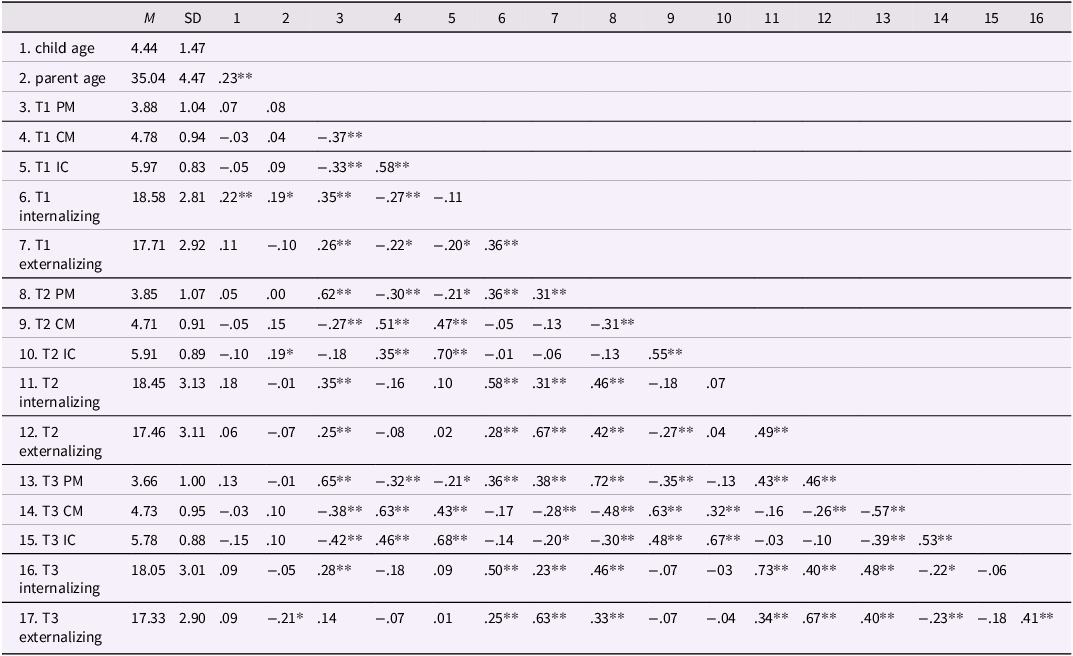
Table 1 presents the means, standard deviations, and correlations of parental reflective functioning and children’s behavioral problems across three waves. Parental reflective functioning scores were significantly positively correlated across the three waves, with correlation coefficients ranging from .51 to .72, indicating a moderate-to-high correlation. Similarly, internalizing and externalizing behavioral problems scores were significantly positively correlated across the three waves, with correlation coefficients ranging from .50 to .73.
Descriptive statistics for parental reflective functioning and internalizing and externalizing behavioral problems in children with ASD

Note. PM = pre-mentalization, CM = parental certainty about their child’s psychological state, IC = parental, interest and curiosity about their child’s psychological state, **p < .01; *p < .05.
Furthermore, the scores of PM and internalizing/externalizing behavioral problems showed low-to-moderate positive correlations at the cross-sectional level, with correlation coefficients ranging from .26 to .48 (ps < .01). Across timepoints, the scores of PM and internalizing/externalizing behavioral problems showed low to moderate significant positive correlations, with correlation coefficients ranging from .25 to .46 (ps < .01), except that PM at T1 and externalizing behavioral problems at T3 were not significantly correlated. At the cross-sectional level, CM was significantly negatively correlated with internalizing and externalizing behavioral problems at T1 and T3, with correlation coefficients ranging from −.22 to −.27 (ps < .05). There was no significant correlation between CM and internalizing behavioral problems at T2. Across timepoints, only CM at T3 was significantly negatively correlated with externalizing behavioral problems at T1 (r = −.28, p < .01) and T2 (r = −.26, p < .01). In terms of correlations between IC and behavioral problems, only IC at T1 had a significant negative correlation with externalizing behavioral problems (r = −.20, p < .05) at the cross-sectional level. Only externalizing behavioral problems at T1 were significantly negatively correlated with IC at T3 (r = −.20, p < .05).
Demographic differences in parental reflective functioning and children’s behavioral problems
As indicated in Table 1, there was a low significant positive correlation between child age and internalizing behavioral problems at T1 (r = .22, p < .05). Similarly, parent age was weakly significant positively correlated with internalizing behavioral problems at T1 (r = .19, p < .05) and with IC at T2 (r = .19, p < .05). Parent age also had a low significant negative correlation with externalizing behavioral problems at T3 (r = −. 21, p < .05).
Independent samples t tests were used to examine the gender differences in parental reflective functioning and internalizing and externalizing behavioral problems. No significant gender difference was found in parental reflective functioning or children’s internalizing or externalizing behavioral problems, considering both parental and child gender (ps > .05).
Cross-lagged panel analysis of parental reflective functioning and internalizing and externalizing behavioral problems in children with ASD
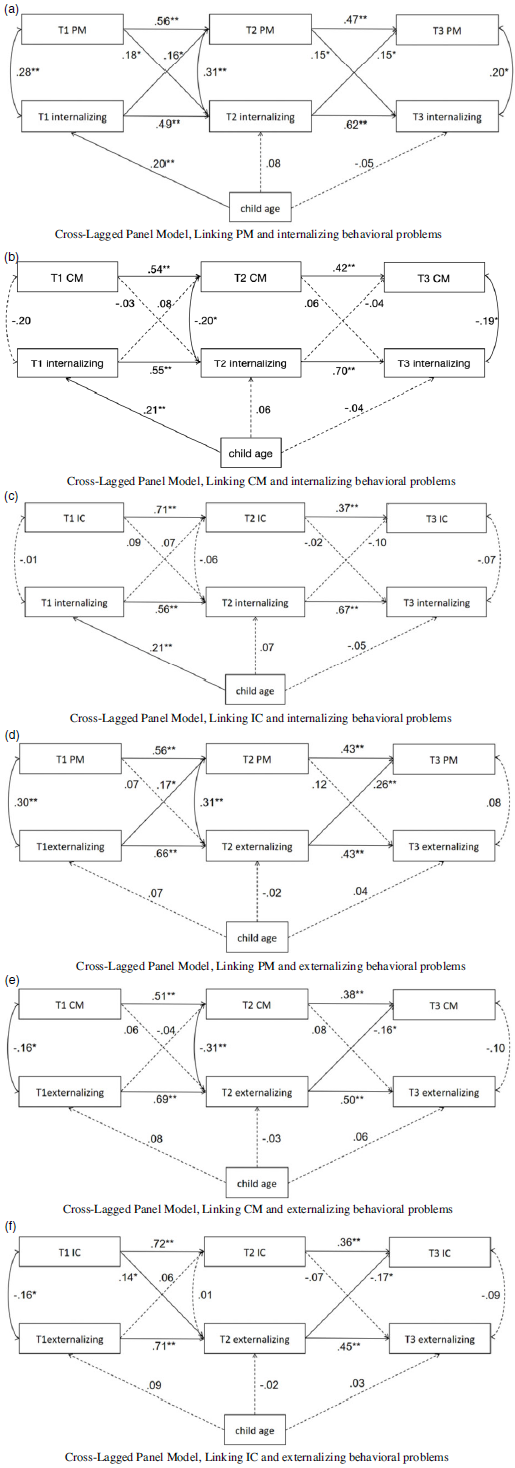
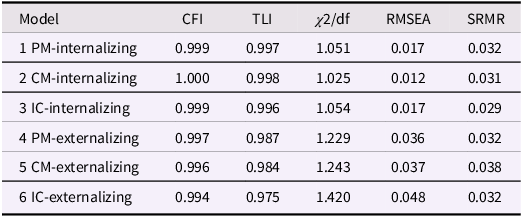
Six CLPMs assessing the relationships between the subscales of parental reflective functioning (including PM, CM, and IC) and internalizing and externalizing behavioral problems in children with ASD were examined via path analysis. Child age was set as a control variable due to its significant correlation with internalizing behavioral problems at T1. Figure 1 presents the standardized path coefficients for the models. As shown in Table 2, all six models demonstrated acceptable fit indices.
Reciprocal associations model: associations between parental reflective functioning and behavioral problems in children with ASD. Note. **p < .01, *p < .05.

Model fit indices of cross-lagged model of reciprocal associations between parental reflective functioning and behavioral problems in children with ASD

Models 1, 2, and 3 were CLPM models of parental reflective functioning (PM/CM/IC) and internalizing behavioral problems. As results of Model 1 indicated, the autoregressive effects were significant for both PM and internalizing behavioral problems, and significant cross-lagged effects were found between PM and internalizing behavioral problems. PM at the previous timepoint significantly and positively predicted internalizing behavioral problems at the later timepoint (from T1 to T2, the path coefficient = .18, p < .05; from T2 to T3, the path coefficient = .15, p < .05), and internalizing behavioral problems at the previous timepoint significantly and positively predicted PM at the later timepoint (from T1 to T2, the path coefficient = .16, p < .05; from T2 to T3, the path coefficient = .15, p < .05). In Model 2 and Model 3, although significant autoregressive effects were identified for CM (Model 2)/IC (Model 3) and internalizing behavioral problems, the cross-lagged effects between CM/IC and internalizing behavioral problems were not significant.
Models 4, 5, and 6 examined the relationship between parental reflective functioning (PM/CM/IC) and externalizing behavioral problems in children. In Model 4, significant autoregressive effects were found for PM and externalizing behavioral problems. For the cross-lagged effects, externalizing behavioral problems at T1 were associated with PM at T2 (path coefficient = .17, p < .05), and externalizing behavioral problems at T2 were associated with PM at T3 (path coefficient = .26, p < .01). In Model 5, autoregressive effects were significant for both CM and externalizing behavioral problems. Additionally, there was a negative association between externalizing behavioral problems at T2 and CM at T3 (path coefficient = −.16, p < .05). Similarly, in Model 6, significant autoregressive effects were identified for IC and externalizing behavioral problems. Furthermore, IC at T1 and externalizing behavioral problems at T2 were significantly associated (path coefficient = .14, p < .05). Externalizing behavioral problems at T2 and IC at T3 were significantly associated (path coefficient = −.17, p < .05).
Discussion
This study employed a cross-lagged design to provide empirical evidence for the bidirectional relationship between parental reflective functioning and the behavioral problems of children with ASD, addressing a critical gap in understanding the dynamics of parenting within these families. The results revealed a significant bidirectional relationship between parental pre-mentalizing and children’s internalizing behavioral problems, as well as a significant child-driven effect in the association between parental reflective functioning and children’s externalizing behavioral problems. These findings underscore the importance of considering reciprocal processes within the parent–child dynamic when parenting a child with ASD.
Child-driven effects may exert cumulative and cascading impacts that endure over an extended period, influencing both parental functioning and children’s developmental trajectories (Masten & Cicchetti, Reference Masten and Cicchetti2010). Supporting our hypothesis and consisting with longitudinal studies on normatively developing children (Yan et al., Reference Yan, Ansari and Peng2021), our study revealed that both internalizing and externalizing behavioral problems in children predicted reductions in parental reflective functioning three months later. Specifically, internalizing behavioral problems predicted heightened levels of pre-mentalizing, while externalizing behavioral problems predicted both increased pre-mentalizing and reduced levels of certainty about child’s mental states and parents’ curiosity and interest. As indicated by our results and findings of other researchers (Hastings, Reference Hastings2002), behavioral problems among children with ASD demonstrate relative stability over time and can serve as long-term sources of stress for families. These problems co-occur with social relational deficits that impair their ability to read subtle communicative signals, respond to social cues, and express their needs (Toth et al., Reference Toth, Munson, Meltzoff and Dawson2006), which makes it challenging for parents to understand their child’s behaviors and emotions.
The predictive effect of child’s internalizing problems on parental reflective functioning could be understood from the perspective of children’s limited capacity on emotion processing. The emotional triggers of children with ASD differ from those of normatively developing children. For example, children with ASD frequently suffer from sensory and perceptual abnormalities (Ben-Sasson et al., Reference Ben-Sasson, Hen, Fluss, Cermak, Engel-Yeger and Gal2009), leading to discomfort in ordinary situations. Frustration can arise when their narrow interests are not fulfilled or communication fails. Furthermore, as related to core symptoms of ASD, children with ASD exhibit deficits in emotion awareness, labeling, expression and regulation (Mazefsky et al., Reference Mazefsky, Herrington, Siegel, Scarpa, Maddox, Scahill and White2013). These impairments in emotion processing result in a low threshold for emotional reactions to perceived stressors or challenges (Kaat & Lecavalier, Reference Kaat and Lecavalier2015). Consequently, children may experience frequent emotional outbursts, characterized by abrupt and intense displays of emotions such as anger, frustration or distress (Chung et al., Reference Chung, Mevorach and Woodcock2022, Reference Chung, Lowenthal, Mevorach, Paula, Teixeira and Woodcock2023). These emotional outbursts are often disproportionate to the context (Chung et al., Reference Chung, Mevorach and Woodcock2022), making it challenging for parents to understand the underlying causes of their child’s emotional responses and leading to perceptions of the behavior as incomprehensible. Additionally, deficits in social interaction and communication skills in children with ASD may also manifest as inappropriate behaviors during peer interactions (Horiuchi et al., Reference Horiuchi, Oka, Uno, Kawabe, Okada, Saito, Tanigawa and Ueno2014), such as difficulty engaging in conversations, trouble making friends, and/or victimization of bullying/harassment. As these behaviors deviate from social norms, parents often have trouble interpreting their child’s behaviors, contributing to low parental reflective functioning.
We also found that as externalizing behavioral problems increase, parents’ ability to mentalize decreased indicated by increased PM and decreased CM/IC. Externalizing behavioral problems render children more challenging to care for, predicting increase in parents’ subsequent incompetent parenting and psychological distress (Yan et al., Reference Yan, Ansari and Peng2021). This exhausts parents’ psychological resources, resulting in difficulties in reflection on both their own and their child’s behaviors. Parents may tend to interpret their child’s aggression and opposition as intentional provocation, assuming the child can simply control their behaviors and respond with threats and punishment, ignoring the mental states behind these behaviors. Therefore, it is understandable that heightened levels of externalizing behaviors hinder parental understanding of their child, resulting in poorer reflective functioning. It is noteworthy that the associations between children’s externalizing behaviors and parental IC/CM were not significant from T1 to T2, but became significant from T2 to T3. One possible explanation for this result might relate to sample attrition: parents with lower levels of CM/IC were more likely to drop out over time. This non-random attrition may have resulted in a more homogeneous or selective sample at later waves, thereby influencing the observed associations. Therefore, this issue warrants further examined in future studies.
Partially supporting our hypotheses, we found a significant parent-driven effect in the association between parental reflective functioning and children’s internalizing behavioral problems. However, this effect was not significant for externalizing behavioral problems. This asymmetry may be interpreted in light of the conceptual distinction between externalizing and internalizing behaviors. Externalizing behaviors are characterized by outwardly directed actions that negatively impact the external environment, while internalizing behaviors primarily affect the individual’s internal psychological world (Eisenberg et al., Reference Eisenberg, Cumberland, Spinrad, Fabes, Shepard, Reiser, Murphy, Losoya and Guthrie2001). Given this distinction, internalizing problems may be more sensitive to the quality of parent-child relational dynamics and parental mentalization capacities, as these behaviors are more likely to develop in the context of emotional misattunement or unmet relational needs. Specifically, parental pre-mentalizing positively predicted subsequent internalizing behavioral problems. Pre-mentalizing can be considered as the opposite of mentalizing. In this mode, parents struggle to accurately recognize the emotions, intentions, and thoughts behind the child’s behaviors (Khoshroo & Seyed Mousavi, Reference Khoshroo and Seyed Mousavi2022). Pre-mentalizing modes are associated with lower stress tolerance (Rutherford et al., Reference Rutherford, Booth, Luyten, Bridgett and Mayes2015) and reduced parental sensitivity and warmth (Grienenberger et al., Reference Grienenberger, Kelly and Slade2005; Ye et al., Reference Ye, Ju, Zheng, Dang and Bian2022). Parents with higher levels of pre-mentalizing tend to react more impulsively and dismissively to their child’s behaviors, leaving the child’s needs neglected, thus negatively reinforcing the child’s internalizing behavioral problems (Ensink et al., Reference Ensink, Normandin, Plamondon, Berthelot and Fonagy2016; Esbjørn et al., Reference Esbjørn, Pedersen, Daniel, Hald, Holm and Steele2013). In contrast, parents with lower pre-mentalizing levels tend to focus more on the reasons behind child’s behaviors rather than solely on the emotional symptoms. Therefore, they are more likely to engage in constructive conversations with the child about his/her needs and intentions. This helps the child regulate emotions when faced with overwhelming and emotionally charged situations, thereby reducing internalizing behavioral problems. This study supports the idea that children with ASD benefit from parents with optimal reflective functioning.
The nonsignificant parent-driven effect on externalizing behavioral problems may be related to the nature of these behaviors, which were represented by hyperactivity and conduct problems in this study. Children with ASD often exhibit certain characteristics associated with attention-deficit/hyperactivity disorder (Ames & White, Reference Ames and White2011), such as inattention and hyperactivity. This externalizing behavioral problem is associated with deficit in inhibitory control (Blanken et al., Reference Blanken, White, Mous, Basten, Muetzel, Jaddoe, Wals, van der Ende, Verhulst and Tiemeier2017), suggesting neurobiological involvement, particularly altered connectivity in networks within frontal regions (De La Fuente et al., Reference De La Fuente, Xia, Branch and Li2013). Consequently, the influence of parenting on inattention hyperactivity may be attenuated by biological factors. Besides, externalizing behavioral problems are often more observable, disruptive, and immediate, thus exerting more direct influence on the parent’s psychological and regulatory state (i.e., a child-driven effect), but may not be as easily modifiable through reflective parenting alone. The relatively small sample size in this study may have reduced the statistical power, rendering an effect with a small effect size nonsignificant. Nevertheless, the potential influence of parental mentalizing on the externalizing behavioral problems of children with ASD warrants further investigation. Contrary to our hypothesis, a positive association was found between IC at T1 and externalizing behavior problems at T2. Children’s externalizing behavior problems may be driven by a desire for attention, and parents’ excessive focus on these behaviors may inadvertently reinforce them by being perceived as attention (Dreikurs & Stolz, Reference Dreikurs and Stolz1991). However, this association was observed only between T1 and T2, suggesting that it may be a transient or unreliable finding due to the small sample size.
Overall, this study revealed the reciprocal nature of the relationship between parental reflective functioning and behavioral problems of children with ASD. Theoretically, the findings extended previous literature by revealing the effects of parental reflective functioning in rearing a child with ASD and providing evidence of the variation of parental reflective functioning in challenging parenting contexts. There are also important practical implications. First, the significant parent-driven effect highlights the benefits to children by conducting intervention programs targeting on improving parental reflective functioning. Over the past decade, psychologists have developed a range of mentalization-based treatment programs for children, adolescents, and families. These approaches have been applied to parents of children with ASD. For example, a mentalization-based parenting intervention delivered weekly over a six-month period was found to enhance reflective functioning and emotion regulation in parents of children with ASD, while also promoting the children’s cognitive and social development (Frolli et al., Reference Frolli, Bosco, Carmine, Cavallaro, Lombardi, Sergi, Corrivetti and Ricci2021). Similarly, a short-term four-week intervention conducted by Enav et al. (Reference Enav, Hardan and Gross2022) was effective in improving cognitive reappraisal in parents of children with ASD. Because of children’s social and communicative difficulties, parents need to adjust their parenting behaviors to suit their child’s unique characteristics (Dieleman et al., Reference Dieleman, De Pauw, Soenens, Mabbe, Campbell and Prinzie2018; van Esch et al., Reference van Esch, Vanmarcke, Ceulemans, Van Leeuwen and Noens2018), which rely on higher level of reflective functioning toward both their children and themselves. Therefore, interventions on parental reflective functioning are crucial for developing children’s emotion regulation, self-regulation, and sense of security (Borelli et al., Reference Borelli, Lai, Smiley, Kerr, Buttitta, Hecht and Rasmussen2021; Fonagy & Target, Reference Fonagy and Target1997), which in turn reduce behavioral problems (Lin et al., Reference Lin, Kehoe, Pozzi, Liontos and Whittle2024; Ştefan & Avram, Reference Ştefan and Avram2017). Second, while significant child-driven effects have been highlighted in studies of ASD populations (Baker et al., Reference Baker, Smith, Greenberg, Seltzer and Taylor2011), our findings over a relatively short time span further underscore the urgent need for early preventive interventions. As parents are more likely to experience “mentalization offline” as a result of their child’s behavioral problems, it is essential to provide support for parents. Professional mental health interventions and diversified social support network should be offered to help parents maintain their mental well-being and empower parents to better manage parenting challenges. Finally, results suggest that both parental and child characteristics continuously shape each other in families with children with ASD over time. It is important for interventions to address the reciprocal dynamics of the parent–child relationship, rather than focusing on either party in isolation.
However, several limitations should be acknowledged. First, approximately three-quarters of the participants were mothers, resulting in an underrepresentation of fathers in the sample. This gender imbalance limits the generalizability of the findings, as fathers may play a different role in influencing their children’s behavior and parental reflective functioning. Second, both parental reflective functioning and children’s behavioral problems were assessed through parent reports, which may introduce subjective bias and inflate associations between variables, even though the longitudinal design helps mitigate some limitations of single-informant data. Third, the internal consistency of the instrument used to assess behavioral problems (the SDQ) was relatively low, which may have increased measurement error. This limitation may be due to the symptom heterogeneity among children with ASD, their young age and their variability in language development, overlap between SDQ items and core ASD symptoms, as well as the challenges of relying on parent-report measures in this population. Moreover, the attrition was relatively substantial and parents with lower levels of reflective functioning dropped. This selective attrition may have led to an underestimation of the association between parental mentalization and child problem behaviors, and limits the generalizability of our findings to families with lower mentalization levels. Finally, although the inclusion criterion for participants was a diagnosis of ASD in their children, this information was obtained through parental report and was not further verified using standardized assessment tools such as the ADOS or ADI-R. Future studies could address these limitations by adopting several methodological improvements. First, recruitment efforts should also aim to include more fathers to reduce sample bias. Second, tools ensuring consistent and accurate diagnosis of ASD should be incorporated. In addition, utilizing ASD-specific assessment tools to measure behavioral problems, or employing behavioral observation methods, would provide a more precise evaluation of behavioral problems among children with ASD. Furthermore, parental mentalizing (reflective functioning) is a complex construct that, according to the broader literature, is often assessed through interviews in addition to self-report questionnaires. Incorporating such diverse assessment methods in future research would help reduce common method bias and enhance the validity of the findings. These methodological enhancements would not only deepen the understanding of the dynamics between parents and children but also provide more nuanced recommendations for interventions aimed at improving reflective functioning and reducing behavioral problems in children with ASD.
Conclusion
A mutually predictive relationship between parental reflective functioning and behavioral problems exists in children with ASD. Specifically, higher levels of internalizing and externalizing behavioral problems longitudinally predicted reduction of parental reflective functioning. Additionally, improving parental reflective functioning have a positive effect on reducing internalizing behavioral problems in children with ASD.