Introduction
It has been suggested by some authorities that children with sudden or fluctuating hearing loss should undergo exploratory surgery to exclude perilymph fistula as the underlying cause for their symptoms and, where necessary, to block the fistula in an effort to prevent progression of symptoms. The potential sites of these fistulae and the methods used to close them have been variously described. However, the diagnosis of a perilymph fistula remains controversial, and most series rely on subjective opinion at the time of operation. Although short-term hearing outcomes have been reported, the long-term outcome for the operated ear in such children (and comparison with the non-operated ear) has not been well documented; this study addresses this issue.
Method
The senior author (EJB) prospectively collected data on all children undergoing exploration for perilymph fistula at The Children's Hospital, Sydney, Australia, between 1985 and 1992. Pre- and post-operative hearing levels were documented, together with the site of, and method used to close, the fistula where appropriate. Any relevant radiographic findings, blood tests, and medical, genetic or family history were also recorded.
Ethical approval was obtained to contact these patients, and consent was subsequently obtained to access current medical records, scans and hearing tests, which were reviewed by AHJ. The pre-operative audiological data (mean of 500, 1000, 2000 and 4000 Hz results) were compared with the most recently available data (patient age range two to 15 years) and with the six-month post-operative data. The hearing outcomes for both the operated and non-operated ears were analysed using the Wilcoxon signed rank test.
Results
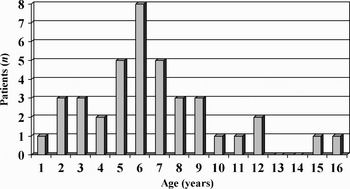
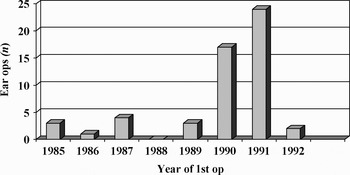
A total of 49 operations were undertaken in 39 children (20 male and 19 female) aged one to 16 years (Figures 1 and 2); long term results were obtained for 35 of these children. Presenting symptoms included fluctuating deafness, sudden hearing loss, progressive hearing loss and vertigo, consistent with other studies.
Patients' age distribution at first operation.

Number of initial ear operations (ops) carried out per year, to 1992.

A review of patients' case notes for other potential causes of hearing loss identified the following risk factors. Five children had evidence of cytomegalovirus, mumps or toxoplasmosis infection. Five children had a family history of hearing loss. Three children had a history of meningitis. One child each had a diagnosis of hydrops, Pendred's syndrome or chondrodysplasia.
A review of patients' computed tomography scan reports showed the following diagnoses: reported as normal (n = 21); osteoneogenesis post-meningitis (one); Mondini defect (nine); large vestibular aqueduct (two).
A review of patients' operative findings to establish the presence and site of fistula showed the following results: oval window (n = 36); round window (two); oval and round window (two); no fistula found (nine); abnormal stapes (12).
A variety of packing materials was used to pack the oval and round windows, including connective tissue, fat and perichondrium.
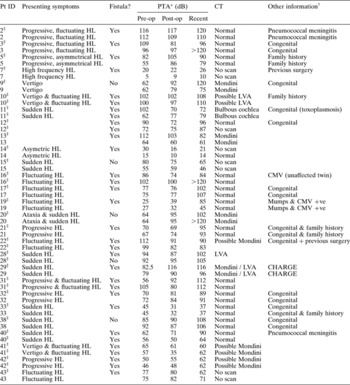
Full details of the presenting symptoms, presence or absence of fistula, and other findings for the 35 children with long-term follow up are given in Table I.
Patient details

* Average of 500, 1000, 2000 and 4000 Hz results. †Other potential risk factors for hearing loss. ‡Operated ear. Pt ID = patient identification number; PTA = pure tone audiometry; CT = computed tomography; pre-op = pre-operative; post-op = 6 months post-operative; HL = hearing loss; LVA = large vestibular aquaduct; CMV = cytomegalovirus; +ve = positive
Audiological data
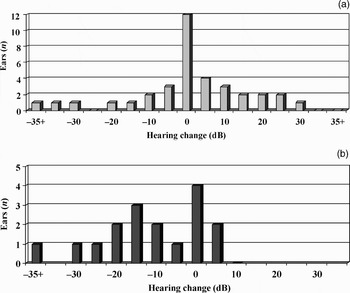
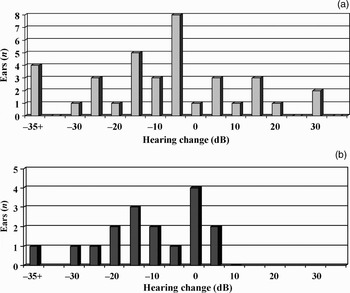
Figures 3 and 4 show graphical representations of hearing change data for both the operated and non-operated ears. Analysis of audiological data (mean of 500, 1000, 2000 and 4000 Hz results) using the Wilcoxon signed rank test showed no statistically significant progression of hearing loss (compared with pre-operative levels) in either the operated or non-operated ears in the short term. In the longer term however, the Wilcoxon signed rank test showed significant progression of hearing loss in both the operated and non-operated ears (operated ear, p < 0.017; non-operated ear, p < 0.009). However, it should also be noted that if a 10 dB hearing change is taken as the cut-off level for test–retest variation, then seven of 44 ears in the operated group showed an improvement of 10 dB or more in the longer term, compared with zero of 17 in the non-operated group.
Patients' short-term hearing outcomes. Change in hearing (as average of 500, 1000, 2000 and 4000 Hz results) in the (a) operated and (b) non-operated ears, compared with pre-operative average hearing levels. Worsening hearing is indicated by negative values. For operated ears: mean hearing change = 0.39 dB; standard deviation (SD) = 16.4 dB; 95% confidence intervals (CI) = −5.0 to 5.8. For non-operated ears: mean hearing change = −6.0 dB; SD = 12.0 dB; 95% CI = −0.2 to −11.8.

Patients' long-term hearing outcomes. Change in hearing (as average of 500, 1000, 2000 and 4000 Hz results) in the (a) operated and (b) non-operated ears, compared with pre-operative average hearing levels. Worsening hearing is indicated by negative values. For operated ears: mean hearing change = −9.7 dB; standard deviation (SD) = 22.0 dB; 95% confidence intervals (CI) = −2.6 to −17.0. For non-operated ears: mean hearing change = −13 dB; SD = 17.1 dB; 95%CI = −4.7 to −21.4.

Ten per cent of the children in this study subsequently progressed to cochlear implantation.
Discussion
Perilymph fistula is easily defined as an abnormal connection between the perilymph space of the inner ear and the middle ear. However, the diagnosis and treatment of such cases remains much more controversial. No consistent collection of symptoms and signs are described, with any combination of hearing loss, tinnitus and vestibular symptoms being possible.Reference Seltzer and McCabe1 Although beta-2 transferrin has been used to support the diagnosis,Reference Weber, Kelly, Bluestone and Bassiouny2 the specificity of the test is unclear and it does not enable pre-operative diagnosis.Reference Weber, Bluestone and Perez3 Careful history-taking and exclusion of other causes have been used to support surgical exploration, with packing of the round and/or oval windows if a fistula is seenReference Hughes, Sismanis and House4 or, in some cases, if no evidence of a fistula is found at surgery.Reference Weber, Bluestone and Perez3 The outcomes from these studies are variable, with stable or improved hearing in 23 to 87 per cent of patients.Reference Weber, Bluestone and Perez3, Reference Black, Lilly, Nashner, Peterka and Pesznecker5, Reference Black, Pesznecker, Norton, Fowler, Lilly and Shupert6
Our study represents a retrospective analysis of a case series with meticulous data collection. Most of the data are comparable to other studies in this area, in terms of patient age, variety of presenting symptoms and positive findings at surgery.
• Several authors have suggested that surgery for suspected perilymph fistula is effective in preventing deterioration of hearing and in improving hearing in some cases in the short term
• This paper reports long-term hearing outcome data from 35 children undergoing exploration for presumed perilymph fistula at The Children's Hospital, Sydney, Australia, between 1985 and 1992
• Short-term results showed no significant change in hearing at six months; however, a subsequent significant progression of hearing loss was observed in both the operated and non-operated ears
External advice was sought from a medical statistician regarding formal analysis and presentation of data. Our results suggest that exploration and repair of suspected perilymph fistula does not adversely affect the short-term hearing results, and may appear to offer protection against further loss. However, our longer-term results show that this hearing stabilisation was not maintained. Both operated and non-operated ears showed a statistically significant progression of hearing loss in the longer term, as judged by the Wilcoxon signed rank test. However, seven of the 44 ears in the operated group showed a hearing improvement of 10 dB or more in the longer term, compared with zero of 17 in the non-operated group. We were unable to find any correlations with symptoms, investigations, or radiological or surgical findings in the sub-group showing improvement, which might identify those patients who would benefit from exploratory surgery.
The presence of a perilymph fistula is difficult to confirm and is undoubtedly a subjective diagnosis in the operative setting. Our group of patients was investigated at a time when exploratory surgery and treatment for suspected perilymph fistula was accepted practice for a variety of symptoms. It is unlikely that all of these patients would undergo such surgery today, and we accept that a number of different aetiologies may have been responsible for these children's symptoms. However, the short-term results are in keeping with other published series which have suggested that exploration and surgical repair may prevent further deterioration in hearing. Our results suggest that this preservation may not be maintained in the longer term.