1. Introducing The Field
In recent years, research and practice in sound design applied to daily environments has experienced a substantial evolution. In an area traditionally dominated by physical acoustics and musical theories, a wide range of new concepts and methods have emerged, allowing accurate, site-specific interventions beyond the limited noise-reduction strategies (insulation, absorption, noise cancelling, energy masking, etc.) or ‘conductist’ approaches to commercial spaces by profit-oriented initiatives such as Muzak. The mono-disciplinary approach to sound issues is no longer advocated, since traditional methods only proved to be partial answers to more complex questions.
From the sound studies and ambience research fields, different tools and methods have been explored and provided for dealing with everyday complex public or private shared environments. The work of Barry Truax on a communication model of sound (Reference Truax2001) and Jean-François Augoyard and Laboratoire CRESSON on a transversal approach to the concept of sonic effect (2006) represent two relevant efforts against the restricting disciplinary boundaries. The concepts and tools developed at CRESSON since the 1990s soon found an application in different research case studies (Hellström Reference Hellström2003) and practice-based interventions (Hellström Reference Hellström2005). Getting a space as silent as possible is far from being enough: every sonic diagnosis and treatment needs to be reconnected with the complexity of a whole physical, social and sensorial environment, as shown by CRESSON and their ambience theories (Thibaud Reference Thibaud2010). This implies the need for breaking a second restriction (the first was the mono-disciplinary approach to sound): an exclusively ‘sonic’ evaluation of sound issues; relevant answers will require not only an interdisciplinary but also an inter-sensorial approach to place where sound is no longer detached from the whole situated experience. Sound research and practice is thus in demand today by interdisciplinary teams of professionals coming from sonic and spatial disciplines (architecture, urban planning) as well as engineering (computer science in particular) or human and social sciences.
In practical terms, this traditionally narrow field is growing exponentially today due to several factors, one of the main being the new paradigm of urban sustainability: density, as opposed to the previous ‘diffuse city’ (Secchi Reference Secchi2005), necessarily involving some controlled implosion of the city, with building processes taking place on the left-overs, in the noisier areas bordering communication networks, such as highways, railways and airports, and in industrial areas. Again, insulation and absorption have been the main responses till now for this dense city, but these are limited solutions.
In line with these new theories and paradigms, new methodologies have been explored and developed, incorporating tools from fields such as psychoacoustics, with the introduction of the concept of information or attention masking (see as an example and case study Nilsson et al. Reference Nilsson, Alvarsson, Rådsten-Ekman and Bolin2010), and ambience theory (Thibaud Reference Thibaud2010) including new methods and concepts such as interdisciplinary sonic effects (Augoyard and Torgue Reference Augoyard and Torgue2006). In parallel with this extended conceptual and methodological context, relevant new tools have also emerged such as the auralisation technique (sonic virtual spaces), just to mention one of today’s main laboratory techniques.
Focusing now on the new practical responses for dealing with complex environments, one of the main possibilities explored today is the insertion of subtle sound textures added to a local ambience, able in theory to transform the perception and experience of place, in a conscious or unconscious way. This process of surgical development and insertion of place-specific designed ambiences is the practical method explored and evaluated in this article, and the physical contexts intervened in here are the recent modalities of shared office space: flex and activity-based offices, presenting a dense sensorial environment often in conflict with the concentrated tasks to be accomplished in such spaces.
1.1. Ambience of work
Regarding specific sound research on working environments or related conditions, several aspects have been marked as relevant. Research has proved for example that sound perception is emotionally conditioned: a general positive attitude towards the work environment results in greater tolerance for the acoustic environment (Västfjäll Reference Västfjäll2002); sounds derived from things we like are considered less disturbing (Västfjäll Reference Västfjäll2002); sounds that we understand the meaning of and which we find useful disturb us less (Kjellberg et al. Reference Kjellberg, Landström, Tesarz, Söderberg and Åkerlund1996). In addition, it has also been proved that constant noise disturbs us less than occasional, sudden noises (Kjellberg et al. Reference Kjellberg, Landström, Tesarz, Söderberg and Åkerlund1996; Nassiri et al. Reference Nassiri, Monazam, Dehaghi, Abadi, Zakerian and Azam2013). Of course the type of work to be performed will also affect our sensitivity.
The focus of previous research in the field has primarily been on noise reduction and understanding the effect of such noise on working conditions while very little has been done in terms of how to actively improve such complex environments. One of the first and few examples corresponds to the exploration from the 1970s of the masking potential of white noise employed at low levels; no conclusive results could be found in terms of masking capabilities while generating a problematic background in communication and collaboration terms among co-workers. According to Franinovic and Visell (Reference Franinovic and Visell2008) there is a need for more knowledge about how to integrate creative practices with contextual influences (users, environments, or activities) that are seen as key elements of situated design practices.
In this study we explore the possibility of improving the sound environment through inserting context-sensitive, adaptive sonic textures in an activity-based office environment. Our aim is to prove that active (as opposed to passive, traditional acoustic methods, i.e., noise reduction, absorption and insulation) and ‘positive’ interventions (those analysing such environments not just in problematic terms) are required for a significant improvement of such complex contexts.
2. Everyday listening
As a first theoretical frame, we initiated our research process and design concept in Pierre Schaeffer’s musique concrète theory (Schaeffer Reference Schaeffer1966), in which sound perception is categorised into four different ‘Listening Modes’: hearing, listening, comprehending and understanding. Hearing is the most elementary perceptual level where we passively take in sounds that we do not try to listen to or understand. Listening involves the collection of information, where we direct our aural attention to someone or something in order to identify the event. Comprehending, however, involves processing and selection of sounds, to choose what interests us, to qualify and react to the inherent properties of the sound. Understanding involves semantics where the sound is interpreted as a sign or code that represents something meaningful to us.
The concept of ‘everyday listening’ is described by Gaver (Reference Gaver1993), where each person hears the environing sounds as surrounding events in a larger context and not as sounds to pay attention to per se. Another similar idea is suggested by Amphoux (Reference Amphoux1993) when describing our common sonic attention mode as ‘floating listening’ (écoute flottante in French), that is, perceiving without focusing our attention, keeping some kind of potential listening and finally reacting when unexpected, uncommon events emerge. Truax in Acoustic Communication (Reference Truax2001) also refers to the same notion as ‘listening-in-readiness’ to describe a monitoring state ready to react to significant sounds. In everyday listening mode or floating attention, we are aware on a more subconscious level of the origin of a sound. Where sounds get a function and can be related (e.g. to an activity), everyday listening is then more of a response to hearing. We often unconsciously shift between these different listening modes.
2.1. Sound users
Another relevant concept connected to the question of listening modes has been suggested by the music research field: music users (Reybrouck Reference Reybrouck2012; Krueger Reference Krueger2014). They argue that listeners or performers only include some of the many potential ways of dealing with music. ‘Users’ is a more general and broad category that better captures the different means in which music can be utilised. A common use of music is, for example, as an atmosphere-enriching sonic additive. Music can affect individual and social actions: alter our mood and sharpen our attentional focus (Sridharan et al. Reference Sridharan, Levitin, Chafe, Berger and Menon2007). Music can also get us into different conditions of action-readiness required for various activities. The concept of user signals that music is used as a tool to support different activities.
We propose here to enlarge this concept to one of sound users, as a way to embrace all sonic expressions and not just music. Having shown the limitations of music regarding the palliative treatment of problematic (sonic) environments, this research project will avoid a musical restrictive approach in favour of a large sonic perspective. And in this sonic expanded field, the notion of sonic user is even more pertinent as corresponding to everyday urban usage as opposed to the displaced notion of listener.
3. THE SOUND BUBBLE
One of the main design concepts handled in this project is the creation of a sound bubble, a space able to provide the appropriate ambient conditions for supporting specific activities or tasks by removing our attention from a disturbing sonic environment. We do not intend to isolate the user by physically masking the environing sounds but by redirecting or, better, abstracting the user’s attention from the environing context. In this sense we could employ here the notion of informational (Nilsson et al. Reference Nilsson, Alvarsson, Rådsten-Ekman and Bolin2010) or attentional masking (Atienza and Billström Reference Atienza and Billström2012), understanding by that a masking action, the purpose of which is not to attract but to distract from the environment towards a focused working mode. This sound bubble aims to be context-sensitive in the sense that the inserted sounds are adapted in real time to the surrounding sonic environment, further described below.
3.1. Masking the environment
Masking is, according to Augoyard (Augoyard and Torgue Reference Augoyard and Torgue2006), an effect that refers to the occurrence of a sound that partially or completely hides another sound due to its intensity and the distribution of its frequencies. This effect can be judged as either favourable or parasitic, depending on whether the masked sound is perceived as pleasant or not (i.e. parasitic). Augoyard points out the opposite values a favourable or parasitic masking may induce; the same type of sound will depend on the context to produce different or even opposed subjective perceptions.
This has implications regarding how to approach the concept of masking as applied to acoustic design since the inserted sounds should not be restricted to a purely functional nature, in this particular case the treatment of speech and noise in an office landscape. Masking should also be context sensitive, thus creating a pleasant sound environment while avoiding intrusion (dominance) or monotony. Therefore, we are dealing here not just with aural perception, but also with all other elements composing the sonic experience of a place, from its aesthetic properties to the emotional sensations experienced by the user.
Our concept of the sound bubble is based on the creation of a transparent and personal space in the space where user and sound form what Krueger (Reference Krueger2014) considers to be an integrated system for regulating and transforming behaviour and attention.
The notion of an ‘acoustic bubble’ has already been proposed by Bull (Reference Bull2007), occurring when voluntarily embedding oneself in a sound environment within the surrounding one, controlling both the sound material and the degree to which it mixes with the environment by using a medium such as an iPod. However, an essential difference between both concepts (sound and acoustic bubble) must be mentioned, regarding the openness of the relation between user and surrounding environment. Our early studies (Eriksson and Pareto Reference Eriksson and Pareto2015) showed, for example, that using headphones signalled ‘unavailable to talk to’ and generated a social barrier towards others.
3.2. Designing a micro-milieu
The sound bubble concept was designed to help users attain and stay in hearing mode or everyday listening mode in order to help them focus better on their job tasks. To achieve that, undesired talk needed to be camouflaged through partial masking and thus creating what Augoyard (Augoyard and Torgue Reference Augoyard and Torgue2006) describes as a ‘sonic micro-milieu’ that takes precedence over a distant or secondary perceptive field. The resulting dominant effect is that of perceptually placing the inserted environment in front of the background sound.
Different techniques were tested and evaluated to create a suitable micro-milieu. This demanded a subtle work on the existing environment such as space and time manipulation of the existing sounds and insertion of other sonic contexts and materials; the goal was to generate a micro-milieu not invoking any specific sonic attention, but providing a somehow ‘natural’ environment for such context and tasks to be accomplished. The sound components should be abstract enough (e.g. non-musical) so that most people do not recognise them as being familiar or analyse them in terms of musical taste, for example.
3.3. Playing with the attention
Smith, Stephan and Parker (Reference Smith, Stephan and Parker2004) investigated the ease of learning different sound types and found that abstract sounds were learned and retained with far greater difficulty than both speech and representational sounds. A dual and contradictory condition thus defines the nature of the sound insertions we are in search of: on the one hand, they should be ‘obvious’ enough not to attract prolonged attention in such contexts, and, on the other, they should not be recognisable as that may also lead to focused attention. This is an interesting paradox we have tried to resolve in this research.
The sounds were designed to blend into the environment and to be perceived as a continuous stream of similar sounds, able to trigger the hearing mode and ultimately everyday listening only. Users are thus embedded by a proximity sound environment requiring less sonic attention. The concept was designed with the intention to interweave the local sound environment with the added one and thus generate an embedding but still semi-transparent bubble. This makes it possible for the user to select in which space they should direct their attention – within the sound bubble or outside the bubble in the surrounding sound environment.
3.4. Conceiving the added sounds
The different sound environments developed were based on the results of previous research conducted by one of the authors regarding the sound design of high-speed trains (Atienza and Billström Reference Atienza and Billström2012; Billström and Atienza Reference Billström and Atienza2012). These studies focused on different spaces and situations but the questions and methods employed in that case were similar, also exploring the potential improvement of complex environments through the insertion of specifically designed sound environments. In that research project, concepts such as cycle and repetition proved to be the most pleasant ones compared to designs based on the notions of variation or improvisation. In particular, the idea of cycle was connected in that case with rhythms of the human body (e.g. breathing) as well as sea rhythms.
To create the sounds used in the sound bubble we sampled the sound environments already present in the offices in question and subtly altered them, working on this original material or inserting new sound textures (e.g. filtered noise), or even inducing a slow movement into these added sounds, moulding them to the particular needs of the space and activities in question. The two main purposes of this added layer were first to have attention-masking effects on surrounding talk and background noise (as opposed to traditional energy masking, e.g., water sounds of a fountain for treating the sounds of traffic), and second to be congruent with activities in an office landscape.
The sounds were modified, for example, by changing the frequency range, applying different perceptual effects (such as inserting delay lines), creating certain rhythms, or masking the speech by adding sounds able to absorb or flatten major variations in the original sound image. The sound-generation techniques employed here do not essentially differ from some of the traditional tools and processes characterising electroacoustic as well as soundscape composition techniques.
Our expectation is that such sound environments would only be perceived in hearing mode, which means they needed to establish some kind of new background atmosphere while not attracting too much attention. This could be achieved by composing as ‘legato’ as possible, thereby avoiding sudden changes leading to focused attention. Schlittmeier and Hellbrück (Reference Schlittmeier and Hellbrück2009) show that legato (i.e. a continuous sonic stream characterised by few dynamic and spectral variations) affects cognitive ability less than music with distinct temporal and spectral variations.
3.5. Designing the added sounds
Two main different working situations or modes were examined: a focused work situation and a more open and creative one. For each one of these cases, two sounds were generated. A last sound environment was our ‘placebo’, a neutral control case: a recording of the background noise of an empty office, presenting a static ambient background related to the room rather than to the activities potentially hosted in it.
In order to evaluate the users’ experience of the sound bubble in various working situations, five different sound environments were developed in total. The first two sounds, A and B, aimed at supporting focused work through the exploration of static sequences in terms of emerging sound events, dynamic progressions and timbre variations. The sounds were designed to be perceived as spatially confining, soothing and favouring introspection. They were deliberately composed to be perceived as monotonous in order to stay cognitively in the background and induce hearing mode. Conversely, sounds C and D intended to promote creative work through more dynamic (even if still modest) characteristics; in order to reach that, these sequences were given a subtle discursive line, slowly evolving in register and timbre. These sounds were created with the intention of simulating a larger space, with sound textures that arose from random locations in the sound image and the emergence of unexpected elements to slightly stimulate a creative state of mind.
Sound A (Sound example 1) was intended to simulate the sound of sea waves and wind. It was generated by dynamically filtering pink noise. The filter enabled a softer and more appealing pink noise. In order to achieve a corporeal rhythm, this pink noise was faded in and out imitating a slow breathing tempo. The modulation was panned, with a slow movement between the speakers to give the impression of wave cycles. Natural sounds and/or filtered noise are commonly used for masking unwanted sounds; we wanted to test how they were really perceived and evaluate their pertinence when compared to other sounds.
Sound B (Sound example 2) was based on the material and concept of sound A, but given a tone-based quality instead of the noise character of sound A. For that, a resonator and a delay have been added. The resonator was used to affect the timbre and create spectral pitch centres within the pink noise, transforming its perception into a tonal musical mode. The sound was split into two layers, the second layer pitched an octave above the first and delayed to maintain the sensation of a wave motion.
Sound C (Sound example 3) was designed with the aim of generating a non-referential structure able to induce a suspended, everyday listening mode in the participant. For that, a cyclical structure was generated presenting no distinct reference points for the listener. It was structured around an iterative fifth interval, producing ever-changing tonal relations; different chains of ascending fifths follow each other, starting in non-related tones (not belonging to the same traditional scale in Hz). Randomised reverberation alters the duration of sounds, creating a sensation of motion inside a changing spatial space.
Sound D (Sound example 4) suggests a corporeal movement through coloured sound textures rhythmically combined and displayed. Its spectral envelope slowly expands within a cyclical structure. Created by applying different sound effects (equalisers, reverb, delays and resonators) that transform the recording of a walk between a pebble and a sandy beach, the purpose was here to obtain a static sound texture where walking is still present as a physical background.
Sound E is a recording of an empty office, our ‘placebo’. The recording was equalised and amplified for it to be clearly noticeable as a distinct sound material within the local surrounding environment. We insert here a space within a space, both of similar character, exploring the masking potential of such a confrontation.
The five sound environments have a length of 15 minutes each and are seamlessly looped when played. They have been evaluated with the help of a field experiment where office workers could test a prototype while realising ordinary tasks in their office space.
3.6. Prototype design
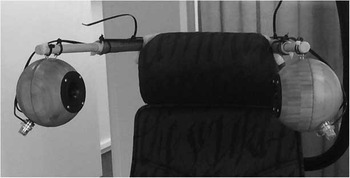
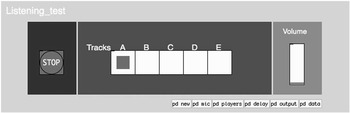
The prototype (Figure 1) was a remodelled office chair on which speakers were attached at the headrest on two rods directed forward; this makes it possible to move the speakers horizontally and somewhat modify the listening position. When the speakers were close to the head, the resulting effect is best described as the sensation of an encapsulating sound bubble. A laptop connected to the speakers controlling all audio events and parameters logged selected file and playback duration. An interface with the purpose of allowing user evaluation and comparison of the five environments was developed in the graphic programming environment PureData (Figure 2). The users were confronted with a very simple window reduced to five boxes labelled A–E where it was possible to select the different sound environments (random distribution different for every user) and to adjust their amplitude level. Since the purpose was to investigate how added sound in an office landscape is perceived, we chose not to enable the users to mute the sound completely.
The prototype: detailed view of the speakers.

Interface

A microphone connected to the prototype registered amplitude changes of the surrounding environment, which affected how sounds were processed in the laptop. We made the assumption that amplitude increase (measured via the microphone) would be originated by local activities (e.g. people moving in the immediate environment or conversations). Such amplitude variations automatically affected the tempo and panning of the playback in the sound bubble. Registered amplitude increase led thus to a narrower stereophonic sonic space; the sound bubble was then perceived as more compact and encapsulating. In parallel to that variation, amplitude increase also generated a temporal acceleration in terms of playback speed. Such processes take place automatically (via PureData) without the tester of the prototype having any influence on them in order not to distract their attention.
The prototype was tested in an activity-based office at the IT department in a large manufacturing industry in West Sweden.
4. EVALUATION METHODS
The sound bubble was developed and user tested using an iterative, multidisciplinary design-based approach (for a more detailed description of the approach, see Eriksson, Pareto and Atienza Reference Eriksson, Pareto and Atienza2016). In the first phase the sound concept was evaluated in a laboratory setting by experts, in the second phase end-users evaluated the concept in a real office environment.
4.1. Laboratory test
A first trial run was carried out in a laboratory environment to explore the possibility of enhancing the room ambience by actively adding sound, thereby creating a barely noticeable sound environment influencing the user. The test simulated an office environment situation through playback of audiovisual stimuli. Test subjects worked with self-selected tasks for the purpose of reducing active listening.
4.2. Field experiment
Participants in the field experiment used the sound bubble prototype whilst working. They were asked to answer a questionnaire after the session including background questions about gender, age and perceived hearing sensitivity, work-related questions and overall questions about the sounds and their experience of using the prototype. The system logged which sonic environments the participants played, how long they were played as well as what amplitude level the user chose.
Our evaluation method was grounded on a model by Axelsson, Nilsson and Berglund (Reference Axelsson, Nilsson and Berglund2010), based on several previous projects realised since the 1980s in search of pertinent criteria for the assessment of an environment. The participants had to evaluate their preferred added sound environment in terms of four dual criteria, presented as eight separate items (pleasant/unpleasant, eventful/uneventful, peaceful/chaotic, exciting/monotonous). Therefore, the results presented here represent each participant’s preferred sound by displaying the qualities characterising it.
All sessions were observed and documented. The participants had the opportunity to read through the resulting annotations to comment and clarify any misunderstandings. The observer took notes on visual and auditory events and how the test subjects seemed to react to the events. Two test participants were recruited to use the prototype for an entire working day, and these test sessions were followed up with supplementary semi-structured interviews.
5. RESULTS
The first general and positive result comes from a direct question enquiry: did the sound bubble change the participant’s sound environment for the better, same or worse? The result was that 74.4% answered positively, 16.3% felt no difference and 9.3% responded worse.
One test subject that described the preferred sound as restful stated:
I now felt less disturbed by noise from the office.
5.1. Which sound bubbles are preferred?
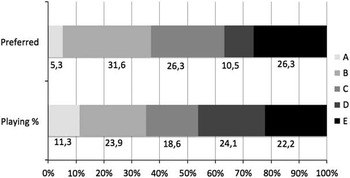
Regarding the preference of the sounds (Figure 3), the most popular sound B was preferred by 31.6% of the participants compared to 26.3% who preferred the sound C and just as many who preferred the ‘placebo’ sound E. At a significant distance, 10.5% preferred D. The least popular sound was A (dynamically filtered pink noise), which was preferred by only 5.3% of the participants.
Preferred sounds and playing time percentage.

This last result questions two of the most common resources in the field: the use of background noise and natural saturated sounds (sea, wind) for their broadband masking properties. As expected, the forms of perceptual masking closer to their most drastic expression (energy masking) are not an appropriate response, even if evoking natural sounds. This resonates with the poor results in terms of inhabitants’ appreciation obtained in the insertion of natural water sounds (e.g. fountains) for the treatment of traffic noise. In the case of working environments this may even be reinforced negatively, as very dense spectral sound sequences (closer to noise, the sound A) may increase fatigue and reduce concentration. Sound B, on the other hand, was preferred despite being generated as similar to the last-place A and presenting the same general envelope. As soon as the texture reduces its density in spectral terms, its positive appreciation increases drastically as the result for sound B suggests.
These findings are in accordance with the research of (Schlittmeier and Hellbrück Reference Schlittmeier and Hellbrück2009), where participant ratings spoke in favour of legato music instead of continuous noise as an added acoustic background. They propose that inserted sonic environments must be specially designed with respect to both objective performance effects and subjective ratings.
The obtained percentages also contain surprises such as the significant success of our intended neutral placebo sound E being the second most popular sound. This points at the potential of extremely reduced interventions in terms of the nature and amount of the added sound material. A window is open here towards real-time intervention modes only employing subtly altered in-situ sounds.
The participants were asked in an open question how they chose the sounds. Over half (52.2%) answered that they picked the one most pleasant for them, 17.5% felt that the sound they chose was least disturbing, 12.5% answered that the sound helped them to concentrate, 10% stated that the sound blocked out surrounding sounds and finally 7.5% indicated that they didn’t know the reason for their choice.
5.2. Users description of the sound bubble experience
Beyond these first quantitative results, we intended to deepen them with a qualitative evaluation on the users’ impressions of the sound bubble as well as on the experience of each selected sound environment. As described above, the participants had to evaluate their preferred sound environment by rating how much the sound was characterised by the four dual criteria (pleasantness, eventfulness, peacefulness and excitement) on a numeric scale. A free space on the survey form also invited participants to express openly their reaction to the experience, material that will be particularly useful in our analyses when confronted with more quantitative or qualitative but framed results.
Of these four criteria, two of them present a clearly defined dominance, pleasantness and peacefulness. For these, participants clearly stated a preference for their positive dimension (pleasant and peaceful or calm).
The sound I chose was pleasant and I could ignore the [sonic] details, it did not change too much. The sound was very constant. […], it was in the background all the time. It was easier not to focus on it. The wind sound (A) was a bit too significant, I was thinking too much about the sound and too little about the job.
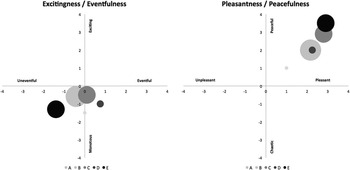
Qualities (pleasant and peaceful) seemed to be globally reinforced for the preferred sounds and in particular for sound 5, the ‘placebo’ (in black on the figures). A high correlation can be observed in fact between pleasantness and peacefulness (see Figure 4, second graph).
A sonic wallpaper that gave a faint pleasant sound – Silence in a wave noise. The sound felt both calm and gave focus.
Two graphs showing the results of the evaluation of preferred sounds by the participants. The graphs analyse correlation between excitement and eventfulness (first graph) and pleasantness with peacefulness (second graph), with a high correlation degree for this second case. The physical dimension of the spheres corresponds to the number of people having chosen each sound (preference).

For the criterion excitement, this preference is less apparent while always presenting a tendency in favour of monotonous sound environments (versus exciting ones). Finally, regarding the criterion eventfulness, it is even more difficult to describe a clear tendency towards one of the poles; two of the three preferred sounds (E and B) seem to present a narrow tendency towards the uneventful, while C and D are on an average value.
5.3. A well-defined sound character
In general, all criteria are characterised by a low degree of deviation of the results for the different sounds (Figure 5), even narrower when just considering the preferred ones (B, C and E). This low degree of deviation indicates that the preferred sounds present, for the participants, a quite well-defined character (limited variation in range) regarding the criteria evaluated.
In summary, this chosen character corresponds in general to pleasant and peaceful sounds, with a less marked tendency towards monotony, and a medium degree of eventfulness (neither eventful nor uneventful).
The sound I listened to most was relaxing, one might say that it brought me back [to focus mode] when my thoughts drifted away. It was just kind of present all the time. Some were disturbing because I thought that they maybe had too fast a tempo or if there was too much happening.
The majority of the participants considered the sound environment in the bubble as positive in comparison to the usual acoustic environment. The reasons given by the participants were that the sound bubble provided aesthetic qualities to the sound environment and supported focused attention by masking unwanted sounds while still letting the users pick up information from the environment.
I prefer the sounds that sounded more musical. I usually listen to music while I work. It was pleasant with other sounds than people’s talk.
We can conclude that a more active acoustic approach shows potential and clear advantages for generating context-sensitive sound environments that better satisfy individual auditory needs in today’s office environments.
6. DISCUSSION AND FUTURE WORK
6.1. Review of the results
The sound bubble concept clearly presented advantages over the usual acoustic environment in activity-based offices. The majority of the participants considered that the sound bubble improved the auditory conditions facilitating focus and concentration. Whether the sound bubble could enhance more open, creative work tasks was not revealed by this study due to limitations in the test situation. Also, how the differences operate among the five sounds still remains unclear and in need of further investigation. We improved our knowledge in terms of preferred experiential qualities, but it is too early to link such information to precise sonic attributes in practice-based design terms.
One hypothesis that could explain the variation of preference is based on different subjective/individual interpretations of the sound material inserted; this would somehow point to the problem of sonic/musical taste conditioned by diverse cultural and education backgrounds. In this research project, careful attention was employed to avoid as far as possible such musical prejudgements by exploring a sonic material as non-musical and abstract as possible, but it is not possible to fully discard such tastes operating at different levels other than just as a direct matter of musical language.
As described in some of the open reflections of the participants, those who felt that the sound environment became better were aided by the prototype to end up in hearing mode or everyday listening mode. In such cases the sound bubble succeeded in establishing a sonic micro-milieu and masking, in attention terms, other disturbing background sounds. Future research could explore if those who felt that they focused better did in fact become more productive.
Regarding preferred sounds, the three most popular sequences included one designed for concentration (B), one for open creative activities (C), and the ‘placebo’ (E). Hence, we could not connect the sound characteristics with a particular type of activity, at least not yet. Our findings show that the most popular sounds’ predominant characteristics were pleasant and peaceful, with a less marked tendency towards monotony and a medium degree of eventfulness, revealing the importance of both aesthetic and functional values.
6.2. Future explorations
One of the critical aspects of our design challenge was the homogeneous temporal behaviour of the sequences. We mainly explored here the small time-scale events generating the continuous textures evaluated, but very little was still done in terms of larger scales at the origin of musical ‘sentences’ and discourse. A male participant who was critical of his experience stated that the sounds became disturbing/distracting after some time:
The sound was too monotonous. After a while it became annoying.
This point needs to be carefully treated in the future for the success of long listening sessions, as it is the case in our office work context.
Another main concern will guide the next phases: enhancing the adaptive nature of the inserted sound environments, developing their capacity and ability to first listen and analyse, that is, learn from their surroundings in order to provide a more accurate sonic response to the questions posed by each context. This dialogue should take place without demanding any particular attention from the end-user, as processes that naturally (while subtly) modify the inserted sound textures according to the evolving conditions of an environment.
Further developments should also provide means for the sound bubble to adjust not only to environmental conditions, but also to personal biometric data such as pulse or stress.
It is still not possible to deny the presence of external compositional minds in the development of such inserted environments; however, the final aim of this research project is to evolve this role of a designer/composer more into one of a sound programmer able to model the patterns of a basic intelligent dialogue with a given context.
Supplementary Material
To view supplementary material for this article, please visit https://doi.org/10.1017/S1355771816000418