Introduction
Spermatogonial stem cells (SSCs) originate from primordial germ cells (PGCs) in mammals (before birth) and teleostean fish (generally after hatching). SSCs reside within the seminiferous tubules of testis. SSCs undergo the tightly regulated and complex processes of spermatogenesis, involving their self-renewal to maintain their own pool and differentiation to form mature spermatids. Unlike in mammals, spermatogenesis in fish takes place in a cyst within seminiferous tubules (Schulz et al., Reference Schulz, Menting, Bogerd, Franca, Vilela and Godinho2005; Panda et al., Reference Panda, Barman and Mohapatra2011). The cysts are formed when a Sertoli cell(s) encapsulates a single primary spermatogonium that subsequently divides synchronously to constitute an isogenic germ cell clone. The numbers of differentiated spermatogonia are also much higher in teleosts as compared with their mammalian counterpart (Vilela et al., Reference Vilela, Silva, Peixoto, Godinho and Franca2003; Schulz et al., Reference Schulz, Menting, Bogerd, Franca, Vilela and Godinho2005).
SSCs are indeed unique adult stem cells – capable of transmitting genetic information in a Mendelian fashion. Hence, in vitro propagation could provide the opportunistic platform for targeted genetic modifications, having implications in basic as well as applied biology research. The establishment of pure or significantly enriched populations of male germ line stem cells is an important aspect for in vitro propagation to undertake biological experimentation and male germ-cell manipulations. A major problem associated with in vitro propagation has been the lack of sufficient knowledge regarding their candidate phenotypic and genotypic features. A developmental stage-specific understanding of those signatures, linked with either self-renewal or differentiation, is essential for efficient purification and accurate characterization during in vitro propagation. Ample evidence on isolation, culture and maintenance of rat (Rattus norvegicus), sheep (Ovis aries), mouse (Mus musculus), human (Homo sapiens), buffalo (Bubalus bubalis), goat (Capra hircus) and chicken (variety: Hy Line-36) (Gallus gallus) SSCs in vitro is available (Buom-yong et al., Reference Buom-yong, Orwig, Hiroshi, Avarbock and Brinster2004; Rodriguez-Sosa et al., Reference Rodriguez-Sosa, Dobson and Hahnel2006; Dym et al., Reference Dym, Kokkinaki and He2009; He et al., Reference He, Kokkinaki, Jiang, Dobrinski and Dym2010; Hua et al., Reference Hua, Zhu, Pan, Liu, Sun, Ma, Dong, Liu and Li2011; Liu et al., Reference Liu, Tang, Xiong and Tang2011; Kala et al., Reference Kala, Kaushik, Singh, Kadam, Singh, Manik, Singla, Palta and Chauhan2012; Vlajkovi'c et al., Reference Vlajkovi'c, Cukuranovi'c, Bjelakovi'c and Stefanovi'c2012; Baazm et al., Reference Baazm, Abolhassani, Abbasi, Habibi Roudkenar, Amidi and Beyer2013; Wu et al., Reference Wu, Song, Zhu, Niu, Mua, Lei, Yang, Peng, Li, Li and Hua2013; Momeni-Moghaddam et al., Reference Momeni-Moghaddam, Matin, Boozarpour, Sisakhtnezhad, Mehrjerdi, Farshchian, Dastpak and Bahrami2014).
There is a very little information about spermatogonial self-renewal and differentiation in fish testis. Male germ cell markers such as Pou2 (Pit-Oct-Unc-2, an orthologue of mammalian Pou5f1, expressed in proliferating SSCs), Plzf (promyelocytic leukemia zinc finger as an undifferentiated marker) and c-Kit (the transmembrane tyrosine kinase receptor for stem cell factor, a candidate differentiation gene) have been documented in rohu (Labeo rohita), medaka fish (Oryzias latipes) and dogfish (Scyliorhinus canicula) (Hong et al., Reference Hong, Liu, Zhao, Xu, Wang, Liu, Chen, Deng and Gui2004; Loppion et al., Reference Loppion, Crespel, Martinez, Auvray and Sourdaine2008; Mohapatra et al., Reference Mohapatra, Barman, Panda, Kumar, Das, Mohanta, Mohapatra and Jayasankar2010; Sanchez-Sanchez et al., Reference Sanchez-Sanchez, Camp, Garcia-Espana, Leal-Tassias and Mullor2010; Panda et al., Reference Panda, Barman and Mohapatra2011; Mohapatra & Barman, Reference Mohapatra and Barman2014; Mohapatra et al., Reference Mohapatra, Patra, Panda, Mohanta, Saha, Das Mahapatra, Jayasankar and Barman2014; Zhao et al., Reference Zhao, Zhang, Feng, Guo, Chang, Qi, Zhong, Zhou and Wang2015).
Unlike in laboratory animals, evidence regarding a well defined culture system for highly purified SSCs is not available for any fish species. The enrichment of SSCs from total testicular cells by magnetic activated cell sorting (MACS) using Gfrα1 antibody has been demonstrated in mammalian species including human and rodents (Meng et al., Reference Meng, Lindahl, Hyvonen, Parvinen, de Rooij, Hess, Raatikainen-Ahokas, Sainio, Rauvala, Lakso, Pichel, Westphal, Saarma and Sariola2000; Buageaw et al., Reference Buageaw, Sukhwani, Ben-Yehudah, Ehmcke, Rawe, Pholpramool, Orwig and Schlatt2005; Ebata et al., Reference Ebata, Zhang and Nagano2005; Hofmann et al., Reference Hofmann, Braydich-Stolle and Dym2005; Gassei et al., Reference Gassei, Ehmcke and Schlatt2009; Kossack et al., Reference Kossack, Meneses, Shefi, Nguyen and Chavez2009; Yuan et al., Reference Yuan, Hou and Wu2009; He et al., Reference He, Kokkinaki, Jiang, Dobrinski and Dym2010). It has also been possible to sort spermatogonial cells of rodents, non-human primates and bull by fluorescence activated cell sorting (FACS) and magnetic activated cell sorting (MACS) using Thy1 (CD90) antibody (Kubota et al., Reference Kubota, Avarbock and Brinster2003; Ryu et al., Reference Ryu, Orwig, Kubota, Avarbock and Brinster2004; Hermann et al., Reference Hermann, Sukhwani, Simorangkir, Chu, Plant and Orwig2009; Reding et al., Reference Reding, Stepnoski, Cloninger and Oatley2010). Other markers such as CD9 and a6-integrin have been identified as phenotypic surface markers in the case of rodents (Shinohara et al., Reference Shinohara, Avarbock and Brinster1999; Kanatsu-Shinohara et al., Reference Kanatsu-Shinohara, Toyokuni and Shinohara2004). We have previously devised a modified two-step protocol (Ficoll gradient centrifugation followed by Thy1 antibody-labelled MACS sorting) for enriching SSCs of a commercially important farmed rohu carp, Labeo rohita (Panda et al., Reference Panda, Barman and Mohapatra2011). We demonstrated that Thy1-mediated purification is better than Gfrα1-mediated purification to obtain highly pure rohu SSCs, these could be cultured for longer periods in an undifferentiated state. Subsequently, Thy1-mediated purification of spermatogonial cells has been adopted successfully for other species such as dairy goat (Capra hircus), mammals and mouse (Niu et al., Reference Niu, Goodyear, Rao, Wu, Tobias, Avarbock and Brinster2011; Kaucher et al., Reference Kaucher, Oatley and Oatley2012; Wu et al., Reference Wu, Song, Zhu, Niu, Mua, Lei, Yang, Peng, Li, Li and Hua2013). Recently, isolation and transplantation of spermatogonia of Siberian sturgeon (Acipenser baerii) in newly hatched sterlet Acipenser ruthenus larvae was used successfully to produce germline chimera in sturgeon (Pšenička et al., Reference Pšenička, Saito, Linhartová and Gazo2015).
Induced breeding technology has been successfully demonstrated for both sexes of commercially important freshwater fishes, except that of male catfish (Clarias batrachus), commonly known as magur. While stripping-based milt collection is possible in the majority of commercially important freshwater fishes, male magur is mandatorily required to be sacrificed to collect milt for external fertilization. The sacrifice of highly valued male magur for breeding purposes has been a concern. In vitro production of sperm from the cultured spermatogonial cells under culture condition could be an alternative strategy for producing male gametes to be used in magur breeding programmes. In vitro production of spermatids from cultured spermatogonial in the presence of feeder cells has been documented in bovine, Japanese eel and mouse (Miura et al., Reference Miura, Yamauchi, Takahashi and Nagahama1991; Izadyar et al., Reference Izadyar, Ouden, Creemers, Posthuma, Parvinen and Rooij2003; Kanatsu-Shinohara et al., Reference Kanatsu-Shinohara, Ogonuki, Inoue, Miki, Ogura, Toyokuni and Shinohara2003; Marh et al., Reference Marh, Tres, Yamazaki, Yanagimachi and Kierszenbaum2003). Immortalized mouse germ cells were also capable of generating haploid sperm (Hofmann et al., Reference Hofmann, Hess, Goldberg and Millan1994; Feng et al., Reference Feng, Chen, Dettin, Reijo-Pera, Herr, Goldberg and Dym2002). Medakafish (O. latipes) spermatogonial cell line co-cultured with stromal cells of the embryonic rainbow trout gonad cell line were capable of differentiating into haploid sperm-like cells in culture (Hong et al., Reference Hong, Liu, Zhao, Xu, Wang, Liu, Chen, Deng and Gui2004). Recently, SSCs generated from the hyperplastic testis of zebrafish and sperms were produced in vitro in the presence of Sertoli feeder cells (Kawasaki et al., Reference Kawasaki, Siegfried and Sakai2016). However, it would be of interest to produce fertile sperm in vitro from the enriched spermatogonial cells in the absence of any feeder cells.
In our previous study, a population of enriched and proliferating SSCs of rohu carp (L. rohita) generated/produced fertile sperm (Panda et al., Reference Panda, Barman and Mohapatra2011). This technique provided an unique opportunity to generate fertile male gamete throughout the year, instead of being normally dependent on the breeding (monsoon) season. Keeping these aspects in mind, we intended to explore SSC-mediated sperm production in vitro from the highly valued magur, C. batrachus. We demonstrated efficient enrichment, cultivation and characterization of magur spermatogonial cells, and the successful production of fertile sperm from cultured magur SSCs in the absence of any feeder cells.
Materials and methods
Fish and sample collection
Live adult male and female magur fish (Clarias batrachus) of ~100 g body weight (and about 1 year old) were collected during the month of June from the hatcheries of ICAR – Central Institute of Freshwater Aquaculture, Kausalyaganga, Bhubaneswar, Odisha, India. Different tissue samples such as muscle, kidney, heart, spleen, liver, gill, brain, intestine, testis and ovary were collected aseptically and stored at −80°C until further use.
Gradient separation of magur spermatogonial cells from testicular cells
Primary culture of magur testicular cells and Ficoll gradient separation of spermatogonial cells were performed following an established protocol as described (Panda et al., Reference Panda, Barman and Mohapatra2011). Briefly, two-thirds of aseptically dissected testis [~70 mg; Gonadosomatic Index (GSI) is 0.07] were treated with 0.5% of sodium hypochlorite, chopped and digested with collagenase type II (500 units/ml in 20 mM HEPES, 0.5% BSA, 5% FBS and penicillin/streptomycin antibiotics) for 2 h at 28°C. Dissociated cells were pelleted and the pellet was resuspended in 4 ml of 1× PBS containing 2 mM EDTA, and 0.5% BSA and antibiotics; and layered onto 3 ml of Ficoll-Paque PLUS (GE Healthcare). Gradient separation was performed by centrifugation at 800 g for 30 min at room temperature. Another part of the testis was frozen to extract total RNA as described below.
Purification and culture of pure spermatogonial stem cells by magnetic activated cell sorting
MACS was carried out as described (Panda et al., Reference Panda, Barman and Mohapatra2011). Briefly, the gradient-separated cells (total ~6 × 10⁶ cells/ml, counted under a microscope using a haemocytometer), were resuspended in MACS buffer (1× PBS, 0.5% BSA, 2 mM EDTA and 1× penicillin/streptomycin antibiotics), and were then incubated with mouse anti-Thy1.2 (also known as CD90.2)-conjugated microbeads (Miltenyi Biotech, Germany, order no.: 130–049–101). Thy1 is a glycosyl phosphatidylinositol (GPI)-anchored membrane glycoprotein of the Ig superfamily, involved in adhesion mechanisms and signal transduction and was originally discovered as a thymocyte antigen. Microbeads containing the cell suspension were passed through a MACS column placed in a strong magnetic field separator and the flow through was collected as the depleted fraction. After repeated washing, the Thy1.2-labelled cells (sorted fraction) were collected and maintained in L-15 complete medium containing 10 mM HEPES, 2 mM l-glutamine, 1 mM sodium pyruvate, 1× minimum essential medium (MEM) non-essential amino acid solution, 100 µM 2-mercaptoethanol, 2 nM sodium selenite, 6 mg/mL d(+)- glucose, 0.5% BSA (fraction V), 1% carp serum, 10% FBS, 1× N-2 supplement (Invitrogen, USA) at 28°C in a humidified chamber containing 5% CO2 in air for in vitro propagation.
Sperm motility test
The sperm motility test was performed manually as described in the World Health Organization (WHO) manual (WHO, 2010). Briefly, sperm-containing medium was further diluted with L-15 complete medium. About 10 μl diluted sperm sample was overlaid onto a haemocytometer containing a coverslip and examined under a bright-field microscope.
Total RNA isolation and cDNA synthesis
DNase I-treated total RNA was extracted from magur muscle, kidney, heart, spleen, liver, gill, brain, intestine, testis and ovary by the TRIzol (Invitrogen, USA) method. Quality checks and quantification were performed following established methods of gel electrophoresis and NanoDrop spectrophotometer readings. RNA was reverse-transcribed to cDNA using the SMART Scribe Reverse Transcriptase cDNA Synthesis Kit (Clontech, USA) as per the manufacturer's guidelines (Mohanta et al., Reference Mohanta, Jayasankar, Mahapatra, Saha and Barman2014; Panda et al., Reference Panda, Chakrapani, Patra, Saha, Jayasankar, Kar, Sahoo and Barman2014; Patra et al., Reference Patra, Chakrapani, Panda, Mohapatra, Jayasankar and Barman2015). RNA was also extracted from the purified SSCs (up to 3 × 10⁶ cells) by the TRIzol method as mentioned above and cDNA synthesis was achieved using the Smarter Pico cDNA Synthesis Kit (Clontech, USA) according to the manufacturer's instructions.
Quantitative real-time PCR (polymerase chain reaction) (qPCR) and statistical analysis
mRNA expression profiling for Plzf (Promyelocytic Leukemia Zinc Finger), Pou2 (Pit-Oct-Unc-2, an ortholog of mammalian Pou5f1) and Gfrα1 (GDNF family receptor alpha 1) in different organs including proliferating SSCs was evaluated by qPCR. Sequence information for Plzf, Gfrα1 and Pou2 of C. batrachus was lacking. Therefore, for the purpose of accuracy, we first cloned and characterized full-length cDNA sequences for the Plzf and Gfrα1 genes (unpublished data, submitted GenBank accession numbers: KU215904 and KU215905 respectively) including the partial cDNA sequence of Pou2 (GenBank accession number: KU215906) following which, primer sets of these three genes for qPCR analysis were designed as shown in Table S1. PCR amplification was performed using various primer combinations to verify single band amplification; these were confirmed by bi-directional sequencing. qPCR and data analysis of different marker genes and the β-actin house-keeping gene were performed in triplicate for each cDNA sample using the SYBR Green 1 Kit (Roche Diagnostics, Germany) in a Light Cycler 480 Real-Time PCR system (Roche Diagnostics, Germany) as per the manufacturer's instructions (Panda et al., Reference Panda, Barman and Mohapatra2011; Mohapatra et al., Reference Mohapatra, Kumar, Jayasankar and Barman2013; Mohanta et al., Reference Mohanta, Jayasankar, Mahapatra, Saha and Barman2014; Panda et al., Reference Panda, Chakrapani, Patra, Saha, Jayasankar, Kar, Sahoo and Barman2014; Patra et al., Reference Patra, Chakrapani, Panda, Mohapatra, Jayasankar and Barman2015). Negative control reactions with respective RNA templates were performed to rule out the possibility of genomic DNA contamination.
All data of triplicate experiments were normalized with respect to β-actin, which was used as the house-keeping gene. The threshold cycle (Ct) value (the PCR cycle number at which fluorescence was detected above threshold and decreased linearly with increasing input target quantity) was obtained using the qPCR system software (Roche Diagnostics, Germany) and used to calculate fold change for relative gene expression using the standardized log2 ΔΔCt method. The significance of expression of target genes was analyzed using the Kruskal–Wallis test using SAS (v 6.12) without checking the normal distribution of expression level. A P-value of 0.05 was used to reject the null hypothesis.
Karyotypic analysis
Chromosome preparation from the kidney tissue of magur hatchlings (about 20 g) was performed following a standard protocol as described previously (Ida et al., Reference Ida, Murofushi, Fujiwara and Fujino1978; Pradeep et al., Reference Pradeep, Srijaya, Zain, Papini and Chatterji2011). Briefly, 200 μl of 0.5% colchicine was injected intramuscularly per fish for a period of 2 h. Subsequently, fish were anaesthetized with tricaine methanesulfonate MS222 (Sigma Aldrich) (Panda et al., Reference Panda, Chakrapani, Patra, Saha, Jayasankar, Kar, Sahoo and Barman2014) and kidney tissues were collected. Tissues were homogenized in hypotonic solution (0.56% KCl) and allowed to swell for 20–25 min at room temperature (25°C). Swollen cells were fixed with chilled Carnoy's solution (methanol:glacial acetic acid, at a ratio of 3:1). Fixed cells were dropped onto glass slides from a height, air-dried, stained (5% Giemsa stain in phosphate-buffered saline) and observed under a microscope.
Results
Spermatogonial cell enrichment from testicular cells
The percentage of SSCs in a testis is very low in mammalian and non-mammalian species including fish species (Mardanpour et al., Reference Mardanpour, Guan, Nolte, Lee and Hasenfuss2008; Panda et al., Reference Panda, Barman and Mohapatra2011; Shang et al., Reference Shang, Su, Lipke, Perera, Li, Qin, Li, Dunn, Cek, Peatman and Dunham2015). Hence, we tried to purify spermatogonial cells from the primary culture of total testicular cells. Total testicular cells prepared from magur (C. batrachus) by enzymatic digestion were cultured in L-15 complete medium. Microscopic observations of primary testicular culture contained a mixed population of somatic cells and spermatogonial cells (various stages of spermatogenesis) including motile sperm.
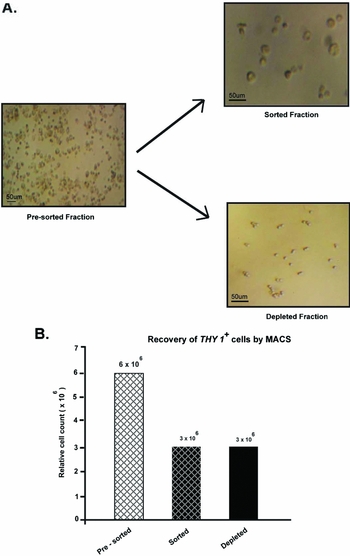
Based on an established enrichment protocol (Panda et al., Reference Panda, Barman and Mohapatra2011), attempts were made to purify magur spermatogonial cells from the total testicular cells. First, a primary culture of enzymatically digested testicular cells was separated by gradient (over 3 ml of Ficoll-Paque PLUS; GE Healthcare) that resulted in partly removing unwanted somatic cells and spermatids (data not shown). Ficoll gradient centrifugation-separated spermatogonia remained at the top as well as in the middle layers, whereas spermatids, spermatozoa, cell debris, etc. were pelleted down at the bottom of the tube. Using this procedure, we could not achieve a highly purified sample of spermatogonia as per our requirement. Second, these gradient-separated cells (top and middle layers) were subsequently subjected to MACS using Thy1.2 (CD90.2) antibody. MACS generated about 3 × 10⁶ spermatogonial cells from the gradient-separated 6 × 10⁶ cells (Fig. 1 A, B). Microscopic observation confirmed that sorted cells were free from (decontaminated) spermatids, etc. (Fig. 1 A). The morphology of sorted cells was like that of spermatogonial cells, bearing the typical characteristics of a larger nucleus within a thin cytoplasmic rim. The nucleus also contained dark perinuclear bodies, the typical features of spermatogonial cells.
Enrichment of spermatogonial cells by magnetic activated cell sorting (MACS). (A) A representative figure showing the Ficoll gradient separated cell suspension known as pre-sorted fraction (left side). Gradient-separated cells were further subjected to MACS using Thy1.2 (CD90.2) labelled microbeads. Magnetically sorted (top right side) and depleted cell fractions (bottom right side) are shown. (B) On an average 6 × 10⁶ pre-sorted cells were loaded onto a MAC separator column of which 50% cells were recovered in the sorted fraction using the Thy1.2 (CD90.2) antibody.

Such morphological features of purified cells provided the clue that Thy1 (CD90) is likely to be present on the plasma membrane of magur SSCs. This result is in line with rat, non-human primates, human, bull, mouse, rohu, mammals and goat (Kubota et al., Reference Kubota, Avarbock and Brinster2003; Buom-yong et al., Reference Buom-yong, Orwig, Hiroshi, Avarbock and Brinster2004; Ryu et al., Reference Ryu, Orwig, Kubota, Avarbock and Brinster2004; Hermann et al., Reference Hermann, Sukhwani, Simorangkir, Chu, Plant and Orwig2009; He et al., Reference He, Kokkinaki, Jiang, Dobrinski and Dym2010; Reding et al., Reference Reding, Stepnoski, Cloninger and Oatley2010; Niu et al., Reference Niu, Goodyear, Rao, Wu, Tobias, Avarbock and Brinster2011; Panda et al., Reference Panda, Barman and Mohapatra2011; Kaucher et al., Reference Kaucher, Oatley and Oatley2012; Wu et al., Reference Wu, Song, Zhu, Niu, Mua, Lei, Yang, Peng, Li, Li and Hua2013).
Enriched spermatogonial cells were proliferative and undifferentiated in nature
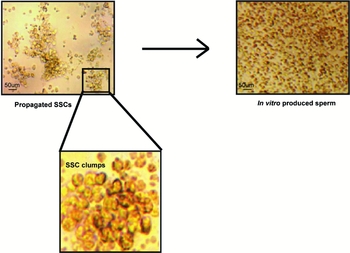
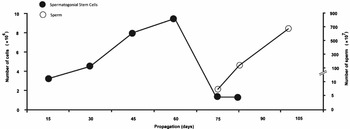
The purified cells were cultured in vitro for 2 months in L-15 complete medium under the conditions listed in Materials and methods. The sorted cells proliferated, forming characteristic clumps/colonies and remained loosely attached to the culture dish. The morphology of these cells looked like SSCs, with the feature of a larger nuclear compartment as compared with the cytosolic compartment. The darker perinuclear bodies, the typical characteristics of SSC, were also observed under a microscope. Even though the cells were not tightly attached, they seemed to have affinity for each other; and thereby proliferating cells formed clumps (Fig. 2). The initial 3 × 10⁶ cells resulted in about 9 × 10⁶ cells after 60 days of culture (Fig. 3). The counted dead cells were negligible as estimated by trypan-blue dye exclusion examination (data not presented).
In vitro culture of magur enriched spermatogonial stem cells (SSCs) forming clumps that are loosely attached to the surface and in vitro production of motile/fertile sperm.

Graphical representation of spermatogonial stem cell proliferation (approximately 1 × 10⁶) with respect to sperm production (approximately 1 × 10⁷). The sorted spermatogonial stem cells (3 × 10⁶) resulted in about (9 × 10⁶) cells on 60 day of culture; the self-renewing population produced motile sperm, approximately ~6 × 10⁷ on day 75. The SSC population was reduced from day 60 onwards. Sperm were produced, approximately ~102 × 107 and ~678 × 107 on days 80 and 100, respectively. Approximately, 678 × 107 sperm were produced from 3 × 10⁶ enriched SSCs within a span of 3½ months.

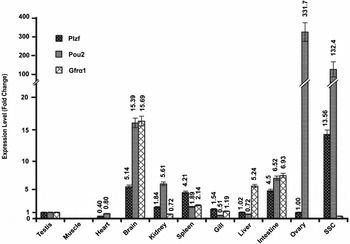
In order to verify the stemness properties of the proliferating purified cells, the mRNA expression levels for Plzf and Pou2 were quantified at 55 days of culture using qPCR. The heightened mRNA expression levels of Pou2 and Plzf were noticed in cultured SSCs as compared with muscle, heart, brain, kidney, spleen, gill, liver and intestine (Fig. 4). The heightened expression of Pou2 and Plzf on the proliferating spermatogonial cells revealed that the SSCs were undifferentiated in nature.
Differential expression profiles of stem cell markers in different tissues including enriched spermatogonial cells of C. batrachus detected by quantitative real-time PCR (qPCR).

Production of motile/fertile sperm in vitro from proliferating magur spermatogonial stem cells
The major population of SSCs proliferated for a period of 2 months with negligible sperm counts. To our surprise, after 60 days of culture, the SSC population started depleting dramatically together with a change in morphological characteristics as observed under the microscope. The clumped cells started dissociating from each other and were relatively larger in shape and size. It appeared that cells started to differentiate. We also observed spermatids, including free-swimming (with non-progressive motility) sperm in the culture dish. About 70% sperm showed a swimming pattern confined to a tight circle, but not in a forward straight line as observed in progressive motility, and hence were classified as the non-progressive motile category. The remaining 30% of in vitro-produced sperm were non-motile, having no movement. As shown in Fig. 3, the self-renewing population of magur spermatogonial cells produced motile sperm of approximately ~6 × 10⁷ on day 75. The SSC population depleted dramatically (1 × 10⁶) from day 60 onwards. At the same time, the in vitro-produced sperm increased by about 20-fold on day 80. Enormous numbers of sperm were produced in the region of ~102 × 107 and ~678 × 107 on days 80 and 100, respectively. On average, 678 × 107 sperm were produced from 3 × 10⁶ enriched spermatogonial cells (2260 sperm/SSC) within a span of 3½ months.
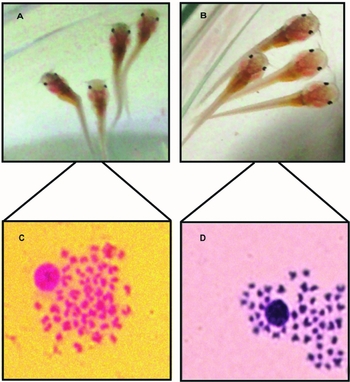
These results indicated that proliferating SSCs differentiated in the undefined media formulation. The major population of the in vitro-produced sperm showed non-progressive movement in the culture medium, demonstrating that they were motile in nature. To examine the fertile nature of these motile sperm, the pelleted sperm were fertilized with magur eggs stripped from a matured female following a standard induced breeding technique. The success rate of fertilization was about 2%. The newly hatched off-springs were quite active and their morphology seemed to be similar to that of the control hatchlings (Fig. 5). The test hatchlings grew well in our hatchery with the artificial feed, up to fingerling stage.
Fertilized magur (C. batrachus) off-spring (diploid) derived from in vitro-produced sperm. (A) Experimental hatchlings and (B) control hatchlings. (C) Representative figures showing diploid metaphase chromosomes of experimental hatchlings (n = 4) and (D) control hatchlings (n = 2).

The metaphase chromosomes were prepared from kidney cells of the magur hatchlings. As shown in Fig 5(C), the cytogenetic profile of magur hatchlings (C. batrachus) was found to be diploid (2n = 52 to 54) (Siraj et al., Reference Siraj, Sukardi, Imm, Mei, Vellasamy, Panandam and Daud2009) in number, revealing possible contributions from sperm produced in vitro.
Discussion
Because of seasonal breeding and other difficulties in breeding male magur (C. batrachus) by hormonal manipulation, we undertook studies linked to culture of SSCs, aiming to produce sperms in vitro. Our established protocol of purifying spermatogonial cells (Panda et al., Reference Panda, Barman and Mohapatra2011) was implemented to enrich magur spermatogonial cells. The dramatically heightened recovery rate, in the region of 50% sorted magur spermatogonial cells using Thy1 immuno-magnetic beads, was comparable with that of rohu (L. rohita) spermatogonial cells. This finding that Thy1 is expressed on the plasma membrane of spermatogonial cells was consistent with earlier findings (Kubota et al., Reference Kubota, Avarbock and Brinster2003; Buom-yong et al., Reference Buom-yong, Orwig, Hiroshi, Avarbock and Brinster2004; Ryu et al., Reference Ryu, Orwig, Kubota, Avarbock and Brinster2004; Hermann et al., Reference Hermann, Sukhwani, Simorangkir, Chu, Plant and Orwig2009; He et al., Reference He, Kokkinaki, Jiang, Dobrinski and Dym2010; Reding et al., Reference Reding, Stepnoski, Cloninger and Oatley2010; Niu et al., Reference Niu, Goodyear, Rao, Wu, Tobias, Avarbock and Brinster2011; Panda et al., Reference Panda, Barman and Mohapatra2011; Kaucher et al., Reference Kaucher, Oatley and Oatley2012; Wu et al., Reference Wu, Song, Zhu, Niu, Mua, Lei, Yang, Peng, Li, Li and Hua2013). This result also implied that Thy1 (CD90) is likely to be conserved across eukaryotes and could be considered as a potential candidate marker for spermatogonial cells.
Purified cells could be cultured for a period of 2 months in an undifferentiated state, as documented by typical morphological features and heightened mRNA expression profiles for Plzf and Pou2. The Pou2 gene expression level was high in the case of ovary, compared with other genes, which is in the line with the rohu Pou2 expression pattern (Mohapatra et al., Reference Mohapatra, Patra, Panda, Mohanta, Saha, Das Mahapatra, Jayasankar and Barman2014). These results also implied that Plzf and Pou2 play major roles in SSC proliferation and maintenance in line with earlier findings (Hong et al., Reference Hong, Liu, Zhao, Xu, Wang, Liu, Chen, Deng and Gui2004; Loppion et al., Reference Loppion, Crespel, Martinez, Auvray and Sourdaine2008; Mohapatra et al., Reference Mohapatra, Barman, Panda, Kumar, Das, Mohanta, Mohapatra and Jayasankar2010; Sanchez-Sanchez et al., Reference Sanchez-Sanchez, Camp, Garcia-Espana, Leal-Tassias and Mullor2010; Panda et al., Reference Panda, Barman and Mohapatra2011; Kala et al., Reference Kala, Kaushik, Singh, Kadam, Singh, Manik, Singla, Palta and Chauhan2012; Mohapatra & Barman, Reference Mohapatra and Barman2014; Shang et al., Reference Shang, Su, Lipke, Perera, Li, Qin, Li, Dunn, Cek, Peatman and Dunham2015; Zhao et al., Reference Zhao, Zhang, Feng, Guo, Chang, Qi, Zhong, Zhou and Wang2015). Gfrα1 could not be detected in the proliferating cells, which is in line with previous reports of rohu SSCs (Panda et al., Reference Panda, Barman and Mohapatra2011). Our study reconfirmed that Pou2 and Plzf could be used as spermatogonial stem cell markers in wide range of fish species. Consensus is also being developed that Thy1 could effectively be used to enrich for proliferative spermatogonial cells that are undifferentiated in nature.
The major population of proliferating SSCs differentiated to produce free-swimming sperm with non-progressive motility from 60 days onwards. This result is in line with earlier findings of in vitro sperm production from male germ cells in culture (Hofmann et al., Reference Hofmann, Hess, Goldberg and Millan1994; Izadyar et al., Reference Izadyar, Ouden, Creemers, Posthuma, Parvinen and Rooij2003; Hong et al., Reference Hong, Liu, Zhao, Xu, Wang, Liu, Chen, Deng and Gui2004). The exact reason for the dramatic shift from the undifferentiated to the differentiated state is not known. One reason could be that the medium formulation for mitotic activity was not properly defined, especially in the presence of FBS and carp serum. A population of proliferating rohu spermatogonial cells also produced fertile sperm in vitro (Panda et al., Reference Panda, Barman and Mohapatra2011). Interestingly, it was possible to produce about 2260 live sperm per spermatogonia (sorted) over the period of 3½ months. Out of those, 2% were capable of fertilizing eggs to generate healthy fingerlings. Even though the rate of fertile sperm production is very low, our documented evidence provided a way of in vitro fertile sperm production from magur SSCs in culture. Future studies could be undertaken to fine tune improved fertile and quality sperm production using defined media formulations supplemented with specific growth factor(s). Interestingly, these hatchlings contained a 2n chromosomal complement providing a pointer of both parental contributions. However, the possibility of diploid gynogens (maternal) cannot be ruled out at this stage. Both parental contributions could be clarified by genotyping (depending upon the availability of DNA markers) in future. This study also provided an avenue for gene manipulation. Recently, we established a highly efficient nucleofection protocol for rohu SSCs (Barman et al., Reference Barman, Mohanta, Patra, Chakrapani, Panda, Nayak, Jena, Jayasankar and Nandanpawar2015). Enriched and proliferating magur SSCs (2n complement) could be transfected with donor DNA construct within 60 days of cultivation to produce genetically modified fertile sperm (n) from 60 days onwards. These manipulated sperm could be fertilized to generate transgenic magur. Due to the only small success rate in producing transgenic farm fishes using conventional methods, mainly due to mosaic expression (Stuart et al., Reference Stuart, Vielkind, McMurray and Westerfield1990; Rahman et al., Reference Rahman, Hwang, Razak, Sohm and Maclean2000), spermatogonial stem cell-mediated transgenesis could be an effective alternative transgenesis. Established techniques of SSC propagation and transfection protocol together should trigger experiments towards the basic understanding of complex spermatogenesis processes.
In conclusion, this is the first evidence of successful enrichment, characterization and in vitro propagation of magur (C. batrachus) spermatogonial cells in the undifferentiated state. Furthermore, evidence was provided with regard to in vitro production of fertile sperm from proliferating SSCs. The medium formulation used in this study was not clearly defined either linked to self-renewal or differentiation. Future studies could be undertaken to uncover unique essential growth factors required for self-renewal versus differentiation to facilitate the developmental stages of spermatogenesis in vitro. In vitro sperm production could mitigate the problem of sacrificing the male magur during milt collection. Sperm could also be produced all year round, and therefore not restricted to the breeding season. Although the success rate of fertile sperm production was only 2%, this study has provided the platform for future basic and applied biology research in this area.
Acknowledgements
This research was funded by the Indian Council of Agricultural Research (ICAR), Ministry of Agriculture, Government of India. Miss Swapanarani Nayak is a recipient of an Inspire Fellowship from the Department of Science and Technology (DST), Government of India. The necessary infrastructural facility provided by the Director of this Institute is acknowledged.
Supporting information
To view supplementary material for this article, please visit http://dx.doi.org/10.1017/S0967199416000149