Within the scope of study of schizophrenia, cognitive dysfunction has received the main focus of attention in many recent investigations, being associated with a wide range of deficits, including impairment of memory, attention, executive functioning and general intellectual functioning (Goldberg, David, & Gold, Reference Goldberg, David, Gold, Hirsch and Weinberger2003).
The impairment of executive functions is one of the more important and central deficits that is associated with schizophrenia (Carter et al., Reference Carter, Barch, Bullmore, Breiling, Buchanan, Butler and Wykes2011; Goldman-Rakic, Reference Goldman-Rakic1994; Kerns, Nuechterlein, Braver, & Barch, Reference Kerns, Nuechterlein, Braver and Barch2008; Liddle & Morris, Reference Liddle and Morris1991; Reeder, Newton, Frangou, & Wykes, Reference Reeder, Newton, Frangou and Wykes2004), occurring not only in the chronic stage of the disease, but also in the first episode (Chan, Chen, & Law, Reference Chan, Chen and Law2006), in the prodromic stage (Cornblatt, Lenzenweger, Dworkin, & Erlenmeyer-Kimling, Reference Cornblatt, Lenzenweger, Dworkin and Erlenmeyer-Kimling1992; Davidson et al., Reference Davidson, Reichenberg, Rabinowitz, Weiser, Kaplan and Mark1999), and in direct descendants (Snitz, Macdonald, & Carter, Reference Snitz, Macdonald and Carter2006; Szöke et al., Reference Szöke, Schurhoff, Mathieu, Meart, Ionescu and Lebover2005).
On the other hand, a large research body has identified a strong association between executive deficits and structural and functional cerebral deficits, by which the executive processes, although strongly dependant on the frontal cortex (Eisenberg & Berman, Reference Eisenberg and Berman2010), also require the cooperation of external structures of the frontal lobes, namely the inferior parietal lobe (Jansma, Ramsey, van der Wee, & Kahn, Reference Jansma, Ramsey, van der Wee and Kahn2004; Jonides et al., Reference Jonides, Schumacher, Smith, Koeppe, Awh, Reuter-Lorenz and Willis1998), medial / hippocampus temporal lobe (Graham et al., Reference Graham, Phua, Soon, Oh, Au, Shuter and Yeh2009), basal ganglia (Eslinger & Grattan, Reference Eslinger and Grattan1993) and thalamus (Tanibuchi & Goldman-Rakic, Reference Tanibuchi and Goldman-Rakic2003).
The impairment of executive functions can further cause an impact on functional results in patients with schizophrenia, which can have a variety of effects on the daily life activities of these patients, including the capability to work or go to school, responsibilities at home or engaging in appropriate social relationships (Freedman & Brown, Reference Freedman and Brown2011; Kerns et al., Reference Kerns, Nuechterlein, Braver and Barch2008). Additionally, Green, Kern, and Heaton (Reference Green, Kern and Heaton2004) discovered that the executive function deficits found in patients with schizophrenia determined the poor functional results with regards to living in the community, self-care activities, social problem solving capabilities and psychosocial competences.
In this manner, if we try to understand the nature of the difficulties inherent to executive dysfunction, they can be reasonably understood as being a failure at the level of Norman & Shallice’s SAS model (1986), also creating the basis for the main characteristics of dysexecutive syndrome, a term proposed by Baddeley (Reference Baddeley1986), characterized as a more functional cognitive deficit associated with frontal lobe syndrome. SAS is interpreted as being necessary for the effective control of an action in a number of situations: situations requiring planning or decision making; situations which involve the correction of errors or problem solving, situations in which the replies are not well perceived or contain new sequences of actions; situations deemed dangerous or technically difficult and, finally, situations which demand overcoming a strong usual response. Various tests have been planned based on the SAS model and have been designed specifically for the acquisition of different SAS components, namely the Six Element Test, first described by Shallice and Burgess (Reference Shallice and Burgess1991), later incorporated into BADS (Wilson, Alderman, Burgess, Emslie, & Evans, Reference Wilson, Alderman, Burgess, Emslie and Evans1996), and also the Hayling Test (Burgess & Shallice, Reference Burgess and Shallice1996), incorporated into INECO Frontal Screening.
Nonetheless, the neuropsychological study of executive dysfunction and its corresponding rehabilitation, however, face inherent difficulties. One of them is the precise and valid evaluation of executive functions. Executive functions are developed to understand a variety of competences in order to achieve a goal (Damasio, Reference Damasio1995; Shallice, Reference Shallice1988; Stuss et al., Reference Stuss, Alexander, Shallice, Picton, Binns, Macdonald and Katz2005; Stuss & Benson, Reference Stuss and Benson1986). Therefore, a failure in tests which assess executive functions may be due to many reasons, such as damage in any process of its components is difficult to be completely overlooked after the emergence of cerebral lesions or psychopathologies. Furthermore, the neuropsychological evaluation devices which have been used for this purpose are of an excessively artificial and structured nature and thus, few are those that have been developed to assess executive functions quickly, not reflecting conveniently the demands of real life, where dysfunctions are felt (Barbosa & Monteiro, Reference Barbosa and Monteiro2008).
To this end new instruments have emerged that combine a solid theoretical foundation with adequate psychometric and ecologic al validity. The Behavioral Assessment of the Dysexecutive Syndrome (BADS) is one of the instruments that systematically use everyday tasks as a way to assess executive functions (Wilson et al., Reference Wilson, Alderman, Burgess, Emslie and Evans1996). This battery was developed in response to the need for more sensitive, valid and reliable neuropsychological instruments in this area, while at the same time, trying to overcome the deficiencies associated with conventional tests. Despite its relatively recent development, according to several researchers (Crawford, Reference Crawford1998; Groth-Marnat, Reference Groth-Marnat2000; Norris & Tate, Reference Norris and Tate2000; Wilson, Evans, Emslie, Alderman, & Burgess, Reference Wilson, Evans, Emslie, Alderman and Burgess1998), this battery shows a promising potential for responding to the aforementioned needs.
This battery has also been applied to the research of executive functioning in schizophrenia. The research of Evans, Chua, McKennna, and Wilson (Reference Evans, Chua, McKenna and Wilson1997) and Krabbendam, Vugt, Derix, and Jolles (Reference Krabbendam, Vugt, Derix and Jolles1999) showed that BADS is an essential contributor in the identification of executive deficits in people diagnosed with schizophrenia, especially in those with their general intellectual capability intact. Nonetheless, it is as extensive exam that requires time to be applied, expensive equipment or highly trained professionals to apply it. On the other hand, instruments designed specifically to quickly assess executive functions are few. Thus, a screening tool that is easy to use denotes high sensitivity, specificity and predictive value would be of great importance to practitioners. Various instruments of cognitive screening have desirable diagnostic and statistical properties (Keefe et al., Reference Keefe, Goldberg, Harvey, Gold, Poe and Coughenour2004), but few were developed to specifically assess executive functioning. As proof of the intrinsic difficulties that arise with the development of such tools, various screening batteries that have tried to measure executive dysfunction do not show reasonable psychometric characteristics. For example, Rothlind and Brandt (Reference Rothlind and Brandt1993) proposed a brief cognitive screening test for the identification of frontal-subcortical dysfunction, however, patients with AD showed worse results in this test than patients with frontal dysfunction, demonstrating the low specificity of the tool. Royall, Mahurin and Gray (Reference Royall, Mahurin and Gray1992) developed an interview for executive functioning by reflecting on a problem, however, it also revealed itself to be sensitive to non-executive dysfunction. Ettlin and Kischka (Reference Ettlin, Kischka, Miller and Cummings1999) developed the Frontal Lobe Index, but application of this tool requires at least 40 minutes. Nonetheless, this difficulty is not unilateral, in other words, a solely psychometric problem, but also an executive functioning construct which is multifaceted, complex and dynamic. Thus, even though efforts have been made to measure executive functions, their complexity constitutes an enormous challenge (Miyake et al., Reference Miyake, Friedman, Emerson, Witzki, Howerter and Wager2000).
Given the above mentioned difficulties and based on previous research relating to executive testing (Clark, Manes, Antoun, Sahakian, & Robbins, Reference Clark, Manes, Antoun, Sahakian and Robbins2003; Clark & Manes Reference Clark and Manes2004; Manes et al., Reference Manes, Sahakian, Clark, Rogers, Antoun, Aitken and Robbins2002; Torralva et al., Reference Torralva, Kipps, Hodges, Clark, Bekinschtein, Roca and Manes2007), a tool has recently been developed at the Institute of Cognitive Neurology (INECO) in Buenos Aires, which aims at diagnosing executive dysfunction in a quick and specific manner: the INECO Frontal Screening (IFS; Torralva, Roca, Gleichgerrcht, López, & Manes, Reference Torralva, Roca, Gleichgerrcht, López and Manes2009). The authors of this study designed this screening test in order to make available to health care providers a sensitive and specific test, for early diagnosis of frontal dysfunction in dementia patients. To achieve this, they applied IFS to patients with Alzheimer’s Disease (AD) and Frontotemporal Dementia (FTD). The results showed that patients with FTD presented more serious executive dysfunction, represented by their lower score in the general IFS, in comparison with patients with AD. In this manner, the study of Torralva et al. (Reference Torralva, Roca, Gleichgerrcht, López and Manes2009) showed that IFS is a quick, sensitive and specific tool for the diagnosis of executive dysfunction associated with neurodegenerative diseases.
In this manner, the aim of the present study is to verify if the INECO Frontal Screening, test which quickly assesses executive functions, is as sensitive and specific as BADS, a battery for assessment of dysexecutive syndrome with high ecological validity, for detecting executive dysfunction in schizophrenia.
Method
Participants
65 Individuals participated in this research, in which the experimental group consisted of 34 patients with schizophrenia, mainly males (70.6%), with ages ranging between 22 and 62 years (M = 39.59, DP = 10.697). Data collection was obtained from the Alto Ave Hospital Center, E.P.E., in Guimarães, whose board and ethics committee consented to this research being carried out. Candidate selection was carried out based on inclusion and exclusion criteria for the sample, having included candidates with confirmed diagnosis of Schizophrenia, according to the criteria established in the DSM-IV-TR, and excluding all uncompensated candidates from a psychopathological point of view at the time of data collection, with dual diagnosis, with organic cerebral lesions, who presented a severe level of cognitive deterioration or even mental deficiency, who were illiterate, due to the nature of the proposed tasks, and that presented a current or recent history of substance abuse.
On the other hand, the control group consisted in 31 individuals, mainly males (61.3%), with ages ranging between 20 and 55 years (M = 35.52, DP = 10.211). This group was recruited in the Vale do Sousa residential area, in order to guarantee the best possible adjustment of the samples with regards to school qualifications (obligatory education or less), or socioeconomic background (lower or lower-middle class). All participants were informed of the nature and aims of the study and participation in all neuropsychological tests was voluntary.
The two groups do not differ significantly with regards to gender t(63) = –.783, p = .437, age t(63) = 1.566, p = .122, or level of education t(63) = –.856, p = .395.
Materials
In order to assess the executive functioning of the participants, neuropsychological tests deemed pertinent to completing the objectives of the study were applied: BADS, WCST and INECO Frontal Screening.
Behavioral Assessment of the Dysexecutive Syndrome
Consists of six tasks. For each task a reference score is obtained (maximum of 4 and minimum of 0). The Rule Shift Card test assesses the capability of changing an established response pattern using familiar items. The Action Program assesses the capability of solving practical problems. Key Search is a test to assess the capability to plan a strategy. The Temporal Judgment Test includes four questions that assess the capability to foresee or estimate how long it takes, in average, to complete various tasks, events or daily activities. The Zoo Map Test assesses the planning of actions. And lastly, the Modified Six Elements Test is a test of a planning, temporal organization of tasks and self-assessment of success test (Wilson et al., Reference Wilson, Alderman, Burgess, Emslie and Evans1996).
Wisconsin Card Sorting Test
Consists in matching 128 answer cards with four stimulus cards. While carrying out the task, the participants try to lay out the cards according to a criterion which is unknown to them and should be inferred by means of feedback from the test administrator. The total number of errors, perseverative and non-perseverative errors and the number of complete categories was considered for the purpose of score. This test assesses capabilities for planning, organized research, orientated behavior and the adequate use of feedback to change strategies and modulate an impulsive response (Strauss, Sherman, & Spreen, Reference Strauss, Sherman and Spreen2006).
INECO Frontal Screening
Is a brief, sensitive and specific neuropsychological exam to detect executive dysfunction in neurodegenerative pathologies, developed by Torralva et al. (Reference Torralva, Roca, Gleichgerrcht, López and Manes2009) and adapted for the Portuguese population by Caldeira (Reference Caldeira2011). The exam consists of eight sub-tests. In the Motor Programming subtest the subject should perform the Luria series “fist, edge, palm” by initially copying the administrator, and by subsequently doing the series on his or her own then by repeating the series six times alone. In the Conflicting Instructions (Sensitivity to Interference) subtest, the subjects are asked to hit the table once when the administrator hits it twice, or to hit the table twice when the administrator hits it only once. In the Go–No Go subtest, the subjects are told that when the test administrator hits the table once, they should hit it once as well, but when the examiner hits twice, they should do nothing. In the Backward Digit Span subtest, the subjects are invited to repeat string of digits in the reverse order. In turn, in the Verbal Working Memory subtest, the subjects are asked to list the months of the year backward, starting with December. In the Spatial Working Memory subtest, the administrator presents the subject with four cubes and points at them in a given sequence, which the patient should repeat in reverse order. In the Abstraction Capacity - Proverb Interpretation subtest, three proverbs are read to the subjects who are then invited to explain their meaning. The Verbal Inhibitory Control subtest is inspired in the Hayling Test, which measures the capacity of the subject to inhibit an expected response (Torralva et al., Reference Torralva, Roca, Gleichgerrcht, López and Manes2009).
The Mini Mental State Examination (MMSE; Folstein, Folstein, & McHugh, 1975 )
It was also applied as a control method, in the sense of excluding all individuals who presented a score lower than 22 points (cognitive deficit cut-off score for the Portuguese population with 1 to 11 years of education).
Procedures
The neuropsychological assessment was made in the Psychiatric and Mental Health Department of the Alto Ave Hospital Center, in Guimarães. The hospital’s ethics committee issued a favorable report for completion of the study and the informed consent was obtained from all individuals that taking part in the study. Before the executive functioning evaluation, all participants were submitted to a MMSE, with the aim of determining the existence of more sever neurocognitive disorders. Consecutively, the previously mentioned neuropsychological tests were applied, such as BADS, WCST and IFS, with the aim of obtaining the results of the executive functioning evaluation. The instruments used in this study were applied transversely, with a duration that varied between one or two sessions, each lasting an hour, depending on the performance of the individual and also to avoid possible effects of fatigue. All participants completed the proposed assessment.
Analysis and Data Processing
The statistical analysis was performed using the statistical analysis program SPSS – Statistical Package for the Social Sciences, version 19.0. Univariate descriptive analysis procedures were employed, specifically central tendency and dispersion measures (median and standard deviation) and frequency distribution. Subsequently, a bivariate descriptive analysis using Student’s t-test for independent samples was applied. Differences with p < .05 were considered as significant. The ability of the IFS to assessment executive functions in comparison to BADS was determined using a receiver operating characteristic (ROC) curve analysis.
Results
Description of the executive functioning of the Experimental and Control Group
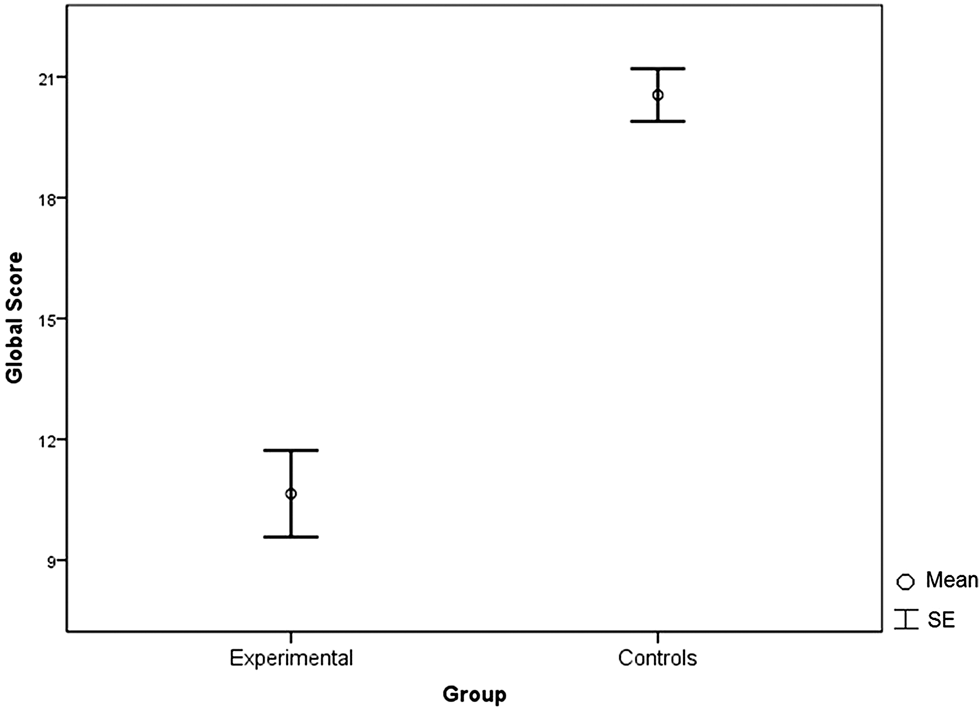
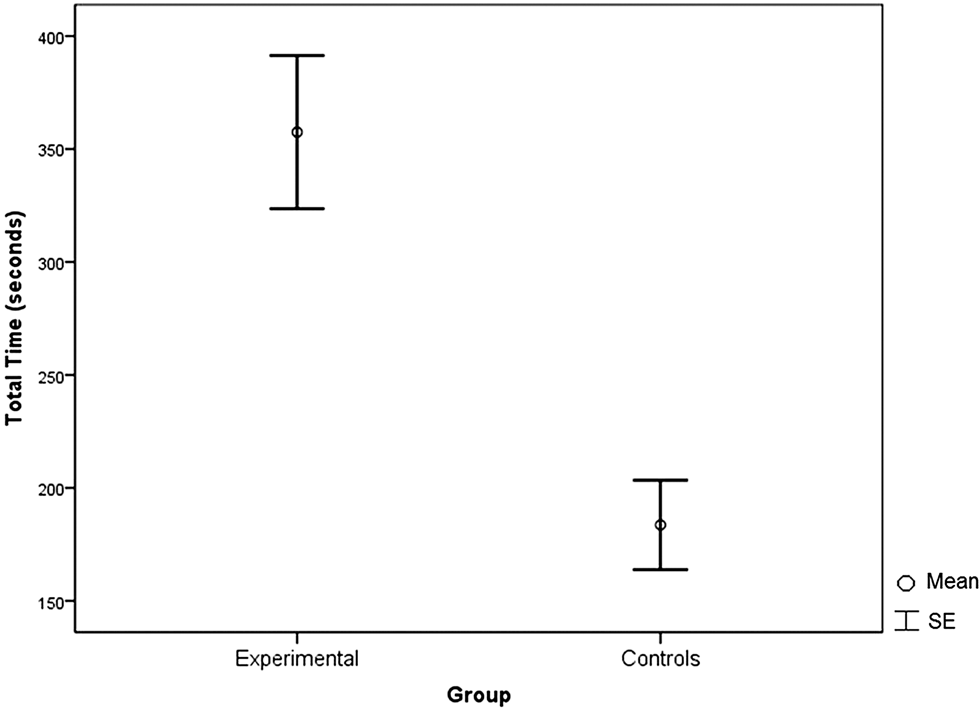
The results obtained by the two groups in the BADS, regarding to total score obtained, demonstrate that the schizophrenia group obtained results which were clearly lower (M = 10.65, DP = 3.074) in comparison with the control group (M = 20.55, DP = 1.786), being the difference highly significant, t(54)= –16.046, p < .001, 95% CI [–11.163, –5.664] (see Figure 1). Also, the time it took to complete the battery revealed a statistically significant difference, t(52) = 9.019, p < .001, 95% CI [135.182, 212.534], in favor of the control group (M = 183.61, DP = 53.889) which demonstrated itself quicker in comparison with the experimental group (M = 357.47, DP = 97.213) (see Figure 2).
Averages and standard error of the total score obtained by the Experimental and Control Groups in BADS completion.

Averages and standard error of the total time spent (in seconds) by the Experimental and Control Groups in the completion of the BADS subscales.

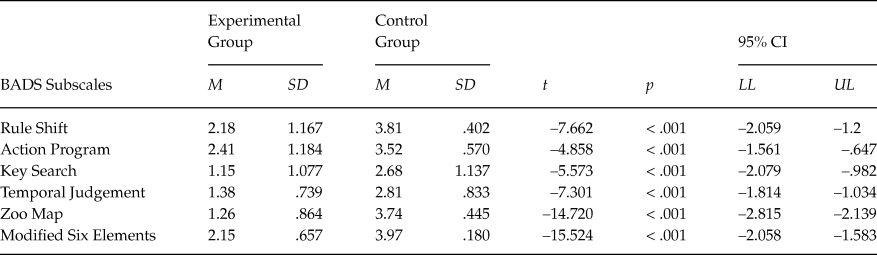
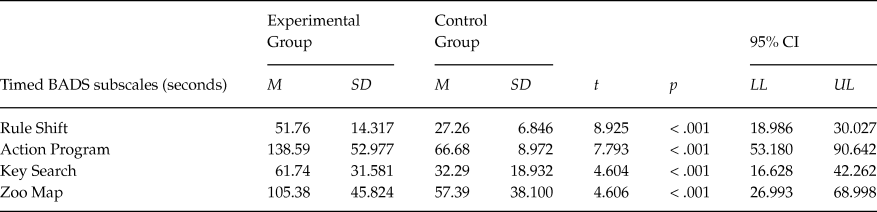
With regards to the scores obtained in each BADS subtest, we can realize that the schizophrenia group was less successful than the control group in all the subscales of the battery, without exception (see Table 1). The performance differences revealed to be statistically significant in all the subtests (p < .05).With regards to the time spent for complete each task, for the subtests in which time was a factor (subtests 1, 2, 3 and 5), it could be verified that the schizophrenia group required significantly longer periods of time in comparison with the control group, in order to conclude the tasks of all the subscales (see Table 2).
Averages, Standard Deviations, t Values, p Values and Confidence Intervals of the results of the Experimental and Control Groups in each of the BADS subtest

Note: Cl = confidence interval; LL = lower limit; UL = upper limit.
Averages, Standard Deviations, t Values, p Values and Confidence Intervals of time spent (in seconds) by the Experimental and Control Groups in completing each of the BADS subtest

Note: Cl = confidence interval; LL = lower limit; UL = upper limit.
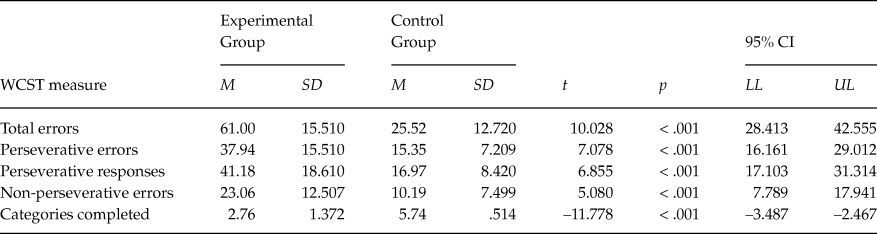
In regard to performance in the WCST, the group of patients with schizophrenia presented a greater number of errors, as well as a greater number of perseverative errors, more perseverative answers, more non-perseverative errors and a lesser amount of completed categories in comparison to the control group, in a statistically significant manner (see Table 3)
Averages, Standard Deviations, t Values, p Values and Confidence Intervals of the results obtained by the Experimental and Control Groups in the various dimensions of the WCST

Note: Cl = confidence interval; LL = lower limit; UL = upper limit.
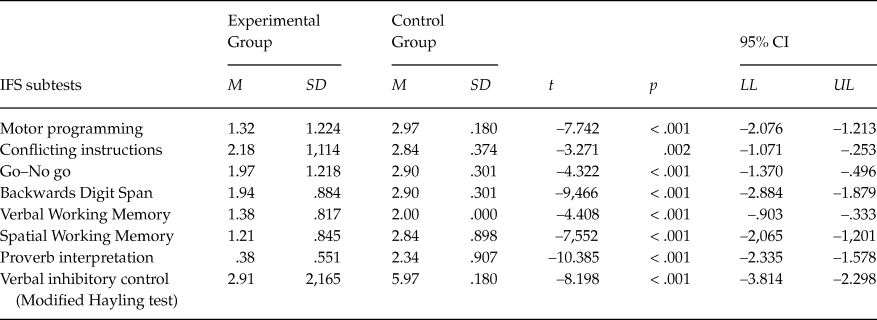
Finally, the total scores obtained by the different groups in the INECO Frontal Screening allow us understand that the group of patients with schizophrenia was less successful (M = 13.29, DP = 4.859), in a highly significant manner, t(44) = –14.291, p < .001, 95% CI [–14.737, –11.094], than the control group (M =26.21, DP = 1.948). In turn, if we analyze the scores obtained for each subtest, we can conclude the group of patients with schizophrenia clearly presents inferior results to those of the control group in all IFS subtests in a manner which is statistically significant (see Table 4).
Averages, Standard Deviations, t Values, p Values and Confidence Intervals of the results obtained by the Experimental and Control Groups in each of the INECO Frontal Screening subtests

Note: Cl = confidence interval; LL = lower limit; UL = upper limit.
Definition of sensitivity and specificity of IFS comparatively to BADS
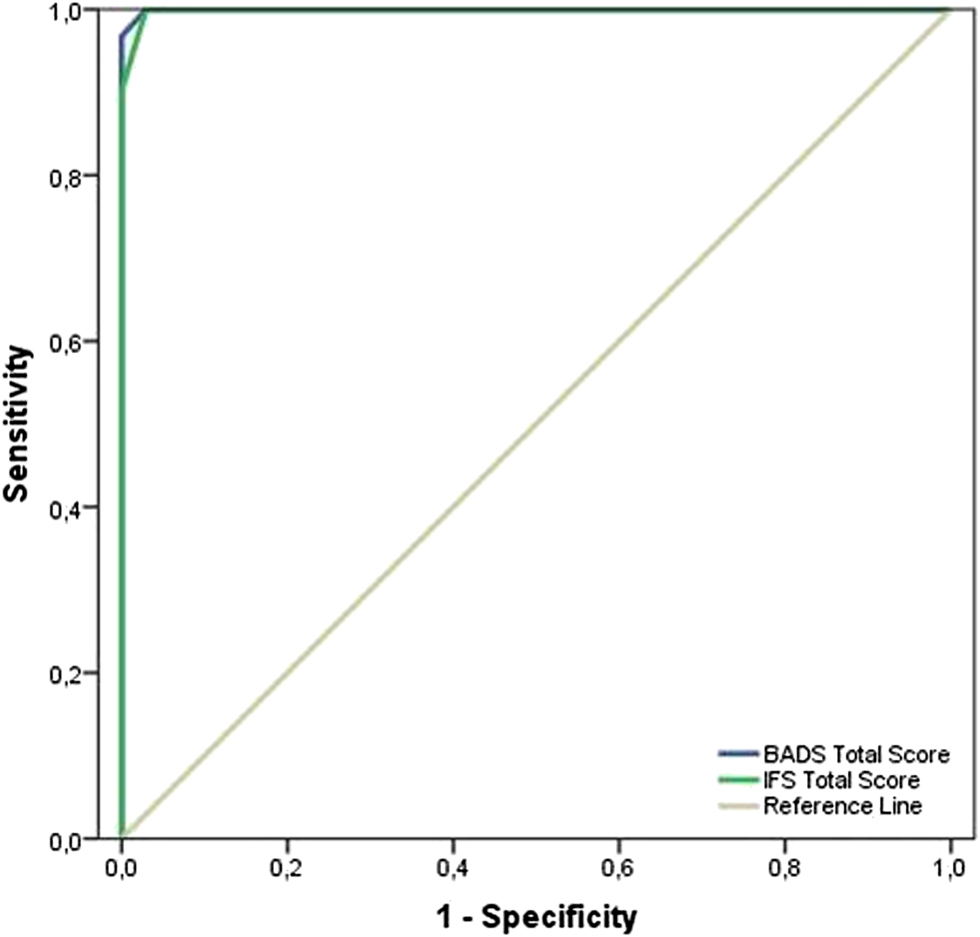
The capacity of IFS in briefly assessing executive functioning, in comparison to BADS, was determined by the analysis of the ROC curves (see Figure 3). Analysis of the ROC curve for the total IFS score between the control group and the patients with schizophrenia generated an area under ROC curve of .999. If we consider a cut-off point of 14 points, IFS shows 100% sensitivity and 56% specificity, in the distinction between the patients with schizophrenia and control group. In turn, the ROC curve analysis for the total BADS score generated an area under curve of 1. If we consider a cut-off point of 11 points, BADS shows a 100% sensitivity and 50% specificity. This way, we can verify that IFS produces sensitivity and specificity results very close to those of BADS when detecting executive dysfunction in schizophrenia.
ROC curve analysis for evaluation of specificity and sensitivity of IFS comparatively to BADS in order to detect executive dysfunction in schizophrenia.

Discussion
The current research revealed the existence of deficits in executive functions of patients with schizophrenia, corroborating the data found in the literature (Eisenberg & Berman, Reference Eisenberg and Berman2010; Everett, Lavoie, Gagnon, & Gosselin, Reference Everett, Lavoie, Gagnon and Gosselin2001; Heinrichs & Zakzanis, Reference Heinrichs and Zakzanis1998; Palmer, Heiby, Fujii, & Kameoka, Reference Palmer, Heiby, Fujii and Kameoka2008). Analysing the results, the poor performance of the schizophrenia group in completing BADS suggests impairment in multiple components of executive functioning, since it is not a one-dimensional construct (Miyake et al., Reference Miyake, Friedman, Emerson, Witzki, Howerter and Wager2000). In the Rule Shift Card subtest, we can verify some difficulty in these patients to use feedback in order to control or modify their behavior (Strauss et al., Reference Strauss, Sherman and Spreen2006). In turn, the Action Program Test requires the subjects to be capable to manipulate a variety of materials in order to solve a non-routine problem (Wilson et al., Reference Wilson, Alderman, Burgess, Emslie and Evans1996), and its validity lies in the difficulty found by patients with pre-frontal lesions to develop new plans or cognitive strategies in order to solve a problem. This test implies the action of the Supervisory Attentional System (Norman & Shallice, Reference Norman, Shallice, Davidson, Schwartz and Shapiro1986), which stimulates or inhibits the representation of actions which are normally activated by certain stimuli, avoiding the creation of routine actions, such as completing the test by inverting the tube in order to access the plug, for example. Our research shows that the process of the Supervisory Attentional System is compromised in the schizophrenia group since they showed less capacity to solve the presented problem. In the Key Search Test, the patients with schizophrenia demonstrated poor performance, evidencing difficulties in planning efficient actions and in their capacity to monitor their own performance, since the patients could look at the lines drawn to show the itinerary followed and come to the conclusion that the search was not efficient. On the other hand, in the Temporal Judgment Test, it is required of the subject to make an estimate of the time needed to complete various tasks, therefore the existence of a highly significant difference between the groups in this test could be attributed to the impairment of abstract judgment and thought capacity of the schizophrenic patients, since the answers are based on common sense. In the Zoo Map Test, the schizophrenia group also demonstrated a less significant capacity for planning when compared to the control group. In this test, the subjects have to identify and temporarily organize various stages, depending on the rules and specific objectives. The deficit demonstrated by the schizophrenia group may be related to the frequent errors made by the patients with frontal lesions when they try to follow specific instructions. This becomes obvious in the labyrinth tests, or in learning tasks, where the subject has to choose the most adequate answer from between a set of answers to achieve the final objective. Finally, in the Modified Six Elements Test, the schizophrenia patients demonstrated difficulties in the conception and implementation of strategies, since the task requires the capacity to manage time.
These results are consistent with the findings obtained in other scientific investigations, such as the studies of Evans et al. (Reference Evans, Chua, McKenna and Wilson1997), Ihara, Berrios, and McKenna (Reference Ihara, Berrios and McKenna2000), Krabbendam et al. (Reference Krabbendam, Vugt, Derix and Jolles1999).
The group of patients with schizophrenia demonstrated a poorer performance in the WCST when compared to the control group, which is consistent with the conclusions found in literature (Heinrichs & Zakzanis, Reference Heinrichs and Zakzanis1998). According to Koren et al. (Reference Koren, Seidman, Harrison, Lyons, Kremem, Caplan and Tsuang1998), perseveration and the total number of categories completed seem to translate the more sensitive scores into deficits in schizophrenia; in fact, in the current study, significant differences were verified between controls and the schizophrenics for the segment of perseverative answers and a poor performance in average of the patients with schizophrenia the level of number of categories completed. According to Greve, Stickle, Love, Bianchini, and Stanford (Reference Greve, Stickle, Love, Bianchini and Stanford2005), these results demonstrate the difficulty of the patient in changing to correct principled organization and as a consequence generate a large number of perseverative answers and few completed categories. Thus, the performance of patients with schizophrenia reflects a difficulty on abstraction and cognitive flexibility level.
In turn, with regards to the performance of the groups in completing the INECO Frontal Screening, it can be concluded that the group of patients with schizophrenia clearly presents poorer results in comparison to the control group. Similar results were obtained in a study by Báez et al. (Reference Báez, Gleichgerrcht, Urquina, Lischinsky, Roca, Manes and Torralva2011), in which two groups of adult patients with Bipolar Disorder and with Attention Deficit Hyperactive Disorder obtained significantly lower scores than the control group with regards to the total score obtained in IFS. In this manner, this screening test proved to be a solid and useful tool for the detection of executive dysfunction in various psychiatric disorders, both in the study of Báez et al. (Reference Báez, Gleichgerrcht, Urquina, Lischinsky, Roca, Manes and Torralva2011) as in the current study.
Thus, the results obtained by means of the neuropsychological tests used in the current study demonstrate the impairment of various executive function components in the group with schizophrenia, revealing the presence of an executive dysfunction. This disorder relates to a clinical state characterized by disorder in the planning and organization of actions, poor capacity for initiative, perseverance, inflexibility, a difficulty in conceiving and implementing strategies, difficulty in problem solving and in selective attention (Goldberg, David, & Gold, Reference Goldberg, David, Gold, Hirsch and Weinberger2003; Palmer & Heaton, Reference Palmer, Heaton, Sharma and Harvey2000). In the cases of pathology, lesion or cerebral dysfunction, the dysexecutive syndrome may manifest itself through a myriad of problems in everyday life, namely inappropriate social behavior, difficulty with decision making, high levels of impulsiveness, distraction, difficulty in using feedback from the environment to regulate behavior, preventing full functional recovery and the possibility of reclaiming a socially responsible life, independent and well adjusted (Barbosa & Monteiro, Reference Barbosa and Monteiro2008; Gioia, Isquith, Guy, & Kenworthy, Reference Gioia, Isquith, Guy and Kenworthy2000).
In turn, when analyzing the objectives of this study, it was possible to verify that IFS is as sensitive and specific as BADS. It is an assessment battery for dysexecutive syndrome with high ecological validity, particularly efficient in the detection of subtle difficulties with the planning and organization of actions, especially in cases of people for whom cognitive capacity seems to be preserved in well-structured situations (Strauss et al., Reference Strauss, Sherman and Spreen2006). In this way, the current study concluded that IFS shows high sensitivity and specificity in comparison with BADS in the detection of executive dysfunction in schizophrenia, demonstrating itself to be a good way to briefly assess functions related with the frontal lobe, allowing for the differentiation of the two groups included in the study.
To this end, the current study demonstrated that IFS is an instrument of quick application and possesses high sensitivity in order to be used in clinical practice. However, it is possible that by being as sensitive as BADS, it is qualitatively less rich due to its lengthier nature and artificiality of the tasks, since BADS is a robust exam, with good theoretical background, good psychometric properties and has good ecological validity, reflecting the everyday problems of executive dysfunction presented by the patients. Yet, a brief cognitive screening tool which is easy to apply and presents high sensitivity, specificity and predictive value such as IFS would be of great importance to health care professionals since in clinical practice, they do not always have access to highly trained neuropsychologists, specific instruments to assess certain cognitive domains or the length of time required to administer a complete neuropsychological battery.
With the advent of discoveries related to executive functioning and the implication of the frontal lobe in such specific tasks, it is our understanding that this exam is a very useful tool for health care professionals for it allows them to evaluate certain areas of executive functioning and providing information on the need to carry out further neuropsychological exploration. It is definitely of vital importance to be able to count on sensitive and specific tools for the diagnosis of neurological and psychiatric diseases with the aim of furthering neuropsychological research and elaborate strategies for cognitive intervention in such a manner that the patients recover those capabilities that allow a person to live in an independent manner, with a specific goal, with self-sufficient behavior and in a satisfactory way (Lezak, Howieson, & Loring, Reference Lezak, Howieson and Loring2004).
Still, many additional limitations of this study may be observed. There is no current symptomatology data for the patients, the sample is heterogeneous, the number of participants is relatively small and performance in the executive functioning tests and its relation to other cognitive processes may be different for individuals with schizophrenia that are stable in comparison to those with more active and severe symptoms. Further, future investigations should also explore behavioral observations (e.g., time taken to complete the tasks, latency of response, etc.) during IFS evaluation as alternative and complementary tools.