The diamond-shaped squid, Thysanoteuthis rhombus Troschel, 1857 is a non-abundant epipelagic inhabitant of warm tropical and partially subtropical waters (water temperature >20 or 21°C, usually 23 to 26°C) of the World Oceans and the Mediterranean (Nigmatullin et al., Reference Nigmatullin, Arkhipkin and Sabirov1995). The squid penetrates into the upper latitudes of subtropical and temperate waters (the Japan Sea, and the waters of South Africa and America) with warm currents. It occupies near-surface waters during the night and midwaters during the day and often occurs alone or in pairs and has a life span of approximately one year (Nigmatullin et al., Reference Nigmatullin, Arkhipkin and Sabirov1995). The most abundant populations have been found in the waters of Japan (Nishimura, Reference Nishimura1966) where some local fisheries target this species (Bower & Myahara, Reference Bower and Myahara2005). This species was first described from the Strait of Messina in the Mediterranean Sea which is the type locality of T. rhombus, but it is rare (Mangold & Boletzky, Reference Mangold, Boletzky, Clarke and Trueman1988). There were no records of diamond-shaped squid in the Adriatic Sea.
This paper presents the first record and morphometry of this species from the Adriatic Sea.
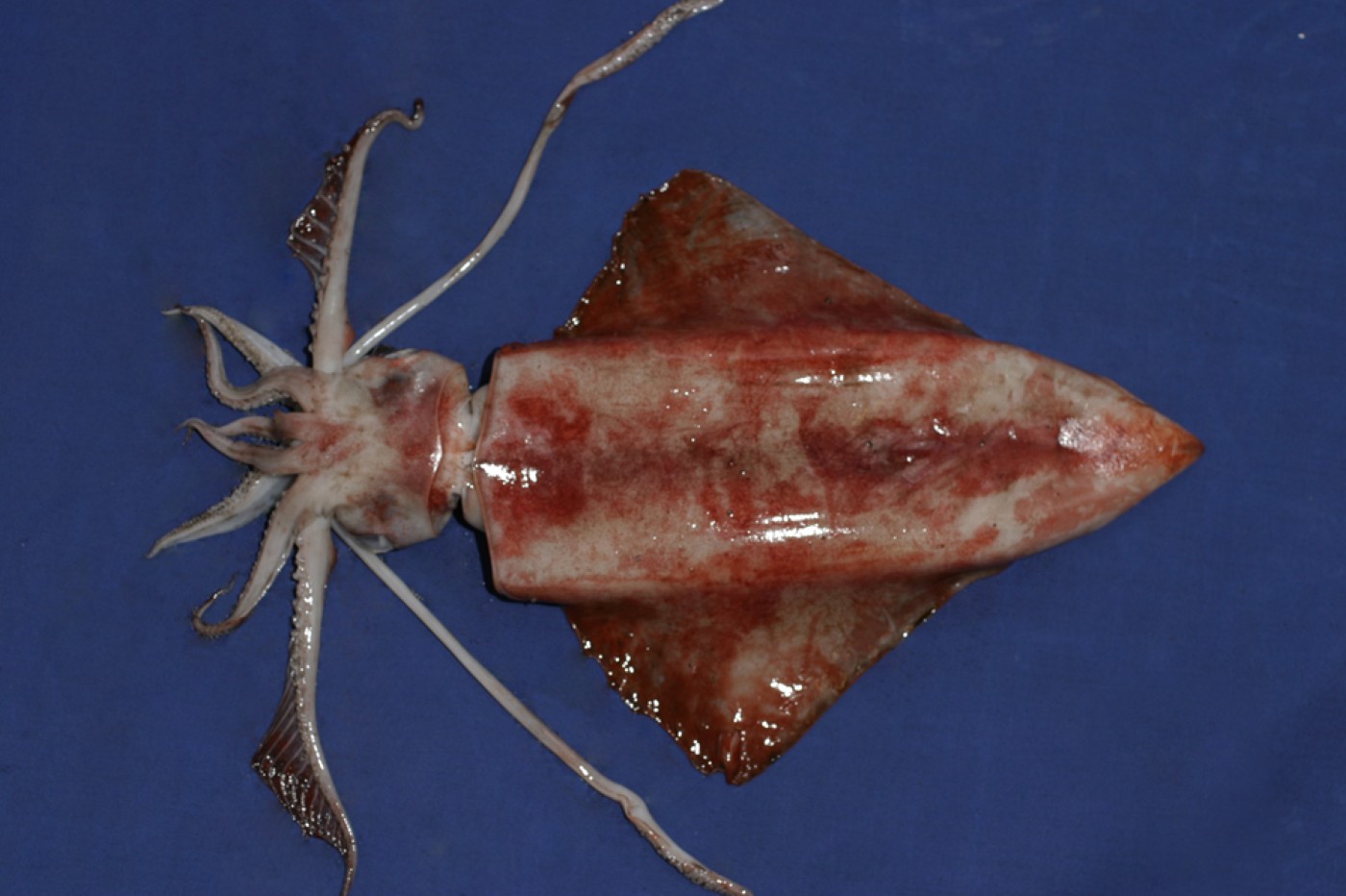
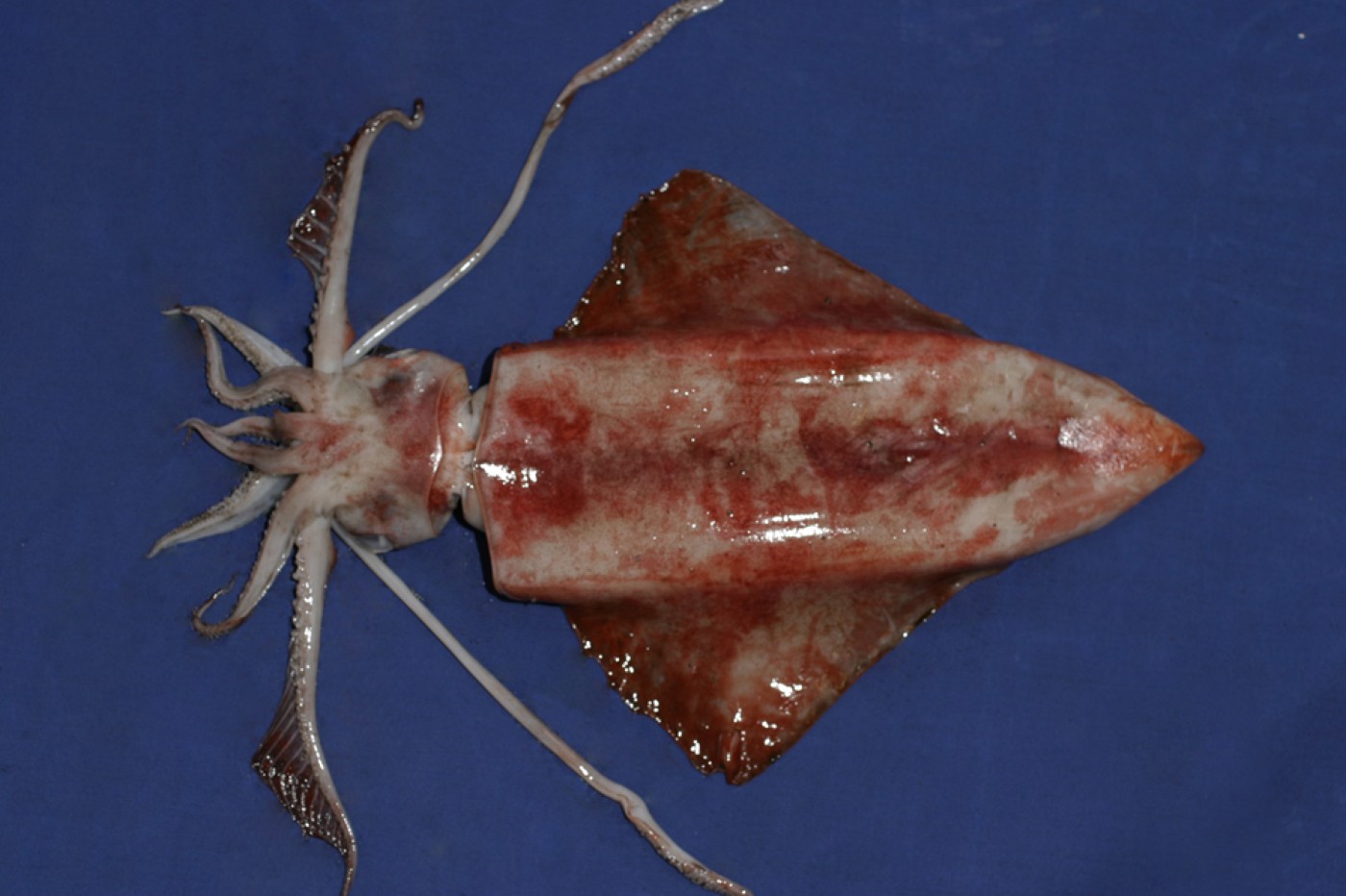
A single male specimen of T. rhombus (Figure 1) was caught using a hand squid jig just after dusk on 26 December 2006, 15 metres offshore Dolfin Islet (44°41′N 14°41″E) at the depth of 10 m (the shallowest recorded capture of a live specimen in the Mediterranean Sea), near the islands of Rab and Pag in the eastern part of the northern Adriatic Sea. At the time of capture, the sea temperature was 12°C, and the air temperature was 15°C. The species was identified using the key in the FAO Cephalopod Catalogue (Roper et al., Reference Roper, Sweeney and Nauen1984). The specimen is archived in the malacological collection of the Rijeka Natural History Museum under inventory number PMR004979. Analysis of the individual included measurements to the nearest millimetre, body weight to the nearest gram, determination of sex and maturity stage.
Male specimen of Thysanoteuthis rhombus (DML = 346 mm) caught on 26 December 2006, off Dolfin Islet, northern Adriatic, Croatia.
This is the first record of this species in the Adriatic Sea and the northernmost capture in the Mediterranean Sea.
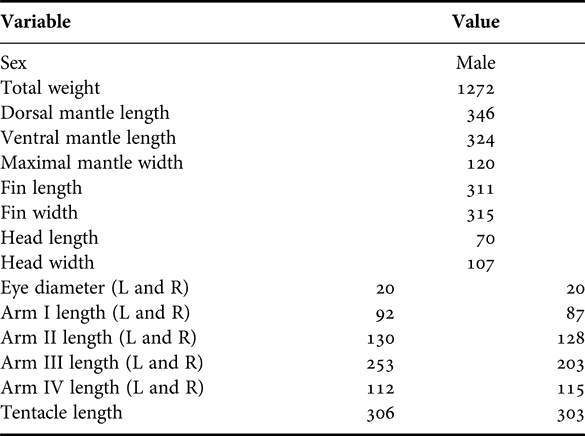
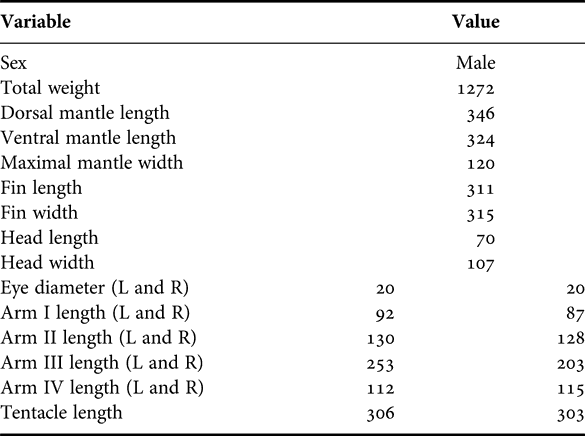
All the measurements of the specimen are presented in Table 1. There was no hectocotylized arm, and sex was determined by examining the gonads in the mantle cavity. The testis had an elongated oval shape which suggests that the specimen was mature. However, its mantle length was smaller than the size at which the species matures (Nigmatullin et al., Reference Nigmatullin, Arkhipkin and Sabirov1995; Bower & Myahara, Reference Bower and Myahara2005). The morphological transition that occurs between juveniles and adults is gradual (Nigmatullin & Arkhipkin, Reference Nigmatullin, Arkhipkin and Okutani1998), so this specimen could have been in an intermediary phase. According to the relationship between the number of increments in statoliths and mantle length (Nigmatullin et al., Reference Nigmatullin, Arkhipkin and Sabirov1995), it is possible to approximate the age of specimen to between 150 and 180 days.
Sex, morphometric characters and total weight of caught Thysanoteuthis rhombus.
Planktonic egg masses (Guerra et al., Reference Guerra, Gonzalez, Rocha, Sagarminaga and Canadas2002) and juveniles (Issel, Reference Issel1920; Berdar & Cavallaro, Reference Berdar and Cavallaro1975; Salman et al., Reference Salman, Katagan and Avni Benli2003) have been collected in the Mediterranean Sea. Adult specimens have been captured near Menorca Island (Morales, Reference Morales1980), in the Euboikos Gulf of the Aegean Sea (Vardala-Theodorou et al., Reference Vardala-Theodorou, Giamas and Dimitropoulos1991), off the coast of Tunisia (Ezzeddine-Najai, Reference Ezzeddine-Najai, Oloriz and Rodrigues-Tovar1996) and near Sicily (Jereb & Ragonese, Reference Jereb and Ragonese1994; Giordano et al., Reference Giordano, Perdichizzi and Greco1998) and Sardinia (Maggiani, 1995). Several published articles on cephalopods of the Adriatic Sea (Gamulin-Brida & Ilijanić, Reference Gamulin-Brida and Ilijanić1972; Mandić, Reference Mandić1984; Bello, Reference Bello1990; Krstulović-Šifner et al., Reference Krstulović-Šifner, Lefkaditou, Ungaro, Ceriola, Osmani, Kavadas and Vrgoč2005) have not included T. rhombus as a member of the Adriatic cephalopod fauna. Only a pair of beaks of this species were found in the stomach contents of swordfish in the southern Adriatic Sea (Bello, Reference Bello1999). This could not be treated as the valid record or confirmation of presence of this species in the Adriatic Sea, since the swordfish is a highly migratory species which could enter the Adriatic Sea from the Ionian or Aegean Seas.
In Okinawa, T. rhombus occurs at temperatures between 6 and 21°C, with highest catches occurring at 14–15°C (Bower & Myahara, Reference Bower and Myahara2005). The number of ‘thermophilic’ species caught during the last decade have increased in the central and northern Adriatic. Several species, fairly rare or very rare until now, are more abundant, while some are new to the Adriatic Sea (Dulčić et al., Reference Dulčić, Grbec and Lipej1999). Similar sporadic records of some marine organisms have also been reported earlier. Their occurrence has tried to be explained by the influence of the ‘Adriatic ingression’ (the entrance of Ionian Sea waters into the Adriatic Sea in the surface and intermediate layers increasing temperature, salinity and amount of nutrients of Adriatic waters) (Pallaoro, Reference Pallaoro1988; Dulčić & Grbec, Reference Dulčić and Grbec2000). Probably this record could be related with this effect and could be supported with the fact that T. rhombus is a relatively slow swimmer (Nishimura, Reference Nishimura1966), and the specimen was simply introduced by the currents entering Ionian waters. Another explanation of such a ‘late’ record in the Adriatic Sea could lie simply in its rarity in all areas of the Mediterranean Sea (Mangold & Boletzky, Reference Mangold, Boletzky, Clarke and Trueman1988), or in some unknown aspect of squid metabolism and/or behaviour.
ACKNOWLEDGEMENTS
We thank C. Nigmatullin and G. Bello for their advice and information. We also thank the Croatian Ministry of Science, Education and Sport for financial support (Project nos. 119-1782739-1233 and 001-0013077-0844).