


Introduction
A widening of the scope of theoretical models and therapeutic strategies is evident in the field of cognitive therapy (Leahy, Reference Leahy2004; Wills and Sanders, Reference Wills and Sanders1997). For example, a number of features have received attention: interpersonal (Saatsi, Hardy and Cahill, Reference Saatsi, Hardy and Cahill2007), meta-communicative (Safran and Muran, Reference Safran and Muran2000), developmental (Liotti, Reference Liotti2004) and experiential (Elliot, Watson, Goldman and Greenberg, Reference Elliot, Watson, Goldman and Greenberg2004). While there are numerous studies on the efficiency and outcomes of cognitive therapy (Norton and Price, Reference Norton and Price2007; Westbrook and Kirk, Reference Westbrook and Kirk2005), research on cognitive therapy training, supervision and therapists’ competence is scarce (Bennett-Levy, Reference Bennett-Levy2006). In light of the new developments, it is challenging to plan and run therapy training programmes. In the following, we shall discuss this challenge from four points of view: 1) psychotherapist's competence as a combination of different kinds of skills; 2) trainees’ prior knowledge and views of cognitive therapy as a base for their learning orientation; 3) the role of reflection in professional learning processes; and 4) the nature of professional identity development.
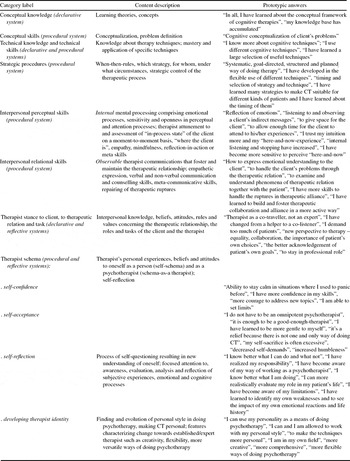
According to the conceptual model (DPR) of Bennett-Levy (Reference Bennett-Levy2006), the “psychotherapist competence” includes three aspects: declarative knowledge, procedural knowledge and self-reflective skills (see Table 1 for examples of the categories). The declarative system includes interpersonal, conceptual, and technical knowledge, while the procedural system consists of skills that are the manifestation of declarative knowledge in practice, such as technical and interpersonal skills (Bennett-Levy and Thwaites, Reference Bennett-Levy, Thwaites, Gilbert and Leahy2007). Therapists acquire expertise by combining different skills into an increasingly sophisticated range of when-then rules that enable them to decide what to do with the client in different situations.
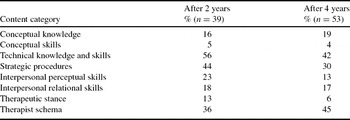
Content categories of open answers

At the beginning of their training, trainees “orientate to new learning tasks” and process new information on the basis of their prior knowledge of and expectations towards cognitive therapy. In other words, CT trainees’ prior learning and experiences affect what they expect of training, what learning goals they set for themselves, what they pay attention to, and how they become motivated to practise different skills. Before the trainees have acquired therapy skills, all information about other people is processed through their self-schema (“the person of the therapist”) which is idiosyncratically related to their personal life history. But as soon as they acquire therapy-specific skills, this processing progressively takes place on the basis of the self-as-therapist-schema, which includes different therapeutic skills, attitudes and rules (Bennett-Levy, Reference Bennett-Levy2006). Consistent with the above, it has been noticed that prior experience in CT predicts the development of competence in CT (James, Blackburn, Milne and Reichfelt, Reference James, Blackburn, Milne and Reichfelt2001). Presumably, the trainees with prior CT experience can more easily assimilate the new information provided by the training programme into their already existing knowledge base.
The reflective skills – the third system in the DPR model (Bennett-Levy, Reference Bennett-Levy2006) – become important when trainees realize that something is not consistent with what they hold to be true, or when they are dissatisfied with their current ways of thinking or doing psychotherapy. Here, focused attention and reflection on the problem are needed (Bennett-Levy, Reference Bennett-Levy2006). These cognitive conflicts or “disorienting dilemmas” can stimulate reflection and the re-evaluation of prior knowledge. This in turn may lead to the accommodation of old knowledge and to the construction of new knowledge (e.g. Baumgartner, Reference Baumgartner2001; Marsick and Watkins, Reference Marsick and Watkins2001; Mezirow, Reference Mezirow1991, Reference Mezirow1996, Reference Mezirow, Mezirow and Associates2000). In other words, conceptual change and transformative learning may even require a collision of old and new knowledge. In short, continuous reflection and learning of reflective skills are important for long-term development of professional expertise (Bennett-Levy, Reference Bennett-Levy2006; Bennett-Levy and Beedie, Reference Bennett-Levy and Beedie2007; Bennett-Levy and Thwaites, Reference Bennett-Levy, Thwaites, Gilbert and Leahy2007; Hawkins and Shohet, Reference Hawkins and Shohet2006; Rønnestad and Skovholt, Reference Rønnestad and Skovholt2003; Schön, Reference Schön1983, Reference Schön1987).
Learning and doing psychotherapy are not, however, only a matter of mastering theories and techniques, but also have to do with the therapist's personal self, life history, attitudes, and goals. The therapist's “professional identity development” is, by nature, a personal and emotional one. Trainees start to develop a therapist identity (self-as-therapist-schema) that is distinct from their self-schema, but yet shares some common elements (Bennett-Levy, Reference Bennett-Levy2006). The personal and professional beings are thus intertwined in every psychotherapeutic encounter. Both of them are likely to influence trainees’ current goals, concerns, and readiness to reflect on their actions.
It is possible to identify different phases in the professional development on the basis of trainees’ and experts’ primary concerns and foci of attention (Hawkins and Shohet, Reference Hawkins and Shohet2006). Furthermore, differences also exist in the way therapists tend to apply their psychotherapeutic knowledge and skills at different stages of their career. At first, beginners show self-centred activation and personal orientation. For example, a helper tends to hasten towards identification of the problem and tends to provide strong emotional support and specific advice based on his/her own experience (Rønnestad and Skovholt, Reference Rønnestad and Skovholt2003). For example, it has been observed that junior medical students show an emotional and self-centred focus (Niemi, Reference Niemi1997). Furthermore, intermediate medical students tend to activate all they know about a subject, even if irrelevant, from their already large base of detailed knowledge (Boshuizen and Schmidt, Reference Boshuizen and Schmidt1992; van de Wiel, Boshuizen and Schmidt, Reference Van de Wiel, Boshuizen and Schmidt2000). Likewise, cognitive therapy trainees find training intensely challenging, and they become increasingly aware of the standards required of a cognitive therapist. They set high demands on themselves and feel pressure to do things perfectly. A strong need for certainty, self-doubts and dependence are often expressed. Trainees try to control their anxiety and uncertainty by using techniques that can be easily applied to all clients. But, at this early phase of their professional learning, CT techniques are applied in a relatively standard, cautious and even rigid way. Trainees lack the flexibility that is needed, especially when working with more complex cases (Bennett-Levy and Beedie, Reference Bennett-Levy and Beedie2007; Haarhoff, Reference Haarhoff2006; James et al., Reference James, Blackburn, Milne and Reichfelt2001).
Only during the next phases of professional development are therapists able to orientate in more client- and process-centred ways in psychotherapeutic encounters. For example, the significance of the therapeutic relationship is increasingly recognized. Finally, at the master level, the focus is process-in-context-centred. At this stage, the therapist is already able to apply when-then rules in a flexible way (Bennett-Levy, Reference Bennett-Levy2006; Hawkins and Shohet, Reference Hawkins and Shohet2006; Rønnestad and Skovholt, Reference Rønnestad and Skovholt2003; Stoltenberg, Reference Stoltenberg2005).
In all, there is evidence of significant gains in therapist competence during and after the formal training but there also seems to be considerable variation across different skills and between individuals. In accordance with the descriptions of the early professional phase, empirical observations show that technical orientation overrides that of interpersonal learning. For example, trainees show significant gains in technical expertise, e.g. in cognitive behavioural techniques, while evidence of gains in general interview procedures or in interpersonal skills is not as unequivocal. In other words, a similarly increased level of mastery in basic or advanced interpersonal skills is not found as in technical expertise (Bennett-Levy and Beedie, Reference Bennett-Levy and Beedie2007; Brosan, Reynolds and Moore, Reference Brosan, Reynolds and Moore2007; James et al., Reference James, Blackburn, Milne and Reichfelt2001; Milne, Baker, Blackburn, James and Reichelt, Reference Milne, Baker, Blackburn, James and Reichelt1999; Orlinsky and Rønnestad, Reference Orlinsky and Rønnestad2005; Westbrook, Sedgwick-Taylor, Bennett-Levy, Butler and McManus, Reference Westbrook, Sedgwick-Taylor, Bennett-Levy, Butler and McManus2008).
To sum up, improved competence can be expected especially in conceptual knowledge and technical skills while similar evolution in interpersonal skills might not be perceptible. Presumably, trainees’ learning orientation, foci of reflection, and the attained level of mastery in different skills are likely to alter phase by phase (Bennett-Levy, Reference Bennett-Levy2006; Bennett-Levy, Lee, Travers, Pohlman and Hamernik, Reference Bennett-Levy, Lee, Travers, Pohlman and Hamernik2003; Hawkins and Shohet, Reference Hawkins and Shohet2006). In the present study, we were interested in finding out how CT trainees’ conceptual knowledge, technical and interpersonal skills, and the foci of their self-reflection, emerge at two points of time during a 4-year training in cognitive therapy.
Aims
We aimed to answer the following questions:
1. What do CT trainees perceive to be important to be learned in their training, i.e. what is their learning orientation?
2. What aspects of professional learning do they focus on when they reflect on their own learning experiences, i.e. what are the foci of self-reflective processing?
3. How do they assess their competences as psychotherapists?
These questions were posed at two different stages of the training (2 and 4 years) and thus a further aim of the study was to see how these features changed over time.
Method
Participants and procedure
Finnish cognitive psychotherapy training takes 4 years and it includes modules of theoretical learning (400 hours of seminars, tutorials, writing an article as a final exam), clinical practice (300 hours) and supervision (140–180 hours). On average, there are six 2-day seminars in a year. The tutorials, therapy practice and supervision run parallel with the seminars. During the first 2 years of training, teaching focuses on conceptual models of cognitive therapy, conceptualization skills and basic cognitive therapy techniques. Later on, issues of therapeutic relationships, the therapist's “self”, and the application of different CT strategies in different psychiatric disorders are increasingly implemented into the programme. At the end of the training, the trainees write their final essays to formally demonstrate their comprehensive and deep learning in cognitive therapy. Finnish training programmes also include group cognitive psychotherapy during the first 2 years of training (40 hours). This is a person-centred model for self-reflection and self-practice (Bennett-Levy et al., Reference Bennett-Levy, Turner, Beaty, Smith, Paterson and Farmer2001; Laireiter and Willutszki, Reference Laireiter and Willutzki2003). Group psychotherapy is followed by individual cognitive psychotherapy (40 hours), where self-reflection is naturally a core component.
The participants in the present study were trainees in 4-year training programmes: psychologists, psychiatrists and other mental health professionals, aged on average 41.3 (SD = 5.6) in the first inquiry and 43.1 (SD = 6.3) years in the second inquiry; 87% were women. We collected data after 2 years’ training in three programmes (n = 39, return 72%) and after the entire 4 years’ training in four programmes (n = 53, return 66%). The participants had several years of clinical experience (on average 7.8 and 9.5 years, respectively), many of them with prior training in psychotherapy, e.g. basic courses in cognitive therapy. Altogether 30 of the trainees participated in both inquiries (time1 – time2), which allowed analyses of changes between the two points of time in this “subgroup t1-t2”.
Measures
Three assessment measures were employed. We used self-ratings of psychotherapist skills and competence and written self-reports to study the trainees’ learning orientation and foci of their self-reflections. First, we constructed a skills inventory (Finnish Inventory of Cognitive Psychotherapist Skills, FICPS) consisting of 54 items on essential skills and techniques in “cognitive” (e.g. Socratic dialogue, identifying automatic thoughts), “behavioural” (e.g. behavioural experiments), “experiential” (e.g. imagery, role plays) and “constructivist-interpersonal” therapies (e.g. identifying meaning organizations, evaluation of the quality of the alliance). The participants rated the “importance”, “mastery” and “practice” of these skills on Likert scales (range of variation 0–3). We then calculated component scores for these skills. Cronbach alfa scores varying between 0.632–0.898 indicated reasonable internal consistency of the measures.
The second measure was based on the work of Orlinsky et al. (Reference Orlinsky, Ambuhl, Rønnestad, Davis, Gerin, Davis, Willutzki, Botermans, Dazord and Cierpka1999), Orlinsky and Rønnestad (Reference Orlinsky and Rønnestad2005), and on the ideas of Safran and Muran (Reference Safran and Muran2000). First, a global self-appraisal of “psychotherapist competence” was requested on a scale of 0–100 (on which 100 signified a complete subjective match with the standards set for a newly graduated psychotherapist). Then, self-assessments were given in “technical” expertise (e.g. theoretical understanding of therapy, Cronbach alfa 0.656), in “basic relational skills” (e.g. feeling “natural”, effective communication of concern, Cronbach alfa 0.674), in “advanced relational” skills (e.g. constructive use of one's own reactions, Cronbach alfa 0.603) and in “self-awareness” (e.g. awareness of the impact of one's own life history, Cronbach alfa 0.683).
Third, we used a qualitative approach that posed four open questions: i) What is the most important thing you have learned in cognitive therapy training? ii) How have you developed as a psychotherapist during the training? iii) What has been difficult to learn or practise during the training? iv) What would be your targets for further professional development (in comparison to your view of the ideal psychotherapist)? The open form of questions was chosen to give scope for the trainees to freely report their reflections on, their experiences of, and their problems concerning their professional learning. We wanted to grasp their spontaneous foci of self-reflections and the meanings they attached to their learning process.
Data analyses
Self-appraisals of skills and competence were compared between the groups using Student's t-test for independent samples. The analyses of changes in skills between the two points of time during the training were done in sub-group t1-t2 by Student's t-test for paired samples.
The qualitative material was processed by the NVivo-program. The content analysis was mainly conceptually driven, inspired by and modified on the basis of the model and research by Bennett-Levy and colleagues (Bennett-Levy, Reference Bennett-Levy2006; Bennett-Levy and Beedie, Reference Bennett-Levy and Beedie2007; Bennett-Levy et al., Reference Bennett-Levy, Turner, Beaty, Smith, Paterson and Farmer2001, Reference Bennett-Levy, Lee, Travers, Pohlman and Hamernik2003). In addition, new sub-categories were identified on the basis of the material itself to illustrate in detail the nuances of the trainees’ views. This data-driven analysis shows some similarity to strategies applied in grounded theory. The process of content analysis proceeded in a cyclic manner. First, the main researchers (PN and JT) read all the material, after which preliminary categories were identified on the basis of Bennett-Levy's conceptual model and on the quality of the answers. Second, independent coding of the material was performed and consequent refining of the criteria and boundaries for each category was carried out. Third, an independent rater – an experienced cognitive therapist – coded a sample of answers to assess the reliability of the coding system (agreement rate 75.6 %). The main researchers negotiated and decided on the final categories, e.g. concerning the need to conflate some categories together.
The analysis resulted in eight categories (Table 1). Many of the written answers were too limited to allow for distinctions between some categories of declarative, procedural or reflective domains. The categories highlight the content or focus of self-reflections more than the underlying processes in different skills systems. In real life therapeutic encounters, these phenomena are inseparable. For example, a therapist's personal stance both to him/herself and to the client is closely linked with his/her interpersonal knowledge or skills (Bennett-Levy and Thwaites, Reference Bennett-Levy, Thwaites, Gilbert and Leahy2007; Thwaites and Bennett-Levy, Reference Thwaites and Bennett-Levy2007). Consequently, some of the distinctions were a matter of the degree of articulation in the answer. For example, the categories of technical knowledge and technical skills were conflated into one category, because the answers were not sufficiently explicit to be classified either as declarative or procedural knowledge. Accordingly, category “therapist stance” includes interpersonal knowledge, which was not frequently reported, and beliefs, attitudes, rules and values concerning the therapeutic relationship, the roles and tasks of the client and the therapist. On the other hand, we wanted to and were able to keep the two interpersonal categories – perceptual and relational skills – separate. Finally, the self-schema and the self-as-therapist-schema were combined because the references to the former were infrequent. Further, the material lent itself to the following additional sub-categories: self-confidence, self-acceptance, self-reflection and developing therapist identity.
The frequencies in the categories and the percentages (of what was mentioned and of the participants) were calculated for all four questions (Tables 1–5). If a person reported several examples of the same category in his/her answer to the same question, these were coded only once. The distributions of the answers in the two groups of trainees and between the two points of time were compared by calculating chi squares.
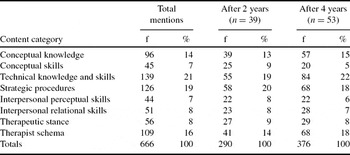
The number of mentions across the questions: “What one has learned”, “How one has developed”, “What has been difficult to learn” and “What would the targets be for further development?”

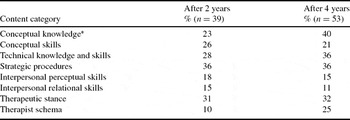
The number of mentions to the question “What is the most important thing you have learned in cognitive therapy training?” The percentages of those trainees who gave an answer in this category

*p<0.05
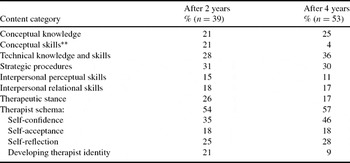
The number of mentions to the question “How have you developed as a psychotherapist during the training?” The percentage of those trainees who gave an answer in this category

**p<0.01
The number of mentions to the question “What would be your targets for further professional development?” The percentage of those trainees who gave an answer in this category

Results
Quantitative analyses on learning orientation, self-assessed therapist skills and competence
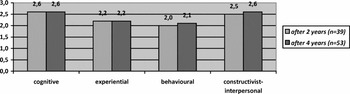
Basic cognitive techniques and constructivist-interpersonal skills were considered the most important skills to be learned (Figure 1). There were no differences between the two groups or any changes in sub-group t1-t2 between the two points of time.
The perceived importance of different therapeutic techniques and skills. Means of ratings on FICPS scales (0 = indifferent, unnecessary, 1 = of minor use, use only seldom, 2 = of substantial use, necessary for most cognitive therapists, 3 = essential technique, necessary for all cognitive therapists)

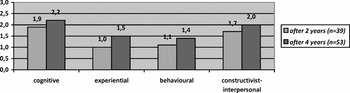
Cognitive and constructivist-interpersonal skills were practised the most (Figure 2). Significant group differences and changes between the two points of time (in sub-group t1-t2,) took place in practising skills in all composite scores: cognitive (group difference: t(69) = −3.2, p < .01; change: t(48) = −3.0, p < .05), constructivist-interpersonal (group difference: t(79) = −3.6, p < .001; change: t(51) = −2.5, p <.05), experiential (group difference: t(86) = −4.5, p < .001; change: t(56) = −3.1, p < .01) and behavioural (group difference: t(74) = −3.3, p < .001; change: t(50) = −3.4, p < .001) techniques.
The self-assessed practice of different therapeutic techniques and skills. Means of ratings on FICPS scales (0 = not at all, 1 = occasional trials, 2 = increasing use, 3 = regular use)

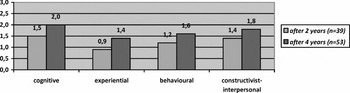
The highest levels of self-assessed mastery were found in cognitive and constructivist-interpersonal techniques, and the lowest in experiential and behavioural techniques (Figure 3). Significant group differences and changes were found in all scores: cognitive (group difference: t(71) = −4.7, p < .001; change: t(49) = −3.0, p < .01), constructivist-interpersonal (group difference: t(81) = −5.1, p < .001; change: t(51) = −3.1, p < .01), experiential (group difference: t(86) = −4.7, p < .001; change: t(56) = −3.0, p < .01) and behavioural techniques (group difference: t(71) = −4.7, p < .001; change: t(49) = −4.3, p <.001).
The self-assessed mastery of different therapeutic techniques and skills. Means of ratings on FICPS scales (0 = not at all, 1 = adequately, 2 = fairly well, 3 = very well)

A highly significant group difference in the global self-assessment of psychotherapist competence was found (M = 52.2 and 78.1, t(87) = −8.9, p < .001). The change in competence ratings between the two time-points was also highly significant (t(57) = −4.4, p < .001).
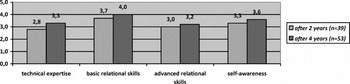
The basic relational skills were assessed as highest already after 2 years’ training (Figure 4). The significant group differences and changes were found in technical expertise (group difference: t(87) = −4.6, p < .001; change: t(57) = −4.3, p < .001), in basic relational skills (group difference: t(84) = −3.1, p < .01; change: t(55) = −2.6, p < .05), and in self-awareness (group difference: t(88) = −3.1, p < .01; change: t(54) = −3.0, p < .01). The smallest group difference was found in advanced relational skills (group difference: t(86) = −2.0, p < .05); the change in these skills was not significant (t(56) = −1.9, p < .10).
Self-assessed competence as a psychotherapist. Means of ratings on scales 0 = not at all, 5 = well

Qualitative analyses of professional learning and development
The answers to the four open questions (“What has been learned, how one has developed, what has been difficult to learn and what would the targets be for further learning?”) resulted in 666 “mentions” or coding units (two materials combined), which gives an overall view of the foci of the trainees’ self-reflective processing (Table 2). The highest frequencies were found in technical domain, strategic procedures, therapist schema and conceptual knowledge. Statistically significant differences were not found between the two groups of trainees.
The answers to the open question “What is the most important thing you have learned in cognitive therapy training?” revealed that important learning outcomes were identified in technical knowledge and skills and in strategic procedures, but also in the accumulation of conceptual knowledge, and in learning about the therapeutic stance (Table 3). Interpersonal perceptual and relational skills were mentioned relatively infrequently. No significant differences were found between the groups: there was only a trend for graduating trainees to mention more often conceptual knowledge as a learning outcome (chi2 = 5.2, p < .05).
The trainees reported “problems of learning” and practising (a table for the figures is not included) in technical skills (28% and 45%) and in strategic control (38% and 25%) of the therapeutic process, whereas difficulties were not recognized in learning interpersonal skills (0% and 2%), or therapeutic stance (0%), and nor were problems described in reference to self as a therapist (5% and 2%).
When the trainees were asked to reflect on their “development as psychotherapists”, most often they described their therapist schema (Table 4), especially their increased self-confidence. Developing therapist identity was reported less often at the end of the training, but the difference did not reach statistical significance. Increases in self-reflective skills were also reported but their relative weight did not increase during the training, as was also the case with self-acceptance. Only one group difference was found: those with 2 years of training behind them mentioned conceptual skills (chi2 = 7.4, p < .01) more often.
In the trainees’ answers to the question “What would be your targets for further professional development?” technical and strategic skills were raised as major targets (Table 5). Relatively frequently they also sketched their learning needs in terms of the therapist schema but only a minority mentioned the need to develop their interpersonal skills.
Discussion
This study analysed cognitive therapy trainees’ learning orientation, foci of self-reflections, and their self-appraisals of professional learning. First, we assumed that learning proceeds differently in the different domains of skills. Second, we argued that trainees’ views on the importance of learning different skills, i.e. trainees’ learning orientation, play an essential role in their subsequent learning process. Our findings provided support for these notions. In all, the trainees’ perceived competence as therapists improved significantly but there were marked differences in different domains of skills. Progress was most notable in technical and conceptual domains, e.g. in the skill of conceptualization and in the increase of conceptual knowledge. On the contrary, the least progress was made and the lowest level of competence was reached in advanced interpersonal skills. Our findings also underline the importance of trainees’ learning orientation. Namely, what the trainees considered important to be learned was also practised the most, which ultimately resulted in better learning outcomes.
Third, in our opinion, engaging in self-reflection and the learning of reflective skills are crucial for the accommodation of prior knowledge, for setting new goals for learning and, subsequently, for continuous professional development. Fourth, we suggested that the foci of self-reflections are different in the different periods of professional development. For example, conceptual and technical learning are likely to be in the trainees’ focus at the beginning of the training, while a more reflective and client-centred focus develops later on (Bennett-Levy, Reference Bennett-Levy2006; Bennett-Levy et al., Reference Bennett-Levy, Lee, Travers, Pohlman and Hamernik2003; Hawkins and Shohet, Reference Hawkins and Shohet2006; Rønnestad and Skovholt, Reference Rønnestad and Skovholt2003). Thus, the trainees of our study reflected on their progress and also recognized the greatest difficulties and the need for further learning mainly in terms of technical knowledge, skills and higher-order strategic procedures (e.g. when-then-rules). Interpersonal skills emerged as the domain in which essential learning outcomes, problems or needs for further learning were least often recognized and spontaneously reflected upon. However, we observed no clear signs of increased self-reflection or client-centred focus during the training.
On the whole, our results support the different emphasis assigned to technical vs. interpersonal skills when orienting to and making efforts to learn CT skills. To understand this, we need to pay attention to the nature of learning technical vs. interpersonal skills and to the background of the trainees’ learning orientations. First, interpersonal skills are skills that the trainees might have felt they had already mastered prior to the CT training, because these skills had been learned incidentally and informally as part of previous interpersonal experiences (Bennett-Levy and Thwaites, Reference Bennett-Levy, Thwaites, Gilbert and Leahy2007; Marsick and Watkins, Reference Marsick and Watkins2001). In addition, these skills might have been practised in earlier psychotherapy training or in clinical practice. Thus, the trainees may not recognize a need for further development of interpersonal skills. It is, however, worth noting that their actual skills, however good they may be initially, may nevertheless prove inadequate in a new context such as cognitive psychotherapy. For example, trainees with experience in other fields of psychotherapy may not benefit from their prior experience (James et al., Reference James, Blackburn, Milne and Reichfelt2001), but may instead have to unlearn their prior ways of doing therapy as these may turn out to be dysfunctional in doing cognitive therapy (Niemi and Äärelä, Reference Niemi and Äärelä2000). This is why it is important to engage in self-reflection and in the re-evaluation of prior knowledge and skills when altered standards for psychotherapist competence are set in CT training. In other words, trainees may need to accommodate their prior knowledge, perhaps even their existing schema as a therapist. Second, unlike interpersonal skills, technical and conceptual skills may seem more salient and formal goals for trainees (to be learned “de novo”) (Bennett-Levy and Thwaites, Reference Bennett-Levy, Thwaites, Gilbert and Leahy2007). In addition, cognitive therapy may appeal to them as a logical, rational and practical therapy (Haarhoff, Reference Haarhoff2006; Niemi and Äärelä, Reference Niemi and Äärelä2000). Hence it is easier to recognize conceptual and technical skills and to become aware of shortcomings and the consequent need to put effort into practising them. In other words, we suggest that the collision of formerly attained competence and the new standards for therapist competence is more likely to take place in the domain of technical learning, whereas it is more difficult to appraise tacit, less conscious interpersonal skills and to become aware of the need to refine them.
Accordingly, the trainees of our study seemed to be satisfied with their basic relational skills and rated them as good even at the initial stages of training. Thus, this state of satisfaction, i.e. the apparent absence of cognitive conflict between perceived current level of mastery vs. perceived standards in interpersonal skills, may not serve as a proper catalyst for self-reflection and further learning. From this perspective, it is also worth noting that only a quarter of the trainees reported progress in their self-reflective skills, a finding consistent with that of Bennett-Levy and Beedie (Reference Bennett-Levy and Beedie2007). What is more, there were no more reflections on interpersonal and self-reflective issues at the end of the training than earlier, although such elements – for example, the trainees’ personal psychotherapies – were increasingly included in the programmes. Altogether, the trainees’ views of the importance of different therapy skills and their foci of self-reflections did not change between the two time-points during the training.
It is important to notice that, in addition to technical emphasis, the early stage of professional development is characterized by self-centred, personal and emotional orientation. Hence, it might be fruitful to explore the observed technical dominance and scarce focusing on interpersonal and self-reflective skills from this emotional and personal perspective. Technical dominance may result from the trainees’ uncertainty, their great self-demands, and their attempt to achieve control by close adherence to methods (Haarhoff, Reference Haarhoff2006; Hawkins and Shohet Reference Hawkins and Shohet2006; Rønnestadt and Skovholt 2001). CT's emphasis on structure can also encourage the expectation that there is always an “answer” and a “right way” to proceed, which may actually increase the trainees’ distress. Accordingly, the trainees of the present study often elaborated their therapist schema in terms of evolving self-confidence and assertiveness. It is thus also understandable that they tend to attribute their difficulties to their own shortcomings (Bennett-Levy and Beedie, Reference Bennett-Levy and Beedie2007; Niemi and Tiuraniemi, Reference Niemi and Tiuraniemi2005). Self-centred, emotional activation or strict adherence to methods may also, in turn, delimit trainees’ resources for grasping subtle situational and interpersonal aspects in therapeutic encounters. Even negative treatment outcomes may result, especially with more complicated cases (Castonguay, Goldfried, Wiser, Raue and Hayes, Reference Castonguay, Goldfried, Wiser, Raue and Hayes1996). Fluctuations in self-confidence can be seen (Bennett-Levy and Beedie, Reference Bennett-Levy and Beedie2007), and trainees may feel helpless and incompetent in difficult patient encounters (Niemi and Tiuraniemi, Reference Niemi and Tiuraniemi2005). Furthermore, feelings of incompetence may result in avoidance of therapeutic measures that are expected to challenge the felt sense of “self-as-therapist”, or the trainees may avoid techniques such as exposure for fear of upsetting the patients (Haarhoff, Reference Haarhoff2006). Advanced interpersonal skills, e.g. “making the patient do his/her part in the therapy”, may also be found difficult for this reason. In agreement with this, the trainees in our study reported less often practising and lower mastery of specific experiential and behavioural skills that are likely to require active measures on the part of the therapist, and which may increase the patient's resistance. In short, these are some examples of the ways in which a mutual and potentially “regressive” interchange between technical learning and, on the other hand, emotional and personal aspects of therapist identity development may emerge in the professional learning process.
It is, however, important to notice that some of the self-reflections provided by the trainees suggested that also a mutually beneficial interaction or a “progressive” cycle can emerge between different learning domains. For example, increased mastery of techniques was seen to support the felt sense of competence, which, in turn, was likely to encourage more challenging goal setting for further learning. This kind of positive cycle may explain the finding that, towards the end of the training, the greatest increase in practice was seen in behavioural and experiential techniques, which were generally found difficult to master. This may exemplify a gradual progress towards a more advanced orientation in career development. In addition, when outlining their future development as psychotherapists, the trainees often adopted the perspective of the “therapist schema”, e.g. they described their personal attributes, attitudes and behaviour in psychotherapeutic encounters. This finding suggests that the development of psychotherapist identity was seen as an important goal in post-training professional development.
What might then be the pedagogical implications of our findings? In the following, we present some suggestions and recommendations for CT trainers concerning: 1) trainees’ learning orientation; 2) learning of self-reflection; and 3) professional identity development and the integration of the different skills into overall competence as a psychotherapist.
Trainee's learning orientation: how to orientate trainees to the learning of cognitive psychotherapy?
i) Address CT trainees’ expectations and views of cognitive therapy already during the enrolment and in the early stages of training because prior knowledge, beliefs and expectations are likely to direct trainees’ goal setting and efforts in the subsequent learning process.
ii) Orientate trainees to engage in a continuous task of self-exploration and emphasize the learning of self-reflective skills as a “meta-goal” for professional learning throughout a therapist's career. One way to continuous self-exploration might start from modelling, e.g. from observing experienced therapists’ performance from video-recordings, and from reflecting on their performance. This could orientate trainees towards the tasks of self-exploration and of learning to explicate the ways of doing psychotherapy both in theoretical and in practical terms.
Learning of self-reflection: how to enhance self-reflection and learning of self-reflective skills?
i) Enhance the recognition of and reflection on interpersonal skills, and the therapist's personal life history, and the influence of these on psychotherapeutic encounters. It is understandable that trainees may have “blind spots” regarding their own interpersonal issues. This may result in apparent satisfaction with the self-perceived mastery of interpersonal skills and a failure to focus on these skills. Trainees may also feel vulnerable around these personal and interpersonal issues, and this may dispose them to a defensive learning orientation (Salonen, Lehtinen and Olkinuora, Reference Salonen, Lehtinen, Olkinuora and Brophy1998) and to a failure to engage in self-reflection. This in turn may lead to difficulties in learning more advanced skills and in working with difficult cases. Therefore, it is important that these issues are explicitly addressed during the training, and that their existence is acknowledged as nothing to be ashamed of.
ii) Foster reflective discourse in an emotionally secure and validating learning environment. Deliberate practice and learning from errors (collision of prior learning and current demands for performance) require “emotionally secure” learning contexts. Thus, the CT trainers also need to pay attention to the evolution of group dynamics among the trainees. A safe learning context makes it easier for learners to accept feedback about their performance instead of developing a defensive learning orientation (Salonen et al., Reference Salonen, Lehtinen, Olkinuora and Brophy1998). Transformational learning – changing the “how we know” in addition to the “what we know” – obviously benefits from consensual validation and reflective discourse with other learners (Baumgartner, 2000; Mezirow, Reference Mezirow, Mezirow and Associates2000).
iii) Offer opportunities for feedback and make use of experiential techniques for self-practice and self-reflection of skills. There is evidence that self-reflective skills and accuracy of self-assessments can be taught by giving external feedback to students and by helping them to integrate this feedback with their own self-perceptions (Mok, Lung, Cheng, Cheung and Ng, Reference Mok, Lung, Cheng, Cheung and Ng2006; Roberts, Borden, Christiansen and Lopez, Reference Roberts, Borden, Christiansen and Lopez2005). Experiential techniques such as simulations, role-play and video-feedback (e.g. “interpersonal process recall”, Bennett-Levy and Thwaites, Reference Bennett-Levy, Thwaites, Gilbert and Leahy2007) are effective tools for learning skills, getting feedback and enhancing self-reflection. For example, self-practice and self-reflection (SP/SR) opportunities may nurture the development of a more subtle appreciation of, and sensitivity to clients’ “in-process states” (Bennett-Levy et al., Reference Bennett-Levy, Lee, Travers, Pohlman and Hamernik2003).
Professional identity development and the integration of the different skills into competence: how to enhance the development of psychotherapist identity and the integration of different therapy skills into an overall competence as a psychotherapist?
i) Make the linkages between conceptual, technical, interpersonal and self-reflective learning transparent and traceable to trainees in different learning contexts throughout the training. Setting a continuous, overall learning task of self-reflection for the whole duration of the training programme, covering all the modules of training, may help trainees to integrate different skills systems and to become more aware of all aspects of their learning. For example, in seminars, in personal therapy and in supervision sessions, therapeutic phenomena could be simultaneously explored and explicated in theoretical, technical and interpersonal terms. The inclusion of personal therapy in CT training programmes is likely to increase the trainee's awareness of the “self-schema”, while supervision will strengthen the evolving psychotherapist identity, i.e. the “self-as-therapist schema”. “The person of the therapist” and “self-as-therapist” might become more closely integrated if their impacts on psychotherapeutic encounters were simultaneously and repeatedly reflected on during the training.
ii) Provide for individually tailored learning goals and supervision. It is a challenging task for CT trainers to find the optimal sequence for the different training modules in order to achieve a “cyclic”, mutually stimulating learning process among the different psychotherapy skills. Furthermore, attention should be paid to the obvious individual differences in learning, e.g. in the pace of learning different skills. Consequently, these should be considered in the supervision and in the time scheduling of the training modules. According to the idea of self-directed adult learning, it is the learners who are in charge of their learning and goal setting. For realistic goal setting to occur, it is important that trainees have learned self-reflective skills that enable them to accurately assess their current level of competence. For example, working too early with too complicated cases and being confronted with problems in the therapeutic relation may put novice therapists’ self-confidence as a therapist at risk (James et al., Reference James, Blackburn, Milne and Reichfelt2001). The task of the trainers and supervisors is to provide stimulation for self-reflection and to guide trainees from one learning task to the next (Gruber, Palonen, Rehrl and Lehtinen, Reference Gruber, Palonen, Rehrl, Lehtinen, Gruber and Palonen2007; Mok et al., Reference Mok, Lung, Cheng, Cheung and Ng2006; Roberts et al., Reference Roberts, Borden, Christiansen and Lopez2005). This “scaffolding” is optimal when implemented within the proximal zone of development (Vygotsky, Reference Vygotsky1978; Wood, Bruner and Ross, Reference Wood, Bruner and Ross1976). All through the psychotherapists’ career, social scaffolding and collaborative inquiry play an important role in their expertise development. This can be seen as being embedded in discussions with mentors, co-trainees and colleagues in various social and CT networks (Baumgartner, 2000; Gruber et al., Reference Gruber, Palonen, Rehrl, Lehtinen, Gruber and Palonen2007; Marsick and Watkins, Reference Marsick and Watkins2001; Yan and Fischer, Reference Yan and Fischer2002; Yorks and Marsick, Reference Yorks, Marsick, Mezirow and Associates2000).
Strengths and weaknesses of the study
We have used mixed methods, fine-grained analyses of qualitative data together with quantitative self-assessments, to highlight learners’ personal learning experiences and spontaneous foci of self-reflections. The qualitative and quantitative methods yielded fairly consistent findings of trainees’ learning experiences. The self-assessed levels of competence in our study corresponded closely to those reported by Orlinsky and Rønnestad (Reference Orlinsky and Rønnestad2005), a fact that also supports the reliability and validity of our measures. The use of self-reports as measures of psychotherapists’ skills can be justifiably criticized for several reasons (e.g. Bennett-Levy and Thwaites, Reference Bennett-Levy, Thwaites, Gilbert and Leahy2007), such as lack of reliability and fidelity of supervisees’ self-disclosures (Chevron, Rounsaville, Rothblum and Weissman, Reference Chevron, Rounsaville, Rothblum and Weissman1983). To encourage honest self-disclosure, the respondents of our study answered anonymously and handed in or posted their answers in sealed envelopes directly to the researchers. Furthermore, our aim was not to measure an “objective” level of skills but to explore trainees’ subjective experiences and views, for which purposes self-reports are a regular choice. Consistency between self-assessments and external ratings of skills is an important issue to be studied in the future since the evidence on the accuracy of self-assessments is conflicting (Cassidy, Reference Cassidy2007; Davis et al., Reference Davis, Mazmanian, Fordis, Van Harrison, Thorpe and Perrier2006; Dunning, Heath and Suls, Reference Dunning, Heath and Suls2004; Eva, Cunnington, Reiter, Keane and Norman, Reference Eva, Cunnington, Reiter, Keane and Norman2004; Langendyk, Reference Langendyk2006).
In the content analysis, we quantified the observations or “mentions” in separate categories to highlight the relative emphasis given to each skills domain. However, this analysis strategy may overlook the context of a single mention and the respondent's overall perspective. It is also possible that our material (short written descriptions) was insufficient to grasp the subtle nuances of interpersonal skills. These may have been embedded in the “techniques” answers due to lack of more specific elaborations and, consequently, we may have failed to identify and classify them in their own right. It is also apparent that self-reports cannot uncover all aspects of learning that might have, e.g. incidentally, taken place because trainees’ self-reflective skills affect their self-reports. Written self-reports are neither sufficient to make distinctions between declarative and procedural knowledge, nor to reveal whether trainees’ knowledge is inert, merely theoretical knowledge, or whether deep, internalized learning has occurred. We need more sensitive and intensive research strategies and in-depth process-oriented research on the long-term learning of therapy skills.
We did not have baseline measures of skills and learning orientations, and only two time-points for measures may not have been enough to reveal potential changes during the training. A high baseline level of skills, e.g. in basic interpersonal skills, may explain the results indicating modest progress in some of the skills. Thus, there is a need for further studies using objective skills ratings, starting with pre-training measures of competence, followed by more frequent follow-up measures. In addition, parallel analyses of both trainees’ learning processes and the implementation of the training programme are needed to explain what happens in trainees’ professional learning in different skills domains during different phases of training.
Acknowledgements
We are grateful to Raija Oja-Koski for her contribution to the qualitative data analyses, and to the Finnish Association for Cognitive and Behaviour Therapy for support in carrying out this study.



Comments
No Comments have been published for this article.