INTRODUCTION
In the context of the United Nations Framework Convention on Climate Change (UNFCCC), REDD (Reducing Emissions from Deforestation and Forest Degradation) represents one of the main mechanisms devised by the international community to mitigate climate change. Several studies have analysed how the framework of the UNFCCC is reflected in the national implementation of REDD+ with reference to legal frameworks (Chapman et al. Reference Chapman, Wilder, Millar and Dibley2015; Haywood et al. Reference Haywood, Wardell, Cordonier Segger and Holmgren2015), to the complexity of climate governance (van Asselt Reference van Asselt2011; Gupta et al. Reference Gupta, Pistorius and Vijge2016) or to the practices of climate change governance (Palmujoki & Virtanen Reference Palmujoki and Virtanen2016; Turnhout et al. Reference Turnhout, Gupta, Wheatherley-Singh, Vijge, de Koning, Visseren-Hamakers, Herold and Lederer2017). There are few studies concerning national implementation of REDD+ in Mozambique (Naess et al. Reference Naess, Newell, Newsham, Phillips, Quan and Tanner2015; Palmujoki & Virtanen Reference Palmujoki and Virtanen2016; Quan et al. Reference Quan, Naess, Newsham, Sitoe, Fernandez and Nunan2017). This paper studies how the practices of climate change governance have reshaped the national REDD+ policy process in Mozambique, in particular vis-à-vis REDD+ projects and programmes in the country. The focus of the study is on the national REDD+ strategy, which reflects the official policy, and its preparation process. We put particular emphasis on the question of how the original goals of Mozambican REDD+ strategy expressed in the first national draft strategy (NS-1) changed in the final national REDD+ strategy (NS-2) in the interplay of different governance-related practices, both those originating locally and nationally, and those coming from international organisations (IOs) and international society.
Methodologically, the paper is constructed on qualitative content analysis, which is based on the theoretical and political discourses of climate change mitigation and development taking place in REDD+ projects. We draw from these theoretical and political discussions basic hypotheses on how different discursive practices at different levels or sites of governance shape the content of REDD+ in Mozambique. The primary material of the study includes project documents and strategy papers of prime stakeholders, such as international actors (both governmental and non-governmental) and Mozambican government and its agencies, as well as critical position papers of different NGOs. All these actors are expected to shape the REDD+ process in Mozambique.
DIVERSIFICATION OF CLIMATE CHANGE GOVERNANCE PRACTICES: CLIMATE MITIGATION AND DEVELOPMENT ASSISTANCE IN REDD
The theoretical underpinnings and assumptions of the paper build on the analytical frameworks of multilevel governance and practice theory in asking how different modes of governance are adopted in REDD+ governance. Multilevel governance has been widely used in studies analysing how common goals with diverse levels of authorities, institutions and actors can be achieved in climate change interventions (Betsil & Bulkeley Reference Betsil and Bulkeley2006; Arts et al. Reference Arts, Kleinschmit, Pülzl, Spraargaren, Lammers and Weenik2016; Jänicke Reference Jänicke2017). The concept can be divided into nested or hierarchical type of governance, where the ‘actor levels’ are more formal and strictly divided, and polycentric governance, where the levels meld with different kinds of ties and networks without a dominant actor (Bulkeley et al. Reference Bulkeley, Davies, Evans, Gibbs, Kern and Theobald2003; Jänicke Reference Jänicke2017).
An example of the hierarchical approach is a comprehensive comparative study of REDD+ by the Center for International Forestry Research, which identifies the international level (UNFCCC, IOs, bilateral donors, carbon trading schemes); the national level comprising central governmental authority and legislation; and the local level including multiple actors, such as NGOs, companies and village communities (Forsyth Reference Forsyth and Angelsen2009; Angelsen et al. Reference Angelsen, Brockhaus, Sunderlin and Vercho2012; Saito-Jensen Reference Saito-Jensen2015; also Doherty & Schroeder Reference Doherty and Schoeder2011). The problem with this approach is the assumption that the implementation of climate change practices takes place top-down: the national and local authorities together with IOs execute the UNFCCC's climate mitigation and adaptation goals. From the point of view of hierarchical multilevel governance, the other actors and practices – acting inconsistently with the UNFCCC rules and practices – bring about the fragmentation of climate change governance leading to uncoordinated and contradictory policies, and inefficient governance (Biermann et al. Reference Biermann, Pattberg, van Asselt and Fariborz2009).
In climate change-related development programmes, such as REDD+, fragmentation is, however, inevitable owing to their multiple goals, actors and practices. Polycentric governance seeks to turn the multiplicity and heterogeneity of actors into positive diversification, where apparently uncoordinated and diverse actors aim at the same goals and complement each other. In this approach, the governance structure is not automatically hierarchical (Ostrom Reference Ostrom2010; Jänicke Reference Jänicke2017).
There are certain similarities between polycentric multilevel governance and the second analytical framework, which turns the focus from actors to the practices linking domestic and global policy sectors (Arts et al. Reference Arts, Kleinschmit, Pülzl, Spraargaren, Lammers and Weenik2016). In contrast to hierarchical multilevel governance, practice theory does not build on the top-down model, nor does it automatically assume a diminishing role of the state (Palmujoki & Virtanen Reference Palmujoki and Virtanen2016). But this does not mean that ‘levels’ have no importance in climate-related governance. In many cases, the role of an international actor (IO or other donor) can be dominant in the policy processes of a developing country. However, the question of unequal power relations is not addressed by either version of the multilevel governance framework, both of which focus on the achievement of mutual understanding on goals and principles by the actors at all levels (Arts et al. Reference Arts, Kleinschmit, Pülzl, Spraargaren, Lammers and Weenik2016: 202; compare Naess et al. Reference Naess, Newell, Newsham, Phillips, Quan and Tanner2015).
The focus on practices challenges the idea that governance strategies and policies are best analysed by reducing them to purposeful intention. Rather, organisations, governments and other actors follow practices (Arts et al. Reference Arts, Behagel, Turnhout, de Koning and van Bommel2014; Ayana et al. Reference Ayana, Vandenabeele and Arts2017). While strongly established practices can become institutions, they remain socially and historically contingent and thus not inevitable even though continuous and stable (Lederer Reference Lederer2012; Palmujoki & Virtanen Reference Palmujoki and Virtanen2016).
The chief objectives of the UNFCCC REDD initiative were to connect forest conservation to carbon trading and to create mechanisms to mitigate greenhouse gas (GHG) emissions in developing countries covered by tropical forest. The original initiative, proposed by Papua New Guinea and Costa Rica at COP 11 in Montreal in 2005, provided for both emissions trading and direct payments from developed countries to REDD countries, and also identified funding strategies to be established in REDD target countries, by which income from forest conservation would be allocated to national and local stakeholders. The subsequent discussion of the transition from the original RED to REDD and ultimately to REDD+ in the UNFCCC highlights the different interests and practices in contemporary climate change governance (Pistorius Reference Pistorius2012; Haug & Gupta Reference Haug, Gupta, Gupta, van der Grijp and Kuik2013; den Besten et al. Reference den Besten, Arts and Verkooijen2014). In particular, REDD target countries differed in terms of their payment mechanisms and national authority for MRV (measuring, reporting and verification), their goals for development and sustainability, and their means of distributing income from forest conservation (Okereke & Dooley Reference Okereke and Dooley2010).
UNFCCC negotiations on REDD+ preceding COP 21 in 2015 concentrated on market- and non-market-based financing, accounting systems, the safeguard information system and reference levels. To address these, a broad framework called the Warsaw Framework of REDD+ was agreed upon at COP 19 in 2013. It has sought to create a results-based financing system for REDD+, in which emissions reductions compensated to target countries require the implementation of transparent rules of verification (Voigt & Ferreira Reference Voigt and Ferreira2015). Although some developing countries had been prepared to apply existing rules in REDD+ contexts, in UNFCCC negotiations prior to COP 21, no consensus was reached regarding concrete rules for verifying GHG reductions. Even when the Paris Agreement was signed at COP 21, countries remained divided about REDD+ funding, reference levels and the safeguard information system, control of which was thereby delegated to national governments. The laxity of REDD+ rules was confirmed by the new approach of the agreement, which stressed accepting different kinds of practices, even bottom-up ones, to the agreed-upon text (Palmujoki Reference Palmujoki, Cadman, Maguire and Sampford2017; Turnhout et al. Reference Turnhout, Gupta, Wheatherley-Singh, Vijge, de Koning, Visseren-Hamakers, Herold and Lederer2017).
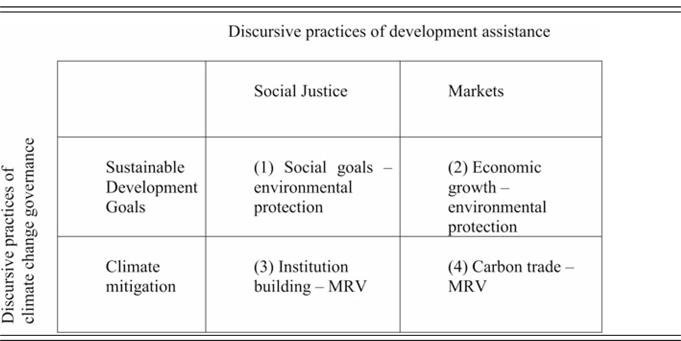
The idea of REDD+ includes both climate mitigation and development. Development assistance, which has a crucial role in climate and conservation projects, together with the various sectors and actors involved, follows several practices, some of them established in international conventions. The actors in development assistance balance between social justice and economic growth. In the post-Cold War era the impetus to economic growth is drawn from markets (Willis Reference Willis2005; OECD 2009; ECOSOC 2014). Therefore, the discursive practices of social justice and markets are the ultimate variables of development assistance. Similarly, among the UNFCCC regime, the practices of climate change governance include two principal sets of practices – sustainable development goals, which include economic and social development issues among climate change measures, and the practices of curbing emissions. By combining the discursive practices of development assistance and climate change governance, we draft a fourfold table (Table I). The discursive practices of development assistance, which emphasise social justice and the role of markets, form the horizontal side of the table. The discursive practices of climate change governance, which include the sustainable development goals (economic, social and environmental goals) and climate mitigation, form the vertical side.
Discursive practice of development assistance and climate change governance

The first cell in Table I, which combines the emphasis on social justice in development assistance and the sustainability goals of climate change governance, has the primary emphasis on social goals with a secondary role given to environmental protection and climate mitigation. The second cell places the emphasis on economic growth with the support of markets and private property rights, with secondary emphasis placed on environmental protection. The third cell, with focus on climate mitigation and social justice, emphasises institution building, which enables the country's integration to UNFCCC climate governance for the purposes of global climate mitigation, while a secondary objective is to create a credible MRV-system. The fourth cell combines climate mitigation with market practices. Integration into global carbon markets requires credible carbon accounting, which highlights the importance of a credible MRV system.
Table I illustrates our preliminary hypotheses on how the discursive practices develop. As the discursive practices and the concrete practices and policies are bound together, we can estimate how these four assumptions appear in the development of REDD+ governance. Therefore, although global carbon trading was a very important part of the UNFCCC REDD+ initiative, the volatility of the carbon market and chronic low price of global CERs (certified emission reductions) practically nullify the fourth hypothesis about the role of carbon trade practices in REDD+ governance (Palmujoki & Virtanen Reference Palmujoki and Virtanen2016). However, since market-based carbon trading has remained an option in the UNFCCC regime concerning REDD+ governance, it is still useful to examine REDD+ projects from this angle, too.
The research material consists of the documents and reports of ten REDD+ initiatives from which the practices of international society, development assistance, and – more particularly – the practices of the UNFCCC are identified. In the following sections, we present the main contents of the key documents. As our primary research material consists of the REDD+ related project plans and reports as well as critical NGO papers, including 29 different documents, the approach focuses more on the discursive side of practices. However, the discursive practices and their ‘material’ counterparts are mutually constitutive and inseparable (Adler & Pouliot Reference Adler and Pouliot2011: 7; compare Banjade Reference Banjade2012; Behagel et al. Reference Behagel, Arts and Turnhout2017). In analysing these documents, we try to find common development and conservation (including climate change) practices – practice-arrangement nexuses, which connect (or separate) different programmes and projects. We are inclined to argue that these nexuses – not the opaque joint intentions or multilevel frameworks – have reshaped REDD+ governance.
THE CHANGING REDD+ LANDSCAPE IN MOZAMBIQUE
In order to understand the changes between the two versions of Mozambique's national REDD+ strategy, we argue that different practices established in several REDD+ projects and funded by different donors stand out together with political bargaining between domestic bodies and between Mozambican authorities and international donors. We argue further that the outcome of the bargaining does not directly reflect the intentions of the actors but the established practices that limit the playing field of different actors. In this section we give an overview of the projects that underpinned the practices that set the outlines to Mozambican REDD+ governance. Nevertheless, we do not claim that the Mozambican REDD+ developments are unique but follow in many respects general trends. As our preliminary assumptions (Table I) show, general development-related mitigation practices are universal (see also Nielsen Reference Nielsen2016; Palmujoki Reference Palmujoki, Cadman, Maguire and Sampford2017) as are many features of domestic REDD+ developments (Korhonen-Kurki et al. Reference Korhonen-Kurki, Brockhaus, Sehring, Di Greggio, Assembe-Mvondo, Babon, Bekele, Benn, Gebara, Kambire, Kengoum, Maharani, Menton, Meoliono, Ochieng, Paudel, Pham, Dkamela and Sitoe2019).
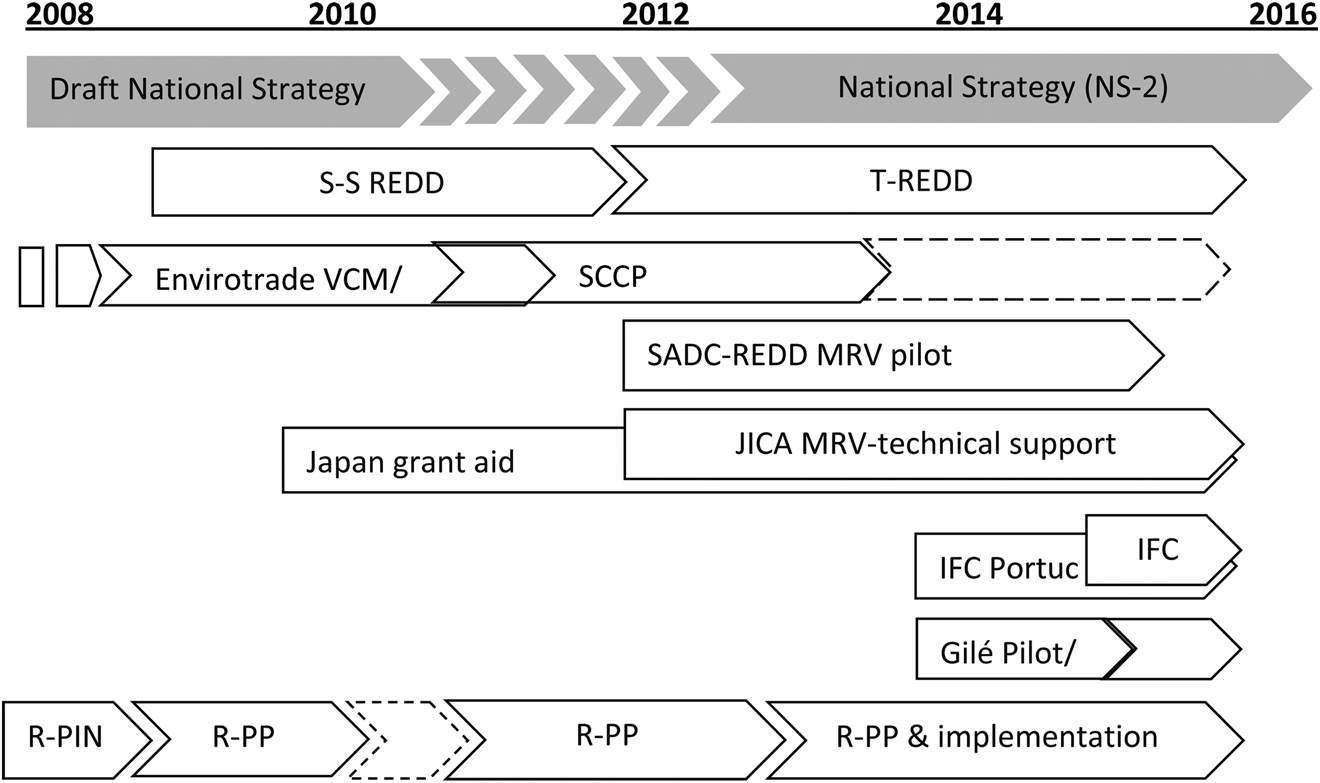
Introduction of REDD+ in Mozambique was characterised by a high level of fragmentation as different actors sought privileged access to expected international funding and other benefits (IIED 2009; Quan et al. Reference Quan, Naess, Newsham, Sitoe, Fernandez and Nunan2017). In terms of concrete practices and arrangements, the work advanced through two overlapping constellations: preparation of a framework document (Readiness Preparation Proposal – R-PP) for WB funding led by the forest directorate within the Ministry of Agriculture (MINAG), and preparation of a national REDD+ strategy led by the Ministry of Environment (MICOA), both of them funded mainly by Norway (Figure 1). The division reflects the different mandates and competences of the institutions. MICOA was the lead agency on climate change and it considered REDD+ as an opportunity for climate change mitigation and revenue generation from carbon payments or from disbursement of global funds. MINAG, on the other hand, was the lead technical agency on forest management, and it saw REDD+ mainly as a means to strengthen technical capacity (Naess et al. Reference Naess, Newell, Newsham, Phillips, Quan and Tanner2015). However, in early 2010 the government decided to halt the first process and focus on the national strategy, of which a draft version was ready in August 2010. In early 2011, the government again revised its approach and decided to proceed with the preparation of the WB project (Sitoe et al. Reference Sitoe, Salomão and Wertz–Kanounnikoff2012; Quan et al. Reference Quan, Naess, Newsham, Sitoe, Fernandez and Nunan2017).
The REDD process in Mozambique.

When the government drafted its first version of a national REDD+ strategy (NS-1), the emphasis was on broad development goals with support from additional finance expected from carbon trading (Palmujoki & Virtanen Reference Palmujoki and Virtanen2016). The key discursive practices emphasise that environmental services (including carbon sequestration) belong to the sphere of national sovereignty, and that REDD+ must bring benefits to different segments of the society, in particular to rural populations. The document observes that the state recognises community land rights and should also recognise their rights to carbon. In the case of private enterprises’ carbon credit sales on voluntary carbon markets, the draft stipulates that 60–80% of the receipts go to local communities. It also highlights certain premises regarding national ownership, such as management of REDD+ carbon credits paid to the state through a national fund administered by a Mozambican bank (MICOA 2011).
The NS-1 document presents a broad analysis of the causes of deforestation and forest degradation, pointing out elevated demand for timber in internal and external markets and the prevalence of shifting cultivation. In addition to the forest sector, key drivers of deforestation and forest degradation include energy and agriculture sectors (MICOA 2011).
Key barriers to achieve the REDD+ objectives identified in the draft include weak policy implementation and law enforcement. These barriers urge the government to move from planning progressive legislation to efficient and transparent implementation with emphasis on local initiative and participation. On the other hand, the document puts little emphasis on technical and operational aspects, such as MRV. From the resources disbursed through the REDD+ fund, only 20% are for operations, including realisation of MRV (MICOA 2011). The low emphasis does not seem to be in keeping with the importance of technical capacities typically emphasised in REDD+. While some historical data on forest-cover change did exist, it was inadequate and MRV capacity was limited by incomplete spatial coverage, inadequate data and technical capacity (Sitoe et al. Reference Sitoe, Salomão and Wertz–Kanounnikoff2012).
However, changes in several, mostly external factors during 2010–2012 led to re-assessment of the relevance and viability of the REDD+ -related discursive practices promoted by different stakeholders, such as the emphasis on carbon markets, and forests, and eventual adoption of an integrated landscape approach – which was promoted by key international partners – as the framework for Mozambique's 2016 National REDD+ Strategy (MITADER 2016b). This means that attempts to secure funding for forest conservation and afforestation must increasingly follow the practices of market economy, including large-scale agribusiness, energy and mining. This is well in line with the government's policy of rural modernisation and increasing market orientation based on private-public-partnerships and foreign direct investment (Kaarhus Reference Kaarhus2011; IIED 2015b). The strategy is to link commercial investment in agriculture and forestry with ‘patient capital’ from public sources for non-profit-making infrastructure development, which thus serves as a long-term subsidy for commercial activities (Kaarhus Reference Kaarhus2011). The NS-2 document also highlights the importance of harmonising sectoral policies. This approach was already reflected in the reorganisation of government ministries in 2015, when key REDD+ functions were brought under the new Ministry of Land, Environment and Rural Development (MITADER 2016a), and was subsequently strengthened in the revised REDD+ regulation in 2018 (RM 2018).
Although the strategy takes up many of the issues highlighted in NS-1, such as institution building and contribution to rural livelihoods, there are clear differences. In NS-2 more attention is devoted to capacity building to reach the technical levels required by UNFCCC in tasks such as MRV and socio-environmental safeguards. The landscape approach also moves the focus away from forests to rural development, forwarding the role of the private sector and CSOs while the state is expected to provide the normative and institutional framework, monitor and facilitate. In terms of funding, the state has a key role in management of global forest carbon funds; private funding is expected mainly from FDI for agriculture and forestry, whereas expectations of revenue from carbon trading is very cautious (MITADER 2016a; RM 2018).
The theory of change behind NS-2 is that improving the enabling environment for forest and agriculture investments and exports will promote sustainable forest and land management practices, contribute to improved rural livelihoods, and support efforts to address the drivers of deforestation and forest degradation (MITADER 2016a; UT-REDD & MITADER 2016). But while NS-2 assembles a large number of different discursive practices and respective actors, including public institutions, the private sector and CSOs, the number of practices and actors included does not necessarily reflect equal distribution of influence and power to take decisions. One interesting indicator is resource allocation within the NS-2 action plan, where the lion's share (83%) goes to industrial forest plantations. Most of the remaining REDD+ funding is directed to institution building (including MRV capacity) and diverse rural development practices (MITADER 2016b).
Establishing the basics: the Brazil–Mozambique S-S REDD and TREDD
During the readiness phase until 2012, the main source of support was a south-south REDD initiative (S-S REDD) between Brazil and Mozambique, funded by the government of Norway (Sitoe et al. Reference Sitoe, Salomão and Wertz–Kanounnikoff2012). It was based on an agreement between MICOA and Fundação Amazonas Sustentavel, a Brazilian NGO with experience from the REDD+ process in the Brazilian Amazon. The consortium included MINAG, MICOA, Eduardo Mondlane University (UEM) and Centro Terra Viva (NGO) from Mozambique, and the International Institute for Environment and Development (IIED) from the UK, which managed the project and provided technical leadership with support from a consultancy company. The aim was to establish the practices under which Mozambique could embark on the implementation of REDD+. This meant supporting the design of a national REDD+ strategy and the preparation of R-PP for the Forest Carbon Partnership Facility (FCPF), strengthening the technical, institutional and legal capacity for REDD+ implementation, conducting viability studies, and identifying potential areas and mechanisms for pilot activities (IIED 2012). Both the drafting of a national strategy and the preparation of R-PP advanced with support from the project, which enabled broad consultation with stakeholders. Although the approach enabled the definition of national priorities that were subsequently registered in NS-1, it also revealed that the practices and outcomes expected from REDD+ by the government and by WB differed significantly.
The initial intent of S-S REDD was to replicate the Brazilian Bolsa Floresta model, which resembles the community-based natural resources management practices introduced to Mozambique through development cooperation in the mid-1990s (IIED 2009). It sought to use carbon offset payments to strengthen local institutions and enterprises, and to improve access to basic social services in the target communities. However, it soon became evident that simple transfer of the model and related development practices was not feasible due to the socioeconomic differences between the countries. Different from the Brazilian Amazon, the rural landscape in Mozambique was fully occupied by subsistence farmers who depended on access to natural resources. The country also lacked the financial resources and technical capacity to formalise land and forest rights, or to operate viable natural resource-based value chains (IIED 2012; compare FAS 2008).
In line with NS-1, the focus was on institution building and social goals, such as strengthening livelihoods and social justice rather than climate mitigation per se. It highlighted the fact that a large part of the land identified for REDD+ was actually used by local communities, which meant that there would be substantial opportunity costs. In the context of Mozambique's relatively weak cadastral system, project reports recommended early formalisation of community land rights to avoid seizure of the land without adequate compensation by private investors. Access to concrete benefits by community members and their engagement in tangible activities alongside carbon trading were also stressed. On the other hand, both national and foreign experts emphasised that the knowledge of climate-change mitigation, in particular in forestry and MRV, and related planning and implementation capacity were very limited in Mozambique, and considerable institution building on all levels was needed (Sitoe et al. Reference Sitoe, Salomão and Wertz–Kanounnikoff2012).
Subsequent testing of the selected REDD+ delivery practices was done through a new project, TREDD, which was launched in 2012 and focused on the Beira corridor in central Mozambique. The target was to provide a detailed analysis of the rate and causes of deforestation and forest degradation, to design and test models for the reduction of emissions, and to elaborate investment packages for implementation. A consortium consisting mainly of S-S REDD partners was convened under IIED. Based on both evaluation of previous research and new studies, the project produced refined analysis of MRV practices and the drivers of land-use change. The former highlighted the lack of technical capacity for MRV beyond the basic level and consequent need for capacity building (IIED 2013, 2015a). The latter confirmed the role of unsustainable agricultural practices by smallholders but emphasised that ‘the biggest drivers of deforestation are still large scale investments in land use change’ (IIED 2015a: 14). Even in the case of smallholders, logging is often the starting point for a sequence of practices, which leads to forest degradation and deforestation. While logging extracts only high value timber, it opens access tracts to the forest and is typically followed by charcoal production, which eventually leads to conversion for agriculture (IIED 2015a).
Re-focusing REDD+ to markets: the World Bank's Forest Carbon R-PP
As noted above, the REDD+ process advanced initially through two lines. MINAG had submitted a Readiness Project Idea Note (R-PIN) to the FCPF already in 2008, and after a brief interlude in 2010, the government decided to prioritise the R-PP (Sitoe et al. Reference Sitoe, Salomão and Wertz–Kanounnikoff2012; Quan et al. Reference Quan, Naess, Newsham, Sitoe, Fernandez and Nunan2017). Release of the first part of FCPF funding (€156,000) with the approval of the R-PP in 2012 made WB the leading donor in the REDD+ process (FCPF 2014). In 2013 Mozambique received a second tranche of funding of €2.7 million, and in 2015 a third one amounting to €4.5 million (World Bank 2015).
R-PP is the key tool in the WB's attempt to formulate REDD+ practices in Mozambique. Its main elements include support for preparation of a national REDD+ strategy and a related implementation framework, MRV system, Reference Emission Level (REL) scenario for submission to the UNFCCC, and safeguards following the Bank's own Strategic Environmental and Social Assessment (SESA) model. The first two elements have included creation of a national REDD+ technical unit, facilitation of public consultations, support to dissemination activities and promotion of community level activities. Support to MRV and REL has built on parallel donor projects and consists mainly of consultancy services, procurement of new equipment and support to field costs. Preparation of the REDD+ legal framework and SESA were undertaken by the national technical unit with support from foreign consultants (World Bank 2015).
In development discourse, the R-PP emphasises marketisation and privatisation (Palmujoki & Virtanen Reference Palmujoki and Virtanen2016). Yet, while the R-PP recognises that consultations during the preparation phase underscored that opportunity costs fall largely on the rural population – which it considers the main driver of deforestation – it maintains that the benefits from REDD+ to them should primarily materialise indirectly as a result of improved access to social services, or else due to technical support and financing for agricultural modernisation, not through direct payments (RM 2013b).
Securing ownership rights to land and carbon stocks is considered crucial to the REDD+ process, for despite Mozambique's relatively sound legal and policy framework, weak law enforcement and policy implementation constitute a major stumbling block (RM 2013b). However, in the discursive practice of the Bank the main objective of strengthened land tenure security is facilitation of the transfer of rural land use rights, not the protection of local communities’ land rights (World Bank 2015). The WB has – along with other donors – supported the development of legislation about licensing of REDD+ projects and associated financial issues (Naess et al. Reference Naess, Newell, Newsham, Phillips, Quan and Tanner2015). While recognising communities along with national and foreign public or private actors as licence holders, the first REDD+ regulation separated carbon from land rights and left benefit-sharing to market negotiations guided by further regulations, stipulating only the distribution of the licence fee and carbon credit tax, to be divided between the government (80%) and local communities (20%) (RM 2013a). Even though welcomed by the private sector and conservation NGOs, which have been eager to start projects, the decree has been criticised for encouragement of large-scale projects and failure to protect local rights (Naess et al. Reference Naess, Newell, Newsham, Phillips, Quan and Tanner2015).
The third FCPF grant approved in late 2015 foregrounds two new initiatives, revision of relevant policy and legislation, and adoption of the landscape approach. The revised REDD+ regulation clarified the procedures and concentrated administration of REDD+ projects and programmes to the National Fund for Sustainable Development, whereas the registration of titles and certificates, as well as financial rules and transactions, was made the responsibility of the Ministry of Finance (RM 2018). The regulation thus seeks to integrate carbon projects into a national REDD+ monitoring system while formalising the role of donor funded ‘results-based-payment’ programmes (compare Streck Reference Streck2019).
The landscape approach is expected to reduce deforestation while promoting rural development, and is supported through two performance-based landscape management projects (in Zambezia and Cabo Delgado), as well as another landscape project funded by the International Development Association. In addition to the R-PP funding, the WB (together with other donors) has recently allocated €72 million for REDD+ implementation through the Landscape Program, €27 million for investment in forestry through the Forest Investment Program (FIP) and over €45 million for results-based-payments through the FCPF Carbon Fund. Some REDD+ support is also channelled through WB's other sustainable development initiatives, such as the biodiversity project Mozbio (World Bank 2015). According to the Bank's own view, ‘these phases integrally reinforce each other: national policies and strategies developed with FCPF readiness support and investments under FIP can help to lay the groundwork for later emissions reductions and ultimately facilitate performance based natural resource finance for Mozambique’ (World Bank 2015: 4).
The rise and fall of carbon trading: the Sofala Community Carbon Project (SCCP)
Despite high initial interest shown by both the private and NGO sector to start REDD+ pilot projects (Naess et al. Reference Naess, Newell, Newsham, Phillips, Quan and Tanner2015), in 2012 the SCCP was the only functioning pilot in Mozambique. It started in 2003 as an EU-funded development project, which later transformed into a certified community forestry project aiming to finance itself through voluntary carbon market sales (University of Edinburgh (UE) 2008; Plan Vivo 2015). As one of the first carbon payment schemes in Africa, the project was quoted in the R-PP (RM 2013b) and advertised widely in international media and IO websites (Mutasa Reference Mutasa2014).
The climate mitigation strategy of the project was to generate verifiable Certified Emission Reductions (CERs) through forest-based practices that promote sustainable rural livelihoods. It was implemented by a consortium comprising the University of Edinburgh and a private company (dissolved in 2015) from the UK, and Envirotrade, a private enterprise responsible for field-based implementation and sale of carbon credits. Two types of mitigation practices were used: carbon sequestration through agroforestry by individual farmers in their farmlands, and improved management of surrounding community woodlands for REDD-type credits (UE 2008). Similar carbon agroforestry projects in Zambezia and Cabo Delgado provinces have since been closed.
The carbon offsets were calculated on the basis of a reduction in biomass loss from the average deforestation rate estimated for the entire area, combined with carbon sequestration offsets from agroforestry and sold as one lot to buyers. Initially it was estimated that two-thirds of the carbon revenue would go toward meeting project costs (Jindal et al. Reference Jindal, Kerr and Carter2012). Between 2009 and 2012 the sales totalled approximately €1.3 million, but direct project expenses were almost twice that amount: the gap was filled mainly by cash injections from Envirotrade (Kill Reference Kill2013). Over the last decade, carbon credit prices for CERs have collapsed from over €17 per ton of CO2 equivalent in 2008 to below €0.40. The fall took place in two periods in 2008–2009 and in 2011–2013 (Sendeco2 2018), and forced the project to terminate operations at the end of 2015 (Plan Vivo 2015).
Sustainable development goals were pursued ‘by using some fraction of the income to start micro-industries, thus developing a business ethos in the community’ (UE 2008: 25), but according to a critical review, ‘initial project funding provided a jump-start for community enterprises with little demonstrable sustainable and positive financial effect in the community’ (Kill Reference Kill2013: 15).
The main innovation of SCCP concerned the technical practices of carbon trading directly with communities and individuals (UE 2008). However, the computer model developed to measure changes in carbon stocks is unreliable due to site-specific variation in biomass, while the permanence of the offsets is also questionable. The clients bought the credits on the understanding that they represented carbon captured and stored for 100 years, but the farmers were paid the entire value during the first seven years. Thereafter, benefits from planted trees were expected to provide sufficient incentives for the households to protect them for the next 93 years, which seems unlikely (Jindal et al. Reference Jindal, Kerr and Carter2012). Although the project was able to provide useful lessons about problems faced when implementing small-scale market-based REDD+ projects, critical reviewers see it as proof of the non-viability of forest carbon markets (Kill Reference Kill2013).
The JICA and SADC projects: connecting Mozambican REDD+ to the UNFCCC practices
The projects funded by the Japanese Development Cooperation Agency (JICA) and Southern African Development Community (SADC) represent a third type of practice arrangement nexus, where the practices are directly linked to the UNFCCC criteria and required technical competences. The emphasis is on issues discussed in the UNFCCC negotiations, such as MRV, reference levels and accounting. As the focus is on mitigation, the sustainable development goals, such as the practices related to social justice, received only minor attention or were neglected.
The first major project to develop UNFCCC-compatible MRV practices started in 2010 with Japanese grant aid (approximately €6 million). The focus was on providing technical equipment and software to develop MRV to sustain forest information. Two years later, JICA started a technical cooperation project with MINAG to establish reference levels, design an MRV system, and build capacity with the equipment and facilities provided by grant aid. The effort focuses on monitoring deforestation and forest degradation using satellite images combined with ground monitoring in two pilot provinces, and establishing a basic MRV system in two target districts in the other provinces (UNEP 2012).
SADC member states also decided to develop a regional REDD+ program (2012–2015) to improve the member states’ capacity to manage and benefit from their national REDD+ programmes through policy harmonisation, and increase the influence of SADC in the REDD+ process (SADC 2011). A regional approach has some potential benefits, such as realising economies of scale and addressing the risk of leakage. However, as critics have noted, ‘SADC's natural resources capacity is spread very thinly’, which ‘reflects marginalisation of the sector also at the regional level’ (du Preez Reference du Preez2013: 6). Within the programme, only a subproject to develop a standard regional MRV system was implemented with funding and technical support from the German Agency for International Cooperation. Four countries with different forest ecosystems were chosen for pilot studies, which included a field inventory to determine biomass and emission factors and satellite image interpretation to assess changes in forest cover. Although Mozambique was selected for one pilot, the field inventory was cancelled and done instead in Namibia (du Preez Reference du Preez2013; SADC 2015).
The SADC and JICA projects did not pay particular attention to the development of carbon trading practices as such, although the development of MRV and institution building serve emission trading as well. However, coincident with the turn from market-based carbon trading to other types of compensation for forest conservation in the UNFCCC discussions, in project implementation JICA and SADC resorted to conventional development assistance practices.
From forests to sustainable landscape development: the Gilé–ZILMP initiative
NS-2 includes two REDD+ pilot projects for identifying and piloting ‘best practices’ for results-based-payment programmes. Interestingly, they are not located in the Beira corridor, where substantial background data had already been collected by previous projects. This may be due to dwindling away of the ambitious agricultural growth corridor initiative after the main private-sector partner withdrew from it, and subsequent change of FDI focus to the north (compare Kaarhus Reference Kaarhus2018). Instead, the new pilots are built around protected areas, the Gilé National Reserve in Zambézia and the Quirimbas National Park in Cabo Delgado emphasising the sustainable development goals. In both, the key actor is a consortium of French development institutions – the French Global Environmental Facility (FFEM) and the French Development Agency, which in the Quirimbas were joined by the World Wide Fund for Nature. In Quirimbas, the consortium supported the project from 2004–2015, including a REDD+ component (AFD 2012). Under NS-2, continuation of the project in expanded scope is foreseen with funding sought from the WB (World Bank 2015).
In Gilé, the International Foundation for Wildlife Management has had a co-management agreement with the government to rehabilitate the reserve since 2009. In 2014 a REDD+ pilot project was launched with funding from the FFEM to promote the adoption of conservation agriculture practices by local communities surrounding it. Two French environmental NGOs provided technical support, and the target was to sell carbon credits from reduced deforestation. Subsequently, the initiative was up-scaled to the Zambézia Integrated Landscapes Management Program (ZILMP), which covers seven districts in the province. A project idea note was successfully submitted to the WB in 2015, and the government is now preparing a programme document for selling carbon credits to the FCPF Carbon Fund, a ‘results-based-payment’ programme, which has pledged to buy up to €46 million worth of emission reductions (Etc Terra 2016).
In the context of ZILMP preparation, a French NGO was contracted to design a REDD+ programme following the FCPF methodological framework. Based on quantitative analysis of immediate causes, the report found that ‘deforestation is almost exclusively driven by small-scale agriculture for maize and cassava’ (Etc Terra 2016: 6) based on shifting cultivation. As the analysis indicated that agriculture was constrained by labour rather than access to land, land use planning was deemed redundant, while degradation from illegal logging was perceived too difficult to address. The report recommends adoption of agro-ecology extension as the core development practice (Etc Terra 2016). However, shifting cultivation was not analysed as one part in a complex process, which often starts from selective logging and charcoal production. The report also downplays the role of large-scale farming and forest plantations, which it considers marginal in the study area, even though one of the key players in ZILMP is the forest industry, which is currently establishing large exotic plantations in the area (Portucel Moçambique 2017). Standard development assistance practices and technical tools of environmental protection and agricultural extension dominate the project strategy, but deeper causal factors are largely neglected.
The new pilot projects are funded mainly by the WB, but although the emphasis of these ‘flagship’ projects has been on biodiversity and modernisation of small-scale agriculture, they do not give an accurate picture of the future of REDD+ in Mozambique, as their share in overall resources is marginal. In the NS-2 action plan nature conservation gets less than 1%, while the lion's share goes to industrial forest plantations (MITADER 2016b). A more typical trait is that a large part of the donor funding goes to international NGOs and private consultancy companies following standard WB practices in development assistance projects.
The World Bank group's support of large-scale forest plantations
The Emission Reductions in the Forest Sector through Planted Forests project, funded by the WB group's International Finance Corporation (IFC), falls under the larger MozFIP programme, for which the IFC project's share is €1.8 million. Co-financing from the private sector and the Pilot Program for Climate Resilience administered by the WB is expected to double that share. The project's development strategy is to leverage the linkage between the private sector and local communities in the context of major forest investment. It is based on the argument that local small-scale farming practices are the principal driver of deforestation, whereas large-scale forest plantations combined with more efficient agricultural methods will create a win-win situation for achieving both economic growth and environmental protection (UT-REDD & MITADER 2016; World Bank 2017).
The project is directly linked to parallel IFC funding to Portucel Moçambique for the implementation of integrated plantation forestry, agriculture, pulp and green energy investment with an estimated total budget of €1.9 billion in Mozambique. In 2010–2011, the Mozambican government granted Portucel Moçambique a 50-year concession over 173,000 hectares in Zambezia Province, which is the focus of IFC's MozFIP project, and 183,000 hectares in Manica Province for plantations (Portucel Moçambique 2016). During 2014–2016, the aim of the first phase was to test Portucel Moçambique's forestry model by developing up to 40,000 hectares of plantations and establishing its operational base in Mozambique. The estimated total investment of this phase was €103 million, of which IFC was to provide 20%. The second phase of the project will involve establishing commercial-scale plantations, building agriculture partnerships, and constructing a 1.5-million-ton pulp mill and a biomass power generation plant (IFC 2014).
The MozFIP project funded by IFC intends to support ‘forestry companies, SMEs and smallholder farmers to transform degraded landscapes into highly productive mosaics of forestry blocks, out-grower tree production, houses, agricultural fields and well managed natural forests’ (UT-REDD & MITADER 2016: 104). With the improved community-based management practices, zoning and the promotion of conservation agriculture, it is expected to improve food security, increase agricultural income, create employment and contribute to carbon sequestration. Approximately 69% of the concession area is targeted for forest plantations. The company plans to de-annex homesteads, agricultural fields and conservation areas from Portucel Moçambique's lands via the delimitation and registration of community and individual land titles. Allegedly, successful approaches can be replicated elsewhere (Impacto 2014; UT-REDD & MITADER 2016).
Even though representatives of Portucel Moçambique claim that the mosaic landscape produced by the project will benefit all concerned (Portucel Moçambique 2017), critical assessments have identified several problems that give rise to scepticism (Baffoni & Haggith Reference Baffoni and Haggith2017). Even some sources that typically favour foreign investment projects have been critical; for example, the United States abstained from investment in the IFC project due to concerns about its environmental and social impacts (Jansen et al. Reference Jansen, Bagnoli and Focacci2008). Although the project document recognises the significant risks of deforestation in non-plantation areas, which tend to offset afforestation in plantation areas, the project is expected to upgrade ecosystem services and improve the protection of biodiversity even in the face of increased land pressure (UT-REDD & MITADER 2016). Moreover, though the project promises to directly create 7,500 jobs, experience from similar projects shows that employment opportunities are typically limited to the initial phase and tend to be short term. Consequently, only very few households are able to improve their livelihoods in the long term. As the expansion of alienated areas inevitably reduces access to key productive resources and forest products, local farmers often state that the need for agricultural land is more important than the few jobs created, which cannot make up for the vast degradation of natural resources (Jansen et al. Reference Jansen, Bagnoli and Focacci2008; Bleyer et al. Reference Bleyer, Kniivilä, Horne, Sitoe and Falcão2016).
CONCLUSION
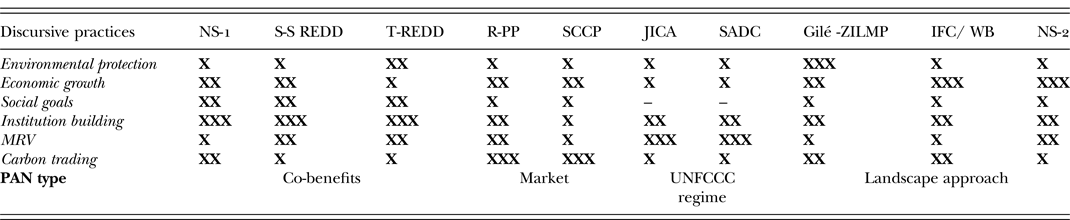
The political processes, according to our analysis, produced four different practice arrangement nexuses (PANs), which have reshaped the Mozambican REDD+ strategy (Table II). They reflect the bundles of practices including environmental protection, economic growth and social goal together with institutional building, MRV and carbon trading. Our analysis does not focus on the interaction between the nexuses but clearly shows the bundles of practices between certain strategies, programmes and projects. At the same time, it addresses the change in REDD+ practices, which is reflected in the changes between NS-1 and the final NS-2. These bundles of practices originate outside of the UNFCCC and, in fact, gain force toward the end of the period under scrutiny. The bundles in the Mozambican REDD+ process, which refer more to general development goals than to climate targets, are manifested already in the initial institution building and social goals, but even more clearly in the current landscape approach. Although the latter has been adopted to some extent in the UNFCCC discussions, we argue that it reflects the acknowledgement of the fragmentation and marginalisation of REDD+, rather than the domination of the consensual ideals of the multi-level governance framework in climate-change politics.
The practice arrangement nexuses (PAN) in the Mozambican REDD initiatives

XXX = Main focus; XX = Substantial focus; X = Secondary focus; – = Neglected.
In NS-1 the original idea of REDD+, carbon-centred mitigation based on international emission markets, was not in the foreground, which was occupied by traditional development goals supported by selected sustainable development practices based on international funding, such as the S-S REDD project. Carbon trading and related verification practices were accepted as a co-benefit, an additional source of development financing. Highlighted in the R-PP, they were subsequently included in the form of small-scale, donor-funded pilot activities such as the SCCP and JICA projects, but in subsequent REDD+ projects market-based carbon trading disappeared with the collapse of the CER markets. Therefore, the practices of carbon trading have neither enabled nor restricted REDD+ initiatives after 2013. On the other hand, the development of MRV practices, which has been an important part of emission markets as well as the main mechanism through which the UNFCCC connects the national projects to global climate governance, was the focus of two REDD projects and is by now established as a standard REDD practice. However, as funding through global emission markets dried up, the main (if not only) source for REDD+ financing in Mozambique over the last few years has been development assistance – albeit under the guise of global climate-change funds, such as the FCPF Carbon Fund. The changes in the discursive practices of development assistance have been influential in shifting the National REDD+ Strategy toward the development policies and practices of the major international donors, such as the WB (see also Korhonen-Kurki et al. Reference Korhonen-Kurki, Brockhaus, Sehring, Di Greggio, Assembe-Mvondo, Babon, Bekele, Benn, Gebara, Kambire, Kengoum, Maharani, Menton, Meoliono, Ochieng, Paudel, Pham, Dkamela and Sitoe2019). The shift, which was affirmed in NS-2, means that attempts to secure funding for forest conservation have increasingly turned to the landscape approach, which emphasises the practices of market economy and large-scale agribusiness. The only relatively constant discursive practice has been institution building, albeit in different forms.
A number of established environmental NGOs and academic institutions have joined the PANs through which the new landscape approach to REDD+ is implemented and funding is directed to the development of small-scale agriculture and nature conservation. The way the implementation of the new approach actually unfolds depends, however, on the relative weight given to the different bundles of practices promoted by the implementation partners. Here it is important to note the huge differences in the political power wielded by different actors (Fairbairn Reference Fairbairn2013). The WB is the key player, together with multinational companies and the government, which appears to have given full backing to the large-scale investors (Fairbairn Reference Fairbairn2013; IIED 2015b). Various academic and civil society actors have noted that current governance practices, which largely favour FDI-based economic growth over environmental protection and social justice, must be revised in order to address the ‘governance gaps’ in REDD+ related practices (IIED 2015a, 2015b). The current pilot studies have not been able to address fully the potential environmental and social impacts of the practices regularly adopted by large-scale agriculture and forestry projects, and arguably that was not even the objective as they have focused on protected areas and small-scale agriculture. In their comparative qualitative analysis of REDD+ implementation in various REDD+ target countries, Korhonen-Kurki et al. (Reference Korhonen-Kurki, Brockhaus, Sehring, Di Greggio, Assembe-Mvondo, Babon, Bekele, Benn, Gebara, Kambire, Kengoum, Maharani, Menton, Meoliono, Ochieng, Paudel, Pham, Dkamela and Sitoe2019) noted the mixed results of REDD+ governance due to institutional and policy arena factors. The study supports our view of the stochastic steering of established practices in implementation of the REDD+ process in Mozambique.
While we argue that PANs – not the top-down implementation of multilevel governance – have reshaped REDD+ governance in Mozambique, we largely agree with the notion of watering down of market mechanisms in REDD+. Now a REDD+ project can mean whatsoever in a broad variety of development projects with reference to climate change and forests. The idea of the compensation for conservation of tropical forests to mitigate climate change has become invisible among the general economic and social goals of the landscape approach, to which climate-related environmental protection is included (compare Nielsen Reference Nielsen2016). This tendency is reflected by the UNFCCC: the emphasis, which was given to REDD+ in Copenhagen 2009, melted in the Paris Agreement to vague definitions, which provide no general framework for global mechanisms on REDD+, whether we are talking about MRV, emissions units, or avoiding double accounting, that is, about the necessary institutions for credible, measurable and attributable climate change mitigation through forest conservation.