Introduction
‘All of us who work on the comparative study of slavery are in intellectual debt to Sir Moses Finley’. So wrote Orlando Patterson, the best-known advocate of a comparative approach to slavery, in the preface to Slavery and social death (1982, p. xii). This acknowledgement reminds us not only of the existence of a long and distinguished tradition of synchronic and diachronic comparative slavery studies, but also of the very close intellectual ties between ancient and modern historians working in this field. Greek and Roman archaeologists have rarely sought to contribute to this fertile dialogue, and to the extent that they study slavery at all, they do so almost entirely within Graeco-Roman spatial and temporal confines. The majority do not compare – and they do not want to. This discussion article asks why. In so doing, I will focus principally on developments within Roman archaeology. Classical archaeologists in general have traditionally resisted comparative methodologies (Terrenato 2002), but as will become clear below, it is important – and instructive – to distinguish between Greek and Roman archaeology in this respect. Ian Morris's pioneering discussion of the archaeology of the excluded in classical Athens (Morris 1993) draws directly on North American comparanda, and is a work to which I will return below. But it provides a singular exception to the rule that, on the whole, diachronic comparison of any kind remains even less attractive to Greek archaeologists than to their Roman counterparts. Asking why will take us to the heart of comparative archaeology itself, and to the future prospects for a comparative archaeology of ancient slavery.
2007 saw the bicentenary of the 1807 abolition of the British slave trade, and throughout the year I presented papers on the material culture of 17th- and 18th-century slave ships (the primary focus of my own slavery research at the moment; see e.g. Webster 2008). The 2007 ‘Wilberfest’ stimulated public interest in classical slavery, too, and so I also gave talks on the archaeology of Roman slavery, along with a handful of papers with a diachronic focus: meditations on the potentials of a comparative archaeological approach to studying slave experience in the Roman world. This contribution springs from conversations generated by these ‘comparative’ papers, and owes much to discussions with colleagues and postgraduate students attending the 2007 Roman Archaeology Conference in London and the 2007 Edinburgh Table Ronde on Ancient Slavery. Our discussions centred on the fact that it is almost impossible to find archaeologists drawing on ‘New World’ (c.1500–1800) slavery studies to inform the investigation of slavery in the Roman world. This is the case even in the USA, which for more than 30 years has pioneered the archaeological investigation of slavery, and where rich and complex archaeological strategies for discerning the material traces of enslaved persons have evolved as a result (for an overview see Singleton 1985; 1999; and Haviser 1999). Some of the approaches developed by archaeologists of the African diaspora are outlined in recent papers by Ian Morris and myself (Morris 1993; Webster 2005), where they are brought to bear on Greek and Roman slavery respectively. Further elaboration is offered below, in a comparative case study exploring the use of ideograms, symbolic markers and other forms of informal inscription among slaves in both the Atlantic and Roman worlds.
Do classical archaeologists compare anything?
Archaeology is an inherently comparative discipline, in the sense that analogy plays a central role in archaeological reasoning. As all students know, one can only infer that ‘this is an axe’ by drawing on knowledge from living or near-contemporary societies that have also made and used axes (Hodder 1982, 1–27). Some archaeologists acquire that knowledge empirically, by undertaking ethnoarchaeological fieldwork for themselves, but most rely on data collected by anthropologists and ethnographers. Moreover, since the advent of processualism in the 1960s, engagement with anthropology has played a crucial part in driving forward key theoretical developments in the archaeological interpretation of past societies. But how far is that statement true for the classical world? Prehistorians routinely make use of cross-cultural parallels, as indeed do archaeologists who work in ‘historical’ periods, but who focus on non-literate subaltern groups, including indigenous peoples and slaves (see, for example, Jamieson 1995 on the ‘flow of traits’ between anthropology, ethnohistory and archaeology in the study of New World slave mortuary practices). Classical archaeologists, by contrast, rarely stray onto comparative ground. Their reluctance is undoubtedly traceable in part to an underlying belief that comparison undermines the uniqueness of the classical past and its now well-documented ancestral value for the West (Ridley 1992; Morris 1994; Dietler 2005; Terrenato 2005). In short, as Terrenato (2002, 1109) puts it, it is still widely believed that classicity ‘must be reverentially explored and dusted, but it cannot be compared with, or measured on the same scale as, the rest of the human past’.
As Terrenato himself notes, however (2002, 1109), the default historicist stance of classical archaeology is also maintained by privileging textual sources. The mere existence of written texts – however limited in quantity and range, however flawed or biased by authorial intent, naivety or prejudice – seems to be enough to ensure that, for many classical archaeologists, cross-cultural analogy – and most other methodologies favoured by anthropological archaeologists – remain irrelevant: ahistorical weapons of very last resort in the armoury of text-aided archaeological interpretation. As Terrenato persuasively argues in charting the fortunes of classical archaeology in the pages of the journal Antiquity, the New Archaeology of the 1970s, with its focus on comparative and evolutionary perspectives, fostered a decisive split between classical archaeologists (who retained their faith in cultural-historical norms) and everyone else (who did not). ‘The more everybody start[ed] thinking in cross-cultural terms (developing in the process a body of theoretical and methodological thought), the further Classicists slid unnoticed towards the stage exit’ (Terrenato 2002, 1108). Coming back to the concerns of the present paper, it is by no means coincidental that those Greek and Roman archaeologists who have made use of cross-cultural anthropological perspectives have tended to work either on the impact of Mediterranean trade upon ‘peripheral’ Iron Age communities (a theme of particular interest to US-based scholars trained in anthropological archaeology, including Wells 1980; and Dietler 1997; 1999) or on the creation and maintenance of identity in the Greek colonies and Roman provinces. In both cases, cross-cultural parallels seem to fill in where textual sources run out (or run thinly): amongst non-literate, colonized and otherwise subaltern groups.
Twenty years ago we would happily have used the acculturative terms ‘Romanization’ and ‘Hellenization’ in discussing emergent colonial identities; today we are more circumspect both about the former and, increasingly so, about the latter (Wallace-Hadrill 2007). Important studies of hybrid identities in the Greek colonies have been published in recent years (Antonaccio 2003; 2005; Hall 2007; Hodos 2006; Lyons and Papodopoulos 2002; Tsetskhladze 2006), but it is important to note that this body of work largely post-dates – and derives inspiration from – earlier critiques of acculturative models of contact and culture developed by archaeologists of the Punic and Roman colonies (for early examples see Bénabou 1976; Van Dommelen 1997; Mattingly 1996). One reason for this divergence has undoubtedly been the greater willingness of scholars in these fields to critique their textual sources. That willingness can itself be argued to stem from a closer engagement with anthropological archaeology. When my own generation of ‘postcolonial’ Roman archaeologists began, some 20 years ago now, to question the validity of ‘Romanization’ as a model for culture change in the Roman provinces, we were explicitly influenced by the work of postcolonial anthropologists and ethnographers, who had long been questioning the ways in which western observers generate and codify knowledge about non-literate, colonized ‘others’ (Said 1978; Clifford and Marcus 1986; Fabian 1983; Geertz 1988). Put another way, critique of the material culture of ‘Romanization’ went hand in hand with a radical reassessment of the textual record of Rome's encounter with its colonial ‘other’. Things are rather different in the world of Greek colonization archaeology, where anthropological archaeology of all kinds is distrusted by many (Snodgrass 1987, 1–13), where textual sources continue to drive forward interpretative frameworks, and where archaeological data are rarely used to challenge long-established models of colonial interaction. A postcolonial Romanist delving into ongoing debates on the nature (or even existence – Osborne 1998) of Greek colonization feels a little like Alice in Wonderland, falling into a disorientating world of inverted understandings. One of the most useful things to emerge from Roman archaeology's recent engagement with postcolonial theory has surely been the now widely accepted understanding that our discipline itself developed in an imperialist context, which had a profound influence upon the ways in which the relationship between Rome and its colonial ‘others’ has been modelled and interpreted (Mattingly 1997; 2006; Hingley 2000; 2005). That understanding has in turn reshaped our approach to the creation and maintenance of identities in the Roman world. Greek archaeologists, on the other hand, have apparently always acknowledged that their discipline draws on modern European colonialism as an explicit analogy for archaic Greek colonization, but have recently decided that this is actually a ‘Bad Thing’ (Owen 2005, 10). Indeed, some are now fighting a rearguard action against this long-lived but ‘anachronistic’ practice (Owen 2005; Snodgrass 2005).
This is, of course, a caricature of extreme positions, and, as noted above, numerous recent studies of identity in the Greek colonies have pinned their colours firmly to the ‘postcolonial’ mast. But the point remains that some Greek archaeologists are actively drawing away from comparative colonialism, at precisely the moment that romanists appear to be embracing the notion fully. Indeed, within Roman archaeology, attention has recently been drawn to what might be called a reverse comparative swing: the use of parallels drawn from imperial Rome to enlighten understanding of the contemporary world. Hingley (2005) usefully summarizes these instances, including those found in Hardt and Negri's controversial Empire (2000), which argues, for example, that the Roman republican system was reinvented in the USA and forms the core of the current global world system. Most recently, De Bivar Marquese and Joly (2008) have explored the ideological usage of Graeco-Roman texts by Jesuit slave-owners in colonial Brazil.
A new diachronic, globalizing approach to colonial history is emerging (Dal Lago and Katsari 2008b, 6; see also Gosden 2004; and, for earlier approaches in a similar vein, Bartel 1985; Dyson 1985), within which Rome (though not, as we have seen, Greece) is being repositioned as one player among many. Notable here is the work of Walter Scheidel, a leading scholar of the Roman slave supply, who has long made use of synchronic and diachronic comparanda in his work on slavery (see e.g. Scheidel 1997; 2005a; 2005b), but has also championed the development of a comparative history of the Roman and Chinese empires (Scheidel 2006). The comparative approach favoured by Scheidel, and by many of the historians mentioned below, is the ‘contrast of contexts’ method (as defined by Skocpol and Somers 1980, 178), whereby comparisons are made between equivalent units in order to identify the unique features in each. To compare, in other words, is also to contrast, and on this basis to see the differences, as well as the similarities, between societies and social processes. In Scheidel's view (2006, 4),
we cannot really hope to understand developments in one system – say, the Roman empire, or the Han empire – unless we have some appreciation of how things turned out in broadly analogous cases; without comparisons we can never know if particular outcomes were common or rare, and which variables were endowed with causative agency. To some extent, the historical study of a single case – a single empire in our case – can only result in the antiquarian accumulation of data and untestable and therefore inherently arbitrary claims about significance and causality.
Scheidel's comment on analogy is a good one to hold in mind as we turn to consider the phenomenon of chattel slavery, and the use of comparative approaches there.
Slavery compared (by historians)
It was suggested above that archaeologists of the Greek and Roman worlds have traditionally avoided cross-cultural analogy in large part because they regard it as a dangerously ‘ahistorical’ tool, one irrelevant to disciplines blessed with textual sources. Yet historians do not seem to think that way. Comparative methodologies have been regularly employed in studying aspects of European (and colonial) history since the 1920s (Bloch 1928; Skocpol and Somers 1980). Kolchin (2003) has usefully distinguished between ‘soft’ and ‘rigorous’ forms of historical comparison: the former placing a single specific case study in a broader context of historical comparison and the latter adopting a ‘compare-and-contrast’ approach to two case studies of equal weight. Hodder's rather similar distinction between ‘relational’ and ‘formal’ analogy (Hodder 1982, 16) is a reminder that far more is shared by the disciplines of archaeology and history, methodologically speaking, than we sometimes acknowledge. Examples of ‘soft’ comparison or relational analogy are common among historians, examples of ‘rigorous’ comparison or formal analogy less so (Dal Lago and Katsari 2008b, 187). Hodder – the prehistorian – would approve of this, Dal Lago and Katsari – the historians – do not: a reminder of how much our disciplines also differ.
Comparative historical studies of New World slavery appeared as early as the 1940s (see Tannenbaum 1947; Genovese 1969 for synchronic examples; and Davis 1966 for a diachronic one), but the 1980s was perhaps the key decade for comparative work. The year 1981 brought publication of George Fredrickson's White Supremacy. A comparative study of American and South African history and Orlando Patterson's Slavery and social death. A comparative study appeared a year later. Patterson was a cultural sociologist and historian schooled in the Weberian comparative method and had been publishing on comparative slavery throughout the 1970s (1970; 1977a; 1977b). Slavery and social death was a tour de force global analysis of slavery, which he defined as ‘the permanent violent domination of natally alienated and generally dishonoured persons’ (Patterson 1982, 13). It remains the best-known diachronic study of chattel slavery. Patterson argued here and elsewhere (Patterson 1977b; 1991; 2008) that inherent essences define slavery as an institution, whenever and wherever it may be found. The use of wide-ranging diachronic comparanda, drawn from places and times stretching from the ancient world and medieval Europe and Africa to the early modern Americas and Africa, allowed him to isolate ‘universal’ features of slave systems, and of slave experience. For example, Patterson argued that all slaves suffer ‘natal alienation’, or genealogical deracination (Patterson 1982, 35–76), with those enslaved within lineage-based societies being considered kinless, and those within more advanced societies (including that of ancient Rome) being considered legally dead. Thus Patterson drew on data from the ancient world in a very specific way – not in order to isolate unique features of Greek and Roman slave systems, but in order to place Graeco-Roman slavery within a continuum of practice stretching over millennia. Patterson was interested in difference as well as similarity, of course, and had much to say on the specifically Roman concept of the slave as property, but at the same time he undermined the perceived ‘uniqueness’ of other features of the Roman slave system, including the ideology and practice of ‘benevolent’ manumission (Patterson 1982, 209–39).
Patterson had very little indeed to say about archaeological evidence at any period, and this may be why classical archaeologists have ignored him almost completely. Yet historical archaeologists in the Americas have engaged with his work fully, and often very critically, making a significant contribution to the dismantling of one of Patterson's central tenets: the concept of the slave as a socially dead person. Patterson argued that the institution of slavery denied individuals access to the inherited meanings of their ancestors. Archaeologists exploring African-American and African-Caribbean mortuary and ritual practices have demonstrated that, contrary to Patterson's assertion, African religious beliefs and practices played an important part in slave life throughout the Americas (Jamieson 1995). Today, we would regard ‘social death’ as something wished for by slave-owners but impossible to achieve (Hall 2000, 137) because slaves fought successfully against efforts to suppress their humanity, often using material culture in that struggle.
More recent comparative work has tended towards a synchronic focus (though see Phillips 1996 for a diachronic approach). Important studies include those by Kolchin (1987; 2003) and Dal Lago (2005). In a welcome development, Dal Lago has collaborated with the ancient historian Constantina Katsari in editing a recently published volume of studies on ancient and modern slave systems (Dal Lago and Katsari 2008c). A number of contributions to this volume adopt a diachronic approach, comparing and contrasting case studies from both the ancient and early modern worlds. These include Dal Lago and Katsari on models of slave management, Scheidel on the comparative economics of slavery and Hodkinson's illuminating comparative study of helotage and other forms of unfree labour.
Slavery compared (by ancient historians)
The cornerstone in the development of a comparative approach to ancient slavery appeared in 1968, in the form of an encyclopedia entry on slavery written by Moses Finley (Finley 1968, 303–13). It was followed by Keith Hopkins's Conquerers and slaves (1978) and Finley's own Ancient slavery and modern ideology (1980). These works shared (with each other and with Orlando Patterson) a wide-ranging and broadly ‘sociological’ approach to chattel slavery. Patterson's debt to Finley has already been noted, but it is worth emphasizing here that Patterson (1982, 7) specifically credits to Finley (1968) the initial articulation of the ‘outsider status’ of a slave, so influential in his own work. In his 1968 article Finley had also proposed (and Hopkins 1978 further advanced) the notion of the genuine ‘slave society’, defined as one in which social and political elites depended primarily upon slave labour for basic production needs, and within which slaves formed a significant proportion of the overall population. Such societies, they argued, had occurred only five times in human history: in classical Greece and later republican Italy and Sicily, and, far more recently, in the southern USA, the Caribbean and Brazil. This distinction between genuine ‘slave societies’ and those in which slavery was simply present has proven both a blessing and a curse. On the one hand it laid the foundation for a diachronic approach to chattel slavery, but on the other, with its insistence that slave societies existed only where economic and social elites depended upon slave labour for basic production (Finley 1968), it imposed strict limits upon what could actually be compared. I come back to the true ‘slave society’ later on.
Finley's Ancient slavery and modern ideology was specifically concerned with the imposition of modern ideologies upon the interpretation of ancient slave regimes, and the author was particularly vexed by the ‘apologist’ tone of the classical humanist tradition of writing on classical slavery, exemplified first by Eduard Meyer and later by Joseph Vogt and the Mainz school (Finley 1998, 3–73). This way of thinking regarded slavery as both ‘milder’ in the classical world than in the modern, and as a necessary sacrifice for the successful development of classical civilization. In emphasizing the brutalities of slave systems everywhere, Finley drew on comparanda from the southern United States, the Caribbean and Brazil (see, for example, his discussion of slave revolts: 1980, 179–82) – an approach that many others were subsequently to adopt (for a fine example, very much in the spirit of Finley's own approach to the work of Vogt, see Joshel's (1986) study of Roman slave women who nursed their masters’ infants). As Harris (1999, 68) recently noted with reference to the intellectual cross-fertilization between ancient and modern historians of slavery,
In an era which has been re-awakened to the life-conditions of slaves in the latter [early modern] milieu by such books as Toni Morrison's Beloved, any attempt to argue that one slave regime was worse than another may seem distasteful. On the other hand there is a long and tiresome tradition among classicists of softening the realities of the Roman slave system. A good antidote is to read any account of the way in which the ancients tortured slaves for legal testimony. More to the point is that in the extremely unpleasant world of Caribbean slavery in the eighteenth century, which was characterised by under-nourishment and corporal punishment, all sorts of measures were taken for the physical well-being of the slaves which would have been unthinkable in the Roman Empire.
The strand of comparative work championed by Finley provided ancient historians with a reality check that, today, seems as much needed as it was in the 1980s. But ancient historians have looked to modern comparanda in ways that do more than offer a wake-up call regarding the universal bestiality of slave regimes. For example, comparative data have played a key part in an ongoing debate about the internal slave supply (Hopkins 1978; Scheidel 1997; 2005a; 2005b; 2008; Harris 1999). Ancient historians working on ‘natural’ (Aristotelian) slave theory also make use of New World data (Garnsey 1996). Comparanda have also informed studies of other aspects of Roman slavery. Examples include D'Arms (1991) on household slaves, Joshel's (1992) study of slave occupations, Bodel's (2005) work on slave-traders and Dal Lago and Katsari (2008b) on models of slave management. Finally, of course, Keith Bradley, a long-time champion of comparative historical analysis, regularly makes use of historical studies of New World slavery in his work. Indeed, he has suggested (1994, 185) that a number of important North American texts, including Patterson (1982), should be ‘compulsory for all historians of slavery’.
Slavery compared (by archaeologists)
In March 2008, whilst writing this piece, I attended the excellent postgraduate Critical Roman Archaeology Conference (CRAC) at the Stanford Archaeology Center, where I chaired a session on ‘Diaspora and Migration’. Given the central role of US-based archaeologists in developing an archaeology of the African diaspora, and noting that Stanford is home to Walter Scheidel, whose comparative work is discussed above, I was reasonably confident that the ‘Diaspora’ session would attract papers by American postgraduates developing innovative approaches to the study of Roman slavery. Not so: not a single abstract was received on any aspect of Roman slavery, let alone Roman slavery in comparative perspective. How to explain this? As I have noted elsewhere (Webster 2005), archaeologists have shown little interest in Roman slavery for decades, in part because they regard slavery as archaeologically irretrievable, a point to which I return below. Recent signs of a revival of interest, in slave markets at least (see the five papers brought together by Elizabeth Fentress in the Journal of Roman archaeology, 2005), seem not yet to have fed into the postgraduate consciousness. At the same time, the current dominance of agency theory within classical archaeology (as everywhere else: Johnson 2006) appears actively to mitigate against an interest in classical slaves: not because slaves were not active agents – indeed one of the great triumphs of recent American and Caribbean work on their 18th-century counterparts has been to reveal precisely the opposite – but because discussions of slave agency, in whatever historical context, must remain firmly rooted in the acknowledgement of gross structural inequalities that, for the moment at least, remain unattractive to the majority of classical archaeology postgraduates. Thus it has come to pass that the ‘agency’ generation (following Sanjek 2003) have recast diaspora as voluntary rather than forced migration, and at CRAC the term was wholly used to discuss the movement of free migrants within the Roman world. This is a step too far for me, but perhaps this is because I have spent the last five years reading primary accounts of the treatment of undeniably forced migrants: Africans carried into slavery on board 18th-century slave ships. Like Gilroy (1993, 205–12), who has detailed the origins of the term ‘diaspora’ and its transfer from Jewish thought into the vocabulary of black studies, I find it hard to separate diaspora from ideas of exile and slavery.
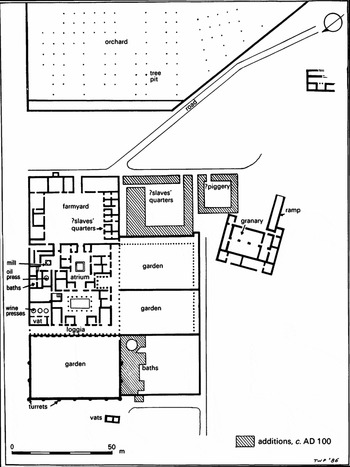
Whatever the reasons we may advance for it, it is clear that few classical archaeologists are interested in slavery, and only a tiny handful of those have ever advocated a comparative approach to the archaeology of Rome's unfree. Witness the fact that the bibliography of the most recent synthesis of archaeological evidence for Greek and Roman slavery (Thompson 2003) does not contain a single reference to New World slavery studies. Undoubtedly, the best-known archaeological study to draw on ‘New World’ comparanda in a classical context remains the hugely influential Italo-British Settefinestre project (Carandini 1979; 1984). Large-scale, estate-based agricultural enterprises were a common feature of the slave systems of both republican Rome and the antebellum South, and the Settefinestre project, centred on a late republican/early imperial villa at Cosa, was explicitly inspired by the potential for comparison between the Roman villa (conventionally assumed to be a purpose-built, slave-run estate) and the ‘New World’ plantation (figure 1). Andrea Carandini, the project director, was a Marxist archaeologist whose interest in the field of diachronic comparison had been directly inspired by Marx's formulation of the slave mode of production (Terrenato 2005, 65). Carandini's account (1984) of Settefinestre concludes with a chapter entitled ‘Schiavitù antica e moderna a confronto’ which examines archaeological studies of plantation sites in Virginia, South Carolina and Louisiana, and suggests that these might potentially help us to identify slave quarters on villa sites (ibid., 188–89).
Plan of the Settefinestre villa complex, showing possible slave quarters (from Potter 1987, 105).

Very few classical archaeologists have taken up Carandini's suggestion and run with it. Morris (1993) has made tentative comparative steps with reference to the houses and ceramics of Thracian and Phrygian slaves in the Lavreotiki, Attica, and I have done the same for putative slave housing in Roman Britain (Webster 2005) – these contributions are discussed more fully below. But these two studies aside, we need to look well beyond the classical world to find another archaeologist working on slavery in comparative perspective. This is of course Martin Hall, in his groundbreaking study of the material culture of 18th-century Virginia and the South African Cape (Hall 1992; 2000). Hall's approach is synchronic; his study areas are widely separated in space, but not in time. Nevertheless, one of the key arguments Hall makes is that colonial societies embodying certain similar institutions, practices and inequalities, including slave-ownership, inevitably exhibit comparable regimes of truth and knowledge (that is, comparable forms of discourse), out of which arise comparable material ‘statements’ (Hall 2000, 22).
Hall's study concerns two 18th-century societies that, despite their differences, can both be set in the context of an early modern discourse of the expansion of European merchant capital (1992, 379). Notwithstanding, it would be interesting to know whether Hall himself would feel that the ‘fact of slavery’ (ibid.) might generate recognizably similar material statements among other slave-owning peoples in other periods, including ancient ones. Keith Bradley, who has argued that slavery exhibits universalist features (1994, 180) across space and time, would probably be happy with this suggestion. Should Orlando Patterson have found room in his study for a consideration of material culture, he would no doubt have liked the idea too: Patterson, as we have seen, believed strongly in the structural constants of slavery across time and space.
Universal laws? Structural constants? There, perhaps, lies the problem. We have already seen above that by 1982, when Patterson's great work of diachronic synthesis appeared, few archaeologists trusted in either of these (unless they were prehistorians, or James Deetz). Mention of James Deetz reminds us, however, that Martin Hall's brilliant comparative study of the transcripts of slavery in Virginia and the Cape explicitly rejects the Deetzian, structuralist notion of ‘universal laws of the mind’ (Hall 2000, 24) whilst simultaneously arguing that the ‘fact of slavery’ generated shared material culture ‘statements’ in disparate locales. I read Hall to be arguing that strategies for living are not infinite in societies containing masters and slaves: there are only so many transcripts (material or otherwise) to be written, only so many ways to coerce, to suppress, to rebel, or to adapt. I would suggest that we find similar discourses going on in all slave-owning societies, from Virginia to Dacia, from Cape Town to Gaul (Webster 1997, 2003). If we accept this, then it seems perverse not to engage in diachronic as well as synchronic comparative analysis.
Some myths debunked
One way to understand the continuing reluctance of archaeologists to engage in comparative slavery studies is to address the major objections which – in my own experience of speaking and writing about the topic – come up when one attempts to offer comparisons between Rome and the Atlantic world. There are four key objections, and they run as follows:
• New World Slavery was black slavery. Colour prejudice was a major ideological factor informing ‘New World’ slavery, and the Romans (whatever their faults) were not racists.
• Even if some level of diachronic comparison is allowable, this should be limited to the five ‘genuine’ slave societies: Greece, Rome, the southern states of the USA, the Caribbean and Brazil.
• There are more, and better, documentary sources available for the Americas.
• The extent of slavery and the segregated nature of plantation life were such that slavery is archaeologically more visible in the Americas: slave-specific sites (plantations, slave quarters and so on) can easily be identified and excavated.
Let us begin with race. Racial prejudice was more common in the classical world than is sometimes realized (Bauman 2000, 120–22; see also Sherwin-White 1967; Thompson 1989), but this was directed against many peoples, not simply people of colour. That is to say, while there is some evidence to suggest that Roman Africans were singled out for offensive comment specifically on account of their appearance (Bauman 2000, 121; Thompson 1989, 26–38, 40–47), skin colour was not an a priori basis for regarding others as inferior. This is why the charge of colour prejudice is rarely levied against Greece and Rome, and explains why Isaac (2004; 2006) is able to argue that the Greeks ‘invented’ (proto-)racism yet were not racists. In the Roman world, then, racial and colour prejudice did not necessarily walk hand in hand. But up to a point (and I mean here a point in time) the same can be said of the Americas. During the earliest phase of the transatlantic slave trade (c.1500–1700) Africans were not enslaved because they were black, but because they were available for sale, and they were not Christian (Deetz 1996, 224). The ideology of colour prejudice was a later development, emerging only as plantation slavery became the economic mainstay of the colonies: at the point, in other words, at which perceived economic necessity made it expedient to invent a ‘justification’ for the mass enslavement of Africans. In British North America and the Caribbean, this was not until the late 1600s. The Atlantic slave trade had already existed for almost 200 years prior to this, and slave experiences in the earlier phase differed significantly from those at the height of the plantation era (c.1700–1860). The life of a slave in 17th-century Virginia would certainly have been very different to that of another in 18th-century South Carolina or Georgia, states which only began importing slaves in significant numbers after the plantation system was established, and within which blacks made up the majority of the population from the early 18th century. In the Americas as in Rome, then, perceptions of colour and race were complex, intertwined and subject to change over time. The existence of colour prejudice in the New World does not, in itself, disbar romanists from drawing lessons from the Americas.
Furthermore, what of Finley's five ‘genuine’ slave societies? If we compare, should we limit analysis to these? As Higman (2001) notes in his excellent historiography of the modern invention of the ‘slave society’, Finley's definition is but one of several and has been regarded by some (including Bradley 1994, 30) as too limiting. Patterson (2008, 33) has recently spoken of the five-slave-societies concept as ‘too absurd to be taken seriously’. Three additional considerations can be offered. First, true ‘slave societies’ in Finley's sense were uncommon even in early modern America and – just like the imperial Roman provinces – the north-eastern states of the USA (including Massachusetts, Maryland and the ‘borderline’ state of Virginia) should properly be characterized in the same terms as ‘slave-using’ societies. Given this, it may be argued that rather than focusing exclusively on the true ‘slave societies’ of late republican Rome and the southern states of the USA, as ancient historians have tended to do, romanists with an interest in provincial slavery should actually consider turning their attention to slavery – and its archaeology – in the north-eastern US states, and in other areas (for example Peru, Venezuela and some Caribbean islands) where slavery contributed to, but was not the backbone of, the local economy. Second, it is important to emphasize that despite differences in scale and emphasis, shared material-culture discourses of North American slavery were taking place in both the northern and southern states. In other words, slave-owners and slaves spoke a similar material language, wherever they were found. Finally, it is important to stress that we actually know very little indeed about the numbers of slaves in most Roman provinces, or the percentage they made up of any given population. For this reason alone, it is difficult to accept the outright rejection of comparanda from more recent slave societies, or indeed slave-using societies. But reject them we have.
Turning to the third objection in the list above, it is certainly true that the quantity of documentary evidence for the Atlantic slave trade is far greater than that for the Roman world, but quantity and quality are not the same thing. The bulk of the New World documentary source material on slavery concerns the movement and management of people who appear to us not as individuals but as names and numbers. Most importantly, only a tiny proportion of the contemporary written record was the work of men and women of African descent. Similarly, not a single slave biography survives from the classical world. In this critical sense – that we see slaves almost wholly through the (written) lens of the slave-owning class – the American and Roman worlds are very alike.
The last of these objections is undeniably the hardest to counter. Prior to 1700, the majority of slaves lived, worked and were even buried alongside their owners (see King and Ubelaker 1996 on a slave burial from the Patuxent Point Cemetery, Maryland). After 1700, however, many plantation slaves were segregated from their white owners and lived in purpose-built quarters that can often be identified from maps and documentary sources. This in turn means that it is possible to isolate areas, and sites, where slaves predominated, allowing archaeologists, as Morris (1993, 199) puts it, to sidestep some of the problems of artefact attribution.
As I have discussed elsewhere (Webster 2005), Graeco-Roman slaves are frequently assumed to be ‘archaeologically invisible’, leaving no clear material footprint, other than artefacts of restraint or ownership, for excavators to identify. As Morris (1993, 193) points out, slaves are ‘invisible’ largely because we have failed to look for them, but I would add here that lack of confidence in our ability to find them stems in part from the uneasy relationship between archaeologists and ancient historians of slavery. Put simply, ancient historians feel archaeology has little to contribute to the exploration of ancient slavery, and archaeologists – who have been conditioned to privilege texts over other forms of artefact – have a sneaking feeling they are right. Walter Scheidel, whose own comparative work is discussed above, offers an illuminating insight into this mindset in his review of Schumacher's Sklaverei in der Antike (2001). Scheidel is rightly critical of the absence of a comparative focus in this study, but also concludes (2003, 581) that it is ‘unreasonable to expect archaeology to make a significant contribution to the modern reconstruction of Graeco-Roman slave systems’. This is because ‘rather than driving [the] reconstruction of ancient slave life, archaeological material tends to be relegated to the supporting role of illustrating independently derived findings’. By ‘independently derived’ Scheidel means ‘textually’ derived. Even the work of archaeologists of modern slavery, he suggests (2003, 581), confirms ‘that it is impossible to identify slave presences in the archaeological record from that record alone’. Scheidel seems to be implying that archaeology will only ‘prove’ its value as a source of information on ancient slavery when it can do so independently of text (in similar vein see Finley 1985, 25). Ultimately, these comments reveal far more about ancient historians’ sense of the purity of their own discipline than about the true value of archaeology in studying ancient slavery. They also betray a fundamental misunderstanding of the relationship between documents and artefacts – the unity of ‘words’ and ‘things’ – that Hall so persuasively argues is necessary for the emergence of a new, transdisciplinary approach to the historical archaeology of colonial contexts (Hall 2000, 16). I come back to this point in my case study below.
In his excellent comparative study of the archaeology of the excluded in classical Greece (1993), Ian Morris is rather more optimistic about the ability of archaeologists not only to render slaves visible, but to offer insights into their life experiences. Morris draws (as I have also done elsewhere: Webster 2003) on Leland Ferguson's work on slave-made ceramics known as colonowares, and their role in the foodways and ritual activities of slaves living on the rice plantations of South Carolina (Ferguson 1991; 1992). This work, Morris suggests (1993, 199), offers new ways to think about the archaeology of Greek slavery:
When we can examine the artefacts against a textual record that tells us certain areas were demographically dominated by slaves, as in South Carolina, we can side-step some of the problems of attribution. We cannot say that a specific hut belonged to a slave or that a particular pot was made by a European, but we can say that certain kinds of assemblage appear in regions or sites where we know that slaves predominated. We might even be able to say, as Ferguson does, that the character of these assemblages tells us something about the extent to which slaves constructed cultural worlds which stood apart from those of the master class.
Morris goes on to explore an area of ancient Greece in which slaves were demographically predominant: the silver mines of Lavreotiki, Attica. The majority of these slaves originated from Thrace and Phrygia, and in a study focusing on pottery and housing Morris attempts to isolate material traits that may reflect these points of origin. His conclusion is that Thracian and Phygian slaves very quickly lost sight of the material culture of their homelands, which was rapidly subsumed by the pervasive material culture of the master class (Morris 1993, 211). As a result, he suggests, the slaves of Lavreotiki remain far less visible than their Atlantic counterparts.
As will be clear from that discussion, Morris regards determination of ethnic origin as a precondition for the confident attribution of material culture to enslaved persons. Yet, as archaeologists working on Atlantic slavery have argued (Singleton 1999, 8; Fennell 2003), the quest for ethnic ‘markers’ (known as Africanisms) betrays a static conceptualization of ethnicity, and does not help us to explain why those markers emerged, persisted or creolized. As Morris himself notes (1993, 198), and as Ferguson did also (1992, 37–41), slave-made artefacts are far less common throughout the US plantation belt as a whole than are artefacts of European origin, and slaves largely shaped and expressed their identity through European manufactures. Laurie Wilkie's work (2000; 2001) on the use of European-made ceramics by slaves at Clifton Plantation in the Bahamas offers a perfect illustration of this point. Wilkie demonstrates that an enslaved Bahamian family with access to island markets selected European ceramics and pipes for their home in accordance with BaKongo aesthetic principles, for example preferring orange and brown, banded and incised dipped wares, and selecting decorated wares bearing symbols (including birds, cross markings and quartered circles) resonating with BaKongo beliefs. Wilkie's careful study demonstrates that whilst Atlantic slaves were largely dependent on the material culture of the master class, they used those materials in adaptive (or creolizing) ways that enabled them to maintain a sense of ethnic identity and heritage. I suggest that there can be no archaeology of ancient slavery until we accept this insight and employ it in seeking out the material world of Greek and Roman slaves.
Isolating the invisible
As Morris (1993) suggests with reference to Greece, comparative analysis can help scholars of ancient slavery to isolate material categories that, across time and space, have proved to be important foci for the negotiation and expression of identity among the unfree. These categories include ceramics, touched on above, and housing. As noted earlier, it is commonly argued that slave quarters are much harder to isolate in the ancient world than in the Americas. Is this really the case? As Morris (ibid.) demonstrates with reference to Greece, it is possible to isolate sites or areas with large numbers of resident slaves. These include mines and quarries (Thompson 2003, 131–86) and also, of course, agricultural estates.
Slaves of Roman agricultural estates, unlike their Atlantic plantation counterparts, do not appear to have been housed in dedicated slave quarters or villages, but this does not mean we are clueless as to their likely whereabouts. Columella (De re rustica 1.6.3) says that on an ideal (Italian) villa estate, the kitchen of the villa rustica or farmhouse should be regarded as a rest-room for slaves, and that servi soluti should be housed there in cubicles (cellae) sited to receive the midday sun in spring and autumn. This tells us at the very least that a villa's domestic slaves had a little private space of their own. We also know that private ergastula (or carceres) were a feature of many agricultural estates and rural villas, and that these sometimes served as communal workhouses for slaves who worked in the fields. I have discussed elsewhere the urgent need to isolate more examples of this little-studied class of building (Webster 2005).
Nor are we entirely lacking a sense of the household spaces frequented by urban slaves. In his (forthcoming) study of the inscriptions from the Insula of the Menander, Pompeii, Mouritsen argues convincingly that the large clusters of graffiti found in the kitchen corridor and latrine of the House of the Menander must have been produced by slaves or freedmen. As he remarks, the area outside the kitchen would have been a warm and secluded place: a social hub for the household slaves. Brief acquaintance with North American work makes it clear that it is in those secluded spaces that we should be seeking material evidence for the ways in which slaves made a world for themselves. As Anne Yentsch (1994) memorably demonstrated in her account of the wealthy and powerful Calvert household in Annapolis (Maryland), it is possible to say something about the life and work of a small and virtually undocumented group of urban domestic slaves, even – as in this case – when they served a ruling colonial family. Armed with only a tiny handful of artefacts that might potentially be associated with the Calvert slaves, Yentsch ‘saw’ her targets by extracting every possible contextual nuance from the few ‘small things’ available to her (a handful of beads, a small guinea-fowl brooch, faunal remains). Equally importantly, she gave as much attention to the yards and kitchen of the Calvert residence as to the elite residential portion of the house. In such places, stories of slavery are told.
Ephemeral inscription: a comparative case study
Many readers will remain unmoved by the above (trust me when I say this – I have been there before). But archaeology is a practical discipline, and I would like to end by discussing one practice common to slaves in both the ancient and modern worlds, in order to illuminate ways in which methods and strategies developed by archaeologists of modern slavery might aid those of us attempting to reach into the world of Rome's servile classes. At the same time, I will suggest that romanists also have something to offer their early modern colleagues here. Comparative methodologies do cut both ways, after all.
My case study concerns literary and figural ‘scribbles’ found on walls, ceramic tiles and other surfaces, and commonly known in the Roman world as informal inscriptions, or graffiti. Slaves certainly made graffiti, as discussed below, but individuals at all levels of Roman society did the same thing. Mouritsen (forthcoming) thus emphasizes that the modern understanding of informal inscription as a subversive, covert practice favoured by subaltern or excluded groups has no relevance in the Roman context: everyone made graffiti. In what follows, I accept this point, but suggest that the traditional understanding of Roman graffiti as texts, not objects (words, not things) actively inhibits our ability to explore the extent to which – and the distinctive ways in which – slaves may have employed informal forms of inscription. Studies of symbolic expression amongst slaves in the Americas (and in particular Fennell's 2003 work on material expressions of the west central African BaKongo cosmogram; see figure 2) might help us to develop new perspectives on the stylistic abbreviation of core or key symbols of ethnicity and belief, by slaves creating figural graffiti in the Roman world.
The BaKongo cosmogram (Fennell 2003, 6, figure 2; courtesy of Christopher Fennell).

All Roman graffiti – whether literary, figural or both – are categorized as inscriptions. A distinction is drawn between ‘dipinti’ (painted inscriptions) and ‘graffiti’ (carved inscriptions), and between examples made on walls and on other surfaces – so much so that in the Corpus Inscriptionum Latinarum, parietal and non-parietal types are published separately – but all are conceptualized as texts. As Mouritsen (forthcoming) notes, the study of both dipinti and graffiti has traditionally been the preserve of linguists, who have focused their attentions either on verbal graffiti expressing basic human emotions (love, lust), or on those containing personal names. In this context, whilst numerous graffiti have been attributed to Roman slaves, particularly in Pompeii, attribution is inevitably on epigraphic grounds: graffiti preserving ‘servile’ cognomina are assumed to have been produced by slaves. But what of those slaves who were unable or unwilling to write down their names? What of those for whom symbols carried more meaning than words?
Readers of a nervous disposition should look away now: I am about to come dangerously close to identifying a universal ‘law’ of slavery. Archaeologists of the diaspora have long noted a preoccupation with informal inscription among enslaved communities. Enslaved persons across time and space – individuals whose voices were deliberately muted by others, and for whom the only certainty was uncertainty – have felt a strong need to make their mark upon objects, walls and grave markers. In the Atlantic world, where slave literacy was especially limited, these markings rarely incorporate lettering and are usually referred to as ideograms or symbols. Archaeologists have associated some of these markings with the belief systems of slaves by paying close attention both to the imagery they employ and to the contexts in which they occur. The best-known and most fully studied of these symbols is the above-mentioned BaKongo cosmogram (figure 2), which in its full form consists of intersecting horizontal and vertical axes, set within a circle or ellipse, with smaller circles or disks at the four ends of those crossed lines (Fennell 2003, 6). Among the BaKongo people of west central Africa, this symbol served as an emblematic expression of identity, ‘summarising a broad array of ideas and metaphoric messages that comprised their sense of identity within the cosmos’ (ibid.). Simplified or abbreviated versions of this ‘core’ symbol (ibid., 2) have been found across the US plantation belt and the Caribbean (figure 3). Many are etched on the bases of curved, bowl-shaped objects ranging from slave-made pottery through to European manufactures (Ferguson 1992; Fennell 2003; Wilkie 1997. As noted above, Wilkie 2000 has also argued that slaves of BaKongo origin might favour European manufactures bearing imagery comparable with the cosmogram).
Abbreviations of the BaKongo cosmogram (after Fennell 2003, 8, figure 3; courtesy of Christopher Fennell).

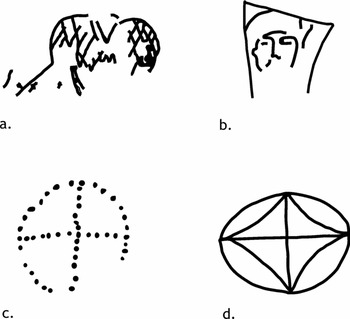
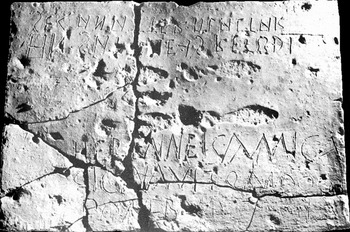
Langner's recent (2001) study of more than 2,500 examples of graffiti drawings from the ancient world brings home the extent to which imagery was employed by Roman ‘graffiti artists’ (see also Funari 1993 for a brief but interesting discussion of the semiotics of Pompeiian caricature). Alongside the verbal graffiti on the walls of Pompeii and Ostia we find hunting scenes, gladiatorial combats, caricatures of the human face and form, ships, birds, animals and a wide variety of emblematic ‘scribbles’ that are neither immediately recognizable nor intuitively intelligible (figure 4). Similarly, symbols and other markings frequently accompany non-parietal graffiti. A tile from the terracotta tile factory at Pietrabbondante (Samnium) illustrates this point perfectly. This tile bears a bilingual Latin–Oscan inscription recording the names of two individuals (?Detfri and Amica), almost certainly female slaves (Adams 2003, 124–25). But before writing their names, these women impressed the soles of their shoes in the wet clay of the tile (figure 5).
Graffiti from Ostia: a. elephant (Casa di Diana); b. face on the prow of a ship (Cassegiato degli Aurighi); c. circle and cross motif (Case a Giardano); d. oval geometric motif (Terme del Foro). Reproduced courtesy of the Ostia Harbour of Ancient Rome website (http://www.ostia-antica.org).

Terracotta tile from Pietrabbondante, bearing the names and shoe impressions of the slaves ?Detfri and Amica. Courtesy of Davide Monaco and the L'Osco dei Sanniti website (http://xoomer.alice.it/davmonac/sanniti/smlin.html).

Detailed analysis of graffiti and dipinti attributable to slaves, either on contextual grounds (as in Mouritsen's work) or because they include ‘servile’ names, might allow us to identify recurrent symbols which may, in turn, be traceable to specific ethnic groups and belief systems. Fennell (2003) correlated the BaKongo cosmogram with a specifically Congo-Angolan (rather than generally ‘African’) diaspora by constructing an ethnographic analogy based on 16th- to 19th-century accounts of west central African belief and practice. Identification of ‘core’ symbols among Roman slaves cannot proceed by looking forwards from our period in this way, but we can compare sideways, to the symbolic systems of peoples dominating the external slave supply at specific points in Roman history. Two points of clarification should be offered here. First, I am fully aware that many uncertainties surround the Roman slave supply, some of which were noted above with reference to Walter Scheidel's work. It is, however, clear that in the Roman world, as in the Atlantic, that supply flowed in dominant channels, allowing us to recognize broad demographic patterns over time. Second, although I am advocating an ethnically centred approach to visual graffiti, I do not mean thereby to suggest that Rome's unfree carried intact and unchanging identities with them into slavery, any more than did their Atlantic counterparts. One of the most compelling features of studies of symbolic expression among slave groups in the Americas (including Fennell 2003; Wilkie 2000) is the recognition that, over time, core symbols could be abbreviated and reconfigured by those whose knowledge of these symbols had developed in an entirely creole context. It would be very interesting to see how far that insight could be carried in the Roman world, with reference not simply to the material world of slaves, but also to provincial religious ‘art’ more generally (Webster 2003). Undeniably, we have further to go, and less demographic data to draw on, than our Atlantic counterparts in determining the dominant routes to slavery in the Roman world, but the potential for progress is clearly there. It may be remarked in this context that the Roman fondness for bestowing Greek cognomina on slaves, whatever their origin, is a severe impediment to current efforts to explore issues of demography and ethnicity. A focus on visual rather than verbal identification strategies might actually help us break through that barrier.
In the Roman world, inscription (in this case of the literate kind) was of course a notable preoccupation of former slaves. This point is brought out very strongly in Mouritsen's recent work on Ostia and Pompeii (Mouritsen 2005). An astonishing proportion of funerary monuments in these locales commemorate former slaves: around 75 per cent of the total record. As Mouritsen points out, manumitted individuals continued to be marked with the stigma of inferiority, and an investment in the architecture of death helped them to claim and assert a place in society. At the same time, these monuments speak of the preoccupations of those who have lived lives of uncertainty: family, inheritance, genealogy, security. In this context, it is worth noting that the grave markers of postbellum (emancipated) African-Americans have recently become a focus for research in the USA (see for example Rainville 2008; and the Virginia cemetery database at http://www.virginia.edu/woodson/projects/aacaac/). Thus far, this work has tended to explore postbellum grave markers in order to better understand antebellum examples. It would be interesting to know what Mouritsen would make of the language and iconography of these grave markers, and whether he would recognize in them similar concerns to those he has identified among manumitted individuals at Ostia and Pompeii. Joshel's (1992) epigraphic study of Roman workers (including slaves) has drawn explicitly on ‘New World’ comparanda, and shows how closely these two fields of analysis might potentially entwine.
Conclusion
I have suggested above that chattel slavery is one of the characteristics of the classical world most often subject to comparative analysis – but not by archaeologists. Despite over 20 years of engagement with postcolonial thinking, archaeologists of the ancient world cling to a sense of the ‘uniqueness’ of ancient slave systems in particular, and of Graeco-Roman colonial ventures more generally. This perception actively prevents the development of comparative approaches, but that, of course, is why we do it in the first place. To paraphrase a telling comment made by Nicola Terrenato at the CRAC Stanford conference, of course classical archaeologists know that comparative analysis goes on elsewhere, they just don't want it coming to Greece and Rome – leave it to the prehistorians, and the modern historians. I would add that in thinking about slavery, one of the least edifying aspects of the classical past, we are finding it harder than our ancient-historian colleagues to let go of the ‘apologist’ mentality that Finley so firmly dissected some 25 years ago. Archaeologists want to believe that the experience of slaves in the classical world was somehow ‘better’ than that of their Atlantic counterparts. Cross-cultural comparison can only undermine that illusion – and for that reason, we knowingly avoid it.
Acknowledgements
I am indebted to Ulrike Roth, who organized the TRAS meeting at Edinburgh in 2007; to Irene Schrüfer-Kolb, who invited me to speak in her session at the London RAC/TRAC 2007 conference; and to Corisande Fenwick, Kathryn Lafrenz Samuels and Darian Totten for their invitation to attend the 2008 Critical Roman Archaeology Conference (CRAC) at Stanford. I owe an especial debt to Nicola Terranato, whose CRAC plenary session on The Future of Roman Archaeology came at just the right moment to help me crystallize some of the ideas set out here – it was also very, very funny. Nicola also drew my attention to the graffiti from Samnium discussed above. I am equally grateful to Henrik Mouritsen for allowing me to draw on his forthcoming publication on the inscriptions from the Insula of the Menander, and for his insights into the history of the study of Pompeiian inscriptions. Diana Paton, Ian Haynes and two anonymous reviewers offered detailed comments on an earlier draft of this paper, and made numerous suggestions on ways to improve it. I am most grateful for their advice, and for the new directions they suggested.