China had a minimal presence in Latin America only two decades ago. Today it has become impossible to talk about Latin America in an international context without mentioning China. Since the turn of the century, Sino-Latin American trade has grown by a factor of ten. In 2000 China ranked 16th as a buyer of Latin American and Caribbean exports and ninth as a source of imports. Less than a decade later, in 2008, China ranked second as bothFootnote 1 – it is nowadays Latin America's second trading partner and source of foreign direct investment, behind only the United States.Footnote 2
China's landing in Latin America presents a number of important questions. There is one that stands out: how do two strangers get to know each other when they are unexpectedly thrown into a relationship? This is like a marriage in which the bride and groom meet on the wedding day. We are witnessing a “close encounter” between two distant “others” who barely know each other, and the encounter is playing in fast motion. This rapidly evolving interaction challenges us to unravel the ways in which the image of the other takes shape. Relationships are mutually constitutive, thus we need to examine the dynamics of perception in order to understand what the parts think of each other. The public representation of a partner is a vital component in the construction of a relationship. This article focuses on the Latin American side and concentrates on the media to examine, in particular, what major newspapers say about China. Such an analysis can help us understand how a slice of the public sphere views China and the types of images that are created via news coverage. I am particularly interested in exploring not only the ways in which the media have represented the accelerated economic growth of China and its role in Latin America and the world, but also how they perceive other dimensions of the East Asian power.
For Latin America's own identity, growing engagement with China poses critical challenges. The unprecedented hegemony of democracy is a crucial component of Latin America's identity. As the analysis presented in this article shows, the new presence of China in the western hemisphere has made Latin Americans look at themselves in a new light. Allegiance to global values, the will to innovate and the difficult challenges posed by tensions between economic development and freedom are among the issues shaping debates in the public sphere of countries such as Colombia.
Knowledge about China in Latin America is still thin. There are few academic programmes, think tanks or research institutes with the resources and expertise necessary to develop substantial and comprehensive studies on China.Footnote 3 Latin American ideas have been largely based on an “imported Orientalism,” which tends to be dominated by misrepresentations of Chinese society and culture. A combination of timeworn images of China as “mysterious” and the projection on to China of changing beliefs and interests in the West have coloured Latin American conceptions. Nevertheless, the lacunae of knowledge about China and the largely blank slate upon which the relationship is being built offers Latin America an opportunity to create a new vision to serve as a corrective to imported views and its own biases.
This article presents an empirical analysis of the ways in which the press in Colombia portrays China with a focus on two of its major newspapers. As an exploratory study, this piece focuses on a single case in order to identify some of the parameters that define the “construction” of a China image in media outlets. Understanding the impact of Chinese expansion on the public sphere of one nation may suggest possible similar developments in other Latin American countries.
As expected, we find a broad range of perspectives on China in the Colombian media. Colombia has significantly increased its commercial relationship with China – it was, as of 2010, its second largest trading partner – but it continues to hold a close connection with the United States, with which it implemented a Free Trade Agreement in 2011. Colombia thus stands in the middle of the road in terms of its dependence on China; furthermore, its relationship with the East Asian power is not coloured by ideological factors such as those of Venezuela. Colombia also offers a good opportunity to examine how the news media in a country that has been dealing with serious human rights problems view China's human rights record, one of the areas that attract media attention in Latin America and the rest of the world. Additionally, the comparative analysis of news coverage in Colombia's two mainstream newspapers, the right-leaning El Tiempo and its left-leaning counterpart El Espectador, allows us to examine whether ideological positions affect perceptions about China.
Colombia, as the study shows, reflects a trend found in Latin America and beyond: coverage of China has increased significantly in recent years. The nature of this coverage has changed too: reporting informs the public about China but is also developing a critical position with regard to the East Asian power's emergence in Latin America. China has a larger role in the news and, rather than being considered a distant actor, it is increasingly viewed as a tangible and concrete, albeit looming and problematical, presence in the region. Political preferences and ideology influence coverage; however, there are common concerns about China's expansionism, namely scepticism regarding the actual benefits that China brings to the region and the long-term effects of this engagement as well as China's new role in the international scene.
Not surprisingly, the subject of economic power dominates coverage of China in the Colombian press, which befits Beijing's focus upon “the economic face of power.”Footnote 4 Analysis also suggests that both the left and right are less concerned with China's political system than they are with its “global values,” which for the left represents a defence of human rights, while it is environmental performance that preoccupies the right. The Colombian press views human rights and environmental protection as values associated with China's role as a “responsible stakeholder,” a term originated in Washington, and is thus concerned that China is not fulfilling its responsibilities as a rising global power. However, coverage of these topics reveals a gamut of reactions to China's domestic record on human rights as well as its behaviour with regards to the environment. Preoccupation with “universal values” does not mean that influential media outlets avoid the temptation, common among many governments, to assume a more lenient tone in denouncing human rights violations and other discreditable actions in China.
The study reveals a Janus-faced image of China: on the one hand, a growing power perceived as an auspicious trade partner in the region; on the other, a troubling new actor in the international context. There is expectation that Beijing's “going out” policy should abide by a set of standards that go beyond the economic realm. While there is a substantial degree of optimism regarding China's potential as an economic power, there is concern about the sustainability and global impact of Chinese involvement. This is a serious issue for Latin America, where many countries have yet to improve their own environmental controls, where social conflicts linked to the extraction of natural resources have escalated in recent years, and where corruption continues to affect institutions and governability.Footnote 5
Yet a close look at the “China talk” in the media shows that there is much more than dichotomies. China's landing in Latin America has triggered new debates focused on strategic options, damage control and development models, among other issues.Footnote 6 Most of the discussions seem to occur in the realm of economics and politics, yet the debate over ideas, identity, rhetoric and Weltanschauungs is probably the one with the most serious implications for the future. The public sphere is the realm where such debate takes shape. The array of implications brought about by the rise of China, particularly in the specific ways in which they influence the West, suggests that the images and representations of China in the public sphere are likely to attain increasingly more weight. A systematic analysis of news coverage on China is timely. Moreover, an examination of representations of China that attempts to look beyond simplistic analysis, binary logics and stereotypes can yield new information about the formation of a China image in Latin America.Footnote 7
While it is possible to observe a certain degree of stereotyping in the way the Colombian press covers the subject of China, most of the coverage reveals a sensible consideration of different, and sharply contrasting, aspects of Chinese engagement with Colombia and Latin America more generally. The findings show that Colombia's mainstream newspapers pay significant attention to the role of China as a global player, that is, there is considerable interest in its international actions beyond bilateral relations. This tendency seems to dominate media attention in other countries of the region as well.Footnote 8 The perception of China's rise does not follow the same patterns as in the case of Japan's ascent in the 1980s. While the case of China's emergence differs from that of Japan – for example, with regards to China's stage of development compared to Japan's, its reliance on expansive markets for basic manufactured goods and a competitive relationship with the United States in the realm of security – there are additional factors that make China a special case.Footnote 9 How the media perceive China appears to be strongly defined by the East Asian country's non-democratic status, the “new normality” of interdependency in the world, and the model of trade and development that China represents for Latin America's future.
The unusual situation posed by China's sudden relevance in Latin America offers the opportunity to inquire how the press in a democratic country such as Colombia, where human rights violations have been a serious problem for decades, responds to an emergent, non-democratic power. As in the case of Africa, Latin American states and societies are not passive victims of a Chinese strategy aimed at imposing a particular model of development on a continent. The negative aspects of China's aggressive capitalism may be potentiated by the nature of the Latin American context (corruption, weak rule of law, lack of transparency and so on), and therefore it is important to understand not only how China's emergence in Latin America is processed in the public sphere but also how the image of China evolves in the context of Latin America's own ghosts, uncertainties and weaknesses.
Colombia and the New Presence of China
China became Colombia's second largest trading partner at the beginning of this decade.Footnote 10 Prior to this position, China was the 35th recipient of Colombian exports and 15th supplier of imports in 2000.Footnote 11 Nevertheless, Colombia's largest trade deficit is that with China – a problematic situation that the Colombian government has sought to address by encouraging Chinese investment in infrastructure and the mining sector.Footnote 12 The United States remains by far Colombia's most important trading partner, although it has been growing at a slower pace than China. Recent US congressional approval of a Free Trade Agreement with Colombia is likely to boost US–Colombian trade. The other emerging power in the region, Brazil, is only relevant as a source of imports for Colombia, ranking fourth by 2010.Footnote 13
Chinese investment in Colombia's automobile sector, telecommunications and natural resource extraction has grown significantly in the last decade. Chinese companies are particularly interested in areas with large but unexploited potential to expand both the extraction of natural resources (primarily mining) and the development of agroindustry.Footnote 14 As noted, there are substantial expectations that China would invest in infrastructure, which is the greatest weakness in Colombia's competitiveness in the region and beyond.Footnote 15 Announcements about a possible “dry canal” that would connect Colombia's Pacific and Atlantic ports by rail, and the construction of a pipeline (initiated but constantly interrupted) that would connect oil and natural gas reserves in eastern Venezuela and Colombia with the Pacific in order to supply the Chinese market received significant attention in the international news media.Footnote 16
Colombia's industrial conglomerates and small and medium-sized businesses are concerned about their capacity to compete against cheap imports from China. The shoe industry, traditionally very important in the north-eastern region of Colombia, has been virtually destroyed as a result of Chinese and Brazilian competition. The Colombian textile sector has also suffered heavily from the wave of cheap Chinese imports and the smuggling of Chinese clothing into Colombia. Textile exports collapsed in the last decade and the sector has not been able to regain its export capacity – in a context in which the national economy has continued to grow.Footnote 17 In different ways, Chinese competition in these sectors has forced Colombian entrepreneurs to explore new markets, distribution chains and overall innovation in order to remain competitive.
In the 1980s and 1990s, it was common for a Colombian bureaucrat with long-standing ties with China to be designated as ambassador in Beijing. However, from the late 1990s, businessmen became the top choice for Colombia's ambassadorial post in China. The South American nation's diplomatic corps has been traditionally weak, a trend that has been reflected in the relationship with China. With the exception of a few symbolic gestures to show national autonomy (see the analysis of the events surrounding the 2010 Nobel Peace Prize below), Colombia tends to follow the United States in its international relations. Its close alliance with the United States is an important factor in its relationship with China, particularly from the perspective of Beijing.Footnote 18
The Santos administration used the “China threat” sentiment in Washington to bolster support in Congress for ratification of a Free Trade Agreement with the United States. President Santos's comments on the idea to build a “dry canal” with Chinese support were largely intended to highlight Colombia's potential as a regional hub for trade with China, a component of a foreign policy agenda centred on geographic diversification and oriented to open up new business opportunities for Colombia.Footnote 19 Closer economic co-operation with Chile and Peru, the re-establishment of diplomatic relations with Venezuela, and a free trade agreement with Mexico all became part of a strategy to create a regional bloc to take advantage of the booming Asian markets.Footnote 20
Given that there are so few cultural, linguistic or historical ties with China, the media are a good place to start exploring how the China–Colombia relationship is being built in the 21st century. Reporting on China in two newspapers that represent mainstream voices in Colombia's public sphere, El Tiempo and El Espectador, offers a preliminary window into this process. Both newspapers are published in Bogota, Colombia's capital and its largest city, but are considered the two “national” newspapers because of their distribution, coverage and audience.Footnote 21 A right-leaning newspaper, El Tiempo represents the status quo in Colombia. It has been a staunch supporter of US involvement in the country's war against drug-traffickers and guerrillas as well as an advocate for the “Washington Consensus,” a set of economic policy prescriptions that include trade liberalization, deregulation, privatization and a minimal state. El Espectador is positioned on the left side of the ideological spectrum, which in the Colombian context entails a critical position with respect to free-market policies and condemnation of political violence, human and labour rights violations, and corruption in the political class. No other newspaper in the country has been hit as hard as El Espectador by the violence perpetrated against journalists by non-state actors (drug-traffickers, guerrillas and paramilitary groups): for instance, a terrorist attack in the 1990s destroyed its printing facilities; and its director and many of its journalists were assassinated for exposing illicit activities and denouncing human rights atrocities.
The results presented in this article were drawn from a quantitative study of news coverage in El Tiempo and El Espectador (see the Appendix for a methodological note) complemented by a qualitative study of these newspapers. For the most part, results are reported in a narrative form because of limitations in space. Given that this is an exploratory study that aims to define general trends that can help understand the construction of China's image, I chose not to use a computer-assisted procedure to determine patterns of word association and “semantic networks.”Footnote 22 Instead, the sample and subsamples were coded by different researchers to trace the main types of representations contained in the newspaper articles.
Systematic data on news reports for the first decade of the 21st century were only available for El Tiempo. These data show that the United States received the most news coverage during the decade without any significant increase. In contrast, the volume of news coverage on China more than doubled from 2000 to 2010, even though it was lower than that of the United States and that of a newcomer, Brazil, which became the focus of a dramatic increase in reporting in recent years, approximating the volume of news about the United States by the end of the decade. Most of the China coverage in El Tiempo consistently focused on the East Asian nation as a “trade partner,” a trend that reflected China's spectacular commercial expansion from less than a billion dollars in exports to Colombia at the beginning of the decade to $5.5 billion in 2010. Coverage of China as a potential threat (economic, military or other) experienced an increase in the later part of the decade and by 2010 it approximated the focus on China as a trade partner.
A quantitative analysis of articles from the two newspapers for the period 2008 to 2010 (the only years for which complete data are currently available) confirmed the relevance of China as an emergent economic power and trade partner. News coverage also reflected China's new role as a pre-eminent political actor in the international context (diplomatic, military, regional and world power), whereas issues concerning liberal democracy (human rights, civil rights, democratic institutions and freedom of the press) received comparatively little attention. The newspapers devoted some coverage to environmental issues, but it was very modest in relation to the importance of China as an engine of economic growth: the environment received only a quarter of the coverage dedicated to China's economic power.
A qualitative analysis of El Tiempo and El Espectador points first to a dichotomy of optimism (“Colombia will be China's door to Latin America in three years”) and disenchantment (“it is the trade of the ‘copied,’ ‘stolen,’ ‘fake’ and ‘duplicate’ that is growing in Colombia … a dark and lucrative business”).Footnote 23 China is depicted as a nation thirsty for new products, a consumer market driven by a rising middle class so large that it would be virtually impossible to satisfy (“a population of 1.3 billion of consumers who want to eat at least one [chicken wing] per day …”) and, at the same time, the source of a seemingly uncontrollable flood of illegal imports (“20 million [shoes] arrived at 20 US cents each”) with the potential to ruin entire sectors of Colombia's economy.Footnote 24 Nevertheless, reporting on China presents shades of grey that reveal a more complex, continuously evolving image of China. This image suggests patterns that echo Colombia's reaction to China's growing economic presence in Latin America but also have a more global tone, namely the ways in which China's “going out” policy and its “landing” in Latin America are connected to the fast individualization of Chinese society, the reinforcement of consumerism in the official ideology, and the rise of a culture of self-reliance and self-realization.Footnote 25
El Tiempo and El Espectador view China primarily in terms of political and economic power, trade partnership and domestic development (economic, political and social dimensions). Liberal democracy and the environment receive significantly less coverage. When assessing the various dimensions, both newspapers display admiration for China's economic miracle, but offer constant reminders about the uncertainties that the Chinese system presents to an interdependent world. China's model of capitalism elicits respect from politically conservative El Tiempo, which views its success as proof of socialism's hopelessness and capitalism's unrelenting potential, and from left-leaning El Espectador, which defends a return to the state as a leading actor in economic development. Despite this approval, both newspapers present more negative views of China than positive ones.Footnote 26 Aggregating news coverage of China in El Tiempo and El Espectador yields 39 per cent of negative views compared to 27 per cent of positive ones for the period 2008–10.
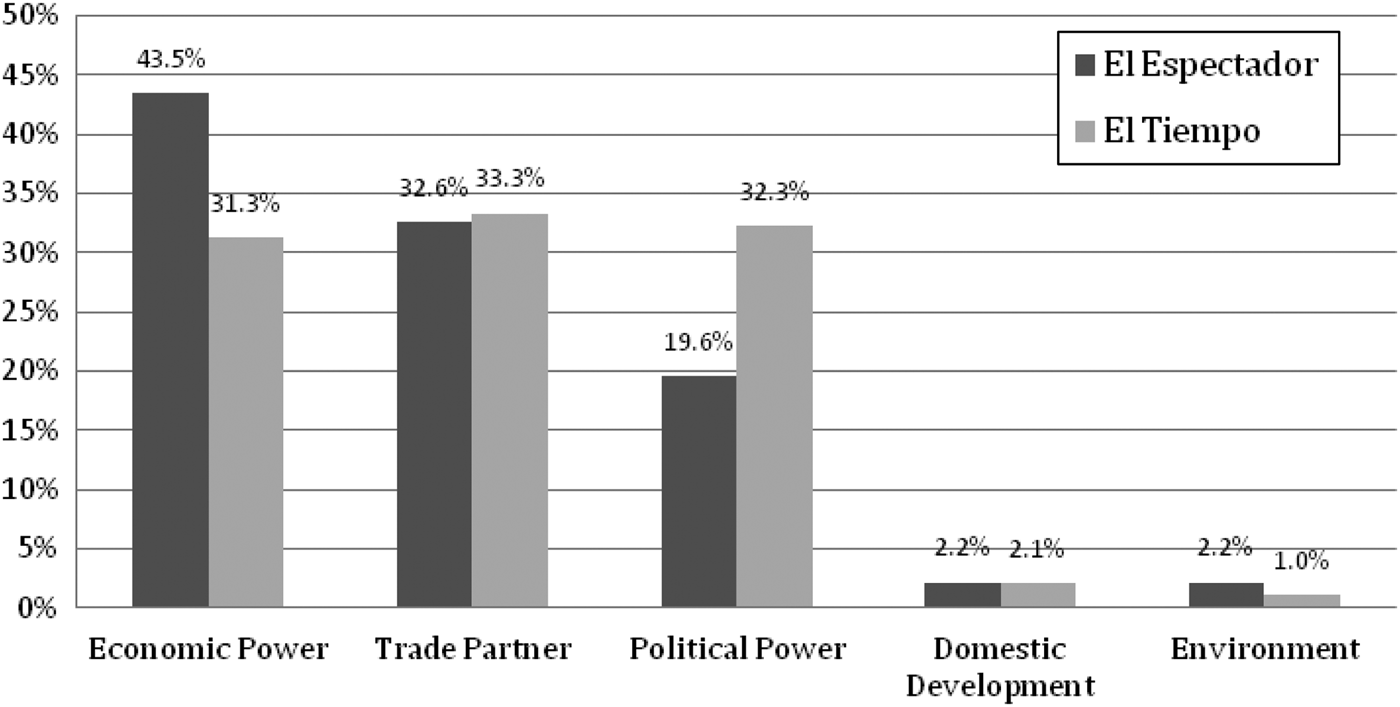
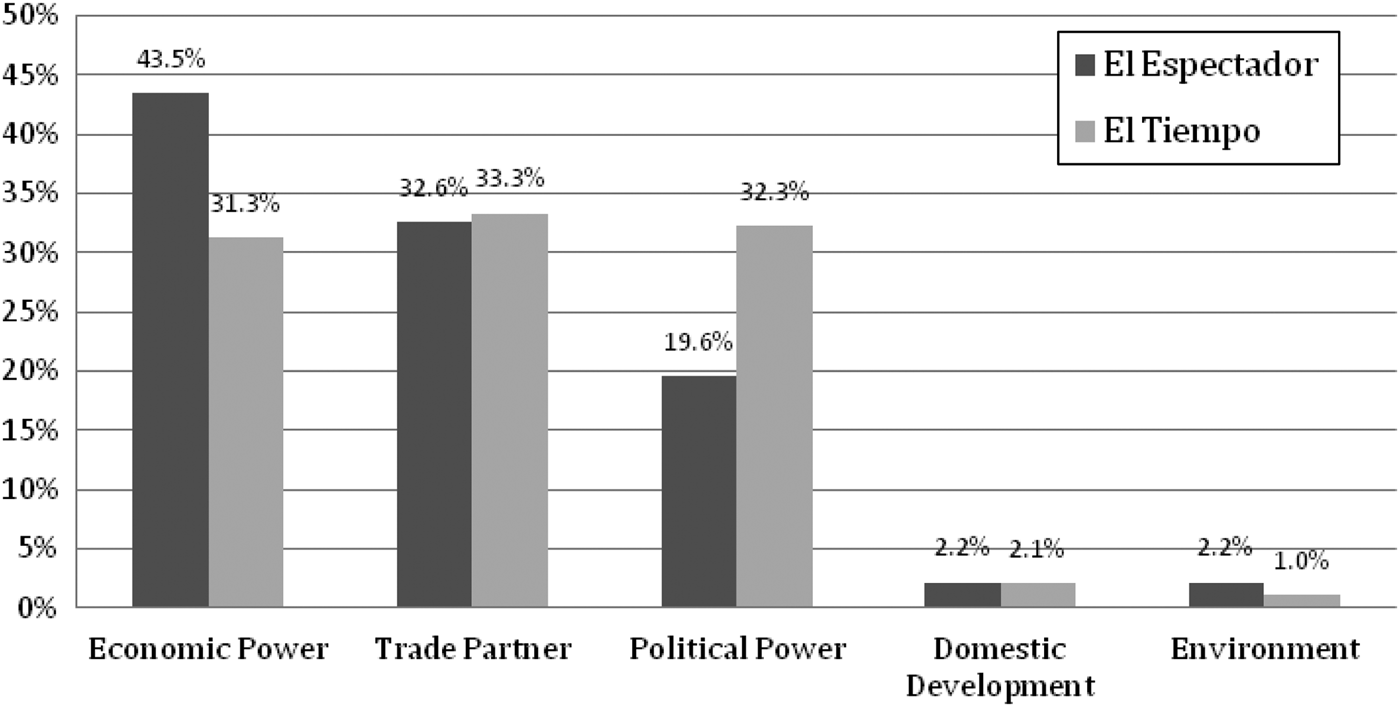
Figures 1 and 2 show positive and negative images of China in El Tiempo and El Espectador and serve as a tool to identify general trends that define different perspectives on the East Asian country. China's economic power receives more positive than negative attention in the newspapers. Positive views on China as a trade partner are similar in both newspapers, but El Espectador is significantly more critical than El Tiempo with regards to the actual effects of China's trade relationship with Colombia. This negative image is expressed in different ways. For example, human rights are explicitly linked to unfair trade practices, stressing how China's authoritarian system and disregard for labour rights are a source of unbalance and give the East Asian nation an advantage in world markets. The following excerpt is illustrative of this argument, which often appeals to emotions: “They lived in inhuman conditions for years. Their mission: to produce cheap shoes for Western consumers … Exploitation, 24-hour working day, child labour or meagre salaries are constantly denounced in the West.”Footnote 27 Political decisions such as Beijing's monetary policy are also a matter of criticism.Footnote 28El Tiempo's position regarding China's political power is expressed in a higher percentage of positive and negative views when compared to El Espectador's treatment of this issue. Domestic development, the environment and liberal democratic issues elicit very little positive assessments in either newspaper.
Positive Images of China in El Espectador and El Tiempo
Source:
www.elespectador.com.co and www.eltiempo.com search engines for news 2008 to 2010.
Negative Images of China in El Espectador and El Tiempo
Source:
www.elespectador.com.co and www.eltiempo.com search engines for news 2008 to 2010.
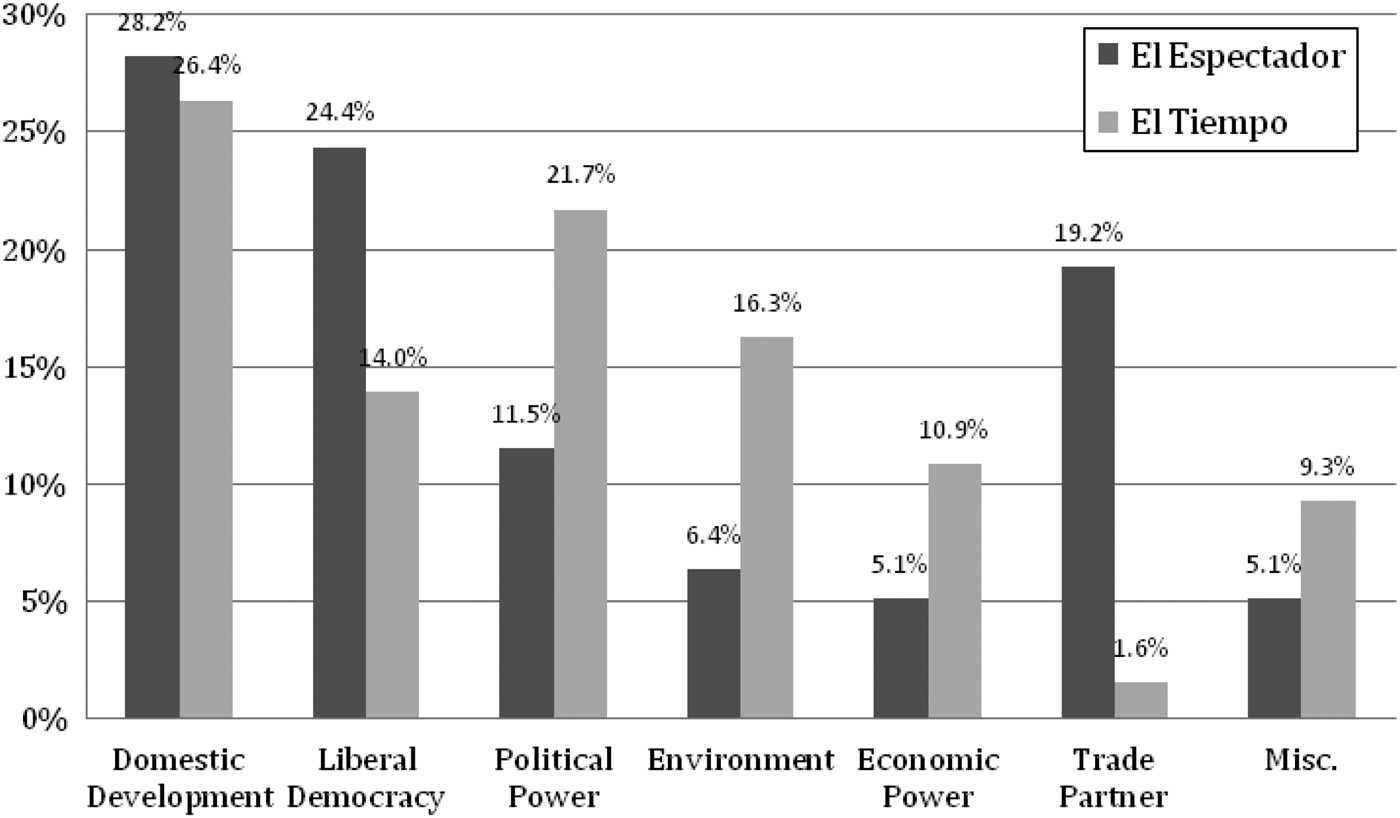
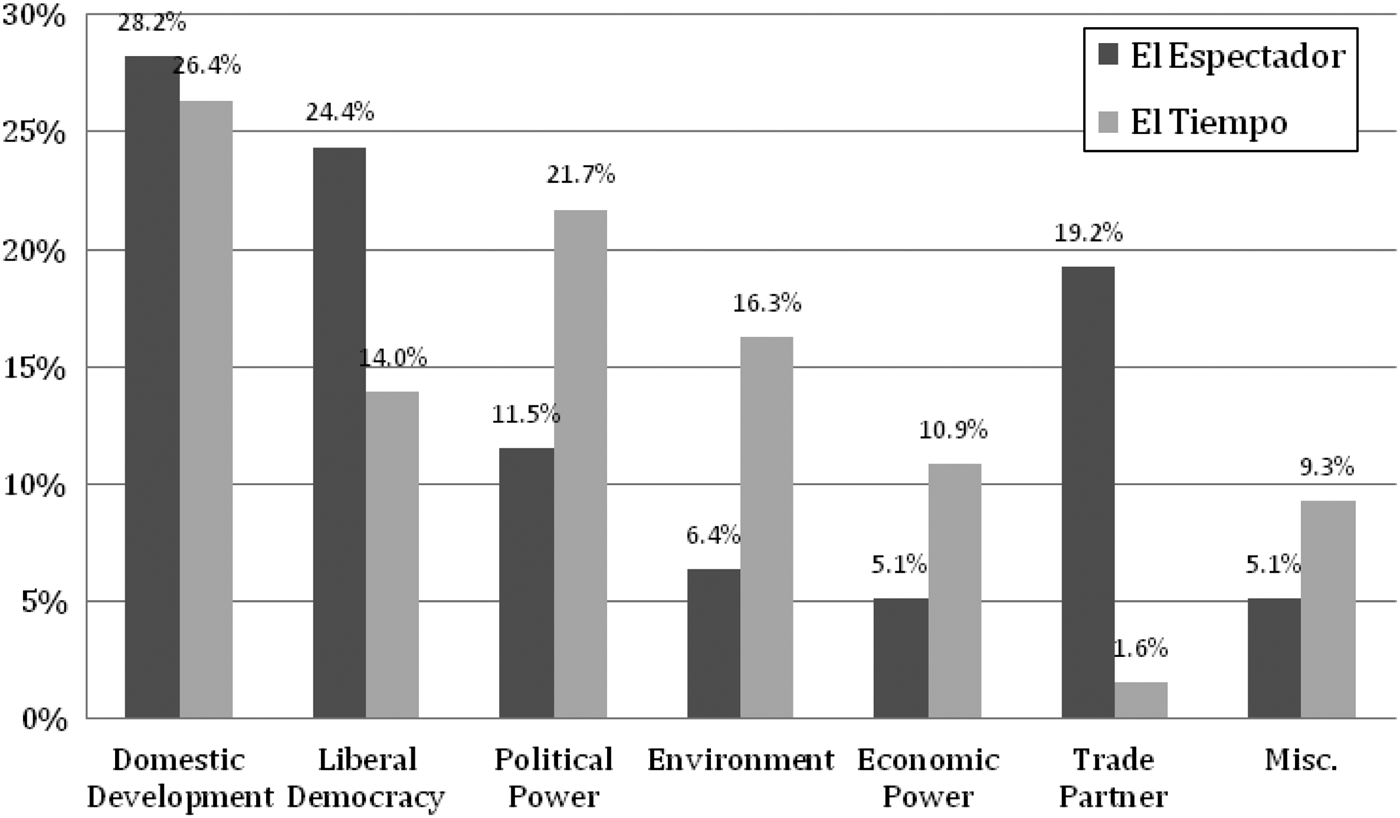
A closer look at the negative assessments of China is particularly illuminating. Figure 2 shows that both newspapers are similarly critical of China's domestic development, which tops the list of concerns. However, they differ substantially with regards to other categories. El Tiempo is uneasy about China's political power and the country's impact on the environment, two dimensions that refer to China's role as a “responsible stakeholder” in global affairs. China receives significant attention in terms of emissions control and the strenuous impact that its increasing demand for food and energy has on the global environment. Whereas China is praised for developing alternative, clean energy (such as solar and wind power), the Chinese government's pledge to reduce emissions is viewed with profound distrust and Beijing is criticized for its negative impact on global warming and climate change.Footnote 29
El Tiempo's tendency to discuss the environmental aspects of China with scorn appears counterintuitive for a paper that defends free market approaches, but this is explained by the newspaper's adherence to the parameters of the Kyoto Protocol – especially the possibility of selling the excess of Kyoto quota units to another party (such as Europe), which confers a marketable dimension to environmental issues. Additionally, criticism of China's environmental practices is linked to criticism of the United States’ weak commitment to solving global warming: news coverage shows concern for the lack of sound leadership on the part of both established and emergent powers.Footnote 30 Concern for the environment suggests a growing demand for China to adopt and promote Western-style values that are deemed as universal.
Negative views about China in El Tiempo disapprove of domestic development, political power and environmental issues. El Espectador also criticizes domestic development but questions the absence of liberal democracy in the East Asian country and views serious shortcomings in the relationship with China as a trade partner. These patterns represent two global trends that, I hypothesize, structure perceptions of China. The dramatic social and economic changes that China is experiencing at the domestic level, which involve important reconfigurations that range from social distances to moral values, are connected to China's role in the international arena. This role involves two different dimensions: on one hand, an expectation that China will join the other global powers by assuming responsibility for its actions in the military, diplomatic and environmental fronts; on the other, a serious apprehension about the asymmetries that China's model of “authoritarian capitalist” introduces in the relations with the rest of the world, namely the unfair advantages that China enjoys by virtue of its disregard for democratic procedures and respect for a wide range of rights.
China's image is definitely negative when news coverage addresses human rights violations or arbitrary/illegal actions against citizens by the Chinese state. Both El Tiempo and El Espectador condemn the detention of activists and other citizens who question the regime. Criticism is often worded as a demand for China to accept that its new global role carries responsibilities, both domestically and internationally.Footnote 31 Left-leaning El Espectador is much more adamant in its negative views of China when it comes to human rights abuses.Footnote 32 When Chinese leaders express views that suggest some progress in securing respect for human rights or some degree of political liberalization, their image becomes significantly more positive in the eyes of the press.Footnote 33 Words employed to qualify the Chinese state include such terms such as tyranny, control, repression, detention and arbitrariness. However, a closer look at coverage on violations of human rights reveals a tendency to focus on the actions of dissidents (which are presented in a positive manner) rather than an emphasis on direct criticism of the Chinese state's behaviour. This is a pattern that emerged clearly in coverage of the unrest in Urumqi, capital of Xinjiang province, in 2009.Footnote 34
The granting of the 2010 Nobel Peace Prize to jailed Chinese dissident Liu Xiaobo received significant media attention in Colombia. Following China's decision to refuse to allow him and his wife to travel to Norway to accept the prize, the Colombian government decided not to send an ambassador to the award ceremony in Oslo. This decision triggered a heated debate in Colombia.Footnote 35El Tiempo devoted little coverage to the matter, thus expressing virtually no interest in human rights issues.Footnote 36 In contrast, El Espectador took a strong stand, viewing the matter as an important example of the responsibility of governments worldwide to denounce China's authoritarian regime.Footnote 37
El Espectador's position was that downplaying the significance of the Nobel Committee's choice entailed accepting China's anti-democratic stance, a decision that further eroded Colombia's commitment to human rights.Footnote 38 One of the most interesting aspects of El Espectador's editorial position – one that illustrates well how the “other” helps define “self”Footnote 39 – was the newspaper's emphasis on Colombia's inability to come to terms with a consistent position on human rights.Footnote 40 Indeed, El Espectador presented subsequent decisions by the Colombian Foreign Ministry, which diverged from international legal norms in the defence of human rights, as continuations of the misstep made in the Liu Xiaobo case.Footnote 41
Interactions with China pose new challenges for the Colombian public sphere: as it reacts to China's political model and moral values, it is forced to look at itself in a different light. Human rights violations have been a serious problem in Colombia for decades, and according to human rights organizations, academics and average citizens in that country, these violations have continued into the present, manifested in abuses against labour and human rights activists, journalists, Afro-Colombians and others.Footnote 42 Taking sides with the Chinese government echoes Colombia's own troubles with the protection of human rights.
Another event that received particular attention in the news was the 20th anniversary of the Tiananmen Square protests. Both newspapers offered very critical perspectives of the 1989 events and the government's brutal repression. Interestingly, El Tiempo did not reproduce foreign columns but resorted to its own staff of journalists and to prestigious Colombian intellectuals to cover the issue. There was an emphasis on the dichotomy represented by China: economic liberalization and political illiberalism.Footnote 43 The analysis also stressed the theme of the confrontation of the average citizen against the power of the state.Footnote 44 For instance, an op-ed article discussed democracy as a “universal value” and alerted Colombians (and Latin Americans in general) to the risks associated with the emergence of a wealthy and powerful nation dominated by a single party that views democracy as a threat to the dominance of the ruling elite.Footnote 45El Tiempo emphasized that China's material and moral dimensions are two essential, intertwined components of its rise.Footnote 46 Some contributors went even further and argued that the democratization of China is a moral and political precondition to acceptance of it as a world power.Footnote 47
El Tiempo, which consistently displays admiration for China's economic development and the potential that the East Asian power presents for Colombia and Latin America, condemns the absence of liberal democratic values in China from a perspective rooted in individual rights and the rejection of an all-too-powerful state. Interestingly, this is an example of the unusual repercussions that China's “landing” may have in Latin America: a right-leaning newspaper such as El Tiempo that would not have made significant efforts to accommodate a critical position concerning democratic rights being violated in Colombia's domestic realm, actively disapproved of China's disregard for the rights of its citizens. With editorial headlines such as “Tiananmen, open wound” and “The Chinese of the tanks,” El Tiempo sided with the average citizen, whose vulnerability vis-à-vis the power of the state was deemed unacceptable – a position that stood in contrast with the newspaper's views regarding Colombia's own domestic conflict.
Interestingly, both newspapers (to different degrees) are sympathetic to China's diplomatic agenda of multilateralism and “democratization” of international relations, but do not advocate a closer relationship with China as a vehicle to balance US power and influence. Both Washington and Beijing are viewed as hypocritical in their diplomatic relations. The United States’ proclaimed reasons to defend human rights or promote democracy are not always the ones behind its actual behaviour in the international realm. At the same time, Chinese official criticism of US double standards in the promotion of democracy is dismissed as a farce, that is, as an artifact of a rhetoric whose purpose is to divert denunciation of China's authoritarian regime.Footnote 48
Is China the New Japan?
I want to explore briefly whether the issues unveiled in the examination of the Colombian newspapers are “China-specific” concerns or concerns related to the world's (or hemisphere's) perception of a “new hegemon.” This question dovetails with the analysis presented in the article by Gonzalo Paz in this volume, which looks at reactions to the emergence of a rising power external to the region that challenges the status quo established by the United States (the hegemonic power in the hemisphere for most of the 20th century).Footnote 49 Like Paz, I am interested in the Latin American reaction to such a situation. Considering that the perception of a challenge to an existing hegemon is enough to trigger rhetorical reactions, it is a good idea to examine how the Colombian press responded to the previous rise of an extraterritorial power that made new inroads into Latin America, namely Japan. The case of Japan's rise in the 1980s (and its demise in the 1990s) offers an opportunity to explore whether media responses to China's new engagement with Latin America are typical of “new hegemon concerns” (in this case, both coming from Asia) or whether they reveal specific concerns about China.
A review of El Tiempo and El Espectador in the 1980s reveals both continuities and differences between Japan's rise in the 1980s and China's rise in the 2000s.Footnote 50 Japan's image as an emerging power is built around two dimensions: its role as an ally of the United States and the other Western powers, and admiration for its success (the Japanese “economic miracle”) as well as its potential as a new trade partner for Latin America and Colombia. Even though there were tensions between Japan and the United States in the 1980s – the perceived correlation between economic and military capabilities was a matter of concern among some sectors in the United States – Japan, a Western-style liberal democracy, did not pose an ideological challenge to the hemispheric hegemon.Footnote 51 Colombian newspapers did not see Japan as an adversary to the United States or to Colombia. On the contrary, they paid special attention to the role that Japan played in the military realm as an important ally in the Western bloc. For example, as El Tiempo reported, Japan's capacity to increase its military power for defensive purposes was viewed as a vital contribution to release some of the financial burden incurred by the US forces stationed in Japan.Footnote 52
This view stands in stark contrast with concerns about Chinese military power. While some US analysts viewed Japan as a potential military adversary in some distant future, the prevalent image of Japan in the Colombian press was that of an ally of the United States. China's rising global presence, on the other hand, has raised qualms because of the potential of conflict with Taiwan, the sustained growth of Chinese military capabilities and the increasing military collaboration with some Latin American countries. The perceived threat that China poses as a contender in the western hemisphere has been shaped by ideological and geopolitical considerations that are very different from those that defined the rise of Japan and its potential for hegemonic contestation.
As seen in the Colombian press, the dominant image of both Japan in the 1980s and China in the 2000s was their potential role as an engine for Latin America's economic development. Overall, Japan's image in the newspapers was positive. Exceptions to this trend included Japan and Colombia's divergent interests on agricultural issues in GATT and similar organizations. Japan was presented as advancing an agenda of agricultural subsidies, which was a major point of contention between countries such as Colombia, which relied heavily on agricultural exports, and highly industrialized nations.Footnote 53 While coffee represented over 70 per cent of Colombian exports to Japan in the 1980s (a trade relationship based on commodities that resembles the one that Colombia has with China today), Japanese companies made substantial investments in Colombia, especially in the automotive sector.Footnote 54 The role of Japan as leader of the “economic miracle” attained by the “Asian Tigers” resonated with admiration in El Tiempo, particularly in the early 1990s, when Colombia started to liberalize its economy.Footnote 55
China may elicit admiration for its spectacular economic growth, but it is criticized for the means employed to attain this result. For instance, while the reality of long and exacting workdays in China has often been depicted negatively in the Colombian press, an emphasis on hard work was portrayed in positive terms in the case of Japan. Hard work (even beyond regular hours, without additional pay) did not imply exploitation in the Japanese context: “Work is a sacred obligation and it is always performed in a group. Each one is part of a team perfectly co-ordinated and organized, always with a goal in mind: Japan's progress. This ideal is strongly rooted in Japanese consciousness; thus [Japanese] responsibility and honesty vis-à-vis work, even when individuality is often sacrificed … is what has made the ‘Japanese miracle’ possible.”Footnote 56 Even when taking into account the real gap between labour conditions in Japan and China, the fact that Japan's manufactures did not threaten the Colombian industry, as the Chinese do, plus other positive aspects of the relationship (Japan's extensive investment in Colombia's industry, its willingness to provide economic aid, and broad technical and educational co-operation between the two countries)Footnote 57 seemed to have contributed to create contrasting images in the Colombian press. Japan represented a respected alternative to stagnant Western individualism; China embodies a threat to Western values. Perceptions about China are not simply a reaction to a “new hegemon,” but they are significantly moulded by the current situation of Colombia, global economic and geopolitical trends, and specific traits of China itself.
In terms of news coverage, a quantitative analysis of El Tiempo Footnote 58 shows that Japan received more coverage than China from 1990 to 2002, after which the trend reversed dramatically. A similar pattern emerges in the analysis of coverage that contains the notion of “co-operation” with Japan and China: the latter surpassed Japan in 2002 and the gap widened from 2005 onwards. Indeed, coverage in Colombia's largest newspaper responded to the decline of Japan's relations with Latin America in the 1990s – a reflection of Japan's eroding economic position – and to the emergence of China as the up-and-coming player in the region in the 2000s.
Conclusion
The analysis of the news coverage in Colombia offers insight into a critical dimension of Chinese global power: its direction and purpose. China seems to represent a paradigm of “modernity without enlightenment.” This paradigm may exemplify a successful road to economic development but it questions the universality of Western values, particularly democracy and human rights.Footnote 59 Such a scenario is likely to become more complex because of the fast-changing moral landscape in China and the increasing disconnect between the transformation of moral values and an economic and social structure in rapid flux.Footnote 60 The existing interdependence between China and the United States/Europe, deepened as a result of the global economic crisis, poses important challenges to the debate over the future of rights and freedom in the world. The growing legitimacy of a discourse that emphasizes “Chinese exceptionalism” could become a double-edged sword if it condones the notion that economic prowess renders political repression and restrictions on civil and political rights acceptable.Footnote 61 While the West cannot claim innocence with regards to destruction and barbarism, it is troubling that China's rise has created a situation of some confusion about the role of values that underpin the Western democratic experience. This is a situation of utmost relevance for Latin America.
In contrast to the United States, China does not have (yet) a rhetorical apparatus that can provide an alternative to the US self-definition of “enlightened self-interest,” an idea crafted by the United States even before it emerged as a world power. It is true that the United States did not behave as an “enlightened” actor in Latin America. The historical record provides ample evidence of Washington's support for dictators and military regimes in the region. As for China, criticism against its alleged abusive role in Latin America, which is negligible in comparative perspective, often seems to assume that the existing paradigm of globalization is neutral and benefits everyone. The perception that China's expansionism aims to create a new, Chinese-prone paradigm is thus viewed as inherently problematic.Footnote 62 As Julia StraussFootnote 63 discusses in her article, China has sought to advance a rhetoric that expresses a deep connection with the interests and aspirations of other developing countries without challenging a US-centred global paradigm. Similar to Western powers, China advances a public humanitarianism that is presented as a moral tool, but which veils economic and political objectives. This duplicity is evident in many of Beijing's policies (for instance, in energy security) and often triggers critical reactions from the media in regions such as Latin America.Footnote 64 It will be vital to pay attention not only to the evolution of China's official and semi-official rhetoric, but also to the ways in which other actors – such as the media – in the rest of world make sense of their relations with China.
The Colombian newspapers examined in this article reflect idiosyncratic traits of Colombia's socioeconomic and political arenas, but they also represent global trends that are well exposed in their characterization of China. First, by connecting trade issues with China's deficiencies in domestic development and dearth of liberal democratic values, they advance a conception of society in the contemporary world that recognizes that individual self-reliance to compete in a market economy requires institutions that sustain the rule of law, freedom of speech, checks and balances, and a welfare state. Second, an emphasis on domestic development, political power and the environment underscores a worldview that is predicated upon both the rise of the enterprising individual and the importance of general rules that safeguard competition, free markets, and the creation of multilateral protection regimes to control fundamental problems on a global basis.Footnote 65
By raising the issue of a “marriage between strangers,” this article states the relevance of an agenda that examines the construction of China's image in Latin America as a way to understand the process of “going out” and “landing.” This agenda should compare several countries in the region over time and study similarities and differences between China's image and that of the United States. Studies focused on the media, which serve as a window to understand how elites in Latin America view China, should be complemented by other research that shows perceptions held by average citizens and groups that play a relevant role in the relationship with China. This is, to a significant extent, untilled territory in Latin America. Rising engagement with China poses new, fascinating questions that go beyond ongoing economic interactions and touch on Latin American identity, global outlook and future role in a changing world.
Appendix: A Brief Methodological Note
Whenever systematic data were available, we employed the embedded search engines in each of the newspapers’ websites (which reproduce the articles published in their print version). We performed searches with the keyword “China” and its variations in the full text of the articles. From a total of 8,812 entries, we drew a random sample of 400. Each news article selected for the study presented an image of China in at least one dimension.Footnote 66 Each observation was assigned a value (positive, neutral or negative) according to the view of China displayed in the coverage. Coding reflected our responses to a set of questions about the text of the articles: (1) critical, supportive or indifferent to the issue, (2) assigns responsibility to China on issues that are deemed positive or negative, (3) informs without taking sides, (4) balances facts and opinion, and (5) presents indicators that depict asymmetries, win-win transactions, benign or malicious relationships, and related arguments. Based on an exploratory study, we elaborated a list of terms and semantic constructions that guided decisions on coding articles as positive, negative or neutral (available upon request). My research assistant and I did coding independently. As for the categories employed in the quantitative analysis, we built an original set of dimensions from a pilot sample. After coding the full sample and identifying the most recurrent and relevant dimensions, we aggregated dimensions into umbrella categories in order to keep the analysis manageable and make it more relevant to the reader. These are the resulting categories: