Introduction
Neuropsychological impairment is a key feature of late-life depression (LLD) and remains after clinical recovery (Butters et al. Reference Butters, Becker, Nebes, Zmuda, Mulsant, Pollock and Reynolds2000; Nebes et al. Reference Nebes, Pollock, Houck, Butters, Mulsant, Zmuda and Reynolds2003; Murphy & Alexopoulos, Reference Murphy and Alexopoulos2004; Bhalla et al. Reference Bhalla, Butters, Mulsant, Begley, Zmuda, Schoderbek, Pollock, Reynolds and Becker2006; Kohler et al. Reference Kohler, Thomas, Barnett and O'Brien2010). Case–control studies using a variety of manual and computerized tasks have revealed reduced performance in LLD across multiple domains, including executive function, processing speed, episodic memory, language skills and visuospatial skills (Butters et al. Reference Butters, Whyte, Nebes, Begley, Dew, Mulsant, Zmuda, Bhalla, Meltzer, Pollock, Reynolds and Becker2004; Sheline et al. Reference Sheline, Barch, Garcia, Gersing, Pieper, Welsh-Bohmer, Steffens and Doraiswamy2006; Elderkin-Thompson et al. Reference Elderkin-Thompson, Mintz, Haroon, Lavretsky and Kumar2007; Herrmann et al. Reference Herrmann, Goodwin and Ebmeier2007; Dillon et al. Reference Dillon, Allegri, Serrano, Iturry, Salgado, Glaser and Taragano2009; Kohler et al. Reference Kohler, Thomas, Barnett and O'Brien2010). However, it is unclear whether deficits in multiple domains represent relatively independent processes with specific neural correlates or whether they can be explained by cognitive deficits in executive function or processing speed (Butters et al. Reference Butters, Whyte, Nebes, Begley, Dew, Mulsant, Zmuda, Bhalla, Meltzer, Pollock, Reynolds and Becker2004; Sheline et al. Reference Sheline, Barch, Garcia, Gersing, Pieper, Welsh-Bohmer, Steffens and Doraiswamy2006; Elderkin-Thompson et al. Reference Elderkin-Thompson, Mintz, Haroon, Lavretsky and Kumar2007; Kohler et al. Reference Kohler, Thomas, Barnett and O'Brien2010).
Executive function has been proposed as a key cognitive deficit in LLD, as deficits cannot be fully explained by impairments in processing speed, but can contribute to deficits in other domains (Alexopoulos, Reference Alexopoulos2003; Sheline et al. Reference Sheline, Barch, Garcia, Gersing, Pieper, Welsh-Bohmer, Steffens and Doraiswamy2006; Elderkin-Thompson et al. Reference Elderkin-Thompson, Mintz, Haroon, Lavretsky and Kumar2007). For example, deficits in executive function can impact upon strategic controlled encoding and retrieval in tasks assessing episodic memory (Buckner, Reference Buckner2004; Elderkin-Thompson et al. Reference Elderkin-Thompson, Mintz, Haroon, Lavretsky and Kumar2007). It is hypothesized that impaired executive function in LLD results from the disruption of frontal-striatal-limbic networks (Alexander et al. Reference Alexander, DeLong and Strick1986; Mayberg, Reference Mayberg1997; Alexopoulos, Reference Alexopoulos2003). In support of this hypothesis, several diffusion tensor imaging (DTI) studies investigating white matter integrity have detected significant associations between executive function and fractional anisotropy (FA) in frontal-striatal-limbic regions in LLD (Alexopoulos, Reference Alexopoulos2002; Murphy et al. Reference Murphy, Gunning-Dixon, Hoptman, Lim, Ardekani, Shields, Hrabe, Kanellopoulos, Shanmugham and Alexopoulos2007; Yuan et al. Reference Yuan, Zhang, Bai, Yu, Shi, Qian, Zang, Zhu, Liu and You2007; Schermuly et al. Reference Schermuly, Fellgiebel, Wagner, Yakushev, Stoeter, Schmitt, Knickenberg, Bleichner and Beutel2010). However, other studies have proposed that impaired executive function is mediated by slowed processing speed (Butters et al. Reference Butters, Whyte, Nebes, Begley, Dew, Mulsant, Zmuda, Bhalla, Meltzer, Pollock, Reynolds and Becker2004) and that it is processing speed that is a central cognitive deficit in LLD. In support of this theory, several studies examining the relationship between neuropsychological deficits in LLD have suggested that neuropsychological impairment in multiple domains may be partially or fully mediated by slowed processing speed (Butters et al. Reference Butters, Whyte, Nebes, Begley, Dew, Mulsant, Zmuda, Bhalla, Meltzer, Pollock, Reynolds and Becker2004; Sheline et al. Reference Sheline, Barch, Garcia, Gersing, Pieper, Welsh-Bohmer, Steffens and Doraiswamy2006; Kohler et al. Reference Kohler, Thomas, Barnett and O'Brien2010). In the only DTI study of depression to date to examine correlates of processing speed, correlations were observed between processing speed and anisotropy of prefrontal white matter and mean diffusivity (MD) of prefrontal white matter, deep white matter and the corpus callosum (Shimony et al. Reference Shimony, Sheline, d'Angelo, Epstein, Benzinger, Mintun, McKinstry and Snyder2009).
Episodic memory is typically supported by the circuitry of the medial temporal lobe, including the hippocampus (reviewed in Dickerson & Eichenbaum, Reference Dickerson and Eichenbaum2010). In support of this model, impairments in episodic memory in LLD have been associated with reduced volumes of the hippocampus (Ballmaier et al. Reference Ballmaier, Narr, Toga, Elderkin-Thompson, Thompson, Hamilton, Haroon, Pham, Heinz and Kumar2008; Avila et al. Reference Avila, Ribeiz, Duran, Arrais, Moscoso, Bezerra, Jaluul, Castro, Busatto and Bottino2011) and cingulate gyrus (Yuan et al. Reference Yuan, Zhu, Zhang, Bai, Yu, Shi, Qian, Liu, Jiang, You and Liu2008). However, both reductions in executive function and processing speed have been found to contribute to deficits in episodic memory (Butters et al. Reference Butters, Whyte, Nebes, Begley, Dew, Mulsant, Zmuda, Bhalla, Meltzer, Pollock, Reynolds and Becker2004; Sheline et al. Reference Sheline, Barch, Garcia, Gersing, Pieper, Welsh-Bohmer, Steffens and Doraiswamy2006; Elderkin-Thompson et al. Reference Elderkin-Thompson, Mintz, Haroon, Lavretsky and Kumar2007; Kohler et al. Reference Kohler, Thomas, Barnett and O'Brien2010).
We investigated the pattern of neuropsychological impairment in LLD in 36 participants with LLD and 25 control participants, as well as the relationships between neuropsychological impairment and magnetic resonance imaging (MRI) measures in LLD participants. First, group differences were examined across five domains: executive function; processing speed; episodic memory; language skills; visuospatial skills. In accordance with previous studies, we hypothesized that deficits will be observed across all domains, with executive function, processing speed and episodic memory most severely impaired (Butters et al. Reference Butters, Whyte, Nebes, Begley, Dew, Mulsant, Zmuda, Bhalla, Meltzer, Pollock, Reynolds and Becker2004; Herrmann et al. Reference Herrmann, Goodwin and Ebmeier2007). Second, the influence of deficits in executive function and processing speed on other neuropsychological domains was investigated. We hypothesized that deficits in both executive function and processing speed will contribute to deficits in other domains. In addition, we performed an exploratory analysis of the relationship between MRI measures and executive function, processing speed and episodic memory in LLD. As reported elsewhere, analysis of group differences in grey matter (GM), white matter and functional connectivity only revealed significant differences in white matter measures (C.E. Sexton et al. unpublished observations), the relationship between reduced FA and neuropsychological impairment will be the focus of this analysis. The relationship between hippocampal volume and neuropsychological impairment will also be explored. Although hippocampal volume was not found to be reduced in LLD (C. E. Sexton et al. unpublished observations), several previous studies of LLD have reported a significant relationship between reduced hippocampal volume and impaired episodic memory. We hypothesized that FA of tracts with frontal projections will be associated with deficits in executive function and processing speed. As episodic memory is hypothesized to be dependent upon executive function and processing speed, we hypothesized that episodic memory will also be associated with FA of frontal tracts, in addition to FA of hippocampal tracts and hippocampal volume. As a recent meta-analysis detected significant relationships between increased depression severity and reduced scores in episodic memory, executive function and processing speed (McDermott & Ebmeier Reference McDermott and Ebmeier2009), the relationships between neuropsychological and MRI measures and current symptom severity were also explored.
Method
Participants
Participants with LLD were identified from the general adult and old age psychiatric services of Oxford Health National Health Service Foundation Trust and also directly from the community by word of mouth and advertisements. Control participants were identified from the community through speaking at and displaying posters at local groups (for example, at University of the Third Age meetings). Eligible participants were aged ⩾60 years, with no potentially confounding co-morbid medical, psychiatric or neurological conditions (including diagnoses of Alzheimer's disease, bipolar disorder, mild cognitive impairment, Parkinson's disease, stroke, schizophrenia) and no implanted metallic devices, as required by standard MRI protocols. Participants with LLD met the DSM-IV criteria for major depression in the past, as assessed in a detailed structured clinical assessment by an experienced psychiatrist, but were not necessarily currently depressed. Control volunteers with a history of memory impairment or psychiatric illness were excluded, using the Structured Clinical Interview for DSM-IV Axis I Disorders Non-Patient Edition (January 2007) (First et al. Reference First, Spitzer, Gibbon and Williams2007). The study was conducted with approval from the Local Research Ethics Committee (Licence 06/Q160/90). Informed written consent was obtained from all participants.
Clinical assessment
All participants underwent a clinical assessment to determine years of education, full-scale intelligence quotient (FSIQ) (National Adult Reading Test – Full Scale Intelligence Quotient) (McGurn et al. Reference McGurn, Starr, Topfer, Pattie, Whiteman, Lemmon, Whalley and Deary2004), cognitive impairment [Addenbrooke's cognitive examination revised (ACE-R), mini-mental state examination] (Folstein et al. Reference Folstein, Folstein and McHugh1975; Mioshi et al. Reference Mioshi, Dawson, Mitchell, Arnold and Hodges2006) and handedness (Briggs & Nebes, Reference Briggs and Nebes1975). Age at onset, current symptom severity and medication status were also determined in LLD participants. Age at onset was defined as the age at which an individual experienced their first episode of major depression and was determined from personal testimony and hospital notes. Current symptom severity was assessed using the 17-item Hamilton Rating Scale for Depression (HAMD) (Hamilton, Reference Hamilton1967) and the 15-item Geriatric Depression Scale (Yesavage et al. Reference Yesavage, Brink, Rose, Lum, Huang, Adey and Leirer1982). Medication was classified into the following categories: anticonvulsant; antidepressant; antipsychotic; anxiolytic; lithium salts.
Statistical analysis was performed using PASW Statistics version 18 (IBM Corporation, USA). Continuous demographic variables were compared between groups using independent samples t tests and categorical demographic data were compared using χ2 tests.
Neuropsychological assessment
All participants completed a comprehensive battery of neuropsychological tests valid for use within an elderly population with depression, including: CANTAB reaction time (Sahakian et al. Reference Sahakian, Owen, Morant, Eagger, Boddington, Crayton, Crockford, Crooks, Hill and Levy1993); category fluency (Mioshi et al. Reference Mioshi, Dawson, Mitchell, Arnold and Hodges2006); copied drawings (Mioshi et al. Reference Mioshi, Dawson, Mitchell, Arnold and Hodges2006); clock drawing (Mioshi et al. Reference Mioshi, Dawson, Mitchell, Arnold and Hodges2006); digit span (Wechsler, Reference Wechsler1997); digit symbol (Wechsler, Reference Wechsler1997); graded naming test (McKenna & Warrington, Reference McKenna and Warrington1980); Hopkins Verbal Learning Task Revised (HVLT-R) (Brandt, Reference Brandt1991); letter fluency (Mioshi et al. Reference Mioshi, Dawson, Mitchell, Arnold and Hodges2006); Rey–Osterrieth complex figure (RCF) (Osterrieth, Reference Osterrieth1944); trail making test (TMT) A and B (Reitan, Reference Reitan1958).
MRI acquisition
All participants underwent a MRI scan at the University of Oxford Centre for Clinical Magnetic Resonance Imaging using a 3.0 Tesla Trio Siemens scanner with a 12-channel head-coil (Siemens, USA). High-resolution 3D T1-weighted MRI scans were acquired using a magnetization-prepared rapid gradient echo sequence (TR=2040 ms, TE=4.7 ms, flip angle=8°, field of view=192 mm, voxel dimension=1 mm isotropic). Whole-brain DTI was acquired using an echoplanar imaging sequence (TR=7900/7800 ms, TE=98/82 ms, field of view=240 mm, voxel size=2.5 mm isotropic, b value=1000, number of directions=60, number of acquisitions=2).
Neuropsychological analysis
First, raw neuropsychological data were converted to standardized z scores based on the mean and standard deviation of the control group. Where necessary, signs were reversed to ensure that higher z scores represented a better performance for all variables (e.g. TMT: A and B; CANTAB: reaction time). Second, composite scores were calculated by summing the z scores within the neuropsychological domains listed below. Cronbach's α was computed and scores ⩾0.70 classified as indicative of a high level of internal consistency.
The executive function domain included digit span: forward, digit span: backward, letter fluency and TMT: B. The processing speed domain included digit symbol, TMT A, CANTAB: simple reaction time, CANTAB: simple movement time, CANTAB: five-choice reaction time and CANTAB: five-choice movement time. The episodic memory domain included measures of visual episodic memory (RCF: immediate, RCF: delay) and verbal episodic memory (HVLT-R: total, HVLT-R: recall, HVLT-R: recognition). The language skills domain included the graded naming test and category fluency. The visuospatial skills domain included clock drawings, copied drawings and RCF: copy.
Group differences were investigated using a multivariate general linear model, with age and gender as covariates. The percentage of LLD and control participants whose performance fell below the 10th percentile of the control group for each domain was also calculated, as in previous studies (Butters et al. Reference Butters, Whyte, Nebes, Begley, Dew, Mulsant, Zmuda, Bhalla, Meltzer, Pollock, Reynolds and Becker2004).
In order to examine whether multiple deficits are mediated by deficits in executive function or processing speed, analyses were repeated with the z scores of the executive function or processing speed included as an additional covariate.
MRI correlates of neuropsychological impairment
Image analysis was performed using tools from the FMRIB software library (FSL version 4.1, (Smith et al. Reference Smith, Jenkinson, Woolrich, Beckmann, Behrens, Johansen-Berg, Bannister, de Luca, Drobnjak, Flitney, Niazy, Saunders, Vickers, Zhang, de Stefano, Brady and Matthews2004) www.fmrib.ox.ac.uk/fsl).
Processing of the DTI data was carried out using Tract-Based Spatial Statistics (TBSS), which projects all participants' FA data on to a mean FA tract skeleton (Smith et al. Reference Smith, Jenkinson, Johansen-Berg, Rueckert, Nichols, Mackay, Watkins, Ciccarelli, Cader, Matthews and Behrens2006). As reported previously (C. E. Sexton et al. unpublished observations), group differences in FA were investigated across the whole skeleton using ‘randomize’ (Nichols & Holmes, Reference Nichols and Holmes2002), with age and gender included as confound regressors. Mean FA in voxels showing significant differences between groups were then extracted for a set of tracts of interest (TOI) including the anterior thalamic radiation, genu, body and splenium of the corpus callosum, cingulum, corticospinal tract, fornix, inferior longitudinal fasciculus, superior longitudinal fasciculus and uncinate fasciculus.
Partial correlation analysis, with age and gender as covariates, was performed between mean values of DTI measures in voxels showing significant differences between groups in each TOI and composite z scores for executive function, episodic memory and processing speed in LLD participants.
T1-weighted images were brain-extracted using the brain extraction tool (Smith, Reference Smith2002). Segmentation of the hippocampus was performed using FIRST (Patenaude et al. Reference Patenaude, Smith, Kennedy and Jenkinson2011). Partial correlation analysis was performed between executive function, processing speed and episodic memory and whole brain volume, with age and gender as covariates, and between executive function, processing speed and episodic memory and hippocampal volume, with age, gender and whole brain volume as covariates.
Severity
Partial correlation analysis, with age and gender as covariates, was performed between current severity and composite z scores for all five neuropsychological domains, WB volume and FA of each TOI. Partial correlation analyses, with age, gender and WB volume as covariates, were performed between severity and hippocampal volume.
Results
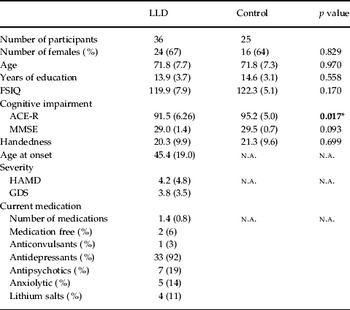
Demographic and clinical data are presented in Table 1. LLD and control participants were well matched for age, gender, years of education FSIQ and handedness. The LLD group had significantly lower ACE-R scores compared with the control group. Age at onset ranged from 10 to 78 years; thus, our sample included both early-onset and late-onset depression. The majority of LLD participants were currently receiving antidepressant treatment. Altogether 10 LLD participants had previously received electroconvulsive therapy, with treatment ending at least 6 months prior to participation in the study.
Demographic data

LLD, Late-life depression; FSIQ, full-scale intelligence quotient; ACE-R, Addenbrooke's Cognitive Examination Revised; MMSE, mini-mental state examination; HAMD, Hamilton Rating Scale for Depression; GDS, Geriatric Depression Scale.
Values presented are mean (s.d.) unless specified otherwise.
* Indicates statistical significance (data shown in bold; p<0.05).
Raw scores and z scores of neuropsychological tests are presented in the Supplementary material (Appendices S1, S2, available online). Composite z scores of neuropsychological domains are illustrated in the supplementary material (Appendix S3). All neuropsychological domains had a Cronbach's α ⩾0.70 (executive function: 0.70; processing speed: 0.80; episodic memory: 0.84; language skills: 0.73; visuospatial skills: 0.73).
After covarying for age and gender, the LLD group performed significantly worse than the control group in executive function (p<0.001), processing speed (p=0.001), episodic memory (p=0.030) and language skills (p=0.026), but not visuospatial skills (p=0.077). Significant differences in episodic memory did not survive the addition of executive function (p=0.417) or processing speed (p=0.307) as a covariate. Significant differences in language skills did not survive the addition of executive function (p=0.458) or processing speed (p=0.305) as a covariate. Differences in executive function remained significant after covarying for processing speed (p=0.011), but differences in processing speed were reduced to a trend only (p=0.082), after covarying for executive function.
In total, 72% of LLD participants performed below the 10th percentile in at least one domain, compared with 32% of control participants. Executive function was the most frequently impaired domain in LLD, with 44% of participants performing below the 10th percentile, compared with processing speed (33%), episodic memory (22%), language skills (31%) and visuospatial skills (31%).
MRI correlates of neuropsychological impairment
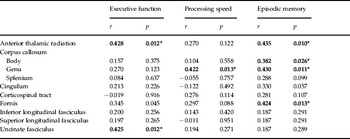
Correlations between FA and executive function, processing speed and episodic memory, after covarying for age and gender, are presented in Table 2 and Appendix S4. Impaired executive function was associated with reduced FA of the anterior thalamic radiation (r=0.428, p=0.012) and uncinate fasciculus (r=0.425, p=0.012). Impaired processing speed was associated with reduced FA of the genu of the corpus callosum (r=0.422, p=0.013). Impaired episodic memory was associated with reduced FA of the anterior thalamic radiation (r=0.435, p=0.010), body and genu of the corpus callosum (body: r=0.382, p=0.026; genu: r=0.430, p=0.011) and fornix (r=0.424, p=0.013).
Correlations between FA and neuropsychological impairment in late-life depression, after covarying for age and gender

Correlation values (r) and p values are presented for correlations between fractional anisotropy (FA) and executive function, processing speed and episodic memory.
Significant values are shown in bold.
After covarying for age and gender, whole brain volume was not associated with executive function (r=−0.010, p=0.957), processing speed (r=0.191, p=0.279) or episodic memory (r=0.304, p=0.081). After covarying for age, gender and whole brain volume, reduced right hippocampal volume was associated with impairment in episodic memory (right: r=0.381, p=0.029; Appendix S5), but not impairment in executive function (r=0.050, p=0.781) or processing speed (r=−0.166, p=0.355). Left hippocampal volume was not associated with episodic memory (r=0.281, p=0.113), executive function (r=−0.013, p=0.942; Appendix S5) or processing speed (r=−0.035, p=0.846).
Severity
Altogether, 27 LLD participants had HAMD scores indicative of remission (HAMD ⩽7), eight participants had scores indicative of mild depression (HAMD 8–13) and one participant had a score indicative of moderate depression (HAMD 18).
Current symptom severity was not significantly associated composite z score of any neuropsychological domain (p>0.5). Severity was not significantly correlated with WB volume (r=−0.320, p=0.065), hippocampal volume (left: r=−0.233, p=0.193; right: r=−0.060, p=0.741) or hippocampal shape. No significant correlations between severity and GM were detected using FSL-VBM. No significant correlations were detected between symptom severity and FA using TBSS.
Discussion
We examined the pattern of neuropsychological impairment in LLD and the relationships between neuropsychological impairment and MRI measures. In line with the hypotheses and previous studies, the LLD group performed worse across multiple neuropsychological domains (Butters et al. Reference Butters, Becker, Nebes, Zmuda, Mulsant, Pollock and Reynolds2000; Sheline et al. Reference Sheline, Barch, Garcia, Gersing, Pieper, Welsh-Bohmer, Steffens and Doraiswamy2006; Elderkin-Thompson et al. Reference Elderkin-Thompson, Mintz, Haroon, Lavretsky and Kumar2007; Herrmann et al. Reference Herrmann, Goodwin and Ebmeier2007; Dillon et al. Reference Dillon, Allegri, Serrano, Iturry, Salgado, Glaser and Taragano2009; Kohler et al. Reference Kohler, Thomas, Barnett and O'Brien2010). The percentage of LLD participants performing below the 10th percentile was also comparable with previous studies, with over 60% of LLD participants substantially impaired in at least one domain (Butters et al. Reference Butters, Becker, Nebes, Zmuda, Mulsant, Pollock and Reynolds2000).
In agreement with the hypotheses and previous studies, executive function appeared to be a key deficit in LLD (Alexopoulos, Reference Alexopoulos2003; Sheline et al. Reference Sheline, Barch, Garcia, Gersing, Pieper, Welsh-Bohmer, Steffens and Doraiswamy2006; Kohler et al. Reference Kohler, Thomas, Barnett and O'Brien2010). Executive function was the most frequently impaired neuropsychological domain, with 44% of participants performing below the 10th percentile of the control group. Furthermore, inclusion of executive function as an additional covariate was sufficient to reduce deficits in all other neuropsychological domains to non-significant levels, while deficits in executive function could not be fully accounted for by slowed processing speed. In the LLD group, executive function was correlated with FA of the anterior thalamic radiation, which connects the prefrontal cortex (PFC) and thalamus, and uncinate fasciculus, which connects frontal and temporal lobes. Thus, findings support the importance of frontal-striatal-limbic connections in executive function in LLD (Alexopoulos, Reference Alexopoulos2002; Murphy et al. Reference Murphy, Gunning-Dixon, Hoptman, Lim, Ardekani, Shields, Hrabe, Kanellopoulos, Shanmugham and Alexopoulos2007; Yuan et al. Reference Yuan, Zhang, Bai, Yu, Shi, Qian, Zang, Zhu, Liu and You2007; Schermuly et al. Reference Schermuly, Fellgiebel, Wagner, Yakushev, Stoeter, Schmitt, Knickenberg, Bleichner and Beutel2010).
Processing speed was found to contribute to deficits in episodic memory, language skills and visuospatial skills, in line with previous studies (Butters et al. Reference Butters, Becker, Nebes, Zmuda, Mulsant, Pollock and Reynolds2000; Sheline et al. Reference Sheline, Barch, Garcia, Gersing, Pieper, Welsh-Bohmer, Steffens and Doraiswamy2006; Kohler et al. Reference Kohler, Thomas, Barnett and O'Brien2010). Processing speed was associated with FA of the genu of the corpus callosum. This localization is in line with the findings of Shimony et al. (Reference Shimony, Sheline, d'Angelo, Epstein, Benzinger, Mintun, McKinstry and Snyder2009), who reported that processing speed was associated with relative anisotropy in the PFC and MD in the corpus callosum, PFC and deep white matter in LLD. Reduced FA within the genu of the corpus callosum has also been related to slow processing speed in studies of healthy adults (Kennedy & Raz, Reference Kennedy and Raz2009; Kochunov et al. Reference Kochunov, Coyle, Lancaster, Robin, Hardies, Kochunov, Bartzokis, Stanley, Royall, Schlosser, Null and Fox2010).
Deficits in episodic memory did not survive additional covarying for executive function or processing speed. In line with these findings, impaired episodic memory was associated with reduced FA in the anterior thalamic radiation and genu of the corpus callosum – tracts also associated with executive function or processing speed. Impaired episodic memory was associated with reduced FA of the fornix, a key tract in hippocampal circuitry, and reduced right hippocampal volume.
Severity was not associated with any neuropsychological or MRI measure. However, as the LLD group did not include any participants with HAMD scores >18, representing severe or very severe depression, the analyses may have been insufficiently powered.
Methodological considerations
The mean FSIQ score of the LLD group was above average and reflected the local community; with controls well matched for FSIQ. While high FSIQ scores meant there were fewer confounding reasons for poor performance in neuropsychological tests, it is important to note that the high FSIQ of our participants may not be particularly representative of older depressed participants in general.
A key strength of this study was that it included assessment of multiple neuropsychological tests, which were then categorized into five key neuropsychological domains. Cronbach's α was ⩾0.70 for all domains, indicating a high level of internal consistency, and supporting the categorization of neuropsychological tests. However, few tests can be easily attributed to a single domain and categorization always remains somewhat arbitrary (Veiel, Reference Veiel1997). For example, a speed component is important in letter fluency and TMT B. Further, each domain can be broken down into multiple subdomains, for example, the executive function domain contained measures of planning, working memory, attention and cognitive flexibility, the episodic memory domain contained measures of verbal and visual episodic memory. However, given the number of participants included in our study, we wished to limit the number of domains studied. An alternative approach to classifying neuropsychological tests is factor analysis. Again, such an approach was unsuitable in our study, given the limited number of participants.
Analysis of MRI correlates of neuropsychological impairment did not include correction for multiple comparisons, and results should therefore be considered exploratory. Multiple tracts were included as widespread regions were significantly different in FA between groups. Although analysis could have been limited to the a priori hypotheses of executive function and processing speed being associated with FA of tracts with frontal projections, and episodic memory being associated with FA of tracts with frontal and hippocampal projections, we thought that displaying the full pattern of correlations would be most informative and transparent.
Conclusion
In conclusion, both executive function and processing speed appear to represent key cognitive deficits in LLD, which contribute to deficits in other domains, and are related to reductions in FA in frontal tracts. In contrast, deficits in episodic memory may be influenced by executive dysfunction and slowed processing speed. In support of this model, impairments in episodic memory were associated with reductions in FA within frontal tracts, in addition to reductions in FA in hippocampal tracts.
Acknowledgements
C.E.S., L.L.H., U.G.K. and L.M. were supported by the Gordon Edward Small's Charitable Trust (Scottish Charity Register: SC008962). C.L.A. had support from Oxford University Clinical Academic Graduate School.
Note
Supplementary material accompanies this paper on the Journal's website (http://journals.cambridge.org/psm).
Declaration of Interest
None.