There is currently much interest in probiotics, which are live microorganisms that confer a health benefit on the host when they are administered in adequate amounts (Araya et al. Reference Araya, Morelli, Reid, Sanders, Stanton, Pineiro and Ben Embarek2002). Probiotics usually belong to the genera Bifidobacterium and Lactobacillus. These microorganisms are now added to many functional foods, including yogurt, milk-based or non-milk-based beverages, and dry foods (Champagne et al. Reference Champagne, Gardner and Roy2005). There is no universal viable count that will ensure the functionality of probiotics, but one regulatory organisation now requires a minimum level of 109 viable cells per serving for a company to be able to use general non-strain-related claims (Canadian Food Inspection Agency, 2009). In commercial applications, probiotics are added to functional foods as frozen concentrated inoculates, lyophilised powder or microencapsulated cells, the latter potentially improving the survival and delivery of probiotics (Saxelin et al. Reference Saxelin, Grenov, Svensson, Fondén, Reniero and Mattila-Sandholm1999; Champagne et al. Reference Champagne, Gardner and Roy2005; Champagne & Fustier, Reference Champagne and Fustier2007). Probiotics from Lactobacillus and Bifidobacterium species are fastidious bacteria and require rich media for propagation. In milk-based media, many probiotic strains grow poorly, and nitrogen supplementation (with casein or whey protein hydrolysates, yeast extracts, meat extracts, peptone, tryptone) is required to produce high bacterial biomass levels (Petschow & Talbott, Reference Petschow and Talbott1991; Poch & Bezkorovainy, Reference Poch and Bezkorovainy1991; Klaver et al. Reference Klaver, Kingma and Weerkamp1993; Ibrahim & Bezkorovainy, Reference Ibrahim and Bezkorovainy1994; Proulx et al. Reference Proulx, Ward, Gauthier and Roy1994; Dave & Shah, Reference Dave and Shah1998; Gomes et al. Reference Gomes, Malcata and Klaver1998). Many Lactobacillus and Bifidobacterium species have low proteolytic activities (Donkor et al. Reference Donkor, Henriksson, Vasiljevic and Shah2007) or do not produce surface proteinases (PrtP−) (Kunji, Reference Kunji1996; Janer et al. Reference Janer, Arigoni, Lee, Peláez and Requena2005; Saarela et al. Reference Saarela, Virkajärvi, Alakomi, Sigvart-Mattila and Mättö2006) and, therefore, require an available source of nitrogen. There is a need for data on milk protein proteolysis to enable the production of high biomass levels of probiotic bacteria.
Caseinomacropeptide (CMP) is a 7-kDa phosphoglycopeptide that is produced by the proteolysis of milk κ-casein (residues 106–169) by gastric pepsin or is released into cheese whey during chymosin-induced milk renneting (Farrell et al. Reference Farrell, Jimenez-Flores, Bleck, Brown, Butler, Creamer, Hicks, Hollar, Ng-Kwai-Hang and Swaisgood2004). In vitro and in vivo studies suggest that CMP exhibits several biological activities associated with microbiota establishment and control within the gastrointestinal tract (Thomä-Worringer et al. Reference Thomä-Worringer, Sørensen and López-Fandiño2006). Bifidogenic activity is among the reported activities of CMP. However, there is ongoing debate about this growth-promoting activity. Studies by Janer et al. (Reference Janer, Peláez and Requena2004) and Azuma et al. (Reference Azuma, Yamauchi and Mitsuoka1984) concluded that CMP can effectively stimulate growth for lactic acid bacteria (LAB). Although some bifidogenic activity of CMP was reported by Idota et al. (Reference Idota, Kawakami and Nakajima1994), their results did not show any dose-dependent effect. The specific effectiveness of CMP was not clearly established in the study by Cicvárek et al. (Reference Cicvárek, Čurda, Elich, Dvořáková and Dvořák2010) using an enriched preparation of CMP. Poch & Bezkorovainy (Reference Poch and Bezkorovainy1991) did not observe any bifidogenic effects of CMP supplementation. These discrepancies can be ascribed to the growth media that were used and, more importantly, to the quality and/or purity of the CMP. Recently, the present authors showed that highly purified CMP exhibits dose-dependent growth-promoting activity for LAB in a minimal culture medium. We also concluded that the presence of oligosaccharides linked to CMP is not required for the growth-promoting activity (Robitaille, Reference Robitaille2013). Lastly, enriched preparations of CMP added to diets given to infants (Brück et al. Reference Brück, Redgrave, Tuohy, Lönnerdal, Graverholt, Hernell and Gibson2006) and piglets (Hermes et al. Reference Hermes, Molist, Francisco, érez, de Segura, Ywazaki, Davin, Nofrarías, Korhonen, Virkola and Martín-Orúe2013) increased lactobacilli populations in faeces and in ileal and proximal colonic digesta, respectively, suggesting that CMP could also be a growth promoter for LAB in vivo.
During the digestive process, peptides derived from CMP are detected in the intestinal lumen (Chabance et al. Reference Chabance, Marteau, Rambaud, Migliore-Samour, Boynard, Perrotin, Guillet, Jollès and Fiat1998; Ledoux et al. Reference Ledoux, Mahé, Dubarry, Bourras, Benamouzig and Tomé1999; Boutrou et al. Reference Boutrou, Gaudichon, Dupont, Jardin, Airinei, Marsset-Baglieri, Benamouzig, Tomé and Leonil2013). It is unknown whether the biological effects of CMP are mediated via these peptides rather than intact CMP. With a view to addressing the effect of hydrolysis on the growth-promoting activity of CMP, the aim of the present study was to evaluate the effects of peptic and tryptic digests of CMP on probiotic LAB growth.
Materials and methods
Bacterial strains and culture
The following cultures were used: Bifidobacterium animalis subsp. lactis (Bifido. lactis) BB-12 (Chr. Hansen, 2970 Horsholm, Denmark), Bifido. thermophilum RBL67 (Laval University, Quebec, QC, Canada), Bifido. longum R0175 (Lallemand Health Solutions, Montreal, QC, Canada), Lactobacillus rhamnosus GG (ATCC 53103; Valio, Finland), Lb. rhamnosus RW-9595M (Food Research and Development Centre culture collection, St-Hyacinthe, QC, Canada), and Lb. plantarum 299 V (Probi, Lund, Sweden). The bacterial strains were stored frozen at −80 °C in a milk-based medium made of reconstituted low-heat skim milk powder (RSM) (120 g/l; Agropur, Granby, QC, Canada) in deionised water containing sucrose at 50 g/l.
Peptide preparation
Caseinomacropeptide was isolated from sodium caseinate as described previously (Robitaille, Reference Robitaille2013) and was either dissolved at 50 g/l in 10 mM-phosphate (pH 2·5) and treated with porcine pepsin (E/S ratio of 1 : 20 [w/w]; EC 3.4.23.1; 3460 units/mg of enzyme) to produce pepsin-treated CMP (CMP-P), or dissolved in Tris-HCl/CaCl2 buffer (50 mM-Tris and 20 mM-CaCl2, pH 8) and digested with trypsin from bovine pancreas (E/S ratio of 1 : 20 [w/w]; EC 3.4.21.4; 12 345 units/mg to produce trypsin-treated CMP (CMP-T). Hydrolysis was carried out for 3 h at 37 °C. The preparations were then heated at 80 °C for 15 min, centrifuged at 3200 g for 15 min, and sterilised by filtration on 0·45-μM filters.
Growth in culture media
Bacteria were subcultures twice in MRS broth (Difco Laboratories, Detroit, MI, USA) containing cysteine hydrochloride (0·5 g/l) and ascorbic acid (1 g/l) (mMRS) at 37 °C under anaerobic conditions for 4 h (Forma Anaerobic System, Thermo Fisher Scientific, OH, USA) before being used to inoculate mMRS at 1% (vol/vol), which was incubated at 37 °C under anaerobic conditions for 4 h. The optical density at 600 nm (OD600nm) was then adjusted to 0·1 in mMRS and diluted 50 times in double-strength (2×) mMRS. The peptide preparations solubilised in water were blended with an equal volume of the bacterial suspension to reach final concentrations of 0·5 and 2 mg/ml in a volume of 0·2 ml. For controls, mMRS was supplemented with peptone (Bacto-peptone, Difco Laboratories) at the same concentrations. The experiments were carried out in 96-well microplates using automated spectrophotometry to monitor growth, and the data were processed as described previously (Robitaille, Reference Robitaille2013). Three characteristics of the optical density growth curve were calculated to compare the effects of hydrolysed CMP supplementation: the time needed to reach the inflexion point of the sigmoid curve (T inf), which signalled the end of the exponential growth phase; the OD600nm at T inf (ODinf); and the OD600nm at the end of the incubation period (OD24h).
Milk fermentation
RSM was inoculated at 1% (v/v) with an overnight bacterial culture and incubated at 37 °C under anaerobic conditions without pH control for 16 h. The resulting bacterial culture was used to inoculate RSM that was unsupplemented or was supplemented with CMP-P at 0·5 to 4 mg/ml; CMP-P was directly dissolved at 4 mg/ml and serially diluted down to 0·5 mg/ml with inoculated milk. The milk was incubated at 37 °C under anaerobic conditions without pH control for 48 h. Aliquots were taken at 0, 24, and 48 h and then were serially diluted in phosphate buffered saline (10 mm-phosphate and 150 mM-NaCl, pH 7·5) and plated on MRS agar for bacterial cell counts. Unless otherwise specified, the chemicals were obtained from Fisher Scientific Canada (Ottawa, ON, Canada), and the biochemicals were obtained from Sigma-Aldrich Canada Ltd. (Oakville, ON, Canada).
Statistical analyses
The assays were conducted in triplicate, and the data from three independent replicate trials. An analysis of variance (ANOVA) was performed using the Generalised Linear Model (GLM) procedure of the SAS System (SAS Institute Inc., Cary, NC, USA) to evaluate the additives and the concentrations as fixed effects on bacterial growth parameters. Differences were considered significant at the level P<0·05. Standard errors were obtained from the statistical model and are indicated in the tables.
Results and discussion
Growth in mMRS
Most experiments on the efficacy of peptides as growth supplements for probiotic LAB are carried out in defined media (e.g. Robitaille, Reference Robitaille2013), nitrogen-limited growth media (Gaudreau et al. Reference Gaudreau, Renard, Champagne and van Horn2002), or in untreated milk, which is poor in free peptides (Oliveira et al. Reference Oliveira, Sodini, Remeuf and Corrieu2001). The present experiment was designed to simulate a digested food. In this study, the medium contained not only the experimental CMP hydrolysates but also other peptones that would simulate the products of the hydrolysis of food proteins. Thus, the mMRS contained peptones, yeast extracts, and a beef extract in addition to CMP-P or CMP-T.
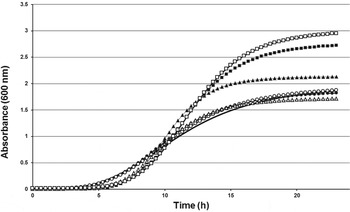
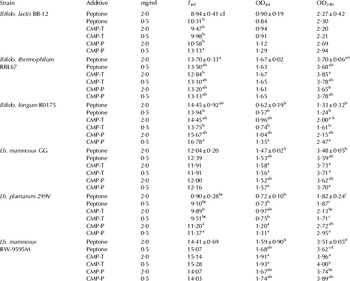
In the mMRS broth, the OD24h reached 1·8 with Lb. plantarum 299 V (Fig. 1). Further addition of peptone had no effect on growth. The mMRS, which is recognised as a very good medium for the multiplication of probiotic bacteria (Champagne et al. Reference Champagne, Ross, Saarela, Hansen and Charalampopoulos2011), supported growth so that all strains were in the late exponential growth phase or the stationary growth phase after 24 h at 37 °C, with OD24h reaching more than 1·3 (Table 1). The OD24h in mMRS supplemented with 0·5 mg/ml of peptone was similar to the one supplemented with 2 mg/ml, (P>0·1) for all strains. However, OD24h can significantly differ between strains. This allows grouping of the bacterial strains based on the OD24h values: a group of strains reaching ⩾3·5 OD600nm, the high biomass producing strains (Lb. rhamnosus RW-9595M, Lb. rhamnosus GG, and Bifido. thermophilum RBL67), and a group having significantly lower OD24h (⩽2·3; P<0·05), the low biomass producing strains (Bifido. lactis BB-12, Lb. plantarum 299 V, and Bifido. longum R0175). This group were probably more sensitive to low pH, low essential nutrients, and/or to metabolic products.
Growth curve at 37 °C of Lactobacillus plantarum 299 V in modified MRS (de Man, Rogosa and Sharpe) medium that was unsupplemented or was supplemented at 0·5 or 2 mg/ml with peptone or with hydrolysates of bovine caseinomacropeptide treated with pepsin (CMP-P) or trypsin (CMP-T).

Effect of supplementing modified MRS (de Man, Rogosa and Sharpe) medium with caseinomacropeptide treated with pepsin (CMP-P) or trypsin (CMP-T) on three growth parameters: the time needed to reach the inflexion point of the sigmoid curve (T inf); the OD600nm (optical density at 600 nm) at T inf (ODinf); and the OD600nm at the end of the incubation period (OD24 h)

For a given strain and a given growth parameter, values that are followed by different superscript letters are significantly different (P<0·05)
Effect of CMP hydrolysates on growth in mMRS
In comparison with the control conditions, supplementation of mMRS with CMP-P positively affected bacterial growth in a strain-dependent manner (Table 1). Supplementation with CMP-P significantly increased (P<0·05) the bacterial density of two low biomass producing strains Lb. plantarum 299 V and Bifido. longum R0175 by a factor >1·5, with concomitant increases in ODinf and T inf. Statistical analyses indicated that, for both strains, high correlations existed between ODinf and T inf (R=0·90 and 0·95 for strains R0175 and 299 V, respectively), and between ODinf and OD24h (R=0·98 for both strains). These correlations indicated that changes in T inf and ODinf were linked mostly to increased fermentation time and to the ultimate biomass level that was produced rather than to important changes in the growth rate during the exponential growth phase. A tendency toward an improvement of the growth parameters can also be observed with CMP-P supplementation for Bifido. lactis BB-12, the other low biomass producing strain. For these strains, CMP-P was more efficient in stimulating bacterial growth than CMP-T. It is suggested that CMP-P could improve the resistance to acid stress, based on a previous study showing that a Lb. rhamnosus strain can survive for a longer period of time in acidic media in presence of CMP-P (Robitaille et al. Reference Robitaille, Lapointe, Leclerc and Britten2012). In contrast, the effect of CMP-P on the high biomass producing strains, namely Lb. rhamnosus RW-9595M, Lb. rhamnosus GG, and Bifido. thermophilum RBL67, was much weaker, given that the bacterial growths reached in the presence of CMP-P and CMP-T were close to the growth obtained in the control medium. The differences in the efficiency of the mMRS by itself in sustaining growth can partially explain these differences from strain to strain. For the strains that did not grow optimally on mMRS, additional growth-promoting factors might help them produce high biomass levels; that role was played by CMP-P in this study. As mentioned previously, mMRS is a rich medium, and some of the potential growth-promoting activities of CMP-P were thus hidden for some strains, such as the high biomass producing ones (Bifido. thermophilum RBL67, Lb. rhamnosus RW-9595M, and Lb. rhamnosus GG). Indeed, Robitaille (Reference Robitaille2013) showed that the bacterial growth of Lb. rhamnosus RW-9595M and Bifido. thermophilum in minimal media was stimulated by intact CMP. It is noteworthy that the benefits for growth that CMP-P provide were not enhanced by increasing their concentration; the OD24h values at 0·5 mg/ml as at 2 mg/ml were not significantly different (P>0·1) (Table 1). This observation suggests that CMP-P provide an important growth modulator that is not required at a high concentration. The methodology used, based on a peptone-rich base medium that simulated a digested food, was instrumental in obtaining this observation, since growth in mMRS was presumably not limited by a lack of amino acids or peptides.
Effect of CMP-P on bacterial growth in milk
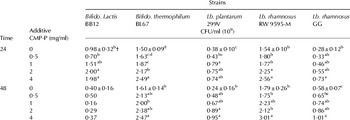
Many probiotic cultures grow poorly in milk. Therefore, the most active supplement, CMP-P, was tested as a growth promoter in milk. Table 2 presents the bacterial contents of milk with and without supplementation after 24 and 48 h of fermentation for five of the probiotic cultures. After 24 h of fermentation, Lb. rhamnosus RW-9595M, Bifido. thermophilum RBL67, and Bifido. lactis BB-12 had good growth, while Lb. plantarum 299 V and Lb. rhamnosus GG had much lower viable counts. Both Bifido. thermophilum RBL67 and Lb. rhamnosus RW-9595M grew well in milk as was also the case in mMRS. On the other hand, Lb. rhamnosus GG, defined as a high biomass producing strain in mMRS, reached only 0·28×109 CFU/ml after 24 h in unsupplemented milk. A slight increase in CFU/ml was obtained when fermentation was extended to 48 h for these stains. In contrast, Lb. plantarum 299 V and Bifido. lactis BB-12 showed viability losses after 24 h of incubation at 37 °C: the bacterial counts decreased 2·45 and 1·58 times, respectively, at 48 h.
Effect of supplementing milk with pepsin-treated caseinomacropeptide (CMP-P) on the bacterial counts (109 CFU/ml) after 24 and 48 h of fermentation at 37 °C under anaerobic conditions

† For a given strain and a given time, values that are followed by different superscript letters are significantly different (P<0·05)
In the milk supplemented with CMP-P, a significant increase in bacterial count (P<0·05) was obtained for all strains after 24 h of fermentation. Thus, as a function of the strain and of the CMP-P concentration, the CFU-per-millilitre values in the milk enriched with CMP-P increased by 1·7 to 2·6 times after 24 h (Table 2). The tendency toward an improvement in bacterial count was already obtained with CMP-P at 1 mg/ml. Thereafter, bacterial counts did not greatly differ with four of the strains, and the comparative CFU-per-millilitre data in milk at 24 and 48 h for the corresponding CMP-P contents were similar. Bifido. lactis BB-12 showed a dramatic decline in bacterial viability when fermentation was extended to 48 h. This Bifidobacterium strain seemed unstable in acidified milk at 37 °C, and far from being stopped by CMP-P, this viability loss seemed to be amplified by the presence of the peptide. Indeed, the bacterial counts decreased more rapidly at 48 h (>7 times) in the milk containing CMP-P at 1 mg/ml or more, in contrast to 2·5 times in the non-supplemented milk (P<0·05). Consequently, the fermentation time must be controlled to optimise the growth-promoting effect of CMP-P, as unstable strains can be adversely affected by supplementation after a long fermentation period. Obviously, no industrial process could accommodate a 48-h fermentation time with a milk medium, but these data serve to demonstrate that the growth of probiotics in milk is slow and that enrichment is necessary to improve biomass levels.
In conclusion, CMP-P can promote the development of probiotics even in peptone-rich environments such as mMRS, a fact indicating that CMP has a metabolic effect on bacteria. Interestingly, the effect was strain-dependent and seemed to affect the growth of fastidious probiotic species in particular. These data also suggest that CMP-P could enhance the growth of probiotics in the intestinal tract, where proteolytic CMP products are present. Furthermore, for all species analysed, CMP-P added to milk significantly increased the bacterial biomass levels after 24 h of fermentation, given that biomass levels were significantly improved, by 1·7 to 2·6 times, depending on the strains. Thus, when supplemented with CMP-P, milk appears to be a more efficient culture medium for the production of high biomass levels in order to produce milk-based preparations with high densities of probiotics, such as DanActive™ or BioK+®. The use of CMP is also interesting in the context of enhancing the value of cheese whey by-products.
This study was supported by Agriculture and Agri-Food Canada's research program. The authors wish to thank C. Lapointe, G. Gouasdoué, and S. Ingrassia for their excellent technical assistance during the course of the work.