Introduction
Aminoglycoside antibiotic-induced hearing impairment has been detected in sensorineural deafness patients from widely differing ethnic backgrounds.Reference Casano, Hamon, Fischel-Ghodsian, Torricelli, Bykhovskaya and Johnson1–Reference Tekin, Duman, Boğoçlu, Incesulu, Çomak and Fitoz4 Particularly in Asian populations, the A1555G mutation is maternally inherited in a significant proportion of cases.Reference Hu, Fang, Zhang, Zhou, Qui and Wu5–Reference Li, Liao, Xiong, Zhu, Li and Chen7 Hu et al. described 36 Chinese families with a maternally transmitted predisposition to aminoglycoside ototoxicity,Reference Hu, Fang, Zhang, Zhou, Qui and Wu5 while Higashi reported that 26 of 28 families with streptomycin-induced deafness had maternally inherited transmission.Reference Higashi6 In addition, this mutation may also induce hearing loss in the absence of aminoglycosides.Reference Lehtonen, Majamaa, Uimonen and Hassinen8 Tatsuo et al. reported a Japanese hearing loss pedigree with a maternal inheritance pattern, due to the A1555G mitochondrial mutation, in the absence of aminoglycoside use.Reference Tatsuo, Hiroshi and Shiroma9
We identified a large Chinese family in which the A1555G mutation was prevalent. Some of the family members had previously been exposed to aminoglycosides. We conducted interviews and performed pure tone audiometry and genetic testing in maternally related members of this family. This enabled us to characterise the clinical, genetic and molecular patterns of the auditory dysfunction associated with the A1555G mutation, following aminoglycoside exposure.
Materials and methods
Subjects and audiological examination
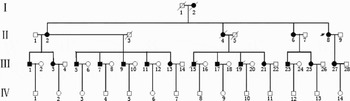
A large Chinese pedigree (Figure 1) was identified through the otology clinic at Shanghai Number Five Hospital, Fudan University.
The four-generation hearing impairment pedigree. Generations are indicated by Roman numerals on the left, and family members within each generation are indicated by Arabic numerals. The proband is denoted by an arrow. White square = unaffected male; white circle = unaffected female; black square = affected male; black circle = affected female; / = deceased

All the subjects underwent comprehensive history-taking and physical examination in order to identify syndromic findings, history of aminoglycoside use, and other factors related to hearing impairment (such as tympanitis and exposure to noise). Inner-ear abnormalities were excluded by magnetic resonance imaging (including inner-ear three-dimensional reconstruction) and computed tomography (GE Medical Systems, Milwaukee, Wisconsin, USA). Age-appropriate audiological examinations were then performed, including otoscopy, pure tone audiometry (PTA) and/or auditory brainstem response (Madsen-602; GN Otometrics, Taastrup, Denmark), and distortion product otoacoustic emissions (AuDX plus, Bio-logic Systems, Chicago, Illinois, USA). The PTA was calculated from the sum of the audiometric thresholds at 500, 1000, 2000, 4000 and 8000 Hz. The severity of hearing impairment was classified into five grades: normal = <26 dB; mild = 26–40 dB; moderate = 41–70 dB; severe = 71–90 dB; and profound = >90 dB. Informed consent was obtained from participants prior to their participation in the study, in accordance with the standards of our hospital's ethics committee.
Mutational analysis
Blood samples were collected from 27 family members (19 matrilinear and eight non-matrilinear). Genomic deoxyribonucleic acid (DNA) was isolated from whole blood using SiMax™ genome DNA isolation kits (Saibaisheng Biotech, Shanghai, PR China). Deoxyribonucleic acid fragments spanning the nucleotide 1555 position of the mitochondrial DNA 12S ribosomal ribonucleic acid (RNA) gene were amplified by polymerase chain reaction, using oligodeoxynucleotides corresponding to positions 1280–1300 and 2001–2020.Reference Li, Cao, Han, Yuan, Wang, Yang and Jiang10 The A1555G mutation was screened by polymerase chain reaction restriction fragment length polymorphism, using endonuclease Alw26I (Shanghai Sangon Biological Engineering Technology & Services, Shanghai, PR China), and each fragment was purified and analysed by direct sequencing using the BigDye® terminator v1.1 cycle sequencing kit in an ABI (ABI is the symbol of a company of Applied Biosystems Incorporation in the Foster City, California, USA) 3730 automated DNA sequencer. The resultant sequence data were compared with the updated consensus Cambridge sequence (GenBank accession number NC_001807),Reference Guan, Fischel-Ghodsian and Attardi11 using Jellyfish 3.3 sequence analysis software.
Results and analysis
Clinical presentation
In this family, the proband (II-8) was a 61-year-old woman with hearing loss from Shanghai, eastern China. Her hearing had been normal up to the age of 58 years. At this age, however, she began suffering bilateral hearing impairment which gradually worsened over the next year. Audiological evaluation showed mild to moderate hearing impairment (65 dB for the right ear, 39 dB for the left) with a sloping pattern. The patient had no other relevant events in her medical history.
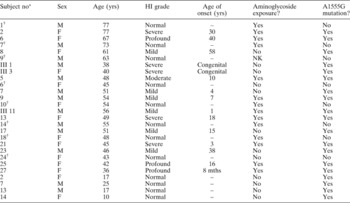
A comprehensive history and physical examination were performed to identify aminoglycoside usage and any syndromic findings in the 19 available members of the four-generation family. In the 19 matrilinear relatives evaluated for hearing disability, two were congenitally deaf, four showed no hearing impairment, and the other 13 suffered mild to profound hearing loss (Table I). All hearing deficits were sensorineural in type and symmetrical. Overall, hearing disabilities were identified in 15 family members, and were more frequent in older than younger subjects. In addition, some of subjects' hearing deficits were associated with aminoglycoside use while others were not. The age of onset also varied: two cases were congenital and the others were post-lingual. In addition, the age of onset was lower in the hearing disabled subjects with aminoglycoside use, and these subjects tended to exhibit more severe hearing loss. There was no significant difference in occurrence between male and female subjects.
Subjects' clinical data

* Roman numerals indicate family generation; Arabic numerals indicate the family member (see Figure 1).
† Non-matrilinear subjects. No = number; yrs = years; HI = hearing impairment; M = male; F = female; NK = not known; mths = months
Mitochondrial deoxyribonucleic acid analysis
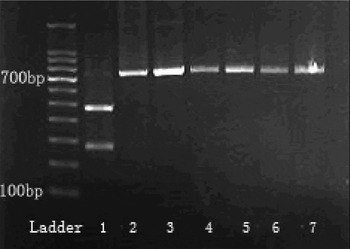
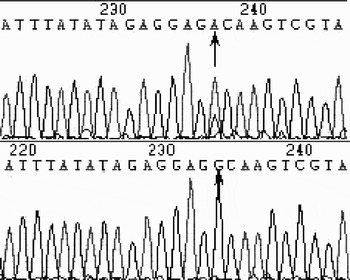
Following polymerase chain reaction restriction fragment length polymorphism analysis (Figure 2), only a single, slower-migrating DNA band was detected for the homoplasmic A1555G mutation (lanes two to seven). However, two faster-moving fragments could be seen in the case of a non-matrilinear member without the mutation (lane one). Each fragment was purified and then analysed by DNA sequencing. We did not detect mutations at position 1494 in the 12S ribosomal RNA gene.Reference Zhao, Li, Li, Cao, Young and Yan12 However, the A1555G mutation in the 12S ribosomal RNA gene was found in all the maternal members (Figure 3).
Screening of the mitochondrial deoxyribonucleic acid (DNA) A1555G mutation by polymerase chain reaction restriction fragment length polymorphism analysis; 100 base pair (bp) DNA ladder. Lanes 1–7 show samples digested by the endonuclease Alw26I. Lane 1 (non-matrilinear member) has no mutation and the target fragment is cut into two fragments (463 and 278 bp). Lane 2 (proband) and lanes 3–7 (affected matrilinear relatives) samples are positive for the A1555G mutation; thus, target fragments were undigested by Alw26I, yielding the full-length 741 bp band. The presence of a single band indicates homoplasmy.

Sequencing of the mitochondrial deoxyribonucleic acid (DNA) A1555G mutation. The arrows indicate the mitochondrial DNA 1555 locus, and the DNA sequence shows the A to G base change in the affected member (lower) compared with a control (upper). A = adenine; T = thymine; G = guanine; C = cytosine

Discussion
In the proband of this pedigree, a homoplasmic A1555G mutation was detected by polymerase chain reaction restriction fragment length polymorphism analysis, indicating that all of the proband's mitochondrial genomes harboured the mutation. As mitochondrial DNA exhibits exclusively maternal inheritance,Reference Fischel-Ghodsian13 all maternally related family members should carry the homoplasmic A1555G mutation. Indeed, we detected this as a homoplasmic mutation in the other 18 maternal subjects who were also screened. The involvement of this mutation in the hearing loss pathogenesis within this pedigree is strongly indicated by (1) the occurrence of the A1555G mutation in the genetically related subjects affected by hearing impairment, and (2) the absence of the mutation in non-matrilinear relatives.
In 1993, Prezant et al. Reference Prezant, Bu, Arnos, Oztas, Agapian and Bohlman14 initially reported the nucleotide 1555 A to G substitution in the 12S ribosomal RNA gene in a large pedigree associated with antibiotic-induced, non-syndromic deafness. Data from our pedigree are similar to these authors’ findings. We found a clear relationship between hearing loss and aminoglycoside usage in some maternally related members, together with the corresponding A1555G mutation. However, some deaf family members with the A1555G mutation had not been exposed to aminoglycosides. These data confirm the findings of a previous study which showed that the A1555G mutation may induce hearing loss with or without exposure to aminoglycosides.Reference Lehtonen, Majamaa, Uimonen and Hassinen8 Some subjects who had used aminoglycosides and experienced the onset of hearing loss before the age of 10 years suffered severe to profound hearing loss. This association between young age of onset and high degree of severity suggests that the defensive or reparative system of the cochlea may be immature during early childhood. It has been reported that mammals, including humans, are more sensitive to chemical and drug-induced ototoxicity during their developmental years than during adulthood, although the molecular mechanisms of this hypersensitivity have not been delineated.Reference Li, Cao, Guan, Liu, Xing and Han15, Reference Estivill, Romero, Zeviani, Badenas, Scozzri, Govea, Moral, D'Urbano, Barceló and Torroni16 This association also illustrates the importance of careful audiological evaluation and follow up in maternally related family members who carry the A1555G mutation and who are suspected of having hearing loss during early childhood.Reference Malik, Kadir, Sangkot, Nova and Herawati6
• The A1555G mitochondrial deoxyribonucleic acid (DNA) mutation is suspected in individuals with familial hearing loss which follows a maternal inheritance pattern, with or without aminoglycoside exposure
• This pedigree case report describes an association between the A1555G mitochondrial DNA mutation and sensorineural hearing loss, varying from mild to severe, in some maternally related members exposed to aminoglycosides
• Significantly, affected subjects using aminoglycosides tended to exhibit a more severe degree of hearing loss
The A1555G mutation has been reported in sporadic hearing-impaired patients and also in hearing loss pedigrees worldwide. It has been reported with a relatively high frequency in Spanish and some Asian populations, but it is apparently rare in other populations.Reference Malik, Kadir, Sangkot, Nova and Herawati17 Therefore, in pedigrees with this hereditary phenotype, we strongly advocate screening for the A1555G mutation before the administration of aminoglycosides, especially when prolonged treatment with aminoglycosides is necessary.
Conclusion
The present study elucidated the characteristics and the prevalence of deafness in maternally-related members of the study pedigree, following aminoglycoside exposure. The prevalence of deafness in individuals with the A1555G mitochondrial mutation was higher than in individuals without the mutation. The age of hearing disability onset was lower in subjects exposed to aminoglycosides, and those affected tended to exhibit a more severe degree of hearing loss. Therefore, these data provide valuable information which could help predict which individuals are at risk of ototoxicity and also improve the safety of aminoglycoside therapy. This may eventually lead to a decrease in the incidence of aminoglycoside-related deafness.
Acknowledgements
We thank Professor Zuo Ji PhD, Dr Guo Feng PhD, Dr Yang Ling PhD and Ms Hao Jinyu for their technical assistance. We also thank Dr Yu Guijun, Dr Huang Chunping, Dr Shi Yonghui, Ms Tao Weifang and other colleagues for their efforts in data collection, and for their constructive advice.